
Diluted EPS Calculation — Complete Guide with Interactive Finance Calculator
📋 Table of Contents
▼- Why Diluted EPS Is One of the Most Misunderstood Earnings Metrics
- Diluted EPS Calculator — Five Practical Modes
- Understanding Basic EPS, Diluted EPS, and Potential Common Shares
- Real Financial Scenarios Where Diluted EPS Calculations Mattered
- Common Diluted EPS Calculation Mistakes and How to Avoid Them
- Expert Perspectives from Analysts and Accountants
- Which Diluted EPS Method Fits Your Analysis Situation
Why Diluted EPS Is One of the Most Misunderstood Earnings Metrics
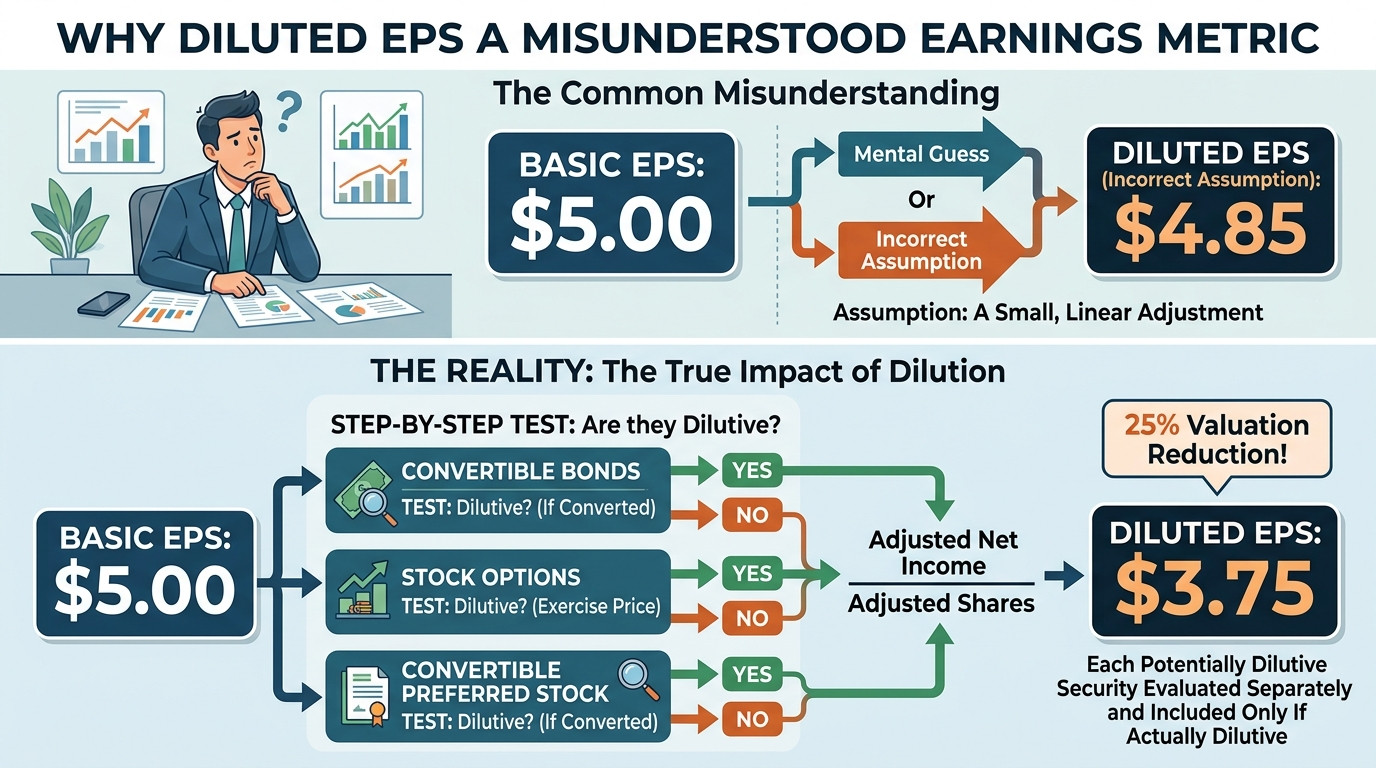
Here is a scenario that plays out regularly in financial analysis: an investor looks at a company and sees basic earnings per share of $5.00. The company also has convertible bonds, stock options, and convertible preferred stock outstanding. The investor assumes that diluted EPS is simply basic EPS minus some small adjustment, perhaps $4.80 or $4.90. In reality, the correct diluted EPS is $3.75 — a 25% reduction that completely changes the valuation picture. The investor missed the full impact of dilution because they did not understand that each potentially dilutive security must be evaluated separately and included only if it is actually dilutive.
Diluted EPS is the earnings per share figure that answers the question: what would EPS be if all potentially dilutive securities were converted or exercised? It is a worst-case scenario for existing shareholders, showing the minimum EPS they would receive if every claim that could become common stock actually became common stock. Under U.S. GAAP and IFRS, public companies must report diluted EPS alongside basic EPS whenever they have potentially dilutive securities outstanding. The calculation is not optional, and it is not a simple afterthought. It is a core disclosure requirement.
This guide is written for anyone who needs to calculate or interpret diluted EPS: accounting students learning the if-converted and treasury stock methods, equity analysts building valuation models, auditors testing EPS disclosures, investors reading 10-K filings, and corporate finance professionals preparing earnings releases. The five calculator modes cover the full range of diluted EPS calculations: basic diluted EPS, convertible bonds, stock options using the treasury stock method, convertible preferred stock, and comprehensive diluted EPS with multiple securities.
For the underlying dilution mathematics that connects to other calculation contexts, our dilution factor calculator handles the ratio and percentage relationships that appear in many diluted EPS calculations. When your analysis involves percentage-based ownership changes, our percentage dilution calculator provides a complementary view. For general solution dilution planning, our solution dilution calculator covers the C₁V₁ = C₂V₂ logic that underlies all dilution mathematics.
Diluted EPS Calculation Calculator
Five modes — basic diluted EPS, convertible bonds, stock options, preferred stock, and comprehensive
Calculation Result
Understanding Basic EPS, Diluted EPS, and Potential Common Shares
Earnings per share is one of the most widely cited metrics in finance. It distorts the entire income statement down to a single number: how much profit is attributable to each share of common stock. Basic EPS uses the actual common shares outstanding. Diluted EPS uses the actual common shares plus the shares that would be created if all potentially dilutive securities were converted. The difference between the two can be small or large, depending on the company’s capital structure.
Basic EPS: The Starting Point
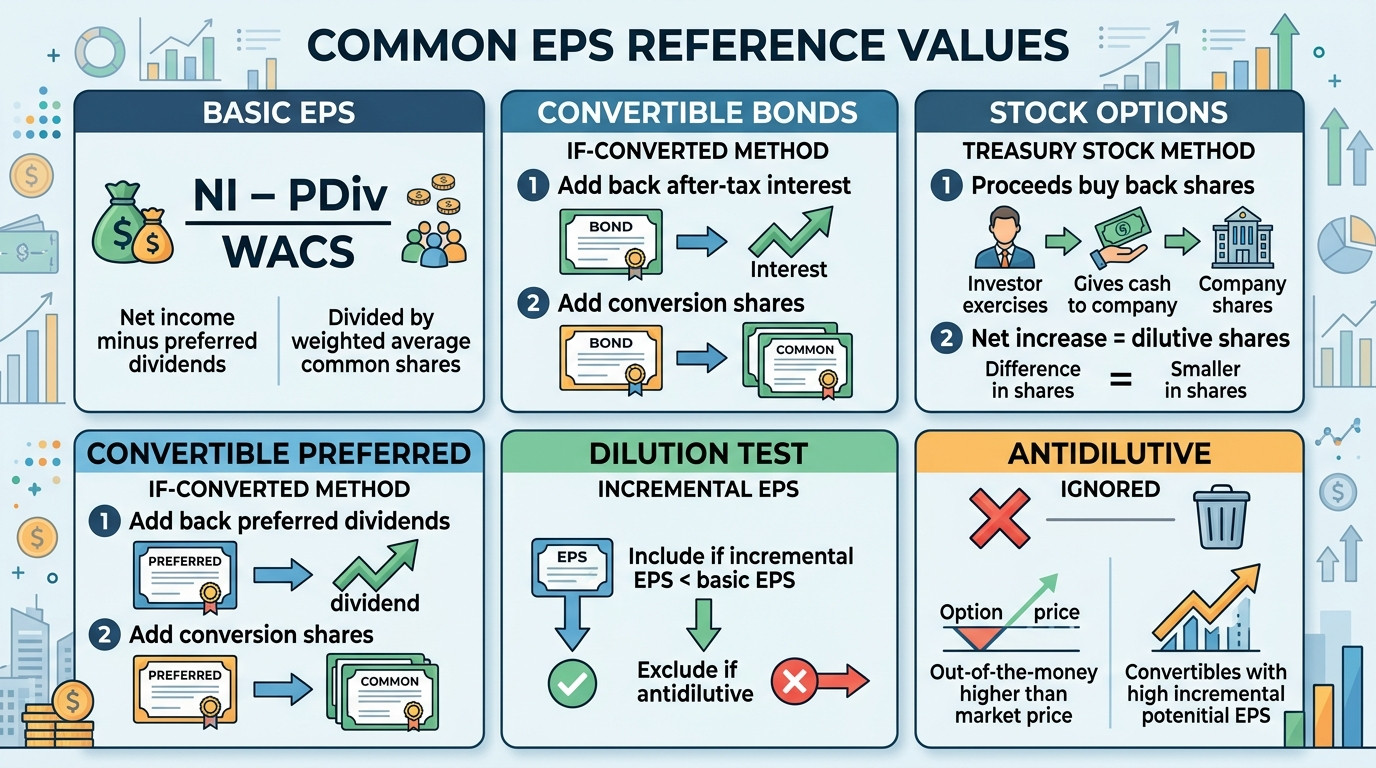
Basic EPS is calculated as net income available to common shareholders divided by the weighted average number of common shares outstanding during the period. Net income available to common shareholders is net income minus preferred dividends, because preferred dividends are not available to common shareholders. The weighted average share count accounts for share issuances, repurchases, and other changes during the period.
The formula is simple: Basic EPS = (Net Income − Preferred Dividends) ÷ Weighted Average Common Shares. This is the number that most investors see first. It tells you what the company earned for each common share that was actually outstanding. But it does not tell you what would happen if the company had issued more shares through convertible securities, options, or warrants.
Diluted EPS: The Worst-Case Scenario for Shareholders
Diluted EPS answers a different question: what would EPS be if all potentially dilutive securities were converted to common stock? It is not a prediction that conversion will happen. It is a hypothetical calculation that shows the maximum possible dilution. If a company has no potentially dilutive securities, basic EPS and diluted EPS are the same. If a company has many convertible bonds and deep-in-the-money options, diluted EPS can be significantly lower than basic EPS.
The numerator of diluted EPS is adjusted for any changes that would occur if the securities were converted. For convertible bonds, the after-tax interest expense would be saved, so it is added back to net income. For convertible preferred stock, the preferred dividends would no longer be paid, so they are added back. For stock options, the numerator is not adjusted because the exercise of options does not change net income; only the denominator increases.
For convertible preferred stock: add back preferred dividends
For stock options: use treasury stock method to calculate incremental shares
Only include securities that are individually dilutive (reduce EPS)
Potentially Dilutive Securities: The Main Categories
Convertible bonds are debt instruments that the holder can convert into common stock. Under the if-converted method, the calculation assumes the bonds were converted at the beginning of the period. The after-tax interest expense is added back to the numerator, and the shares that would be issued are added to the denominator. The test for dilution is whether the incremental EPS from the conversion is less than basic EPS.
Convertible preferred stock is similar to convertible bonds, but it is equity rather than debt. Under the if-converted method, the preferred dividends are added back to the numerator (because they would no longer be paid if converted), and the conversion shares are added to the denominator. Unlike convertible bonds, there is no tax effect because preferred dividends are not tax-deductible.
Stock options, warrants, and similar rights are handled under the treasury stock method. The method assumes that the proceeds from exercising the options are used to buy back common stock at the average market price during the period. The net increase in shares is the incremental shares used in the denominator. Options are dilutive only when the exercise price is below the average market price. If the exercise price is above the market price, the options are antidilutive and ignored.
The Dilution Test: Why Not All Securities Are Included
A potentially dilutive security is included in diluted EPS only if it is actually dilutive — meaning it reduces EPS. The test is performed by calculating the incremental EPS for each security: the adjustment to the numerator divided by the potential shares. If the incremental EPS is less than basic EPS, the security is dilutive and included. If it is greater than basic EPS, the security is antidilutive and ignored.
For example, if a company has basic EPS of $2.00 and convertible bonds with an incremental EPS of $1.50, the bonds are dilutive and included. If another company has basic EPS of $2.00 and convertible bonds with an incremental EPS of $2.50, the bonds are antidilutive and excluded. The diluted EPS calculation is built from the bottom up, adding the most dilutive securities first until no more dilutive securities remain.
Common EPS Reference Values
Divided by weighted average common shares
Add conversion shares
Net increase = dilutive shares
Add conversion shares
Exclude if antidilutive
Convertibles with high incremental EPS
For the underlying dilution factor mathematics that supports EPS analysis, our dilution factor calculator provides a focused verification tool. When percentage-based ownership changes are involved, our percentage dilution calculator offers a complementary calculation.
Real Financial Scenarios Where Diluted EPS Calculations Mattered
The theoretical distinction between basic and diluted EPS becomes vivid when you see it in practice. These five scenarios reflect actual situations from financial reporting, equity analysis, and investment decision-making where the diluted EPS calculation had real consequences.
Scenario 1: The Tech Startup with Massive Option Overhang
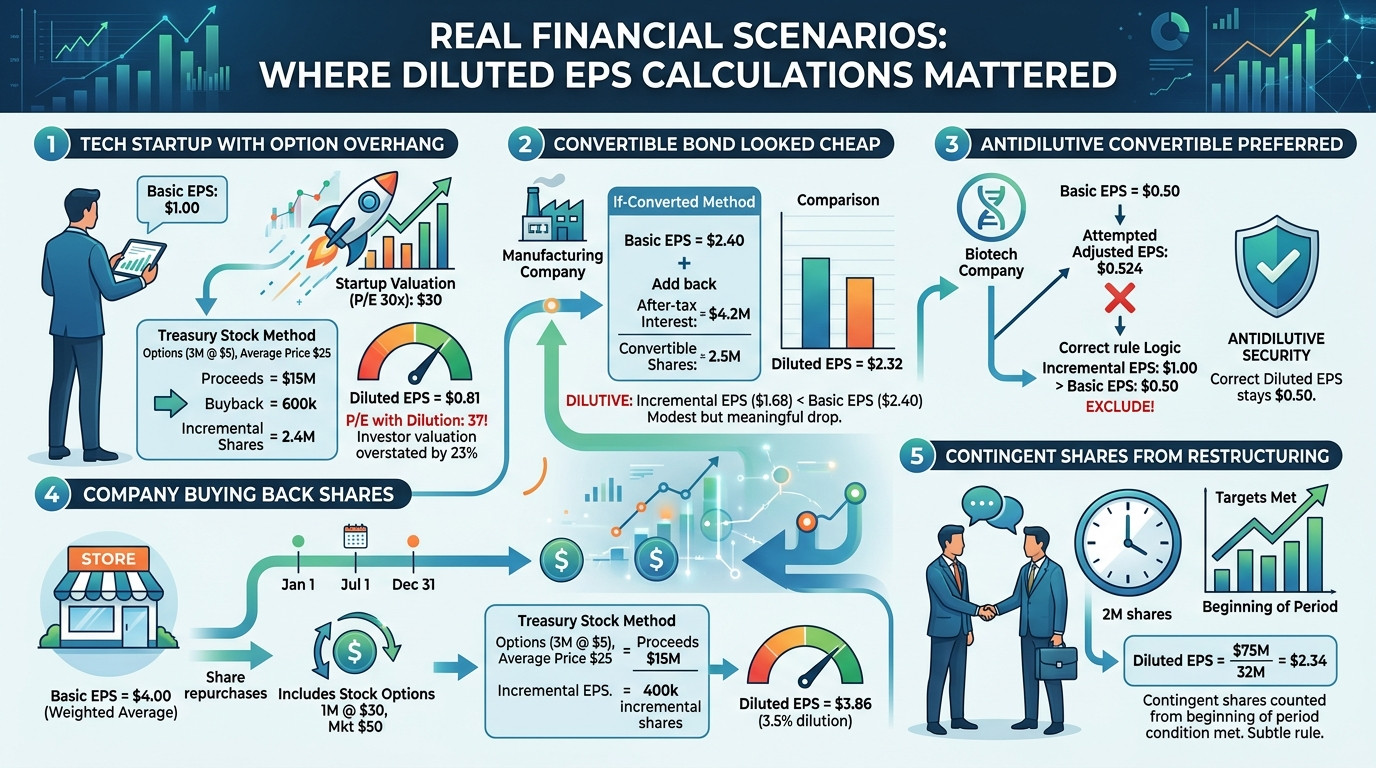
A technology startup went public with basic EPS of $1.00 for the year. The company had 10 million common shares outstanding and 3 million employee stock options with an exercise price of $5. The average market price during the year was $25. An investor looked at the basic EPS and valued the company at 30× earnings, or $30 per share, without considering dilution.
The treasury stock method calculation: proceeds from exercising 3 million options at $5 = $15 million. At the average market price of $25, the company could buy back 600,000 shares. The incremental shares = 3,000,000 − 600,000 = 2,400,000. Diluted shares = 10,000,000 + 2,400,000 = 12,400,000. Diluted EPS = $10,000,000 ÷ 12,400,000 = $0.81. The P/E ratio using diluted EPS is $30 ÷ $0.81 = 37, not 30. The investor’s valuation was based on a 23% overstated EPS figure.
Scenario 2: The Convertible Bond That Looked Cheap
A manufacturing company reported net income of $50 million, preferred dividends of $2 million, and weighted average common shares of 20 million. Basic EPS = ($50 million − $2 million) ÷ 20 million = $2.40. The company also had $100 million of convertible bonds outstanding with a 6% coupon rate, a 30% tax rate, and a conversion ratio of 25 shares per $1,000 bond. The bonds were convertible into 2.5 million shares.
The after-tax interest expense on the bonds was $100 million × 6% × (1 − 30%) = $4.2 million. Under the if-converted method, this is added back to the numerator. The adjusted numerator = $48 million + $4.2 million = $52.2 million. The adjusted denominator = 20 million + 2.5 million = 22.5 million. Diluted EPS = $52.2 million ÷ 22.5 million = $2.32. The convertible bonds were dilutive because the incremental EPS ($4.2 million ÷ 2.5 million = $1.68) was less than basic EPS ($2.40). The diluted EPS was about 3% lower than basic EPS, a modest but meaningful difference for a value investor.
Scenario 3: The Convertible Preferred Stock That Was Antidilutive
A biotech company had basic EPS of $0.50. The company had convertible preferred stock outstanding with annual dividends of $1 million. The preferred stock was convertible into 1 million shares of common stock. An analyst initially added the preferred dividends back to the numerator and the conversion shares to the denominator, calculating adjusted EPS = ($10 million + $1 million) ÷ (20 million + 1 million) = $0.524. This was higher than basic EPS, which would have made the security appear antidilutive.
The correct treatment was to exclude the convertible preferred stock from diluted EPS because it was antidilutive. The incremental EPS from the preferred conversion was $1 million ÷ 1 million = $1.00, which is greater than the basic EPS of $0.50. Including it would increase EPS, which violates the principle that diluted EPS must be less than or equal to basic EPS. The analyst’s initial calculation was wrong because it failed to apply the dilution test. The correct diluted EPS remained $0.50.
Scenario 4: The Company That Bought Back Shares During the Year
A retail company had 12 million shares outstanding at the beginning of the year. On July 1, it repurchased 2 million shares. The weighted average shares for the year were 12 million − (2 million × 6/12) = 11 million. Net income was $44 million, and there were no preferred dividends. Basic EPS = $44 million ÷ 11 million = $4.00. The company also had 1 million stock options outstanding with an exercise price of $30 and an average market price of $50.
Using the treasury stock method, proceeds from exercising the options = 1 million × $30 = $30 million. Shares repurchased at the average market price = $30 million ÷ $50 = 600,000. Incremental shares = 1,000,000 − 600,000 = 400,000. Diluted EPS = $44 million ÷ (11 million + 400,000) = $3.86. The 3.5% dilution from options was small but relevant for a company that was actively returning capital to shareholders through buybacks. The analyst had to remember to use the weighted average share count, not the year-end share count, in the denominator.
Scenario 5: The Restructuring That Triggered Contingent Shares
A company acquired another business in a stock-for-stock transaction. The deal included a contingent consideration provision: if the acquired business met certain revenue targets, the sellers would receive an additional 2 million shares. The targets were met during the year. Under the contingency rules for EPS, these shares are included in diluted EPS from the beginning of the period in which the conditions were met, not from the date of issuance.
The company had net income of $80 million, preferred dividends of $5 million, and 30 million weighted average common shares before the contingent shares. Basic EPS before considering the contingency was $75 million ÷ 30 million = $2.50. Because the contingency was met, the 2 million shares were added to the denominator, giving diluted EPS = $75 million ÷ 32 million = $2.34. The contingent shares were treated as if they had been outstanding from the beginning of the period because the earnings condition was retroactively satisfied. This is a subtle rule that many analysts miss when they build their models.
Common Diluted EPS Calculation Mistakes and How to Avoid Them
The mistakes people make when calculating diluted EPS cluster around a few specific failure points. Many of these are conceptual errors about how dilution works, not arithmetic errors in the final division.
Mistake 1: Forgetting to Use Weighted Average Shares
EPS is calculated using the weighted average number of shares outstanding during the period, not the shares outstanding at the end of the period. If a company issues shares on July 1, those shares are weighted for only half the year. If a company repurchases shares on October 1, the reduction is weighted for only one quarter. Using the year-end share count overstates or understates the denominator depending on the timing of the share changes.
Prevention: always calculate the weighted average share count before computing EPS. Track share issuances and repurchases by date and weight them by the fraction of the year they were outstanding. For convertible securities and options, the potential shares are also weighted for the period they were outstanding, not the full year if they were issued mid-year.
Mistake 2: Adding Back the Gross Interest Expense Instead of the After-Tax Interest
Convertible bond interest is tax-deductible. When assuming conversion, the company saves the interest expense but loses the tax deduction. The correct adjustment to the numerator is the after-tax interest: interest expense × (1 − tax rate). Adding back the full interest expense overstates the numerator and understates the dilution.
Prevention: for convertible bonds, always multiply the interest expense by (1 − tax rate) before adding it back. If the tax rate is 30%, only 70% of the interest expense is added back to net income. This reflects the economic reality that the tax shield from interest disappears upon conversion.
Mistake 3: Including Antidilutive Securities
A security is antidilutive if including it would increase EPS rather than decrease it. The most common example is out-of-the-money stock options, where the exercise price is higher than the average market price. If exercised, the company would buy back more shares than it issues, which would increase EPS. Such options are excluded from diluted EPS. The same logic applies to convertible securities with high incremental EPS.
Prevention: for each potentially dilutive security, calculate the incremental EPS (adjustment ÷ potential shares). If incremental EPS is greater than basic EPS, exclude the security. In the comprehensive calculator, you should input only the dilutive shares from each category, or the calculator must test each one. The test is fundamental to the diluted EPS calculation.
Mistake 4: Using the Treasury Stock Method Incorrectly
The treasury stock method assumes that the proceeds from exercising options are used to buy back shares at the average market price. The incremental shares are options issued minus shares repurchased. A common error is to add the full number of options to the denominator without subtracting the repurchased shares. Another error is to use the year-end market price instead of the average market price for the period.
Prevention: always use the average market price during the period, not the ending price. Calculate repurchased shares as (options × exercise price) ÷ average market price. Subtract the repurchased shares from the options to get the incremental shares. Only include options where the exercise price is below the average market price.
Mistake 5: Confusing Basic and Diluted EPS in Valuation
Many investors use the P/E ratio without checking whether the denominator is basic or diluted EPS. For companies with significant dilution, the difference can be large. Using basic EPS in a P/E ratio produces a lower apparent valuation multiple, which can make a stock look cheaper than it is. Using diluted EPS gives a more conservative and usually more accurate valuation.
Prevention: always use diluted EPS in valuation multiples when it is available. If you are building a model, calculate both basic and diluted EPS and use diluted EPS for P/E, EV/EBITDA multiples, and other per-share metrics. For companies with minimal dilution, the difference is small. For companies with heavy option grants or convertible debt, the difference is material.
💡 Rule of Thumb: Before calculating diluted EPS, determine the weighted average common shares, subtract preferred dividends from net income, and then evaluate each potentially dilutive security separately. Add back after-tax interest for convertible bonds, add back preferred dividends for convertible preferred stock, and use the treasury stock method for options. Include only securities that are individually dilutive. Use the resulting diluted EPS for valuation, not basic EPS. Use the dilution factor calculator as an independent check on percentage dilution effects.
Expert Perspectives from Analysts and Accountants
Diluted EPS is a required disclosure, but its interpretation varies between accountants, who focus on compliance with GAAP and IFRS, and analysts, who focus on valuation. These perspectives come from professionals who use diluted EPS in their daily work.
“I have seen too many investor models that use basic EPS in a P/E ratio for companies with huge option overhang. The valuation can look 20% or 30% cheaper than it really is. Diluted EPS is not a minor adjustment; it is the correct denominator for valuation when a company has potentially dilutive securities. I always calculate it myself from the 10-K rather than taking the reported number at face value.”
“From an audit perspective, the most common error we find is the antidilution test. Companies sometimes include all convertible securities and all options without checking whether each one is actually dilutive. The if-converted method is straightforward, but the test is not optional. Every security must be evaluated individually.”
“The treasury stock method is where students get confused. They want to add all the options to the denominator. The logic of using the proceeds to buy back shares is counterintuitive if you do not think about what happens economically when options are exercised. I always teach the method with a numerical example first, then explain the theory.”
“In venture-backed companies, diluted EPS is almost meaningless because the capitalization table is so complex. We look at fully diluted shares, which includes all convertible preferred stock, options, warrants, and restricted stock units. The concept is the same as diluted EPS, but we apply it to the entire ownership structure, not just earnings per share.”
Which Diluted EPS Method Fits Your Analysis Situation
The five calculator modes above correspond to the five distinct ways diluted EPS is encountered in financial analysis. Choosing the right mode ensures you are applying the correct method and avoiding the common errors that distort the result.
Diluted EPS Method Comparison Table
| Mode | Security Type | Method | Numerator Adjustment | Denominator Adjustment |
|---|---|---|---|---|
| Basic Diluted | Single block of dilutive shares | Direct formula | None (pre-adjusted) | Add dilutive shares |
| Convertible Bonds | Convertible debt | If-converted | Add after-tax interest | Add conversion shares |
| Stock Options | Options, warrants, rights | Treasury stock | No adjustment | Add incremental shares |
| Convertible Preferred | Convertible preferred stock | If-converted | Add preferred dividends | Add conversion shares |
| Comprehensive | Multiple securities | All methods combined | All appropriate adjustments | All dilutive shares |
Practical Decision Guide
You have a single block of already-determined dilutive shares and just want to compute diluted EPS? Use Basic Diluted mode. Enter net income, preferred dividends, weighted average common shares, and the total dilutive potential shares. This mode is the fastest way to compute diluted EPS when the dilutive share count is already known.
You are analyzing a company with convertible bonds and need to apply the if-converted method? Use Convertible Bonds mode. Enter net income, preferred dividends, weighted average shares, bond face value, after-tax interest, and the shares issued upon conversion. The calculator tests whether the bonds are dilutive and computes the adjusted EPS.
You need to calculate the dilutive effect of employee stock options or warrants? Use Stock Options mode. Enter the option shares, exercise price, and average market price. The calculator applies the treasury stock method to determine the incremental shares and tests whether the options are dilutive. For related dilution math, our dilution factor calculator provides a complementary verification.
You have convertible preferred stock and need to apply the if-converted method? Use Convertible Preferred mode. Enter net income, weighted average shares, the convertible preferred dividends, and the conversion shares. The calculator tests for dilution and adjusts the numerator and denominator accordingly.
You are building a comprehensive model with multiple dilutive securities and want to see the combined effect? Use Comprehensive mode. Enter net income, preferred dividends, weighted average shares, and the dilutive components from bonds, options, and preferred stock. The calculator combines all adjustments and reports the final diluted EPS. This is the mode most closely aligned with actual financial reporting.
Advanced Applications of Diluted EPS Across Finance and Accounting
Diluted EPS is not just a disclosure requirement in a 10-K footnote. It is a tool used in valuation, merger analysis, compensation planning, and capital structure decisions. The same basic calculation — adjusting the numerator and denominator for potentially dilutive securities — appears in many specialized contexts, each with its own nuances. Understanding these advanced applications helps analysts and accountants move beyond mechanical compliance to genuine financial insight.
1. Valuation Multiples and Per-Share Metrics
The most common use of diluted EPS is in the price-to-earnings ratio. When an analyst compares the P/E ratios of two companies, both denominators should be diluted EPS. Otherwise, a company with heavy stock-based compensation will look artificially cheaper than a company with clean capital structure. The same principle applies to other per-share metrics: dividend per share, book value per share, sales per share, and free cash flow per share should all be calculated on a fully diluted basis when the company has potentially dilutive securities.
In discounted cash flow models, the terminal value is often estimated using a P/E or EV/EBITDA multiple. The denominator of that multiple should be diluted EPS. Using basic EPS in a terminal multiple can inflate the valuation by ignoring the economic claim that dilutive securities represent. This is especially important for technology companies, biotechnology companies, and venture-backed firms where options and convertible securities are common.
2. Merger and Acquisition Analysis
When one company acquires another, the pro forma diluted EPS of the combined entity matters to both the buyer and the seller. The seller’s shareholders want to know whether the transaction is accretive or dilutive to their earnings per share. The buyer’s management wants to model the combined diluted EPS under different financing scenarios: cash, stock, or debt.
Stock-for-stock acquisitions add a layer of dilution analysis. If the acquirer issues new shares to buy the target, the share count increases. The acquirer’s diluted EPS must be recalculated with the additional shares and the target’s earnings. Convertible securities of both companies must also be considered. The acquisition agreement may include contingent shares that are issued if the target meets performance targets; these are included in diluted EPS if the targets are met.
3. Stock-Based Compensation and Dilution Planning
Companies grant stock options, restricted stock units (RSUs), and performance shares to employees. These grants create future dilution that must be estimated and disclosed. The diluted EPS calculation captures the effect of outstanding options and RSUs, but it does not capture the future grants that the company has committed to make. Investors and compensation committees often look at fully diluted share counts, which include all outstanding equity awards plus authorized but unissued shares reserved for future grants.
Corporate finance teams model the dilutive effect of compensation plans when they decide how many shares to authorize for employee equity programs. They also estimate the impact on diluted EPS in their earnings guidance. A company that grants too many equity awards may see its diluted EPS growth lag net income growth, even when the underlying business is performing well. This is one reason mature companies sometimes shift from options to cash bonuses or RSUs with shorter vesting periods.
4. Convertible Securities and Capital Structure Optimization
Companies issue convertible bonds and convertible preferred stock to raise capital at a lower cost than straight debt or equity. The conversion feature makes the security attractive to investors, allowing the issuer to pay a lower coupon or dividend. But the conversion feature also creates future dilution. The diluted EPS calculation shows shareholders the cost of that financing choice in per-share terms.
When a convertible bond is in-the-money, meaning the conversion value exceeds the bond value, investors may convert. The company can force conversion through a call provision if the bond price rises above the call price. Upon conversion, the diluted EPS calculation becomes irrelevant because the shares are now actually outstanding. Until conversion, diluted EPS is the best measure of the security’s impact on shareholder earnings. CFOs use this measure when deciding whether to call a convertible bond or leave it outstanding.
5. Financial Statement Auditing and Compliance
Auditors test diluted EPS calculations for compliance with accounting standards. Under ASC 260 (U.S. GAAP) and IAS 33 (IFRS), public companies must present basic and diluted EPS on the face of the income statement. The calculation must use the treasury stock method for options and the if-converted method for convertibles. The company must disclose the securities that were excluded because they were antidilutive.
Auditors verify the weighted average share count, the identification of potentially dilutive securities, the tax rate used for convertible bond adjustments, and the average market price used for the treasury stock method. They also test whether contingently issuable shares were included correctly. Errors in diluted EPS can lead to restatements, especially when the error is material to investor decisions. For this reason, the diluted EPS calculation is a standard focus area in quarterly and annual reviews.
For related dilution factor calculations in financial analysis, our dilution factor calculator provides a quick verification tool for ownership percentage changes and dilution effects.

Frequently Asked Questions About Diluted EPS Calculation
These questions come from accounting students, equity analysts, auditors, and investors who encounter diluted EPS in their work. The answers focus on practical problems and common misconceptions.
Basic EPS is calculated using the actual weighted average common shares outstanding during the period. It represents the earnings attributable to each share that was actually outstanding. Diluted EPS is calculated using the actual shares plus the shares that would be issued if all potentially dilutive securities were converted or exercised.
Basic EPS = (Net Income − Preferred Dividends) ÷ Weighted Average Common Shares. Diluted EPS = (Net Income − Preferred Dividends + Adjustments) ÷ (Weighted Average Common Shares + Dilutive Potential Shares). Diluted EPS is always less than or equal to basic EPS. If there are no dilutive securities, the two are equal.
Diluted EPS is a hypothetical worst-case measure. It does not predict that all options will be exercised or all bonds will be converted. It simply shows what EPS would be if every potential claim on common equity were exercised.
The treasury stock method assumes that the company uses the proceeds from exercising options to buy back its own shares at the average market price during the period. The incremental shares are the options issued minus the shares repurchased.
Formula: Incremental shares = Options outstanding − [(Options outstanding × Exercise price) ÷ Average market price]. If the exercise price is above the average market price, the options are out-of-the-money and antidilutive. They are excluded from the diluted EPS calculation.
Example: 1 million options with an exercise price of $20, average market price of $50. Proceeds = $20 million. Shares repurchased = $20 million ÷ $50 = 400,000. Incremental shares = 1,000,000 − 400,000 = 600,000. These 600,000 shares are added to the denominator. The numerator is not adjusted because exercising options does not change net income.
The if-converted method assumes that the convertible bonds were converted to common stock at the beginning of the period. Two adjustments are made. First, the after-tax interest expense on the bonds is added back to net income because the company would no longer pay interest if the bonds were converted. Second, the shares that would be issued upon conversion are added to the denominator.
Example: Net income = $10 million, convertible bonds with $500,000 annual interest expense, tax rate = 30%, conversion shares = 1 million. After-tax interest = $500,000 × (1 − 0.30) = $350,000. Adjusted net income = $10 million + $350,000 = $10.35 million. Adjusted shares = 5 million + 1 million = 6 million. Diluted EPS from bonds = $10.35 million ÷ 6 million = $1.725.
The bonds are dilutive if the incremental EPS ($350,000 ÷ 1 million = $0.35) is less than basic EPS. If the incremental EPS is greater than basic EPS, the bonds are antidilutive and excluded.
The dilution test determines whether a potentially dilutive security actually reduces EPS. A security is dilutive if its incremental EPS — the adjustment to the numerator divided by the potential shares — is less than basic EPS. If the incremental EPS is greater than basic EPS, the security is antidilutive and must be excluded from the diluted EPS calculation.
The test is important because diluted EPS is defined as the lowest possible EPS figure after considering all potential common shares. Including an antidilutive security would violate this definition by increasing EPS. The test is applied to each security individually, not to the aggregate.
Example: basic EPS = $2.00. Convertible bonds have incremental EPS of $1.50. Stock options have incremental EPS of $0. Both are dilutive and included. A second class of convertible preferred stock has incremental EPS of $2.50. It is antidilutive and excluded.
Convertible preferred stock is handled under the if-converted method. The preferred dividends are added back to net income because they would not be paid if the preferred stock were converted to common stock. The conversion shares are added to the denominator. There is no tax adjustment because preferred dividends are not tax-deductible.
Example: net income = $20 million, convertible preferred dividends = $1 million, weighted average shares = 10 million, conversion shares = 2 million. Adjusted net income = $20 million + $1 million = $21 million. Adjusted shares = 10 million + 2 million = 12 million. Incremental EPS = $1 million ÷ 2 million = $0.50. If basic EPS is $2.00, the preferred stock is dilutive and diluted EPS = $21 million ÷ 12 million = $1.75.
Non-convertible preferred stock dividends are subtracted in the basic EPS numerator, but the preferred shares themselves are not added to the denominator because they do not convert to common stock.
Contingently issuable shares are shares that will be issued only if certain conditions are met. Common conditions include achieving a specified earnings target, completing an acquisition, or reaching a milestone. These shares are included in diluted EPS from the beginning of the period in which the conditions are met, not from the date the shares are actually issued.
Example: a company agrees to issue 2 million additional shares if earnings exceed $100 million in 2026. In December 2026, the company reports that earnings were $110 million. The 2 million shares are included in diluted EPS for the entire year 2026, even though they will not be issued until 2027. If the condition had not been met by year-end, the shares would be excluded from 2026 diluted EPS.
The rationale is that if the earnings condition is satisfied, the shares are effectively earned as of the beginning of the period. The same principle applies to acquisition-related contingencies and performance-based stock awards.
Use diluted EPS for the P/E ratio when the company has potentially dilutive securities. Diluted EPS reflects the maximum potential claim on earnings by all common shareholders and potential common shareholders. Basic EPS ignores these claims and can make the stock appear cheaper than it really is.
Example: a stock trades at $50. Basic EPS is $2.50, diluted EPS is $2.00. The P/E based on basic EPS is 20. The P/E based on diluted EPS is 25. An investor using basic EPS would think the stock is valued at 20× earnings, but the correct multiple is 25×.
For companies with no dilutive securities, basic EPS and diluted EPS are identical, so the choice does not matter. For companies with stock options, convertible bonds, or convertible preferred stock, always use diluted EPS.
Weighted average common shares is calculated by weighting each share issuance or repurchase by the fraction of the reporting period it was outstanding. Shares outstanding at the beginning of the period are weighted by 1. Shares issued during the period are weighted by the number of months outstanding divided by 12. Shares repurchased are weighted by the number of months they were no longer outstanding divided by 12.
Example: 10 million shares outstanding at January 1. On April 1, the company issues 2 million shares. On October 1, it repurchases 1 million shares. Weighted average shares = 10 million + (2 million × 9/12) − (1 million × 3/12) = 10 million + 1.5 million − 0.25 million = 11.25 million.
For stock dividends and stock splits, the share count is retroactively adjusted. A 2-for-1 stock split is treated as if it occurred at the beginning of the earliest period presented. This ensures comparability across periods.
Diluted EPS is a per-share earnings metric that includes the dilutive effect of potentially dilutive securities. Fully diluted shares is a share count that includes all common shares plus all potential common shares, regardless of whether they are dilutive or antidilutive. In venture capital and private equity, fully diluted shares is often used to calculate ownership percentages and valuation per share.
The difference is that diluted EPS applies the dilution test and excludes antidilutive securities. Fully diluted shares does not apply the test and includes all options, warrants, convertible securities, and unissued shares in the pool. For EPS reporting under GAAP and IFRS, diluted EPS is the required measure. For cap table analysis and ownership negotiations, fully diluted shares is the more common measure.
Calculate basic EPS first. Then test each potentially dilutive security individually using the incremental EPS method. Rank the securities from most dilutive to least dilutive. Add the most dilutive security first, recalculate the running EPS, and then add the next security if it remains dilutive relative to the running EPS. Continue until no more securities are dilutive.
Example: basic EPS = $2.00. Convertible bonds have incremental EPS of $1.50. Stock options have incremental EPS of $0. Convertible preferred stock has incremental EPS of $1.80. Add bonds first, then options, then preferred stock. The preferred stock is still dilutive because $1.80 is less than the running EPS after adding bonds and options. The final diluted EPS is the lowest figure after all dilutive securities are included.
Most practical calculations do not need a strict ranking because the securities are independent. However, when the order matters, the standard approach is to rank securities by their incremental EPS from lowest to highest. The comprehensive calculator in this guide handles the combined calculation directly.
Antidilutive securities are potentially dilutive securities that would increase EPS if included in the diluted EPS calculation. They are excluded from the diluted EPS calculation. Common examples include out-of-the-money stock options, convertible bonds with high incremental EPS, and convertible preferred stock with high incremental EPS.
Under U.S. GAAP and IFRS, companies must disclose the securities that were excluded from the diluted EPS calculation because they were antidilutive. This disclosure is usually in the earnings per share footnote. The disclosure helps investors understand the potential future dilution that could occur if the securities become dilutive, such as when the stock price rises or earnings change.
Stock splits and stock dividends increase the number of shares without changing total equity. For EPS purposes, the share count is retroactively adjusted. A 2-for-1 stock split is treated as if it occurred at the beginning of the earliest period presented. This means the weighted average shares for all prior periods are restated to reflect the split.
Example: a company had 10 million weighted average shares in 2024 and 11 million in 2025. In 2026, it declares a 2-for-1 stock split. The 2024 and 2025 share counts are restated to 20 million and 22 million, respectively, so that EPS is comparable across periods. The same adjustment applies to option exercise prices and convertible security conversion ratios.
Diluted EPS Calculation Best Practices Checklist
These practices distinguish reliable diluted EPS calculations from error-prone ones. Many of these are compliance requirements under GAAP and IFRS, while others are analytical habits that improve valuation accuracy.
Before Starting the Calculation
During the Calculation
After the Calculation
For the complete set of dilution tools that support financial and analytical work: dilution factor calculator, solution dilution calculator, dilution ratio calculator, percentage dilution calculator, mg/mL dilution calculator, calculate the dilution factor, and cell dilution calculator.

Trusted Reference Resources for Diluted EPS Calculation
These are the authoritative references and standards that accountants, auditors, and analysts rely on when diluted EPS intersects with financial reporting and compliance.
FASB (Financial Accounting Standards Board) — fasb.org — ASC 260 is the U.S. GAAP standard for earnings per share. It defines the calculation of basic and diluted EPS, the treasury stock method, the if-converted method, and the disclosure requirements for public companies.
IASB (International Accounting Standards Board) — ifrs.org — IAS 33 is the IFRS standard for earnings per share. It provides the international equivalent of ASC 260 and is used by companies reporting under IFRS.
SEC (Securities and Exchange Commission) — sec.gov — The SEC requires public companies to report basic and diluted EPS in their quarterly and annual filings. SEC staff guidance and comment letters address common EPS disclosure issues.
PCAOB (Public Company Accounting Oversight Board) — pcaobus.org — The PCAOB sets auditing standards for public company audits in the United States, including the review of EPS calculations and disclosures.
AICPA (American Institute of Certified Public Accountants) — aicpa.org — The AICPA provides technical guidance, practice aids, and educational resources for CPAs on earnings per share and other financial reporting topics.
CFA Institute — cfainstitute.org — The CFA curriculum covers earnings per share, dilution, and valuation in depth. CFA Institute publications are a key resource for equity analysts and investment professionals.
On our platform, the full suite of related calculation tools includes: dilution factor calculator, solution dilution calculator, dilution ratio calculator, percentage dilution calculator, mg/mL dilution calculator, calculate the dilution factor, cell dilution calculator, and alcohol dilution calculator.
User Reviews & Ratings
📝 Share Your Experience with This Diluted EPS Calculator
Final Thoughts on Diluted EPS Calculation
Diluted EPS is one of the most important per-share metrics in financial reporting and valuation. It is also one of the most frequently misunderstood. The basic formula is simple: net income available to common shareholders divided by the weighted average shares plus potential shares. But the details matter enormously. The average market price, the tax rate, the timing of share changes, the dilution test, and the distinction between dilutive and antidilutive securities all affect the final number.
What makes diluted EPS valuable is that it forces investors and accountants to look at the capital structure as a whole. A company can report strong net income growth, but if it is issuing stock options and convertible bonds aggressively, the growth in diluted EPS may lag significantly. The metric captures the hidden cost of equity-based financing in a way that net income alone cannot.
The five calculator modes in this guide cover the practical range of diluted EPS calculations. The basic mode provides a quick calculation when the dilutive share count is already known. The convertible bond mode applies the if-converted method with the correct after-tax interest adjustment. The stock option mode applies the treasury stock method with the average market price. The convertible preferred mode handles the if-converted method for preferred stock. The comprehensive mode combines multiple securities and tests each one for dilution. Together, they provide a complete toolkit for students, analysts, auditors, and investors.
Beyond the calculator, the deeper lesson is that diluted EPS should be used thoughtfully. It is not a prediction of future dilution, but a hypothetical measure of current potential dilution. It should be used for valuation and comparison, not as a forecast. When combined with basic EPS, the fully diluted share count, and the footnote disclosure of antidilutive securities, it gives a complete picture of a company’s earnings attributable to common shareholders.
Explore our complete calculation toolkit for financial and analytical work: dilution factor calculator, solution dilution calculator, dilution ratio calculator, percentage dilution calculator, mg/mL dilution calculator, calculate the dilution factor, cell dilution calculator, and alcohol dilution calculator.
🔒 Privacy Guarantee: Every calculation on this page runs entirely within your browser. No data — net income, share counts, option terms, or any other inputs — is transmitted to any external server, stored in any database, or shared with any third party. Your calculations are completely private.