
Concentrations and Dilutions Calculator — Complete Guide with Calculator
📋 Table of Contents
▼- Why Concentrations and Dilutions Trip Up So Many People
- Concentrations and Dilutions Calculator — Five Calculation Modes
- Understanding Concentrations and Dilutions — What the Numbers Mean
- Real Scenarios Where Concentration and Dilution Math Made a Difference
- Common Concentration and Dilution Mistakes and the Science Behind Them
- Expert Perspectives from Chemists and Lab Educators
- Which Calculation Method Fits Your Situation
- Advanced Concentration and Dilution Topics Across Disciplines
- Frequently Asked Questions
- Concentrations and Dilutions Best Practices Checklist
- Trusted Reference Resources
- User Reviews & Ratings
- Final Thoughts on Mastering Concentrations and Dilutions
Why Concentrations and Dilutions Trip Up So Many People
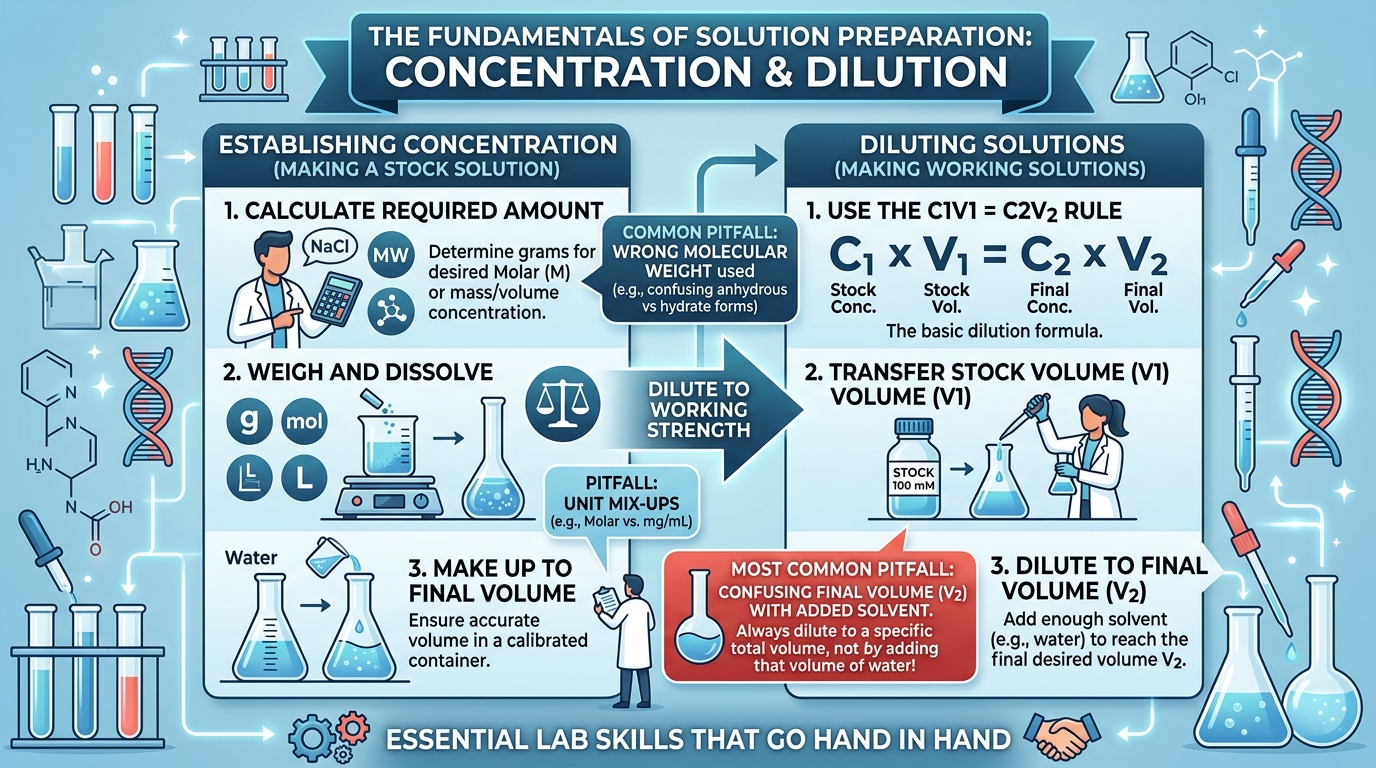
Here’s a scene that plays out constantly in chemistry, biology, and clinical labs: someone needs to express how concentrated a solution is, convert it between units, then dilute it to a working strength — and somewhere in that chain a unit gets mixed up, the molecular weight is wrong, or the final volume is confused with the water added. Concentration and dilution are the two most fundamental skills in solution preparation, and they go hand in hand: you first establish a concentration, then you dilute it to whatever the experiment needs.
Concentration answers “how much solute is in the solution?” and can be written in several units — molarity (mol/L), percent (% w/v), mass per volume (mg/mL), or parts per million (ppm). Dilution answers “how do I make it weaker?” and rests on the fact that the amount of solute is conserved when you add solvent, so concentration times volume before equals concentration times volume after (C₁V₁ = C₂V₂). Master both, and you can prepare almost any solution and move between any pair of units.
I’ve worked alongside students and technicians learning solution work, and the confusion follows predictable patterns. People mix concentration units without converting (percent with molar, mg/mL with ppm), forget to convert volume to litres for molarity, use the wrong molecular weight, or treat the final dilution volume as the diluent. The individual calculations are short; keeping the units consistent across the concentration step and the dilution step is where things go wrong.
This calculator and guide cover both halves together. The five calculation modes span the full workflow: computing molarity from mass, molecular weight, and volume; the classic C₁V₁ = C₂V₂ dilution solver; a “how much solvent to add” helper; a concentration unit converter between molarity, %, mg/mL, µg/mL, and ppm; and a serial dilution builder for standard and dose series. Whether you’re a student preparing a buffer, a technician making working solutions, an analyst building standards, or anyone who needs concentration and dilution answers fast, this tool gives you the result and the reasoning behind it.
For focused single-purpose tools, our molarity dilution calculator handles molar preparation and our solution dilution calculator covers C₁V₁ = C₂V₂ cleanly.
Concentrations and Dilutions Calculator
Five modes — molarity from mass, C₁V₁=C₂V₂, solvent to add, unit converter & serial series
Calculation Result
💡 Tip: Concentration and dilution are a pair — first nail the concentration (and its unit), then dilute with C₁V₁ = C₂V₂. Keep one consistent unit across both steps, convert volume to litres for molarity, and remember V₂ is the total final volume, not the solvent you add.
Understanding Concentrations and Dilutions — What the Numbers Mean
Preparing a solution involves two linked ideas. Concentration describes how much solute is present, expressed in a chosen unit. Dilution lowers that concentration by adding solvent. They work together: you establish a concentration first, then dilute to the strength your experiment needs. Both rest on simple arithmetic, but each leans on details — the right unit, the molecular weight, the volume in litres — that the other does not.
Concentration: How Much Solute Is Present
Concentration can be written several ways. Molarity (M) is moles of solute per litre of solution and is the standard chemical unit. Percent (% w/v) is grams per 100 mL. Mass per volume (mg/mL) counts milligrams per millilitre. Parts per million (ppm) is used for trace amounts and, for dilute water, equals mg/L. These are all valid descriptions of the same solution; converting between them needs the molecular weight only when molarity is involved.
Dilution: Conservation of Solute
Diluting a solution adds solvent without adding solute, so the amount of solute is conserved. Since amount equals concentration times volume, the product C₁V₁ before dilution equals C₂V₂ after. Add solvent and the volume rises, so the concentration falls by the same factor. This works in any concentration unit, as long as C₁ and C₂ are in the same one.
Mass needed (g) = molarity × MW × volume(L) · Solvent to add = V₂ − V₁
1% w/v = 10 mg/mL · 1 mg/mL = 1000 µg/mL · 1 ppm ≈ 1 mg/L (water)
Dilution factor = C₁ ÷ C₂ = V₂ ÷ V₁ · Serial series: Cₙ = C₀ ÷ (step factor)ⁿ
How Concentration and Dilution Connect
The everyday workflow chains the two. You weigh a solid to make a concentrated stock at a convenient concentration, then dilute that stock to the working concentrations you actually use. Making a stock once and diluting from it repeatedly is more accurate and faster than weighing tiny masses each time, which is why concentration and dilution are taught and used together.
Converting Between Concentration Units
The conversions are where many errors hide, so they are worth knowing. Percent w/v times 10 gives mg/mL (1% = 10 mg/mL). Milligrams per millilitre times 1000 gives µg/mL. For dilute water, 1 ppm equals 1 mg/L, which equals 1 µg/mL. And molarity equals mg/mL divided by the molecular weight (after matching units), or grams per litre divided by molecular weight. Only molarity conversions need the molecular weight; the mass-based units convert among themselves with simple factors.
Common Concentration Units at a Glance
needs molecular weight
= 10 g/L
= 1 g/L
(for water)
how many times weaker
stock volume
Remember: The concentration step needs the right unit (and the molecular weight plus litres for molarity); the dilution step needs C₁ and C₂ in the same unit and V₂ read as the total final volume. Get those right and concentration and dilution are simple arithmetic.
Our percentage dilution calculator handles percent-based work, while our mg/mL dilution calculator covers mass-per-volume preparation.

Real Scenarios Where Concentration and Dilution Math Made a Difference
The theory becomes vivid in practice. These five scenarios reflect real situations from teaching labs, biochemistry, clinical work, and analytical chemistry where the concentration or dilution arithmetic had real consequences.
Scenario 1: The Buffer Calculated in Millilitres, Not Litres
A student preparing 250 mL of 0.1 M buffer calculated the mass as molarity × MW × volume but used the volume as 250 instead of 0.250 litres, calling for a thousand times too much solid. Molarity is per litre, so the volume must be in litres. The fix: mass = 0.1 × MW × 0.250, not × 250.
This is the most common molarity slip. The Molarity mode converts the volume for you, removing the trap, and is the concentration half of the concentration-and-dilution pair.
Scenario 2: Mixing Percent and Molar in a Dilution
A lab worker had a stock labeled in percent and a target written in molar, and tried to plug both into C₁V₁ = C₂V₂. The units didn’t match, so the answer was meaningless. Converting first — percent to mg/mL, then mg/mL to molarity with the molecular weight — let both concentrations share a unit.
The dilution equation only works in one consistent unit. The Unit Convert mode reconciles percent, mg/mL, µg/mL, ppm, and molarity before you dilute. Our percentage dilution calculator also handles percent recipes.
Scenario 3: The Dilution That Overshot the Final Volume
An analyst diluting a 10 M stock to 2 M for 100 mL calculated V₁ = (2 × 100) ÷ 10 = 20 mL of stock, then added 100 mL of water — treating V₂ as the water volume. The result was 120 mL and a concentration below target.
V₂ is the total final volume, so solvent to add is V₂ − V₁ = 80 mL. The Solvent to Add mode returns the diluent volume directly, preventing the overshoot.
Scenario 4: Clinical Saline and the Percent-to-Molar Bridge
A pharmacy student converted 0.9% normal saline to molarity. The 0.9% w/v is 9 g/L, and dividing by the molecular weight of NaCl (58.44) gives 0.154 mol/L, or about 154 mM — the familiar clinical figure. A classmate who treated 0.9 as a molarity got a value over five-fold too high.
Percent and molarity are different units, and converting needs the molecular weight. Once in molar terms, any dilution uses C₁V₁ = C₂V₂. The Unit Convert mode bridges the two. Our mg/mL dilution calculator supports the mass-per-volume side.
Scenario 5: A Standard Curve Read as Additive
A researcher built a tenfold serial dilution standard curve over six steps and assumed the total dilution was 60-fold, mislabeling the lower standards. Serial dilution factors multiply, so six tenfold steps give 10⁶ — a million-fold — not 60-fold.
The total dilution factor is the per-step factor raised to the number of steps. The Serial Series mode lays out each tube’s cumulative factor and concentration so the curve is labeled correctly. Our dilution factor calculator checks the cumulative factors.

Common Concentration and Dilution Mistakes and the Science Behind Them
The mistakes people make cluster around a few specific failure points. Understanding why they happen is more useful than simply being told the right answer.
Mistake 1: Mixing Concentration Units
Concentration can be molar, percent, mg/mL, or ppm, and these are different scales. Using a percent number against a molar number, or mg/mL against µg/mL, without converting produces a meaningless result. The dilution equation and unit conversions only work within one consistent system.
Prevention: convert everything to one unit before calculating. The Unit Convert mode reconciles the common concentration units in one step.
Mistake 2: Not Converting Volume to Litres for Molarity
Molarity is moles per litre, but solutions are usually measured in millilitres. Calculating molarity or mass-needed with the volume in millilitres, without converting to litres, throws the answer off by a factor of 1000.
Prevention: convert millilitres to litres (divide by 1000) for any molarity calculation, or let the calculator’s unit selector handle it.
Mistake 3: Using a Wrong or Rounded Molecular Weight
The molecular weight bridges grams and moles, so an inaccurate value feeds straight into the concentration. Using the wrong hydrate form (anhydrous vs. a hydrate) or rounding too aggressively shifts the molarity by several percent.
Prevention: use the exact molecular weight for the actual compound and hydrate form you have, from the label or a reliable reference.
Mistake 4: Confusing Final Volume With Solvent Added
In C₁V₁ = C₂V₂, V₂ is the total final volume of the diluted solution, not the volume of solvent you add. Adding solvent equal to V₂ overshoots the final volume and makes the solution too dilute. Solvent to add equals V₂ − V₁.
Prevention: solve for V₂ (the total), then compute solvent as V₂ − V₁, or use the Solvent to Add mode which returns it directly.
Mistake 5: Treating Serial Dilution Factors as Additive
In a serial dilution the steps multiply, not add. Six tenfold steps give 10⁶ (a million-fold), not 60-fold. Treating the cumulative factor as additive — or applying one step’s factor when back-calculating from a later tube — produces answers off by orders of magnitude.
Prevention: compute the total dilution factor as the per-step factor raised to the number of steps. The Serial Series mode does this for you.
💡 Rule of Thumb: Get every concentration into one unit, use the exact molecular weight and litres for molarity, then dilute with C₁V₁ = C₂V₂, treating V₂ as the total and solvent as V₂ − V₁. The formulas are M = grams ÷ (MW × L) and C₁V₁ = C₂V₂ — the accuracy lives in the units. Use the calculation of dilution guide as a companion resource.
Which Calculation Method Fits Your Situation
The five calculator modes correspond to the five distinct contexts where concentration and dilution math is needed. Choosing the right mode ensures you apply the correct logic for your specific task.
Concentration & Dilution Method Comparison Table
| Mode | Use Case | Key Formula | Inputs Needed | Typical Applications |
|---|---|---|---|---|
| Molarity | Mass ↔ concentration | M = g ÷ (MW × L) | mass or M, MW, volume | Making a stock |
| C₁V₁=C₂V₂ | Solve any unknown | C₁V₁ = C₂V₂ | 3 of 4 values | Working solutions |
| Solvent to Add | Diluent volume | solvent = V₂ − V₁ | C₁, V₁, C₂ | Bench dilution |
| Unit Convert | Reconcile units | M ↔ %, mg/mL, ppm | value, unit, MW | Matching labels |
| Serial Series | Standard / dose series | Cₙ = C₀ ÷ DFⁿ | start, factor, steps | Calibration curves |
Practical Decision Guide
Need to find a concentration or the mass to weigh? Use Molarity mode. Compute molarity from mass, molecular weight, and volume, or the mass needed for a target molarity. Our molarity dilution calculator offers a complementary view.
Have a stock and need a working solution? Use C₁V₁=C₂V₂ mode. Enter any three of stock concentration, stock volume, final concentration, and final volume, leaving one blank, and it solves the fourth. Our solution dilution calculator provides an alternative.
Have a fixed amount of stock and want the diluent volume? Use Solvent to Add mode. Enter the stock concentration and volume plus your target, and it returns the solvent to add (V₂ − V₁).
Your stock and target are in different concentration units? Use Unit Convert mode to reconcile molarity, percent, mg/mL, µg/mL, and ppm before diluting. Our percentage dilution calculator handles percent recipes directly.
Building a standard or dose-response series? Use Serial Series mode. Enter the starting concentration, per-step factor, and number of steps for the full tube-by-tube table. Our dilution factor calculator checks the cumulative factors.
Advanced Concentration and Dilution Topics Across Disciplines
Establishing a concentration and then diluting it is the most universal pair of operations in any wet lab, and the same arithmetic — molarity and the other concentration units, plus C₁V₁ = C₂V₂ — appears across analytical chemistry, molecular biology, clinical medicine, pharmacology, and environmental science. Here are five areas where getting both halves right is essential.
1. Analytical Chemistry — Standards and Calibration
Quantitative analysis lives on accurately prepared standards. A primary standard is weighed to a precise concentration, then serially diluted to build a calibration curve spanning the working range of an instrument. The accuracy of every reported result traces back to the concentration of that first standard and the dilution factors of the curve, so both the concentration calculation and the dilution must be exact.
Standards may be expressed in molarity, mg/L, or ppm depending on the method, so unit fluency is part of the work. For the dilution side of standard preparation, our solution dilution calculator handles C₁V₁ = C₂V₂, while the Molarity and Unit Convert modes cover the concentration side.
2. Molecular Biology — Buffers, Reagents, and Master Mixes
Molecular biology runs on concentrated buffers and reagents — Tris, EDTA, sodium chloride, primers, nucleotides — usually prepared as concentrated stocks and diluted into working solutions. The concentration is set when the stock is made, and each component’s working concentration is set by C₁V₁ = C₂V₂, so a mistake in one stock concentration propagates into every reaction made from it.
The concentrated-stock approach saves repeated weighing and improves reproducibility, which is exactly why concentration and dilution are paired skills here. For molar preparation of these stocks, our molarity dilution calculator handles the math, and the Molarity mode sizes how much solid to weigh.
3. Clinical and Pharmaceutical Preparation
Clinical and pharmacy settings prepare solutions at defined concentrations for diagnostics and patient care, frequently converting between percent, mg/mL, and molar units. Normal saline (0.9% NaCl ≈ 154 mM), electrolyte solutions, and intravenous additives all require accurate concentration math, and dilutions of concentrated stock solutions are routine.
The percent-to-molar and mg/mL conversions are daily tasks, and accuracy is not optional because concentration errors in clinical solutions have direct consequences. The Unit Convert mode bridges these units, and our mg/mL dilution calculator handles mass-per-volume dosing.
4. Pharmacology and Drug Discovery — Dose-Response
Dose-response curves and potency measurements (IC₅₀, EC₅₀) are built on a stock at a known concentration, serially diluted across the active range. The accuracy of the reported potency depends directly on the stock concentration and the dilution factors of the series, so an error in either biases the curve.
Compounds are often dissolved at a high concentration and then diluted into assay medium, so tracking both the concentration and the dilution through the series is essential. The serial dilution math lays out each dose, and our dilution factor calculator provides an independent check on the cumulative factors.
5. Environmental Science — Water Quality and Trace Analysis
Environmental labs prepare reagent and standard solutions at defined concentrations for water and soil analysis, and dilute samples and standards across wide concentration ranges to reach instrument-appropriate levels. Trace analysis often requires large dilution factors built from serial steps, since target analytes span many orders of magnitude.
Concentration units shift between disciplines here — molar for reagents, mg/L or ppm for analytes — so converting cleanly and keeping units consistent through each dilution is part of producing defensible data. The Unit Convert and Serial Series modes cover both the conversion and the dilution; our dilution ratio calculator offers a ratio-based view of each step.

Frequently Asked Questions About Concentrations and Dilutions
These questions come from students, lab technicians, researchers, and clinicians who prepare and dilute solutions in their actual work. The answers address the real stumbling points rather than rehearsing definitions.
Concentration describes how much solute is in a solution — expressed as molarity, percent, mg/mL, or ppm. Dilution is the process of lowering that concentration by adding solvent. They are the two halves of solution preparation.
The everyday workflow chains them: you first establish a concentration (often by weighing a solid into a known volume to make a stock), then dilute that stock to the weaker working concentration your experiment needs.
Concentration is a state; dilution is an action that changes that state. Both rest on simple arithmetic, but concentration calculations may need the molecular weight, while dilution only needs consistent units.
This calculator covers both: the Molarity mode and Unit Convert handle concentration, while C₁V₁ = C₂V₂ and the Solvent to Add and Serial Series modes handle dilution.
It depends on the unit you want. For molarity, divide the moles of solute by the volume in litres — and moles equal mass divided by molecular weight, so molarity = mass ÷ (molecular weight × litres).
For percent w/v, divide grams of solute by the volume in mL and multiply by 100 (or simply, grams per 100 mL). For mg/mL, divide the milligrams of solute by the volume in mL. For ppm in water, mg/L is effectively ppm.
Example: 5.85 g of NaCl (molecular weight 58.44) in 1 litre is 5.85 ÷ 58.44 ÷ 1 = 0.1 M.
The Molarity mode computes molarity from mass, and the Unit Convert mode moves between percent, mg/mL, ppm, and molarity.
The dilution formula is C₁V₁ = C₂V₂, which states that the amount of solute is conserved when you add solvent. C₁ and V₁ are the concentration and volume before dilution; C₂ and V₂ are after.
Knowing any three values lets you solve for the fourth. Most often you know the stock concentration, the target concentration, and the final volume, and solve for the stock volume: V₁ = (C₂ × V₂) ÷ C₁.
Example: to make 100 mL of 1 M from a 10 M stock, V₁ = (1 × 100) ÷ 10 = 10 mL of stock, brought to 100 mL with solvent.
The only requirement is that C₁ and C₂ use the same unit. The C₁V₁=C₂V₂ mode solves for whichever value you leave blank.
The mass-based units convert with simple factors, and molarity needs the molecular weight. 1% w/v equals 10 mg/mL equals 10,000 ppm. 1 mg/mL equals 1000 µg/mL equals 1000 ppm. For dilute water, 1 ppm equals 1 mg/L.
To get molarity, convert to mg/mL (which equals g/L) and divide by the molecular weight: molarity = (mg/mL) ÷ MW. Going the other way, mg/mL = molarity × molecular weight.
Example: a 1 mg/mL solution of a 100 g/mol compound is 0.01 M (10 mM); 0.9% saline is 9 mg/mL, which is 9 ÷ 58.44 = 0.154 M.
The Unit Convert mode shows all of these together, asking for the molecular weight only when molarity is involved.
For a molar target, mass in grams equals molarity times molecular weight times volume in litres. For a mg/mL target, mass in mg equals the mg/mL times the volume in mL.
Example: to make 500 mL of 0.5 M NaCl (molecular weight 58.44), mass = 0.5 × 58.44 × 0.5 = 14.61 g. To make 100 mL of a 10 mg/mL solution, you need 10 × 100 = 1000 mg = 1 g.
Convert the volume to litres for molar calculations, and use the exact molecular weight for the compound and hydrate form you have.
In practice, dissolve the solid in less than the final volume, then make up to the mark. The Molarity mode computes the mass needed for a target molarity.
You almost always do them in sequence: establish a concentration, then dilute it. The standard practice is to make a concentrated stock at a convenient concentration, then dilute it to the working concentrations you actually use.
This is more accurate than weighing tiny masses for each dilute solution, because small masses are hard to weigh precisely. Making one stock and diluting from it repeatedly also improves consistency across an experiment.
For example, you might weigh out a 1 M stock, then dilute it to 0.1 M, 0.01 M, and so on. The concentration calculation sizes the stock; C₁V₁ = C₂V₂ makes each working solution.
Keeping one consistent unit across both steps is what ties the two calculations together cleanly.
Find the final volume with C₁V₁ = C₂V₂, then subtract the volume of stock you started with. Solvent to add = V₂ − V₁.
Example: you have 20 mL of a 5 M stock and want 1 M. The final volume V₂ = (5 × 20) ÷ 1 = 100 mL. Solvent to add = 100 − 20 = 80 mL.
The common error is treating V₂ as the solvent volume. V₂ is the total final volume, so the solvent you add is always V₂ minus the stock volume.
For accurate work, dilute to the mark in a volumetric flask rather than measuring solvent separately, since mixing can slightly change the total volume. The Solvent to Add mode returns the diluent volume directly.
Almost always because the volume was not converted to litres. Molarity is moles per litre, but solutions are usually measured in millilitres, so using millilitres directly gives an answer 1000 times too large or too small.
If you calculate molarity = moles ÷ volume with the volume in millilitres, you get the wrong scale unless you convert. Divide the millilitre volume by 1000 to get litres first.
A quick sanity check: 1 M means 1 mole in 1000 mL, so a 1 M solution of a 100 g/mol compound is 100 g/L, or 10 g per 100 mL. If your numbers are wildly different, suspect a unit error.
The Molarity mode handles the volume conversion for you, preventing this common mistake.
A serial dilution is a sequence of stepwise dilutions where each step reduces the concentration by the same factor, and the diluted output of one step becomes the input to the next. The total dilution factor is the per-step factor raised to the number of steps, so it compounds multiplicatively.
Use one when you need a very large total dilution (a single step would require an impractical volume) or when you need many intermediate concentrations, such as a calibration curve or dose-response series.
Example: a tenfold series over six steps gives 10⁶ — a million-fold dilution — using comfortable 1-in-10 transfers. Six tenfold steps is 10⁶, not 60-fold, because the factors multiply.
For a single modest dilution, use C₁V₁ = C₂V₂. For large factors or many points, the Serial Series mode lays out the full table.
Yes. C₁V₁ = C₂V₂ works with any concentration unit — molarity, percent, mg/mL, µg/mL, ppm — because it simply expresses that the amount of solute is conserved during dilution.
The only requirement is that C₁ and C₂ use the same unit as each other, and V₁ and V₂ use the same unit. You cannot mix molarity for the stock with percent for the target.
If your stock and target are in different units, convert one first. The mass-based units convert with simple factors, and molarity conversions need the molecular weight.
So pick the unit that matches your label and target, keep it consistent, and the equation applies. The Unit Convert mode reconciles units before you dilute.
Yes. The molecular weight you use must match the form of the compound you actually weigh, including any water of crystallization (hydrate). A hydrated salt weighs more per mole than its anhydrous form because of the bound water.
Using the anhydrous molecular weight for a hydrated salt makes your solution more dilute than intended, because you’ve under-counted the mass needed per mole. The error can be several percent or more depending on how many waters the hydrate carries.
Always read the exact form from the bottle label — it specifies anhydrous or the number of waters — and use the matching molecular weight.
This is a common silent error: the calculation looks correct but the molecular weight was for the wrong form. Use the molecular weight printed for your specific reagent.
Because weighing very small masses accurately is difficult, and a concentrated stock lets you reach dilute working concentrations precisely by dilution instead of by weighing tiny amounts.
To make 100 mL of a 0.001 M solution of a 200 g/mol compound directly, you’d weigh 0.02 g — within the error range of many balances. Instead, weigh a sensible mass for a 0.1 M stock, then dilute 100-fold to reach 0.001 M accurately.
A stock also saves time and improves consistency: you weigh once and make many working solutions, all traceable to the same accurately prepared stock.
The practical workflow is the Molarity mode for the stock, then C₁V₁ = C₂V₂ for each dilution — exactly the concentration-and-dilution pairing this calculator is built around.
Concentrations and Dilutions Best Practices Checklist
These practices distinguish accurate, reproducible solution preparation from error-prone work. Many take only seconds and prevent the kind of unit and volume errors that quietly bias an entire experiment.
Before You Prepare a Solution
During Preparation and Dilution
Verification and Records
For the complete set of tools that support concentration and dilution work: molarity dilution calculator, solution dilution calculator, percentage dilution calculator, and mg/mL dilution calculator.

Trusted Reference Resources for Concentrations and Dilutions
These are the authoritative references that chemists, biologists, and analysts rely on when concentration and dilution work intersects with rigorous or regulated practice.
IUPAC (International Union of Pure and Applied Chemistry) — iupac.org — The authority on chemical nomenclature and units, including the recommended definitions of concentration (amount-of-substance concentration, or molarity) used across chemistry.
NIST (National Institute of Standards and Technology) — nist.gov — Provides reference data, units guidance, and measurement-uncertainty resources that bear directly on accurate weighing, volume measurement, and solution preparation.
ACS (American Chemical Society) — acs.org — ACS journals and educational resources publish peer-reviewed methodology on solution preparation, concentration units, and laboratory best practice for making and diluting solutions.
NCBI / National Library of Medicine — ncbi.nlm.nih.gov — A vast repository of peer-reviewed protocols across the life sciences, including buffer and reagent preparation methods that rely on concentration and dilution.
EPA (Environmental Protection Agency) — epa.gov — EPA analytical methods specify reagent and standard concentrations and the dilution schemes used in environmental water and soil analysis.
USP (United States Pharmacopeia) — usp.org — Sets standards for the concentration and preparation of pharmaceutical solutions, where accurate concentration and dilution are central to quality and safety.
On our platform, the full suite of related calculation tools includes: molarity dilution calculator, solution dilution calculator, dilution ratio calculator, percentage dilution calculator, mg/mL dilution calculator, dilution factor calculator, cell dilution calculator, alcohol dilution calculator, and dilution factor calculator.
User Reviews & Ratings
📝 Share Your Experience with This Calculator
Final Thoughts on Mastering Concentrations and Dilutions
Concentrations and dilutions sit at the foundation of laboratory work — each is simple enough to learn in an afternoon, yet together they underlie nearly every solution you will ever prepare. Computing a concentration or running one C₁V₁ = C₂V₂ dilution is first-week material. Chaining them reliably — establishing the right concentration in the right unit, then diluting to the exact working strength without mixing units or confusing V₂ with the solvent added — is where careful work separates a solution that’s truly on target from one that only looks right.
What matters isn’t memorising formulas — it’s having the right framework: pick one concentration unit and convert everything to it, use the exact molecular weight and volume in litres for molarity, then dilute with C₁V₁ = C₂V₂, treating V₂ as the total volume. That short sequence produces accurate, reproducible solutions every time, even for compounds and concentrations you’ve never worked with before.
The pairing of concentration and dilution is universal because almost everything in a wet lab starts as “make this concentration, then make it weaker.” Analytical standards, molecular biology buffers, clinical solutions, dose-response curves, and environmental reagents all rest on the same two skills and the same handful of unit conversions. These communities don’t treat solution preparation as an afterthought — they treat it as the step that determines whether everything downstream is trustworthy.
Understanding both halves and how they connect makes you more capable and more reproducible as a student, technician, or researcher. You can establish a concentration, convert its units, dilute it confidently, and trace any working solution back to the original stock. That fluency is worth developing, and this calculator is built to support it at every step.
Explore our complete calculation toolkit for solution work: molarity dilution calculator, solution dilution calculator, dilution ratio calculator, percentage dilution calculator, mg/mL dilution calculator, dilution factor calculator, and cell dilution calculator.
🔒 Privacy Guarantee: Every calculation on this page runs entirely within your browser. No data — masses, molecular weights, concentrations, volumes, or any other inputs — is transmitted to any external server, stored in any database, or shared with any third party. Your calculations are completely private.