
Calcul Dilution: The Ultimate Guide to Accurate Dilution Calculations
Table of Contents
In the world of laboratory science, precise measurements and calculations are crucial to success. One of the most fundamental processes that researchers, chemists, and biologists rely on is dilution. Whether preparing solutions for experiments, conducting tests, or calibrating equipment, dilution is essential to achieve accurate concentrations and volumes. However, doing dilution calculations manually can often lead to errors and inefficiencies. This is where calcul dilution tools come into play.
A Dilution Calculator simplifies the process of calculating the dilution factor, saving you time and reducing the risk of human error. In this guide, we will explore what calcul dilution is, why it’s essential, and how to use a dilution calculator to make accurate and quick calculations. Whether you are a researcher, a student, or a professional scientist, understanding how to use dilution calculators effectively is key to ensuring that you get precise results in all of your scientific work.

What Is Calcul Dilution and Why Is It Important?
Calcul dilution refers to the process of reducing the concentration of a solution by adding more solvent, often water, to the solution. This dilution process is used in various fields, including chemistry, biology, and pharmaceutical labs. A dilution calculator helps you calculate the necessary amount of solvent to add to achieve the desired final concentration.
In chemistry, dilution is often used when dealing with concentrated acids, bases, or reagents. For example, you may have a concentrated hydrochloric acid (HCl) solution and need to dilute it to a more manageable concentration for an experiment. A dilution calculator ensures you achieve the right concentration without errors, reducing the risk of mistakes in your experimental setup.
Real-life Example:
Let’s say you are in a laboratory, and you have a 10 M stock solution of hydrochloric acid (HCl). You need to prepare 500 mL of a 1 M solution. Without a calculator, this process might involve many manual calculations and conversions. However, with the right calcul dilution tool, you can quickly calculate that you need 50 mL of the 10 M HCl solution, and the rest can be filled with water.
The Science Behind Dilution: The Dilution Equation
The dilution equation is the core of dilution calculations. It helps to find the relationship between the stock concentration, final concentration, and the volumes involved in the dilution process. The basic dilution equation is:
C₁ = Initial concentration of the stock solution
V₁ = Volume of the stock solution you need to use
C₂ = Final concentration of the diluted solution
V₂ = Final volume of the diluted solution
Breaking It Down with an Example:
Let’s look at an example to illustrate the dilution formula:
You are tasked with preparing 500 mL of a 0.5 M solution of sodium chloride (NaCl) from a 5 M stock solution.
- C₁ = 5 M (the stock concentration)
- C₂ = 0.5 M (the desired concentration)
- V₂ = 500 mL (the final volume of solution)
Calculation Steps
5 M × V₁ = 0.5 M × 500 mL
Solve for V₁: V₁ = (0.5 M × 500 mL) / 5 M = 50 mL
So, you need 50 mL of the 5 M stock solution and fill the rest up to 500 mL with water.
This equation makes it easy to calculate the amount of stock solution you need for dilution, ensuring that the final concentration is exactly what you need.

Why Use a Dilution Calculator?
A calcul dilution tool or Dilution Calculator is more than just a simple tool—it’s an essential asset in laboratory work. Here are some of the key reasons why you should use a dilution calculator:
- Saves Time: Instead of performing manual calculations and conversions, which can be time-consuming and error-prone, a dilution calculator allows you to instantly get accurate results. This gives you more time to focus on the practical aspects of your experiments.
- Reduces Human Error: Manual calculations involve a lot of room for error, especially when converting between units or working with large numbers. A dilution calculator automates these calculations and ensures you get accurate results every time.
- Simplifies Complex Conversions: Sometimes, dilution requires conversions between different units, such as mL to L or M to mM. A dilution calculator takes care of these conversions automatically, so you don’t have to worry about manually switching units.
- Provides Instant Results: With a calcul dilution tool, you get instant results. No need to calculate step by step. Simply input the known values, and the calculator does the rest.
- Reduces the Risk of Mistakes in Critical Applications: When working with dangerous chemicals or preparing drug formulations, even a small mistake can have significant consequences. By using a dilution calculator, you ensure that your results are precise, safe, and ready for your experiment or project.
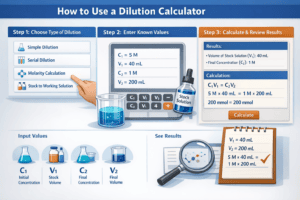
How to Use a Dilution Calculator: Step-by-Step
Using a dilution calculator is easy. Here’s a detailed guide on how to use it for different types of dilution calculations:
Step 1: Choose the Type of Dilution
A good dilution calculator offers multiple dilution modes, including:
- Simple Dilution: Used to prepare a specific concentration of a solution.
- Serial Dilution: Often used in microbiology or experiments that require progressively diluted solutions.
- Molarity Calculations: Used to calculate the molarity of a solution based on the amount of solute and the volume of solvent.
- Stock-to-Working Solution: Used for pharmaceutical applications to prepare working solutions from stock solutions.
Step 2: Enter Known Values
Once you choose the dilution mode, the calculator will prompt you to input known values. These typically include:
- C₁ (Initial Concentration): The concentration of the stock solution.
- C₂ (Final Concentration): The desired concentration of the diluted solution.
- V₁ (Stock Volume): The volume of the stock solution to be used.
- V₂ (Final Volume): The final volume of the diluted solution.
For example, if you need to prepare 200 mL of a 1 M solution from a 5 M stock, you would input these values into the dilution calculator.
Step 3: Calculate and Review Results
After entering the known values, hit Calculate. The tool will give you the required volume of stock solution and the final concentration. It will also display a step-by-step breakdown of how the calculation was performed, ensuring that you understand the math behind it.
Applications of Dilution Calculators
1. In Pharmaceutical Labs
Pharmaceutical labs often need to dilute stock solutions to make them suitable for testing. Whether you’re preparing injectable solutions, oral medications, or syrups, a dilution calculator ensures that the final concentration is exactly what is needed for both safety and efficacy.
2. In Environmental Science
In environmental testing, dilution is often required to measure concentrations of pollutants, such as heavy metals or chemicals, in soil or water. Using a dilution calculator can help environmental scientists prepare solutions for testing and ensure that the concentration levels are accurate.
3. In Microbiology
Microbiologists often use serial dilutions to prepare samples with progressively lower concentrations. This helps in determining the concentration of microorganisms in a sample. A dilution calculator ensures that each step of the serial dilution is accurate, saving time and reducing errors.
4. In Chemistry and Biochemistry
Chemists often need to dilute acids, bases, and other chemicals for various reactions. A dilution calculator simplifies the process of preparing these solutions, ensuring accuracy in chemical reactions, and preventing accidents caused by improper concentrations.
5. In Education and Research
Educational labs and research facilities also benefit from dilution calculators. Students learning basic chemistry or biology can use these tools to better understand how dilution works and ensure that their experiments are successful.
Why Our Dilution Calculator Stands Out
While many dilution calculators are available online, this one offers several features that make it the best option for any lab or research setting.
- Versatility: Unlike other calculators that only support simple dilution calculations, our tool supports serial dilution, molarity calculations, and stock-to-working solution conversions, providing the flexibility needed for a wide range of experiments.
- Unit Conversion: Our calculator automatically handles conversions between mL, L, µL, and concentrations like M, mM, µM. This ensures that no matter what units you’re working with, the tool will give you the correct result.
- Instant Results: You don’t have to wait for the result. Our calcul dilution tool gives you instant feedback and provides a full explanation of the calculation, making it easy to understand and trust the result.
- Real-Time Visuals: Some dilution calculators are just number-crunchers. Our tool provides visual diagrams of the dilution process, including animated liquid transfer between flasks, ensuring that the scientific process is fully understood.
Conclusion
In summary, a calcul dilution tool is indispensable for anyone working in a lab, from beginners to experienced researchers. It streamlines the process of calculating dilutions, reduces human error, saves time, and ensures that experiments are accurate and reproducible. With advanced features like serial dilution support, molarity calculations, and real-time unit conversions, our Dilution Calculator is more than just a simple tool—it’s an essential asset in the laboratory.
Whether you’re preparing chemicals for your next reaction, determining the concentration of a solution for a drug formulation, or performing experiments with microbes, a calcul dilution tool will make the process easier and more reliable. Make sure to incorporate this tool into your lab’s workflow and experience the difference it makes.
Frequently Asked Questions (FAQs)
A dilution calculator is an online tool that helps you calculate the amount of stock solution needed to achieve a desired concentration in a specified volume of solution.
It uses the dilution equation C₁V₁ = C₂V₂ to calculate the required volume and concentration, based on the stock solution and desired final concentration.
Yes, a dilution calculator can handle both simple and serial dilutions, allowing you to prepare multiple dilutions in a single step.
It supports a wide variety of units, including mL, L, µL for volume and M, mM, µM for concentration, with automatic unit conversion.
In pharmaceutical labs, precision in drug preparation is critical. A dilution calculator ensures accurate concentrations for preparing injectable solutions, syrups, and other formulations.
Yes, our dilution calculator supports simple dilution, serial dilution, and molarity calculations, providing versatility for different lab needs.
Absolutely! Our calculator is designed to be intuitive and easy to use, with real-time results and step-by-step explanations to help users understand the dilution process.
Yes, the results can be exported to formats like CSV or PDF for further analysis or record-keeping.
Ready to Simplify Your Lab Work?
Use our professional, accurate, and free Calcul Dilution today to ensure your experiments are precise every time.
Start Calculating Now