
Calcul Dilution — Complete Guide with Calculator
📋 Table of Contents
▼- Why Dilution Calculation Trips Up So Many People
- Dilution Calculator — Five Calculation Modes
- Understanding Dilution — What the Numbers Actually Mean
- Real Scenarios Where the Dilution Calculation Mattered
- Common Dilution Calculation Mistakes and the Science Behind Them
- Expert Perspectives on Getting Dilution Right
- Which Calculation Method Fits Your Situation
- Advanced Applications of Dilution Across Disciplines
- Frequently Asked Questions
- Dilution Calculation Best Practices Checklist
- Trusted Reference Resources
- User Reviews & Ratings
Why Dilution Calculation Trips Up So Many People
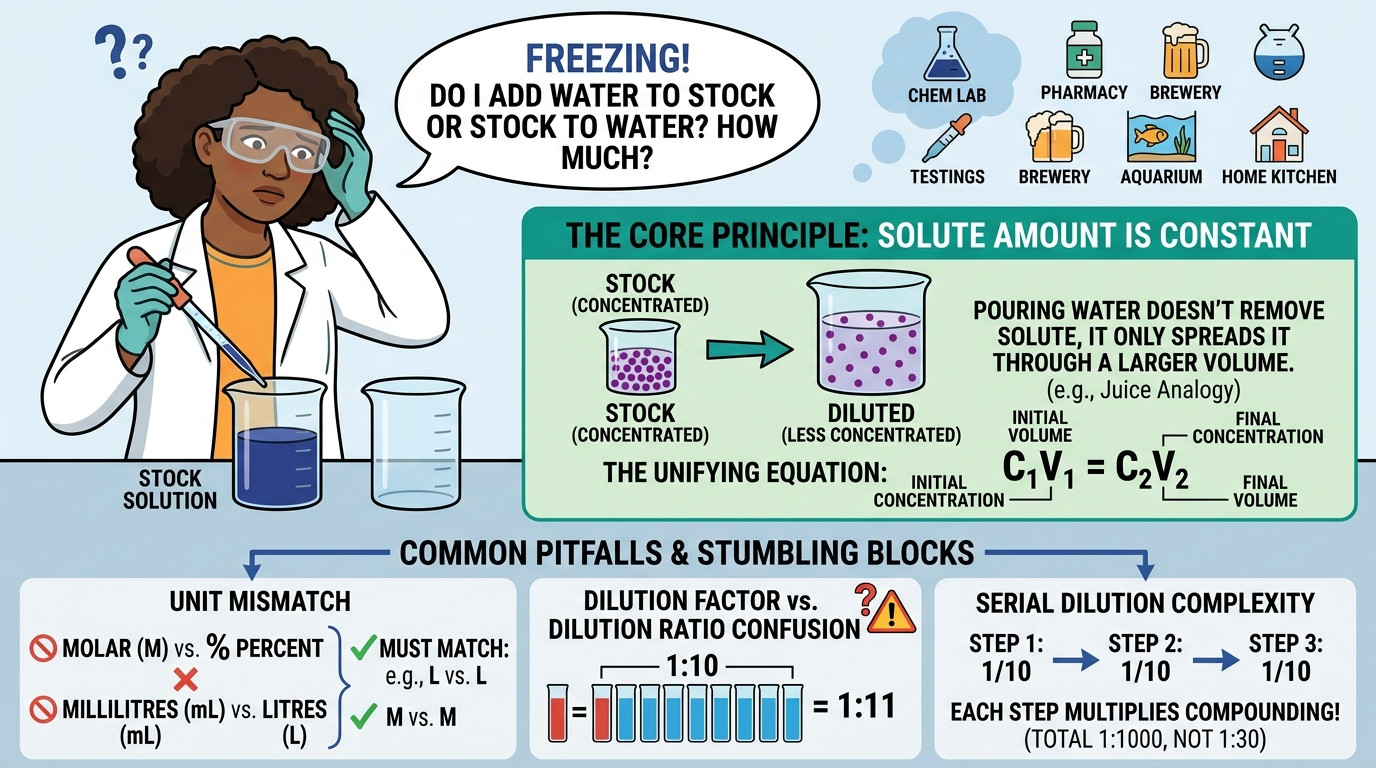
Here is a scene that repeats itself every day in chemistry labs, pharmacies, breweries, aquariums, and even home kitchens: someone has a concentrated solution, knows the strength they want, confidently grabs a pipette or a measuring cup — and then freezes. Do I add water to the stock, or stock to the water? How much of each? The mixing was never the hard part. The dilution calculation — the calcul dilution — is.
Every dilution obeys one elegant principle: the amount of solute does not change when you add solvent. Pouring water into juice does not remove any sugar — it simply spreads the same sugar through a larger volume, so the concentration drops. That single idea is captured by the most important equation in the field, C₁V₁ = C₂V₂: concentration times volume before a dilution equals concentration times volume after it. Master that relationship and most dilution-calculation problems collapse into a single line of arithmetic.
The reason people stumble is rarely the equation itself — it is the surrounding details. Units must match on both sides (you cannot mix molarity with percent, or millilitres with litres, mid-calculation). The difference between a dilution factor and a dilution ratio confuses even experienced workers. And serial dilutions, where each step multiplies the one before it, hide a surprising amount of compounding that is easy to misjudge.
This calculator and guide are built to remove that friction. The five calculation modes cover the entire range of everyday dilution work: the classic C₁V₁ = C₂V₂ solver, a dilution factor and fold calculator, a parts-based ratio mixer (the 1:10 style), a percent-solution dilution tool, and a serial dilution series builder for standard curves and dose ranges. Whether you are a student learning the math, a lab technician preparing reagents, or a hobbyist mixing cleaning solutions, this tool gives you the answer and shows the reasoning behind it.
For a dedicated single-step tool, our solution dilution calculator handles C₁V₁ = C₂V₂ cleanly, while our molarity dilution calculator covers molar-specific preparation.
Calcul Dilution Calculator
Five modes — C₁V₁=C₂V₂, dilution factor, ratio mixing, percent solutions & serial series
Calculation Result
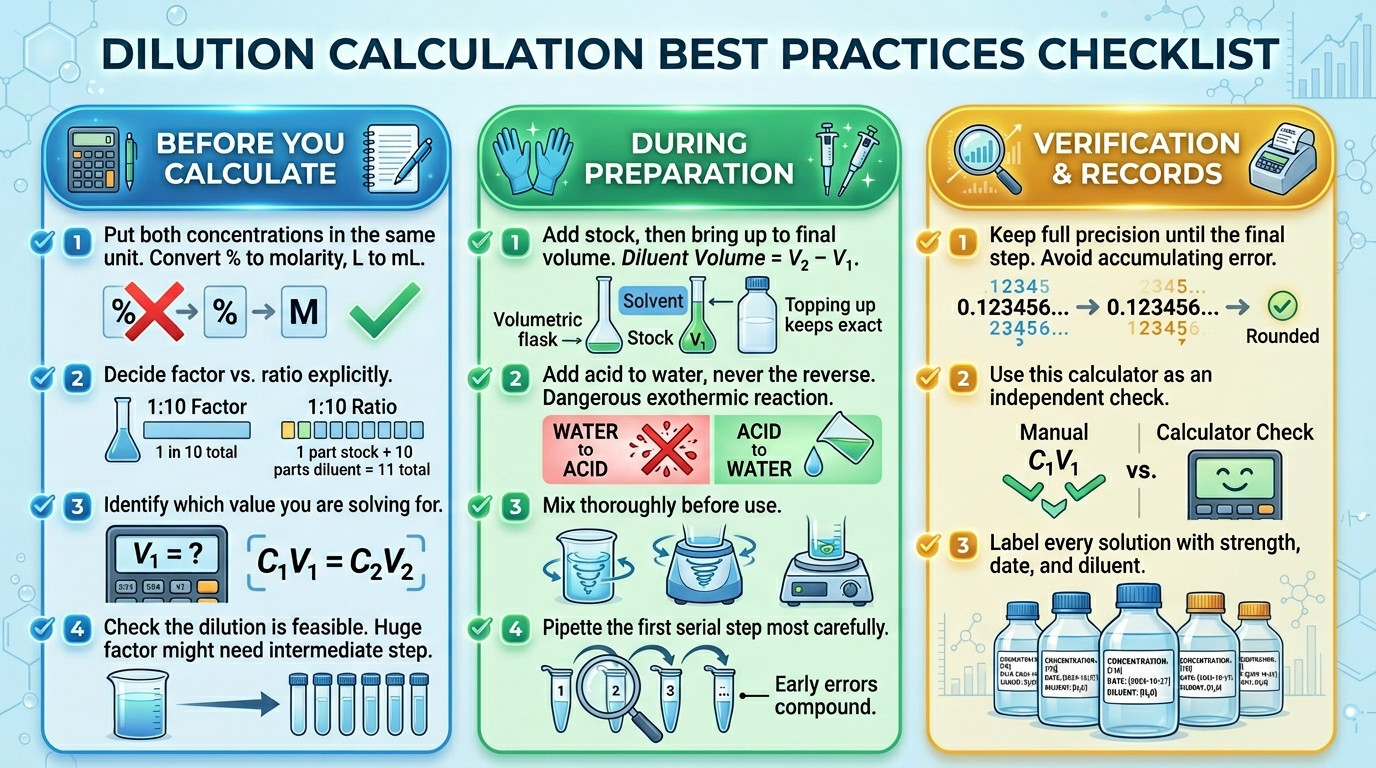
💡 Tip: Keep both concentrations in the same unit before you calculate (molarity with molarity, percent with percent). The diluent you add is always the final volume minus the stock volume — never add the diluent first if a large dilution leaves almost no room for the stock.
Understanding Dilution — What the Numbers Actually Mean
Every dilution calculation rests on a single conserved quantity: the amount of solute. When you dilute, you change the volume and the concentration, but the moles (or grams, or particles) of solute stay exactly the same. Hold that idea in mind and the four most common dilution calculations all become variations of one theme.
The Core Equation: C₁V₁ = C₂V₂
Because the amount of solute is conserved, concentration times volume is the same before and after dilution. Rearranging gives you whatever you need: the volume of stock to take is V₁ = (C₂ × V₂) ÷ C₁, and the diluent to add is simply V₂ − V₁. This works in any unit — molar, mg/mL, percent — as long as C₁ and C₂ share that unit.
Dilution Factor and Fold Dilution
The dilution factor (DF) is how many times more dilute the final solution is than the stock: DF = C₁ ÷ C₂, which also equals V₂ ÷ V₁. A “10-fold” or “1-in-10” dilution has a factor of 10. To make it, you take 1 part stock and bring it to 10 parts total volume.
Ratio mix: stock fraction = parts stock ÷ (parts stock + parts diluent)
Serial series: Cₙ = C₀ ÷ (step factor)ⁿ
Dilution Ratio vs. Dilution Factor — The Classic Confusion
This is where the most errors creep in. A dilution factor of 10 means the final volume is 10× the stock volume (1 part stock + 9 parts diluent = 10 parts total). A dilution ratio written “1:10” is ambiguous in everyday use: in many lab contexts it means 1 part stock to 10 parts diluent (11 parts total, an 11-fold dilution), while in other contexts “1:10” is used loosely to mean a 10-fold dilution. The safe habit is to state the parts explicitly — “1 part stock + 10 parts diluent” — which is exactly what the Ratio mode asks for.
Percent Solutions
Percent concentration (% w/v, % v/v, or % w/w) dilutes by the very same C₁V₁ = C₂V₂ logic, just with percent in place of molarity. To turn 70% stock into 500 mL of 10% solution: V₁ = (10 × 500) ÷ 70 = 71.4 mL of stock, topped up with diluent to 500 mL.
Quick Reference Values
is conserved
dilutions
minus stock
number of steps
100 mL
never reverse
Remember: The calculator gives you the volumes; you supply consistent units and confirm the solution is fully mixed. A dilution that hasn’t been mixed thoroughly is not at the concentration the math promises.
For molar work, our molarity dilution calculator handles the molar side, while for mass-per-volume our mg/mL dilution calculator covers that entry point.

Real Scenarios Where the Dilution Calculation Mattered
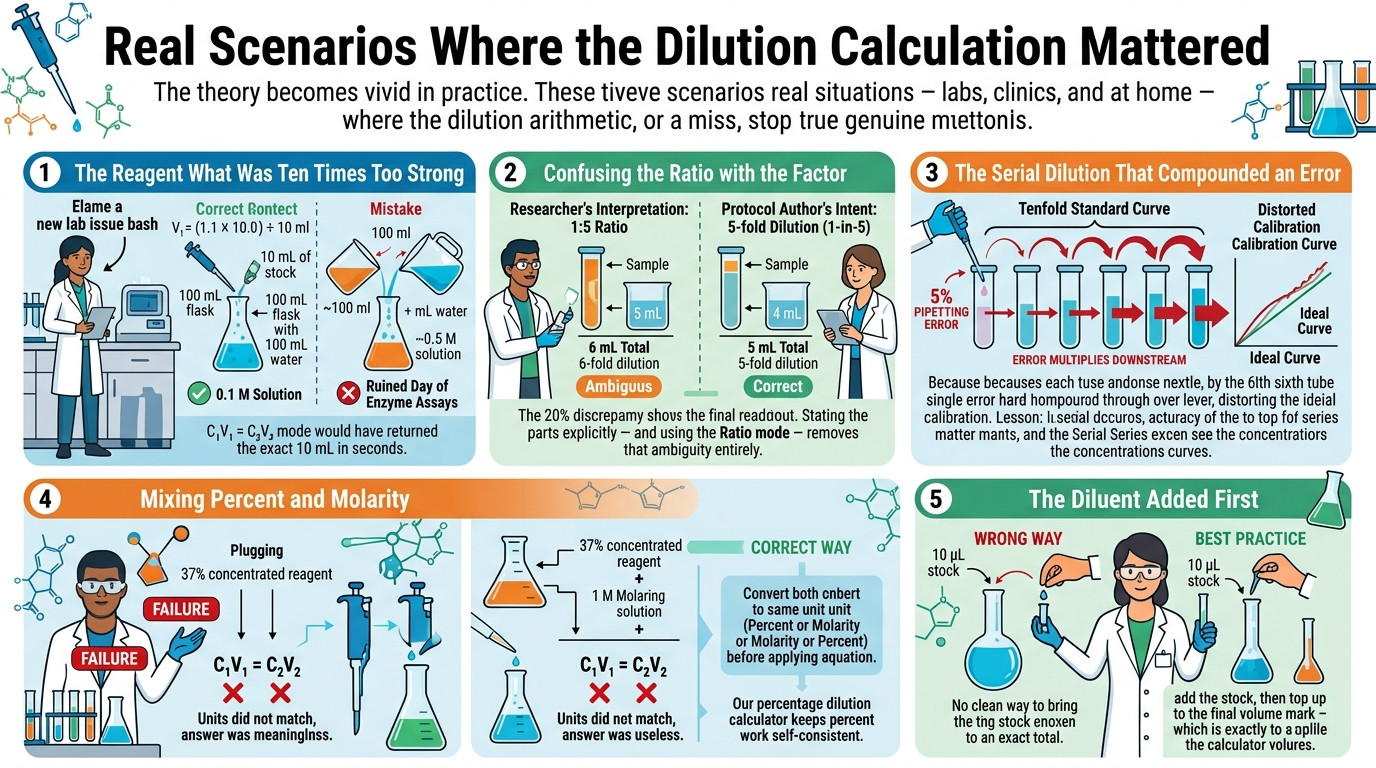
The theory becomes vivid in practice. These five scenarios reflect real situations — in labs, clinics, and at home — where the dilution arithmetic, or a missing step, had genuine consequences.
Scenario 1: The Reagent That Was Ten Times Too Strong
A new lab technician needed 100 mL of 0.1 M buffer from a 1 M stock. The correct calculation is V₁ = (0.1 × 100) ÷ 1 = 10 mL of stock, brought to 100 mL with water. Instead they measured 100 mL of stock and added 100 mL of water — making a solution roughly 0.5 M, five times too strong, which ruined a day of enzyme assays. The C₁V₁ = C₂V₂ mode would have returned the exact 10 mL in seconds.
Scenario 2: Confusing the Ratio with the Factor
A researcher was told to prepare a “1:5 dilution” of a sample. They mixed 1 mL of sample with 5 mL of diluent (6 mL total, a 6-fold dilution), while the protocol author meant a 5-fold dilution (1 mL sample + 4 mL diluent). The 20% discrepancy threw off the final readout. Stating the parts explicitly — and using the Ratio mode — removes that ambiguity entirely.
Scenario 3: The Serial Dilution That Compounded an Error
An analyst building a six-point tenfold standard curve made a small 5% pipetting error at the very first tube. Because each step multiplies the previous one, by the sixth tube that single error had compounded through every level, distorting the whole calibration. The lesson: in serial dilutions, accuracy at the top of the series matters most, and the Serial Series mode lets you see exactly how the concentrations cascade.
Scenario 4: Mixing Percent and Molarity
Someone tried to dilute a “37% concentrated” reagent down to a “1 M” working solution by plugging 37 and 1 straight into C₁V₁ = C₂V₂. The units did not match, so the answer was meaningless. The fix is to convert both values to the same unit first — percent to molarity, or molarity to percent — before applying the equation. Our percentage dilution calculator keeps percent work self-consistent.
Scenario 5: The Diluent Added First
To make a 1000-fold dilution in a 10 mL final volume, only 10 µL of stock is needed. A worker poured nearly 10 mL of diluent into the flask first, then realised there was no clean way to bring the tiny stock volume to an exact total. Best practice is to add the stock, then top up to the final volume mark — which is exactly the recipe the calculator reports.
Common Dilution Calculation Mistakes and the Science Behind Them
The mistakes people make when calculating dilutions cluster around a few predictable failure points. Understanding why they happen is more useful than simply memorising the right answer.
Mistake 1: Mismatched Units
C₁V₁ = C₂V₂ only works when C₁ and C₂ are in the same unit and V₁ and V₂ are in the same unit. Mixing molarity with percent, or millilitres with litres, silently produces a wrong number.
Prevention: convert everything to a single unit before you start. Our molarity dilution calculator helps standardise concentration units.
Mistake 2: Confusing Dilution Factor with Dilution Ratio
A factor of 5 (5-fold, 1 part in 5 total) is not the same as a ratio of 1:5 (1 part stock to 5 parts diluent, 6 total). Treating them as identical introduces a consistent offset.
Prevention: decide whether you mean “parts total” or “parts stock to parts diluent,” and state it explicitly. Our dilution ratio calculator makes the parts unambiguous.
Mistake 3: Adding Diluent Instead of Bringing to Volume
For dilute solutions the stock and diluent volumes are almost equal — but for large dilutions they are not. Adding “V₂ worth of diluent” to a full measure of stock doubles your intended final volume.
Prevention: take the calculated stock volume, then top up to the final volume mark. The diluent added equals V₂ − V₁, not V₂.
Mistake 4: Ignoring Compounding in Serial Dilutions
Each step of a serial dilution multiplies the previous one, so the total dilution is the per-step factor raised to the number of steps. People often underestimate how quickly concentration falls — and how early errors propagate.
Prevention: compute the total factor as DFⁿ and verify with our dilution factor calculator.
Mistake 5: Rounding Too Early
Rounding intermediate values, especially in multi-step or serial calculations, accumulates error. A volume rounded at each tube can drift noticeably by the end of a long series.
Prevention: keep full precision through the calculation and round only the final reported volumes.
💡 Rule of Thumb: Convert to one consistent unit, decide factor-vs-ratio up front, take the stock volume and bring it to the final mark, and treat serial steps as multiplicative. The formula is simple; the accuracy lives in the setup. Our solution dilution calculator is a handy companion for single-step checks.
Expert Perspectives on Getting Dilution Right
The people who dilute solutions for a living tend to agree on what separates reliable work from error-prone work — and it is rarely the equation.
“Nine out of ten dilution errors I see are unit errors, not math errors. The moment a student writes C₁V₁ = C₂V₂ with percent on one side and molarity on the other, the answer is already wrong. Fix the units first, and the arithmetic takes care of itself.”
“For serial dilutions, I tell every new analyst the same thing: your top tube is your foundation. A small slip there is carried through every level below it. Pipette the first transfer like the whole calibration depends on it — because it does.”
“The single best habit is to add the concentrate to the flask and then bring it up to the mark, never the other way around. It keeps your final volume honest and, with acids, it is also the safe order — acid into water, always.”
Which Calculation Method Fits Your Situation
The five calculator modes correspond to the five distinct contexts where a dilution calculation is needed. Choosing the right mode ensures you apply the correct logic for your task.
Dilution Method Comparison Table
| Mode | Use Case | Key Formula | Inputs Needed | Typical Applications |
|---|---|---|---|---|
| C₁V₁=C₂V₂ | Stock → working | V₁ = C₂V₂ ÷ C₁ | 3 of 4 values | Reagents, buffers |
| Dilution Factor | How many-fold | DF = C₁ ÷ C₂ | stock & final conc | Sample prep, planning |
| Ratio (1:X) | Parts-based mixing | stock frac = parts ÷ total | parts, final volume | Cleaners, coolants, stains |
| Percent Solution | % strength → % strength | V₁ = C₂V₂ ÷ C₁ | stock %, target %, volume | Alcohol, bleach, w/v solutions |
| Serial Series | Step-wise series | Cₙ = C₀ ÷ DFⁿ | start, factor, steps | Standard curves, dose ranges |
Practical Decision Guide
Have a stock and need a working solution? Use C₁V₁=C₂V₂ mode. Enter any three of stock concentration, stock volume, final concentration, and final volume, leaving one blank, and it solves the fourth. Our solution dilution calculator provides an alternative view.
Just need to know how many-fold a dilution is? Use Dilution Factor mode. Enter the stock and final concentrations to get the factor, and add a final volume for the full recipe. Our calculate the dilution factor guide explains the concept in depth.
Working from a parts-based ratio like 1:10? Use Ratio mode. Enter the parts of stock and diluent plus the final volume to get exact mixing volumes. Our dilution ratio calculator is purpose-built for this.
Diluting a percent-strength solution? Use Percent Solution mode for alcohol, bleach, or any % w/v or % v/v stock. Our percentage dilution calculator and alcohol dilution calculator cover related percent work.
Building a standard curve or dose range? Use Serial Series mode for the full tube-by-tube table. Our dilution factor calculator gives an independent check on the cumulative factors.
‘;
}window.cdToggleTOC=function(el){
var list=el.closest(‘.cd-toc’).querySelector(‘.cd-toc-list’);
var arrow=el.querySelector(‘.cd-toc-arrow’);
list.classList.toggle(‘collapsed’);
arrow.classList.toggle(‘open’);
};
window.cdSetMode=function(mode,btn){
document.querySelectorAll(‘#swiftcalcu-calcul-dilution-container .cd-panel’).forEach(function(p){p.classList.remove(‘active’);});
document.querySelectorAll(‘#swiftcalcu-calcul-dilution-container .cd-mode-btn’).forEach(function(b){b.classList.remove(‘active’);});
var panel=gid(‘cd-p-‘+mode);
if(panel)panel.classList.add(‘active’);
btn.classList.add(‘active’);
cdHideErr();
gid(‘cd-res’).classList.remove(‘show’);
gid(‘cd-res-table-wrap’).style.display=’none’;
};
window.cdReset=function(mode){
cdHideErr();
gid(‘cd-res’).classList.remove(‘show’);
gid(‘cd-res-table-wrap’).style.display=’none’;
var panel=gid(‘cd-p-‘+mode);
if(panel){
panel.querySelectorAll(‘input[type=”number”]’).forEach(function(i){i.value=”;});
panel.querySelectorAll(‘input[type=”text”]’).forEach(function(i){i.value=”;});
}
};// ===== C1V1 = C2V2 =====
window.cdCalcC1V1=function(){
var c1=gid(‘cd-cv-c1’).value?parseFloat(gid(‘cd-cv-c1’).value):null;
var v1=gid(‘cd-cv-v1’).value?parseFloat(gid(‘cd-cv-v1’).value):null;
var c2=gid(‘cd-cv-c2’).value?parseFloat(gid(‘cd-cv-c2’).value):null;
var v2=gid(‘cd-cv-v2’).value?parseFloat(gid(‘cd-cv-v2’).value):null;
var filled=[c1!==null,v1!==null,c2!==null,v2!==null].filter(Boolean).length;
if(filled<3){cdErr(‘Fill in at least 3 of the 4 fields. Leave exactly ONE blank to solve for it.’);return;}
var solve=”,result;
if(c1===null){solve=’C\u2081′;result=(c2*v2)/v1;}
else if(v1===null){solve=’V\u2081′;result=(c2*v2)/c1;}
else if(c2===null){solve=’C\u2082′;result=(c1*v1)/v2;}
else if(v2===null){solve=’V\u2082′;result=(c1*v1)/c2;}
else{
var lhs=c1*v1,rhs=c2*v2;
var diff=Math.abs(lhs-rhs)/Math.max(lhs,rhs)*100;
cdShowResult(
‘C\u2081V\u2081=’+cdFmt(lhs)+’ | C\u2082V\u2082=’+cdFmt(rhs)+’
‘+(diff<1?’\u2705 Consistent’:’\u26a0\ufe0f Inconsistent’)+’ (\u0394’+diff.toFixed(2)+’%)‘,
‘
Verification
‘+step(1,’C\u2081\u00d7V\u2081 = ‘+cdFmt(c1)+’ \u00d7 ‘+cdFmt(v1)+’ = ‘+cdFmt(lhs))+step(2,’C\u2082\u00d7V\u2082 = ‘+cdFmt(c2)+’ \u00d7 ‘+cdFmt(v2)+’ = ‘+cdFmt(rhs)),null );return; } if(isNaN(result)||!isFinite(result)||result<0){cdErr(‘Invalid calculation. Ensure all values are positive and non-zero.’);return;} var s=’
C\u2081V\u2081 = C\u2082V\u2082 Calculation
‘; s+=step(1,’Formula: C\u2081 \u00d7 V\u2081 = C\u2082 \u00d7 V\u2082 (the amount of solute is conserved)’); s+=step(2,’Solving for ‘+solve+’:’); if(solve===’C\u2081′)s+=step(3,’C\u2081 = (C\u2082\u00d7V\u2082)/V\u2081 = (‘+cdFmt(c2)+’ \u00d7 ‘+cdFmt(v2)+’) / ‘+cdFmt(v1)+’ = ‘+cdFmt(result)+’‘); else if(solve===’V\u2081’){ s+=step(3,’V\u2081 = (C\u2082\u00d7V\u2082)/C\u2081 = (‘+cdFmt(c2)+’ \u00d7 ‘+cdFmt(v2)+’) / ‘+cdFmt(c1)+’ = ‘+cdFmt(result)+’ of stock‘); s+=step(4,’Diluent to add = V\u2082 \u2212 V\u2081 = ‘+cdFmt(v2)+’ \u2212 ‘+cdFmt(result)+’ = ‘+cdFmt(cdRnd(v2-result,6))+’‘); } else if(solve===’C\u2082’)s+=step(3,’C\u2082 = (C\u2081\u00d7V\u2081)/V\u2082 = (‘+cdFmt(c1)+’ \u00d7 ‘+cdFmt(v1)+’) / ‘+cdFmt(v2)+’ = ‘+cdFmt(result)+’‘); else s+=step(3,’V\u2082 = (C\u2081\u00d7V\u2081)/C\u2082 = (‘+cdFmt(c1)+’ \u00d7 ‘+cdFmt(v1)+’) / ‘+cdFmt(c2)+’ = ‘+cdFmt(result)+’ total‘); cdShowResult(solve+’ = ‘+cdFmt(result)+’‘,s,null); };// ===== DILUTION FACTOR ===== window.cdCalcFactor=function(){ var c1=parseFloat(gid(‘cd-df-c1’).value); var c2=parseFloat(gid(‘cd-df-c2’).value); var vol=gid(‘cd-df-vol’).value?parseFloat(gid(‘cd-df-vol’).value):null; if(isNaN(c1)||c1<=0){cdErr(‘Enter a valid stock concentration greater than zero.’);return;} if(isNaN(c2)||c2<=0){cdErr(‘Enter a valid final concentration greater than zero.’);return;} if(c2>c1){cdErr(‘Final concentration must be less than the stock concentration for a dilution.’);return;} var df=cdRnd(c1/c2,6); var s=’
Dilution Factor Calculation
‘;
s+=step(1,’Dilution factor = C\u2081 \u00f7 C\u2082 = ‘+cdFmt(c1)+’ \u00f7 ‘+cdFmt(c2)+’ = ‘+cdFmt(df)+’\u00d7‘);
s+=step(2,’This is a 1-in-‘+cdFmt(df)+’ (or ‘+cdFmt(df)+’-fold) dilution.’);
var valHTML=’Dilution Factor = ‘+cdFmt(df)+’\u00d7‘;
var tHTML=null;
if(vol!==null){
if(vol<=0){cdErr(‘Enter a valid final volume greater than zero.’);return;}
var v1=cdRnd(vol/df,6);
var dil=cdRnd(vol-v1,6);
s+=step(3,’Stock needed = final volume \u00f7 factor = ‘+cdFmt(vol)+’ \u00f7 ‘+cdFmt(df)+’ = ‘+cdFmt(v1)+’‘);
s+=step(4,’Diluent to add = ‘+cdFmt(vol)+’ \u2212 ‘+cdFmt(v1)+’ = ‘+cdFmt(dil)+’‘);
s+=step(5,’Add the stock first, then bring up to ‘+cdFmt(vol)+’ total.’);
valHTML+=’
‘+cdFmt(v1)+’ stock + ‘+cdFmt(dil)+’ diluent \u2192 ‘+cdFmt(vol)+’ total‘;
tHTML=’Component Volume
‘; } cdShowResult(valHTML,s,tHTML); };// ===== RATIO (1:X) ===== window.cdCalcRatio=function(){ var ps=parseFloat(gid(‘cd-rt-stock’).value); var pd=parseFloat(gid(‘cd-rt-dil’).value); var vol=parseFloat(gid(‘cd-rt-vol’).value); if(isNaN(ps)||ps<=0){cdErr(‘Enter a valid number of parts of stock greater than zero.’);return;} if(isNaN(pd)||pd<0){cdErr(‘Enter a valid number of parts of diluent (zero or more).’);return;} if(isNaN(vol)||vol<=0){cdErr(‘Enter a valid final volume greater than zero.’);return;} var total=ps+pd; var stockVol=cdRnd(vol*ps/total,6); var dilVol=cdRnd(vol*pd/total,6); var fold=cdRnd(total/ps,6); var s=’
Ratio Dilution Calculation
‘;
s+=step(1,’Ratio = ‘+cdFmt(ps)+’ part(s) stock : ‘+cdFmt(pd)+’ part(s) diluent = ‘+cdFmt(total)+’ total parts’);
s+=step(2,’Stock fraction = ‘+cdFmt(ps)+’ \u00f7 ‘+cdFmt(total)+’ = ‘+cdFmt(cdRnd(ps/total,6)));
s+=step(3,’Stock volume = ‘+cdFmt(vol)+’ \u00d7 ‘+cdFmt(ps)+’/’+cdFmt(total)+’ = ‘+cdFmt(stockVol)+’‘);
s+=step(4,’Diluent volume = ‘+cdFmt(vol)+’ \u00d7 ‘+cdFmt(pd)+’/’+cdFmt(total)+’ = ‘+cdFmt(dilVol)+’‘);
s+=step(5,’This equals a ‘+cdFmt(fold)+’-fold (1-in-‘+cdFmt(fold)+’) dilution.’);
var tHTML=’Component Parts Volume
‘;
cdShowResult(
‘‘+cdFmt(stockVol)+’ stock + ‘+cdFmt(dilVol)+’ diluent
‘+cdFmt(fold)+’-fold dilution \u2192 ‘+cdFmt(vol)+’ total‘,
s,tHTML
);
};// ===== PERCENT SOLUTION =====
window.cdCalcPercent=function(){
var c1=parseFloat(gid(‘cd-pc-c1’).value);
var c2=parseFloat(gid(‘cd-pc-c2’).value);
var vol=parseFloat(gid(‘cd-pc-vol’).value);
if(isNaN(c1)||c1<=0){cdErr(‘Enter a valid stock strength (%) greater than zero.’);return;}
if(isNaN(c2)||c2<=0){cdErr(‘Enter a valid target strength (%) greater than zero.’);return;}
if(c2>c1){cdErr(‘Target strength must be lower than the stock strength for a dilution.’);return;}
if(isNaN(vol)||vol<=0){cdErr(‘Enter a valid final volume greater than zero.’);return;}
var v1=cdRnd((c2*vol)/c1,6);
var dil=cdRnd(vol-v1,6);
var df=cdRnd(c1/c2,6);
var s=’
Percent Solution Dilution
‘;
s+=step(1,’Formula: C\u2081V\u2081 = C\u2082V\u2082 with percent strengths’);
s+=step(2,’Stock needed = (C\u2082 \u00d7 V\u2082) \u00f7 C\u2081 = (‘+cdFmt(c2)+’% \u00d7 ‘+cdFmt(vol)+’) \u00f7 ‘+cdFmt(c1)+’% = ‘+cdFmt(v1)+’‘);
s+=step(3,’Diluent to add = ‘+cdFmt(vol)+’ \u2212 ‘+cdFmt(v1)+’ = ‘+cdFmt(dil)+’‘);
s+=step(4,’Add the stock, then top up to ‘+cdFmt(vol)+’ (a ‘+cdFmt(df)+’-fold dilution).’);
var tHTML=’Component Volume
‘;
cdShowResult(
‘Use ‘+cdFmt(v1)+’ of ‘+cdFmt(c1)+’% stock
+ ‘+cdFmt(dil)+’ diluent \u2192 ‘+cdFmt(vol)+’ of ‘+cdFmt(c2)+’%‘,
s,tHTML
);
};// ===== SERIAL SERIES =====
window.cdCalcSerial=function(){
var c0=parseFloat(gid(‘cd-sr-conc’).value);
var df=parseFloat(gid(‘cd-sr-df’).value);
var steps=parseInt(gid(‘cd-sr-steps’).value);
var unit=gid(‘cd-sr-unit’).value.trim()||”;
if(isNaN(c0)||c0<=0){cdErr(‘Enter a valid starting concentration greater than zero.’);return;}
if(isNaN(df)||df<=1){cdErr(‘Enter a valid dilution factor greater than 1.’);return;}
if(isNaN(steps)||steps<1||steps>30){cdErr(‘Enter a valid number of steps between 1 and 30.’);return;}
var totalDF=cdRnd(Math.pow(df,steps),6);
var cFinal=cdRnd(c0/Math.pow(df,steps),6);
var u=unit?’ ‘+unit:”;
var s=’
Serial Dilution Series Breakdown
‘;
s+=step(1,’Start C\u2080 = ‘+cdFmt(c0)+u+’, per-step factor = ‘+cdFmt(df)+’, steps = ‘+steps+’‘);
s+=step(2,’Total dilution factor = ‘+cdFmt(df)+’^’+steps+’ = ‘+cdFmt(totalDF)+’\u00d7‘);
s+=step(3,’Final tube = C\u2080 \u00f7 ‘+cdFmt(totalDF)+’ = ‘+cdFmt(cFinal)+u+’‘);
s+=step(4,’At each step, take 1 part of the previous tube and add (‘+cdFmt(cdRnd(df-1,6))+’) parts diluent.’);
var tHTML=’Tube Cumulative DF Concentration’+(unit?’ (‘+unit+’)’:”)+’
‘;
cdShowResult(
‘Final tube (‘+steps+’ steps) = ‘+cdFmt(cFinal)+u+’ The dilution calculation is a daily requirement far beyond the chemistry classroom. The same conserved-solute logic — and the same C₁V₁ = C₂V₂ backbone — shows up wherever a concentrated material must be brought to a usable strength. Here are five areas where getting the dilution math right is essential. Calibration curves, reference standards, and reagent preparation all depend on accurate dilutions. A spectrophotometric standard curve, for instance, is a serial dilution whose accuracy directly determines how trustworthy every measured sample concentration is. Analysts treat the top of the series with particular care because errors there compound downward. For the molar preparation that underpins reagent work, our molarity dilution calculator handles the C₁V₁ = C₂V₂ math at the concentrations these methods require. Reconstituting and diluting medications, preparing intravenous solutions, and titrating doses are all dilution calculations where the margin for error is small. Clinical laboratories also run serial dilutions to determine antibody titers and to bring patient samples into an assay’s measurable range. For cell-counting and sample-prep dilutions in clinical and research settings, our cell dilution calculator handles the specific volumetric math involved. Adjusting the strength of flavorings, standardising syrups, and diluting spirits to bottling proof are everyday percent-based dilutions. Distillers, in particular, dilute high-proof spirit to a target ABV with precision, since both flavour and legal proof depend on it. For alcohol-by-volume work specifically, our alcohol dilution calculator is purpose-built, and our percentage dilution calculator covers general percent strengths. Pesticides, fertilizers, disinfectants, and industrial cleaners almost always ship as concentrates with a recommended dilution ratio printed on the label — “mix 1 part product to 32 parts water,” for example. Getting that ratio right matters for both efficacy and safety, since over-concentrated solutions can damage surfaces, crops, or skin. For these parts-based dilutions, our dilution ratio calculator turns any label ratio into exact mixing volumes. From students learning C₁V₁ = C₂V₂ for the first time to home users diluting concentrated cleaners, fertilizers, or essential oils, the dilution calculation is one of the most broadly useful pieces of practical math there is. A clear, step-by-step result helps the concept stick far better than a single answer. For mass-per-volume dilutions common in many of these tasks, our mg/mL dilution calculator handles the conversions cleanly. These questions come from students, technicians, and everyday users who calculate dilutions in their actual work. The answers address the real stumbling points rather than rehearsing textbook definitions. The fundamental formula is C₁V₁ = C₂V₂, where C₁ and V₁ are the concentration and volume of the stock, and C₂ and V₂ are the concentration and volume of the final diluted solution. Because the amount of solute doesn’t change, you can solve for whichever value is unknown. The most common rearrangement finds the stock volume to use: V₁ = (C₂ × V₂) ÷ C₁. The only requirement is that the two concentrations share the same unit and the two volumes share the same unit. The C₁V₁=C₂V₂ mode solves for any of the four values automatically. First find the stock volume with V₁ = (C₂ × V₂) ÷ C₁, then the water (diluent) to add is simply V₂ − V₁ — the final volume minus the stock volume. For example, to make 100 mL of 0.1 M solution from a 1 M stock: V₁ = (0.1 × 100) ÷ 1 = 10 mL stock, so you add 90 mL of water. Best practice is to add the stock first, then top up to the final volume mark rather than measuring the diluent separately — this keeps the final volume exact, especially for large dilutions. A dilution factor is how many times more dilute the final solution is: factor = C₁ ÷ C₂ = V₂ ÷ V₁. A factor of 10 means a 10-fold (1-in-10) dilution. A dilution ratio is usually written with a colon, like 1:10. In many lab contexts this means 1 part stock to 10 parts diluent (11 parts total, an 11-fold dilution), though some people use “1:10” loosely to mean a 10-fold dilution. Because the ratio notation is ambiguous, state the parts explicitly (“1 part stock + 10 parts diluent”). The Ratio mode asks for parts directly and reports the equivalent fold dilution to remove any confusion. In a serial dilution you repeat the same dilution step several times, so each tube is the previous one divided by the per-step factor. The total dilution is the per-step factor raised to the number of steps (DFⁿ). For a tenfold series from 100 µM over six steps: 100, 10, 1, 0.1, 0.01, 0.001 µM — a total dilution of 10⁶. At each step you typically take 1 part of the previous tube and add 9 parts diluent. Because errors compound, pipette the first transfer most carefully. The Serial Series mode lays out the full tube-by-tube table for any factor and step count. Use C₁V₁ = C₂V₂ with percent in place of concentration. To make 500 mL of 10% from 70% stock: V₁ = (10 × 500) ÷ 70 = 71.4 mL of stock, topped up with diluent to 500 mL (so about 428.6 mL of diluent). This works for % v/v (like alcohol), % w/v (grams per 100 mL), and % w/w, as long as both the stock and target use the same kind of percent. The Percent Solution mode does this directly, and our alcohol dilution calculator is tailored for ABV work. The equation balances the amount of solute on both sides. That balance only holds if the concentrations are expressed in the same unit and the volumes in the same unit — otherwise you are comparing different quantities. You cannot mix molarity with percent, or millilitres with litres, mid-equation. If your stock is in one unit and your target in another, convert first. A simple safeguard: write the units next to every number before you calculate. If they don’t cancel cleanly, fix them before solving. Our molarity dilution calculator helps standardise concentration units. Always add acid to water, never water to acid. Diluting concentrated acids releases a lot of heat, and adding water to acid can cause the mixture to boil and splatter dangerously. By adding acid slowly to a larger volume of water, the heat is absorbed by the water and dissipated safely. This is the order the calculator’s recipe assumes — take the diluent (water) and add the calculated stock (acid) into it. The dilution math is identical either way, but the mixing order is a safety matter, not a calculation one. Always wear appropriate protection when handling concentrated acids. Rearrange the core equation to C₂ = (C₁ × V₁) ÷ V₂. The final concentration equals the stock concentration times the stock volume, divided by the final total volume. For example, diluting 5 mL of a 2 M stock up to 50 mL final gives C₂ = (2 × 5) ÷ 50 = 0.2 M. Equivalently, divide the stock concentration by the dilution factor: a 10-fold dilution of a 2 M stock is 0.2 M. The C₁V₁=C₂V₂ mode solves for C₂ when you leave that field blank. “1 in 20” almost always means a 20-fold dilution: 1 part stock brought to 20 parts total volume (so 1 part stock + 19 parts diluent). The final solution is 1/20th the original strength. “1:20” written with a colon is the ambiguous case — it can mean the same 20-fold dilution, or 1 part stock to 20 parts diluent (21 parts total). Context decides, so confirm with whoever wrote the protocol. To stay safe, the Ratio mode asks for parts of stock and parts of diluent separately and reports the exact fold dilution, so there is never any doubt. It depends on the application, but as a rule, avoid transferring very small volumes when a larger, more accurate transfer is possible. A 1 µL transfer carries far more relative error than a 100 µL transfer. For large dilution factors, use an intermediate dilution rather than pipetting a tiny volume directly — for example, make a 1:10 then another 1:10 instead of a single 1:100 from a 1 µL stock. In serial dilutions, accuracy at the first tube matters most because it propagates through the series. Use calibrated, well-maintained pipettes and pre-wet the tip for viscous or volatile liquids. These practices distinguish accurate, reproducible dilution work from error-prone work. Many take only seconds and prevent the systematic mistakes that quietly bias a whole experiment or batch. For the complete set of dilution tools that support this work: molarity dilution calculator, solution dilution calculator, calculate the dilution factor, and mg/mL dilution calculator. These are authoritative references that students, chemists, and technicians rely on when dilution work intersects with rigorous or regulated practice. LibreTexts Chemistry — chem.libretexts.org — A free, peer-reviewed open textbook platform with clear explanations of dilution, molarity, and the C₁V₁ = C₂V₂ relationship, including worked examples for students. NIST (National Institute of Standards and Technology) — nist.gov — Offers guidance on measurement uncertainty, pipette and balance calibration, and traceability that bear directly on accurate dilution and the standards built from it. IUPAC (International Union of Pure and Applied Chemistry) — iupac.org — The authority on chemical nomenclature and units, useful for getting concentration terms (molarity, molality, percent) and their notation exactly right. NCBI / National Library of Medicine — ncbi.nlm.nih.gov — A vast repository of peer-reviewed methodology, including protocols where serial dilution and accurate concentration preparation are described in detail. Khan Academy — khanacademy.org — Free video lessons and practice on solutions, concentration, and dilution that are ideal for building intuition before tackling harder problems. On our platform, the full suite of related calculation tools includes: molarity dilution calculator, solution dilution calculator, dilution ratio calculator, percentage dilution calculator, mg/mL dilution calculator, dilution factor calculator, cell dilution calculator, alcohol dilution calculator, and peptide dilution calculator. Dilution sits at an interesting point in practical math — the core equation is simple enough to learn in an afternoon, yet the accuracy depends on details that are easy to miss. A single C₁V₁ = C₂V₂ calculation? That’s first-week material. Matching units, telling a factor from a ratio, bringing a solution to volume rather than over-adding diluent, and respecting how serial steps compound? That’s where careful work separates a solution that is truly the strength you wanted from one that only claims to be. What matters isn’t memorising formulas — it’s having the right framework: convert to one consistent unit, decide whether you mean a factor or a ratio, take the stock volume and bring it up to the final mark, and treat serial steps as multiplicative. That short sequence produces an accurate, reproducible dilution every time, for any solution you handle. The sheer breadth of where dilution appears — from analytical labs and pharmacies to breweries, farms, and kitchens — reflects how often we turn a concentrate into something usable. Few pieces of everyday math are as universally applicable, and few reward a little care as reliably. This calculator is built to support that care at every step, with the answer and the reasoning side by side. Explore our complete calculation toolkit: molarity dilution calculator, solution dilution calculator, dilution ratio calculator, percentage dilution calculator, mg/mL dilution calculator, dilution factor calculator, and cell dilution calculator. 🔒 Privacy Guarantee: Every calculation on this page runs entirely within your browser. No data — concentrations, volumes, or any other inputs — is transmitted to any external server, stored in any database, or shared with any third party. Your calculations are completely private.
Total dilution = ‘+cdFmt(totalDF)+’\u00d7‘,
s,tHTML
);
};// ===== FAQ =====
document.addEventListener(‘click’,function(e){
var q=e.target.closest(‘#swiftcalcu-calcul-dilution-container .cd-faq-q’);
if(!q)return;
var item=q.closest(‘.cd-faq-item’);
document.querySelectorAll(‘#swiftcalcu-calcul-dilution-container .cd-faq-item’).forEach(function(fi){
if(fi!==item)fi.classList.remove(‘open’);
});
item.classList.toggle(‘open’);
});// ===== STARS =====
document.addEventListener(‘click’,function(e){
var star=e.target.closest(‘#swiftcalcu-calcul-dilution-container .cd-star-input span’);
if(!star)return;
var val=parseInt(star.getAttribute(‘data-val’));
var container=star.closest(‘.cd-star-input’);
container.setAttribute(‘data-sel’,val);
container.querySelectorAll(‘span’).forEach(function(s){
parseInt(s.getAttribute(‘data-val’))<=val?s.classList.add(‘lit’):s.classList.remove(‘lit’);
});
});// ===== SUBMIT REVIEW =====
window.cdSubmitReview=function(){
var name=gid(‘cd-rname’);
var role=gid(‘cd-rrole’);
var text=gid(‘cd-rtext’);
var sc=document.querySelector(‘#swiftcalcu-calcul-dilution-container .cd-star-input’);
var rating=sc?parseInt(sc.getAttribute(‘data-sel’)||’0′):0;
if(!name.value.trim()){cdErr(‘Please enter your name.’);return;}
if(rating===0){cdErr(‘Please select a star rating.’);return;}
if(!text.value.trim()){cdErr(‘Please write your review.’);return;}
cdHideErr();
var list=document.querySelector(‘#swiftcalcu-calcul-dilution-container .cd-reviews-list’);
var stars=”;
for(var i=0;i<5;i++)stars+=iAdvanced Applications of Dilution Across Disciplines
1. Analytical Chemistry and Laboratory Standards
2. Medicine, Pharmacy, and Clinical Labs
3. Food, Beverage, and Brewing
4. Agriculture, Cleaning, and Industry
5. Education and Home Use

Frequently Asked Questions About Dilution Calculation
Dilution Calculation Best Practices Checklist
Before You Calculate
During Preparation
Verification and Records
Trusted Reference Resources for Dilution Calculation
User Reviews & Ratings
📝 Share Your Experience with This Calculator
Final Thoughts on Mastering Dilution Calculation