
Serial Dilution Calculation: The Definitive Guide to Laboratory Precision
Table of Contents
- 1. The Critical Role of Serial Dilution
- 2. Anatomy of a Serial Dilution
- 3. Serial Dilution Calculator Tool
- 4. Mathematical Theory: Geometric Progression
- 5. Types of Serial Dilution (2-Fold vs. 10-Fold)
- 6. The Physics of Error Propagation
- 7. Advanced Pipetting Mechanics
- 8. Assay Protocols: MIC, ELISA, & qPCR
- 9. Data Analysis & Sigmoidal Curves
- 10. Robotics & High-Throughput Screening
- 11. GLP & Regulatory Compliance
- 12. Integrated Digital Laboratory Ecosystem
- 13. Troubleshooting Common Failures
- 14. Extensive FAQs
- 15. Conclusion
1. The Critical Role of Serial Dilution Calculation in Modern Science
In the meticulous world of the life sciences, the serial dilution calculation is more than just a mathematical operation; it is the scaffolding upon which quantitative data is built. Whether you are counting bacteria in a Petri dish, quantifying viral load in a patient’s blood, or determining the potency of a new cancer drug, the accuracy of your results depends entirely on the precision of your initial serial dilution calculation.
Without a rigorous approach to this calculation, the vast range of biological concentrations—often spanning six to ten orders of magnitude—cannot be measured by standard instruments. A spectrophotometer cannot read an optical density (OD) of 50. A PCR machine cannot quantify a billion DNA copies without saturation. The serial dilution calculation bridges the gap between the concentrated unknown and the measurable reality.
Let us explore three high-stakes scenarios where the integrity of the serial dilution calculation is the difference between scientific breakthrough and costly failure.
Scenario #1 – The Pandemic Response (Viral Load Quantification)
During a viral outbreak, diagnostic labs are flooded with patient samples. To determine if a patient is contagious, technicians must quantify the viral load. A raw sample might contain $10^8$ viral copies per mL. This is too concentrated for direct analysis. The technician must perform a step-wise dilution.
If the serial dilution calculation is performed incorrectly—for example, a technician assumes a 1:10 dilution but pipettes volumes creating a 1:5 dilution—the final reported viral load will be off by orders of magnitude. A patient might be incorrectly flagged as “low risk,” leading to community spread. The digital serial dilution calculation tool acts as a failsafe, ensuring the math matches the pipette settings every single time.
Scenario #2 – Pharmaceutical Quality Control (MIC Testing)
In the pharmaceutical industry, releasing a batch of antibiotics requires Minimum Inhibitory Concentration (MIC) testing. This involves exposing bacteria to decreasing concentrations of the drug. The protocol typically demands a 2-fold dilution series across a 96-well plate.
The serial dilution calculation determines the starting stock concentration required to ensure the MIC falls within the middle of the plate. If the calculation is off, the “endpoint” might fall off the edge of the plate (either all bacteria die, or all survive). This invalidates the test, requiring the destruction of expensive reagents and delaying drug release. Precise serial dilution calculation is a regulatory requirement for Good Manufacturing Practice (GMP).
Scenario #3 – Environmental Toxicology (Water Safety)
An environmental scientist is testing a lake for toxic heavy metals. The concentration must be reported in parts per billion (ppb). The standard reference material arrives at 1000 parts per million (ppm). To create a standard curve that brackets the expected result, the scientist must dilute the standard down by a factor of 1,000,000.
Performing a single-step dilution of 1µL into 1 Liter is prone to massive pipetting error. Instead, the scientist uses a serial dilution calculation to plan a multi-step approach (e.g., three steps of 1:100). This method minimizes physical error and ensures the calibration curve is linear and valid.
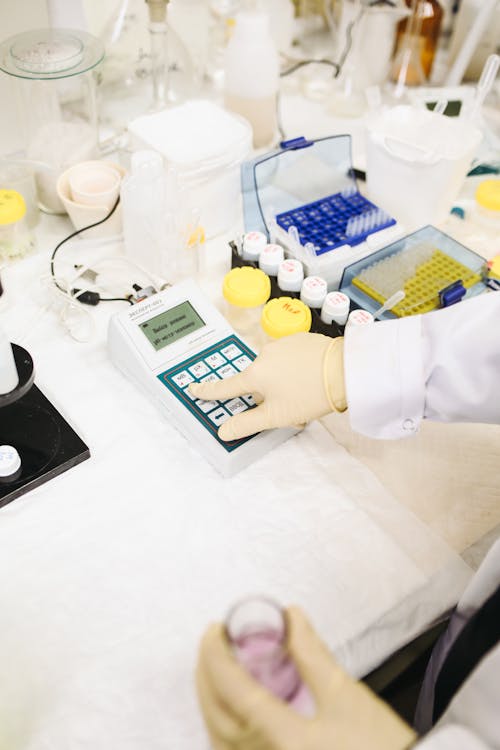
2. Anatomy of a Serial Dilution
To master the serial dilution calculation, one must first understand the physical components that the math describes. A serial dilution is a stepwise dilution of a substance in solution, where the dilution factor is usually constant at each step.
The Core Variables
- Stock Solution ($C_0$): The starting material. The accuracy of the entire series depends on the initial concentration being correct. Always verify this before starting your serial dilution calculation.
- Diluent: The solvent used (e.g., PBS, Water, Saline). The volume of diluent ($V_d$) is a critical variable in the serial dilution calculation.
- Aliquot Volume ($V_t$): Also called the Transfer Volume. This is the amount moved from one tube to the next.
- Total Volume ($V_{total}$): The sum of the Aliquot and the Diluent. $V_{total} = V_t + V_d$.
- Dilution Factor (DF): This is the ratio that defines the drop in concentration. In any serial dilution calculation, $DF = V_{total} / V_t$.
The beauty of the serial dilution calculation is that it allows you to achieve massive dilution factors without using swimming pools of solvent. By carrying the dilution factor over multiple steps, you can turn a drop of ink into a clear liquid using only a few test tubes.
Serial Dilution Calculator
Generate a precise, error-free multi-step protocol instantly.
Calculated Protocol
Based on your serial dilution calculation:
- 1. Transfer Volume ($V_t$): — µL
- 2. Diluent Volume ($V_d$): — µL
This protocol achieves a 1:— dilution at each step.
| Step | Concentration | Cumulative Dilution |
|---|
4. Mathematical Theory: Geometric Progression
The underlying math of every serial dilution calculation is based on geometric progression. Unlike linear decrements (100, 90, 80…), a serial dilution reduces concentration exponentially (100, 10, 1, 0.1…).
The Master Formula
To perform a serial dilution calculation manually, you use the following power law equation:
$$ C_n = C_0 \times (DF)^{-n} $$
Where:
$C_n$: The concentration at step $n$.
$C_0$: The initial concentration.
$DF$: The Dilution Factor (e.g., 10 for a 10-fold dilution).
$n$: The step number (integer 1, 2, 3…).
Many students struggle with the serial dilution calculation when asked to find the Transfer Volume. The rearranged formula for that is:
$$ V_{transfer} = \frac{V_{total}}{DF} $$
$$ V_{diluent} = V_{total} – V_{transfer} $$
Using a validated serial dilution calculation tool eliminates the algebra errors that frequently occur at this stage, particularly when dealing with non-integer dilution factors.
5. Types of Serial Dilution (2-Fold vs. 10-Fold)
While the serial dilution calculation works for any ratio, two specific types dominate the laboratory landscape.
2-Fold Dilution (The Halving Series)
This is the standard for titrations. The serial dilution calculation here uses a Dilution Factor of 2.
Ratio: 1 part sample : 1 part diluent.
Progression: 100%, 50%, 25%, 12.5%…
Log Scale: This represents a $Log_2$ scale. When plotting data, this creates evenly spaced points on a base-2 logarithmic axis, which is ideal for sigmoid curve fitting in immunoassays.
10-Fold Dilution (The Log Series)
This is the standard for microbiology and virology. The serial dilution calculation uses a Dilution Factor of 10.
Ratio: 1 part sample : 9 parts diluent.
Progression: $10^{-1}, 10^{-2}, 10^{-3}$…
Log Scale: This corresponds to a $Log_{10}$ scale. It allows scientists to span huge concentration ranges (from millions to single digits) in just 5 or 6 tubes.
6. The Physics of Error Propagation
This is the most critical concept for accuracy. In a single-step dilution, an error happens once. In a serial dilution, the error compounds. This is why the serial dilution calculation must be paired with flawless technique.
The Multiplier Effect:
If your pipette is uncalibrated and delivers 95µL instead of 100µL in Step 1, you have a 5% error.
By Step 2, you are pipetting from an erroneous solution.
By Step 10, the error hasn’t just added up; it has multiplied. The final concentration could be off by 40-50%.
To mitigate this, you must trust your serial dilution calculation but verify your tools. Calibrate pipettes annually according to ISO 8655 standards. Furthermore, using larger volumes (e.g., 1000µL instead of 10µL) reduces the relative percentage error, a variable often adjustable in the serial dilution calculation tool.
7. Advanced Pipetting Mechanics
A perfect serial dilution calculation is useless if the physical transfer of liquid is flawed. Understanding fluid dynamics is key.
Mixing Efficiency
When you add a dense sample (like serum or glycerol) to a buffer, it sinks. It does not mix instantly. If you perform your serial dilution calculation assuming homogeneity but aspirate from the unmixed top layer, you transfer mostly diluent.
Protocol: Vortex each tube for 3-5 seconds or pipette up and down 10 times. This mechanical energy overcomes the viscosity differences.
Tip Hysteresis (Carryover)
Liquid sticks to the outside of pipette tips. When you move from a high-concentration tube to a low one, that external droplet dissolves into the destination tube. This “carryover” artificially raises the concentration, ruining the linearity predicted by your serial dilution calculation.
The Golden Rule: Change pipette tips between every single step. This is mandatory for analytical chemistry and PCR.

8. Assay Protocols: Where Calculation Meets Reality
The serial dilution calculation is the engine behind specific industry-standard assays.
A. MIC (Minimum Inhibitory Concentration)
To find the lowest dose of antibiotic that kills bacteria, you perform a 2-fold dilution. The serial dilution calculation helps you determine the starting stock needed so that the first well contains the highest relevant dose (e.g., 64 µg/mL).
B. ELISA (Enzyme-Linked Immunosorbent Assay)
To quantify protein, you need a standard curve. The serial dilution calculation ensures that the standard curve covers the “dynamic range” of the assay. If the points are too close, the curve is flat; too far, and you miss the linear region.
C. qPCR Standard Curve
To calculate PCR efficiency, you dilute DNA template 10-fold. The serial dilution calculation allows you to convert DNA mass (nanograms) into Copy Number, ensuring you know exactly how many molecules are in each tube (e.g., $10^6, 10^5, 10^4$).
9. Data Analysis & Sigmoidal Curves
When you plot the results of an assay based on a serial dilution calculation, the data rarely forms a straight line. Biological systems saturate.
The 4-Parameter Logistic (4PL) Model:
This is the standard algorithm for fitting dose-response curves. It relies on the x-axis (concentration) being accurate. If your serial dilution calculation or execution was flawed, the data points will scatter off the curve, the $R^2$ value will drop below 0.95, and the calculated IC50 will be invalid. The integrity of the physical dilution determines the quality of the mathematical fit.
10. Robotics & High-Throughput Screening
In high-throughput labs, humans do not pipette. Robots do. Liquid handling systems (like Hamilton, Tecan, or Beckman Coulter) perform thousands of dilutions daily.
However, robots are only as smart as their programming. The technician must perform the serial dilution calculation to tell the robot: “Transfer X µL into Y µL.” If the human inputs the wrong calculation, the robot will precisely execute a failed experiment 384 times. Thus, the serial dilution calculation acts as the critical software input for hardware automation.
11. GLP & Regulatory Compliance
In Good Laboratory Practice (GLP) and Good Manufacturing Practice (GMP) environments, data integrity is paramount. “Mental math” is not an acceptable citation in a lab notebook.
Digital Validation: Using a standardized serial dilution calculation tool creates a verifiable audit trail. You can print the calculation output and attach it to the batch record. This provides evidence to auditors (FDA, EMA) that the dilution protocol was planned correctly and consistently, reducing the risk of a “483 Observation” during inspections.
12. Integrated Digital Laboratory Ecosystem
A single tool is powerful, but a suite of tools is transformative. Build a complete digital workflow by integrating these complementary resources:
- General Dilution Tool: For calculating the initial stock preparation before the serial dilution calculation begins.
- Peptide Reconstitution: Essential for dissolving lyophilized standards accurately.
- Molarity Calculator: To convert mass to molarity, ensuring the input for your serial dilution calculation is correct.
13. Troubleshooting Common Failures
Diagnostic Guide
- Problem: The standard curve flattens out too early.
Cause: The serial dilution calculation used a dilution factor that was too small, failing to dilute the sample out of the saturation range.
Fix: Increase the DF (e.g., go from 2-fold to 5-fold). - Problem: High variability between replicates.
Cause: Poor mixing or tip carryover. The serial dilution calculation is correct, but the technique is flawed.
Fix: Use fresh tips for every step and vortex longer. - Problem: Calculated concentration doesn’t match biological activity.
Cause: Stock solution degradation.
Fix: Re-verify the stock concentration before starting the serial dilution calculation.
14. Extensive FAQs
Yes. The ratio is what matters. A 1:10 dilution can be 10µL:90µL or 1mL:9mL. The serial dilution calculation works regardless of scale. However, larger volumes minimize pipette error.
YES. This is the golden rule. Carrying over even a microscopic droplet destroys the linearity predicted by the serial dilution calculation. Always change tips.
This is for volume consistency. The serial dilution calculation assumes equal volumes for consistent path length in plate readers. If you don’t discard, the last well has double the volume.
Dilution Ratio is 1 part sample : X parts diluent. Dilution Factor is Final Volume / Sample Volume. A 1:9 ratio creates a Dilution Factor of 10. The serial dilution calculation usually relies on the Factor (DF).
Yes, but you must use reverse pipetting. Viscous liquids defy standard serial dilution calculation assumptions because they stick to the tip inner wall, dispensing less than calculated.
It depends on the assay. A robust serial dilution calculation for ELISA typically plans for 7-8 points to fit a 4PL curve well.
Diluent First. This minimizes evaporation and contamination. Your serial dilution calculation protocol should always specify “Pre-fill tubes with diluent.”
This refers to a 10-fold dilution series. Each step represents one “log” drop (Log10). The serial dilution calculation for this uses a Factor of 10.
Generally no. Low concentration samples degrade fast. Perform the serial dilution calculation and physical mixing immediately before use.
Biological assays saturate. Look for linearity only in the middle range. If the whole curve is messy, re-check your serial dilution calculation for errors.
15. Conclusion
The serial dilution is more than a technique; it is a discipline. It demands a marriage of mathematical foresight and manual dexterity. It is the filter through which we interpret the molecular world. Whether you are detecting a deadly pathogen or validating a new drug, the serial dilution calculation is the first step on the road to discovery.
By utilizing a professional serial dilution calculation tool, you eliminate the cognitive load of math, allowing you to focus on the hypothesis, the experiment, and the data. You transform a source of anxiety into a source of confidence.
Embrace the digital transformation of the laboratory. Let the algorithms handle the serial dilution calculation while you handle the science. For professional-level results, always verify your workflow with trusted digital tools.
CDC Laboratory Standards
NIST Weights and Measures
NCBI PubMed (Search: “Serial Dilution Protocols”)
Start Your Protocol
Eliminate guesswork. Perform your serial dilution calculation now.
Use Calculator