
cell seeding density calculator — Cells per Well, Cells per cm², Viability, Suspension Volume & Plate Planning
A cell seeding density calculator helps calculate how many cells to seed into wells, dishes, flasks, slides, inserts, or culture vessels based on target density, growth area, viable cell concentration, viability percentage, seeding volume, well count, and overage. The core formulas are cells needed = target density × growth area, viable cell concentration = total cells/mL × viability fraction, and seeding volume = cells needed ÷ viable cells/mL. This cell seeding density calculator is useful for adherent cell culture, suspension cell assays, drug screening, transfection setup, imaging plates, clonogenic assays, viability assays, immunostaining, and routine passage planning.
Key facts at a glance
- Cells per well: target density × growth area per well.
- Volume to seed: cells needed ÷ viable cells per mL.
- Viability correction: viable cells/mL = total cells/mL × viability % ÷ 100.
- Total cells: cells per well × number of wells × overage factor.
- Surface scaling: cells/cm² helps translate protocols between plate formats.
- Best practice: verify growth area, viability, passage number, mixing, confluence target, and assay endpoint before seeding.
📋 Table of Contents
▼
- What a cell seeding density calculator Does
- cell seeding density calculator — Advanced Tool
- How Cell Seeding Calculations Work
- Real Scenarios Where Seeding Density Matters
- Common Cell Seeding Mistakes
- Cell Culture Handling & Quality Essentials
- Which Mode Fits Your Workflow
- Frequently Asked Questions
- Cell Seeding Checklist
- Trusted Reference Resources
- User Reviews & Ratings
What a cell seeding density calculator Does
A cell seeding density calculator converts target seeding density, surface area, cell concentration, viability, well count, final volume, and overage into practical cell culture instructions. Instead of guessing how many microlitres of a suspension to add, the calculator shows cells per well, total cells required, viable concentration, medium volume, and plate-level totals. This matters because cell-based assays are sensitive to starting cell number, confluence, passage number, and distribution uniformity.
The cell seeding density calculator is especially helpful when a protocol is written for one format and must be transferred to another. A method may recommend 20,000 cells/cm², but a 96-well plate, 24-well plate, 6-well plate, T25 flask, and 10 cm dish all have different growth areas. The calculator multiplies density by the correct culture area so surface coverage remains comparable across formats. For suspension cells, it can instead work from cells/mL and final well volume.
The tool below includes five modes: density to cells, volume per well, total plate cells with overage, viability correction, and suspension dilution planning. Each mode follows the same blue design pattern, height, spacing, button style, sidebar style, formula boxes, FAQ blocks, review cards, and schema structure used in the previous calculators. The result includes step-by-step working so the output can be copied into a lab notebook or assay worksheet.
Use the cell seeding density calculator as a planning and documentation aid. It does not replace aseptic technique, authenticated cell lines, mycoplasma testing, validated assay protocols, biosafety rules, or cell-line-specific optimization. Seeding density depends on doubling time, attachment behavior, confluence target, assay duration, coating, medium, treatment timing, endpoint readout, and experimental purpose.
cell seeding density calculator
Calculate cells per well, viable seeding volume, total plate cells, overage, viability correction, and cell suspension dilution plans.
Calculation Result
Step-by-step working
How Cell Seeding Calculations Work
Cell seeding calculations connect target cell number with culture surface area, viable cell concentration, and final well volume. A cell seeding density calculator helps calculate how many cells should be added to each culture vessel and how much suspension is needed to deliver that number. The calculation can be expressed as cells per well, cells per cm², cells per mL, or total cells for a plate. The correct choice depends on the assay and culture format.
For adherent cells, density is often expressed as cells/cm² because surface area controls how quickly cells attach, spread, and reach confluence. A cell seeding density calculator multiplies target density by growth area to find cells per well or flask. For suspension cells, density is usually expressed as cells/mL, and the calculation focuses on final culture volume rather than surface area. Both formats require viable cell counts and consistent mixing.
Cells per cm²
Cells per cm² is useful when moving a protocol between plate formats. A cell seeding density calculator calculates cells per well from target density and surface area. For example, 20,000 cells/cm² in a 96-well plate with 0.32 cm² growth area requires 6,400 cells per well. The same density in a 24-well plate requires more cells because the surface area is larger.
Viable Cell Concentration
Cell suspension concentration should be corrected for viability when the assay depends on live cells. A cell seeding density calculator calculates viable concentration by multiplying total cell concentration by the viability fraction. If a suspension contains 1,000,000 cells/mL at 90% viability, the viable concentration is 900,000 cells/mL. Seeding without viability correction can under-seed unhealthy cultures.
Volume per Well
Once cells per well and viable concentration are known, a cell seeding density calculator calculates volume per well. If 10,000 cells are needed and the viable concentration is 500,000 cells/mL, the required volume is 0.02 mL or 20 µL. If the volume is too small for accurate pipetting or even cell distribution, dilute the suspension to a more practical seeding concentration.
Plate Totals and Overage
Plate totals multiply cells per well by the number of wells. A cell seeding density calculator adds overage to cover pipetting loss, dead volume in reservoirs, and repeated mixing. Overage is especially important for 96-well and 384-well plates because small volume errors can create edge effects or variable cell numbers. Many labs use 5–15% overage depending on plate format and technique.
viable cells/mL = total cells/mL × viability % ÷ 100
total cells = cells per well × number of wells × (1 + overage)
C₁V₁ = C₂V₂ for suspension dilution
cells per cm² = cells per well ÷ growth area
Remember: the cell seeding density calculator provides volume and cell number calculations. Cell health, passage number, doubling time, confluence target, plate coating, medium, and assay endpoint must be optimized separately.

Real Scenarios Where Seeding Density Matters
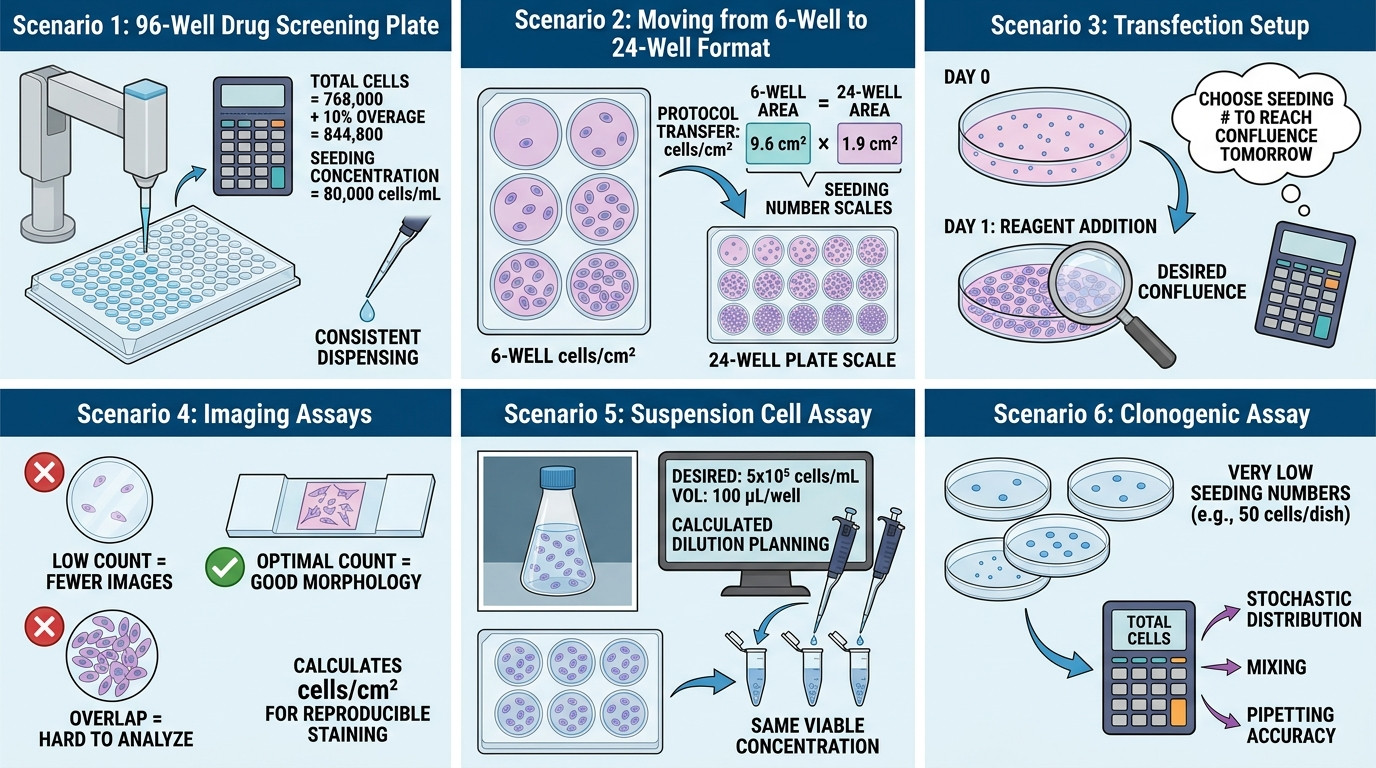
Scenario 1: 96-Well Drug Screening Plate
A drug screening plate needs 8,000 cells per well in 100 µL. A cell seeding density calculator calculates total cells for all wells, overage, and the seeding suspension concentration needed for consistent dispensing.
Scenario 2: Moving from 6-Well to 24-Well Format
A protocol written as cells/cm² can be transferred between vessel sizes. The cell seeding density calculator multiplies the same density by the new growth area so surface coverage remains comparable.
Scenario 3: Transfection Setup
Transfection efficiency depends strongly on confluence at the time of reagent addition. A cell seeding density calculator helps choose the seeding number that will reach the desired confluence the next day.
Scenario 4: Imaging Assays
Cells seeded on coverslips or chamber slides need enough cells for imaging but not so many that morphology overlaps. The cell seeding density calculator calculates cells per surface area for reproducible staining.
Scenario 5: Suspension Cell Assay
Suspension cultures are often seeded by cells/mL rather than cells/cm². The cell seeding density calculator supports dilution planning so each well starts with the same viable concentration.
Scenario 6: Clonogenic Assay
Clonogenic assays may require very low seeding numbers. The cell seeding density calculator can calculate total cells, but stochastic distribution, mixing, and pipetting accuracy become especially important.
Common Cell Seeding Mistakes
Mistake 1: Ignoring Viability
Counting total cells without viability correction can under-seed viable cells. A cell seeding density calculator corrects concentration when viability is entered.
Mistake 2: Using the Wrong Growth Area
Plate growth area varies by manufacturer. A cell seeding density calculator needs the correct area per well, flask, dish, or insert to calculate cells/cm² accurately.
Mistake 3: Letting Cells Settle
Cell suspensions settle quickly. A cell seeding density calculator gives volumes, but repeated gentle mixing is needed so early and late wells receive the same cell number.
Mistake 4: No Overage
Preparing exactly the theoretical volume can leave the final wells short. A cell seeding density calculator can add overage for reservoirs, pipette tips, and dead volume.
Mistake 5: One Density for Every Cell Line
Different cell lines attach, spread, and divide differently. A cell seeding density calculator calculates the selected density, but the density must be optimized for the assay and cell type.
💡 Rule of Thumb: confirm growth area, count viable cells, mix often, include overage, and optimize density for the assay.
Cell Culture Handling & Quality Essentials
Biosafety: Cell culture work may involve human or animal cells, recombinant material, primary cells, infectious agents, viral vectors, drugs, or biohazardous waste. The cell seeding density calculator provides math only. Follow biosafety approvals, PPE, aseptic technique, decontamination procedures, and institutional SOPs.
- Use aseptic technique and work in the correct biosafety cabinet when required.
- Confirm cell identity and passage number before seeding critical assays.
- Check viability and cell clumping before calculating seeding volume.
- Mix gently but frequently to reduce cell settling during plate dispensing.
- Include controls and record plate maps for assay interpretation.
- Monitor mycoplasma and contamination according to lab policy.
Which Mode Fits Your Workflow
| Mode | Use Case | Key Formula | Inputs | Output |
|---|---|---|---|---|
| Density to Cells | cells/cm² to cells/well | density × area | density, area, wells | cells per well |
| Volume per Well | deliver target count | cells/concentration | cells needed, cells/mL | µL per well |
| Plate Total | scale full plate | cells/well × wells × overage | cells, wells, overage | total cells |
| Viability Correct | live-cell concentration | total × viability | total cells/mL, viability | viable cells/mL |
| Dilution Plan | make seeding suspension | C₁V₁ = C₂V₂ | current, target, final | cells + medium |
Adherent Cell Culture
For adherent cells, a cell seeding density calculator is most useful with cells/cm² because plate surface area controls confluence. Growth area should come from the plate or flask manufacturer.
Suspension Cell Culture
For suspension cells, density is often cells/mL. The cell seeding density calculator supports dilution planning so every well or flask receives the same viable concentration.
Drug Screening
Drug screening requires consistent starting cell numbers. A cell seeding density calculator helps scale wells, add overage, and create a uniform seeding suspension.
Advanced Guide to Cell Seeding Density Planning
Growth area selection
A cell seeding density calculator supports growth area selection decisions, but the calculation must match cell biology and assay design. Record cell line, passage number, viability, counting method, growth area, target density, cells per well, suspension concentration, medium volume, plate format, overage, and incubation time. If results vary across a plate, review cell settling, edge effects, clumps, pipetting rhythm, reservoir dead volume, dispensing accuracy, and whether the suspension was mixed often enough during setup.
Viability correction
A cell seeding density calculator supports viability correction decisions, but the calculation must match cell biology and assay design. Record cell line, passage number, viability, counting method, growth area, target density, cells per well, suspension concentration, medium volume, plate format, overage, and incubation time. If results vary across a plate, review cell settling, edge effects, clumps, pipetting rhythm, reservoir dead volume, dispensing accuracy, and whether the suspension was mixed often enough during setup.
Passage number
A cell seeding density calculator supports passage number decisions, but the calculation must match cell biology and assay design. Record cell line, passage number, viability, counting method, growth area, target density, cells per well, suspension concentration, medium volume, plate format, overage, and incubation time. If results vary across a plate, review cell settling, edge effects, clumps, pipetting rhythm, reservoir dead volume, dispensing accuracy, and whether the suspension was mixed often enough during setup.
Doubling time
A cell seeding density calculator supports doubling time decisions, but the calculation must match cell biology and assay design. Record cell line, passage number, viability, counting method, growth area, target density, cells per well, suspension concentration, medium volume, plate format, overage, and incubation time. If results vary across a plate, review cell settling, edge effects, clumps, pipetting rhythm, reservoir dead volume, dispensing accuracy, and whether the suspension was mixed often enough during setup.
Confluence target
A cell seeding density calculator supports confluence target decisions, but the calculation must match cell biology and assay design. Record cell line, passage number, viability, counting method, growth area, target density, cells per well, suspension concentration, medium volume, plate format, overage, and incubation time. If results vary across a plate, review cell settling, edge effects, clumps, pipetting rhythm, reservoir dead volume, dispensing accuracy, and whether the suspension was mixed often enough during setup.
Assay duration
A cell seeding density calculator supports assay duration decisions, but the calculation must match cell biology and assay design. Record cell line, passage number, viability, counting method, growth area, target density, cells per well, suspension concentration, medium volume, plate format, overage, and incubation time. If results vary across a plate, review cell settling, edge effects, clumps, pipetting rhythm, reservoir dead volume, dispensing accuracy, and whether the suspension was mixed often enough during setup.
Plate coating
A cell seeding density calculator supports plate coating decisions, but the calculation must match cell biology and assay design. Record cell line, passage number, viability, counting method, growth area, target density, cells per well, suspension concentration, medium volume, plate format, overage, and incubation time. If results vary across a plate, review cell settling, edge effects, clumps, pipetting rhythm, reservoir dead volume, dispensing accuracy, and whether the suspension was mixed often enough during setup.
Medium volume
A cell seeding density calculator supports medium volume decisions, but the calculation must match cell biology and assay design. Record cell line, passage number, viability, counting method, growth area, target density, cells per well, suspension concentration, medium volume, plate format, overage, and incubation time. If results vary across a plate, review cell settling, edge effects, clumps, pipetting rhythm, reservoir dead volume, dispensing accuracy, and whether the suspension was mixed often enough during setup.
Edge effects
A cell seeding density calculator supports edge effects decisions, but the calculation must match cell biology and assay design. Record cell line, passage number, viability, counting method, growth area, target density, cells per well, suspension concentration, medium volume, plate format, overage, and incubation time. If results vary across a plate, review cell settling, edge effects, clumps, pipetting rhythm, reservoir dead volume, dispensing accuracy, and whether the suspension was mixed often enough during setup.
Reservoir dead volume
A cell seeding density calculator supports reservoir dead volume decisions, but the calculation must match cell biology and assay design. Record cell line, passage number, viability, counting method, growth area, target density, cells per well, suspension concentration, medium volume, plate format, overage, and incubation time. If results vary across a plate, review cell settling, edge effects, clumps, pipetting rhythm, reservoir dead volume, dispensing accuracy, and whether the suspension was mixed often enough during setup.
Cell clumping
A cell seeding density calculator supports cell clumping decisions, but the calculation must match cell biology and assay design. Record cell line, passage number, viability, counting method, growth area, target density, cells per well, suspension concentration, medium volume, plate format, overage, and incubation time. If results vary across a plate, review cell settling, edge effects, clumps, pipetting rhythm, reservoir dead volume, dispensing accuracy, and whether the suspension was mixed often enough during setup.
Mixing rhythm
A cell seeding density calculator supports mixing rhythm decisions, but the calculation must match cell biology and assay design. Record cell line, passage number, viability, counting method, growth area, target density, cells per well, suspension concentration, medium volume, plate format, overage, and incubation time. If results vary across a plate, review cell settling, edge effects, clumps, pipetting rhythm, reservoir dead volume, dispensing accuracy, and whether the suspension was mixed often enough during setup.
Pipetting speed
A cell seeding density calculator supports pipetting speed decisions, but the calculation must match cell biology and assay design. Record cell line, passage number, viability, counting method, growth area, target density, cells per well, suspension concentration, medium volume, plate format, overage, and incubation time. If results vary across a plate, review cell settling, edge effects, clumps, pipetting rhythm, reservoir dead volume, dispensing accuracy, and whether the suspension was mixed often enough during setup.
Primary cells
A cell seeding density calculator supports primary cells decisions, but the calculation must match cell biology and assay design. Record cell line, passage number, viability, counting method, growth area, target density, cells per well, suspension concentration, medium volume, plate format, overage, and incubation time. If results vary across a plate, review cell settling, edge effects, clumps, pipetting rhythm, reservoir dead volume, dispensing accuracy, and whether the suspension was mixed often enough during setup.
Stem cells
A cell seeding density calculator supports stem cells decisions, but the calculation must match cell biology and assay design. Record cell line, passage number, viability, counting method, growth area, target density, cells per well, suspension concentration, medium volume, plate format, overage, and incubation time. If results vary across a plate, review cell settling, edge effects, clumps, pipetting rhythm, reservoir dead volume, dispensing accuracy, and whether the suspension was mixed often enough during setup.
Suspension cells
A cell seeding density calculator supports suspension cells decisions, but the calculation must match cell biology and assay design. Record cell line, passage number, viability, counting method, growth area, target density, cells per well, suspension concentration, medium volume, plate format, overage, and incubation time. If results vary across a plate, review cell settling, edge effects, clumps, pipetting rhythm, reservoir dead volume, dispensing accuracy, and whether the suspension was mixed often enough during setup.
Drug screening
A cell seeding density calculator supports drug screening decisions, but the calculation must match cell biology and assay design. Record cell line, passage number, viability, counting method, growth area, target density, cells per well, suspension concentration, medium volume, plate format, overage, and incubation time. If results vary across a plate, review cell settling, edge effects, clumps, pipetting rhythm, reservoir dead volume, dispensing accuracy, and whether the suspension was mixed often enough during setup.
Transfection timing
A cell seeding density calculator supports transfection timing decisions, but the calculation must match cell biology and assay design. Record cell line, passage number, viability, counting method, growth area, target density, cells per well, suspension concentration, medium volume, plate format, overage, and incubation time. If results vary across a plate, review cell settling, edge effects, clumps, pipetting rhythm, reservoir dead volume, dispensing accuracy, and whether the suspension was mixed often enough during setup.
Imaging density
A cell seeding density calculator supports imaging density decisions, but the calculation must match cell biology and assay design. Record cell line, passage number, viability, counting method, growth area, target density, cells per well, suspension concentration, medium volume, plate format, overage, and incubation time. If results vary across a plate, review cell settling, edge effects, clumps, pipetting rhythm, reservoir dead volume, dispensing accuracy, and whether the suspension was mixed often enough during setup.
Clonogenic assays
A cell seeding density calculator supports clonogenic assays decisions, but the calculation must match cell biology and assay design. Record cell line, passage number, viability, counting method, growth area, target density, cells per well, suspension concentration, medium volume, plate format, overage, and incubation time. If results vary across a plate, review cell settling, edge effects, clumps, pipetting rhythm, reservoir dead volume, dispensing accuracy, and whether the suspension was mixed often enough during setup.
Plate map records
A cell seeding density calculator supports plate map records decisions, but the calculation must match cell biology and assay design. Record cell line, passage number, viability, counting method, growth area, target density, cells per well, suspension concentration, medium volume, plate format, overage, and incubation time. If results vary across a plate, review cell settling, edge effects, clumps, pipetting rhythm, reservoir dead volume, dispensing accuracy, and whether the suspension was mixed often enough during setup.
Troubleshooting variability
A cell seeding density calculator supports troubleshooting variability decisions, but the calculation must match cell biology and assay design. Record cell line, passage number, viability, counting method, growth area, target density, cells per well, suspension concentration, medium volume, plate format, overage, and incubation time. If results vary across a plate, review cell settling, edge effects, clumps, pipetting rhythm, reservoir dead volume, dispensing accuracy, and whether the suspension was mixed often enough during setup.
A cell seeding density calculator should therefore be used before cells enter the plate. The calculation provides a reproducible starting point, but the final assay quality depends on healthy cells, clean technique, accurate counting, appropriate density, and consistent incubation conditions.
Frequently Asked Questions
1. What is a cell seeding density calculator?
A cell seeding density calculator calculates cells per well, seeding volume, total cells, viability-corrected concentration, and dilution volumes for cell culture setup.
2. How do I calculate cells per well from cells/cm²?
Multiply target cells/cm² by the growth area per well in cm².
3. How do I calculate volume to seed?
Divide cells needed by viable cells/mL, then convert mL to µL if needed.
4. Should I correct for viability?
Yes, if the assay depends on live cells. Multiply total cell concentration by viability percentage to get viable cells/mL.
5. Where do I find well growth area?
Use the plate or flask manufacturer specifications because growth area can vary between products.
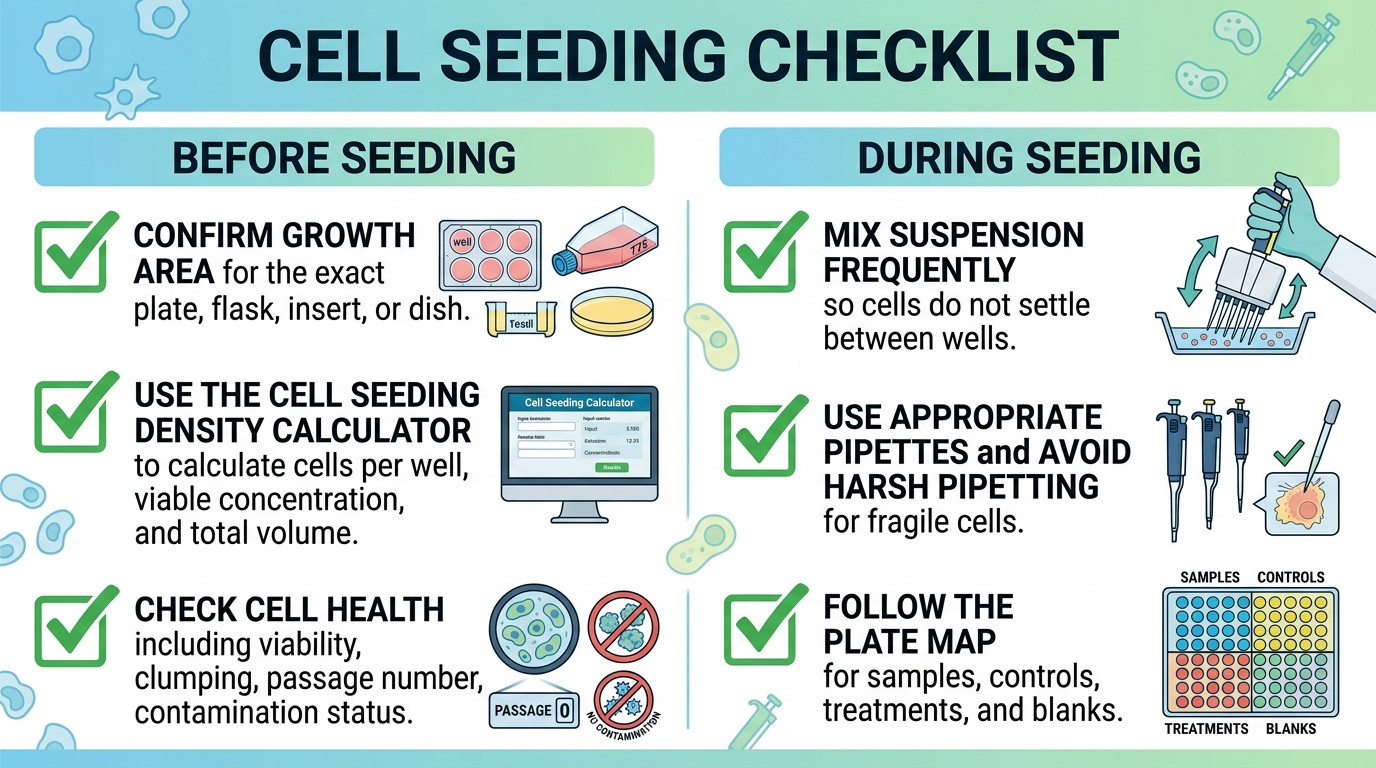
Cell Seeding Checklist
Before Seeding
During Seeding
Trusted Reference Resources
ATCC Cell Culture Guide — ATCC animal cell culture guide provides general cell culture handling and passaging concepts.
Thermo Fisher Cell Culture Basics — Gibco cell culture basics offers practical background for routine cell culture workflows.
User Reviews & Ratings
Share Your Experience with This cell seeding density calculator
Extended Reference Notes for Cell Seeding Workflows
Growth area verification
Growth area verification matters because cell seeding is both a calculation and a biological setup step. The same nominal density can behave differently when cells have changed passage, attachment quality, medium composition, plate coating, treatment timing, or incubation duration. Good practice is to record the chosen density, the reason for that density, the counting method, the viability, and the actual dispensing plan. If a plate shows uneven results, review whether cells settled, whether the suspension was mixed, whether edge wells evaporated, and whether the plate map separated controls from treatments clearly.
Viability counting
Viability counting matters because cell seeding is both a calculation and a biological setup step. The same nominal density can behave differently when cells have changed passage, attachment quality, medium composition, plate coating, treatment timing, or incubation duration. Good practice is to record the chosen density, the reason for that density, the counting method, the viability, and the actual dispensing plan. If a plate shows uneven results, review whether cells settled, whether the suspension was mixed, whether edge wells evaporated, and whether the plate map separated controls from treatments clearly.
Cell clump review
Cell clump review matters because cell seeding is both a calculation and a biological setup step. The same nominal density can behave differently when cells have changed passage, attachment quality, medium composition, plate coating, treatment timing, or incubation duration. Good practice is to record the chosen density, the reason for that density, the counting method, the viability, and the actual dispensing plan. If a plate shows uneven results, review whether cells settled, whether the suspension was mixed, whether edge wells evaporated, and whether the plate map separated controls from treatments clearly.
Plate edge effects
Plate edge effects matters because cell seeding is both a calculation and a biological setup step. The same nominal density can behave differently when cells have changed passage, attachment quality, medium composition, plate coating, treatment timing, or incubation duration. Good practice is to record the chosen density, the reason for that density, the counting method, the viability, and the actual dispensing plan. If a plate shows uneven results, review whether cells settled, whether the suspension was mixed, whether edge wells evaporated, and whether the plate map separated controls from treatments clearly.
Seeding suspension mixing
Seeding suspension mixing matters because cell seeding is both a calculation and a biological setup step. The same nominal density can behave differently when cells have changed passage, attachment quality, medium composition, plate coating, treatment timing, or incubation duration. Good practice is to record the chosen density, the reason for that density, the counting method, the viability, and the actual dispensing plan. If a plate shows uneven results, review whether cells settled, whether the suspension was mixed, whether edge wells evaporated, and whether the plate map separated controls from treatments clearly.
Reservoir dead volume
Reservoir dead volume matters because cell seeding is both a calculation and a biological setup step. The same nominal density can behave differently when cells have changed passage, attachment quality, medium composition, plate coating, treatment timing, or incubation duration. Good practice is to record the chosen density, the reason for that density, the counting method, the viability, and the actual dispensing plan. If a plate shows uneven results, review whether cells settled, whether the suspension was mixed, whether edge wells evaporated, and whether the plate map separated controls from treatments clearly.
Pipetting consistency
Pipetting consistency matters because cell seeding is both a calculation and a biological setup step. The same nominal density can behave differently when cells have changed passage, attachment quality, medium composition, plate coating, treatment timing, or incubation duration. Good practice is to record the chosen density, the reason for that density, the counting method, the viability, and the actual dispensing plan. If a plate shows uneven results, review whether cells settled, whether the suspension was mixed, whether edge wells evaporated, and whether the plate map separated controls from treatments clearly.
Confluence timing
Confluence timing matters because cell seeding is both a calculation and a biological setup step. The same nominal density can behave differently when cells have changed passage, attachment quality, medium composition, plate coating, treatment timing, or incubation duration. Good practice is to record the chosen density, the reason for that density, the counting method, the viability, and the actual dispensing plan. If a plate shows uneven results, review whether cells settled, whether the suspension was mixed, whether edge wells evaporated, and whether the plate map separated controls from treatments clearly.
Passage number
Passage number matters because cell seeding is both a calculation and a biological setup step. The same nominal density can behave differently when cells have changed passage, attachment quality, medium composition, plate coating, treatment timing, or incubation duration. Good practice is to record the chosen density, the reason for that density, the counting method, the viability, and the actual dispensing plan. If a plate shows uneven results, review whether cells settled, whether the suspension was mixed, whether edge wells evaporated, and whether the plate map separated controls from treatments clearly.
Primary cell sensitivity
Primary cell sensitivity matters because cell seeding is both a calculation and a biological setup step. The same nominal density can behave differently when cells have changed passage, attachment quality, medium composition, plate coating, treatment timing, or incubation duration. Good practice is to record the chosen density, the reason for that density, the counting method, the viability, and the actual dispensing plan. If a plate shows uneven results, review whether cells settled, whether the suspension was mixed, whether edge wells evaporated, and whether the plate map separated controls from treatments clearly.
Stem cell coating
Stem cell coating matters because cell seeding is both a calculation and a biological setup step. The same nominal density can behave differently when cells have changed passage, attachment quality, medium composition, plate coating, treatment timing, or incubation duration. Good practice is to record the chosen density, the reason for that density, the counting method, the viability, and the actual dispensing plan. If a plate shows uneven results, review whether cells settled, whether the suspension was mixed, whether edge wells evaporated, and whether the plate map separated controls from treatments clearly.
Suspension culture density
Suspension culture density matters because cell seeding is both a calculation and a biological setup step. The same nominal density can behave differently when cells have changed passage, attachment quality, medium composition, plate coating, treatment timing, or incubation duration. Good practice is to record the chosen density, the reason for that density, the counting method, the viability, and the actual dispensing plan. If a plate shows uneven results, review whether cells settled, whether the suspension was mixed, whether edge wells evaporated, and whether the plate map separated controls from treatments clearly.
Drug response variability
Drug response variability matters because cell seeding is both a calculation and a biological setup step. The same nominal density can behave differently when cells have changed passage, attachment quality, medium composition, plate coating, treatment timing, or incubation duration. Good practice is to record the chosen density, the reason for that density, the counting method, the viability, and the actual dispensing plan. If a plate shows uneven results, review whether cells settled, whether the suspension was mixed, whether edge wells evaporated, and whether the plate map separated controls from treatments clearly.
Imaging field quality
Imaging field quality matters because cell seeding is both a calculation and a biological setup step. The same nominal density can behave differently when cells have changed passage, attachment quality, medium composition, plate coating, treatment timing, or incubation duration. Good practice is to record the chosen density, the reason for that density, the counting method, the viability, and the actual dispensing plan. If a plate shows uneven results, review whether cells settled, whether the suspension was mixed, whether edge wells evaporated, and whether the plate map separated controls from treatments clearly.
Clonogenic low density
Clonogenic low density matters because cell seeding is both a calculation and a biological setup step. The same nominal density can behave differently when cells have changed passage, attachment quality, medium composition, plate coating, treatment timing, or incubation duration. Good practice is to record the chosen density, the reason for that density, the counting method, the viability, and the actual dispensing plan. If a plate shows uneven results, review whether cells settled, whether the suspension was mixed, whether edge wells evaporated, and whether the plate map separated controls from treatments clearly.
Transfection readiness
Transfection readiness matters because cell seeding is both a calculation and a biological setup step. The same nominal density can behave differently when cells have changed passage, attachment quality, medium composition, plate coating, treatment timing, or incubation duration. Good practice is to record the chosen density, the reason for that density, the counting method, the viability, and the actual dispensing plan. If a plate shows uneven results, review whether cells settled, whether the suspension was mixed, whether edge wells evaporated, and whether the plate map separated controls from treatments clearly.
Assay endpoint timing
Assay endpoint timing matters because cell seeding is both a calculation and a biological setup step. The same nominal density can behave differently when cells have changed passage, attachment quality, medium composition, plate coating, treatment timing, or incubation duration. Good practice is to record the chosen density, the reason for that density, the counting method, the viability, and the actual dispensing plan. If a plate shows uneven results, review whether cells settled, whether the suspension was mixed, whether edge wells evaporated, and whether the plate map separated controls from treatments clearly.
Documentation review
Documentation review matters because cell seeding is both a calculation and a biological setup step. The same nominal density can behave differently when cells have changed passage, attachment quality, medium composition, plate coating, treatment timing, or incubation duration. Good practice is to record the chosen density, the reason for that density, the counting method, the viability, and the actual dispensing plan. If a plate shows uneven results, review whether cells settled, whether the suspension was mixed, whether edge wells evaporated, and whether the plate map separated controls from treatments clearly.
Additional Practical Notes for Reproducible Seeding
Replicate planning
Replicate planning can change the apparent outcome of a cell-based assay even when the arithmetic is correct. Record how the cells were prepared, how long they were outside the incubator, whether they were recently passaged or thawed, how the cell count was obtained, and whether the plate was handled consistently after dispensing. When a density is optimized, keep the full context with the result rather than saving only the final cell number. This makes future repeats more reliable and helps another analyst understand why the selected density was appropriate for that exact assay.
Medium volume consistency
Medium volume consistency can change the apparent outcome of a cell-based assay even when the arithmetic is correct. Record how the cells were prepared, how long they were outside the incubator, whether they were recently passaged or thawed, how the cell count was obtained, and whether the plate was handled consistently after dispensing. When a density is optimized, keep the full context with the result rather than saving only the final cell number. This makes future repeats more reliable and helps another analyst understand why the selected density was appropriate for that exact assay.
Treatment timing
Treatment timing can change the apparent outcome of a cell-based assay even when the arithmetic is correct. Record how the cells were prepared, how long they were outside the incubator, whether they were recently passaged or thawed, how the cell count was obtained, and whether the plate was handled consistently after dispensing. When a density is optimized, keep the full context with the result rather than saving only the final cell number. This makes future repeats more reliable and helps another analyst understand why the selected density was appropriate for that exact assay.
Counting chamber technique
Counting chamber technique can change the apparent outcome of a cell-based assay even when the arithmetic is correct. Record how the cells were prepared, how long they were outside the incubator, whether they were recently passaged or thawed, how the cell count was obtained, and whether the plate was handled consistently after dispensing. When a density is optimized, keep the full context with the result rather than saving only the final cell number. This makes future repeats more reliable and helps another analyst understand why the selected density was appropriate for that exact assay.
Automated counter settings
Automated counter settings can change the apparent outcome of a cell-based assay even when the arithmetic is correct. Record how the cells were prepared, how long they were outside the incubator, whether they were recently passaged or thawed, how the cell count was obtained, and whether the plate was handled consistently after dispensing. When a density is optimized, keep the full context with the result rather than saving only the final cell number. This makes future repeats more reliable and helps another analyst understand why the selected density was appropriate for that exact assay.
Cell recovery after thaw
Cell recovery after thaw can change the apparent outcome of a cell-based assay even when the arithmetic is correct. Record how the cells were prepared, how long they were outside the incubator, whether they were recently passaged or thawed, how the cell count was obtained, and whether the plate was handled consistently after dispensing. When a density is optimized, keep the full context with the result rather than saving only the final cell number. This makes future repeats more reliable and helps another analyst understand why the selected density was appropriate for that exact assay.
Serum starvation plans
Serum starvation plans can change the apparent outcome of a cell-based assay even when the arithmetic is correct. Record how the cells were prepared, how long they were outside the incubator, whether they were recently passaged or thawed, how the cell count was obtained, and whether the plate was handled consistently after dispensing. When a density is optimized, keep the full context with the result rather than saving only the final cell number. This makes future repeats more reliable and helps another analyst understand why the selected density was appropriate for that exact assay.
Coating lot changes
Coating lot changes can change the apparent outcome of a cell-based assay even when the arithmetic is correct. Record how the cells were prepared, how long they were outside the incubator, whether they were recently passaged or thawed, how the cell count was obtained, and whether the plate was handled consistently after dispensing. When a density is optimized, keep the full context with the result rather than saving only the final cell number. This makes future repeats more reliable and helps another analyst understand why the selected density was appropriate for that exact assay.
Incubator equilibration
Incubator equilibration can change the apparent outcome of a cell-based assay even when the arithmetic is correct. Record how the cells were prepared, how long they were outside the incubator, whether they were recently passaged or thawed, how the cell count was obtained, and whether the plate was handled consistently after dispensing. When a density is optimized, keep the full context with the result rather than saving only the final cell number. This makes future repeats more reliable and helps another analyst understand why the selected density was appropriate for that exact assay.
Data normalization
Data normalization can change the apparent outcome of a cell-based assay even when the arithmetic is correct. Record how the cells were prepared, how long they were outside the incubator, whether they were recently passaged or thawed, how the cell count was obtained, and whether the plate was handled consistently after dispensing. When a density is optimized, keep the full context with the result rather than saving only the final cell number. This makes future repeats more reliable and helps another analyst understand why the selected density was appropriate for that exact assay.
Final Thoughts on Cell Seeding Density Calculation
Cell seeding density is one of the most important setup variables in cell-based experiments. A cell seeding density calculator makes the arithmetic reliable by calculating cells per well, seeding volume, viability-corrected concentration, plate totals, overage, and dilution planning in one workflow.
Before interpreting assay results, confirm that cells were healthy, counted accurately, mixed well, and seeded according to the plate map. If growth or signal varies unexpectedly, review viability, clumps, passage number, plate edge effects, media volume, incubation time, and whether cells settled during dispensing.