
Bacterial Growth Calculator — Doubling Time, Growth Rate & OD600
A bacterial growth calculator works out how fast a bacterial population is growing by finding its doubling time (generation time), growth rate constant, and predicted future size from growth-curve data. The core rule for exponential growth is N = N₀ × 2(t/Td), where N₀ is the starting population, t is elapsed time, and Td is the doubling time. The generation time itself is found from two data points: Td = t × ln(2) ÷ ln(N/N₀). A bacterial growth calculator also converts OD600 readings to cell density and computes the specific growth rate μ. Enter your values below and the bacterial growth calculator returns exact results, with every step shown.
Key facts at a glance
- Exponential growth: N = N₀ × 2(t ÷ Td) — population doubles every generation.
- Doubling (generation) time: Td = t × ln(2) ÷ ln(N ÷ N₀) from two time points.
- Growth rate constant: k = ln(2) ÷ Td (generations per hour).
- Specific growth rate: μ = ln(N ÷ N₀) ÷ Δt (per hour); Td = ln(2) ÷ μ.
- OD600 conversion: for E. coli, 1 OD600 ≈ 1×10⁹ cells/mL (calibrate for your organism).
- Growth phases: lag, exponential (log), stationary, and death — the bacterial growth calculator targets the log phase.
📋 Table of Contents
▼
- What a Bacterial Growth Calculator Does
- Bacterial Growth Calculator — Five Modes
- How Bacterial Growth Is Calculated
- Real Scenarios Where Bacterial Growth Math Mattered
- Common Bacterial Growth Calculation Mistakes
- Aseptic & Biosafety Essentials
- Which Mode Fits Your Situation
- Frequently Asked Questions
- Bacterial Growth Best Practices Checklist
- Trusted Reference Resources
- User Reviews & Ratings
What a Bacterial Growth Calculator Does
A bacterial growth calculator tells you exactly how fast a bacterial population is doubling and how large it will become, based on measurements you take during the exponential (log) growth phase. It eliminates the layered arithmetic — logarithms, natural-log conversions, doubling-time derivations, and OD600-to-cell-count translations — that turns a simple biological observation into a multi-step calculation. In microbiology research, fermentation, food safety, clinical diagnostics, and synthetic biology, knowing the growth rate of a culture is the foundation of nearly every downstream decision, from when to induce protein expression to whether a water sample meets safety standards.
The reason bacterial growth math trips people up is not the biology; it is the logarithmic bookkeeping. Bacteria grow exponentially, meaning the population does not increase by a fixed amount each hour but by a fixed multiple — it doubles, then doubles again, then doubles again. To capture that, you need logarithms. The doubling time (also called generation time) is derived from the natural log of the population ratio, the growth rate constant inverts it, and the OD600 conversion adds yet another translation layer from absorbance to cell number. A single misplaced logarithm — using log₁₀ where you needed ln, or confusing generations per hour with hours per generation — can shift the result by an order of magnitude, and that error then propagates into induction timing, inoculum sizing, and every comparison between conditions.
This bacterial growth calculator handles the five most common tasks in one place: the doubling-time (generation-time) solver from two growth-curve points, the growth-prediction engine that projects a future population from the doubling time, the growth-rate-constant calculator (k), the OD600-to-cell-density converter, and the specific growth rate (μ) calculator. Each mode shows the answer and every step of the working, so you can verify the reasoning, spot an error, and learn the method rather than trusting an opaque number. Whether you are a student plotting your first growth curve or a senior scientist optimising a fermentation process, the goal is the same: a defensible, reproducible growth parameter that your experiment can rely on.
Because bacterial growth and dilution share the same underlying conservation principles, the tools in the sidebar — including our CFU calculator, cell dilution calculator, and dilution factor calculator — are useful companions for any microbiology concentration task.
Bacterial Growth Calculator
Five modes — doubling time, growth prediction, growth rate, OD600 & specific growth rate
Calculation Result
⚠️ Safety first: Handle all bacterial cultures under the appropriate biosafety level (BSL-1 or BSL-2). Use aseptic technique, autoclave all cultures and waste before disposal, and work in a biological safety cabinet when required.
How Bacterial Growth Is Calculated
Every bacterial growth calculation comes down to one idea: during the exponential phase, a bacterial population doubles at a constant rate. Unlike linear growth, where the same number of cells is added each hour, exponential growth adds a fixed multiple — the population doubles, then doubles again, then doubles again, accelerating as the base grows. Capturing that behaviour requires logarithms, and the calculator exists precisely to handle those logarithmic steps reliably. The doubling time (generation time) is derived from the natural log of the population ratio between two time points, the growth rate constant inverts it, and the OD600 conversion adds a further translation from light absorbance to cell number. Once you understand these building blocks, every growth-curve problem reduces to a single line of arithmetic.
The Four Growth Phases
Before applying any formula, it helps to understand the shape of a bacterial growth curve. When you plot the logarithm of cell density against time, a typical culture passes through four distinct phases. In the lag phase, cells are adapting to fresh medium — they are metabolically active but not yet dividing, so the population stays roughly constant. In the exponential (log) phase, cells divide at their maximum rate and the population doubles at a constant interval; this is the phase the calculator targets, because the doubling time is only meaningful here. In the stationary phase, growth and death balance out as nutrients deplete and waste accumulates, and the net population levels off. Finally, in the death phase, viability declines as conditions become inhospitable. All of the formulas in this bacterial growth calculator assume you are working within the exponential phase — if your data points straddle the lag or stationary phase, the calculated doubling time will be misleadingly slow.
1. Doubling Time (Generation Time) from Two Points
The doubling time, Td, is the average time it takes for the population to double during exponential growth. From two measurements — an initial population N₀ at the start and a later population N after elapsed time t — the number of generations (doublings) is found from the logarithm: n = ln(N ÷ N₀) ÷ ln(2). The doubling time is then the elapsed time divided by the number of generations: Td = t ÷ n = t × ln(2) ÷ ln(N ÷ N₀). For example, if a culture grows from 1×10⁶ to 8×10⁶ cells in 3 hours, the ratio is 8, ln(8) ÷ ln(2) = 3 generations, and Td = 3 ÷ 3 = 1 hour per doubling. The Doubling Time mode of the tool performs this derivation automatically and also reports the implied growth rate constant k.
2. Predicting a Future Population
Once you know the doubling time, you can project the population forward using the exponential growth equation: N = N₀ × 2(t ÷ Td), where t is the time into the future and Td is the doubling time. For example, starting from 1×10⁶ cells with a doubling time of 0.5 hours, after 6 hours the population is 1×106 × 2(6 ÷ 0.5) = 1×106 × 212 = 1×106 × 4096 ≈ 4.1×10⁹ cells. The Predict mode of the growth calculator returns the projected population and the number of doublings, so you can plan induction timing, inoculum volumes, and harvest schedules.
Growth rate constant: k = ln(2) ÷ Td (generations per hour)
Specific growth rate: μ = ln(N ÷ N₀) ÷ Δt (per hour)
OD600 density: cells/mL = OD600 × conversion factor × dilution factor
3. Growth Rate Constant (k)
The growth rate constant k expresses how many generations occur per hour: k = ln(2) ÷ Td. If the doubling time is 0.5 hours, k = 0.693 ÷ 0.5 = 1.39 generations per hour. The Growth Rate mode of the growth calculator converts any doubling time into k, which is useful for comparing the fitness of different strains or conditions.
4. OD600 to Cell Density
OD600 (optical density at 600 nm) measures how much light a culture scatters, which correlates with cell number. To convert an OD600 reading to cells per mL, multiply by a conversion factor calibrated for your organism: cells/mL = OD600 × conversion factor × dilution factor. For E. coli grown in LB, 1 OD600 unit is commonly taken as approximately 1×10⁹ cells/mL, though this varies with strain, medium, and growth phase. The OD600 mode of the tool performs this conversion and reminds you to calibrate the factor for your own system.
5. Specific Growth Rate (μ)
The specific growth rate μ is the per-capita growth rate, expressed in inverse hours (h−1): μ = ln(N ÷ N₀) ÷ Δt. It is mathematically related to the doubling time by Td = ln(2) ÷ μ. The Specific Rate mode of the calculator computes μ directly from two population measurements and also returns the implied doubling time, giving you both representations of growth speed.
Quick Reference Values
How to Build a Growth Curve
To get the best results from this bacterial growth calculator, you need a well-constructed growth curve. Start by inoculating fresh medium with an overnight starter culture to a low initial OD (around 0.05–0.1). Place the culture in a shaking incubator at the correct temperature with adequate aeration. Take OD600 readings every 20–30 minutes for fast growers like E. coli, or every 1–2 hours for slower organisms. For each reading, blank the spectrophotometer with uninoculated medium, dilute the sample if the reading exceeds 0.8, and record both the time and the corrected OD. Plot the natural log (or base-10 log) of OD against time on a semi-log graph: during exponential phase the points will form a straight line. Identify the linear portion of that line and select two well-separated points on it for your doubling-time calculation. The slope of the line on a natural-log plot is the specific growth rate μ directly. The more points you have within the exponential phase, the more reliable your bacterial growth calculator results will be, because averaging across several readings smooths out small pipetting and measurement errors.
Practical Tips for Accurate Growth Data
Several practical factors influence the quality of your growth measurements. Temperature must be controlled precisely — even a 2°C shift can change the doubling time measurably. Aeration matters: a flask filled more than about one-fifth of its volume will be oxygen-limited, slowing growth. Use a consistent flask-to-volume ratio across experiments if you want comparable results. Sampling itself perturbs the culture: removing aliquots reduces volume and introduces contamination risk, so work quickly and aseptically. If you are taking many time points, consider using a plate reader with automatic readings, but be aware that evaporation and edge effects in multi-well plates can distort results — use a humidified chamber and avoid the outer wells if possible. Finally, always run biological replicates (independent cultures, not just technical repeats of the same flask) and report the mean doubling time with its standard deviation. The bacterial growth calculator handles the arithmetic for each replicate; you average the resulting doubling times for the final reported value.
Remember: All bacterial growth formulas assume you are in the exponential phase — do not compute doubling time from data points that span the lag or stationary phase. Measure OD600 only in the linear range of the spectrophotometer (typically 0.1–0.8), diluting if needed, and calibrate the OD-to-cell conversion factor for your specific organism and conditions. This bacterial growth calculator gives you the arithmetic; good experimental design gives you the valid data.

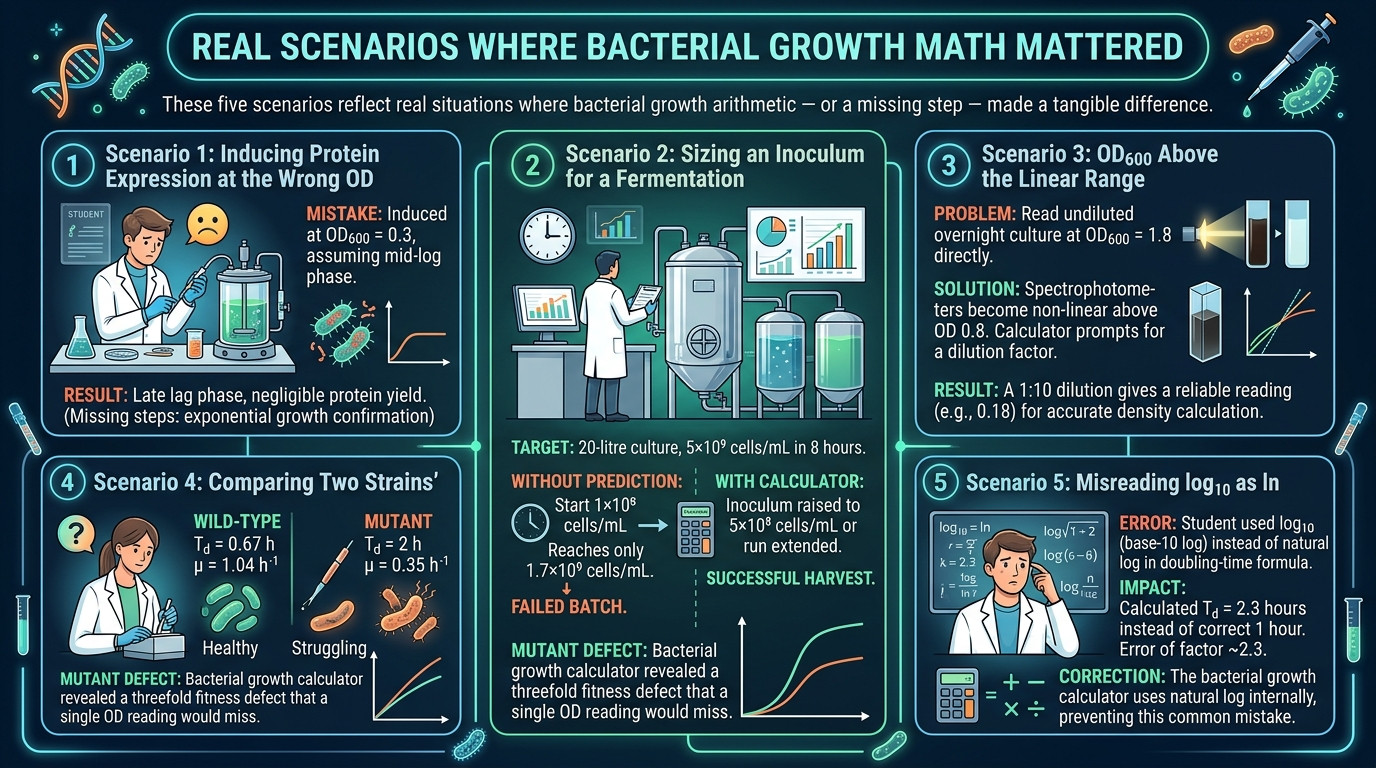
Real Scenarios Where Bacterial Growth Math Mattered
These five scenarios reflect real situations in microbiology research, fermentation, clinical labs, and synthetic biology where the bacterial growth arithmetic — or a missing step — made a tangible difference to the outcome.
Scenario 1: Inducing Protein Expression at the Wrong OD
A graduate student induced a recombinant protein expression system at OD600 = 0.3, assuming the culture was in mid-log phase. In fact the culture was still in late lag phase, so induction occurred before exponential growth — protein yield was negligible. Using the calculator’s Doubling Time mode on two earlier OD readings would have revealed the true growth phase and the correct induction window (typically OD 0.4–0.8 for E. coli). The lesson: always confirm exponential growth with two time points before acting on a single OD reading.
Scenario 2: Sizing an Inoculum for a Fermentation
A fermentation scientist needed a 20-litre culture to reach 5×10⁹ cells/mL within 8 hours. Knowing the strain’s doubling time of 0.6 hours, the Predict mode of the growth calculator showed that starting from 1×10⁸ cells/mL, the culture would reach only 1.7×10⁹ in 8 hours — well short of target. The inoculum had to be raised to 5×10⁸ cells/mL, or the run extended. Without the prediction, the batch would have failed at harvest.
Scenario 3: OD600 Above the Linear Range
A technician read an undiluted overnight culture at OD600 = 1.8 and used it directly. Because spectrophotometers become non-linear above roughly OD 0.8, the true density was far higher than the reading implied. The calculator’s OD600 mode prompts for a dilution factor, encouraging a 1:10 dilution that brought the reading into the linear range (0.18) and gave a trustworthy density after multiplying back.
Scenario 4: Comparing Two Strains’ Fitness
A researcher compared a wild-type and a mutant strain by their doubling times. The wild-type went from 2×10⁷ to 1.6×10⁸ in 2 hours (Td = 0.67 h), while the mutant went from 2×10⁷ to 4×10⁷ in 2 hours (Td = 2 h). The bacterial growth calculator revealed a threefold fitness defect in the mutant — a difference that a single OD reading would never have captured. The specific growth rate μ confirmed it: 1.04 h−1 versus 0.35 h−1.
Scenario 5: Misreading log₁₀ as ln
A student used log₁₀ (base-10 log) instead of natural log in the doubling-time formula and got Td = 2.3 hours instead of the correct 1 hour. The error, a factor of ln(2)÷log₁₀(2) ≈ 2.3, is easy to make with different calculator modes. The calculator uses the correct natural log internally, eliminating this source of error entirely.
Common Bacterial Growth Calculation Mistakes
The errors people make with bacterial growth math cluster around a few predictable points. Understanding why they happen prevents them.
Mistake 1: Using Data Outside the Exponential Phase
The doubling-time formula only holds during exponential growth. If one of your two data points is in lag or stationary phase, the calculated Td will be far too long. Always confirm both points fall on the straight, steep part of the log-growth curve before calculating.
Mistake 2: Confusing ln with log₁₀
The growth formulas use natural logarithm (ln, base e). Using base-10 log introduces a factor of about 2.3 error. The calculator applies the correct natural log internally, so you never have to worry about which log button to press.
Mistake 3: Reading OD600 Above the Linear Range
Spectrophotometers are only linear up to roughly OD 0.8–1.0. Readings above that underrepresent the true density. Always dilute concentrated cultures back into the 0.1–0.8 range and multiply by the dilution factor.
Mistake 4: Using an Uncalibrated OD Conversion Factor
The rule of thumb that 1 OD600 = 1×10⁹ cells/mL is specific to E. coli in LB and varies by strain, medium, and instrument. For accurate cell counts, calibrate your own factor by correlating OD600 with viable counts (CFU) or direct cell counts for your organism.
Mistake 5: Mixing Up Doubling Time and Growth Rate
Doubling time Td is in hours per generation; growth rate k is in generations per hour. They are reciprocals (k = 1 ÷ Td in those units), but mixing them up inverts the answer. The tool reports both clearly labelled.
💡 Rule of Thumb: Take two OD readings in the exponential phase, confirm both are in the linear range (dilute if above 0.8), use natural logs (the calculator handles this), and always state whether your number is a doubling time (hours) or a growth rate (per hour). That sequence gives a defensible growth parameter every time.
Aseptic & Biosafety Essentials
Accurate growth math does not make a culture safe — aseptic technique and containment do. Before handling any bacterial culture, run through these essentials.
Never skip decontamination: autoclave or disinfect all cultures, tubes, plates, and waste before disposal. Work at the biosafety level appropriate to the organism (BSL-1 for most non-pathogenic lab strains, BSL-2 for pathogens and many clinical isolates).
- Work in a biological safety cabinet (BSC) for all open-container manipulations of BSL-2 organisms.
- Use aseptic (sterile) technique — flame-sterilize loops, use sterile pipettes and tips, and minimise exposure time.
- Label every tube and flask with organism, strain, medium, date, and initials.
- Wear appropriate PPE — lab coat, gloves, eye protection; tie back long hair.
- Decontaminate spills immediately with disinfectant and autoclave all biohazard waste.
- Monitor for contamination — unexpected growth rates or morphology may indicate cross-contamination.
This bacterial growth calculator is a planning and arithmetic aid. It is not a substitute for your institution’s biosafety rules or a risk assessment.
Which Mode Fits Your Situation
The five modes of the growth calculator map to the five distinct growth-analysis tasks. Choosing the right one applies the correct logic.
Bacterial Growth Mode Comparison Table
| Mode | Use Case | Key Formula | Inputs Needed | Typical Applications |
|---|---|---|---|---|
| Doubling Time | Find Td from two points | t×ln2÷ln(N/N₀) | N₀, N, t | Growth curves, fitness |
| Predict | Project future population | N=N₀×2t/Td | N₀, Td, t | Induction, inoculum sizing |
| Growth Rate | k from doubling time | k=ln2÷Td | Td | Strain comparison |
| OD600 | Absorbance to cells/mL | OD×factor×dil | OD, factor, dilution | Quick density checks |
| Specific Rate | μ from two points | μ=ln(N/N₀)÷Δt | N₀, N, t | Fermentation, kinetics |
Practical Decision Guide
Have two OD or cell counts from the log phase? Use the Doubling Time mode to get Td.
Know the doubling time and want to predict a future population? Use the Predict mode.
Want generations per hour from a doubling time? Use the Growth Rate mode.
Need cells/mL from a spectrophotometer reading? Use the OD600 mode.
Need the specific growth rate μ for a report? Use the Specific Rate mode — it also returns the doubling time.
Frequently Asked Questions About the Bacterial Growth Calculator
These questions come from microbiology students, research scientists, fermentation engineers, and clinical lab staff who use a bacterial growth calculator in their daily work. Click any question to expand the answer.
1. What is a bacterial growth calculator?
A bacterial growth calculator is a tool that computes bacterial growth parameters — doubling time, growth rate constant, predicted population size, OD600-to-cell-density conversion, and specific growth rate μ — from measurements taken during the exponential growth phase. This bacterial growth calculator provides all five calculations in one place, with worked steps.
2. How is doubling time calculated?
Doubling time Td = t × ln(2) ÷ ln(N ÷ N₀), where N₀ is the initial population, N is the population after time t, and ln is the natural logarithm. For example, growing from 1×10⁶ to 8×10⁶ in 3 hours gives Td = 3 × 0.693 ÷ ln(8) = 1 hour. The Doubling Time mode of the tool performs this automatically.
3. What is the exponential growth equation for bacteria?
The exponential growth equation is N = N₀ × 2(t ÷ Td), where N₀ is the starting population, t is the elapsed time, and Td is the doubling time. This describes the log phase where the population doubles at a constant rate. The Predict mode of the calculator applies this equation directly.
4. What is the difference between doubling time and growth rate?
Doubling time (Td) is in hours per generation — how long one doubling takes. Growth rate (k) is in generations per hour — how many doublings occur per hour. They are reciprocals: k = 1 ÷ Td (when k is in generations per hour). The tool reports both clearly to avoid confusion.
5. How do I convert OD600 to cells per mL?
Cells/mL = OD600 × conversion factor × dilution factor. For E. coli in LB, a common conversion factor is 1×10⁹ cells/mL per OD600 unit, but it must be calibrated for your organism and instrument. The OD600 mode of the tool performs this conversion and reminds you to calibrate.
6. What is the specific growth rate μ?
The specific growth rate μ is the per-capita growth rate in inverse hours: μ = ln(N ÷ N₀) ÷ Δt. It is related to doubling time by Td = ln(2) ÷ μ. The Specific Rate mode of the calculator computes μ from two population measurements and also returns the implied doubling time.
7. Which growth phase should I measure in?
Always measure during the exponential (log) phase, where the population doubles at a constant rate. If your data points span the lag or stationary phase, the growth calculator will return a misleadingly slow doubling time. Confirm both points lie on the straight, steep portion of the log-growth curve.
8. Why does the bacterial growth calculator use natural log?
The exponential growth equation is based on e (Euler’s number), so its derivation uses the natural logarithm ln. Using base-10 log instead introduces an error factor of about 2.3. The calculator applies ln internally, so you never need to worry about which log button to press.
9. What OD600 range is linear?
Spectrophotometers are typically linear between OD600 0.1 and 0.8. Above approximately 0.8–1.0, readings underrepresent true density because too little light reaches the detector. Always dilute concentrated cultures back into the 0.1–0.8 range and multiply by the dilution factor in the calculator.
10. How do I calculate the number of generations?
Number of generations n = ln(N ÷ N₀) ÷ ln(2). For example, growing from 1×10⁶ to 8×10⁶ is ln(8) ÷ ln(2) = 3 generations. The tool reports n alongside the doubling time in the Doubling Time mode.
11. What is a typical doubling time for E. coli?
E. coli in rich LB medium at 37°C typically doubles every 20–30 minutes (0.33–0.5 hours). In minimal medium it may be 1 hour or more. Doubling times vary widely by organism, medium, and temperature — always measure your own with the calculator rather than assuming.
12. How do I predict a future bacterial population?
Use N = N₀ × 2(t ÷ Td). Enter the starting population, the doubling time, and the future time into the Predict mode of the growth calculator. It returns the projected population and the number of doublings, useful for planning induction or harvest.
13. Can the bacterial growth calculator handle OD values as population?
Yes. Because the growth equations are ratios, you can use OD600 values directly as the “population” in the Doubling Time, Predict, and Specific Rate modes — the doubling time will be correct since it depends only on the ratio, not the absolute unit. The OD600 mode then converts an OD reading to cells/mL separately.
14. What is the lag phase?
The lag phase is the period after inoculation during which cells adapt to fresh medium but do not yet divide. The population stays roughly constant. You should not use lag-phase data points in the calculator, because the doubling time formulas assume exponential growth, which begins only after lag phase ends.
15. What is the stationary phase?
The stationary phase occurs when growth and death balance out as nutrients deplete and waste accumulates, and the net population levels off. As with lag phase, stationary-phase points should not be used in the calculator’s growth formulas, because the population is no longer doubling exponentially.
16. How do I calibrate the OD600 conversion factor?
Measure the OD600 of a culture, then count the cells independently (by plate count for CFU, or with a counting chamber / flow cytometer for total cells). The conversion factor = cells per mL ÷ OD600. Repeat at several OD values to confirm linearity. Use this calibrated factor in the calculator’s OD600 mode.
17. What is k, the growth rate constant?
k is the number of generations per hour: k = ln(2) ÷ Td. If the doubling time is 0.5 hours, k = 0.693 ÷ 0.5 = 1.39 generations per hour. The Growth Rate mode of the growth calculator converts any doubling time into k for easy strain comparison.
18. Can I use the bacterial growth calculator for yeast or other microbes?
Yes. The growth equations are general and apply to any organism that grows exponentially by binary fission or budding, including yeast, algae, and mammalian cells in suspension. You only need to use the correct OD600 conversion factor for your organism in the OD600 mode.
19. How accurate are OD600-based cell counts?
OD600 estimates are typically within 10–20% of true counts when the conversion factor is calibrated and readings are in the linear range. For higher accuracy, use direct counts (hemocytometer, flow cytometry) or viable counts (CFU plating). The tool gives the arithmetic; calibration determines the accuracy.
20. How do I compare the growth of two strains?
Measure the doubling time (or specific growth rate μ) of each strain under identical conditions using the calculator. A shorter doubling time (higher μ) means faster growth. Comparing μ values directly is often clearest, because it normalises for different starting densities.
21. What temperature should I grow bacteria at?
Temperature depends on the organism: E. coli at 37°C, many environmental bacteria at 25–30°C, thermophiles at higher temperatures. Temperature strongly affects doubling time, so always report it alongside your bacterial growth calculator results for reproducibility.
22. How often should I measure OD600 for a growth curve?
For E. coli in LB at 37°C (doubling ~20–30 min), measure every 20–30 minutes during exponential phase. For slower growers, every 1–2 hours is enough. Aim for at least 4–5 points within the exponential phase so the bacterial growth calculator can compute a reliable doubling time.
23. Does the bacterial growth calculator account for cell death?
No. The growth equations describe net growth during exponential phase only. In stationary or death phase, the population stops growing or declines, and these formulas no longer apply. For viability assessment, use trypan blue or plate counts alongside the bacterial growth calculator.
24. What is generation time?
Generation time is another name for doubling time — the time required for the population to double during exponential growth. The calculator uses the two terms interchangeably, reporting Td in hours (or minutes if you prefer those input units).
25. How does medium affect bacterial growth rate?
Rich media (like LB) support faster growth than minimal media because they provide pre-formed nutrients. A strain that doubles in 0.3 hours in LB may take 1 hour or more in minimal salts. Always state the medium when reporting bacterial growth calculator results.
26. Can I use this bacterial growth calculator on my phone?
Yes. The bacterial growth calculator is fully responsive and works on phones, tablets, and desktops. You can run it at the bench, in the incubator room, or anywhere with a browser. All calculations happen locally and privately.
27. What units should I use?
Be consistent: if you enter time in hours, the bacterial growth calculator returns doubling time in hours and growth rate in per-hour. If you enter populations as OD600 values or raw cell counts, the ratios work correctly regardless of unit — only the OD600-to-cells conversion needs a calibrated factor.
28. How is the bacterial growth calculator different from a CFU calculator?
A CFU calculator converts plate counts into viable cells per mL (a snapshot of one time point). The bacterial growth calculator works with two or more time points to find how fast the population is changing — the rate of growth. They complement each other: CFU for density, the bacterial growth calculator for kinetics.
29. Why is my calculated doubling time different from the textbook value?
Doubling time depends on strain, medium, temperature, aeration, and growth phase. Textbook values are typical figures, not universal constants. If your bacterial growth calculator result differs, check that both data points are in exponential phase and that conditions match the reference — then trust your measured value.
30. Is this bacterial growth calculator free and private?
Yes. This growth calculator is completely free, runs entirely in your browser, and requires no sign-up. All calculations are private — no growth data, OD readings, or any other inputs are sent to a server or stored. Your data never leaves your device.
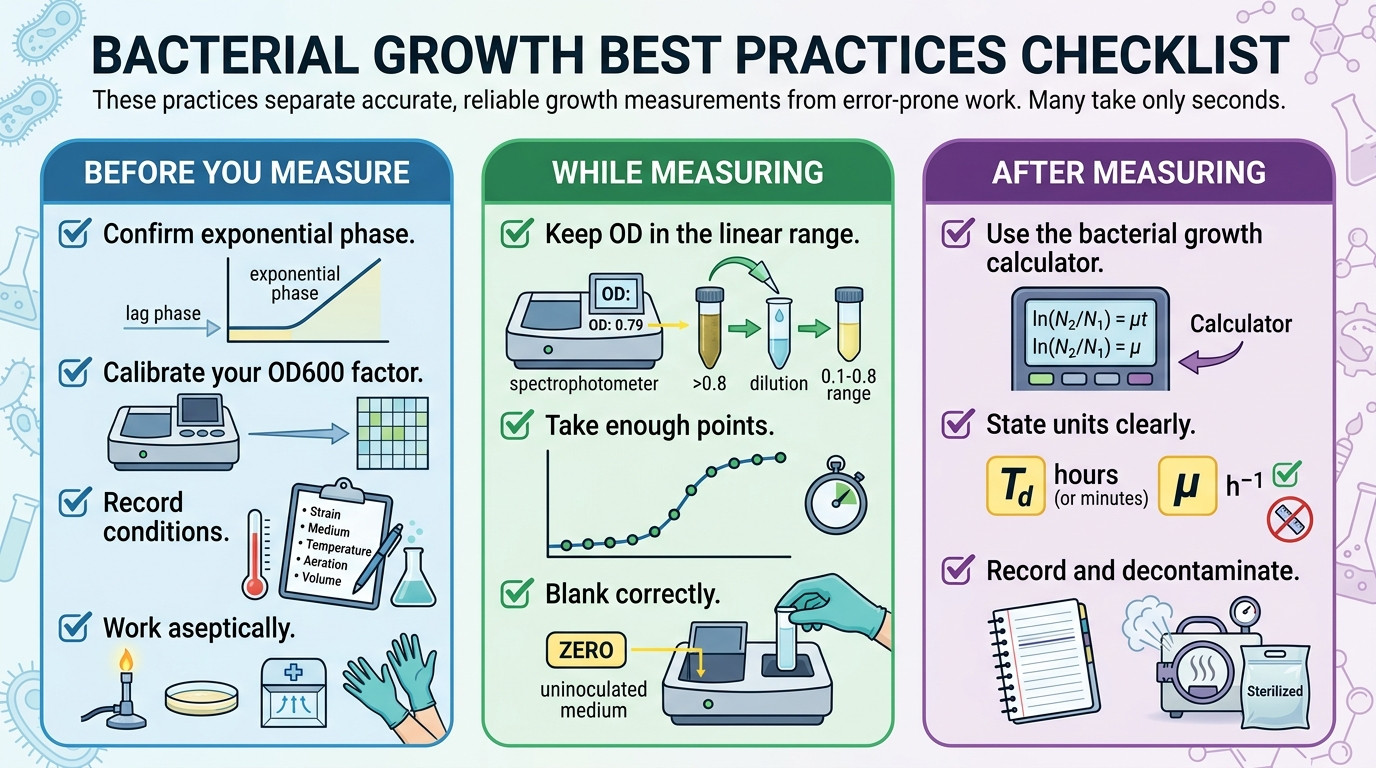
Bacterial Growth Best Practices Checklist
These practices separate accurate, reliable growth measurements from error-prone work. Many take only seconds.
Before You Measure
While Measuring
After Measuring
For the dilution math behind microbiology work, see our CFU calculator, cell dilution calculator, and dilution factor calculator.
Trusted Reference Resources for Bacterial Growth
These are authoritative references for accurate, standardised bacterial growth measurement.
LibreTexts Microbiology — bio.libretexts.org — Free, peer-reviewed explanations of bacterial growth phases, exponential growth math, and generation-time calculations.
NCBI / PMC — ncbi.nlm.nih.gov/pmc — Peer-reviewed protocols for growth-curve analysis, OD600 calibration, and microbial kinetics.
ATCC — atcc.org — Bacterial strain handling guides, growth conditions, and expected doubling times for reference strains.
CDC / NIH Biosafety — cdc.gov — Biosafety levels, BSC use, and aseptic technique for bacterial culture work.
ASM (American Society for Microbiology) — Standard methods for microbial growth measurement and OD-to-cell-count calibration.
On our platform, related calculation tools include: CFU calculator, cell dilution calculator, dilution factor calculator, and dilution ratio calculator.
User Reviews & Ratings
📝 Share Your Experience with This Bacterial Growth Calculator
Final Thoughts on Bacterial Growth Calculation
Bacterial growth calculation is one of those tasks that seems simple until the logarithms, the exponential equation, and the OD600 conversion all meet. The arithmetic is straightforward in principle — take two points in exponential phase, apply natural logs, and solve for the doubling time — but a single misplaced log or a data point taken outside log phase can shift the result by an order of magnitude, and that error then propagates into induction timing, inoculum sizing, strain comparisons, and every downstream conclusion drawn from the growth curve.
The difference between a lab that produces reproducible growth data and one that does not often comes down to discipline: always confirming exponential phase, always reading OD in the linear range, always calibrating the conversion factor, and always using the correct natural log. A systematic approach transforms growth-curve analysis from a source of variability into a reliable foundation for every microbiology experiment. The bacterial growth calculator removes the arithmetic risk by handling the logarithms internally, but good technique remains essential — the tool gives you the right number only when you feed it the right data.
The framework is short: confirm you are in exponential phase, take at least two (ideally four or five) OD readings in the linear range, enter them into the appropriate mode of the growth calculator — Doubling Time, Predict, Growth Rate, OD600, or Specific Rate — and report the result with its units and conditions clearly stated. That sequence gives an accurate, reproducible growth parameter every time, and the worked steps let you verify the reasoning rather than trusting an opaque number.
From basic research and strain engineering to industrial fermentation, food safety, and clinical microbiology, bacterial growth math is everywhere a living culture becomes a quantitative experiment. Keep this growth calculator handy as your starting point, and use the related dilution and counting tools in the sidebar whenever you need to convert between OD, CFU, and cell density.
🔒 Privacy Guarantee: Every calculation on this page runs entirely within your browser. No data — growth readings, OD values, doubling times, or any other inputs — is sent to any server, stored, or shared. Your calculations are completely private.
Pingback: Acid Dilution Calculator - Safe Lab & Industrial Use | Free Tool
Pingback: How to Do a Dilution Calculation: Step-by-Step Guide (C1V1=C2V2)
Pingback: Dilution Factor Calculator: Master Precision in 3 Easy Steps
Pingback: Sodium Hypochlorite Dilution Calculator | Free CDC Bleach Tool
Pingback: Infusion Rate Calculator – Calculate IV Infusion Rates Instantly
Pingback: MIC Dilution Calculator | Calculate MIC Dilutions Instantly
Pingback: IV Dilution Calculator | Calculate IV Drug Dilutions Instantly
Pingback: Star San Sanitizer Tool | Calculate Dilution Instantly
Pingback: Percent by Mass Calculator | Calculate Mass Percentage Instantly
Pingback: Pool Chemical Calculator | Calculate Pool Chemicals Instantly