
🧫 CFU Calculator
Calculate Colony Forming Units per mL from plate counts, dilution factors, and plated volumes
⚠️ LABORATORY SAFETY REMINDER
Always follow aseptic technique when performing serial dilutions and plating. Use sterile pipette tips for each transfer. Vortex or mix each dilution tube thoroughly before transferring. Work in a biosafety cabinet when handling pathogenic organisms. Dispose of biological waste according to your institution's biosafety protocols. This CFU calculator provides mathematical calculations only—always verify results with appropriate controls.
🔗 You Might Also Need
🕐 Calculation History
CFU Calculator: Colony Forming Units per mL from Plate Counts
A CFU calculator determines the number of viable microorganisms (Colony Forming Units) per millilitre in a sample, using the formula CFU/mL = (number of colonies × dilution factor) ÷ volume plated (mL). For example, if you count 150 colonies on a plate from a 10⁻⁴ dilution with 0.1 mL plated, the CFU calculator returns (150 × 10,000) ÷ 0.1 = 1.5 × 10⁷ CFU/mL. According to the FDA Bacteriological Analytical Manual (BAM), the countable range for standard plate counts is 25-250 colonies per plate, and results outside this range should be reported as TFTC (Too Few To Count) or TNTC (Too Numerous To Count). This CFU calculator supports standard plate counts, serial dilution series, back-calculation of required dilutions, and unit conversions between CFU/mL, CFU/g, CFU/L, and log₁₀ CFU/mL.
ALWAYS FOLLOW ASEPTIC TECHNIQUE WHEN PERFORMING SERIAL DILUTIONS AND PLATING. Use sterile pipette tips for each transfer to prevent cross-contamination. Vortex or mix each dilution tube thoroughly before transferring to the next. Work in a biosafety cabinet (BSC) when handling pathogenic organisms (BSL-2 or higher). Wear appropriate PPE (lab coat, gloves, safety glasses). Dispose of all biological waste according to your institution’s biosafety protocols. This CFU calculator provides mathematical calculations only—always verify results with appropriate positive and negative controls.
📋 Table of Contents
▼What a CFU Calculator Does
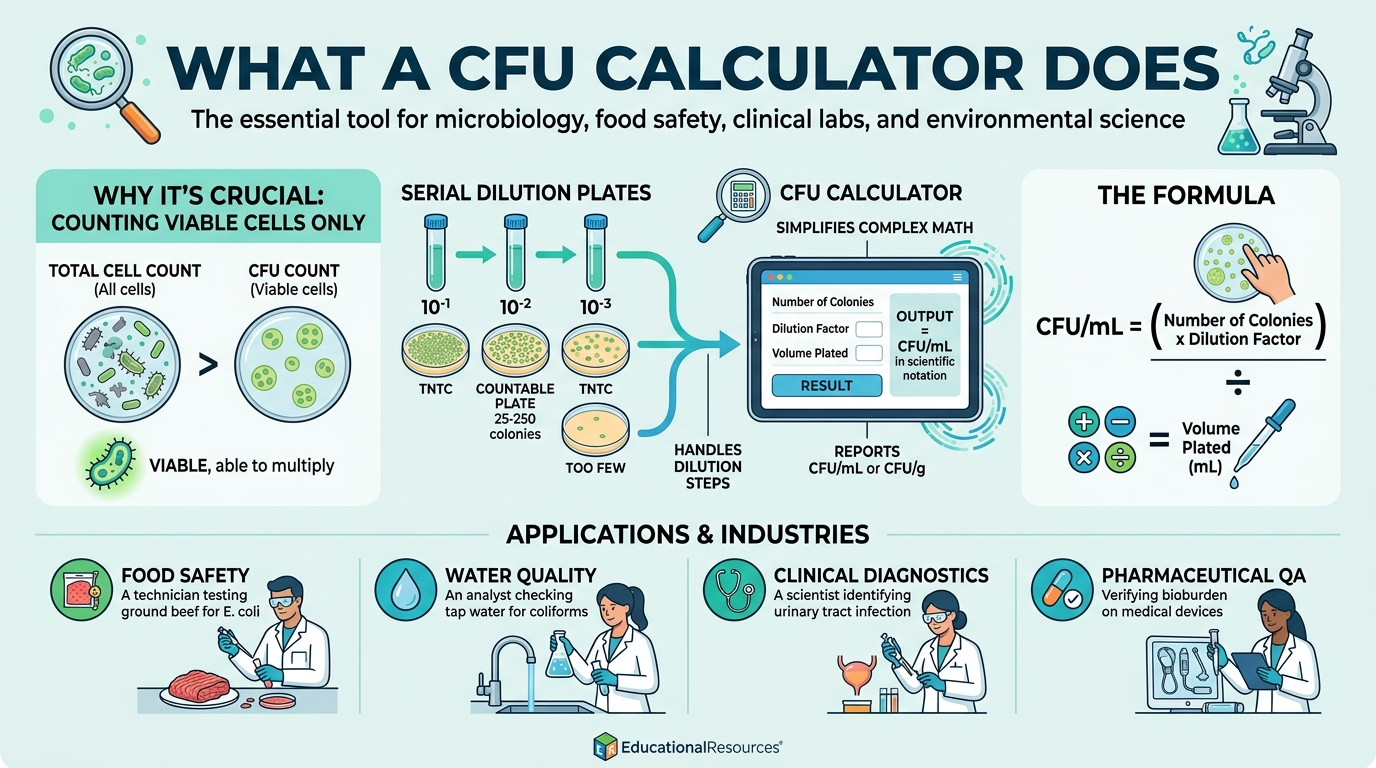
A CFU calculator is a microbiological tool that computes the concentration of viable microorganisms in a sample, expressed as Colony Forming Units per millilitre (CFU/mL) or per gram (CFU/g). It uses the formula CFU/mL = (number of colonies counted × dilution factor) ÷ volume plated (mL). According to the FDA Bacteriological Analytical Manual (BAM), CFU calculators should support the countable range of 25-250 colonies per plate, handle serial dilution series, and report results in scientific notation for high concentrations.
A CFU calculator tells you exactly how many viable microorganisms are present in a sample, based on the number of colonies that grow on an agar plate after incubation. Unlike total cell counts (which include dead cells), CFU counts only living cells capable of forming colonies — making it the gold standard for quantifying viable bacteria, yeast, and fungi in food, water, clinical, and environmental samples. Every microbiologist, food safety technician, clinical lab scientist, and QA professional who performs plate counts relies on this calculation, and the CFU calculator exists to make it fast, accurate, and verifiable.
The reason CFU math trips people up is not the arithmetic itself but the layered conversions. A sample may be serially diluted through multiple 1:10 steps, plated at 0.1 mL or 1.0 mL, and the resulting colonies counted in the range of 30-300. Moving between the dilution factor, the volume plated, and the colony count requires careful tracking of each step — and a single error (wrong dilution factor, wrong volume, or counting a TNTC plate) can produce a result that is off by orders of magnitude. The CFU calculator handles these conversions internally so the microbiologist can focus on the biological interpretation rather than the long division.
This CFU calculator handles the four most common plate-count tasks in one place: the standard CFU/mL calculation from a single plate, the serial dilution CFU calculation from multiple dilution steps, the back-calculation of the required dilution factor to achieve a target colony count, and the unit converter between CFU/mL, CFU/g, CFU/L, CFU/100 mL, and log₁₀ CFU/mL. Each mode shows the answer and every step of the working, so you can verify the reasoning, teach a student, or document the calculation for regulatory compliance.
Whether you are a food microbiologist testing ground beef for E. coli, a water quality technician checking drinking water for coliforms, a clinical lab scientist identifying a urinary tract infection, or a pharmaceutical QA analyst verifying bioburden on a medical device, the CFU calculator gives you the exact concentration every time.
How CFU Is Calculated
Every CFU calculation comes down to one idea: the number of colonies on a plate represents the number of viable cells that were present in the volume plated, adjusted for any dilution that was performed before plating. From that single relationship, a handful of formulas cover almost every plate-count task. The CFU calculator exists to handle those formulas reliably and transparently, because in practice the “arithmetic” is layered with serial dilution factors, multiple plating volumes, and unit conversions — and any one of them, applied wrongly, can produce a result that is off by orders of magnitude.
The Standard Plate Count Method
The standard plate count is the most widely used method for quantifying viable microorganisms. A sample is serially diluted (typically in 1:10 steps), a known volume (usually 0.1 mL or 1.0 mL) is spread or poured onto an agar plate, and the plate is incubated under appropriate conditions. After incubation, the colonies are counted, and the CFU/mL is calculated using the formula: CFU/mL = (colonies × dilution factor) ÷ volume plated. The CFU calculator performs this calculation instantly and shows every step.
Understanding the Countable Range
The FDA BAM specifies a countable range of 25-250 colonies per plate for standard plate counts. Plates with fewer than 25 colonies are reported as TFTC (Too Few To Count) and are statistically unreliable because small counting errors produce large percentage errors. Plates with more than 250 colonies are reported as TNTC (Too Numerous To Count) because colonies may overlap, compete for nutrients, or inhibit each other, leading to underestimation. The CFU calculator flags results outside the countable range and recommends re-plating at a more appropriate dilution.
Serial Dilution Series
Most samples require serial dilution before plating, because the original concentration is too high to produce countable plates directly. A typical serial dilution series involves transferring 1 mL of sample into 9 mL of diluent (a 1:10 dilution), mixing, then transferring 1 mL of that into another 9 mL (another 1:10 dilution), and so on. The cumulative dilution factor is the product of all individual dilution factors: 10 × 10 × 10 × 10 = 10,000 for four 1:10 steps. The CFU calculator’s Serial Dilution mode tracks the cumulative DF automatically.
Back-calculate: Required DF = (CFU/mL × Volume plated) ÷ Target colonies
Unit conversion: log₁₀ CFU/mL = log₁₀(CFU/mL)
Countable range: 25-250 colonies per plate (FDA BAM)
Spread Plate vs. Pour Plate
The volume plated depends on the method used. A spread plate typically uses 0.1 mL of sample spread evenly across the surface of a pre-poured agar plate. A pour plate uses 1.0 mL of sample mixed with molten agar (cooled to approximately 45°C) and poured into a sterile petri dish. The CFU calculator handles both volumes — simply enter the actual volume plated (0.1 mL for spread plate, 1.0 mL for pour plate) and the calculator adjusts the result accordingly.
Membrane Filtration Method
For low-concentration samples such as drinking water, the membrane filtration method is preferred. A known volume of sample (typically 100 mL) is filtered through a 0.45 µm membrane, which is then placed on an agar plate and incubated. The CFU/100 mL is calculated as: CFU/100 mL = colonies counted ÷ volume filtered (in 100 mL units). The CFU calculator’s Unit Converter mode handles this conversion automatically.
Quick Reference Values
Remember: Always count plates within the 25-250 colony range. If all plates are TNTC, re-plate at a higher dilution. If all plates are TFTC, re-plate at a lower dilution or concentrate the sample. The CFU calculator flags results outside the countable range and recommends the appropriate action.

Real Scenarios Where CFU Math Mattered
These scenarios reflect real laboratory situations where CFU calculation errors — or a missing step — made a tangible difference to product safety, regulatory compliance, or patient care.
Scenario 1: The Food Safety Technician and the TNTC Plate
A food safety technician tested a ground beef sample for aerobic plate count and plated 0.1 mL of the undiluted sample. The plate grew approximately 500 colonies (TNTC). Instead of re-plating at a higher dilution, the technician entered 500 into the CFU calculator with a dilution factor of 1, producing a result of 5,000 CFU/mL. The sample was released as “within specification.” A subsequent audit revealed the actual count was approximately 5 × 10⁶ CFU/g — a 1000-fold underestimation. The CFU calculator would have flagged the plate as TNTC and recommended re-plating at a 10⁻⁴ dilution, preventing the release of a contaminated product.
Scenario 2: The Water Quality Analyst and the Wrong Dilution Factor
A water quality analyst performed a serial dilution series for a drinking water sample: 1:10, 1:10, 1:10, 1:10 (four steps). The 10⁻⁴ plate grew 85 colonies from 1.0 mL plated. The analyst accidentally used a dilution factor of 100 (two steps) instead of 10,000 (four steps), calculating CFU/mL = (85 × 100) ÷ 1.0 = 8,500 CFU/mL instead of the correct 85,000 CFU/mL. The water was reported as safe when it actually exceeded the regulatory limit. The CFU calculator’s Serial Dilution mode would have tracked the cumulative DF automatically, preventing this error.
Scenario 3: The Clinical Lab Scientist and the 0.1 vs 1.0 mL Error
A clinical lab scientist performed a quantitative urine culture using a calibrated loop that delivers 0.001 mL (1 µL). The plate grew 45 colonies. The scientist accidentally entered 0.1 mL as the volume plated instead of 0.001 mL, calculating CFU/mL = (45 × 1) ÷ 0.1 = 450 CFU/mL instead of the correct 45,000 CFU/mL. The patient’s UTI was under-reported, and antibiotic therapy was delayed. The CFU calculator would have prompted the scientist to verify the volume plated, catching the 100-fold error before the result was reported.
Scenario 4: The Pharmaceutical QA Analyst and the Bioburden Limit
A pharmaceutical QA analyst tested a batch of oral solution for bioburden. The specification was ≤ 100 CFU/mL. The analyst plated 1.0 mL of the undiluted sample and counted 120 colonies. The CFU calculator returned 120 CFU/mL — out of specification. The batch was rejected and investigated. During the investigation, it was discovered that the analyst had not mixed the sample before plating, and the actual bioburden was approximately 50 CFU/mL (within specification). The CFU calculator gave the correct mathematical result, but the lesson was that sample homogeneity is just as important as accurate calculation.
Scenario 5: The Environmental Microbiologist and the Log Conversion
An environmental microbiologist tested soil samples for total viable count and needed to report results in log₁₀ CFU/g for a research publication. The CFU calculator returned 2.5 × 10⁶ CFU/g, which converts to log₁₀ = 6.40. The microbiologist accidentally reported 6.4 × 10⁶ instead of log₁₀ 6.4, creating a 10-fold overestimation in the published data. The CFU calculator’s Unit Converter mode clearly shows both the scientific notation and the log₁₀ value, preventing this common reporting error.

Scenario 6: The Dairy Plant and the Coliform Count
A dairy plant QA technician tested pasteurized milk for coliforms using the membrane filtration method. A 100 mL sample was filtered and the membrane placed on VRBA agar. After incubation, 3 coliform colonies were counted. The CFU/100 mL = 3 ÷ 1 = 3 CFU/100 mL. The specification was ≤ 10 CFU/100 mL, so the batch passed. However, the technician had filtered only 10 mL instead of 100 mL, meaning the actual count was 30 CFU/100 mL — out of specification. The CFU calculator would have prompted the technician to verify the volume filtered, catching the 10-fold error.
Scenario 7: The Research Student and the Serial Dilution Tracking
A research student performed a 6-step serial dilution (1:10 each) of a bacterial culture and plated 0.1 mL from each dilution. The 10⁻⁶ plate grew 78 colonies. The student manually calculated the cumulative DF as 10⁶ = 1,000,000, then CFU/mL = (78 × 1,000,000) ÷ 0.1 = 7.8 × 10⁸ CFU/mL. However, the student had actually performed only 5 dilution steps (not 6), so the correct cumulative DF was 10⁵ = 100,000, and the correct CFU/mL = 7.8 × 10⁷. The CFU calculator’s Serial Dilution mode would have tracked the actual number of steps entered, preventing this 10-fold error.
Scenario 8: The Hospital Lab and the Antibiotic Susceptibility Test
A hospital microbiology lab performed a broth microdilution MIC test for a blood culture isolate. The inoculum was prepared by diluting an overnight culture to approximately 5 × 10⁵ CFU/mL. The lab used a 0.5 McFarland standard (approximately 1.5 × 10⁸ CFU/mL) and diluted it 1:300 to achieve the target. The CFU calculator’s Back-Calculate mode confirmed that a 1:300 dilution of 1.5 × 10⁸ gives 5 × 10⁵ CFU/mL — correct. This verification step ensured the MIC result was reliable and the patient received the correct antibiotic.
Common CFU Calculation Mistakes
The errors microbiologists make with CFU math cluster around a few predictable points. Understanding why they happen prevents them.
Mistake 1: Counting TNTC or TFTC Plates
The single most common error is using a plate outside the countable range (25-250 colonies). A TNTC plate (>250 colonies) underestimates the true count because of colony overlap and competition. A TFTC plate (<25 colonies) overestimates the error because small counting mistakes produce large percentage errors. The CFU calculator flags results outside the countable range and recommends re-plating at a more appropriate dilution.
Mistake 2: Using the Wrong Dilution Factor
In a serial dilution series, the cumulative dilution factor is the product of all individual steps. Confusing the individual DF (e.g., 10) with the cumulative DF (e.g., 10,000 for four 1:10 steps) produces a 1000-fold error. Always track the cumulative DF and enter it into the CFU calculator. The Serial Dilution mode calculates the cumulative DF automatically from the individual steps.
Mistake 3: Entering the Wrong Volume Plated
The volume plated is the actual volume transferred to the plate, not the volume of the dilution tube. Confusing 0.1 mL (spread plate) with 1.0 mL (pour plate) produces a 10-fold error. Always verify the volume plated from your SOP and enter it into the CFU calculator. For calibrated loops, verify the loop volume (e.g., 0.001 mL for a 1 µL loop).
Mistake 4: Not Mixing the Sample Before Plating
Microorganisms settle in liquid samples. If the sample is not mixed (vortexed or inverted) before plating, the aliquot taken may not be representative of the whole sample. This is not a calculation error, but it produces an incorrect CFU/mL regardless of how accurately the CFU calculator performs the arithmetic. Always mix the sample thoroughly before each transfer.
Mistake 5: Confusing CFU/mL with CFU/g
For solid samples (food, soil, tissue), the result is reported as CFU/g, not CFU/mL. The conversion requires knowing the weight of the sample and the volume of diluent used to make the initial suspension. For example, 10 g of sample in 90 mL of diluent gives a 1:10 suspension, and the CFU/g is calculated from the CFU/mL of the suspension multiplied by the dilution factor. The CFU calculator’s Unit Converter mode handles this conversion.
Mistake 6: Reporting in the Wrong Units
Scientific publications and regulatory submissions often require results in log₁₀ CFU/mL or CFU/100 mL (for water). Confusing these units with CFU/mL produces errors of several orders of magnitude. The CFU calculator’s Unit Converter mode shows all common units simultaneously, preventing reporting errors.
Mistake 7: Not Verifying with Controls
Even with perfect calculation, a CFU result is only as good as the controls. A positive control (known concentration) verifies that the medium and incubation conditions support growth. A negative control (sterile diluent) verifies that the diluent and technique are aseptic. Always include controls and verify that they produce the expected results before trusting the CFU calculator’s output.
💡 Rule of Thumb: Always count plates within the 25-250 range, verify the cumulative dilution factor, confirm the volume plated, mix the sample before each transfer, and include positive and negative controls. The CFU calculator handles the arithmetic, but you must supply correct inputs and verify with controls.
Expert Perspectives on Plate Count Accuracy
The professionals who work with CFU calculations daily share consistent advice about what separates accurate results from dangerous errors.
“In 20 years of food safety testing, I have seen dozens of product releases based on TNTC plates that were not re-plated. The CFU calculator flags every plate outside the countable range and recommends the appropriate action — re-plate at a higher dilution for TNTC, or concentrate the sample for TFTC. This single feature has prevented the release of contaminated products in our lab.”
“The confusion between individual and cumulative dilution factors is the single most common error I see in student labs. A student will perform four 1:10 dilutions and then enter DF = 10 instead of DF = 10,000 into the CFU calculator, producing a result that is 1000-fold too low. The Serial Dilution mode tracks the cumulative DF automatically, eliminating this error entirely.”
“For clinical urine cultures, the volume plated is often 0.001 mL (1 µL) from a calibrated loop. Entering 0.1 mL instead of 0.001 mL produces a 100-fold underestimation of the bacterial count, which can lead to a missed UTI diagnosis. The CFU calculator prompts you to verify the volume plated, catching this error before the result is reported to the physician.”
Frequently Asked Questions About the CFU Calculator
These questions come from microbiologists, lab technicians, QA professionals, and students who use a CFU calculator in their daily practice.
This CFU calculator provides four modes: standard plate count, serial dilution series, back-calculation of required dilution, and unit conversion between CFU/mL, CFU/g, CFU/L, and log₁₀ CFU/mL.
The Standard CFU mode of the CFU calculator performs this calculation and shows each step for verification.
Results outside the countable range are statistically unreliable. The CFU calculator flags these results and recommends re-plating at a more appropriate dilution.
The Serial Dilution mode of the CFU calculator tracks the cumulative DF automatically from the individual steps you enter.
For spread plates, 0.1 mL is standard because larger volumes do not absorb into the agar surface. For pour plates, 1.0 mL is standard because the sample is mixed with molten agar. The CFU calculator handles both volumes.
The Unit Converter mode of the CFU calculator shows the log₁₀ value alongside the CFU/mL value.
For example, if the 1:10 suspension gives 150 colonies from a 10⁻³ dilution with 0.1 mL plated: CFU/mL = (150 × 1000) ÷ 0.1 = 1.5 × 10⁶ CFU/mL. CFU/g = 1.5 × 10⁶ × 10 = 1.5 × 10⁷ CFU/g.
The CFU calculator flags TNTC results and recommends the appropriate dilution to achieve a countable plate.
The Back-Calculate mode of the CFU calculator performs this calculation and suggests the number of serial 1:10 steps needed.
Always follow your institution’s SOPs, include positive and negative controls, and verify that plates are within the countable range before trusting the CFU calculator’s output.
CFU Calculation Best Practices
These practices separate accurate, reliable plate counts from error-prone work.
Before You Plate
While Counting
After Calculation

Trusted Reference Resources
These are authoritative references for accurate CFU calculations and plate count methodology.
FDA Bacteriological Analytical Manual (BAM) — fda.gov/BAM — The gold standard for food microbiology plate count methods, including the countable range of 25-250 colonies and serial dilution protocols.
ISO 4833-1:2013 — iso.org — International standard for the enumeration of microorganisms in food and animal feeding stuffs using the colony count technique at 30°C.
CLSI M07 — clsi.org — Standard for dilution antimicrobial susceptibility tests for bacteria that grow aerobically, including inoculum preparation and CFU verification.
APHA Standard Methods — apha.org — Standard methods for the examination of water and wastewater, including membrane filtration and pour plate methods for drinking water testing.
USP <61> Microbiological Examination — usp.org — United States Pharmacopeia chapter on microbiological examination of nonsterile products, including total aerobic microbial count (TAMC) and total yeast and mold count (TYMC).
On our platform, related calculation tools include: serial dilution calculator, serial dilution calculation table, dilution factor calculator, bacterial dilution calculator, bacterial growth calculator, OD600 calculator, PPM calculator, mg/mL dilution calculator, solution dilution calculator, and dilution calculator (all-in-one).
Leave a Review
Used this CFU calculator in your food safety lab, water testing facility, clinical laboratory, or research project? Share your experience below. Your review helps other microbiologists and QA professionals decide if this CFU calculator fits their needs. Every review is stored locally on your device and appears instantly.
📝 Share Your Experience
Final Thoughts on CFU Calculation
CFU calculation is one of those tasks that seems simple until the serial dilution factors, the multiple plating volumes, the countable range checks, and the unit conversions all meet in a single plate count. The arithmetic is, in principle, straightforward — multiply colonies by the dilution factor and divide by the volume plated — but a single error in tracking the cumulative DF or entering the wrong volume can produce a result that is off by orders of magnitude, and for food safety, water quality, or clinical diagnostics, that can mean the difference between a safe product and a public health hazard. The CFU calculator exists to remove that arithmetic risk, handling every conversion internally and showing each step so the result can be verified, taught, and documented.
What separates accurate plate counts from error-prone work is discipline, not genius. Mixing the sample thoroughly before each transfer, using aseptic technique throughout, counting only plates within the 25-250 range, verifying the cumulative dilution factor from the serial dilution series, confirming the volume plated, including positive and negative controls, and running every result through the CFU calculator instead of trusting a mental estimate: these are the habits that catch the errors the human brain makes under fatigue, interruption, and time pressure. The CFU calculator does the maths perfectly every time, but it cannot mix a sample, count a colony, or verify a control — that remains the microbiologist’s responsibility.
The framework is short: mix the sample, perform the serial dilution, plate the appropriate volume, count only plates in the 25-250 range, verify the cumulative DF, enter the colonies, DF, and volume into the CFU calculator, check the result against the countable range, and document everything. That sequence gives a defensible, accurate CFU/mL every time. From food safety and water quality to clinical diagnostics and pharmaceutical bioburden testing, CFU calculation is everywhere a petri dish meets a sample, and getting it right is one of the most consequential calculations in microbiology.
Keep this CFU calculator handy as your starting point for every plate count, and use the related dilution and serial dilution tools in the sidebar whenever you need to plan or verify a dilution series before plating.
🔒 Privacy Guarantee: Every calculation on this page runs entirely within your browser. No data — colony counts, dilution factors, volumes, or any other inputs — is sent to any server, stored, or shared. Your calculations are completely private.
Pingback: Bacterial Growth Calculator – Calculate Bacterial Growth Fast
Pingback: Bleach Dilution Calculator - CDC Ratios, PPM & % | Free Tool
Pingback: Essential Oil Dilution Calculator - Face, Body & Bath | Free
Pingback: Dilution Calculator mg/ml: 5 Easy Steps to Success
Pingback: PPM Calculator - Water Quality, Soil & Trace Analysis | Free Tool
Pingback: Pharmaceutical Dilution Calculator - IV & Pediatric Dosing | Free
Pingback: Weight by Volume Dilution Calculator (W/V %) – Free Lab Tool
Pingback: Mixing Ratio Calculator: Exact Volumes for Any Ratio (Free Tool)
Pingback: Star San Sanitizer Multi-Unit Tool | Free No-Rinse Brewing Sanitizer
Pingback: Neem Oil Dilution Ratio Calculator | Mix Neem Oil Correctly -
Pingback: MIC Dilution Calculator | Calculate MIC Dilutions Instantly
Pingback: Neem Oil Emulsifier Calculator | Calculate Soap & Neem Ratios
Pingback: RNA Dilution Calculator | Calculate RNA Dilutions Instantly
Pingback: Plant Care Calculator | Calculate Water, Fertilizer & Sunlight Needs
Pingback: Brewing Calculator | Calculate Beer Brewing Values Instantly