
💉 Infusion Rate Calculator
Calculate IV flow rate, drip rate, infusion time, volume, and weight-based drug dose
⚠️ CLINICAL SAFETY REMINDER
This infusion rate calculator is an educational decision-support tool. It is NOT a substitute for professional clinical judgement, institutional protocols, or an independent double-check. For high-alert drugs (heparin, insulin, opioids, vasoactive infusions), always perform an independent double-check with a second qualified clinician. Verify drug concentration on the bag label, confirm patient weight, and read the drop factor from the giving-set packaging. The tool computes; the clinician decides.
🔗 You Might Also Need
🕐 Calculation History
Infusion Rate Calculator: IV Flow Rate, Drip Rate & Drug Dose
An infusion rate calculator determines how fast an intravenous (IV) fluid or medication should be delivered to a patient, expressed as millilitres per hour (mL/hr), drops per minute (gtt/min), or a weight-based drug dose such as mcg/kg/min. The core formula for flow rate is mL/hr = total volume (mL) ÷ infusion time (hr), and the drip rate adds a drop factor: gtt/min = volume (mL) × drop factor ÷ time (min). According to the Institute for Safe Medication Practices (ISMP), infusion rate errors are among the most common and dangerous medication errors in hospitals, particularly for high-alert drugs such as heparin, insulin, and vasoactive infusions. This infusion rate calculator provides five modes: flow rate, drip rate, infusion time, volume delivered, and weight-based dose rate, each with step-by-step solutions for verification and independent double-checking.
THIS INFUSION RATE CALCULATOR IS AN EDUCATIONAL DECISION-SUPPORT TOOL. It is NOT a substitute for professional clinical judgement, institutional protocols, or an independent double-check. For high-alert drugs (heparin, insulin, opioids, concentrated electrolytes, vasoactive infusions), always perform an independent double-check with a second qualified clinician before administration. Verify drug concentration on the bag label, confirm patient weight, read the drop factor from the giving-set packaging, and apply the “Five Rights” (right patient, drug, dose, route, time). The tool computes; the clinician decides.
📋 Table of Contents
▼- What an Infusion Rate Calculator Does
- How Infusion Rate Is Calculated
- Real Scenarios Where Infusion Math Mattered
- Common Infusion Calculation Mistakes
- Medication Safety Essentials
- Which Mode Fits Your Situation
- Frequently Asked Questions
- Infusion Safety Best Practices
- Trusted Reference Resources
- Leave a Review
What an Infusion Rate Calculator Does
An infusion rate calculator is a clinical tool that computes how fast an intravenous (IV) fluid or medication should be delivered to a patient, based on the prescribed volume, time, drop factor, and drug concentration. It eliminates the multi-step arithmetic — unit conversions between hours and minutes, drop-factor multiplications, and weight-based dose translations — that turns a simple prescription into a sequence of error-prone calculations. According to the Institute for Safe Medication Practices (ISMP), infusion rate calculators should support flow rate (mL/hr), drip rate (gtt/min), infusion time, volume delivered, and weight-based dose rate (mcg/kg/min) modes, with step-by-step working for independent double-checking.
An infusion rate calculator tells you exactly how fast an intravenous fluid or medication should be delivered to a patient, based on the prescribed volume, time, drop factor, and drug concentration. It eliminates the multi-step arithmetic — unit conversions between hours and minutes, drop-factor multiplications, and weight-based dose translations — that turns a simple prescription into a sequence of error-prone calculations. In hospitals, critical care, oncology, paediatrics, and home infusion, getting the rate right is a matter of patient safety: too fast can cause fluid overload or toxicity, too slow can leave a patient under-treated or a drug sub-therapeutic. Every nurse, pharmacist, anaesthetist, and prescriber who manages IV therapy relies on this calculation, and the infusion rate calculator exists to make that calculation fast, transparent, and verifiable.
The reason infusion math trips people up is not the arithmetic itself but the layered unit conversions. A prescription may give the volume in millilitres and the time in hours, but the drip chamber works in drops per minute, the pump in millilitres per hour, and the drug dose in micrograms per kilogram per minute. Moving between those units requires converting hours to minutes, milligrams to micrograms, and grams to milligrams, then dividing by the patient’s weight and the drug concentration. A single misplaced decimal — giving 10 mg instead of 1 mg, or setting 100 mL/hr instead of 10 mL/hr — can cause a tenfold dosing error, and high-alert drugs such as heparin, insulin, opioids, and vasoactive infusions carry the greatest risk. The infusion rate calculator handles these conversions internally so the clinician can focus on the clinical decision rather than the long division.
This infusion rate calculator handles the five most common IV-calculation tasks in one place: the flow-rate solver (mL/hr) from volume and time, the drip-rate calculator (gtt/min) for gravity sets, the infusion-time calculator from volume and rate, the volume-delivered calculator from rate and time, and the weight-based dose-rate calculator for critical-care drugs. Each mode shows the answer and every step of the working, so you can verify the reasoning, teach a student, or document the calculation. Whether you are a nursing student learning drip rates for the first time or a senior intensivist titrating a noradrenaline infusion, the goal is the same: a defensible, double-checkable rate that the patient can rely on.

How Infusion Rate Is Calculated
Every infusion rate calculation comes down to one idea: the volume of fluid or drug delivered equals the rate multiplied by the time, and the rate is whatever setting delivers the prescribed volume within the prescribed window. From that single relationship, a handful of formulas cover almost every IV therapy task. The infusion rate calculator exists to handle those formulas reliably and transparently, because in clinical practice the “arithmetic” is layered with unit conversions, drop factors, drug concentrations, and patient weights — and any one of them, applied wrongly, can produce a dangerous result.
The Difference Between Pump and Gravity Infusions
An infusion pump delivers fluid at a precisely controlled flow rate measured in millilitres per hour (mL/hr). You set the pump to that number and it pushes the exact volume electronically — this is the standard for almost all medication infusions and most fluid therapy in modern hospitals. A gravity infusion relies on gravity and a roller clamp; the nurse counts the drops falling in the drip chamber and adjusts the clamp until the rate is correct. Gravity rates are expressed in drops per minute (gtt/min), and converting a prescribed volume over time into a drip rate requires the drop factor of the giving set. The infusion rate calculator handles both: the mL/hr mode for pumps and the drip mode for gravity sets.
Understanding IV Giving Sets and Drop Factors
The drop factor is a property of the IV giving set (administration set) and is always printed on the packaging. A macro-drip set delivers large drops, typically 10, 15, or 20 drops per millilitre. A micro-drip set delivers tiny drops at 60 drops per millilitre, which makes the maths easy (1 mL over 1 hour = 1 drop per minute). Mixing up the two set types is one of the most common and dangerous infusion errors. Always read the drop factor from the actual set in your hand, and enter that exact number into the infusion rate calculator.
Infusion time: time = volume ÷ rate
Volume delivered: volume = rate × time
Dose rate: mcg/kg/min = (rate × concentration) ÷ (weight × 60)
1. Flow Rate (mL/hr) — the Pump Setting
The most common calculation is the pump flow rate: mL/hr = total volume (mL) ÷ infusion time (hr). For example, 1000 mL of normal saline prescribed over 8 hours gives 1000 ÷ 8 = 125 mL/hr. That single number is what you program into the pump. The infusion rate calculator performs this division and shows the working, so a student can verify it or a second nurse can double-check it.
2. Drip Rate (gtt/min) — for Gravity Sets
When no pump is available, you set a gravity drip by counting drops: gtt/min = volume (mL) × drop factor (gtt/mL) ÷ time (min). For example, 1000 mL over 8 hours (480 minutes) with a 20 gtt/mL set gives 1000 × 20 ÷ 480 ≈ 42 gtt/min. The Drip mode of the infusion rate calculator takes the volume, time, and drop factor and returns the drip rate.
3. Infusion Time
Sometimes you know the volume and the rate and need to find how long the infusion will run: time (hr) = volume (mL) ÷ rate (mL/hr). For example, 500 mL at 125 mL/hr will take 4 hours. This is useful for planning bag changes and timing-dependent drugs.
4. Volume Delivered
The reverse calculation finds how much fluid a patient has received: volume (mL) = rate (mL/hr) × time (hr). For example, 100 mL/hr for 4 hours delivers 400 mL. This is useful for fluid-balance charts and intake documentation.
5. Weight-Based Dose Rate (mcg/kg/min)
Critical-care drugs such as noradrenaline, dobutamine, and dopamine are prescribed by patient weight. The relationship is: mcg/kg/min = (rate in mL/hr × concentration in mcg/mL) ÷ (weight in kg × 60). This calculation is the one most often associated with serious medication errors. The Dose mode of the infusion rate calculator handles this conversion and reports both the total drug per minute and the per-kilogram-per-minute dose.
Quick Reference Values
Remember: Always confirm the units of every number before calculating — hours versus minutes, mg versus mcg, gtt/mL of your specific giving set. The infusion rate calculator does the arithmetic, but you must supply correct inputs. For high-alert drugs, perform an independent double-check with a second qualified clinician before administration.

Real Scenarios Where Infusion Math Mattered
These scenarios reflect real clinical situations where infusion-rate arithmetic — or a missing step — made a tangible difference to patient care.
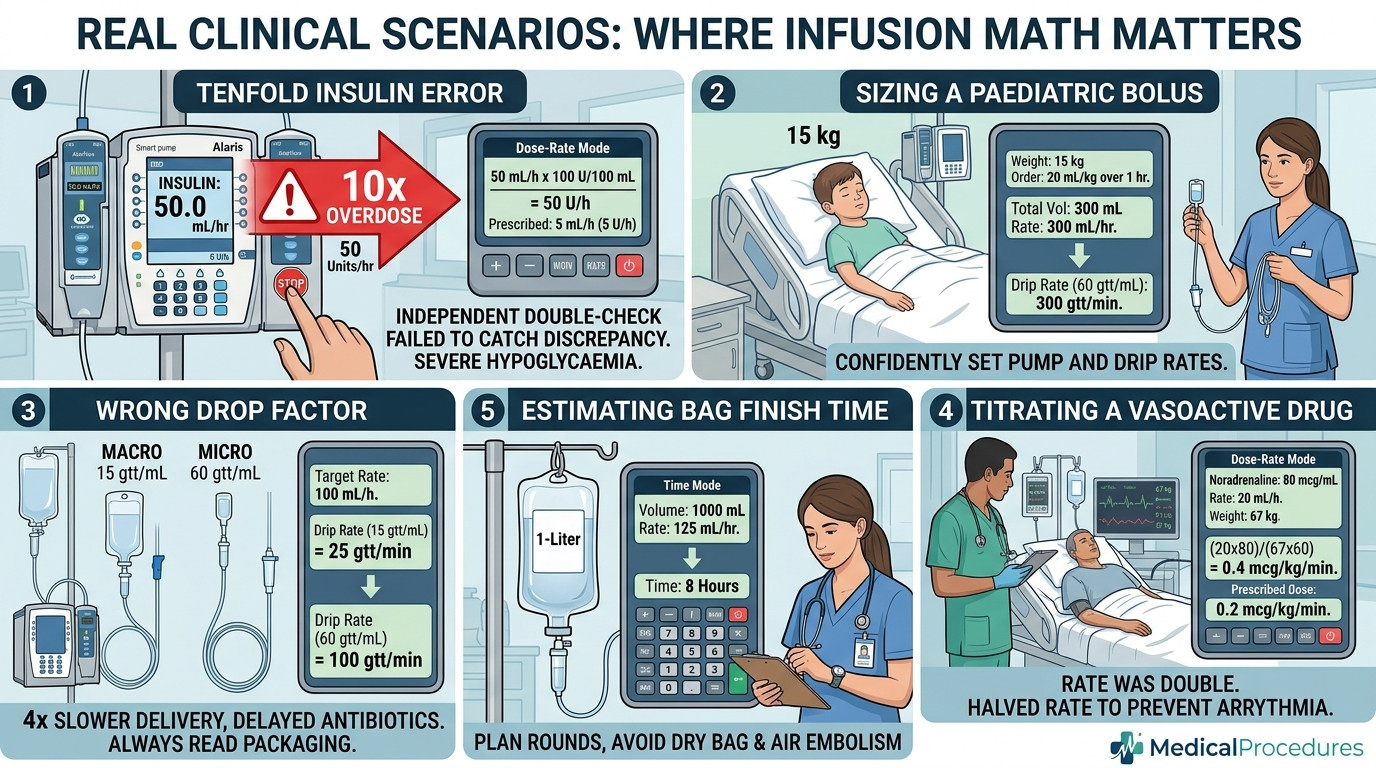
Scenario 1: A Tenfold Insulin Error
A nurse misread a hand-written insulin prescription and programmed a pump for 50 mL/hr instead of 5 mL/hr — a tenfold overdose. The patient became severely hypoglycaemic and required urgent dextrose. An independent double-check using the infusion rate calculator would have caught the discrepancy instantly, because the dose-rate mode would have shown the actual units per hour and flagged it against the prescription. The lesson: never rely on a single calculation for high-alert drugs.
Scenario 2: Sizing a Fluid Bolus in Paediatrics
A paediatrician ordered a 20 mL/kg fluid bolus for a dehydrated 15 kg child over 1 hour. The total is 300 mL, so the rate is 300 mL/hr. Using a micro-drip set (60 gtt/mL), the drip rate is 300 × 60 ÷ 60 = 300 gtt/min. The infusion rate calculator returned both the pump rate and the drip rate, letting the nurse choose the delivery method confidently.
Scenario 3: Wrong Drop Factor
A nurse set a gravity drip assuming a 15 gtt/mL macro-drip set, but the actual set was a 60 gtt/mL micro-drip. The fluid ran four times too slowly, delaying antibiotic delivery. Always read the drop factor printed on the giving-set packaging and enter it into the infusion rate calculator — never assume.
Scenario 4: Titrating a Vasoactive Drug
An intensivist needed to confirm that a noradrenaline infusion running at 20 mL/hr, with a concentration of 80 mcg/mL, was delivering the prescribed 0.2 mcg/kg/min to a 67 kg patient. The dose-rate mode of the infusion rate calculator returned (20 × 80) ÷ (67 × 60) = 0.4 mcg/kg/min — double the intended dose. The rate was halved, preventing hypertension and arrhythmia.
Scenario 5: Estimating Bag Finish Time
A ward nurse needed to know when a 1-litre bag running at 125 mL/hr would finish, to schedule the next bag. Using the Time mode: 1000 ÷ 125 = 8 hours. The infusion rate calculator gave the answer in seconds, allowing the nurse to plan rounds and avoid the bag running dry — which can cause line occlusion and air embolism risk.
Scenario 6: Converting a Dose Back to a Pump Rate
An intensivist prescribed dopamine at 5 mcg/kg/min for a 80 kg patient, with a standard concentration of 1600 mcg/mL (400 mg in 250 mL). The nurse needed to set the pump. Working backwards: total dose per minute = 5 × 80 = 400 mcg/min = 24,000 mcg/hr; rate = 24,000 ÷ 1600 = 15 mL/hr. The infusion rate calculator’s Dose mode lets you verify this in either direction.
Scenario 7: Paediatric Maintenance Fluids
A junior doctor needed to prescribe maintenance fluids for a 12 kg toddler using the Holliday-Segar formula: 100 mL/kg for the first 10 kg, plus 50 mL/kg for the next 10 kg. That gives 1000 + 100 = 1100 mL/day, or about 46 mL/hr over 24 hours. Running this through the mL/hr mode confirmed the rate and let the doctor document the calculation clearly.
Scenario 8: Antibiotic Timing in Sepsis
In suspected sepsis, antibiotics must be given within one hour. A patient needed 500 mg of vancomycin in 100 mL over 60 minutes. The rate is 100 ÷ 1 = 100 mL/hr. The infusion rate calculator confirmed this instantly, and the nurse could program the pump and start the infusion without delay — time-critical calculations are exactly where a tool that removes mental arithmetic under pressure pays off.
Common Infusion Calculation Mistakes
The errors clinicians make with infusion math cluster around a few predictable points. Understanding why they happen prevents them.
Mistake 1: Confusing Units (mg vs mcg, hr vs min)
The single most dangerous error is a unit mismatch — entering milligrams where micrograms were meant, or hours where minutes were meant, producing a tenfold or sixtyfold error. The infusion rate calculator forces you to state the unit of each input, but you must read the prescription carefully. Always write and read units explicitly.
Mistake 2: Using the Wrong Drop Factor
Drip-rate calculations depend entirely on the drop factor of the giving set. Assuming 20 gtt/mL when the set is 60 gtt/mL makes the drip run three times too slowly. Always read the drop factor from the packaging and enter it into the calculator.
Mistake 3: Skipping the Independent Double-Check
For high-alert drugs, a single person’s calculation is never enough. An independent double-check — two clinicians calculating separately and comparing — catches the majority of serious errors. Make it a habit for heparin, insulin, opioids, and all vasoactive infusions.
Mistake 4: Not Verifying Drug Concentration
Concentrations vary between institutions and preparations. A “standard” noradrenaline concentration of 80 mcg/mL in one hospital may be 160 mcg/mL in another. Always verify the actual concentration on the bag label before entering it into the infusion rate calculator.
Mistake 5: Relying on Memory Instead of Calculation
Even experienced clinicians make arithmetic errors under fatigue, interruption, or time pressure. Always run the numbers through the infusion rate calculator rather than trusting a mental estimate, especially for weight-based paediatric and critical-care drugs.
Mistake 6: Forgetting to Account for Patient Weight Changes
In paediatric and critical-care settings, a patient’s weight can change. A dose calculated on last week’s weight may now be wrong. Always use the current, verified weight, and recalculate weight-based infusions when the weight changes significantly.
Mistake 7: Ignoring the Line Dead-Space and Flush
When an infusion finishes or is changed, drug remains in the IV tubing (the dead-space). If the line is simply flushed, that residual drug can be delivered as a bolus — dangerous for drugs like heparin or insulin. Be aware of line dead-space, especially in paediatric lines.
💡 Rule of Thumb: Confirm every unit before calculating, read the drop factor from the giving-set packaging, verify the drug concentration on the bag label, use the infusion rate calculator for every rate, and perform an independent double-check for all high-alert drugs. That sequence protects patients every time.
Medication Safety Essentials
A correct calculation does not make an infusion safe — safe practice and verification do. Before administering any IV therapy, run through these essentials.
High-alert drugs: heparin, insulin, opioids, concentrated electrolytes (e.g. potassium chloride), and vasoactive infusions (noradrenaline, adrenaline, dobutamine, dopamine) carry the greatest risk of serious harm if given incorrectly. They require an independent double-check and extra labelling.
- Perform an independent double-check with a second qualified clinician for all high-alert infusions.
- Use the “Five Rights” — right patient, right drug, right dose, right route, right time — for every infusion.
- Verify the drug concentration on the bag label, not from memory or a default value.
- Read the drop factor from the giving-set packaging before calculating a drip rate.
- Label every infusion line with drug, concentration, rate, and time.
- Use a smart pump with drug-library dose limits wherever available.
- Monitor the patient continuously — clinical response is the ultimate check on any calculation.
- Communicate concentration changes — if a pharmacist changes a standard dilution, every nurse handling that infusion must be informed and recalculate.
- Document the calculation — record the prescribed dose, the concentration used, and the resulting rate.
- Be extra vigilant at handover — the transition between shifts is when infusion errors most often go unnoticed.
Which Mode Fits Your Situation
The five modes of the infusion rate calculator map to the five distinct IV-calculation tasks.
| Mode | Use Case | Key Formula | Inputs Needed | Typical Applications |
|---|---|---|---|---|
| mL/hr | Set pump flow rate | vol ÷ time | volume, time (hr) | Fluids, maintenance, antibiotics |
| Drip | Gravity set rate | vol×df÷min | volume, time (min), drop factor | No pump available |
| Time | Find infusion duration | vol ÷ rate | volume, rate | Bag finish, scheduling |
| Volume | Find volume delivered | rate × time | rate, time | Fluid balance, intake |
| Dose | Weight-based drug rate | (rate×conc)÷(wt×60) | rate, concentration, weight | Critical care, vasoactives |
Worked Examples
Example 1 — Maintenance fluids (mL/hr): A post-operative adult is prescribed 1 litre of 0.9% sodium chloride over 8 hours. Rate = 1000 ÷ 8 = 125 mL/hr. Program the pump to 125.
Example 2 — Gravity drip (gtt/min): A patient on a ward without a pump needs 500 mL over 4 hours (240 minutes) using a 15 gtt/mL macro-drip set. Drip rate = 500 × 15 ÷ 240 = 31 gtt/min.
Example 3 — Bag finish time (Time): A 1-litre bag is running at 83 mL/hr. Time = 1000 ÷ 83 = 12 hours.
Example 4 — Volume delivered (Volume): A patient has been on 62.5 mL/hr for 6 hours. Volume = 62.5 × 6 = 375 mL.
Example 5 — Weight-based dose (Dose): Noradrenaline at 40 mL/hr, concentration 80 mcg/mL, for a 70 kg patient. Dose = (40 × 80) ÷ (70 × 60) = 0.76 mcg/kg/min.
Frequently Asked Questions About the Infusion Rate Calculator
These questions come from nursing students, registered nurses, pharmacists, and critical-care clinicians who use an infusion rate calculator in their daily practice.
This infusion rate calculator provides five modes covering flow rate, drip rate, infusion time, volume delivered, and dose rate — all with step-by-step solutions for independent double-checking.
The mL/hr mode of the infusion rate calculator performs this calculation and shows each step for verification.
For example, 1000 mL over 480 minutes with a 20 gtt/mL set gives 1000 × 20 ÷ 480 ≈ 42 gtt/min. The Drip mode of the infusion rate calculator returns this instantly.
The drop factor converts a volume-over-time prescription into a countable drip rate, so it must always be read from the actual packaging — never assumed. Using the wrong drop factor changes the drip rate by several-fold.
This is useful for predicting when a bag will finish and scheduling the next one. The Time mode of the infusion rate calculator returns the time in both hours and minutes.
This is useful for fluid-balance charts and intake documentation. The Volume mode of the infusion rate calculator performs this multiplication.
For example, 30 mL/hr of a 400 mcg/mL drug for a 70 kg patient gives (30 × 400) ÷ (70 × 60) = 2.86 mcg/kg/min. The Dose mode of the infusion rate calculator handles this conversion.
Always confirm every unit, read the drop factor from the giving-set packaging, verify the drug concentration on the bag label, and double-check heparin, insulin, opioids, and vasoactive infusions with a second qualified clinician.
These require an independent double-check, clear labelling, and the use of smart pumps with drug-library dose limits wherever possible. According to ISMP, these drugs carry the greatest risk of serious patient harm when given in error.
Always verify every result against the prescription, confirm drug concentrations and units, and follow your organisation’s medication-safety procedures. The tool computes; the clinician decides.
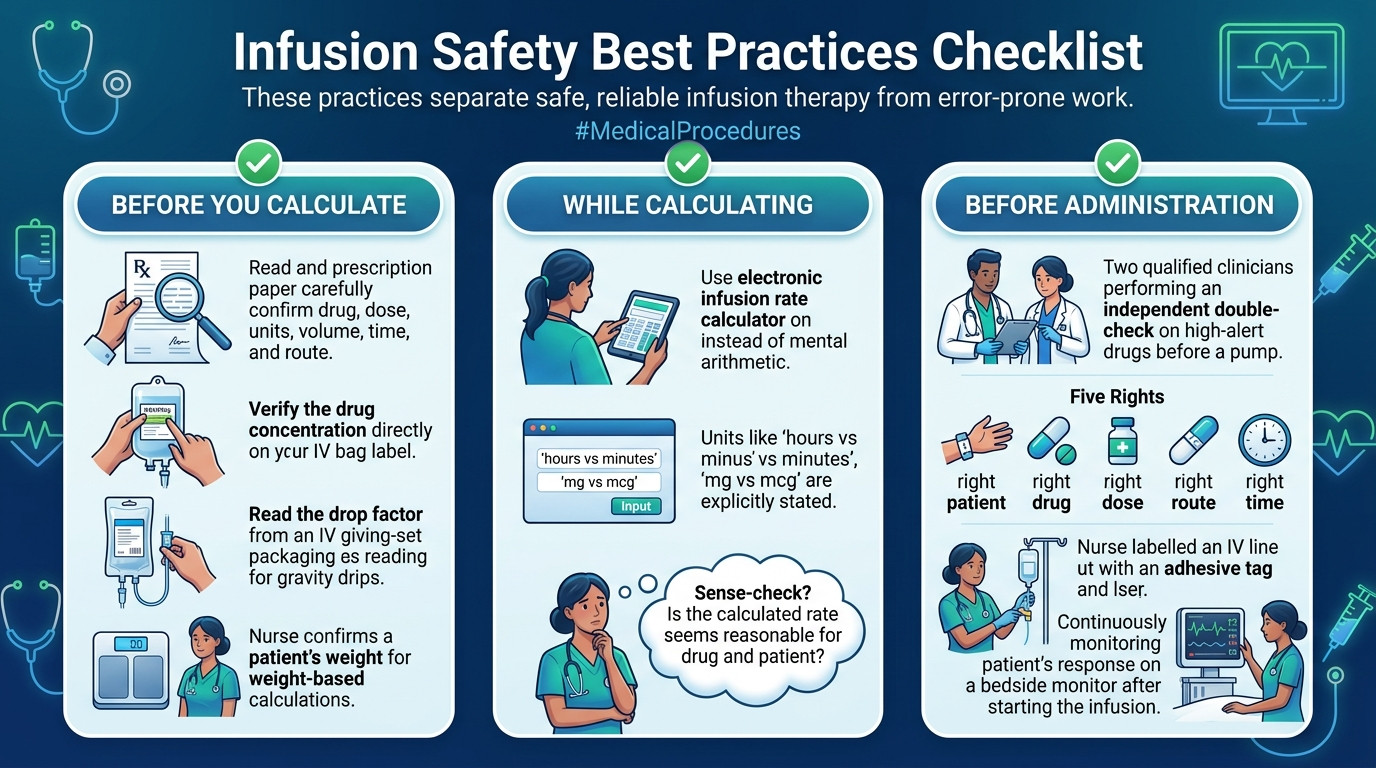
Infusion Safety Best Practices Checklist
These practices separate safe, reliable infusion therapy from error-prone work.
Before You Calculate
While Calculating
Before Administration
Trusted Reference Resources
These are authoritative references for safe and accurate IV therapy calculations.
ISMP (Institute for Safe Medication Practices) — ismp.org — High-alert medication lists, independent double-check guidance, and IV-safety best practices.
WHO (World Health Organization) — who.int — Guidelines on safe IV therapy, fluid management, and medication safety.
CDC Injection Safety — cdc.gov/injectionsafety — Aseptic technique, safe injection practices, and infection control for IV therapy.
NICE (UK National Institute for Health and Care Excellence) — nice.org.uk — Evidence-based guidance on IV fluid therapy and medicines optimisation.
LibreTexts Nursing & Pharmacology — med.libretexts.org — Free, peer-reviewed explanations of IV flow-rate, drip-rate, and dose calculations.
On our platform, related calculation tools include: mg/mL dilution calculator, dilution calculator, molarity dilution calculator, drug dose dilution calculator, dilution factor calculator, solution dilution calculator, medication dilution calculator, pharmaceutical dilution calculator, percentage dilution calculator, and weight by volume dilution calculator.
Leave a Review
Used this infusion rate calculator in your hospital, clinic, or nursing school? Share your experience below. Your review helps other clinicians decide if this infusion rate calculator fits their needs. Every review is stored locally on your device and appears instantly.
📝 Share Your Experience
Final Thoughts on Infusion Rate Calculation
Infusion rate calculation is one of those tasks that seems simple until the unit conversions, the drop factors, the drug concentrations, and the patient weights all meet in a single prescription. The arithmetic is, in principle, straightforward — divide volume by time, multiply by a drop factor, or apply a concentration and weight — but a single misplaced decimal or a unit read wrongly can produce a tenfold error, and for high-alert drugs that can mean the difference between a stable patient and a cardiac arrest. The infusion rate calculator exists to remove that arithmetic risk, handling every conversion internally and showing each step so the result can be verified, taught, and documented.
What separates safe infusion practice from error-prone practice is discipline, not genius. Confirming every unit before calculating, reading the drop factor from the actual giving-set packaging, verifying the drug concentration on the bag label rather than from memory, running every rate through the calculator instead of trusting a mental estimate, and — above all — performing an independent double-check for every high-alert drug: these are the habits that catch the errors the human brain makes under fatigue, interruption, and time pressure. The infusion rate calculator does the maths perfectly every time, but it cannot read a label or question a prescription — that remains the clinician’s responsibility.
The framework is short: read the prescription carefully, confirm the units, verify the concentration and drop factor, choose the right mode of the infusion rate calculator — mL/hr, Drip, Time, Volume, or Dose — and double-check the answer against the clinical context before administering. That sequence gives a defensible, safe infusion rate every time.
Keep this infusion rate calculator handy as your starting point for every IV calculation, and use the related dilution and concentration tools in the sidebar whenever you need to prepare or verify a drug concentration before infusion.
🔒 Privacy Guarantee: Every calculation on this page runs entirely within your browser. No data — volumes, rates, weights, drug concentrations, or any other inputs — is sent to any server, stored, or shared. Your calculations are completely private.
Pingback: Acid Dilution Calculator - Safe Lab & Industrial Use | Free Tool
Pingback: How to Calculate the Dilution Factor: 7 Simple Steps to Success
Pingback: Serial Dilution Calculation Table: Free Generator + Examples
Pingback: Mixing Ratio Calculator: Exact Volumes for Any Ratio (Free Tool)
Pingback: Neem Oil Dilution Ratio Calculator | Mix Neem Oil Correctly -
Pingback: Star San Sanitizer Multi-Unit Tool | Free No-Rinse Brewing Sanitizer
Pingback: Cleaning Solution Calculator | Calculate Dilution Instantly
Pingback: Pesticide Calculator | Calculate Spray Mix Instantly
Pingback: ABV Calculator – Calculate Alcohol by Volume Instantly
Pingback: IV Dilution Calculator | Calculate IV Drug Dilutions Instantly
Pingback: Neem Oil Emulsifier Calculator | Calculate Soap & Neem Ratios
Pingback: Antibiotic Dose Calculator | Calculate Accurate Dosages
Pingback: Brewing Calculator | Calculate Beer Brewing Values Instantly