
Chemical Mixing Calculator — Mix, Dilute & Prepare Solutions
A chemical mixing calculator works out exactly how much of each chemical and solvent to combine to reach a target concentration or volume. The core rule is conservation of solute: C₁V₁ = C₂V₂ for dilutions, a volume-weighted average for blending two solutions, and mass = concentration × volume when mixing from a solid. Enter any known values below and the calculator returns the exact amounts, with steps.
Key facts at a glance
- Dilution formula: C₁V₁ = C₂V₂ — stock concentration × stock volume = final concentration × final volume.
- Mixing two solutions: final concentration = (C₁V₁ + C₂V₂) ÷ (V₁ + V₂), a volume-weighted average.
- From a solid: mass needed = concentration (g/L) × volume (L); for molarity, mass = molarity × volume × molar mass.
- Percent solution: grams of solute = (target % ÷ 100) × final volume (mL) for % w/v.
- Golden safety rule: always add acid to water, never water to acid.
📋 Table of Contents
▼- What a Chemical Mixing Calculator Does
- Chemical Mixing Calculator — Five Modes
- How Chemical Mixing Is Calculated
- Real Scenarios Where Mixing Math Mattered
- Common Chemical Mixing Mistakes
- Chemical Mixing Safety Essentials
- Which Mode Fits Your Situation
- Frequently Asked Questions
- Chemical Mixing Best Practices Checklist
- Trusted Reference Resources
- User Reviews & Ratings
What a Chemical Mixing Calculator Does
A chemical mixing calculator tells you how much of each ingredient to combine to hit an exact concentration or volume. It removes the guesswork from preparing solutions, diluting a concentrate, blending two stocks, or weighing out a solid — the four tasks that make up almost all everyday mixing in labs, workshops, pools, farms, and kitchens.
The reason mixing trips people up is rarely the chemistry; it is the bookkeeping. You must keep units consistent, decide whether you are diluting or blending, and remember that the amount of solute is conserved no matter how much solvent you add. Get those three things right and every mixing problem becomes a single line of arithmetic.
This calculator handles the five most common chemical mixing tasks in one place: the C₁V₁ = C₂V₂ dilution solver, blending two solutions into one, preparing a percent (% w/v) solution, preparing a molar solution from a solid, and parts-based ratio mixing. Each mode shows the answer and the steps, so you can check the reasoning and learn the method.
Because dilution and mixing share the same underlying math, the tools in the sidebar — including our solution dilution calculator and molarity dilution calculator — are useful companions for any concentration task.
Chemical Mixing Calculator
Five modes — dilution (C₁V₁=C₂V₂), blend two solutions, percent solution, molar from solid & ratio mixing
Calculation Result
⚠️ Safety first: This calculator handles concentrations and volumes only. Never mix chemicals without checking compatibility (e.g., never combine bleach and ammonia), always add acid to water, and follow the Safety Data Sheet (SDS) for every substance.

How Chemical Mixing Is Calculated
Every chemical mixing calculation comes down to one principle: the amount of solute is conserved. Adding solvent changes the volume and concentration, but not the quantity of dissolved substance. From this single idea, four formulas cover almost every mixing task.
1. Diluting a Stock (C₁V₁ = C₂V₂)
To dilute, the stock concentration times its volume equals the final concentration times the final volume. Rearranged, the stock to take is V₁ = (C₂ × V₂) ÷ C₁, and the solvent to add is V₂ − V₁.
2. Blending Two Solutions
When you combine two solutions, the result is a volume-weighted average: final concentration = (C₁V₁ + C₂V₂) ÷ (V₁ + V₂). Equal volumes average evenly; unequal volumes pull toward the larger one.
Percent (w/v): grams = (percent ÷ 100) × volume(mL)
Ratio mix: chemical fraction = parts chemical ÷ (parts chemical + parts solvent)
3. Preparing a Percent Solution (% w/v)
A percent weight/volume solution is grams of solute per 100 mL. So grams needed = (target % ÷ 100) × final volume in mL. A 10% w/v solution in 500 mL needs 50 g of solute dissolved and made up to 500 mL.
4. Preparing a Molar Solution from a Solid
To make a molar solution from a powder, grams = molarity × volume in litres × molar mass. For 1 L of 0.5 M sodium chloride (molar mass 58.44 g/mol): 0.5 × 1 × 58.44 = 29.22 g.
Quick Reference Values
conserved
in 100 mL
(example)
stock
reverse
Remember: Keep all concentrations in one unit and all volumes in one unit before you calculate. The calculator returns the amounts; you confirm chemical compatibility and follow safe handling for every substance.

Real Scenarios Where Mixing Math Mattered
These five scenarios reflect real situations — in labs, on farms, in pools, and in cleaning — where the mixing arithmetic, or a missing step, made a real difference.
Scenario 1: A Cleaning Concentrate Mixed Too Strong
A facility diluted a disinfectant rated for 1:64 by eyeballing it, ending up closer to 1:20 — over three times too strong, wasting product and risking surface damage. Using the Ratio Mix mode (1 part chemical to 64 parts water for a given final volume) would have given exact volumes in seconds.
Scenario 2: A Buffer That Was Ten Times Off
A technician needed 250 mL of 0.1 M buffer from a 1 M stock. The correct dilution is V₁ = (0.1 × 250) ÷ 1 = 25 mL of stock made up to 250 mL. Instead they used 250 mL of stock — a tenfold error that ruined the run. The Dilution mode prevents this.
Scenario 3: Weighing a Solid by Guess
A student preparing 1 L of 0.5 M NaCl guessed “about 30 g,” not far off, but for a sensitive assay the small error mattered. The exact figure is 0.5 × 1 × 58.44 = 29.22 g. The Molar (Solid) mode gives the precise mass.
Scenario 4: Blending Two Tanks
A grower combined 200 L of nutrient solution at 30 units with 300 L at 5 units and needed the resulting strength. The blend is (30×200 + 5×300) ÷ 500 = 15 units. The Blend 2 mode answers this volume-weighted question directly.
Scenario 5: A Percent Solution for the Lab
A lab needed 500 mL of 10% w/v solution and wasn’t sure how much solid to weigh. The answer is (10 ÷ 100) × 500 = 50 g dissolved and made up to 500 mL. The Percent mode shows the mass and the method.

Common Chemical Mixing Mistakes
The errors people make when mixing chemicals cluster around a few predictable points. Understanding why they happen prevents them.
Mistake 1: Mismatched Units
C₁V₁ = C₂V₂ only works when both concentrations share a unit and both volumes share a unit. Mixing molarity with percent, or mL with L, silently produces a wrong number.
Prevention: convert everything to one unit first. Our molarity dilution calculator helps standardise units.
Mistake 2: Confusing Dilution with Blending
Diluting adds pure solvent; blending combines two solutions that both contain solute. They use different formulas — use the Dilution mode for the first and Blend 2 for the second.
Mistake 3: Adding Solvent Instead of Making Up to Volume
For large dilutions the stock and solvent volumes differ greatly. Add the calculated stock, then make up to the final volume — the solvent added equals V₂ − V₁, not V₂.
Mistake 4: Ignoring Molar Mass When Mixing from a Solid
You cannot weigh out a molar solution without the molar mass. Grams = molarity × volume × molar mass — skipping the molar mass gives a meaningless number.
Mistake 5: Mixing Incompatible Chemicals
This is the dangerous one. Some combinations release toxic gas or react violently (for example, bleach with ammonia or acid). Always check compatibility and the SDS before combining anything.
💡 Rule of Thumb: Pick the right mode (dilute, blend, percent, molar, or ratio), keep one consistent unit, make up to the final volume rather than over-adding solvent, and confirm chemical compatibility before you mix anything.
Chemical Mixing Safety Essentials
Accurate math does not make a mix safe — compatibility does. Before combining any chemicals, run through these essentials.
Never mix these: bleach + ammonia (toxic chloramine gas), bleach + acids (chlorine gas), hydrogen peroxide + vinegar, and different drain cleaners. When in doubt, do not combine.
- Always add acid to water, never water to acid — dilution is exothermic and can splatter.
- Read the Safety Data Sheet (SDS) for every chemical before mixing.
- Wear appropriate PPE — gloves, eye protection, and ventilation as required.
- Mix in a well-ventilated area and label every container with contents and concentration.
- Add slowly and stir to control heat and reaction rate.
This calculator is an engineering and planning aid for concentrations and volumes. It is not a substitute for professional safety guidance or the SDS.
Which Mode Fits Your Situation
The five modes map to the five distinct chemical mixing tasks. Choosing the right one applies the correct logic.
Chemical Mixing Mode Comparison Table
| Mode | Use Case | Key Formula | Inputs Needed | Typical Applications |
|---|---|---|---|---|
| Dilution | Weaken a stock | V₁ = C₂V₂ ÷ C₁ | 3 of 4 values | Buffers, reagents, cleaners |
| Blend 2 | Combine two solutions | (C₁V₁+C₂V₂)/(V₁+V₂) | 2 conc, 2 volumes | Tanks, batches |
| Percent | Make % w/v solution | g = (%/100)×mL | percent, volume | Saline, lab solutions |
| Molar (Solid) | Weigh from powder | g = M×V×molar mass | molarity, vol, molar mass | Standards, reagents |
| Ratio Mix | Parts-based mixing | frac = parts ÷ total | parts, final volume | Concentrates, coolants |
Practical Decision Guide
Weakening a concentrate? Use Dilution mode, or the dedicated solution dilution calculator.
Combining two solutions? Use Blend 2 mode for the volume-weighted result.
Making a % w/v solution? Use Percent mode, or our percentage dilution calculator.
Weighing a solid for a molar solution? Use Molar (Solid) mode, or the molarity dilution calculator and mg/mL dilution calculator.
Following a label ratio like 1:64? Use Ratio Mix mode, or the dilution ratio calculator.
‘+(diff<1?’\u2705 Consistent’:’\u26a0\ufe0f Inconsistent’)+’ (\u0394’+diff.toFixed(2)+’%)‘, ‘
Verification
‘+step(1,’C\u2081\u00d7V\u2081 = ‘+cmFmt(c1)+’ \u00d7 ‘+cmFmt(v1)+’ = ‘+cmFmt(lhs))+step(2,’C\u2082\u00d7V\u2082 = ‘+cmFmt(c2)+’ \u00d7 ‘+cmFmt(v2)+’ = ‘+cmFmt(rhs)),null);return;} if(isNaN(result)||!isFinite(result)||result<0){cmErr(‘Invalid calculation. Ensure all values are positive and non-zero.’);return;} var s=’Dilution Calculation
‘; s+=step(1,’Formula: C\u2081 \u00d7 V\u2081 = C\u2082 \u00d7 V\u2082 (solute is conserved)’); s+=step(2,’Solving for ‘+solve+’:’); if(solve===’C\u2081′)s+=step(3,’C\u2081 = (C\u2082\u00d7V\u2082)/V\u2081 = (‘+cmFmt(c2)+’ \u00d7 ‘+cmFmt(v2)+’) / ‘+cmFmt(v1)+’ = ‘+cmFmt(result)+’‘); else if(solve===’V\u2081’){s+=step(3,’V\u2081 = (C\u2082\u00d7V\u2082)/C\u2081 = (‘+cmFmt(c2)+’ \u00d7 ‘+cmFmt(v2)+’) / ‘+cmFmt(c1)+’ = ‘+cmFmt(result)+’ of stock‘);s+=step(4,’Solvent to add = V\u2082 \u2212 V\u2081 = ‘+cmFmt(v2)+’ \u2212 ‘+cmFmt(result)+’ = ‘+cmFmt(cmRnd(v2-result,6))+’‘);} else if(solve===’C\u2082’)s+=step(3,’C\u2082 = (C\u2081\u00d7V\u2081)/V\u2082 = (‘+cmFmt(c1)+’ \u00d7 ‘+cmFmt(v1)+’) / ‘+cmFmt(v2)+’ = ‘+cmFmt(result)+’‘); else s+=step(3,’V\u2082 = (C\u2081\u00d7V\u2081)/C\u2082 = (‘+cmFmt(c1)+’ \u00d7 ‘+cmFmt(v1)+’) / ‘+cmFmt(c2)+’ = ‘+cmFmt(result)+’ total‘); cmShowResult(solve+’ = ‘+cmFmt(result)+’‘,s,null); };// ===== BLEND 2 ===== window.cmCalcBlend=function(){ var c1=parseFloat(gid(‘cm-bl-c1’).value),v1=parseFloat(gid(‘cm-bl-v1’).value),c2=parseFloat(gid(‘cm-bl-c2’).value),v2=parseFloat(gid(‘cm-bl-v2’).value); if(isNaN(c1)||c1<0){cmErr(‘Enter a valid concentration for Solution A.’);return;} if(isNaN(v1)||v1<0){cmErr(‘Enter a valid volume for Solution A.’);return;} if(isNaN(c2)||c2<0){cmErr(‘Enter a valid concentration for Solution B.’);return;} if(isNaN(v2)||v2<0){cmErr(‘Enter a valid volume for Solution B.’);return;} if(v1+v2<=0){cmErr(‘Total volume must be greater than zero.’);return;} var blend=cmRnd((c1*v1+c2*v2)/(v1+v2),6); var s=’Blended Concentration
‘; s+=step(1,’Solute from A = ‘+cmFmt(c1)+’ \u00d7 ‘+cmFmt(v1)+’ = ‘+cmFmt(cmRnd(c1*v1,6))); s+=step(2,’Solute from B = ‘+cmFmt(c2)+’ \u00d7 ‘+cmFmt(v2)+’ = ‘+cmFmt(cmRnd(c2*v2,6))); s+=step(3,’Total volume = ‘+cmFmt(v1)+’ + ‘+cmFmt(v2)+’ = ‘+cmFmt(v1+v2)); s+=step(4,’Blend = (‘+cmFmt(cmRnd(c1*v1,6))+’ + ‘+cmFmt(cmRnd(c2*v2,6))+’) \u00f7 ‘+cmFmt(v1+v2)+’ = ‘+cmFmt(blend)+’‘); var t=’total volume ‘+cmFmt(v1+v2)+’‘,s,t); };// ===== PERCENT ===== window.cmCalcPercent=function(){ var pct=parseFloat(gid(‘cm-pc-pct’).value),vol=parseFloat(gid(‘cm-pc-vol’).value); if(isNaN(pct)||pct<=0||pct>100){cmErr(‘Enter a valid percent strength between 0 and 100.’);return;} if(isNaN(vol)||vol<=0){cmErr(‘Enter a valid final volume greater than zero.’);return;} var grams=cmRnd((pct/100)*vol,6); var s=’
Percent (w/v) Solution
‘; s+=step(1,’% w/v means grams of solute per 100 mL’); s+=step(2,’Grams = (percent \u00f7 100) \u00d7 volume = (‘+cmFmt(pct)+’ \u00f7 100) \u00d7 ‘+cmFmt(vol)+’ mL = ‘+cmFmt(grams)+’ g‘); s+=step(3,’Dissolve ‘+cmFmt(grams)+’ g of solute and make up to ‘+cmFmt(vol)+’ mL total.’); var t=’\u2192 make up to ‘+cmFmt(vol)+’ mL = ‘+cmFmt(pct)+’% w/v‘,s,t); };// ===== MOLAR FROM SOLID ===== window.cmCalcMolar=function(){ var M=parseFloat(gid(‘cm-mo-m’).value),V=parseFloat(gid(‘cm-mo-v’).value),mw=parseFloat(gid(‘cm-mo-mw’).value); if(isNaN(M)||M<=0){cmErr(‘Enter a valid molarity greater than zero.’);return;} if(isNaN(V)||V<=0){cmErr(‘Enter a valid volume greater than zero.’);return;} if(isNaN(mw)||mw<=0){cmErr(‘Enter a valid molar mass greater than zero.’);return;} var moles=cmRnd(M*V,6); var grams=cmRnd(M*V*mw,6); var s=’
Molar Solution from a Solid
‘; s+=step(1,’Moles = molarity \u00d7 volume = ‘+cmFmt(M)+’ \u00d7 ‘+cmFmt(V)+’ = ‘+cmFmt(moles)+’ mol‘); s+=step(2,’Grams = moles \u00d7 molar mass = ‘+cmFmt(moles)+’ \u00d7 ‘+cmFmt(mw)+’ = ‘+cmFmt(grams)+’ g‘); s+=step(3,’Dissolve ‘+cmFmt(grams)+’ g and make up to ‘+cmFmt(V)+’ L for ‘+cmFmt(M)+’ mol/L.’); var t=’\u2192 make up to ‘+cmFmt(V)+’ L = ‘+cmFmt(M)+’ M‘,s,t); };// ===== RATIO MIX ===== window.cmCalcRatio=function(){ var ps=parseFloat(gid(‘cm-rt-stock’).value),pd=parseFloat(gid(‘cm-rt-dil’).value),vol=parseFloat(gid(‘cm-rt-vol’).value); if(isNaN(ps)||ps<=0){cmErr(‘Enter a valid number of parts of chemical greater than zero.’);return;} if(isNaN(pd)||pd<0){cmErr(‘Enter a valid number of parts of solvent (zero or more).’);return;} if(isNaN(vol)||vol<=0){cmErr(‘Enter a valid final volume greater than zero.’);return;} var total=ps+pd; var chem=cmRnd(vol*ps/total,6),solv=cmRnd(vol*pd/total,6),fold=cmRnd(total/ps,6); var s=’
Ratio Mixing
‘; s+=step(1,’Ratio = ‘+cmFmt(ps)+’ part(s) chemical : ‘+cmFmt(pd)+’ part(s) solvent = ‘+cmFmt(total)+’ total parts’); s+=step(2,’Chemical = ‘+cmFmt(vol)+’ \u00d7 ‘+cmFmt(ps)+’/’+cmFmt(total)+’ = ‘+cmFmt(chem)+’‘); s+=step(3,’Solvent = ‘+cmFmt(vol)+’ \u00d7 ‘+cmFmt(pd)+’/’+cmFmt(total)+’ = ‘+cmFmt(solv)+’‘); s+=step(4,’This equals a ‘+cmFmt(fold)+’-fold dilution (1-in-‘+cmFmt(fold)+’).’); var t=’‘+cmFmt(fold)+’-fold \u2192 ‘+cmFmt(vol)+’ total‘,s,t); };// ===== FAQ ===== document.addEventListener(‘click’,function(e){ var q=e.target.closest(‘#swiftcalcu-chemical-mixing-container .cm-faq-q’); if(!q)return; var item=q.closest(‘.cm-faq-item’); document.querySelectorAll(‘#swiftcalcu-chemical-mixing-container .cm-faq-item’).forEach(function(fi){if(fi!==item)fi.classList.remove(‘open’);}); item.classList.toggle(‘open’); }); // ===== STARS ===== document.addEventListener(‘click’,function(e){ var star=e.target.closest(‘#swiftcalcu-chemical-mixing-container .cm-star-input span’); if(!star)return; var val=parseInt(star.getAttribute(‘data-val’));var container=star.closest(‘.cm-star-input’);container.setAttribute(‘data-sel’,val); container.querySelectorAll(‘span’).forEach(function(s){parseInt(s.getAttribute(‘data-val’))<=val?s.classList.add(‘lit’):s.classList.remove(‘lit’);}); }); // ===== SUBMIT REVIEW ===== window.cmSubmitReview=function(){ var name=gid(‘cm-rname’),role=gid(‘cm-rrole’),text=gid(‘cm-rtext’); var sc=document.querySelector(‘#swiftcalcu-chemical-mixing-container .cm-star-input’); var rating=sc?parseInt(sc.getAttribute(‘data-sel’)||’0′):0; if(!name.value.trim()){cmErr(‘Please enter your name.’);return;} if(rating===0){cmErr(‘Please select a star rating.’);return;} if(!text.value.trim()){cmErr(‘Please write your review.’);return;} cmHideErr(); var list=document.querySelector(‘#swiftcalcu-chemical-mixing-container .cm-reviews-list’); var stars=”;for(var i=0;i<5;i++)stars+=i
Frequently Asked Questions About Chemical Mixing
These questions come from lab workers, industrial users, growers, and DIYers who mix chemicals in their actual work. The answers are short and direct.
To calculate chemical mixing, use the formula that matches the task. For dilution, use C₁V₁ = C₂V₂. For blending two solutions, use final concentration = (C₁V₁ + C₂V₂) ÷ (V₁ + V₂). For a solid, use grams = molarity × volume × molar mass.
In every case, keep concentrations in one unit and volumes in one unit, and remember the amount of solute is conserved.
This calculator applies all of these automatically and shows the worked steps.
The mixed concentration is a volume-weighted average: C = (C₁V₁ + C₂V₂) ÷ (V₁ + V₂), where C₁ and C₂ are the two concentrations and V₁ and V₂ their volumes.
For example, mixing 200 mL at 30% with 300 mL at 5% gives (30×200 + 5×300) ÷ 500 = 15%.
Use the Blend 2 mode for this exact calculation.
A 1:10 dilution usually means 1 part chemical to 10 parts water (11 parts total). For 1100 mL total, that is 100 mL chemical and 1000 mL water.
If “1:10” means a 10-fold dilution (1 part in 10 total), it is 110 mL chemical and 990 mL water for 1100 mL. Always confirm which definition the label uses.
The Ratio Mix mode lets you enter parts explicitly and returns exact volumes.
For a % w/v solution, grams of solute = (target % ÷ 100) × final volume in mL. A 10% w/v solution in 500 mL needs 50 g.
Dissolve the solute in some solvent, then make up to the final volume — do not just add the full volume of solvent to the solid.
The Percent mode gives the exact mass for any strength and volume.
Grams needed = molarity × volume in litres × molar mass. For 1 L of 0.5 M NaCl (molar mass 58.44 g/mol): 0.5 × 1 × 58.44 = 29.22 g.
You must know the molar mass of the compound — it comes from the periodic table or the chemical’s label.
The Molar (Solid) mode does this for any compound; the molarity dilution calculator covers liquid stocks.
Never mix bleach with ammonia (produces toxic chloramine gas), bleach with acids (produces chlorine gas), or hydrogen peroxide with vinegar. Different drain cleaners should also never be combined.
When in doubt, do not combine chemicals. Always check the Safety Data Sheet (SDS) and product labels first.
This calculator handles concentrations only; chemical compatibility is a separate safety check you must do yourself.
Always add acid to water, never water to acid. Diluting concentrated acid releases heat, and adding water to acid can cause the mixture to boil and splatter dangerously.
Add the acid slowly to a larger volume of water so the heat is absorbed and dissipated safely.
The mixing math is the same either way, but the order is a critical safety rule.
Diluting adds pure solvent to a single stock to lower its concentration, using C₁V₁ = C₂V₂. Blending combines two solutions that both contain solute, using a volume-weighted average.
Use the Dilution mode for the first and the Blend 2 mode for the second — they are different calculations.
Picking the right one is the most important step for an accurate result.
Before calculating, convert all concentrations to one unit (for example, all molarity or all percent) and all volumes to one unit (all mL or all L). Mismatched units are the most common mixing error.
Write the unit next to every number as a check; if they do not cancel cleanly, fix them first.
Our molarity dilution calculator and mg/mL dilution calculator help standardise units.
Yes. This chemical mixing calculator is completely free, runs entirely in your browser, and requires no sign-up.
All calculations are private — no data you enter is sent to any server or stored.
You can use every mode and the related tools in the sidebar at no cost.
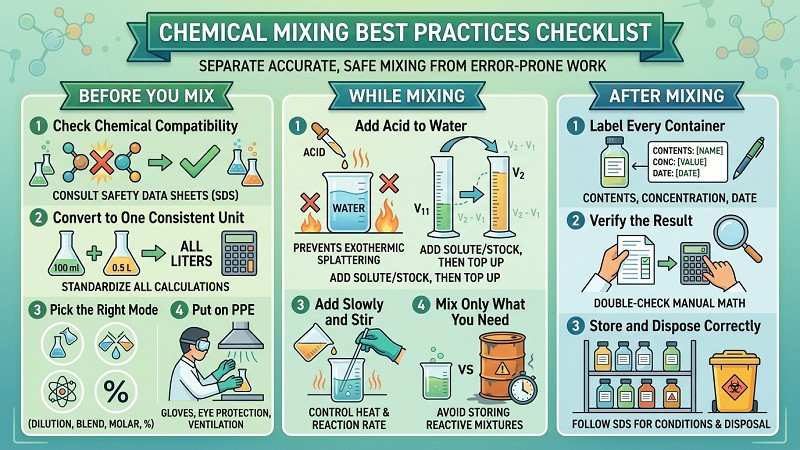
Chemical Mixing Best Practices Checklist
These practices separate accurate, safe mixing from error-prone work. Many take only seconds.
Before You Mix
While Mixing
After Mixing
For the dilution and concentration math behind mixing, see our solution dilution calculator, percentage dilution calculator, and dilution factor calculator.
Trusted Reference Resources for Chemical Mixing
These are authoritative references for safe and accurate chemical mixing.
OSHA (Occupational Safety and Health Administration) — osha.gov — Guidance on hazardous chemical handling, the Hazard Communication Standard, and Safety Data Sheets.
CDC / NIOSH — cdc.gov/niosh — The NIOSH Pocket Guide and chemical incompatibility information for safe workplace mixing.
NIST (National Institute of Standards and Technology) — nist.gov — Reference data on units, molar masses, and measurement accuracy relevant to solution preparation.
LibreTexts Chemistry — chem.libretexts.org — Free, peer-reviewed explanations of molarity, percent solutions, dilution, and concentration math.
US EPA (Environmental Protection Agency) — epa.gov — Guidance on safe use, storage, and disposal of chemicals and concentrates.
On our platform, related calculation tools include: dilution calculator, solution dilution calculator, molarity dilution calculator, and dilution ratio calculator.
User Reviews & Ratings
📝 Share Your Experience with This Calculator
Final Thoughts on Chemical Mixing
Chemical mixing is one of those tasks that seems simple until the numbers and the safety meet. The math is straightforward — conserve the solute, keep units consistent, pick the right formula — but a single unit slip or an incompatible pairing can ruin a batch or create a hazard.
The framework is short: choose the mode that matches your task (dilute, blend, make a percent solution, weigh from a solid, or mix by ratio), keep one consistent unit, make up to the final volume, and always confirm chemical compatibility before combining anything. That sequence gives an accurate, reproducible result every time.
From labs and factories to farms, pools, and homes, chemical mixing math is everywhere a concentrate becomes something usable. Keep this calculator handy as your starting point, and use the related tools in the sidebar whenever you need to adjust a concentration.
🔒 Privacy Guarantee: Every calculation on this page runs entirely within your browser. No data — concentrations, volumes, or any other inputs — is sent to any server, stored, or shared. Your calculations are completely private.
Pingback: Ratio Dilution Calculator - Convert 1:10, 1:32 to Volumes | Free
Pingback: Dilution Calculator mg/mL - Protein, Drug & Lab Solutions | Free
Pingback: Drug Dose Dilution Calculator (Free Online Tool) – Accurate & Instant Results
Pingback: How to Do a Dilution Calculation – Step-by-Step Guide & Free Calculator
Pingback: How to Calculate Dilution Factor: Formula + Free Calculator
Pingback: Mixing Ratio Calculator: Exact Volumes for Any Ratio (Free Tool)
Pingback: Infusion Rate Calculator – Calculate IV Infusion Rates Instantly
Pingback: Neem Oil Dilution Ratio Calculator | Mix Neem Oil Correctly -
Pingback: Western Blot Calculator – Calculate Sample Loading Instantly
Pingback: Cleaning Solution Calculator | Calculate Dilution Instantly
Pingback: ABV Calculator – Calculate Alcohol by Volume Instantly
Pingback: Solution Stability | Complete Guide to Chemical Stability
Pingback: Percent by Mass Calculator | Calculate Mass Percentage Instantly
Pingback: Pool Chemical Calculator | Calculate Pool Chemicals Instantly