
Viscosity Calculator — Dynamic Viscosity, Kinematic Viscosity, Reynolds Number, Unit Conversion & Fluid Flow Planning
A Viscosity Calculator helps calculate dynamic viscosity, kinematic viscosity, shear-based viscosity, Reynolds number, density-linked conversions, and common viscosity units such as cP, mPa·s, Pa·s, poise, cSt, and St. Dynamic viscosity describes a fluid’s internal resistance to flow, while kinematic viscosity equals dynamic viscosity divided by density. The most used relationships are η = shear stress ÷ shear rate, ν = η ÷ ρ, and Re = ρVD ÷ η. This Viscosity Calculator is useful for laboratory QC, process engineering, coatings, lubricants, foods, cosmetics, polymers, fuels, pumps, pipes, and fluid-handling calculations.
Key facts at a glance
- Dynamic viscosity: η = shear stress ÷ shear rate.
- Kinematic viscosity: ν = dynamic viscosity ÷ density.
- Common conversion: 1 cP = 1 mPa·s = 0.001 Pa·s.
- Kinematic unit: 1 cSt = 1 mm²/s.
- Reynolds number: Re = density × velocity × diameter ÷ dynamic viscosity.
- Best practice: always record temperature, density, test method, and whether the fluid is Newtonian or non-Newtonian.
📋 Table of Contents
▼
- What a Viscosity Calculator Does
- Viscosity Calculator — Advanced Tool
- How Viscosity Calculations Work
- Real Scenarios Where Viscosity Matters
- Common Viscosity Mistakes
- Handling, Safety & Quality Essentials
- Which Mode Fits Your Workflow
- Frequently Asked Questions
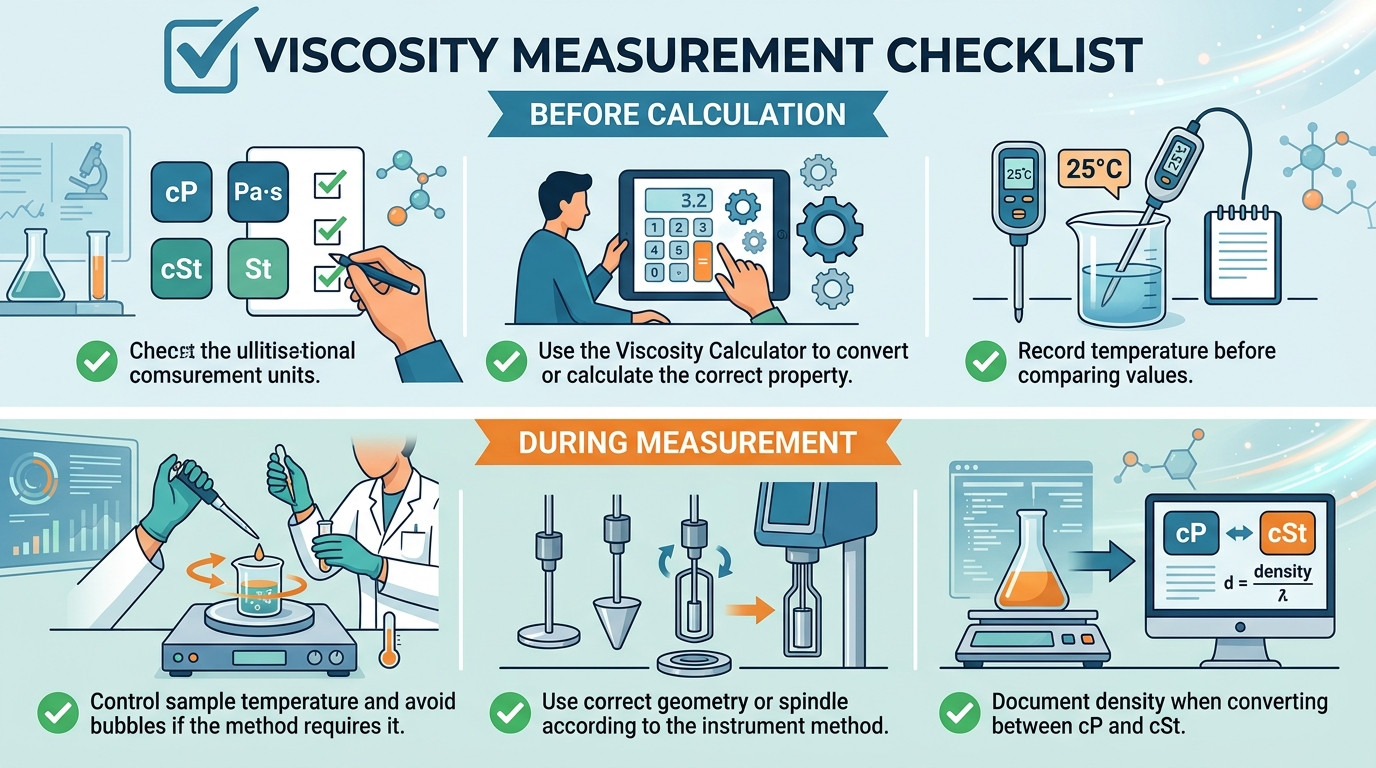
- Viscosity Measurement Checklist
- Trusted Reference Resources
- User Reviews & Ratings
What a Viscosity Calculator Does
A Viscosity Calculator converts viscosity measurements and fluid properties into usable engineering or laboratory values. Viscosity is not just a number; it describes how a fluid flows, pumps, spreads, sprays, coats, mixes, and resists deformation. A thin solvent, a syrup, a lubricant, a polymer melt, a coating, and a cosmetic gel can all be described by viscosity, but they may require different units and different measurement conditions.
The Viscosity Calculator is helpful because viscosity data appear in several unit systems. A lab report may list cP, a lubricant sheet may list cSt, a fluid mechanics calculation may require Pa·s, and a quality-control method may state shear rate and shear stress. This calculator keeps the relationships visible so users can convert values without losing track of density, temperature, or the difference between dynamic and kinematic viscosity.
The tool below includes five modes: shear stress to dynamic viscosity, dynamic-to-kinematic conversion, kinematic-to-dynamic conversion, Reynolds number estimation, and unit conversion. Each mode follows the same blue design pattern as the previous calculator pages, including the same hero panel, button grid, result card, step output, review area, sidebar, FAQ, callouts, reference cards, and schema style.
Use the Viscosity Calculator as a calculation and documentation aid. It does not replace a calibrated viscometer, rheometer, temperature bath, density measurement, validated ASTM or ISO method, safety data sheet, or engineering design review. Real fluids may be Newtonian or non-Newtonian, and viscosity can depend on temperature, shear rate, pressure, concentration, solids content, aging, and sample preparation.
Viscosity Calculator
Calculate shear viscosity, cP to cSt conversion, cSt to cP conversion, Reynolds number, and viscosity unit conversions with step-by-step working.
Calculation Result
Step-by-step working
How Viscosity Calculations Work
Viscosity describes how strongly a fluid resists flow. A Viscosity Calculator can work with dynamic viscosity, kinematic viscosity, density, shear stress, shear rate, and flow geometry. Dynamic viscosity is the direct measure of internal friction in a fluid. Kinematic viscosity adjusts that resistance for density, which is why oils, solvents, syrups, fuels, and aqueous solutions may be reported in different units depending on the field.
The most common dynamic viscosity units are Pa·s, mPa·s, cP, and poise. A Viscosity Calculator is useful because 1 cP equals 1 mPa·s, but 1 Pa·s equals 1000 cP. Unit errors can be very large when converting between laboratory and engineering values. Kinematic viscosity is commonly reported as cSt or mm²/s, especially in lubricant and process-fluid documentation.
Dynamic Viscosity
Dynamic viscosity is calculated as shear stress divided by shear rate for Newtonian fluids. A Viscosity Calculator can use η = τ/γ̇ when shear stress and shear rate are known. This is common in rheology, coatings, food texture, polymer solutions, and quality-control methods. The result is meaningful only when the test conditions, temperature, spindle, geometry, and shear rate are appropriate for the fluid.
Kinematic Viscosity
Kinematic viscosity equals dynamic viscosity divided by density. A Viscosity Calculator converts cP to cSt by first converting cP to Pa·s, dividing by kg/m³ density, and converting m²/s to cSt. For water near room temperature, dynamic viscosity is about 1 cP and kinematic viscosity is about 1 cSt because density is close to 1000 kg/m³.
Reynolds Number
Reynolds number compares inertial forces with viscous forces. A Viscosity Calculator can estimate Re = ρVD/μ for pipe-flow style checks. Low Reynolds number usually indicates laminar flow, high Reynolds number suggests turbulent flow, and intermediate values may be transitional. Exact interpretation depends on geometry, roughness, inlet conditions, and fluid behavior.
Temperature Effects
Viscosity is strongly temperature-dependent. Liquids usually become less viscous as temperature rises, while gases often show different behavior. A Viscosity Calculator can convert units, but it cannot make a value measured at 20°C valid at 60°C. Temperature, pressure, composition, and shear rate should always be recorded with the viscosity result.
1 cP = 1 mPa·s = 0.001 Pa·s
1 cSt = 1 mm²/s
Re = density × velocity × diameter ÷ dynamic viscosity
dynamic viscosity = kinematic viscosity × density
Remember: the Viscosity Calculator provides arithmetic and unit conversions. Real viscosity measurement depends on calibrated instruments, temperature control, sample preparation, and whether the fluid is Newtonian or non-Newtonian.

Real Scenarios Where Viscosity Matters
Scenario 1: Converting cP to cSt
A lubricant datasheet gives dynamic viscosity in cP, but the process worksheet needs kinematic viscosity in cSt. A Viscosity Calculator uses density to convert dynamic viscosity into kinematic viscosity.
Scenario 2: Checking Flow Regime
An engineer wants to know whether flow in a pipe is likely laminar or turbulent. A Viscosity Calculator calculates Reynolds number from density, velocity, diameter, and dynamic viscosity.
Scenario 3: Formulation QC
A cosmetic, syrup, coating, or polymer batch may need a viscosity check at a defined temperature and shear condition. The Viscosity Calculator helps convert the measured value into the required reporting units.
Scenario 4: Food Texture Comparison
Food products such as sauces, syrups, gels, and beverages may be compared by viscosity. The Viscosity Calculator can help standardize unit conversions, but sensory texture and non-Newtonian behavior still require method-specific testing.
Scenario 5: Laboratory Standard Review
Viscosity reference standards are often provided with values at specific temperatures. A Viscosity Calculator helps convert units while the certificate controls the valid temperature and uncertainty.
Scenario 6: Pump and Pipe Selection
High-viscosity fluids need different pump and pipe assumptions than water-like fluids. A Viscosity Calculator can support preliminary calculations, but final equipment selection should include engineering review and manufacturer data.

Common Viscosity Mistakes
Mistake 1: Ignoring Temperature
Temperature can change viscosity dramatically. A Viscosity Calculator can convert units, but it cannot correct a measurement made at the wrong temperature unless a validated temperature model is used.
Mistake 2: Confusing cP and cSt
cP is dynamic viscosity, while cSt is kinematic viscosity. A Viscosity Calculator uses density to convert between them. Without density, the conversion is incomplete.
Mistake 3: Assuming Every Fluid Is Newtonian
Many fluids change apparent viscosity with shear rate. A Viscosity Calculator may use simple equations, but non-Newtonian samples require method-specific shear conditions.
Mistake 4: Missing Density
Kinematic and dynamic viscosity conversion requires density. Entering the wrong density can shift the result and produce misleading values.
Mistake 5: Reporting Without Method Details
Viscosity should be reported with temperature, instrument, geometry, spindle, shear rate, sample preparation, and units when applicable.
💡 Rule of Thumb: record viscosity value, units, temperature, density, and method conditions. The Viscosity Calculator handles math; the measurement method controls validity.
Handling, Safety & Quality Essentials
Safety: Viscosity work may involve hot liquids, solvents, oils, acids, bases, fuels, polymers, biological fluids, or pressurized systems. The Viscosity Calculator provides math only. Follow SDS guidance, PPE requirements, temperature limits, ventilation rules, and instrument SOPs.
- Control temperature before measuring or comparing viscosity.
- Use compatible containers for solvents, oils, and reactive fluids.
- Avoid burns when testing heated liquids or molten materials.
- Prevent bubbles if the method requires bubble-free samples.
- Clean instruments according to the viscometer or rheometer instructions.
- Record density when converting dynamic and kinematic viscosity.
Which Mode Fits Your Workflow
| Mode | Use Case | Key Formula | Inputs | Output |
|---|---|---|---|---|
| Shear Viscosity | Rheology calculation | η = τ/γ̇ | stress, shear rate | Pa·s and cP |
| Dynamic to cSt | cP to cSt | ν = η/ρ | cP, density | cSt |
| cSt to Dynamic | cSt to cP | η = νρ | cSt, density | cP |
| Reynolds Number | Flow regime estimate | Re = ρVD/μ | density, velocity, diameter, viscosity | Re |
| Unit Convert | Report conversion | unit factors | value, unit, density | converted viscosity |
Laboratory QC
For laboratory quality control, a Viscosity Calculator helps convert measured values into the specification unit while the method defines the temperature and instrument setup.
Engineering Design
For pumps, pipes, and mixers, a Viscosity Calculator supports Reynolds number and unit conversion, but detailed design requires engineering review.
Formulation Work
For coatings, cosmetics, adhesives, and foods, viscosity affects application, texture, flow, and stability. A Viscosity Calculator helps with conversions but not sensory or stability judgment.
Advanced Guide to Viscosity Planning
Temperature Control
A Viscosity Calculator supports temperature control decisions by making unit conversions and core equations transparent. However, the value should be tied to the actual method condition. Record temperature, density, sample preparation, instrument geometry, equilibration time, shear rate, and whether the fluid shows time-dependent or shear-dependent behavior. If two viscosity values disagree, check units first, then review temperature control, calibration, sample homogeneity, bubbles, evaporation, contamination, and whether the test method is appropriate for the material.
Newtonian Fluids
A Viscosity Calculator supports newtonian fluids decisions by making unit conversions and core equations transparent. However, the value should be tied to the actual method condition. Record temperature, density, sample preparation, instrument geometry, equilibration time, shear rate, and whether the fluid shows time-dependent or shear-dependent behavior. If two viscosity values disagree, check units first, then review temperature control, calibration, sample homogeneity, bubbles, evaporation, contamination, and whether the test method is appropriate for the material.
Non-Newtonian Fluids
A Viscosity Calculator supports non-newtonian fluids decisions by making unit conversions and core equations transparent. However, the value should be tied to the actual method condition. Record temperature, density, sample preparation, instrument geometry, equilibration time, shear rate, and whether the fluid shows time-dependent or shear-dependent behavior. If two viscosity values disagree, check units first, then review temperature control, calibration, sample homogeneity, bubbles, evaporation, contamination, and whether the test method is appropriate for the material.
Shear Rate
A Viscosity Calculator supports shear rate decisions by making unit conversions and core equations transparent. However, the value should be tied to the actual method condition. Record temperature, density, sample preparation, instrument geometry, equilibration time, shear rate, and whether the fluid shows time-dependent or shear-dependent behavior. If two viscosity values disagree, check units first, then review temperature control, calibration, sample homogeneity, bubbles, evaporation, contamination, and whether the test method is appropriate for the material.
Spindle Selection
A Viscosity Calculator supports spindle selection decisions by making unit conversions and core equations transparent. However, the value should be tied to the actual method condition. Record temperature, density, sample preparation, instrument geometry, equilibration time, shear rate, and whether the fluid shows time-dependent or shear-dependent behavior. If two viscosity values disagree, check units first, then review temperature control, calibration, sample homogeneity, bubbles, evaporation, contamination, and whether the test method is appropriate for the material.
Density Measurement
A Viscosity Calculator supports density measurement decisions by making unit conversions and core equations transparent. However, the value should be tied to the actual method condition. Record temperature, density, sample preparation, instrument geometry, equilibration time, shear rate, and whether the fluid shows time-dependent or shear-dependent behavior. If two viscosity values disagree, check units first, then review temperature control, calibration, sample homogeneity, bubbles, evaporation, contamination, and whether the test method is appropriate for the material.
Kinematic Units
A Viscosity Calculator supports kinematic units decisions by making unit conversions and core equations transparent. However, the value should be tied to the actual method condition. Record temperature, density, sample preparation, instrument geometry, equilibration time, shear rate, and whether the fluid shows time-dependent or shear-dependent behavior. If two viscosity values disagree, check units first, then review temperature control, calibration, sample homogeneity, bubbles, evaporation, contamination, and whether the test method is appropriate for the material.
Dynamic Units
A Viscosity Calculator supports dynamic units decisions by making unit conversions and core equations transparent. However, the value should be tied to the actual method condition. Record temperature, density, sample preparation, instrument geometry, equilibration time, shear rate, and whether the fluid shows time-dependent or shear-dependent behavior. If two viscosity values disagree, check units first, then review temperature control, calibration, sample homogeneity, bubbles, evaporation, contamination, and whether the test method is appropriate for the material.
Pipe Flow
A Viscosity Calculator supports pipe flow decisions by making unit conversions and core equations transparent. However, the value should be tied to the actual method condition. Record temperature, density, sample preparation, instrument geometry, equilibration time, shear rate, and whether the fluid shows time-dependent or shear-dependent behavior. If two viscosity values disagree, check units first, then review temperature control, calibration, sample homogeneity, bubbles, evaporation, contamination, and whether the test method is appropriate for the material.
Pump Selection
A Viscosity Calculator supports pump selection decisions by making unit conversions and core equations transparent. However, the value should be tied to the actual method condition. Record temperature, density, sample preparation, instrument geometry, equilibration time, shear rate, and whether the fluid shows time-dependent or shear-dependent behavior. If two viscosity values disagree, check units first, then review temperature control, calibration, sample homogeneity, bubbles, evaporation, contamination, and whether the test method is appropriate for the material.
Coating Flow
A Viscosity Calculator supports coating flow decisions by making unit conversions and core equations transparent. However, the value should be tied to the actual method condition. Record temperature, density, sample preparation, instrument geometry, equilibration time, shear rate, and whether the fluid shows time-dependent or shear-dependent behavior. If two viscosity values disagree, check units first, then review temperature control, calibration, sample homogeneity, bubbles, evaporation, contamination, and whether the test method is appropriate for the material.
Food Texture
A Viscosity Calculator supports food texture decisions by making unit conversions and core equations transparent. However, the value should be tied to the actual method condition. Record temperature, density, sample preparation, instrument geometry, equilibration time, shear rate, and whether the fluid shows time-dependent or shear-dependent behavior. If two viscosity values disagree, check units first, then review temperature control, calibration, sample homogeneity, bubbles, evaporation, contamination, and whether the test method is appropriate for the material.
Lubricant Grades
A Viscosity Calculator supports lubricant grades decisions by making unit conversions and core equations transparent. However, the value should be tied to the actual method condition. Record temperature, density, sample preparation, instrument geometry, equilibration time, shear rate, and whether the fluid shows time-dependent or shear-dependent behavior. If two viscosity values disagree, check units first, then review temperature control, calibration, sample homogeneity, bubbles, evaporation, contamination, and whether the test method is appropriate for the material.
Polymer Solutions
A Viscosity Calculator supports polymer solutions decisions by making unit conversions and core equations transparent. However, the value should be tied to the actual method condition. Record temperature, density, sample preparation, instrument geometry, equilibration time, shear rate, and whether the fluid shows time-dependent or shear-dependent behavior. If two viscosity values disagree, check units first, then review temperature control, calibration, sample homogeneity, bubbles, evaporation, contamination, and whether the test method is appropriate for the material.
Solvent Blends
A Viscosity Calculator supports solvent blends decisions by making unit conversions and core equations transparent. However, the value should be tied to the actual method condition. Record temperature, density, sample preparation, instrument geometry, equilibration time, shear rate, and whether the fluid shows time-dependent or shear-dependent behavior. If two viscosity values disagree, check units first, then review temperature control, calibration, sample homogeneity, bubbles, evaporation, contamination, and whether the test method is appropriate for the material.
Suspensions
A Viscosity Calculator supports suspensions decisions by making unit conversions and core equations transparent. However, the value should be tied to the actual method condition. Record temperature, density, sample preparation, instrument geometry, equilibration time, shear rate, and whether the fluid shows time-dependent or shear-dependent behavior. If two viscosity values disagree, check units first, then review temperature control, calibration, sample homogeneity, bubbles, evaporation, contamination, and whether the test method is appropriate for the material.
Calibration Standards
A Viscosity Calculator supports calibration standards decisions by making unit conversions and core equations transparent. However, the value should be tied to the actual method condition. Record temperature, density, sample preparation, instrument geometry, equilibration time, shear rate, and whether the fluid shows time-dependent or shear-dependent behavior. If two viscosity values disagree, check units first, then review temperature control, calibration, sample homogeneity, bubbles, evaporation, contamination, and whether the test method is appropriate for the material.
Method Validation
A Viscosity Calculator supports method validation decisions by making unit conversions and core equations transparent. However, the value should be tied to the actual method condition. Record temperature, density, sample preparation, instrument geometry, equilibration time, shear rate, and whether the fluid shows time-dependent or shear-dependent behavior. If two viscosity values disagree, check units first, then review temperature control, calibration, sample homogeneity, bubbles, evaporation, contamination, and whether the test method is appropriate for the material.
Quality Control
A Viscosity Calculator supports quality control decisions by making unit conversions and core equations transparent. However, the value should be tied to the actual method condition. Record temperature, density, sample preparation, instrument geometry, equilibration time, shear rate, and whether the fluid shows time-dependent or shear-dependent behavior. If two viscosity values disagree, check units first, then review temperature control, calibration, sample homogeneity, bubbles, evaporation, contamination, and whether the test method is appropriate for the material.
Batch Records
A Viscosity Calculator supports batch records decisions by making unit conversions and core equations transparent. However, the value should be tied to the actual method condition. Record temperature, density, sample preparation, instrument geometry, equilibration time, shear rate, and whether the fluid shows time-dependent or shear-dependent behavior. If two viscosity values disagree, check units first, then review temperature control, calibration, sample homogeneity, bubbles, evaporation, contamination, and whether the test method is appropriate for the material.
A Viscosity Calculator should therefore be used as a calculation layer, not as a replacement for measurement practice. It can convert and organize numbers, but fluid behavior must be interpreted with method details, sample history, and engineering or laboratory judgment.
Frequently Asked Questions
1. What is a Viscosity Calculator?
A Viscosity Calculator calculates dynamic viscosity, kinematic viscosity, Reynolds number, and common viscosity unit conversions.
2. What is the difference between cP and cSt?
cP measures dynamic viscosity, while cSt measures kinematic viscosity. Density is needed to convert between them.
3. Is 1 cP the same as 1 mPa·s?
Yes. 1 cP equals 1 mPa·s, and both equal 0.001 Pa·s.
4. Why does temperature matter?
Liquid viscosity usually decreases as temperature increases, so viscosity values should always include temperature.
5. Can this calculate Reynolds number?
Yes. Enter density, velocity, diameter, and dynamic viscosity to estimate Reynolds number.
6. Does this replace a viscometer?
No. It only performs calculations and unit conversions. Actual measurement requires a calibrated instrument and method.
Viscosity Measurement Checklist
Before Calculation
During Measurement
Trusted Reference Resources
NIST Chemistry WebBook — NIST Chemistry WebBook provides physical property references for many chemicals.
Engineering Toolbox Viscosity — Engineering Toolbox viscosity tables provide common fluid viscosity reference values.
User Reviews & Ratings
Share Your Experience with This Viscosity Calculator
Extended Reference Notes for Viscosity Workflows
Temperature traceability
Temperature traceability is important because viscosity is strongly connected to the way a sample is prepared, measured, and reported. A value without method conditions can look precise but be difficult to compare with another laboratory, supplier sheet, or engineering specification. Record the sample name, lot, temperature, density if used, instrument model, geometry, spindle or cone, shear rate or rotational speed, equilibration time, and whether the sample was mixed, rested, filtered, heated, cooled, or degassed before measurement. If the fluid contains particles, polymers, proteins, emulsions, foams, gels, or suspended solids, apparent viscosity may change with shear history and time.
For reliable workflow documentation, separate measured values from calculated conversions. The measured value comes from the instrument and method. The converted value comes from arithmetic. If a converted value is outside expectation, check the original unit first, then check density, temperature, decimal placement, and whether dynamic or kinematic viscosity was requested. Do not assume cP and cSt are interchangeable unless density makes them nearly equal. When values are used for pumps, spray nozzles, coating thickness, filling lines, or quality release, confirm that the method conditions match the application conditions as closely as practical.
Newtonian behavior
Newtonian behavior is important because viscosity is strongly connected to the way a sample is prepared, measured, and reported. A value without method conditions can look precise but be difficult to compare with another laboratory, supplier sheet, or engineering specification. Record the sample name, lot, temperature, density if used, instrument model, geometry, spindle or cone, shear rate or rotational speed, equilibration time, and whether the sample was mixed, rested, filtered, heated, cooled, or degassed before measurement. If the fluid contains particles, polymers, proteins, emulsions, foams, gels, or suspended solids, apparent viscosity may change with shear history and time.
For reliable workflow documentation, separate measured values from calculated conversions. The measured value comes from the instrument and method. The converted value comes from arithmetic. If a converted value is outside expectation, check the original unit first, then check density, temperature, decimal placement, and whether dynamic or kinematic viscosity was requested. Do not assume cP and cSt are interchangeable unless density makes them nearly equal. When values are used for pumps, spray nozzles, coating thickness, filling lines, or quality release, confirm that the method conditions match the application conditions as closely as practical.
Non-Newtonian behavior
Non-Newtonian behavior is important because viscosity is strongly connected to the way a sample is prepared, measured, and reported. A value without method conditions can look precise but be difficult to compare with another laboratory, supplier sheet, or engineering specification. Record the sample name, lot, temperature, density if used, instrument model, geometry, spindle or cone, shear rate or rotational speed, equilibration time, and whether the sample was mixed, rested, filtered, heated, cooled, or degassed before measurement. If the fluid contains particles, polymers, proteins, emulsions, foams, gels, or suspended solids, apparent viscosity may change with shear history and time.
For reliable workflow documentation, separate measured values from calculated conversions. The measured value comes from the instrument and method. The converted value comes from arithmetic. If a converted value is outside expectation, check the original unit first, then check density, temperature, decimal placement, and whether dynamic or kinematic viscosity was requested. Do not assume cP and cSt are interchangeable unless density makes them nearly equal. When values are used for pumps, spray nozzles, coating thickness, filling lines, or quality release, confirm that the method conditions match the application conditions as closely as practical.
Shear-rate selection
Shear-rate selection is important because viscosity is strongly connected to the way a sample is prepared, measured, and reported. A value without method conditions can look precise but be difficult to compare with another laboratory, supplier sheet, or engineering specification. Record the sample name, lot, temperature, density if used, instrument model, geometry, spindle or cone, shear rate or rotational speed, equilibration time, and whether the sample was mixed, rested, filtered, heated, cooled, or degassed before measurement. If the fluid contains particles, polymers, proteins, emulsions, foams, gels, or suspended solids, apparent viscosity may change with shear history and time.
For reliable workflow documentation, separate measured values from calculated conversions. The measured value comes from the instrument and method. The converted value comes from arithmetic. If a converted value is outside expectation, check the original unit first, then check density, temperature, decimal placement, and whether dynamic or kinematic viscosity was requested. Do not assume cP and cSt are interchangeable unless density makes them nearly equal. When values are used for pumps, spray nozzles, coating thickness, filling lines, or quality release, confirm that the method conditions match the application conditions as closely as practical.
Instrument geometry
Instrument geometry is important because viscosity is strongly connected to the way a sample is prepared, measured, and reported. A value without method conditions can look precise but be difficult to compare with another laboratory, supplier sheet, or engineering specification. Record the sample name, lot, temperature, density if used, instrument model, geometry, spindle or cone, shear rate or rotational speed, equilibration time, and whether the sample was mixed, rested, filtered, heated, cooled, or degassed before measurement. If the fluid contains particles, polymers, proteins, emulsions, foams, gels, or suspended solids, apparent viscosity may change with shear history and time.
For reliable workflow documentation, separate measured values from calculated conversions. The measured value comes from the instrument and method. The converted value comes from arithmetic. If a converted value is outside expectation, check the original unit first, then check density, temperature, decimal placement, and whether dynamic or kinematic viscosity was requested. Do not assume cP and cSt are interchangeable unless density makes them nearly equal. When values are used for pumps, spray nozzles, coating thickness, filling lines, or quality release, confirm that the method conditions match the application conditions as closely as practical.
Spindle speed
Spindle speed is important because viscosity is strongly connected to the way a sample is prepared, measured, and reported. A value without method conditions can look precise but be difficult to compare with another laboratory, supplier sheet, or engineering specification. Record the sample name, lot, temperature, density if used, instrument model, geometry, spindle or cone, shear rate or rotational speed, equilibration time, and whether the sample was mixed, rested, filtered, heated, cooled, or degassed before measurement. If the fluid contains particles, polymers, proteins, emulsions, foams, gels, or suspended solids, apparent viscosity may change with shear history and time.
For reliable workflow documentation, separate measured values from calculated conversions. The measured value comes from the instrument and method. The converted value comes from arithmetic. If a converted value is outside expectation, check the original unit first, then check density, temperature, decimal placement, and whether dynamic or kinematic viscosity was requested. Do not assume cP and cSt are interchangeable unless density makes them nearly equal. When values are used for pumps, spray nozzles, coating thickness, filling lines, or quality release, confirm that the method conditions match the application conditions as closely as practical.
Sample conditioning
Sample conditioning is important because viscosity is strongly connected to the way a sample is prepared, measured, and reported. A value without method conditions can look precise but be difficult to compare with another laboratory, supplier sheet, or engineering specification. Record the sample name, lot, temperature, density if used, instrument model, geometry, spindle or cone, shear rate or rotational speed, equilibration time, and whether the sample was mixed, rested, filtered, heated, cooled, or degassed before measurement. If the fluid contains particles, polymers, proteins, emulsions, foams, gels, or suspended solids, apparent viscosity may change with shear history and time.
For reliable workflow documentation, separate measured values from calculated conversions. The measured value comes from the instrument and method. The converted value comes from arithmetic. If a converted value is outside expectation, check the original unit first, then check density, temperature, decimal placement, and whether dynamic or kinematic viscosity was requested. Do not assume cP and cSt are interchangeable unless density makes them nearly equal. When values are used for pumps, spray nozzles, coating thickness, filling lines, or quality release, confirm that the method conditions match the application conditions as closely as practical.
Density quality
Density quality is important because viscosity is strongly connected to the way a sample is prepared, measured, and reported. A value without method conditions can look precise but be difficult to compare with another laboratory, supplier sheet, or engineering specification. Record the sample name, lot, temperature, density if used, instrument model, geometry, spindle or cone, shear rate or rotational speed, equilibration time, and whether the sample was mixed, rested, filtered, heated, cooled, or degassed before measurement. If the fluid contains particles, polymers, proteins, emulsions, foams, gels, or suspended solids, apparent viscosity may change with shear history and time.
For reliable workflow documentation, separate measured values from calculated conversions. The measured value comes from the instrument and method. The converted value comes from arithmetic. If a converted value is outside expectation, check the original unit first, then check density, temperature, decimal placement, and whether dynamic or kinematic viscosity was requested. Do not assume cP and cSt are interchangeable unless density makes them nearly equal. When values are used for pumps, spray nozzles, coating thickness, filling lines, or quality release, confirm that the method conditions match the application conditions as closely as practical.
Pipe-flow assumptions
Pipe-flow assumptions is important because viscosity is strongly connected to the way a sample is prepared, measured, and reported. A value without method conditions can look precise but be difficult to compare with another laboratory, supplier sheet, or engineering specification. Record the sample name, lot, temperature, density if used, instrument model, geometry, spindle or cone, shear rate or rotational speed, equilibration time, and whether the sample was mixed, rested, filtered, heated, cooled, or degassed before measurement. If the fluid contains particles, polymers, proteins, emulsions, foams, gels, or suspended solids, apparent viscosity may change with shear history and time.
For reliable workflow documentation, separate measured values from calculated conversions. The measured value comes from the instrument and method. The converted value comes from arithmetic. If a converted value is outside expectation, check the original unit first, then check density, temperature, decimal placement, and whether dynamic or kinematic viscosity was requested. Do not assume cP and cSt are interchangeable unless density makes them nearly equal. When values are used for pumps, spray nozzles, coating thickness, filling lines, or quality release, confirm that the method conditions match the application conditions as closely as practical.
Pump sizing context
Pump sizing context is important because viscosity is strongly connected to the way a sample is prepared, measured, and reported. A value without method conditions can look precise but be difficult to compare with another laboratory, supplier sheet, or engineering specification. Record the sample name, lot, temperature, density if used, instrument model, geometry, spindle or cone, shear rate or rotational speed, equilibration time, and whether the sample was mixed, rested, filtered, heated, cooled, or degassed before measurement. If the fluid contains particles, polymers, proteins, emulsions, foams, gels, or suspended solids, apparent viscosity may change with shear history and time.
For reliable workflow documentation, separate measured values from calculated conversions. The measured value comes from the instrument and method. The converted value comes from arithmetic. If a converted value is outside expectation, check the original unit first, then check density, temperature, decimal placement, and whether dynamic or kinematic viscosity was requested. Do not assume cP and cSt are interchangeable unless density makes them nearly equal. When values are used for pumps, spray nozzles, coating thickness, filling lines, or quality release, confirm that the method conditions match the application conditions as closely as practical.
Coating application
Coating application is important because viscosity is strongly connected to the way a sample is prepared, measured, and reported. A value without method conditions can look precise but be difficult to compare with another laboratory, supplier sheet, or engineering specification. Record the sample name, lot, temperature, density if used, instrument model, geometry, spindle or cone, shear rate or rotational speed, equilibration time, and whether the sample was mixed, rested, filtered, heated, cooled, or degassed before measurement. If the fluid contains particles, polymers, proteins, emulsions, foams, gels, or suspended solids, apparent viscosity may change with shear history and time.
For reliable workflow documentation, separate measured values from calculated conversions. The measured value comes from the instrument and method. The converted value comes from arithmetic. If a converted value is outside expectation, check the original unit first, then check density, temperature, decimal placement, and whether dynamic or kinematic viscosity was requested. Do not assume cP and cSt are interchangeable unless density makes them nearly equal. When values are used for pumps, spray nozzles, coating thickness, filling lines, or quality release, confirm that the method conditions match the application conditions as closely as practical.
Food and beverage texture
Food and beverage texture is important because viscosity is strongly connected to the way a sample is prepared, measured, and reported. A value without method conditions can look precise but be difficult to compare with another laboratory, supplier sheet, or engineering specification. Record the sample name, lot, temperature, density if used, instrument model, geometry, spindle or cone, shear rate or rotational speed, equilibration time, and whether the sample was mixed, rested, filtered, heated, cooled, or degassed before measurement. If the fluid contains particles, polymers, proteins, emulsions, foams, gels, or suspended solids, apparent viscosity may change with shear history and time.
For reliable workflow documentation, separate measured values from calculated conversions. The measured value comes from the instrument and method. The converted value comes from arithmetic. If a converted value is outside expectation, check the original unit first, then check density, temperature, decimal placement, and whether dynamic or kinematic viscosity was requested. Do not assume cP and cSt are interchangeable unless density makes them nearly equal. When values are used for pumps, spray nozzles, coating thickness, filling lines, or quality release, confirm that the method conditions match the application conditions as closely as practical.
Cosmetic formulation
Cosmetic formulation is important because viscosity is strongly connected to the way a sample is prepared, measured, and reported. A value without method conditions can look precise but be difficult to compare with another laboratory, supplier sheet, or engineering specification. Record the sample name, lot, temperature, density if used, instrument model, geometry, spindle or cone, shear rate or rotational speed, equilibration time, and whether the sample was mixed, rested, filtered, heated, cooled, or degassed before measurement. If the fluid contains particles, polymers, proteins, emulsions, foams, gels, or suspended solids, apparent viscosity may change with shear history and time.
For reliable workflow documentation, separate measured values from calculated conversions. The measured value comes from the instrument and method. The converted value comes from arithmetic. If a converted value is outside expectation, check the original unit first, then check density, temperature, decimal placement, and whether dynamic or kinematic viscosity was requested. Do not assume cP and cSt are interchangeable unless density makes them nearly equal. When values are used for pumps, spray nozzles, coating thickness, filling lines, or quality release, confirm that the method conditions match the application conditions as closely as practical.
Lubricant reporting
Lubricant reporting is important because viscosity is strongly connected to the way a sample is prepared, measured, and reported. A value without method conditions can look precise but be difficult to compare with another laboratory, supplier sheet, or engineering specification. Record the sample name, lot, temperature, density if used, instrument model, geometry, spindle or cone, shear rate or rotational speed, equilibration time, and whether the sample was mixed, rested, filtered, heated, cooled, or degassed before measurement. If the fluid contains particles, polymers, proteins, emulsions, foams, gels, or suspended solids, apparent viscosity may change with shear history and time.
For reliable workflow documentation, separate measured values from calculated conversions. The measured value comes from the instrument and method. The converted value comes from arithmetic. If a converted value is outside expectation, check the original unit first, then check density, temperature, decimal placement, and whether dynamic or kinematic viscosity was requested. Do not assume cP and cSt are interchangeable unless density makes them nearly equal. When values are used for pumps, spray nozzles, coating thickness, filling lines, or quality release, confirm that the method conditions match the application conditions as closely as practical.
Polymer processing
Polymer processing is important because viscosity is strongly connected to the way a sample is prepared, measured, and reported. A value without method conditions can look precise but be difficult to compare with another laboratory, supplier sheet, or engineering specification. Record the sample name, lot, temperature, density if used, instrument model, geometry, spindle or cone, shear rate or rotational speed, equilibration time, and whether the sample was mixed, rested, filtered, heated, cooled, or degassed before measurement. If the fluid contains particles, polymers, proteins, emulsions, foams, gels, or suspended solids, apparent viscosity may change with shear history and time.
For reliable workflow documentation, separate measured values from calculated conversions. The measured value comes from the instrument and method. The converted value comes from arithmetic. If a converted value is outside expectation, check the original unit first, then check density, temperature, decimal placement, and whether dynamic or kinematic viscosity was requested. Do not assume cP and cSt are interchangeable unless density makes them nearly equal. When values are used for pumps, spray nozzles, coating thickness, filling lines, or quality release, confirm that the method conditions match the application conditions as closely as practical.
Solvent blending
Solvent blending is important because viscosity is strongly connected to the way a sample is prepared, measured, and reported. A value without method conditions can look precise but be difficult to compare with another laboratory, supplier sheet, or engineering specification. Record the sample name, lot, temperature, density if used, instrument model, geometry, spindle or cone, shear rate or rotational speed, equilibration time, and whether the sample was mixed, rested, filtered, heated, cooled, or degassed before measurement. If the fluid contains particles, polymers, proteins, emulsions, foams, gels, or suspended solids, apparent viscosity may change with shear history and time.
For reliable workflow documentation, separate measured values from calculated conversions. The measured value comes from the instrument and method. The converted value comes from arithmetic. If a converted value is outside expectation, check the original unit first, then check density, temperature, decimal placement, and whether dynamic or kinematic viscosity was requested. Do not assume cP and cSt are interchangeable unless density makes them nearly equal. When values are used for pumps, spray nozzles, coating thickness, filling lines, or quality release, confirm that the method conditions match the application conditions as closely as practical.
Suspension settling
Suspension settling is important because viscosity is strongly connected to the way a sample is prepared, measured, and reported. A value without method conditions can look precise but be difficult to compare with another laboratory, supplier sheet, or engineering specification. Record the sample name, lot, temperature, density if used, instrument model, geometry, spindle or cone, shear rate or rotational speed, equilibration time, and whether the sample was mixed, rested, filtered, heated, cooled, or degassed before measurement. If the fluid contains particles, polymers, proteins, emulsions, foams, gels, or suspended solids, apparent viscosity may change with shear history and time.
For reliable workflow documentation, separate measured values from calculated conversions. The measured value comes from the instrument and method. The converted value comes from arithmetic. If a converted value is outside expectation, check the original unit first, then check density, temperature, decimal placement, and whether dynamic or kinematic viscosity was requested. Do not assume cP and cSt are interchangeable unless density makes them nearly equal. When values are used for pumps, spray nozzles, coating thickness, filling lines, or quality release, confirm that the method conditions match the application conditions as closely as practical.
Foam and bubbles
Foam and bubbles is important because viscosity is strongly connected to the way a sample is prepared, measured, and reported. A value without method conditions can look precise but be difficult to compare with another laboratory, supplier sheet, or engineering specification. Record the sample name, lot, temperature, density if used, instrument model, geometry, spindle or cone, shear rate or rotational speed, equilibration time, and whether the sample was mixed, rested, filtered, heated, cooled, or degassed before measurement. If the fluid contains particles, polymers, proteins, emulsions, foams, gels, or suspended solids, apparent viscosity may change with shear history and time.
For reliable workflow documentation, separate measured values from calculated conversions. The measured value comes from the instrument and method. The converted value comes from arithmetic. If a converted value is outside expectation, check the original unit first, then check density, temperature, decimal placement, and whether dynamic or kinematic viscosity was requested. Do not assume cP and cSt are interchangeable unless density makes them nearly equal. When values are used for pumps, spray nozzles, coating thickness, filling lines, or quality release, confirm that the method conditions match the application conditions as closely as practical.
Calibration standards
Calibration standards is important because viscosity is strongly connected to the way a sample is prepared, measured, and reported. A value without method conditions can look precise but be difficult to compare with another laboratory, supplier sheet, or engineering specification. Record the sample name, lot, temperature, density if used, instrument model, geometry, spindle or cone, shear rate or rotational speed, equilibration time, and whether the sample was mixed, rested, filtered, heated, cooled, or degassed before measurement. If the fluid contains particles, polymers, proteins, emulsions, foams, gels, or suspended solids, apparent viscosity may change with shear history and time.
For reliable workflow documentation, separate measured values from calculated conversions. The measured value comes from the instrument and method. The converted value comes from arithmetic. If a converted value is outside expectation, check the original unit first, then check density, temperature, decimal placement, and whether dynamic or kinematic viscosity was requested. Do not assume cP and cSt are interchangeable unless density makes them nearly equal. When values are used for pumps, spray nozzles, coating thickness, filling lines, or quality release, confirm that the method conditions match the application conditions as closely as practical.
Batch release notes
Batch release notes is important because viscosity is strongly connected to the way a sample is prepared, measured, and reported. A value without method conditions can look precise but be difficult to compare with another laboratory, supplier sheet, or engineering specification. Record the sample name, lot, temperature, density if used, instrument model, geometry, spindle or cone, shear rate or rotational speed, equilibration time, and whether the sample was mixed, rested, filtered, heated, cooled, or degassed before measurement. If the fluid contains particles, polymers, proteins, emulsions, foams, gels, or suspended solids, apparent viscosity may change with shear history and time.
For reliable workflow documentation, separate measured values from calculated conversions. The measured value comes from the instrument and method. The converted value comes from arithmetic. If a converted value is outside expectation, check the original unit first, then check density, temperature, decimal placement, and whether dynamic or kinematic viscosity was requested. Do not assume cP and cSt are interchangeable unless density makes them nearly equal. When values are used for pumps, spray nozzles, coating thickness, filling lines, or quality release, confirm that the method conditions match the application conditions as closely as practical.
Method transfer
Method transfer is important because viscosity is strongly connected to the way a sample is prepared, measured, and reported. A value without method conditions can look precise but be difficult to compare with another laboratory, supplier sheet, or engineering specification. Record the sample name, lot, temperature, density if used, instrument model, geometry, spindle or cone, shear rate or rotational speed, equilibration time, and whether the sample was mixed, rested, filtered, heated, cooled, or degassed before measurement. If the fluid contains particles, polymers, proteins, emulsions, foams, gels, or suspended solids, apparent viscosity may change with shear history and time.
For reliable workflow documentation, separate measured values from calculated conversions. The measured value comes from the instrument and method. The converted value comes from arithmetic. If a converted value is outside expectation, check the original unit first, then check density, temperature, decimal placement, and whether dynamic or kinematic viscosity was requested. Do not assume cP and cSt are interchangeable unless density makes them nearly equal. When values are used for pumps, spray nozzles, coating thickness, filling lines, or quality release, confirm that the method conditions match the application conditions as closely as practical.
Operator training
Operator training is important because viscosity is strongly connected to the way a sample is prepared, measured, and reported. A value without method conditions can look precise but be difficult to compare with another laboratory, supplier sheet, or engineering specification. Record the sample name, lot, temperature, density if used, instrument model, geometry, spindle or cone, shear rate or rotational speed, equilibration time, and whether the sample was mixed, rested, filtered, heated, cooled, or degassed before measurement. If the fluid contains particles, polymers, proteins, emulsions, foams, gels, or suspended solids, apparent viscosity may change with shear history and time.
For reliable workflow documentation, separate measured values from calculated conversions. The measured value comes from the instrument and method. The converted value comes from arithmetic. If a converted value is outside expectation, check the original unit first, then check density, temperature, decimal placement, and whether dynamic or kinematic viscosity was requested. Do not assume cP and cSt are interchangeable unless density makes them nearly equal. When values are used for pumps, spray nozzles, coating thickness, filling lines, or quality release, confirm that the method conditions match the application conditions as closely as practical.
Troubleshooting drift
Troubleshooting drift is important because viscosity is strongly connected to the way a sample is prepared, measured, and reported. A value without method conditions can look precise but be difficult to compare with another laboratory, supplier sheet, or engineering specification. Record the sample name, lot, temperature, density if used, instrument model, geometry, spindle or cone, shear rate or rotational speed, equilibration time, and whether the sample was mixed, rested, filtered, heated, cooled, or degassed before measurement. If the fluid contains particles, polymers, proteins, emulsions, foams, gels, or suspended solids, apparent viscosity may change with shear history and time.
For reliable workflow documentation, separate measured values from calculated conversions. The measured value comes from the instrument and method. The converted value comes from arithmetic. If a converted value is outside expectation, check the original unit first, then check density, temperature, decimal placement, and whether dynamic or kinematic viscosity was requested. Do not assume cP and cSt are interchangeable unless density makes them nearly equal. When values are used for pumps, spray nozzles, coating thickness, filling lines, or quality release, confirm that the method conditions match the application conditions as closely as practical.
Documentation review
Documentation review is important because viscosity is strongly connected to the way a sample is prepared, measured, and reported. A value without method conditions can look precise but be difficult to compare with another laboratory, supplier sheet, or engineering specification. Record the sample name, lot, temperature, density if used, instrument model, geometry, spindle or cone, shear rate or rotational speed, equilibration time, and whether the sample was mixed, rested, filtered, heated, cooled, or degassed before measurement. If the fluid contains particles, polymers, proteins, emulsions, foams, gels, or suspended solids, apparent viscosity may change with shear history and time.
For reliable workflow documentation, separate measured values from calculated conversions. The measured value comes from the instrument and method. The converted value comes from arithmetic. If a converted value is outside expectation, check the original unit first, then check density, temperature, decimal placement, and whether dynamic or kinematic viscosity was requested. Do not assume cP and cSt are interchangeable unless density makes them nearly equal. When values are used for pumps, spray nozzles, coating thickness, filling lines, or quality release, confirm that the method conditions match the application conditions as closely as practical.
These extended notes are included so the page can serve as a complete workflow guide, not just a unit converter. Good viscosity practice combines correct arithmetic with sample control, clean equipment, calibrated instruments, and clear reporting language. The calculation is fast, but interpretation should always stay connected to temperature, density, shear, and the physical behavior of the fluid.
Final Thoughts on Viscosity Calculation
Viscosity affects flow, pumping, mixing, spreading, coating, texture, and quality control. A Viscosity Calculator makes the arithmetic reliable by converting units and connecting dynamic viscosity, kinematic viscosity, density, shear data, and Reynolds number.
Before using a result, confirm the measurement temperature, density, instrument method, and fluid type. If the fluid is non-Newtonian, record shear rate and method conditions. The Viscosity Calculator supports calculations, but the measurement method and sample behavior control the meaning of the result.
🔒 Review Storage Note: Calculations run in your browser. When you submit a review, the review is saved to the WordPress site database through the shortcode AJAX handler.
Pingback: Density Calculator – Calculate Mass, Volume & Density Instantly