
density calculator — Mass, Volume, Specific Gravity, Unit Conversion & Material Density Planning
A density calculator helps calculate density from mass and volume, mass from density and volume, volume from mass and density, specific gravity from density, and common density unit conversions. Density is mass per unit volume, usually written as ρ = m ÷ V. It can be expressed as kg/m³, g/cm³, g/mL, lb/ft³, lb/gal, or other units depending on the application. This density calculator is useful for chemistry, physics, materials, fluids, engineering, formulation, shipping, quality control, laboratory preparation, and education.
Key facts at a glance
- Core formula: density = mass ÷ volume.
- Mass formula: mass = density × volume.
- Volume formula: volume = mass ÷ density.
- Specific gravity: SG = density of sample ÷ density of water.
- Common shortcut: 1 g/mL = 1 g/cm³ = 1000 kg/m³.
- Best practice: record temperature, unit basis, sample condition, and measurement method.
📋 Table of Contents
▼
- What a density calculator Does
- density calculator — Advanced Tool
- How Density Calculations Work
- Real Scenarios Where Density Matters
- Common Density Calculation Mistakes
- Handling, Measurement & Quality Essentials
- Which Mode Fits Your Workflow
- Frequently Asked Questions
- Density Measurement Checklist
- Trusted Reference Resources
- User Reviews & Ratings
What a density calculator Does
A density calculator converts mass, volume, density, specific gravity, and units into practical results. Density is one of the most basic physical properties of a material, but it becomes confusing when measurements use different units. A liquid may be listed in g/mL, an engineering problem may require kg/m³, a shipping estimate may use lb/ft³, and a fuel or formulation worksheet may use lb/gal. The calculator keeps the units visible and shows each step.
The density calculator is useful when a user knows any two of mass, volume, and density and needs the third. A technician may weigh a liquid and need its density. A chemist may need mass from a target volume and known density. A materials student may need volume from mass and density. A process engineer may need to convert density units before using viscosity, flow, or Reynolds number equations.
This tool includes five practical modes: density from mass and volume, mass from density and volume, volume from mass and density, specific gravity, and unit conversion. The layout follows the same blue design pattern as the previous calculator pages, including the same hero card, mode buttons, input fields, result card, step-by-step working, FAQ blocks, review form, sidebar, and schema structure.
Use the density calculator as a calculation aid. It does not replace calibrated balances, volumetric glassware, hydrometers, pycnometers, density meters, temperature control, safety data sheets, or validated quality-control methods. Density can depend on temperature, pressure, composition, air bubbles, dissolved gas, solids content, and sample homogeneity.
density calculator
Calculate density, mass, volume, specific gravity, and density unit conversions with clear step-by-step working.
Calculation Result
Step-by-step working
How Density Calculations Work
Density is mass divided by volume. A density calculator uses this simple relationship to calculate density, mass, or volume depending on which values are known. If a sample has a mass of 100 g and a volume of 80 mL, its density is 1.25 g/mL. If the density and volume are known, the mass is density multiplied by volume. If mass and density are known, volume is mass divided by density.
The density calculator is especially helpful when switching units. Liquids are often measured in g/mL, solids may be reported in g/cm³, engineering calculations use kg/m³, and shipping or petroleum data may use lb/ft³ or lb/gal. Since 1 g/mL equals 1 g/cm³ and 1000 kg/m³, conversions can be straightforward, but mistakes happen when volume units are mixed.
Density from Mass and Volume
The direct calculation is density = mass ÷ volume. A density calculator takes mass and volume and reports density in g/mL and kg/m³. The result is most accurate when mass is measured on a calibrated balance and volume is measured with suitable glassware, a pycnometer, a density meter, or a verified container.
Mass from Density
If density and volume are known, mass = density × volume. A density calculator can estimate how much material is needed to fill a container or prepare a batch. This is useful for liquids, powders, oils, syrups, resins, solvents, and process materials. Overage can be included when transfer loss or residue is expected.
Volume from Density
If mass and density are known, volume = mass ÷ density. A density calculator can estimate whether a weighed material will fit a container or how much volume a shipment, formulation, or sample will occupy. This is useful for inventory planning and lab preparation.
Specific Gravity
Specific gravity compares sample density with water density at a reference temperature. A density calculator divides sample density by water reference density. Specific gravity has no unit, but it depends on temperature and reference conditions. For many simple estimates, water near room temperature is treated as approximately 1 g/mL.
volume = mass ÷ density
specific gravity = sample density ÷ water density
1 g/mL = 1 g/cm³ = 1000 kg/m³
density is temperature dependent for many fluids
Remember: the density calculator gives arithmetic. Measurement accuracy depends on mass measurement, volume measurement, temperature, sample homogeneity, and the method used.

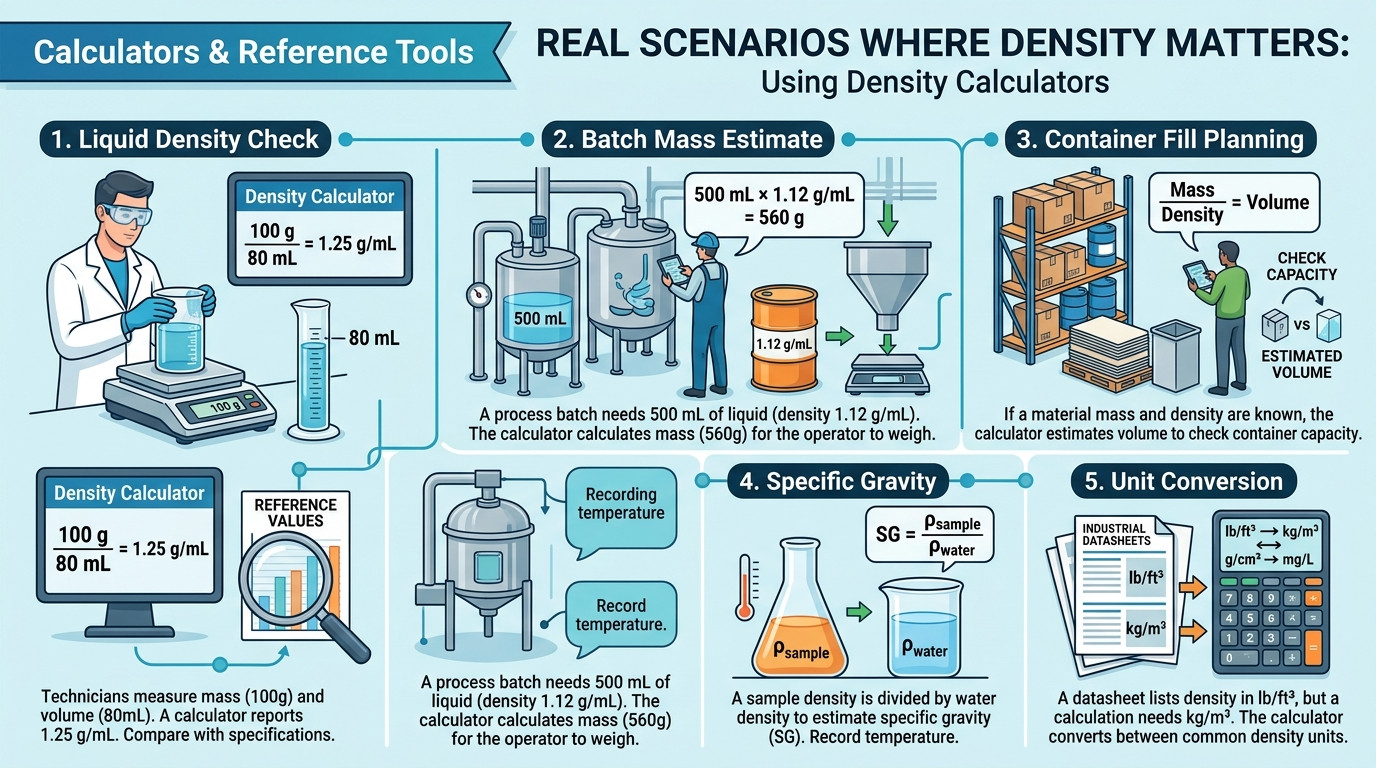
Real Scenarios Where Density Matters
Scenario 1: Liquid Density Check
A technician weighs 100 g of a liquid and measures 80 mL volume. A density calculator reports 1.25 g/mL, which can be compared with a specification or reference value.
Scenario 2: Batch Mass Estimate
A process batch requires 500 mL of a liquid with density 1.12 g/mL. The density calculator calculates mass so the operator can weigh the correct amount.
Scenario 3: Container Fill Planning
If a material mass and density are known, a density calculator estimates volume and checks whether the container has enough capacity.
Scenario 4: Specific Gravity
A sample density is divided by water density to estimate specific gravity. The density calculator makes the calculation clear and reminds users to record temperature.
Scenario 5: Unit Conversion
A datasheet lists density in lb/ft³, but a calculation needs kg/m³. A density calculator converts between common density units.
Common Density Calculation Mistakes
Mistake 1: Mixing Volume Units
mL, L, cm³, m³, gallons, and ft³ cannot be mixed without conversion. A density calculator helps keep unit basis clear.
Mistake 2: Ignoring Temperature
Fluid density changes with temperature. A density calculator can calculate density, but the measurement should record temperature.
Mistake 3: Confusing Density and Specific Gravity
Density has units, while specific gravity is a ratio. A density calculator can calculate both, but they should be reported differently.
Mistake 4: Measuring Volume Poorly
A density result is only as good as the volume measurement. Graduated containers, bubbles, meniscus reading, and sample wetting can affect accuracy.
Mistake 5: Assuming Homogeneity
Suspensions, foams, emulsions, powders, and settling materials may not have uniform density unless properly mixed or prepared.
💡 Rule of Thumb: measure mass and volume carefully, record temperature, and keep units consistent.
Handling, Measurement & Quality Essentials
Safety: Density work may involve chemicals, solvents, oils, acids, bases, powders, hot liquids, fuels, biological samples, or pressurized containers. The density calculator provides math only. Follow SDS guidance, PPE requirements, ventilation rules, waste procedures, and instrument SOPs.
- Use compatible containers for the sample material.
- Record temperature for fluids and reference materials.
- Avoid bubbles when measuring liquid volume.
- Use calibrated balances when density is used for QC.
- Mix samples when the material can settle or separate.
- Label materials after measurement and dispose according to rules.
Which Mode Fits Your Workflow
| Mode | Use Case | Formula | Inputs | Output |
|---|---|---|---|---|
| Density | mass and volume known | m/V | mass, volume | density |
| Mass Needed | fill volume from density | ρV | density, volume | mass |
| Volume Needed | volume from mass | m/ρ | mass, density | volume |
| Specific Gravity | relative density | ρsample/ρwater | sample and water density | SG |
| Unit Convert | unit reporting | conversion factors | value and units | converted density |
Laboratory Measurements
A density calculator helps turn mass and volume readings into reportable density values for QC records.
Engineering Calculations
Engineering workflows often need kg/m³. A density calculator converts lab units into SI units for flow, viscosity, and mass balance calculations.
Material Identification
Density can support material identification, but it should be combined with other tests when materials have overlapping density ranges.
Advanced Guide to Density Planning
Temperature control
A density calculator supports temperature control decisions by making the mass-volume relationship clear. However, density measurement quality depends on sample preparation and measurement technique. Record the material name, lot, temperature, mass, volume, container type, balance, and method. If a value does not match expectation, check unit conversions, trapped air, evaporation, temperature, incomplete filling, residue on the vessel, and whether the sample was homogeneous.
Balance calibration
A density calculator supports balance calibration decisions by making the mass-volume relationship clear. However, density measurement quality depends on sample preparation and measurement technique. Record the material name, lot, temperature, mass, volume, container type, balance, and method. If a value does not match expectation, check unit conversions, trapped air, evaporation, temperature, incomplete filling, residue on the vessel, and whether the sample was homogeneous.
Volume calibration
A density calculator supports volume calibration decisions by making the mass-volume relationship clear. However, density measurement quality depends on sample preparation and measurement technique. Record the material name, lot, temperature, mass, volume, container type, balance, and method. If a value does not match expectation, check unit conversions, trapped air, evaporation, temperature, incomplete filling, residue on the vessel, and whether the sample was homogeneous.
Meniscus reading
A density calculator supports meniscus reading decisions by making the mass-volume relationship clear. However, density measurement quality depends on sample preparation and measurement technique. Record the material name, lot, temperature, mass, volume, container type, balance, and method. If a value does not match expectation, check unit conversions, trapped air, evaporation, temperature, incomplete filling, residue on the vessel, and whether the sample was homogeneous.
Specific gravity
A density calculator supports specific gravity decisions by making the mass-volume relationship clear. However, density measurement quality depends on sample preparation and measurement technique. Record the material name, lot, temperature, mass, volume, container type, balance, and method. If a value does not match expectation, check unit conversions, trapped air, evaporation, temperature, incomplete filling, residue on the vessel, and whether the sample was homogeneous.
Water reference density
A density calculator supports water reference density decisions by making the mass-volume relationship clear. However, density measurement quality depends on sample preparation and measurement technique. Record the material name, lot, temperature, mass, volume, container type, balance, and method. If a value does not match expectation, check unit conversions, trapped air, evaporation, temperature, incomplete filling, residue on the vessel, and whether the sample was homogeneous.
Powder bulk density
A density calculator supports powder bulk density decisions by making the mass-volume relationship clear. However, density measurement quality depends on sample preparation and measurement technique. Record the material name, lot, temperature, mass, volume, container type, balance, and method. If a value does not match expectation, check unit conversions, trapped air, evaporation, temperature, incomplete filling, residue on the vessel, and whether the sample was homogeneous.
Tapped density
A density calculator supports tapped density decisions by making the mass-volume relationship clear. However, density measurement quality depends on sample preparation and measurement technique. Record the material name, lot, temperature, mass, volume, container type, balance, and method. If a value does not match expectation, check unit conversions, trapped air, evaporation, temperature, incomplete filling, residue on the vessel, and whether the sample was homogeneous.
Liquid expansion
A density calculator supports liquid expansion decisions by making the mass-volume relationship clear. However, density measurement quality depends on sample preparation and measurement technique. Record the material name, lot, temperature, mass, volume, container type, balance, and method. If a value does not match expectation, check unit conversions, trapped air, evaporation, temperature, incomplete filling, residue on the vessel, and whether the sample was homogeneous.
Air bubbles
A density calculator supports air bubbles decisions by making the mass-volume relationship clear. However, density measurement quality depends on sample preparation and measurement technique. Record the material name, lot, temperature, mass, volume, container type, balance, and method. If a value does not match expectation, check unit conversions, trapped air, evaporation, temperature, incomplete filling, residue on the vessel, and whether the sample was homogeneous.
Suspensions
A density calculator supports suspensions decisions by making the mass-volume relationship clear. However, density measurement quality depends on sample preparation and measurement technique. Record the material name, lot, temperature, mass, volume, container type, balance, and method. If a value does not match expectation, check unit conversions, trapped air, evaporation, temperature, incomplete filling, residue on the vessel, and whether the sample was homogeneous.
Emulsions
A density calculator supports emulsions decisions by making the mass-volume relationship clear. However, density measurement quality depends on sample preparation and measurement technique. Record the material name, lot, temperature, mass, volume, container type, balance, and method. If a value does not match expectation, check unit conversions, trapped air, evaporation, temperature, incomplete filling, residue on the vessel, and whether the sample was homogeneous.
Foams
A density calculator supports foams decisions by making the mass-volume relationship clear. However, density measurement quality depends on sample preparation and measurement technique. Record the material name, lot, temperature, mass, volume, container type, balance, and method. If a value does not match expectation, check unit conversions, trapped air, evaporation, temperature, incomplete filling, residue on the vessel, and whether the sample was homogeneous.
Solvent density
A density calculator supports solvent density decisions by making the mass-volume relationship clear. However, density measurement quality depends on sample preparation and measurement technique. Record the material name, lot, temperature, mass, volume, container type, balance, and method. If a value does not match expectation, check unit conversions, trapped air, evaporation, temperature, incomplete filling, residue on the vessel, and whether the sample was homogeneous.
Oil density
A density calculator supports oil density decisions by making the mass-volume relationship clear. However, density measurement quality depends on sample preparation and measurement technique. Record the material name, lot, temperature, mass, volume, container type, balance, and method. If a value does not match expectation, check unit conversions, trapped air, evaporation, temperature, incomplete filling, residue on the vessel, and whether the sample was homogeneous.
Fuel density
A density calculator supports fuel density decisions by making the mass-volume relationship clear. However, density measurement quality depends on sample preparation and measurement technique. Record the material name, lot, temperature, mass, volume, container type, balance, and method. If a value does not match expectation, check unit conversions, trapped air, evaporation, temperature, incomplete filling, residue on the vessel, and whether the sample was homogeneous.
Food formulation
A density calculator supports food formulation decisions by making the mass-volume relationship clear. However, density measurement quality depends on sample preparation and measurement technique. Record the material name, lot, temperature, mass, volume, container type, balance, and method. If a value does not match expectation, check unit conversions, trapped air, evaporation, temperature, incomplete filling, residue on the vessel, and whether the sample was homogeneous.
Shipping estimates
A density calculator supports shipping estimates decisions by making the mass-volume relationship clear. However, density measurement quality depends on sample preparation and measurement technique. Record the material name, lot, temperature, mass, volume, container type, balance, and method. If a value does not match expectation, check unit conversions, trapped air, evaporation, temperature, incomplete filling, residue on the vessel, and whether the sample was homogeneous.
Quality control
A density calculator supports quality control decisions by making the mass-volume relationship clear. However, density measurement quality depends on sample preparation and measurement technique. Record the material name, lot, temperature, mass, volume, container type, balance, and method. If a value does not match expectation, check unit conversions, trapped air, evaporation, temperature, incomplete filling, residue on the vessel, and whether the sample was homogeneous.
Documentation
A density calculator supports documentation decisions by making the mass-volume relationship clear. However, density measurement quality depends on sample preparation and measurement technique. Record the material name, lot, temperature, mass, volume, container type, balance, and method. If a value does not match expectation, check unit conversions, trapped air, evaporation, temperature, incomplete filling, residue on the vessel, and whether the sample was homogeneous.
Frequently Asked Questions
1. What is a density calculator?
A density calculator calculates density, mass, volume, specific gravity, and density unit conversions.
2. What is the density formula?
Density equals mass divided by volume.
3. How do I calculate mass from density?
Multiply density by volume.
4. How do I calculate volume from density?
Divide mass by density.
5. What is specific gravity?
Specific gravity is sample density divided by reference water density.
Density Measurement Checklist
Before Measurement
During Measurement

Trusted Reference Resources
NIST Chemistry WebBook — NIST Chemistry WebBook provides physical property references for many chemicals.
Engineering Toolbox Density — Engineering Toolbox density tables provide common material density reference values.
User Reviews & Ratings
Share Your Experience with This density calculator
Additional Density Reference Notes
Pycnometer practice
Pycnometer practice can affect how density is measured and interpreted. The calculation is only the final arithmetic step; the measurement process determines the quality of the result. Record sample preparation, container condition, balance calibration, volume device, temperature, and whether the sample was mixed, degassed, filtered, settled, or corrected for buoyancy. If a value is unexpected, repeat the measurement and review units before changing the calculation.
Hydrometer readings
Hydrometer readings can affect how density is measured and interpreted. The calculation is only the final arithmetic step; the measurement process determines the quality of the result. Record sample preparation, container condition, balance calibration, volume device, temperature, and whether the sample was mixed, degassed, filtered, settled, or corrected for buoyancy. If a value is unexpected, repeat the measurement and review units before changing the calculation.
Digital density meters
Digital density meters can affect how density is measured and interpreted. The calculation is only the final arithmetic step; the measurement process determines the quality of the result. Record sample preparation, container condition, balance calibration, volume device, temperature, and whether the sample was mixed, degassed, filtered, settled, or corrected for buoyancy. If a value is unexpected, repeat the measurement and review units before changing the calculation.
Powder bulk density
Powder bulk density can affect how density is measured and interpreted. The calculation is only the final arithmetic step; the measurement process determines the quality of the result. Record sample preparation, container condition, balance calibration, volume device, temperature, and whether the sample was mixed, degassed, filtered, settled, or corrected for buoyancy. If a value is unexpected, repeat the measurement and review units before changing the calculation.
Tapped density
Tapped density can affect how density is measured and interpreted. The calculation is only the final arithmetic step; the measurement process determines the quality of the result. Record sample preparation, container condition, balance calibration, volume device, temperature, and whether the sample was mixed, degassed, filtered, settled, or corrected for buoyancy. If a value is unexpected, repeat the measurement and review units before changing the calculation.
Temperature correction
Temperature correction can affect how density is measured and interpreted. The calculation is only the final arithmetic step; the measurement process determines the quality of the result. Record sample preparation, container condition, balance calibration, volume device, temperature, and whether the sample was mixed, degassed, filtered, settled, or corrected for buoyancy. If a value is unexpected, repeat the measurement and review units before changing the calculation.
Solvent evaporation
Solvent evaporation can affect how density is measured and interpreted. The calculation is only the final arithmetic step; the measurement process determines the quality of the result. Record sample preparation, container condition, balance calibration, volume device, temperature, and whether the sample was mixed, degassed, filtered, settled, or corrected for buoyancy. If a value is unexpected, repeat the measurement and review units before changing the calculation.
Air bubble control
Air bubble control can affect how density is measured and interpreted. The calculation is only the final arithmetic step; the measurement process determines the quality of the result. Record sample preparation, container condition, balance calibration, volume device, temperature, and whether the sample was mixed, degassed, filtered, settled, or corrected for buoyancy. If a value is unexpected, repeat the measurement and review units before changing the calculation.
Sample homogeneity
Sample homogeneity can affect how density is measured and interpreted. The calculation is only the final arithmetic step; the measurement process determines the quality of the result. Record sample preparation, container condition, balance calibration, volume device, temperature, and whether the sample was mixed, degassed, filtered, settled, or corrected for buoyancy. If a value is unexpected, repeat the measurement and review units before changing the calculation.
Material identification
Material identification can affect how density is measured and interpreted. The calculation is only the final arithmetic step; the measurement process determines the quality of the result. Record sample preparation, container condition, balance calibration, volume device, temperature, and whether the sample was mixed, degassed, filtered, settled, or corrected for buoyancy. If a value is unexpected, repeat the measurement and review units before changing the calculation.
Shipping estimates
Shipping estimates can affect how density is measured and interpreted. The calculation is only the final arithmetic step; the measurement process determines the quality of the result. Record sample preparation, container condition, balance calibration, volume device, temperature, and whether the sample was mixed, degassed, filtered, settled, or corrected for buoyancy. If a value is unexpected, repeat the measurement and review units before changing the calculation.
Quality records
Quality records can affect how density is measured and interpreted. The calculation is only the final arithmetic step; the measurement process determines the quality of the result. Record sample preparation, container condition, balance calibration, volume device, temperature, and whether the sample was mixed, degassed, filtered, settled, or corrected for buoyancy. If a value is unexpected, repeat the measurement and review units before changing the calculation.
Extended Density Calculation Guide
Calibration and traceability
Calibration and traceability matters because density is simple in equation form but sensitive in measurement practice. A value can change if the sample temperature changes, if a liquid contains bubbles, if a powder is packed differently, if a container is wet, or if a balance is not tared correctly. When a density value will be used for quality control, engineering, purchasing, formulation, or teaching, record the sample identity, lot number, mass, volume, temperature, equipment, and unit system. If the material is a suspension, emulsion, slurry, foam, or granular solid, also record how it was mixed or settled before measurement.
Good records make a density result easier to repeat and defend. If two results disagree, first check whether the same unit basis was used, then check mass calibration, volume calibration, temperature, air bubbles, evaporation, meniscus reading, and whether the sample was homogeneous. A calculated result should not be separated from the method used to obtain mass and volume. Density is often used as a quick identity or concentration check, but it should be interpreted with the material specification and measurement uncertainty.
Liquid density workflow
Liquid density workflow matters because density is simple in equation form but sensitive in measurement practice. A value can change if the sample temperature changes, if a liquid contains bubbles, if a powder is packed differently, if a container is wet, or if a balance is not tared correctly. When a density value will be used for quality control, engineering, purchasing, formulation, or teaching, record the sample identity, lot number, mass, volume, temperature, equipment, and unit system. If the material is a suspension, emulsion, slurry, foam, or granular solid, also record how it was mixed or settled before measurement.
Good records make a density result easier to repeat and defend. If two results disagree, first check whether the same unit basis was used, then check mass calibration, volume calibration, temperature, air bubbles, evaporation, meniscus reading, and whether the sample was homogeneous. A calculated result should not be separated from the method used to obtain mass and volume. Density is often used as a quick identity or concentration check, but it should be interpreted with the material specification and measurement uncertainty.
Solid density workflow
Solid density workflow matters because density is simple in equation form but sensitive in measurement practice. A value can change if the sample temperature changes, if a liquid contains bubbles, if a powder is packed differently, if a container is wet, or if a balance is not tared correctly. When a density value will be used for quality control, engineering, purchasing, formulation, or teaching, record the sample identity, lot number, mass, volume, temperature, equipment, and unit system. If the material is a suspension, emulsion, slurry, foam, or granular solid, also record how it was mixed or settled before measurement.
Good records make a density result easier to repeat and defend. If two results disagree, first check whether the same unit basis was used, then check mass calibration, volume calibration, temperature, air bubbles, evaporation, meniscus reading, and whether the sample was homogeneous. A calculated result should not be separated from the method used to obtain mass and volume. Density is often used as a quick identity or concentration check, but it should be interpreted with the material specification and measurement uncertainty.
Irregular object volume
Irregular object volume matters because density is simple in equation form but sensitive in measurement practice. A value can change if the sample temperature changes, if a liquid contains bubbles, if a powder is packed differently, if a container is wet, or if a balance is not tared correctly. When a density value will be used for quality control, engineering, purchasing, formulation, or teaching, record the sample identity, lot number, mass, volume, temperature, equipment, and unit system. If the material is a suspension, emulsion, slurry, foam, or granular solid, also record how it was mixed or settled before measurement.
Good records make a density result easier to repeat and defend. If two results disagree, first check whether the same unit basis was used, then check mass calibration, volume calibration, temperature, air bubbles, evaporation, meniscus reading, and whether the sample was homogeneous. A calculated result should not be separated from the method used to obtain mass and volume. Density is often used as a quick identity or concentration check, but it should be interpreted with the material specification and measurement uncertainty.
Displacement method
Displacement method matters because density is simple in equation form but sensitive in measurement practice. A value can change if the sample temperature changes, if a liquid contains bubbles, if a powder is packed differently, if a container is wet, or if a balance is not tared correctly. When a density value will be used for quality control, engineering, purchasing, formulation, or teaching, record the sample identity, lot number, mass, volume, temperature, equipment, and unit system. If the material is a suspension, emulsion, slurry, foam, or granular solid, also record how it was mixed or settled before measurement.
Good records make a density result easier to repeat and defend. If two results disagree, first check whether the same unit basis was used, then check mass calibration, volume calibration, temperature, air bubbles, evaporation, meniscus reading, and whether the sample was homogeneous. A calculated result should not be separated from the method used to obtain mass and volume. Density is often used as a quick identity or concentration check, but it should be interpreted with the material specification and measurement uncertainty.
Bulk density of powders
Bulk density of powders matters because density is simple in equation form but sensitive in measurement practice. A value can change if the sample temperature changes, if a liquid contains bubbles, if a powder is packed differently, if a container is wet, or if a balance is not tared correctly. When a density value will be used for quality control, engineering, purchasing, formulation, or teaching, record the sample identity, lot number, mass, volume, temperature, equipment, and unit system. If the material is a suspension, emulsion, slurry, foam, or granular solid, also record how it was mixed or settled before measurement.
Good records make a density result easier to repeat and defend. If two results disagree, first check whether the same unit basis was used, then check mass calibration, volume calibration, temperature, air bubbles, evaporation, meniscus reading, and whether the sample was homogeneous. A calculated result should not be separated from the method used to obtain mass and volume. Density is often used as a quick identity or concentration check, but it should be interpreted with the material specification and measurement uncertainty.
Tapped density comparison
Tapped density comparison matters because density is simple in equation form but sensitive in measurement practice. A value can change if the sample temperature changes, if a liquid contains bubbles, if a powder is packed differently, if a container is wet, or if a balance is not tared correctly. When a density value will be used for quality control, engineering, purchasing, formulation, or teaching, record the sample identity, lot number, mass, volume, temperature, equipment, and unit system. If the material is a suspension, emulsion, slurry, foam, or granular solid, also record how it was mixed or settled before measurement.
Good records make a density result easier to repeat and defend. If two results disagree, first check whether the same unit basis was used, then check mass calibration, volume calibration, temperature, air bubbles, evaporation, meniscus reading, and whether the sample was homogeneous. A calculated result should not be separated from the method used to obtain mass and volume. Density is often used as a quick identity or concentration check, but it should be interpreted with the material specification and measurement uncertainty.
Specific gravity reporting
Specific gravity reporting matters because density is simple in equation form but sensitive in measurement practice. A value can change if the sample temperature changes, if a liquid contains bubbles, if a powder is packed differently, if a container is wet, or if a balance is not tared correctly. When a density value will be used for quality control, engineering, purchasing, formulation, or teaching, record the sample identity, lot number, mass, volume, temperature, equipment, and unit system. If the material is a suspension, emulsion, slurry, foam, or granular solid, also record how it was mixed or settled before measurement.
Good records make a density result easier to repeat and defend. If two results disagree, first check whether the same unit basis was used, then check mass calibration, volume calibration, temperature, air bubbles, evaporation, meniscus reading, and whether the sample was homogeneous. A calculated result should not be separated from the method used to obtain mass and volume. Density is often used as a quick identity or concentration check, but it should be interpreted with the material specification and measurement uncertainty.
Temperature expansion
Temperature expansion matters because density is simple in equation form but sensitive in measurement practice. A value can change if the sample temperature changes, if a liquid contains bubbles, if a powder is packed differently, if a container is wet, or if a balance is not tared correctly. When a density value will be used for quality control, engineering, purchasing, formulation, or teaching, record the sample identity, lot number, mass, volume, temperature, equipment, and unit system. If the material is a suspension, emulsion, slurry, foam, or granular solid, also record how it was mixed or settled before measurement.
Good records make a density result easier to repeat and defend. If two results disagree, first check whether the same unit basis was used, then check mass calibration, volume calibration, temperature, air bubbles, evaporation, meniscus reading, and whether the sample was homogeneous. A calculated result should not be separated from the method used to obtain mass and volume. Density is often used as a quick identity or concentration check, but it should be interpreted with the material specification and measurement uncertainty.
Density of mixtures
Density of mixtures matters because density is simple in equation form but sensitive in measurement practice. A value can change if the sample temperature changes, if a liquid contains bubbles, if a powder is packed differently, if a container is wet, or if a balance is not tared correctly. When a density value will be used for quality control, engineering, purchasing, formulation, or teaching, record the sample identity, lot number, mass, volume, temperature, equipment, and unit system. If the material is a suspension, emulsion, slurry, foam, or granular solid, also record how it was mixed or settled before measurement.
Good records make a density result easier to repeat and defend. If two results disagree, first check whether the same unit basis was used, then check mass calibration, volume calibration, temperature, air bubbles, evaporation, meniscus reading, and whether the sample was homogeneous. A calculated result should not be separated from the method used to obtain mass and volume. Density is often used as a quick identity or concentration check, but it should be interpreted with the material specification and measurement uncertainty.
Concentration and density
Concentration and density matters because density is simple in equation form but sensitive in measurement practice. A value can change if the sample temperature changes, if a liquid contains bubbles, if a powder is packed differently, if a container is wet, or if a balance is not tared correctly. When a density value will be used for quality control, engineering, purchasing, formulation, or teaching, record the sample identity, lot number, mass, volume, temperature, equipment, and unit system. If the material is a suspension, emulsion, slurry, foam, or granular solid, also record how it was mixed or settled before measurement.
Good records make a density result easier to repeat and defend. If two results disagree, first check whether the same unit basis was used, then check mass calibration, volume calibration, temperature, air bubbles, evaporation, meniscus reading, and whether the sample was homogeneous. A calculated result should not be separated from the method used to obtain mass and volume. Density is often used as a quick identity or concentration check, but it should be interpreted with the material specification and measurement uncertainty.
Density in shipping
Density in shipping matters because density is simple in equation form but sensitive in measurement practice. A value can change if the sample temperature changes, if a liquid contains bubbles, if a powder is packed differently, if a container is wet, or if a balance is not tared correctly. When a density value will be used for quality control, engineering, purchasing, formulation, or teaching, record the sample identity, lot number, mass, volume, temperature, equipment, and unit system. If the material is a suspension, emulsion, slurry, foam, or granular solid, also record how it was mixed or settled before measurement.
Good records make a density result easier to repeat and defend. If two results disagree, first check whether the same unit basis was used, then check mass calibration, volume calibration, temperature, air bubbles, evaporation, meniscus reading, and whether the sample was homogeneous. A calculated result should not be separated from the method used to obtain mass and volume. Density is often used as a quick identity or concentration check, but it should be interpreted with the material specification and measurement uncertainty.
Density in formulation
Density in formulation matters because density is simple in equation form but sensitive in measurement practice. A value can change if the sample temperature changes, if a liquid contains bubbles, if a powder is packed differently, if a container is wet, or if a balance is not tared correctly. When a density value will be used for quality control, engineering, purchasing, formulation, or teaching, record the sample identity, lot number, mass, volume, temperature, equipment, and unit system. If the material is a suspension, emulsion, slurry, foam, or granular solid, also record how it was mixed or settled before measurement.
Good records make a density result easier to repeat and defend. If two results disagree, first check whether the same unit basis was used, then check mass calibration, volume calibration, temperature, air bubbles, evaporation, meniscus reading, and whether the sample was homogeneous. A calculated result should not be separated from the method used to obtain mass and volume. Density is often used as a quick identity or concentration check, but it should be interpreted with the material specification and measurement uncertainty.
Density in process control
Density in process control matters because density is simple in equation form but sensitive in measurement practice. A value can change if the sample temperature changes, if a liquid contains bubbles, if a powder is packed differently, if a container is wet, or if a balance is not tared correctly. When a density value will be used for quality control, engineering, purchasing, formulation, or teaching, record the sample identity, lot number, mass, volume, temperature, equipment, and unit system. If the material is a suspension, emulsion, slurry, foam, or granular solid, also record how it was mixed or settled before measurement.
Good records make a density result easier to repeat and defend. If two results disagree, first check whether the same unit basis was used, then check mass calibration, volume calibration, temperature, air bubbles, evaporation, meniscus reading, and whether the sample was homogeneous. A calculated result should not be separated from the method used to obtain mass and volume. Density is often used as a quick identity or concentration check, but it should be interpreted with the material specification and measurement uncertainty.
Density in education
Density in education matters because density is simple in equation form but sensitive in measurement practice. A value can change if the sample temperature changes, if a liquid contains bubbles, if a powder is packed differently, if a container is wet, or if a balance is not tared correctly. When a density value will be used for quality control, engineering, purchasing, formulation, or teaching, record the sample identity, lot number, mass, volume, temperature, equipment, and unit system. If the material is a suspension, emulsion, slurry, foam, or granular solid, also record how it was mixed or settled before measurement.
Good records make a density result easier to repeat and defend. If two results disagree, first check whether the same unit basis was used, then check mass calibration, volume calibration, temperature, air bubbles, evaporation, meniscus reading, and whether the sample was homogeneous. A calculated result should not be separated from the method used to obtain mass and volume. Density is often used as a quick identity or concentration check, but it should be interpreted with the material specification and measurement uncertainty.
Density troubleshooting
Density troubleshooting matters because density is simple in equation form but sensitive in measurement practice. A value can change if the sample temperature changes, if a liquid contains bubbles, if a powder is packed differently, if a container is wet, or if a balance is not tared correctly. When a density value will be used for quality control, engineering, purchasing, formulation, or teaching, record the sample identity, lot number, mass, volume, temperature, equipment, and unit system. If the material is a suspension, emulsion, slurry, foam, or granular solid, also record how it was mixed or settled before measurement.
Good records make a density result easier to repeat and defend. If two results disagree, first check whether the same unit basis was used, then check mass calibration, volume calibration, temperature, air bubbles, evaporation, meniscus reading, and whether the sample was homogeneous. A calculated result should not be separated from the method used to obtain mass and volume. Density is often used as a quick identity or concentration check, but it should be interpreted with the material specification and measurement uncertainty.
Density documentation
Density documentation matters because density is simple in equation form but sensitive in measurement practice. A value can change if the sample temperature changes, if a liquid contains bubbles, if a powder is packed differently, if a container is wet, or if a balance is not tared correctly. When a density value will be used for quality control, engineering, purchasing, formulation, or teaching, record the sample identity, lot number, mass, volume, temperature, equipment, and unit system. If the material is a suspension, emulsion, slurry, foam, or granular solid, also record how it was mixed or settled before measurement.
Good records make a density result easier to repeat and defend. If two results disagree, first check whether the same unit basis was used, then check mass calibration, volume calibration, temperature, air bubbles, evaporation, meniscus reading, and whether the sample was homogeneous. A calculated result should not be separated from the method used to obtain mass and volume. Density is often used as a quick identity or concentration check, but it should be interpreted with the material specification and measurement uncertainty.
Density unit audit
Density unit audit matters because density is simple in equation form but sensitive in measurement practice. A value can change if the sample temperature changes, if a liquid contains bubbles, if a powder is packed differently, if a container is wet, or if a balance is not tared correctly. When a density value will be used for quality control, engineering, purchasing, formulation, or teaching, record the sample identity, lot number, mass, volume, temperature, equipment, and unit system. If the material is a suspension, emulsion, slurry, foam, or granular solid, also record how it was mixed or settled before measurement.
Good records make a density result easier to repeat and defend. If two results disagree, first check whether the same unit basis was used, then check mass calibration, volume calibration, temperature, air bubbles, evaporation, meniscus reading, and whether the sample was homogeneous. A calculated result should not be separated from the method used to obtain mass and volume. Density is often used as a quick identity or concentration check, but it should be interpreted with the material specification and measurement uncertainty.
Final Thoughts on Density Calculation
Density is a simple ratio with wide practical importance. A density calculator makes the arithmetic reliable by connecting mass, volume, specific gravity, and units in one workflow.
Before using a result, confirm that mass and volume were measured correctly, units were consistent, and temperature was recorded. The density calculator gives the number, but the measurement method controls quality.
Tip: Keep density results tied to temperature, method, sample condition, and units.