
Mole Fraction Calculator — Find xA, Mole %, and More
📋 Table of Contents
▼- Why a Mole Fraction Calculator Helps
- Mole Fraction Calculator — Five Calculation Modes
- How to Calculate Mole Fraction — Step by Step
- Real Scenarios Where a Mole Fraction Calculator Helped
- Common Mole Fraction Mistakes and the Science Behind Them
- Expert Perspectives from Chemists and Lab Educators
- Which Calculation Method Fits Your Mole Fraction Task
- Advanced Mole Fraction Topics
- Frequently Asked Questions
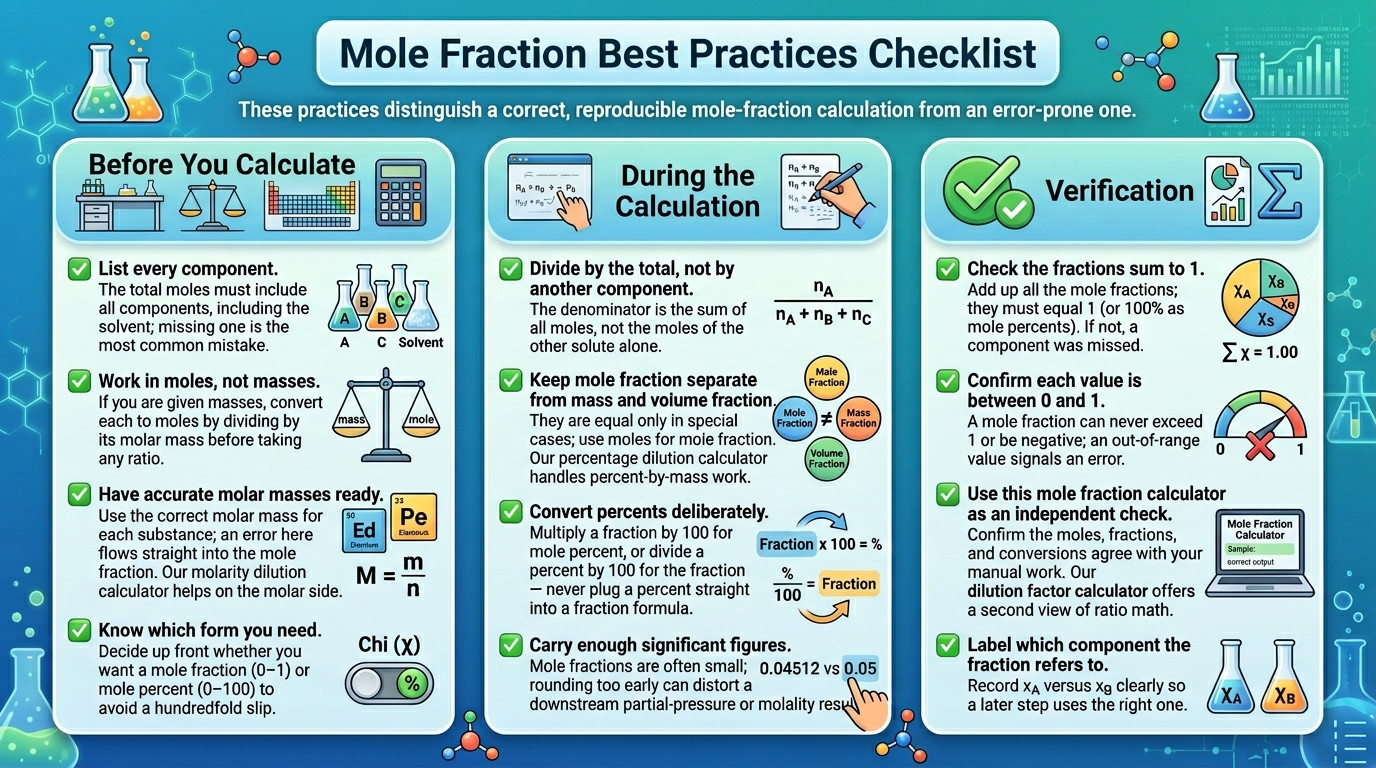
- Mole Fraction Best Practices Checklist
- Trusted Reference Resources
- User Reviews & Ratings
- Final Thoughts on the Mole Fraction Calculator
Why a Mole Fraction Calculator Helps
Mole fraction is one of the cleanest ways to describe the composition of a mixture. It is simply the moles of one component divided by the total moles of everything present — a pure ratio with no units, always between 0 and 1, and the mole fractions of all components always add up to exactly 1. Because it is dimensionless and temperature-independent, mole fraction shows up everywhere from gas-law problems and Raoult’s law to phase diagrams and thermodynamics. A mole fraction calculator turns the raw numbers — moles, or masses with molar masses — into xA, xB, and mole percent in one step.
The reason a dedicated tool helps is that “mole fraction” quietly involves a couple of conversions people stumble over. If you are given masses rather than moles, you first divide each mass by its molar mass to get moles, then take the ratio. If you are given a mole percent, you divide by 100 to get the fraction. And mole fraction connects to other concentration units like molality, which needs the solvent’s molar mass. This mole fraction calculator gathers those paths into one place so you always reach for the right formula.
I have watched a lot of students get tangled here, and it is rarely the hard part of chemistry. It is the framing: forgetting to convert masses to moles first, leaving a component out of the total, confusing mole fraction with mass fraction or volume fraction, or reporting a number bigger than 1. Once you have a reliable procedure — moles over total moles, with everything counted — mole fraction becomes one of the simplest quantities to work with.
This mole fraction calculator and the guide that follows cover the full range of mole-fraction work. The five modes let you find the mole fraction from moles directly, from component masses and molar masses, from a two-component (binary) mixture, convert between mole fraction and mole percent, and relate a solute mole fraction to molality. Whether you are a student, a teacher, or a working chemist, this tool gives you the answer and shows the reasoning behind it.
For related concentration tools, our molarity dilution calculator handles molar concentration and our percentage dilution calculator covers percent strengths.
Mole Fraction Calculator
Five modes — from moles, from masses, two-component mix, mole % ↔ fraction & fraction → molality
Calculation Result
💡 Tip: Mole fraction is moles of a component ÷ total moles of all components, so it is always between 0 and 1, and every component’s mole fraction adds up to exactly 1. If you start from masses, convert each to moles (mass ÷ molar mass) before taking the ratio — and don’t confuse mole fraction with mass fraction or volume fraction.

How to Calculate Mole Fraction — Step by Step
Mole fraction is one of the simplest composition measures in chemistry, but getting it right means counting moles correctly. The whole method comes from a single definition, and once you see it, every mole-fraction problem looks the same. Here is the reasoning, the formulas, and a step-by-step approach you can apply every time.
What Mole Fraction Actually Means
The mole fraction of a component (written xA or χA) is the number of moles of that component divided by the total number of moles of all components in the mixture. It is a dimensionless ratio between 0 and 1, and the mole fractions of every component always sum to exactly 1. Because it is a pure ratio of moles, it does not depend on temperature or volume.
The One Idea Behind Mole Fraction
Everything is counted in moles. If you are given masses, you must first convert each to moles by dividing the mass by that substance’s molar mass. Then the mole fraction is just the ratio of one component’s moles to the grand total. Forgetting to convert, or leaving a component out of the total, is where almost all mistakes happen.
Mole percent: mol% = mole fraction × 100
Binary mix: xA + xB = 1
Molality from x: b = x_solute ÷ [ (1 − x_solute) × M_solvent ]
The Five Steps to Find a Mole Fraction
Step 1 — Identify every component. List each substance in the mixture; the total moles must include all of them, including the solvent.
Step 2 — Get moles for each. If you have moles, use them directly. If you have masses, divide each mass by its molar mass to get moles.
Step 3 — Add up the total moles. Sum the moles of all components to get n_total.
Step 4 — Divide for the fraction. The mole fraction of a component is its moles ÷ total moles. Multiply by 100 for mole percent.
Step 5 — Check that they sum to 1. Add the mole fractions of all components; they must equal 1 (or 100%). If not, recheck the moles.
A Worked Example: From Moles
A mixture has 2 mol of ethanol and 6 mol of water. Total moles = 2 + 6 = 8 mol. The mole fraction of ethanol is 2 ÷ 8 = 0.25, which is 25 mol%. The mole fraction of water is 6 ÷ 8 = 0.75, and 0.25 + 0.75 = 1, as it must. The From Moles mode does this directly.
A Worked Example: From Masses
You mix 18 g of water (molar mass 18.02 g/mol) with 92 g of ethanol (46.07 g/mol). Moles of water = 18 ÷ 18.02 ≈ 0.999 mol; moles of ethanol = 92 ÷ 46.07 ≈ 1.997 mol. Total ≈ 2.996 mol. The mole fraction of water is 0.999 ÷ 2.996 ≈ 0.333, and ethanol ≈ 0.667. The From Masses mode converts and divides for you.
Mole Fraction vs Mole Percent
Mole fraction and mole percent carry the same information in different forms: mole percent is simply the mole fraction times 100. A mole fraction of 0.25 is 25 mol%; a mole percent of 40 is a mole fraction of 0.40. Just as fractions sum to 1, mole percents sum to 100. The Mole % ↔ Fraction mode converts between them.
Common Mole Fraction Relationships at a Glance
total moles
mass (g/mol)
= mol%
add up to 1
only
solvent molar mass M
Remember: Mole fraction is always moles over total moles, counted in moles for every component. Convert masses to moles first, include the solvent in the total, and check that all the fractions add up to 1. Mole percent is just the fraction times 100.
Our molarity dilution calculator handles molar concentration, while our percentage dilution calculator covers percent strengths.

Real Scenarios Where a Mole Fraction Calculator Helped
The method becomes vivid in practice. These five scenarios reflect common situations from classrooms and labs where getting the mole fraction right — or wrong — changed the answer, and where a mole fraction calculator would have settled it instantly.
Scenario 1: Using Masses Without Converting to Moles
A student mixed equal masses of water and ethanol and assumed the mole fraction of each was 0.5. But equal masses are not equal moles — the lighter molecule contributes more moles. Converting first (mass ÷ molar mass) gives very different fractions.
The From Masses mode divides each mass by its molar mass before taking the ratio, so the mole fractions reflect the real number of molecules, not the masses.
Scenario 2: Leaving the Solvent Out of the Total
A learner computing the mole fraction of a solute divided its moles by the moles of the other solutes only, forgetting that the solvent counts too. The total moles must include every component, solvent included.
The From Moles mode asks for the component and all other components separately, making it clear that the denominator is the grand total.
Scenario 3: Confusing Mole Fraction With Mass Fraction
A report quoted a “fraction” of 0.30 without saying whether it was by moles or by mass, and a downstream calculation used the wrong one. Mole fraction and mass fraction are different numbers unless the molar masses happen to match.
Being explicit — and using the From Masses mode, which shows both the moles and the resulting mole fractions — keeps the two straight.
Scenario 4: Reporting a Mole Percent as a Fraction
Someone read “25%” off a table and plugged 25 into a formula that expected a fraction, overstating the amount a hundredfold. Mole percent must be divided by 100 to become a mole fraction.
The Mole % ↔ Fraction mode converts cleanly in both directions, so 25 mol% becomes 0.25 and a 0.40 fraction becomes 40 mol%.
Scenario 5: Relating Mole Fraction to Molality
A physical-chemistry problem gave a solute mole fraction and asked for molality, but the student had no formula linking them. Molality follows from the mole fraction and the solvent’s molar mass.
The Fraction → Molality mode applies b = x ÷ [(1 − x) × M_solvent]; for a 0.05 solute fraction in water it returns about 2.92 mol/kg. Our molarity dilution calculator handles the molar side.

Common Mole Fraction Mistakes and the Science Behind Them
The mistakes people make with mole fraction cluster around a few specific failure points. Understanding why they happen is more useful than simply being told the right answer.
Mistake 1: Using Masses Instead of Moles
Mole fraction is a ratio of moles, not masses. Taking a ratio of grams gives the mass fraction, which differs from the mole fraction unless the components have the same molar mass.
Prevention: convert each mass to moles (mass ÷ molar mass) before taking the ratio. The From Masses mode does this conversion automatically.
Mistake 2: Leaving a Component Out of the Total
The denominator must be the total moles of every component, including the solvent. Dividing by only the other solutes inflates the fraction.
Prevention: list and count all components first, then divide. The From Moles mode separates the component of interest from all the others so the total is complete.
Mistake 3: Confusing Mole Fraction With Mole Percent
A mole fraction is between 0 and 1; a mole percent is between 0 and 100. Plugging a percent where a fraction is expected overstates the amount a hundredfold.
Prevention: divide mole percent by 100 to get the fraction (and multiply by 100 to go the other way). The Mole % ↔ Fraction mode handles both directions.
Mistake 4: Reporting a Fraction Greater Than 1
Because a component’s moles can never exceed the total, a valid mole fraction can never be larger than 1, and all the fractions must sum to exactly 1. A value above 1 signals an arithmetic or setup error.
Prevention: after calculating, check that every fraction is between 0 and 1 and that they add up to 1.
Mistake 5: Confusing Mole Fraction With Volume Fraction
For gases and some liquid mixtures people assume mole fraction equals volume fraction. For ideal gases the two are equal, but for liquids they generally are not, because molar volumes differ.
Prevention: use moles for mole fraction; only equate it to volume fraction when the components are ideal gases at the same conditions.
💡 Rule of Thumb: For a reliable mole fraction — count everything in moles (convert masses first), include every component in the total, keep fractions between 0 and 1, and check that they sum to 1. Mole percent is just the fraction times 100. Use the calculation of dilution guide as a companion resource.
Expert Perspectives from Chemists and Lab Educators
Mole fraction is so fundamental that experienced chemists rarely think about it consciously — yet when they teach it, the same advice comes up again and again. Here is how chemists and educators describe getting a mole fraction right.
“The one sentence I repeat to every class is: everything in moles. Students reach for masses because that is what the balance reads, but a mole fraction needs moles. Divide each mass by its molar mass first, and a mole fraction calculator that does that step makes the idea click.”
“The check I teach is that the fractions add up to one. If a student’s mole fractions sum to 1.3, they know instantly something is wrong — usually a missing component in the total. That sum-to-one rule is the simplest sanity check in all of solution chemistry.”
“Mole fraction is the unit I trust in thermodynamics because it doesn’t change with temperature. But people confuse it with mole percent constantly — a fraction of 0.25 is 25 percent, not 0.25 percent. Convert deliberately and the partial-pressure and Raoult’s-law work falls into place.”
Which Calculation Method Fits Your Mole Fraction Task
The five modes of this mole fraction calculator correspond to the five common ways the question is asked. Choosing the right mode ensures you apply the correct setup for what you are given.
Mole Fraction Method Comparison Table
| Mode | Use Case | Key Formula | Inputs Needed | Typical Use |
|---|---|---|---|---|
| From Moles | Fraction from moles | x = nA ÷ ntotal | moles of A, other moles | Moles already known |
| From Masses | Masses → moles → fraction | n = mass ÷ molar mass | masses & molar masses | Weighed-out mixtures |
| Two-Component Mix | Binary xA and xB | xA + xB = 1 | moles of A and B | Two-substance solutions |
| Mole % ↔ Fraction | Convert the two forms | mol% = x × 100 | one value | Reading tables/labels |
| Fraction → Molality | Relate x to molality | b = x ÷ [(1−x)·M] | solute x, solvent M | Physical chemistry |
Practical Decision Guide
Already know the moles of each component? Use the From Moles mode — the most direct route. Enter the moles of the component you want and the combined moles of everything else, and it returns the mole fraction and mole percent.
Given masses instead of moles? Use the From Masses mode. Enter each mass and its molar mass, and it converts to moles and returns the mole fractions of both components. Our mg/mL dilution calculator also works in mass-per-volume terms.
Working with a simple two-substance mixture? Use the Two-Component Mix mode. Enter the moles of A and B to get xA and xB, with the built-in check that they add up to 1.
Need to switch between a fraction and a percent? Use the Mole % ↔ Fraction mode. Enter the value and choose the direction to convert cleanly between the 0–1 fraction and the 0–100 percent.
Relating a mole fraction to molality? Use the Fraction → Molality mode. Enter the solute mole fraction and the solvent’s molar mass to get molality in mol/kg. Our molarity dilution calculator covers the molar side.
‘; stepsHTML+=’
‘; stepsHTML+=’
‘; stepsHTML+=’
‘;
var tHTML=’Parameter Value
‘;
mfShowResult(
‘x\u2090 = ‘+mfFmt(x)+’
= ‘+mfFmt(pct)+’ mol% of the mixture‘,
stepsHTML,tHTML
);
};// ===== FROM MASSES =====
window.mfCalcMass=function(){
var ma=parseFloat(gid(‘mf-ms-massa’).value);
var mma=parseFloat(gid(‘mf-ms-mma’).value);
var mb=parseFloat(gid(‘mf-ms-massb’).value);
var mmb=parseFloat(gid(‘mf-ms-mmb’).value);
if(isNaN(ma)||ma<0){mfErr(‘Enter a valid mass for component A (0 or more).’);return;}
if(isNaN(mma)||mma<=0){mfErr(‘Enter a valid molar mass for component A (greater than 0).’);return;}
if(isNaN(mb)||mb<0){mfErr(‘Enter a valid mass for component B (0 or more).’);return;}
if(isNaN(mmb)||mmb<=0){mfErr(‘Enter a valid molar mass for component B (greater than 0).’);return;}
var na=ma/mma, nb=mb/mmb;
var total=na+nb;
if(total<=0){mfErr(‘Total moles must be greater than zero.’);return;}
var xa=mfRnd(na/total,6), xb=mfRnd(nb/total,6);
var stepsHTML=’
Mole Fractions From Masses
‘; stepsHTML+=’
‘; stepsHTML+=’
‘; stepsHTML+=’
‘; stepsHTML+=’
‘;
var tHTML=’Component Moles Mole Fraction Mole %
‘;
mfShowResult(
‘x\u2090 = ‘+mfFmt(xa)+’, x_B = ‘+mfFmt(xb)+’
xA + xB = ‘+mfFmt(mfRnd(xa+xb,6))+’‘,
stepsHTML,tHTML
);
};// ===== TWO-COMPONENT MIX =====
window.mfCalcBinary=function(){
var na=parseFloat(gid(‘mf-bin-a’).value);
var nb=parseFloat(gid(‘mf-bin-b’).value);
if(isNaN(na)||na<0){mfErr(‘Enter a valid number of moles for component A (0 or more).’);return;}
if(isNaN(nb)||nb<0){mfErr(‘Enter a valid number of moles for component B (0 or more).’);return;}
var total=na+nb;
if(total<=0){mfErr(‘Total moles must be greater than zero.’);return;}
var xa=mfRnd(na/total,6), xb=mfRnd(nb/total,6);
var stepsHTML=’
Binary Mixture Mole Fractions
‘; stepsHTML+=’
‘; stepsHTML+=’
‘; stepsHTML+=’
‘; stepsHTML+=’
‘;
var tHTML=’Component Moles Mole Fraction Mole %
‘;
mfShowResult(
‘x\u2090 = ‘+mfFmt(xa)+’, x_B = ‘+mfFmt(xb)+’
sum = ‘+mfFmt(mfRnd(xa+xb,6))+’‘,
stepsHTML,tHTML
);
};// ===== MOLE % <-> FRACTION =====
window.mfCalcPct=function(){
var val=parseFloat(gid(‘mf-pct-val’).value);
var dir=gid(‘mf-pct-dir’).value;
if(isNaN(val)||val<0){mfErr(‘Enter a valid value (0 or more).’);return;}
var stepsHTML=’
Mole Fraction \u2194 Mole Percent
‘; var out, frac, pct; if(dir===’frac’){ if(val>1){mfErr(‘A mole fraction must be between 0 and 1.’);return;} frac=val; pct=mfRnd(val*100,6); stepsHTML+=’
‘; stepsHTML+=’
‘; out=’‘+mfFmt(pct)+’ mol%‘; } else { if(val>100){mfErr(‘A mole percent must be between 0 and 100.’);return;} frac=mfRnd(val/100,6); pct=val; stepsHTML+=’
‘; stepsHTML+=’
‘;
out=’x = ‘+mfFmt(frac)+’‘;
}
var tHTML=’Form Value
‘;
mfShowResult(out+’
x = ‘+mfFmt(frac)+’ = ‘+mfFmt(pct)+’ mol%‘, stepsHTML, tHTML);
};// ===== MOLE FRACTION -> MOLALITY =====
window.mfCalcMolality=function(){
var x=parseFloat(gid(‘mf-ml-x’).value);
var mm=parseFloat(gid(‘mf-ml-mm’).value);
if(isNaN(x)||x<=0||x>=1){mfErr(‘Enter a solute mole fraction strictly between 0 and 1.’);return;}
if(isNaN(mm)||mm<=0){mfErr(‘Enter a valid solvent molar mass greater than zero (g/mol).’);return;}
// molality b = x_solute / ( (1 – x_solute) * M_solvent_kg ) ; M_solvent in kg/mol = mm/1000
var mmKg=mm/1000;
var b=mfRnd(x/((1-x)*mmKg),6);
var stepsHTML=’
Molality From Mole Fraction
‘; stepsHTML+=’
‘; stepsHTML+=’
‘; stepsHTML+=’
‘; stepsHTML+=’
‘;
var tHTML=’Parameter Value
‘;
mfShowResult(
‘‘+mfFmt(b)+’ mol/kg Mole fraction is more than a textbook definition — it is the natural unit for many of the most important relationships in physical chemistry. Seeing where mole fraction appears across gas mixtures, vapour pressure, colligative properties, phase diagrams, and unit conversions makes the concept concrete. Here are five areas where mole fraction does real work. For an ideal gas mixture, the mole fraction of a component equals its fraction of the total pressure: the partial pressure of A is xA times the total pressure (Dalton’s law). Because all the molecules occupy the same volume at the same temperature, mole fraction and pressure fraction coincide for ideal gases. This makes mole fraction the key to gas-phase composition — air, anaesthetic mixtures, and industrial gas streams are all described by it. The same fraction also equals the volume fraction for an ideal gas. For solution-phase concentration work, our molarity dilution calculator handles molar concentration. Raoult’s law states that the vapour pressure of a component above an ideal solution is its mole fraction in the liquid times its pure vapour pressure. So the composition that matters for vapour pressure is expressed in mole fractions, not mass or volume. This underlies distillation, solvent evaporation, and the behaviour of mixed solvents. Getting the liquid-phase mole fractions right is the first step in any vapour-pressure calculation. For percent-based composition you may need to convert first, our percentage dilution calculator covers percent strengths. Boiling-point elevation, freezing-point depression, and osmotic pressure depend on the amount of solute relative to solvent, often expressed through mole fraction or the closely related molality. The solvent’s mole fraction sets how much its vapour pressure is lowered. Converting a mole fraction to molality (using the solvent’s molar mass) bridges mole-fraction thinking and the molality used in colligative formulas — exactly what the Fraction → Molality mode does. For the molality bridge, the Fraction → Molality mode applies b = x ÷ [(1 − x) × M_solvent]. Binary phase diagrams almost always plot composition as a mole fraction along the horizontal axis, from x = 0 (pure B) to x = 1 (pure A). Reading a tie line or a eutectic point means reading mole fractions directly off the axis. Because the axis runs cleanly from 0 to 1 and the two fractions always sum to 1, mole fraction is the natural choice for these diagrams. The Two-Component Mix mode mirrors that binary structure. For ratio-style composition, our dilution ratio calculator handles part-to-part mixing. Mole fraction sits in a web of concentration units — molarity, molality, mass fraction, mole percent, ppm. Converting between them is a common exam and lab task, and each conversion hinges on counting moles correctly and knowing molar masses (and density for volume-based units). The cleanest conversions stay close to moles: mole fraction to mole percent is just times 100, and mole fraction to molality uses the solvent’s molar mass. Volume-based units like molarity additionally need the solution’s density. For mass-per-volume conversions, our mg/mL dilution calculator handles those units. These questions come from students, teachers, and working chemists calculating mole fraction. The answers address the real stumbling points rather than rehearsing textbook definitions. Mole fraction is the number of moles of one component divided by the total number of moles of all components in a mixture. It is written xA or χA and is a dimensionless number between 0 and 1. Because it is a ratio of moles, it has no units and does not change with temperature or volume. The mole fractions of all components in a mixture always add up to exactly 1. For example, in a mixture of 2 mol ethanol and 6 mol water, the mole fraction of ethanol is 2 ÷ 8 = 0.25. The From Moles mode computes this directly from the moles you enter. Divide the moles of the component you are interested in by the total moles of all components: xA = nA ÷ n_total. If you are given masses rather than moles, first convert each mass to moles by dividing by that substance’s molar mass, then take the ratio. Add up the moles of every component — including the solvent — to get the total, then divide. The From Moles and From Masses modes handle each case and show the steps. Convert each component’s mass to moles by dividing by its molar mass, then divide one component’s moles by the total moles. For example, 18 g of water (18.02 g/mol) is about 0.999 mol, and 92 g of ethanol (46.07 g/mol) is about 1.997 mol. The mole fraction of water is 0.999 ÷ (0.999 + 1.997) ≈ 0.333. The key step is the mass-to-mole conversion — taking a ratio of masses gives the mass fraction, which is different. The From Masses mode does the conversion and the ratio automatically. No. Mole fraction is a ratio of moles to moles, so the units cancel and it is dimensionless. It is always a number between 0 and 1. This is part of why it is so useful in thermodynamics and gas laws — it does not depend on the units of measurement, temperature, or volume. If you multiply a mole fraction by 100 you get mole percent, which carries the “%” label but is the same information. A mole fraction can never exceed 1, and all the fractions in a mixture sum to 1. They carry the same information in different forms. Mole percent is simply the mole fraction multiplied by 100, so a mole fraction of 0.25 is 25 mole percent. Mole fractions range from 0 to 1 and sum to 1; mole percents range from 0 to 100 and sum to 100. To convert, multiply a fraction by 100 for the percent, or divide a percent by 100 for the fraction. The Mole % ↔ Fraction mode converts in both directions. Mole fraction is based on the number of moles; mass fraction is based on mass. They are equal only when the components have the same molar mass, which is rarely the case. For equal masses of two different substances, the one with the smaller molar mass contributes more moles, so its mole fraction is larger than its mass fraction. Always convert masses to moles first if you need the mole fraction. The From Masses mode shows the moles it computes, so you can see how the mole fraction differs from the mass split. Yes. Because every component’s moles are part of the same total, the fractions must sum to exactly 1 (or 100% as mole percents). This is a defining property of mole fraction. It is also the best sanity check: after calculating, add the fractions. If they do not sum to 1, a component was missed or a number is wrong. In a two-component mixture this means xA + xB = 1, so xB = 1 − xA. The Two-Component Mix mode displays the sum so you can confirm it equals 1. Divide each component’s moles by the total of the two. For nA moles of A and nB of B, xA = nA ÷ (nA + nB) and xB = nB ÷ (nA + nB). For example, 3 mol of A and 1 mol of B give xA = 3 ÷ 4 = 0.75 and xB = 1 ÷ 4 = 0.25, which sum to 1. You only need one fraction, since the other is 1 minus it, but computing both is a good check. The Two-Component Mix mode returns xA and xB together. For an ideal gas mixture, the partial pressure of a component equals its mole fraction times the total pressure (Dalton’s law): pA = xA × P_total. So if a gas is 0.21 mole fraction oxygen at 1 atm total, the partial pressure of oxygen is 0.21 atm. For ideal gases the mole fraction also equals the volume fraction, because equal moles occupy equal volumes at the same temperature and pressure. Use the From Moles mode to get the gas mole fractions, then multiply by the total pressure. For a solute with mole fraction x in a solvent of molar mass M (in kg/mol), molality b = x ÷ [(1 − x) × M]. The (1 − x) term is the solvent’s mole fraction. For example, a solute mole fraction of 0.05 in water (molar mass 0.01802 kg/mol) gives b = 0.05 ÷ (0.95 × 0.01802) ≈ 2.92 mol/kg. This assumes a two-component solution of one solute and one solvent. The Fraction → Molality mode performs this conversion for you. No. A mole fraction is always between 0 and 1 inclusive. A value of 0 means the component is absent and 1 means the sample is pure that component. A result above 1 or below 0 always signals an error — usually a component left out of the total, a unit mix-up, or a mole percent treated as a fraction. If you get such a value, recheck that the denominator is the total moles of everything and that masses were converted to moles. The calculator validates inputs and flags impossible entries. Only for ideal gases. In an ideal gas mixture, mole fraction equals volume fraction because all molecules occupy the same volume per mole at the same temperature and pressure. For liquids and real mixtures, mole fraction and volume fraction generally differ, because different substances have different molar volumes. So use moles for mole fraction, and only equate it to volume fraction when dealing with ideal gases. For liquid mixtures, compute the mole fraction from moles with the From Moles or From Masses mode. These practices distinguish a correct, reproducible mole-fraction calculation from an error-prone one. Many take only seconds and prevent the kind of unit and counting errors that quietly throw off an answer. For the complete set of concentration tools that support mole-fraction work: molarity dilution calculator, percentage dilution calculator, mg/mL dilution calculator, and solution dilution calculator. These are the authoritative references that students, chemists, and educators rely on when mole fraction intersects with rigorous chemistry. IUPAC (International Union of Pure and Applied Chemistry) — iupac.org — The authority on chemical quantities and units, including the formal definition of amount fraction (mole fraction) and amount of substance. NIST (National Institute of Standards and Technology) — nist.gov — Provides units guidance, reference data, and the molar masses and constants used in mole-fraction and related calculations. ACS (American Chemical Society) — acs.org — ACS journals and educational resources publish peer-reviewed methodology and teaching materials on composition, concentration units, and solution chemistry. Khan Academy — khanacademy.org — Offers free, clear tutorials on moles, mole fraction, partial pressure, and colligative properties that walk through the calculations step by step. LibreTexts Chemistry — chem.libretexts.org — A free, peer-reviewed online chemistry textbook with detailed sections on mole fraction, Raoult’s law, and concentration unit conversions. NCBI / National Library of Medicine — ncbi.nlm.nih.gov — A vast repository of peer-reviewed scientific literature, including physical-chemistry studies that use mole fraction for solution and gas-phase composition. On our platform, the full suite of related calculation tools includes: molarity dilution calculator, percentage dilution calculator, mg/mL dilution calculator, solution dilution calculator, dilution ratio calculator, dilution factor calculator, cell dilution calculator, and alcohol dilution calculator. Used this mole fraction calculator? Leave a review to help others. Mole fraction is one of the most elegant ideas in chemistry — a pure, dimensionless ratio that describes composition without depending on temperature or volume. The math is short: moles of a component over total moles, with everything counted in moles. Yet that one requirement, counting in moles, is where most mistakes happen, which is why a calculator that converts masses and shows the steps is so useful. What matters isn’t memorising a formula — it’s a dependable routine: list every component, convert any masses to moles, divide by the total, and check that the fractions sum to 1. Keep mole fraction separate from mass and volume fraction, and convert deliberately between fraction and mole percent. Those habits prevent nearly every mole-fraction error. A mole fraction calculator is valuable because the same quantity underpins so much chemistry — partial pressures and Dalton’s law, Raoult’s law and vapour pressure, colligative properties, phase diagrams, and unit conversions. Get comfortable with mole fraction and a whole swathe of physical chemistry becomes easier to read and to compute. Understanding the idea behind mole fraction — amount of substance as a fraction of the whole — and the practical steps that follow makes you faster and more reliable, whether you are a student, a teacher, or a working chemist. You can read a problem, count the moles correctly, divide for the fraction, and convert to whatever form you need with confidence. That fluency is worth developing, and this mole fraction calculator is built to support it at every step. Explore our complete calculation toolkit for composition and concentration: molarity dilution calculator, percentage dilution calculator, mg/mL dilution calculator, solution dilution calculator, dilution ratio calculator, dilution factor calculator, and cell dilution calculator. 🔒 Privacy Guarantee: Every calculation on this page runs entirely within your browser. No data — moles, masses, molar masses, fractions, or any other inputs — is transmitted to any external server, stored in any database, or shared with any third party. Your calculations are completely private.
molality of the solute‘,
stepsHTML,tHTML
);
};// ===== FAQ =====
document.addEventListener(‘click’,function(e){
var q=e.target.closest(‘#swiftcalcu-mole-fraction-container .mf-faq-q’);
if(!q)return;
var item=q.closest(‘.mf-faq-item’);
document.querySelectorAll(‘#swiftcalcu-mole-fraction-container .mf-faq-item’).forEach(function(fi){
if(fi!==item)fi.classList.remove(‘open’);
});
item.classList.toggle(‘open’);
});// ===== STARS =====
document.addEventListener(‘click’,function(e){
var star=e.target.closest(‘#swiftcalcu-mole-fraction-container .mf-star-input span’);
if(!star)return;
var val=parseInt(star.getAttribute(‘data-val’));
var container=star.closest(‘.mf-star-input’);
container.setAttribute(‘data-sel’,val);
container.querySelectorAll(‘span’).forEach(function(s){
parseInt(s.getAttribute(‘data-val’))<=val?s.classList.add(‘lit’):s.classList.remove(‘lit’);
});
});// ===== SUBMIT REVIEW =====
window.mfSubmitReview=function(){
var name=gid(‘mf-rname’);
var role=gid(‘mf-rrole’);
var text=gid(‘mf-rtext’);
var sc=document.querySelector(‘#swiftcalcu-mole-fraction-container .mf-star-input’);
var rating=sc?parseInt(sc.getAttribute(‘data-sel’)||’0′):0;
if(!name.value.trim()){mfErr(‘Please enter your name.’);return;}
if(rating===0){mfErr(‘Please select a star rating.’);return;}
if(!text.value.trim()){mfErr(‘Please write your review.’);return;}
mfHideErr();
var list=document.querySelector(‘#swiftcalcu-mole-fraction-container .mf-reviews-list’);
var stars=”;
for(var i=0;i<5;i++)stars+=iAdvanced Mole Fraction Topics
1. Gas Mixtures and Partial Pressure
2. Raoult’s Law and Vapour Pressure
3. Colligative Properties
4. Phase Diagrams and Composition Axes
5. Converting Between Concentration Units

Frequently Asked Questions About Mole Fraction
Mole Fraction Best Practices Checklist
Before You Calculate
During the Calculation
Verification
Trusted Reference Resources for Mole Fraction
User Reviews & Ratings
Share Your Experience
Final Thoughts on the Mole Fraction Calculator