
Water Hardness Calculator — Convert, Classify & Blend
📋 Table of Contents
▼- What Water Hardness Is and Why It Matters
- Water Hardness Calculator — Five Modes
- Understanding Water Hardness — Units and Numbers
- Real Scenarios Where Water Hardness Math Mattered
- Common Water Hardness Mistakes and the Science Behind Them
- Expert Perspectives on Managing Hard Water
- Which Calculation Mode Fits Your Situation
- Frequently Asked Questions
- Water Hardness Best Practices Checklist
- Trusted Reference Resources
- User Reviews & Ratings
What Water Hardness Is and Why It Matters
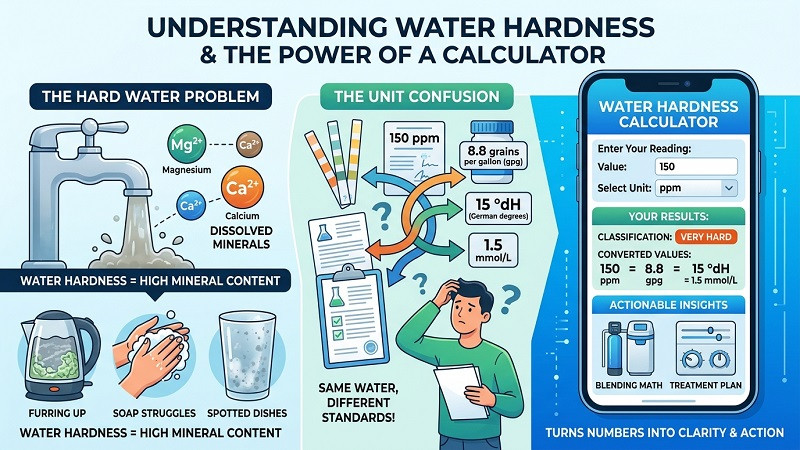
Water hardness is a measure of the dissolved minerals — mainly calcium and magnesium — in your water. It is the reason a kettle furs up with limescale, soap struggles to lather, and a glass comes out of the dishwasher spotted. A water hardness calculator turns the raw numbers on a test strip or lab report into something you can actually act on: a classification, a clean conversion between units, and the math to blend or treat water to the level you want.
The challenge is that hardness is reported in a confusing range of units. The same water might be labelled “150 ppm,” “8.8 grains per gallon,” “15 °dH,” or “1.5 mmol/L” depending on who measured it and where. Each is correct, but comparing a US softener spec in grains to a European appliance rating in German degrees means converting first — and that is exactly where mistakes happen.
This calculator removes that friction. It converts between every common hardness unit, classifies water from soft to very hard, builds total hardness from separate calcium and magnesium readings, and even blends two water sources (or dilutes a hard supply with soft water) to hit a target hardness. Whether you are setting up a water softener, dosing an aquarium, dialing in an espresso machine, or interpreting a utility report, this tool gives you the answer and the reasoning.
Because blending and dilution math share the same logic across chemistry, you may also find our solution dilution calculator and percentage dilution calculator useful companions when adjusting concentrations of any kind.
Water Hardness Calculator
Five modes — unit converter, Ca + Mg total hardness, classification, blend two waters & blend to target
Calculation Result
💡 Tip: “Total hardness” is conventionally expressed as mg/L (ppm) of calcium carbonate (CaCO₃), even though the minerals are mostly calcium and magnesium. When comparing a softener spec, an appliance rating, and a lab report, convert everything to one unit first.
Understanding Water Hardness — Units and Numbers
Water hardness comes almost entirely from dissolved calcium (Ca²⁺) and magnesium (Mg²⁺) ions. By long-standing convention, total hardness is reported “as CaCO₃” — that is, the calcium and magnesium are expressed as the equivalent amount of calcium carbonate, so everything lands on one comparable scale.
Building Total Hardness from Calcium and Magnesium
If your lab report lists calcium and magnesium separately in mg/L, you convert each to its CaCO₃ equivalent and add them. Calcium is multiplied by about 2.497 (the ratio of CaCO₃ to Ca molar mass), and magnesium by about 4.118. The sum is your total hardness as CaCO₃.
1 gpg = 17.118 ppm · 1 °dH = 17.848 ppm · 1 °fH = 10 ppm · 1 °e = 14.254 ppm
1 mmol/L = 100.09 ppm · 1 mEq/L = 50.04 ppm
Blend: H = (H₁V₁ + H₂V₂) ÷ (V₁ + V₂)
The Common Hardness Units
The same hardness can be written many ways. ppm or mg/L as CaCO₃ is the international scientific standard. Grains per gallon (gpg) is standard for US water softeners. German degrees (°dH) are common across Europe and on many appliances. French degrees (°fH) and Clark/English degrees (°e) appear in their respective regions. Converting between them is just multiplication by a fixed factor.
Hardness Classification
The widely used classification (based on mg/L as CaCO₃) is: Soft 0–60, Moderately hard 61–120, Hard 121–180, and Very hard above 180. These bands help you decide whether treatment is worthwhile and how aggressive to be.
Quick Reference Values
little scaling
noticeable
scaling likely
treatment helps
US softeners
German degree
Remember: “Hardness as CaCO₃” does not mean your water actually contains that much chalk — it is a standardised way of expressing calcium and magnesium together so any lab, softener, or appliance can be compared on one scale.

Real Scenarios Where Water Hardness Math Mattered
The theory becomes vivid in practice. These five scenarios reflect real situations — at home, in aquariums, and in small businesses — where the hardness numbers, or a missing conversion, made a real difference.
Scenario 1: A Softener Sized in the Wrong Units
A homeowner bought a water softener rated in grains per gallon but had a utility report in ppm. Their water was 300 ppm, which is about 17.5 gpg — but they read “300” as grains and oversized the system dramatically. Converting first (300 ÷ 17.118 ≈ 17.5 gpg) would have matched the right unit and the right capacity.
Scenario 2: An Aquarium Crash from Misread °dH
An aquarist following a guide written in German degrees (°dH) set a target of “8” but measured their water in ppm, reading 8 ppm as on-target when the guide meant about 143 ppm. The fish, which needed moderately hard water, were kept far too soft. Converting 8 °dH to ppm (8 × 17.848 ≈ 143 ppm) would have shown the gap immediately.
Scenario 3: Espresso Scale from Hard Water
A café’s espresso machine scaled up within months. Their supply was 220 ppm — very hard — and the manufacturer recommended blending down to around 80–100 ppm. Using the blend-to-target math, they mixed roughly two parts reverse-osmosis water to one part tap to reach the target and protect the boiler.
Scenario 4: Adding Calcium and Magnesium Separately
A brewer had a lab report listing calcium at 40 mg/L and magnesium at 12 mg/L but no total hardness figure. Treating them as if they added directly (52) understated the true hardness. The correct total is (40 × 2.497) + (12 × 4.118) ≈ 149 ppm — nearly three times the naive sum, because each ion must be converted to its CaCO₃ equivalent first.
Scenario 5: Blending Two Wells
A property had two wells — one at 350 ppm and one at 90 ppm — and the owner wanted to know the hardness if both fed a tank in different amounts. Mixing 2 parts of the hard well with 3 parts of the soft one gives (350×2 + 90×3) ÷ 5 = 194 ppm. The blend calculator answers this directly, and the same weighted-average logic underlies any dilution ratio calculator problem.

Common Water Hardness Mistakes and the Science Behind Them
The mistakes people make with water hardness cluster around a few predictable failure points. Understanding why they happen is more useful than simply memorising the right answer.
Mistake 1: Comparing Different Units Directly
Reading a softener spec in grains and a report in ppm as if they were the same number is the most common error. 10 gpg is about 171 ppm, not 10 ppm — a 17-fold difference.
Prevention: convert everything to one unit (ppm as CaCO₃ is the safest) before comparing. The Unit Converter mode does this instantly.
Mistake 2: Adding Calcium and Magnesium Without Converting
Calcium and magnesium in mg/L cannot simply be added to get hardness — each must first be expressed as its CaCO₃ equivalent (×2.497 for Ca, ×4.118 for Mg).
Prevention: use the Ca + Mg mode, which applies the correct factors automatically.
Mistake 3: Confusing Total Hardness with Carbonate Hardness
“Total hardness” (all calcium and magnesium) is not the same as “carbonate hardness” or alkalinity (KH), which measures buffering capacity. They are related but distinct, and aquarists especially must track both.
Prevention: know which one your test or guide refers to; this calculator computes total hardness (GH), not KH.
Mistake 4: Assuming Hardness Is Constant
Hardness can vary by season, source, and even within a distribution network. A single old reading may not reflect today’s water.
Prevention: re-test periodically, especially before sizing equipment or setting up sensitive systems like aquariums.
Mistake 5: Ignoring the Blend Math
When mixing two waters, the result is a volume-weighted average, not a simple midpoint. Equal volumes average evenly, but unequal volumes pull toward the larger one.
Prevention: use the Blend modes, which weight by volume. The same principle drives our solution dilution calculator.
💡 Rule of Thumb: Convert to one consistent unit, build total hardness from calcium and magnesium with the proper factors, classify against the standard bands, and treat any blend as a volume-weighted average. The arithmetic is simple; the accuracy lives in the units.
Expert Perspectives on Managing Hard Water
The people who work with water for a living tend to agree on what separates reliable decisions from costly guesses — and it usually starts with the units.
“Most softener sizing mistakes I see come down to grains versus ppm. Get the unit conversion right first, then size the system. A two-minute conversion saves a wrongly specified unit and years of poor performance.”
“In the aquarium hobby, GH and KH get mixed up constantly. Total hardness tells you about calcium and magnesium for your livestock and plants; carbonate hardness is your pH buffer. Track both, and always know which unit your source is quoting.”
“For coffee and steam equipment, blending to a target hardness is the practical lever. A simple weighted-average blend of RO and tap water hits the sweet spot that protects the boiler without making flat-tasting water.”
Which Calculation Mode Fits Your Situation
The five calculator modes correspond to the five distinct contexts where water hardness math is needed. Choosing the right mode ensures you apply the correct logic for your task.
Water Hardness Mode Comparison Table
| Mode | Use Case | Key Formula | Inputs Needed | Typical Applications |
|---|---|---|---|---|
| Unit Converter | Compare reports | ×/÷ fixed factor | value, unit | Softener specs, appliances |
| Ca + Mg | Build total hardness | Ca×2.497 + Mg×4.118 | Ca, Mg in mg/L | Lab reports, brewing |
| Classify | Soft → very hard | band lookup | value, unit | Deciding on treatment |
| Blend 2 Waters | Mix two sources | (H₁V₁+H₂V₂)/(V₁+V₂) | 2 hardness, 2 volumes | Wells, tanks |
| Blend to Target | Hit a target | fraction = (Ht−Hd)/(H1−Hd) | hard, soft, target, vol | Espresso, aquariums |
Practical Decision Guide
Comparing a softener spec, an appliance rating, and a utility report? Use Unit Converter mode to put them all in one unit first.
Only have calcium and magnesium values? Use Ca + Mg mode to build total hardness with the correct conversion factors.
Just want to know if your water is hard? Use Classify mode to place it on the soft-to-very-hard scale.
Mixing two water sources? Use Blend 2 Waters mode for the volume-weighted result.
Need to reach a specific hardness? Use Blend to Target mode to find how much soft (or RO) water to mix with your hard supply. The same dilution logic powers our percentage dilution calculator and dilution factor calculator.
Unit Conversion
‘; s+=step(1,’Input = ‘+whFmt(val)+’ ‘+UNAME[unit]+’‘); s+=step(2,’Convert to base: ‘+whFmt(val)+’ \u00d7 ‘+whFmt(F[unit])+’ = ‘+whFmt(ppm)+’ ppm CaCO\u2083‘); s+=step(3,’Classification: ‘+cls.label+’‘); var tHTML=’‘+cls.label+’‘, s,tHTML ); };// ===== Ca + Mg ===== window.whCalcCaMg=function(){ var ca=parseFloat(gid(‘wh-cm-ca’).value); var mg=parseFloat(gid(‘wh-cm-mg’).value); if(isNaN(ca)||ca<0){whErr(‘Enter a valid calcium value (zero or more).’);return;} if(isNaN(mg)||mg<0){whErr(‘Enter a valid magnesium value (zero or more).’);return;} var caC=ca*2.4973; var mgC=mg*4.1180; var total=whRnd(caC+mgC,6); var cls=classify(total); var s=’
Total Hardness from Ca + Mg
‘; s+=step(1,’Calcium as CaCO\u2083 = ‘+whFmt(ca)+’ \u00d7 2.497 = ‘+whFmt(whRnd(caC,6))+’ ppm‘); s+=step(2,’Magnesium as CaCO\u2083 = ‘+whFmt(mg)+’ \u00d7 4.118 = ‘+whFmt(whRnd(mgC,6))+’ ppm‘); s+=step(3,’Total hardness = ‘+whFmt(whRnd(caC,6))+’ + ‘+whFmt(whRnd(mgC,6))+’ = ‘+whFmt(total)+’ ppm CaCO\u2083‘); s+=step(4,’Classification: ‘+cls.label+’‘); var tHTML=’‘+cls.label+’‘, s,tHTML ); };// ===== CLASSIFY ===== window.whCalcClassify=function(){ var val=parseFloat(gid(‘wh-cl-val’).value); var unit=gid(‘wh-cl-unit’).value; if(isNaN(val)||val<0){whErr(‘Enter a valid hardness value (zero or more).’);return;} var ppm=toPpm(val,unit); var cls=classify(ppm); var s=’
Water Hardness Classification
‘; s+=step(1,’Input = ‘+whFmt(val)+’ ‘+UNAME[unit]+’ = ‘+whFmt(ppm)+’ ppm CaCO\u2083‘); s+=step(2,’Soft 0\u201360 \u00b7 Moderately hard 61\u2013120 \u00b7 Hard 121\u2013180 \u00b7 Very hard 180+’); s+=step(3,’Your water is ‘+cls.label+’.’); whShowResult( ‘‘+cls.label+’‘+whFmt(ppm)+’ ppm CaCO\u2083‘, s,null ); };// ===== BLEND 2 WATERS ===== window.whCalcBlend=function(){ var h1=parseFloat(gid(‘wh-bl-h1’).value); var v1=parseFloat(gid(‘wh-bl-v1’).value); var h2=parseFloat(gid(‘wh-bl-h2’).value); var v2=parseFloat(gid(‘wh-bl-v2’).value); if(isNaN(h1)||h1<0){whErr(‘Enter a valid hardness for Water A.’);return;} if(isNaN(v1)||v1<0){whErr(‘Enter a valid volume for Water A.’);return;} if(isNaN(h2)||h2<0){whErr(‘Enter a valid hardness for Water B.’);return;} if(isNaN(v2)||v2<0){whErr(‘Enter a valid volume for Water B.’);return;} if(v1+v2<=0){whErr(‘Total volume must be greater than zero.’);return;} var blend=whRnd((h1*v1+h2*v2)/(v1+v2),6); var cls=classify(blend); var s=’
Blended Water Hardness
‘; s+=step(1,’Water A: ‘+whFmt(h1)+’ ppm \u00d7 ‘+whFmt(v1)+’ vol = ‘+whFmt(whRnd(h1*v1,6))+”); s+=step(2,’Water B: ‘+whFmt(h2)+’ ppm \u00d7 ‘+whFmt(v2)+’ vol = ‘+whFmt(whRnd(h2*v2,6))+”); s+=step(3,’Blend = (‘+whFmt(whRnd(h1*v1,6))+’ + ‘+whFmt(whRnd(h2*v2,6))+’) \u00f7 ‘+whFmt(v1+v2)+’ = ‘+whFmt(blend)+’ ppm‘); s+=step(4,’Classification: ‘+cls.label+’‘); var tHTML=’‘+cls.label+’‘, s,tHTML ); };// ===== BLEND TO TARGET ===== window.whCalcTarget=function(){ var h1=parseFloat(gid(‘wh-tg-hard’).value); var hd=parseFloat(gid(‘wh-tg-soft’).value); var ht=parseFloat(gid(‘wh-tg-target’).value); var vf=parseFloat(gid(‘wh-tg-vol’).value); if(isNaN(h1)||h1<0){whErr(‘Enter a valid hard water hardness.’);return;} if(isNaN(hd)||hd<0){whErr(‘Enter a valid soft/dilution water hardness (often 0).’);return;} if(isNaN(ht)||ht<0){whErr(‘Enter a valid target hardness.’);return;} if(isNaN(vf)||vf<=0){whErr(‘Enter a valid final volume greater than zero.’);return;} if(h1<=hd){whErr(‘Hard water must be harder than the soft/dilution water.’);return;} if(ht
Blend to Target Hardness
‘; s+=step(1,’Hard fraction = (Target \u2212 Soft) \u00f7 (Hard \u2212 Soft) = (‘+whFmt(ht)+’ \u2212 ‘+whFmt(hd)+’) \u00f7 (‘+whFmt(h1)+’ \u2212 ‘+whFmt(hd)+’) = ‘+whFmt(whRnd(frac,6))+’‘); s+=step(2,’Hard water = ‘+whFmt(whRnd(frac,6))+’ \u00d7 ‘+whFmt(vf)+’ = ‘+whFmt(vHard)+’‘); s+=step(3,’Soft/dilution water = ‘+whFmt(vf)+’ \u2212 ‘+whFmt(vHard)+’ = ‘+whFmt(vSoft)+’‘); s+=step(4,’Mix to reach ‘+whFmt(ht)+’ ppm (‘+cls.label+’).’); var tHTML=’\u2192 ‘+whFmt(vf)+’ at ‘+whFmt(ht)+’ ppm‘, s,tHTML ); };// ===== FAQ ===== document.addEventListener(‘click’,function(e){ var q=e.target.closest(‘#swiftcalcu-water-hardness-container .wh-faq-q’); if(!q)return; var item=q.closest(‘.wh-faq-item’); document.querySelectorAll(‘#swiftcalcu-water-hardness-container .wh-faq-item’).forEach(function(fi){ if(fi!==item)fi.classList.remove(‘open’); }); item.classList.toggle(‘open’); });// ===== STARS ===== document.addEventListener(‘click’,function(e){ var star=e.target.closest(‘#swiftcalcu-water-hardness-container .wh-star-input span’); if(!star)return; var val=parseInt(star.getAttribute(‘data-val’)); var container=star.closest(‘.wh-star-input’); container.setAttribute(‘data-sel’,val); container.querySelectorAll(‘span’).forEach(function(s){ parseInt(s.getAttribute(‘data-val’))<=val?s.classList.add(‘lit’):s.classList.remove(‘lit’); }); });// ===== SUBMIT REVIEW ===== window.whSubmitReview=function(){ var name=gid(‘wh-rname’); var role=gid(‘wh-rrole’); var text=gid(‘wh-rtext’); var sc=document.querySelector(‘#swiftcalcu-water-hardness-container .wh-star-input’); var rating=sc?parseInt(sc.getAttribute(‘data-sel’)||’0′):0; if(!name.value.trim()){whErr(‘Please enter your name.’);return;} if(rating===0){whErr(‘Please select a star rating.’);return;} if(!text.value.trim()){whErr(‘Please write your review.’);return;} whHideErr(); var list=document.querySelector(‘#swiftcalcu-water-hardness-container .wh-reviews-list’); var stars=”; for(var i=0;i<5;i++)stars+=i
Frequently Asked Questions About Water Hardness
These questions come from homeowners, aquarists, brewers, and anyone interpreting a water report. The answers address the real stumbling points rather than rehearsing textbook definitions.
The most common units are ppm (or mg/L) as calcium carbonate, grains per gallon (gpg), German degrees (°dH), French degrees (°fH), and Clark or English degrees (°e). Scientific work also uses mmol/L and mEq/L.
They all describe the same thing — dissolved calcium and magnesium — just on different scales. For example, 1 gpg ≈ 17.1 ppm and 1 °dH ≈ 17.8 ppm.
The safest habit is to convert everything to ppm as CaCO₃ before comparing. The Unit Converter mode does this in one step.
Multiply grains per gallon by 17.118 to get ppm (mg/L) as CaCO₃. So 10 gpg × 17.118 ≈ 171 ppm.
To go the other way, divide ppm by 17.118: 300 ppm ÷ 17.118 ≈ 17.5 gpg.
This single conversion prevents the most common sizing error, where a softener rated in grains is matched against a report in ppm. The Unit Converter mode handles both directions.
Convert each ion to its calcium carbonate equivalent and add them: total hardness = (calcium mg/L × 2.497) + (magnesium mg/L × 4.118), giving ppm as CaCO₃.
For example, 40 mg/L calcium and 12 mg/L magnesium give (40 × 2.497) + (12 × 4.118) ≈ 149 ppm.
You cannot simply add the raw mg/L values — each must be scaled to the CaCO₃ standard first. The Ca + Mg mode applies the factors automatically.
A widely used classification in ppm as CaCO₃ is: soft 0–60, moderately hard 61–120, hard 121–180, and very hard above 180.
Many people first notice hardness effects — limescale, poor lather, spotting — somewhere in the moderately hard to hard range.
The Classify mode places any value (in any unit) on this scale instantly, so you can decide whether treatment is worthwhile.
Total or general hardness (GH) measures all dissolved calcium and magnesium. Carbonate hardness (KH), or alkalinity, measures the water’s buffering capacity against pH change, mainly from bicarbonate and carbonate.
They are related but distinct. Water can be high in one and lower in the other, which matters a great deal in aquariums and brewing.
This calculator computes total hardness (GH). If you need buffering capacity, test specifically for KH or alkalinity.
The blend is a volume-weighted average: hardness = (H₁V₁ + H₂V₂) ÷ (V₁ + V₂). Equal volumes average evenly; unequal volumes pull toward the larger one.
To hit a specific target, the fraction of hard water needed is (target − soft) ÷ (hard − soft). For 300 ppm tap and 0 ppm RO aiming for 100 ppm, that fraction is 100 ÷ 300 = one-third hard water.
The Blend 2 Waters and Blend to Target modes do both calculations. The same logic underlies our solution dilution calculator.
Hard water is generally safe to drink and even contributes small amounts of dietary calcium and magnesium. Its problems are practical rather than medical — limescale, reduced soap lather, and spotting on glassware.
That said, this calculator is an engineering and planning tool, not medical advice. For any health concern about your water supply, consult your local water authority or a qualified professional.
If hardness is causing scale or appliance issues, treatment such as softening or blending is usually the practical answer.
One German degree of hardness (°dH) equals about 17.848 ppm as CaCO₃. So 8 °dH ≈ 143 ppm, and 300 ppm ≈ 16.8 °dH.
German degrees are common on European appliances and in aquarium guides, so converting to ppm is essential when following instructions written for a different region.
The Unit Converter mode shows °dH alongside every other unit at once.
Limescale forms when hard water is heated and calcium carbonate precipitates out. The harder the water and the hotter it gets, the faster scale builds up.
If your water is in the hard or very hard band (above about 120–180 ppm), scaling is expected without treatment. Options include a softener, descaling regularly, or blending with softer water for sensitive equipment.
Use the Classify mode to confirm your band, and the Blend to Target mode to plan a gentler supply for appliances like espresso machines.
Test strips give a quick, approximate reading — usually good enough to place water in a hardness band. For precise figures, a titration kit or a certified lab report is more reliable.
Whatever the source, note the unit it reports in and convert consistently. A precise number in the wrong unit is still misleading.
Re-test periodically, since hardness can change with season and source. The calculator works with whatever unit and value you have.
Water Hardness Best Practices Checklist
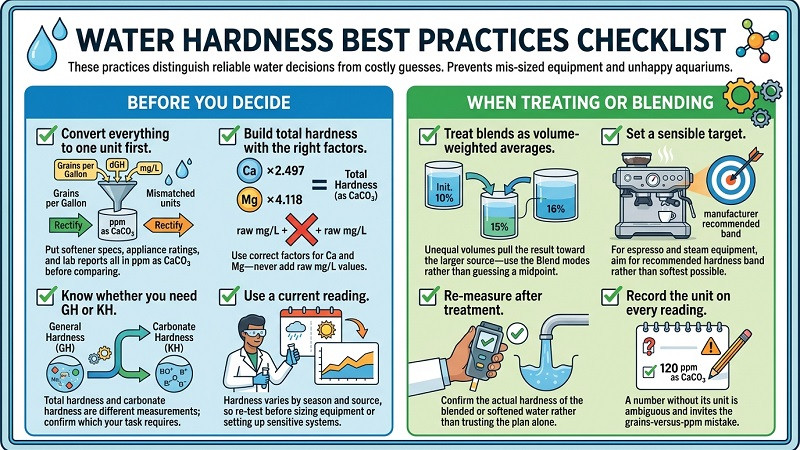
These practices distinguish reliable water decisions from costly guesses. Many take only seconds and prevent the systematic errors that lead to mis-sized equipment or unhappy aquariums.
Before You Decide
When Treating or Blending
For the dilution and blending math that supports water work, see our solution dilution calculator, dilution ratio calculator, and percentage dilution calculator.
Trusted Reference Resources for Water Hardness
These are authoritative references that homeowners, aquarists, and water professionals rely on when hardness decisions need solid backing.
USGS (U.S. Geological Survey) — usgs.gov — Provides clear explanations of water hardness, the standard classification bands, and data on hardness across regions.
WHO (World Health Organization) — who.int — Publishes guidance on drinking-water quality, including the role of calcium and magnesium and the health context of hardness.
US EPA (Environmental Protection Agency) — epa.gov — Offers resources on drinking-water standards, testing, and treatment relevant to hardness and scaling.
NIST (National Institute of Standards and Technology) — nist.gov — Useful for measurement units, conversion factors, and calibration relevant to accurate water testing.
LibreTexts Chemistry — chem.libretexts.org — A free, peer-reviewed platform explaining hardness chemistry, calcium carbonate equivalents, and concentration units.
On our platform, related calculation tools include: solution dilution calculator, percentage dilution calculator, dilution ratio calculator, and dilution factor calculator.
User Reviews & Ratings
📝 Share Your Experience with This Calculator
Final Thoughts on Understanding Water Hardness
Water hardness is one of those everyday measurements that seems simple until the units get in the way. The science is straightforward — dissolved calcium and magnesium, expressed as calcium carbonate — but the moment a softener spec in grains meets a lab report in ppm and an appliance rating in German degrees, a quick conversion becomes essential.
What matters is having the right framework: convert everything to one unit, build total hardness from calcium and magnesium with the proper factors, classify against the standard bands, and treat any blend as a volume-weighted average. That short sequence turns a confusing pile of numbers into a clear, actionable answer for softeners, aquariums, coffee equipment, and more.
From homes fighting limescale to aquarists protecting livestock and cafés saving their boilers, water hardness math shows up wherever water meets equipment. Keep this calculator handy as your starting point for any hardness question, and use the related dilution and blending tools in the sidebar whenever you need to adjust a concentration.
🔒 Privacy Guarantee: Every calculation on this page runs entirely within your browser. No data — hardness values, volumes, or any other inputs — is transmitted to any external server, stored in any database, or shared with any third party. Your calculations are completely private.