
What Is Dilution Ratio? Complete Guide to Understanding Concentration and Mixing
I was standing in a lab fifteen years ago when a new technician made a mistake that cost our company several thousand dollars. She was preparing a cleaning solution and said she understood dilution ratios. When I asked what 1:10 meant, she hesitated. Her uncertainty turned into a careless mistake—she prepared a solution at the wrong concentration, used it to clean expensive equipment, and damaged the surfaces because the chemical was too strong.
That single incident taught me something crucial: most people don’t actually understand what a dilution ratio is. They’ve heard the term. They might even use dilution ratios in their work. But ask them to explain it clearly, and confusion sets in.
After that day, I made sure everyone on my team understood dilution ratios completely—not just the math, but the why behind it. Because understanding dilution ratios isn’t just academic knowledge. It’s practical information that prevents expensive mistakes, protects safety, and ensures your work produces the results you need.
What Exactly Is a Dilution Ratio?
A dilution ratio is the relationship between the amount of solute (the substance being diluted) and the amount of solvent (usually water) used to dilute it. It expresses how much of the original concentrated material you’re using compared to how much total solution you’ll have at the end.
The confusion usually starts with notation. When someone says “1:10 ratio,” what exactly does that mean? Is it 1 part concentrate to 10 parts total? Or 1 part concentrate to 10 parts water? Different industries use different conventions, and that’s where mistakes happen.
The Core Definition
A dilution ratio expresses the proportion of concentrate to final solution (or concentrate to solvent, depending on the context). It tells you exactly how much concentrated material you need and how much solvent to add to achieve a specific concentration.
Example: A 1:10 dilution ratio typically means 1 part concentrate mixed with 9 parts solvent to create 10 parts total solution. The concentrate makes up 10% of the final volume.
This is why notation matters so much. In chemistry, we’re dealing with precise measurements. A 1:10 ratio is not the same as a 1:9 ratio, and when you’re dealing with caustic chemicals, medical solutions, or industrial applications, that difference isn’t minor—it can be critical.

Understanding the Mathematics Behind Dilution
At its heart, a dilution ratio is just a proportion problem. But understanding the math helps you grasp why dilution works the way it does.
When you create a dilution, you’re not magically changing the chemical composition of the original material. You’re distributing it across a larger volume. Think of it like dissolving a teaspoon of sugar in water. Whether you dissolve it in one cup of water or ten cups of water, you still have the same amount of sugar. The difference is concentration—how much sugar is in each milliliter of the solution.
C1 = Starting concentration
V1 = Starting volume
C2 = Final concentration
V2 = Final volume
This formula is the foundation of all dilution work. It comes from a simple principle: the amount of solute doesn’t change when you add solvent. You’re just spreading it out.
For example, if you have 100 mL of a 10% solution and you add 100 mL of water, you don’t have 200 mL of 10% solution anymore. You have 200 mL of 5% solution because the original solute is now distributed across twice the volume.
Practical Example: The Cleaning Solution
Let me use the scenario that caused that expensive mistake in our lab. We needed a cleaning solution at 5% concentration from a 50% concentrate.
Using the formula: If we take 100 mL of 50% concentrate and want to end up with 5% solution, we need to know how much total volume we’ll have.
50% × 100 mL = 5% × V2
5000 = 5 × V2
V2 = 1000 mL
So we needed 100 mL of concentrate diluted to 1000 mL total. That means 900 mL of water.
The technician who made the mistake didn’t do this calculation. She eyeballed it and got it wrong. The equipment damage was the result.

Different Types of Dilution Ratios You’ll Encounter
Dilution ratios appear in different formats depending on the industry and the specific application. Understanding these different formats prevents confusion and mistakes.
The 1:X Format (Most Common)
When someone says “1:10 dilution,” they usually mean 1 part concentrate to 10 parts total solution. This is standard in chemistry and laboratory work.
In this notation:
- 1:10 means 1 part concentrate + 9 parts solvent = 10 parts total (10% concentration)
- 1:5 means 1 part concentrate + 4 parts solvent = 5 parts total (20% concentration)
- 1:100 means 1 part concentrate + 99 parts solvent = 100 parts total (1% concentration)
The Part Ratio Format
Sometimes you’ll see ratios written as “3:2:1” which might mean 3 parts ingredient A, 2 parts ingredient B, 1 part ingredient C. This format is common in concrete mixing, paint formulation, and other multi-component applications.
The Percentage Format
This is the most straightforward: “10% solution” simply means 10 parts solute per 100 parts total solution. If you have a 5% hydrogen peroxide solution, that means 5 mL of pure hydrogen peroxide in every 100 mL of total solution.
Example: Understanding Format Differences
Let’s say you need to prepare a disinfectant solution:
- If told “1:10 dilution”: 10 mL concentrate + 90 mL water = 100 mL of 10% solution
- If told “10% solution”: Same thing—10 mL concentrate + 90 mL water = 100 mL total
- If told “1 part concentrate to 9 parts water”: Also the same result
Same final result. Different notation. This is why clear communication is critical in work settings.
Why Dilution Ratios Matter in Different Fields
Healthcare and Medical Applications
In healthcare, dilution ratios aren’t optional—they’re critical safety measures. A wound irrigant that’s too concentrated can damage tissue. A disinfectant that’s too dilute won’t work. I’ve worked with nurses who prepare diluted solutions daily, and the ones who deeply understand dilution ratios make fewer mistakes.
When a hospital prepares a hydrogen peroxide solution for wound care at 3%, that’s not arbitrary. It’s the concentration that cleans effectively without damaging healthy tissue. Use 6% and you risk chemical burns. Use 1% and it’s ineffective.
Laboratory and Research Work
Lab work absolutely depends on precise dilution ratios. Whether you’re preparing bacterial culture media, chemical reagents, or testing solutions, the concentration matters tremendously. A miscalculation can invalidate entire experiments, waste expensive materials, or produce dangerously concentrated solutions.
Industrial and Manufacturing
In industrial settings, dilution ratios affect product quality, safety, and cost. A cleaning chemical might need to be diluted 1:5 for normal cleaning but 1:10 for sensitive surfaces. A pesticide might need specific dilution ratios to be effective without causing environmental damage.
Agricultural Applications
Farmers regularly work with dilution ratios when preparing fertilizers, pesticides, and herbicides. An incorrectly diluted pesticide might kill the crop instead of protecting it. An improperly diluted fertilizer can cause chemical burns on plants.
I’ve spoken with agricultural consultants who say that dilution ratio mistakes are among the most common causes of crop damage in small farms. Often it’s not malice or incompetence—it’s just lack of understanding about what the ratio actually means.
Food and Beverage Industry
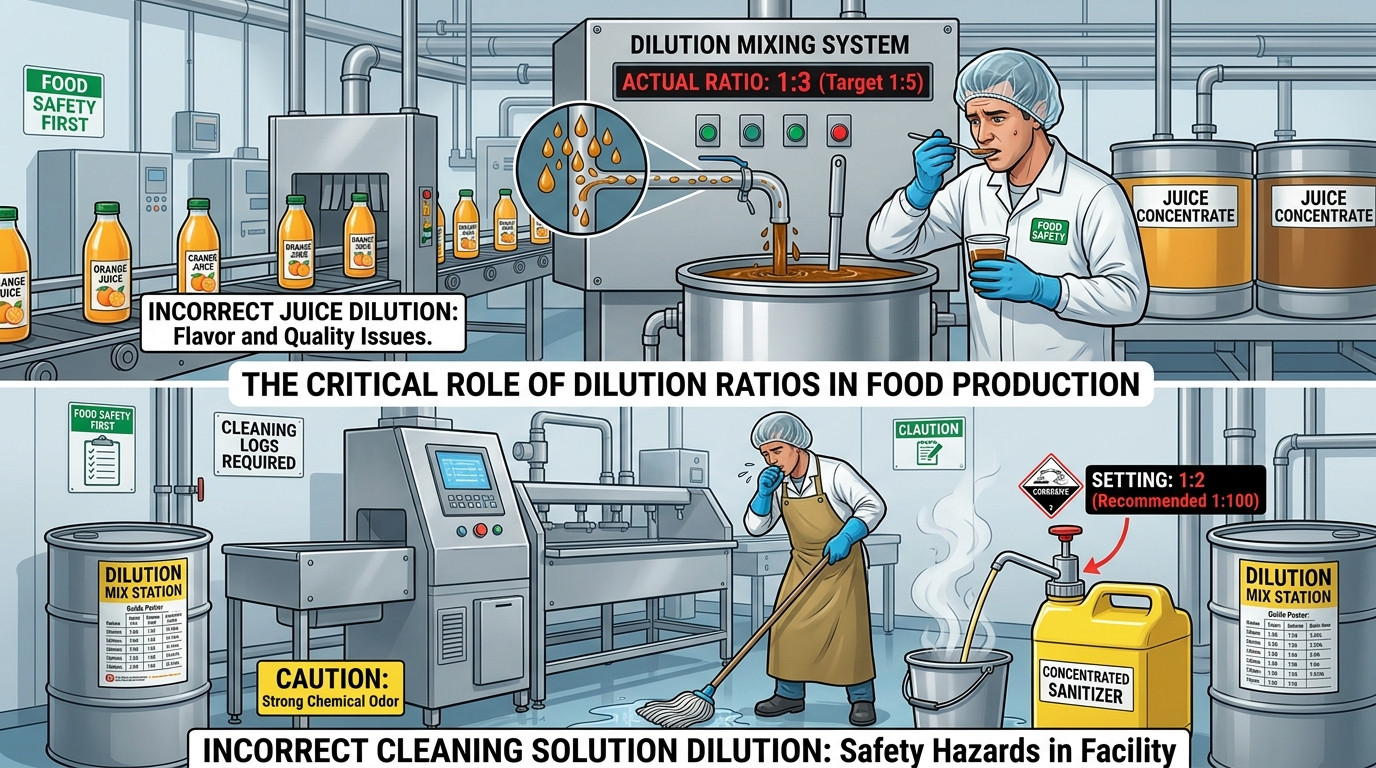
In food production, dilution ratios control flavor concentrations, ingredient strength, and food safety. A juice concentrate diluted at the wrong ratio won’t taste right. A cleaning solution in a food facility diluted incorrectly could create safety hazards.
Real Mistakes I’ve Seen (and How to Avoid Them)
❌ Mistake #1: Confusing “1:10” With “1 To 10 Parts”
What Happened:A facility manager was told to prepare a 1:10 dilution. He interpreted it as “1 part concentrate to 10 parts water” (creating 11 parts total). The result was a solution 10% weaker than needed. The dilution didn’t work for its intended purpose, and the problem went undetected for days.
The Real Issue:1:10 means 1 part concentrate to 9 parts water (10 parts total), not 1 to 10 parts water. That one word—”to” versus “total”—created a 9% difference in concentration.
How to Prevent:Always clarify: “Is this 1 part concentrate to 10 parts total, or 1 part concentrate to 9 parts water?” Write it out clearly. Never rely on verbal explanations alone for critical dilutions.
❌ Mistake #2: Not Accounting for Water In the Original Concentrate
What Happened:A chemist was preparing a solution from a concentrate that already contained 10% water. She calculated the dilution assuming pure concentrate, but the actual final concentration was 10% lower than she expected.
The Real Issue:Concentrates often contain water or other inert ingredients. You have to account for this when calculating dilutions, or your final concentration will be wrong.
How to Prevent:Always check the product label or safety data sheet. Know exactly what percentage of the concentrate is actually the active ingredient. Account for water and other inert materials in your calculations.
❌ Mistake #3: Using Tap Water Instead of Distilled Water
What Happened:A technician prepared a calibration solution using tap water. The solution appeared fine initially, but the minerals in the tap water reacted with the solute over time, causing the concentration to shift and making the solution unusable for precision work.
The Real Issue:Tap water contains minerals, chlorine, and other substances that can react with or degrade the solute. For precision work, distilled or deionized water is essential.
How to Prevent:For medical, laboratory, or precision work, always use distilled or deionized water. For general cleaning or non-critical applications, tap water is usually fine. Know the requirements of your specific application.
❌ Mistake #4: Rounding Calculations Incorrectly
What Happened:A pharmaceutical technician calculated that she needed 33.33 mL of concentrate. She rounded to 33 mL to avoid the fraction. For household use, this would be fine. For pharmaceutical manufacturing, the 0.33 mL difference resulted in a batch that failed quality control testing.
The Real Issue:In critical applications, rounding errors compound. 0.33 mL seems trivial until you’re manufacturing thousands of doses and that tiny error becomes a significant deviation in hundreds of units.
How to Prevent:Know the precision requirements of your application. In pharmaceuticals and precise laboratory work, don’t round. Use exact measurements. In general applications, rounding is acceptable if it’s within the tolerance for that application.
Expert Insights From Laboratory Professionals
How Dilution Ratios Connect to Real-World Tools
Now that you understand what dilution ratios are, you might be wondering how to apply this knowledge in practice. Different situations require different approaches.
For multi-component mixing where you’re combining several ingredients at specific ratios, understanding dilution principles is foundational. This applies whether you’re creating concrete, mixing paint, or combining multiple chemicals. If you’re working on projects that involve precise mixing ratios beyond simple dilution, tools that handle complex mixing ratio calculations can save time and prevent errors.
In laboratory settings, when you need to create precise concentration gradients where each solution feeds into the next one, serial dilutions become essential. This technique is used extensively in microbiology, chemistry, and medical testing. Understanding the dilution ratio principle is critical here because one mistake cascades through all subsequent dilutions. Tools designed for serial dilution calculations help ensure accuracy in these multi-step processes.
When you’re working with specific substances like hydrogen peroxide—whether for medical, industrial, or household purposes—the dilution principles remain the same, but the safety and precision requirements change significantly. Resources dedicated to hydrogen peroxide dilution help ensure you achieve the exact concentration needed for your specific application safely.
Real-World Application Examples
Example 1: Hospital Setting
A nurse needs to prepare 500 mL of a 3% disinfectant solution from a 12% concentrate. Using the dilution principle: If 12% × V1 = 3% × 500 mL, then V1 = 125 mL. She takes 125 mL of the 12% solution and adds 375 mL of sterile water to create exactly 500 mL at 3% concentration. The understanding of dilution ratios means she gets the precise concentration needed for safe disinfection.
Example 2: Laboratory Research
A researcher is creating a dilution series for cell culture work. Understanding dilution ratios allows her to create precise decreasing concentrations: 1:10, then 1:10 again, then 1:10 again to create solutions at 100%, 10%, 1%, and 0.1% of the original concentration. Each step follows the same principle: the solute amount remains constant, but it’s distributed across increasing volumes.
Example 3: Agricultural Application
A farmer needs to prepare 200 liters of pesticide solution at a 1:20 dilution ratio from concentrate. Understanding the ratio means he knows he needs 10 liters of concentrate (200 ÷ 20) plus 190 liters of water. This precision ensures the pesticide is effective without wasting expensive concentrate or creating overly dilute (ineffective) solution.

Frequently Asked Questions About Dilution Ratios
Yes, they mean the same thing in most contexts. A 1:10 dilution means 1 part concentrate to 10 parts total solution, which equals 10% concentration. However, always clarify because some people use “1:10” to mean “1 part to 10 parts of solvent” (which would be 11 parts total and about 9.1% concentration). Clear communication prevents mistakes.
In some applications, rough approximations are fine. But in healthcare, pharmaceuticals, laboratory work, and industrial applications, small concentration errors compound into large problems. A 10% error in concentration might seem minor until you’re treating 1,000 patients or manufacturing thousands of units. The exact ratio ensures consistent, safe, effective results.
Simple dilution is when you dilute a concentrate once to reach your target concentration. Serial dilution is when you dilute, then take that diluted solution and dilute it again, and repeat. Serial dilutions are used in laboratories to create precise concentration gradients. Each step follows the same dilution ratio principle, but you’re building on previous steps.
Mathematically yes, but practically it’s risky. If you diluted and then add more concentrate, you’re making a new calculation based on the diluted solution’s concentration—not the original. It’s easy to miscalculate and end up with the wrong concentration. Better to start over and calculate correctly from the beginning.
It depends on the application. For medical, pharmaceutical, and laboratory work, use distilled or deionized water. For general cleaning or non-critical applications, tap water is usually fine. Tap water contains minerals and chemicals that can affect precision in critical applications, but are irrelevant in others.
Yes. If a 1:10 dilution creates a 10% solution, then a 1:20 dilution creates a 5% solution. Doubling the ratio halves the concentration. This is why understanding the principle is crucial—you can predict how changes in ratio affect final concentration.
The severity depends on the application. In cleaning, it might just be less effective or slightly wasteful. In healthcare, it could cause harm. In manufacturing, it could ruin a batch. In agriculture, it could damage crops. Always verify dilution ratios before using the solution, especially in critical applications. When in doubt, start over and recalculate.
1:10 dilution = 10% solution = 1 part in 10. If someone gives you a dilution ratio and you need a percentage, divide 100 by the second number. 1:20 = 100÷20 = 5%. If you have a percentage and need a ratio, do the reverse: 5% = 1:(100÷5) = 1:20. Practice these conversions until they’re automatic.
In simple terms, yes. But technically, dilution factor is the degree to which the concentration decreases. A 1:10 dilution has a dilution factor of 10 (the concentration is 10 times weaker). Understanding this helps when working with serial dilutions where factors compound.
Final Understanding: Why This Matters
Dilution ratios seem like a simple concept. Mix concentrate with water in the right proportions. That’s it, right?
But the difference between understanding dilution ratios and just following numbers is the difference between professionals who produce consistent, safe results and people who make expensive, dangerous mistakes.
I’ve seen that difference play out hundreds of times. The technician who understands that a 1:10 ratio means the concentrate is now 10% of the total—she gets it right. The one who’s confused about whether it’s “1 to 10” or “1 and 10″—he gets it wrong.
The nurse who truly understands that diluting a 12% solution to 3% requires specific math—she prepares safe disinfectant. The one who estimates—she might prepare something less effective or potentially harmful.
The farmer who knows that dilution ratios directly affect pesticide effectiveness—he protects his crops and his soil. The one who guesses—he risks his livelihood.
Understanding dilution ratios is about more than math. It’s about responsibility. It’s about the difference between careless and careful work. It’s about producing results you can stand behind.
Remember: A dilution ratio is not just a number. It’s a promise about what concentration you’re creating. Make sure you understand that promise completely before you execute it. Your accuracy, safety, and results depend on it.
Advanced Dilution Concepts: Beyond Basic Ratios
Once you understand basic dilution ratios, there’s another layer of knowledge that separates people who can work with dilutions competently from those who truly master them. This is where precision becomes critical and small details make enormous differences.
I learned this lesson the hard way during a consultation with a pharmaceutical company. They were having issues with batch consistency in their manufacturing. At first, I thought it was a training problem—people weren’t following procedures. But when I dug deeper, I realized the real issue: their staff understood how to perform dilutions, but they didn’t understand the subtleties that affected accuracy.
The Concept of Dilution Factor vs. Dilution Ratio
Many people use these terms interchangeably, but there’s a technical distinction that matters in laboratory and industrial work.
Dilution Ratio tells you the relationship: 1:10 means 1 part to 10 parts total.
Dilution Factor tells you the degree of dilution: A 1:10 dilution has a dilution factor of 10 (you’ve diluted the original 10 times).
Why does this matter? In serial dilutions, factors multiply. If you do a 1:10 dilution, then another 1:10 dilution, your dilution factor is 10 × 10 = 100. The concentration is now 1/100th of the original. This is crucial information when you’re creating a dilution series in a laboratory.
Understanding Concentration vs. Strength
I’ve noticed that people sometimes use these terms as if they’re the same thing. They’re not quite the same, and the distinction matters in specific contexts.
Concentration is the amount of solute per unit volume (or mass) of solution. A 10% solution has 10 grams of solute in 100 mL of total solution.
Strength sometimes refers to concentration, but in other contexts, it can mean biological activity or effectiveness. A medicine might be diluted significantly but still retain its strength because only a small amount of the active ingredient is needed for effect.
This distinction becomes important in pharmaceutical and medical contexts. You might dilute a medication 1:100, but its therapeutic strength remains unchanged because only micrograms of the active ingredient are needed per dose.
The Role of Temperature in Dilution
This is something many people overlook completely. Temperature affects volume, which affects concentration calculations.
When you prepare a dilution at 20°C and then the solution is stored at 35°C, the volumes change slightly. For most applications, this is negligible. But for pharmaceutical, chemical, and precision laboratory work, it matters.
I worked with a quality control lab that was getting inconsistent results from their prepared standards. After investigation, we discovered their lab temperature fluctuated 15°C throughout the day. The dilutions prepared in the morning at cool temperatures had slightly different actual concentrations than those prepared in the afternoon when the lab was warmer.
The solution? They calibrated their measuring equipment at the expected working temperature and noted the lab temperature when preparing critical solutions.
The Importance of Homogenization
You can calculate the perfect dilution ratio, measure perfectly, and still create an unusable solution if you don’t mix properly.
I’ve seen laboratory technicians prepare dilutions by combining ingredients and giving them a quick stir, then using the solution immediately. The solute hasn’t fully dissolved or distributed evenly. The first portion you use might be more concentrated, while the last portion is weaker.
Proper mixing techniques depend on the solution type:
- Aqueous solutions: Stir thoroughly for at least 2-3 minutes, or use a magnetic stirrer
- Oil-based solutions: Require different mixing equipment (oil and water don’t mix)
- Viscous solutions: Need longer mixing times or mechanical mixing
- Solutions with solids: Require either complete dissolution or proper suspension technique
A properly mixed solution is homogeneous—the same concentration throughout. Improper mixing creates gradient solutions where concentration varies from top to bottom or from center to edge.

Dilution Errors in Real Professional Settings
I want to share some real incidents from professional settings where dilution ratio mistakes happened. These aren’t hypothetical—they’re actual situations I’ve encountered or learned about from colleagues in the field.
❌ Real Incident #1: The Hospital Cleaning Disaster
What Happened:A hospital hired a new cleaning staff. A supervisor prepared a disinfectant solution at what she believed was a 1:10 dilution. She mixed 10 mL of concentrate into 100 mL of water instead of adding it to water to make 100 mL total. The resulting solution was at roughly 9.1% instead of 10% concentration—a small difference mathematically, but it reduced disinfectant effectiveness enough that infectious disease control became an issue.
The Discovery:Hospital infection rates increased slightly over two weeks. Environmental testing revealed inadequate disinfection on surfaces. Investigation traced the issue to improper dilution ratio interpretation. The supervisor genuinely thought she was following the ratio correctly.
The Lesson:Clear written procedures matter enormously. This hospital now has laminated cards at each cleaning station showing exact dilution procedures with pictures. The cards show: “Take 10 mL concentrate. Pour into a container. Add water until total reaches 100 mL line.” No room for misinterpretation.
❌ Real Incident #2: The Laboratory Data Corruption
What Happened:A research lab was preparing calibration standards for analytical equipment. A new technician prepared a serial dilution for the first time. She understood the concept: 1:10 dilution, then another 1:10 from that result. But she didn’t account for the fact that when you pipette 10 mL from a solution and dilute it, you’re using that exact amount, not 10% of the new total volume.
The Error:Her dilutions were correct mathematically but wrong practically. She prepared: 100%, 10%, 1%, 0.1% correctly. But when analyzing samples against these standards, the results didn’t match expected values. Equipment calibration appeared wrong. The lab suspected equipment failure and called for maintenance.
The Discovery:During the equipment service call, the technician noticed the standards themselves were the problem. Retracing the dilution process revealed the new technician’s error. A senior technician had to redo all the standards. Two days of work was lost, and the lab had to report delayed results to multiple clients.
The Lesson:Supervision matters. This lab now requires a senior technician to verify all new technician work during their first month. Spot-checking during preparation catches errors before they cascade into larger problems.
❌ Real Incident #3: The Agricultural Chemical Spill
What Happened:A farm manager was preparing pesticide solution. The label said “1:20 dilution”—1 part concentrate to 19 parts water to make 20 parts total. The manager calculated he needed 10 liters of concentrate for 200 liters total. That was correct.
But here’s what went wrong: The concentrate he used was already a pre-mixed formulation (50% active ingredient in water). He didn’t account for this when calculating. His actual active ingredient concentration was half what it should have been, making the pesticide ineffective.
The Results:The pest infestation wasn’t controlled. The farm manager reapplied pesticide at the same “1:20” ratio, still not understanding that he was diluting an already-diluted product. By the time the issue was identified, he’d applied four times the intended volume of active ingredient, creating environmental concerns and wasting significant money.
The Lesson:Always check the label or SDS (Safety Data Sheet) to know the active ingredient percentage of your concentrate. A “concentrate” isn’t always 100% active ingredient. Environmental consultants now recommend this be the first step in any pesticide dilution procedure.
❌ Real Incident #4: The Paint Color Nightmare
What Happened:A painting contractor was preparing custom paint color from a concentrated tint. The specification called for a specific dilution ratio. The contractor prepared 50 gallons. The color looked slightly different from the sample, but he applied it anyway.
Once on the walls, it was obvious the color was wrong. Too dark. The contractor tried diluting more paint to match, but now he had a gallon of the wrong color and 50 gallons of paint on the walls that needed to be redone.
Investigation:The original dilution calculation was slightly off (he’d rounded numbers). When the error compounded across 50 gallons, it created a visible color shift. The contractor had to repaint the entire room—thousands of dollars in labor and materials.
The Lesson:For color-critical work, always prepare a small test batch first. Mix a small amount, apply to a test area, let it dry, and verify the color before preparing the full volume. This costs an hour and saves thousands.
Professional Standards and Best Practices
In professional settings, dilution work is controlled by standards and procedures that have been developed over decades. Understanding these standards shows why precision matters.
| Setting | Standard/Regulation | Accuracy Required | Verification Method |
|---|---|---|---|
| Pharmaceutical | FDA, GMP (Good Manufacturing Practice) | ±2% accuracy | Testing every batch |
| Laboratory | ISO 9001, Lab-specific SOP | ±1-5% (depends on application) | Calibrated equipment, supervisor review |
| Healthcare | CLIA, Hospital protocols | ±3-5% accuracy | Double-check system, supervisor approval |
| Environmental/Water | EPA regulations | ±5% accuracy | Regular testing and documentation |
| General Industry | Company-specific SOP | Varies (±5-10%) | Supervisor check, random testing |
Notice the pattern? More critical the application, more stringent the accuracy requirement and verification method.
How Dilution Ratios Relate to Other Calculation Methods
Understanding dilution ratios helps you grasp related concepts that come up in professional work. These aren’t separate topics—they’re all connected.
When you’re scaling recipes or formulations—whether it’s mixing concrete at 1:2:3 ratio, blending paint, or preparing chemical solutions—you’re using the same underlying principle of proportional relationships. A mixing ratio tells you the relationship between components. A dilution ratio tells you the relationship between concentrate and final solution.
In laboratory settings, when you need to prepare a series of dilutions where each one feeds into the next, you’re applying dilution ratio principles repeatedly. Understanding this helps you grasp serial dilution procedures, which are fundamental in microbiology, chemistry, and medical testing.
When you’re working with hydrogen peroxide or other concentrated solutions and need specific working concentrations, dilution ratios become safety-critical. The ability to accurately prepare safe hydrogen peroxide dilutions depends on understanding these ratios at a deep level.
For complex formulations where multiple ingredients need to be combined at specific ratios—whether in construction, manufacturing, or chemistry—understanding dilution ratio principles helps you approach these advanced mixing ratio challenges with confidence.
Expert Perspectives From the Field
Self-Assessment: Do You Really Understand Dilution Ratios?
Before you work with critical dilutions, honestly assess your understanding. Here are genuine questions that separate competence from mastery:
- Can you explain dilution ratios to someone who’s never heard the term and have them actually understand?
- If given a 50% concentrate and asked to make a 5% solution, can you calculate it without looking anything up?
- Do you understand why rounding can be a problem in some contexts but not others?
- Can you identify a “gotcha” in a dilution procedure before you execute it?
- Do you know when to use distilled water vs. tap water for dilutions?
- Can you explain why mixing matters as much as accurate calculation?
- Do you understand how to verify that a dilution is correct after you’ve prepared it?
If you answered “no” to more than one of these, you have some knowledge gaps. That’s not a criticism—it’s an opportunity. Fill those gaps before you work with critical dilutions.

Comprehensive FAQ About Dilution Ratios
After working with dilution ratios for fifteen years and training dozens of people on proper technique, I’ve learned which questions come up repeatedly. These are the ones that reveal the most common confusion points.
Your total dilution factor is 100. When you dilute in series (dilution → then dilute that result), the factors multiply. 10 × 10 = 100. So your final solution is 1/100th the concentration of the original. This is the principle behind serial dilutions used in laboratories. Understanding this multiplication principle is critical in any work involving multiple dilution steps.
Not always, and this is where confusion happens. “1:10” typically means 1 part to 10 parts total (making the solution 10%). But “1 to 10” can ambiguously mean “1 part to 10 parts of solvent” (making 11 parts total, about 9.1%). The safest practice is never to use ambiguous language. Always write: “1 part concentrate to 9 parts water to make 10 parts total” or use the formula C1V1=C2V2. Clear language prevents expensive mistakes.
Yes. A percentage IS a type of ratio—it’s the parts per 100. If something is 20%, that’s equivalent to 1:5 dilution (20 parts per 100, or 1 part per 5). If it’s 5%, that’s 1:20 dilution. To convert percentage to ratio: divide 100 by the percentage number. 10% = 100÷10 = 1:10. This conversion is useful when you have percentage information but need to think in ratio terms.
This is critical. You MUST account for the active ingredient percentage. If your “concentrate” is actually 50% active ingredient in water, then a 1:10 dilution doesn’t give you a 10% solution—it gives you 5%. Always check the label or Safety Data Sheet (SDS) to know the actual active ingredient percentage. This is where many real-world errors happen. People assume “concentrate” means 100% pure, but it often doesn’t.
Calculating the ratio tells you WHAT to combine. Mixing tells you that it’s actually combined properly. If you calculate perfectly but don’t mix thoroughly, you’ll have a gradient solution where parts are more concentrated than others. This is why laboratory procedures specify mixing methods: stirring for aqueous solutions, specific equipment for oils, vigorous mixing for suspensions. The perfect calculation produces wrong results if mixing is inadequate. Both matter equally.
It depends on the application. For household cleaning or general purposes, tap water is fine. For medical, pharmaceutical, or precision laboratory work, use distilled or deionized water. Tap water contains minerals and chlorine that can react with or degrade your solute, affecting concentration accuracy over time. In critical applications, use the right water type or you’re undermining your careful calculations.
Dilution ratio (1:10) describes the relationship between parts. Dilution factor (10) describes the degree of dilution. A 1:10 dilution HAS a dilution factor of 10 (the concentration is 10 times weaker). In serial dilutions, factors multiply while ratios stay the same. This distinction matters most in laboratory work where precision is critical and you’re tracking how many times a solution has been diluted.
The dilution ratio is 1:4. Here’s the math: If 20% × V1 = 5% × V2, then you need 1 part of 20% concentrate to make 4 parts of 5% solution. Or using percentages: 5÷20 = 0.25, which means your concentrate is 25% (or 1/4) of the final solution. So 1 part concentrate to 3 parts water makes 4 parts total at 5%. Understanding this reversal helps you work backward from desired concentration to required ratio.
Yes, especially in precision work. Liquids expand when heated and contract when cooled. A solution prepared at 20°C will have slightly different actual concentration when stored at 35°C because the volume changed. For pharmaceutical, chemical, and laboratory work, solutions should be prepared and used at consistent temperatures. Calibrated equipment is typically calibrated at a standard temperature (often 20°C or 25°C). Temperature variation is usually negligible for general applications but critical in precision laboratory work.
Theoretically yes, but practically it’s risky. If you’ve already diluted and realize the mistake, you could calculate how much concentrate to add to achieve the right concentration. But this creates a new calculation based on the incorrect solution, adding another point of error. Better practice: start over and calculate correctly from the beginning. The cost of starting over is almost always less than the cost of a batch that’s still not quite right.
Verification depends on your application. In laboratories, use testing equipment (pH meter for some solutions, refractometer for sugar solutions, spectrometer for colored solutions). In healthcare, follow institutional testing procedures. In industrial settings, use the method specified in your SOP (Standard Operating Procedure). In general applications, you might do a simple test: if it’s a cleaner, test it on a test surface. If it’s a dye, compare the color to a reference. Always verify before using critical dilutions in production or healthcare settings.
It depends on your application’s tolerance. In household cleaning, rounding is fine. In pharmaceuticals, rounding can cause batch failures. The rule: Know your application’s accuracy requirement, then round only if the error is within acceptable limits. If you need 33.33 mL and your measuring device only shows whole numbers, round to 33 mL only if your application tolerates that 1% error. When in doubt, don’t round—use exact measurements.
Resources and Further Learning
Understanding dilution ratios is foundational knowledge that applies across many fields. If you want to deepen your expertise or encounter specific dilution challenges, these resources help.
For students and professionals learning practical dilution techniques, understanding how dilutions apply in real laboratory settings is invaluable. When you encounter serial dilutions in microbiology or chemistry labs, you’re seeing the principle of dilution ratios applied systematically. Resources dedicated to serial dilution procedures show how the same ratio principle scales to multiple steps.
When working with specific substances where dilution precision is critical, such as hydrogen peroxide for medical or industrial applications, understanding how dilution ratios interact with safety requirements becomes essential. Detailed information on preparing hydrogen peroxide solutions demonstrates how dilution ratios are applied in real safety-critical contexts.
For professionals working with multiple ingredients combined at specific ratios—whether in construction, manufacturing, or chemistry—the principles extend beyond simple dilution. Understanding complex mixing ratios builds on the foundational knowledge of how ratios define relationships between components.
Professional standards organizations like ISO, pharmaceutical regulatory bodies (FDA), and industry-specific standard-setting organizations publish guidelines on how dilution ratios should be handled in their respective fields. Consulting these resources ensures you’re following best practices for your specific application.
The Bottom Line: Why Understanding Matters
I opened this guide with a story about a technician who made an expensive mistake because she didn’t fully understand dilution ratios. Fifteen years later, I’m still seeing similar mistakes in labs, hospitals, manufacturing facilities, and farms.
The pattern is always the same: Someone knows HOW to do dilutions but doesn’t deeply understand WHAT they’re doing. When something goes wrong, they don’t know how to troubleshoot. When they need to adapt a procedure, they don’t know what’s flexible and what’s critical.
But the people who truly understand dilution ratios—what they represent, how they work, why precision matters—those people are invaluable in their organizations. They catch errors before they become expensive. They adapt procedures intelligently when conditions change. They train others effectively.
Understanding dilution ratios isn’t about memorizing formulas. It’s about grasping a fundamental principle: when you dilute, you’re spreading a fixed amount of solute across a larger volume. The ratio tells you exactly how much to spread and how much space to spread it across. Small errors in ratio create large errors in final concentration. Precision matters. Safety matters. Understanding matters.
Whether you’re a student preparing for chemistry class, a healthcare professional preparing medical solutions, a lab technician running tests, or a business owner managing manufacturing processes, dilution ratios matter to your work quality and safety.
Master this concept thoroughly. It will serve you well across your entire career.
Final Thought: A dilution ratio is a promise. You’re promising yourself, your organization, and ultimately your customers or patients that you understand exactly what concentration you’ve created. Make sure that promise is kept with precision, attention, and deep understanding.
Pingback: How to Calculate the Dilution Factor: 7 Simple Steps to Success
Pingback: Weight by Volume Dilution Calculator (W/V %) – Free Lab Tool
Pingback: Mixing Ratio Calculator: Exact Volumes for Any Ratio (Free Tool)
Pingback: Neem Oil Dilution Ratio Calculator | Mix Neem Oil Correctly -
Pingback: Hydrogen Peroxide For Plants Dilution Calculator (3%, 12% & 34% for Root Rot)
Pingback: MIC Dilution Calculator | Calculate MIC Dilutions Instantly
Pingback: IV Dilution Calculator | Calculate IV Drug Dilutions Instantly
Pingback: Paint Thinner Calculator | Calculate Mixing Ratios Instantly
Pingback: ABV Calculator – Calculate Alcohol by Volume Instantly
Pingback: Nanomolar Calculator | Convert & Calculate nM Instantly
Pingback: Micromolar Calculator | Calculate µM Concentrations Instantly
Pingback: Isopropyl Alcohol Calculator | Calculate IPA Dilutions Instantly