
💉 IV Dilution Calculator
Calculate IV medication dilutions, concentrations, and dosing for safe infusion preparation
🚨 CRITICAL MEDICATION SAFETY WARNING
ALWAYS VERIFY ALL IV MEDICATION CALCULATIONS WITH A SECOND LICENSED HEALTHCARE PROFESSIONAL BEFORE ADMINISTRATION. Never rely solely on a calculator for medication preparation. Always check the drug label, verify patient identity, confirm allergies, check compatibility with existing IV lines, and follow institutional protocols. High-alert medications require independent double-checks. This calculator is for educational and reference purposes only—it is NOT a substitute for clinical judgment, institutional protocols, or pharmacist verification. Incorrect IV medication preparation can cause serious harm or death.
🔗 You Might Also Need
🕐 Calculation History
IV Dilution Calculator: Safe IV Medication Dilutions & Dosing
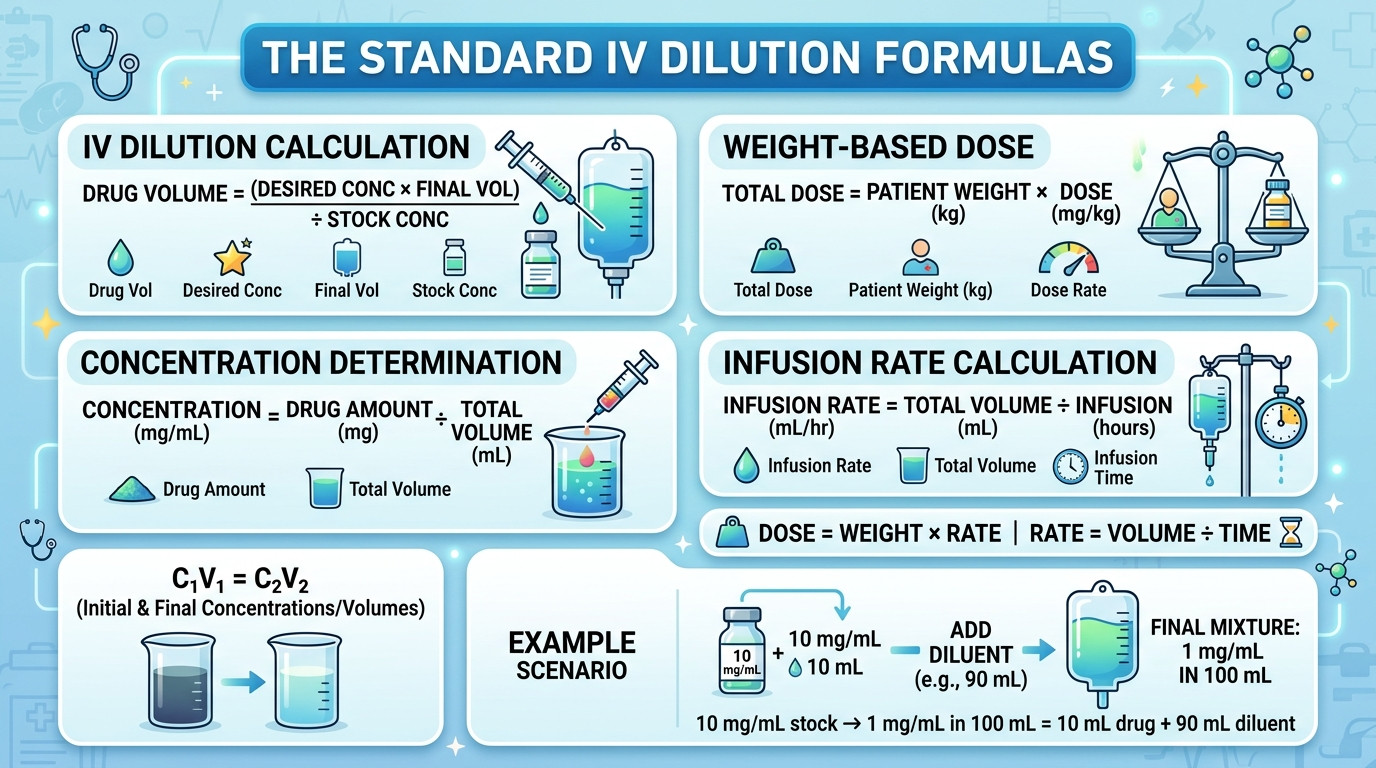
An IV dilution calculator determines the exact volumes of IV medication and diluent needed to prepare a safe infusion at the correct concentration. Using the universal formula C₁V₁ = C₂V₂, an IV dilution calculator can determine that diluting 10 mg/mL stock to 1 mg/mL in 100 mL requires 10 mL of drug + 90 mL of diluent (Normal Saline or D5W). This IV dilution calculator supports IV dilution calculations, concentration calculations, weight-based dosing (mg/kg), and infusion rate calculations for nurses, pharmacists, and healthcare professionals preparing IV medications.
ALWAYS VERIFY ALL IV MEDICATION CALCULATIONS WITH A SECOND LICENSED HEALTHCARE PROFESSIONAL BEFORE ADMINISTRATION. Never rely solely on a calculator for medication preparation. Always check the drug label (right drug, right dose, right route, right patient, right time), verify patient identity using two identifiers, confirm allergies, check IV compatibility, and follow institutional protocols. High-alert medications (heparin, insulin, potassium chloride, chemotherapy) require independent double-checks. This IV dilution calculator is for educational and reference purposes only—it is NOT a substitute for clinical judgment, pharmacist verification, or institutional protocols. Incorrect IV medication preparation can cause serious patient harm or death.
📋 Table of Contents
▼What an IV Dilution Calculator Does
An IV dilution calculator is a specialized tool that computes the exact volumes of IV medication concentrate and diluent (Normal Saline, D5W, or Lactated Ringer’s) needed to prepare a safe intravenous infusion at the prescribed concentration. According to the Institute for Safe Medication Practices (ISMP), IV medication errors are among the most dangerous medication errors because they deliver drugs directly into the bloodstream. The IV dilution calculator uses the universal formula C₁V₁ = C₂V₂ to compute drug volume, diluent volume, final concentration, weight-based doses, and infusion rates for safe IV medication preparation.
An IV dilution calculator tells you the exact volumes of IV medication and diluent for any infusion preparation, making it essential for nurses, pharmacists, pharmacy technicians, and healthcare professionals who prepare IV medications. Unlike simple oral medication calculations, IV dilution calculations involve understanding the relationship between stock concentration, desired concentration, final volume, patient weight, and infusion rate—and any one of them, applied wrongly, can produce a dangerously incorrect IV solution that is delivered directly into the patient’s bloodstream.
The reason IV dilution calculations trip healthcare professionals up is not the arithmetic itself but the high-stakes environment in which they are performed: time pressure, interruptions, look-alike/sound-alike drug names, multiple concentration options, and the need to calculate several interdependent values for a single IV preparation. The IV dilution calculator handles all of these calculations in one place, reducing errors and providing step-by-step verification for every IV medication preparation.
This IV dilution calculator handles the four most critical IV calculation tasks in one place: IV Dilution (C₁V₁ = C₂V₂ for drug and diluent volumes), Concentration (mg/mL from drug amount and volume), Weight-Based Dosing (mg/kg calculations for patient-specific doses), and Infusion Rate (mL/hr, drops/min, and dose rate). Each mode shows the answer and every step of the working, so you can verify the reasoning, perform an independent double-check, or document the calculation for the patient’s medical record.
Whether you are a nurse preparing a vancomycin infusion, a pharmacist verifying a heparin drip, a pharmacy technician compounding IV admixtures, or a physician calculating pediatric weight-based doses, the IV dilution calculator gives you the exact volumes and rates every time.

How IV Dilution Calculations Work
Understanding how IV dilution calculations work comes down to one principle: every IV medication must be prepared at the correct concentration and delivered at the correct rate to achieve the desired therapeutic effect without toxicity. From that single principle, a handful of formulas cover almost every IV calculation task. The IV dilution calculator exists to handle these formulas reliably and transparently, because in practice the “arithmetic” is layered with stock concentrations, diluent selection, patient weight, infusion time, and compatibility checks—and any one of them, applied wrongly, can produce a dangerously incorrect IV medication.
Understanding the C₁V₁ = C₂V₂ Formula for IV Dilutions
The universal dilution formula C₁V₁ = C₂V₂ is the foundation of all IV dilution calculations. C₁ is the stock concentration, V₁ is the volume of stock needed, C₂ is the desired final concentration, and V₂ is the final volume. For example, to prepare 100 mL of vancomycin at 5 mg/mL from a 50 mg/mL stock: V₁ = (5 × 100) ÷ 50 = 10 mL of drug + 90 mL of diluent. The IV dilution calculator performs this calculation instantly for any stock concentration, desired concentration, and final volume.
Understanding Weight-Based Dosing
Many IV medications are dosed based on patient weight (mg/kg or µg/kg). The IV dilution calculator converts weight-based doses to actual volumes using the drug concentration. For example, a 70 kg patient receiving vancomycin at 15 mg/kg needs 1050 mg total. If the stock is 50 mg/mL, the volume is 1050 ÷ 50 = 21 mL of drug added to the appropriate diluent volume.
Concentration: mg/mL = Drug Amount (mg) ÷ Total Volume (mL)
Weight-Based Dose: Total Dose = Patient Weight (kg) × Dose Rate (mg/kg)
Infusion Rate: mL/hr = Total Volume (mL) ÷ Infusion Time (hours)
Example: 10 mg/mL stock → 1 mg/mL in 100 mL = 10 mL drug + 90 mL diluent
Common IV Medication Dilution Concentrations
For quick reference, here are common IV medication dilution concentrations. The IV dilution calculator generates these dilutions automatically for any stock concentration and desired final concentration.
| Medication | Stock Conc. | Standard Dilution | Diluent | Infusion Time |
|---|---|---|---|---|
| Vancomycin | 50 mg/mL | 5 mg/mL | NS or D5W | 60-120 min |
| Piperacillin/Tazobactam | 200 mg/mL | 20-40 mg/mL | NS or D5W | 30 min (extended: 4 hr) |
| Heparin | 5000 units/mL | 100 units/mL | D5W or NS | Continuous infusion |
| Potassium Chloride | 2 mEq/mL | ≤40 mEq/L | NS or D5W | ≤10 mEq/hr |
| Insulin (Regular) | 100 units/mL | 1 unit/mL | NS only | Continuous infusion |
Quick Reference Values
Remember: Always verify IV medication calculations with a second licensed healthcare professional before administration. Check drug compatibility with existing IV lines. Use smart pump drug libraries when available. Label all IV bags with drug name, concentration, patient name, date/time, and initials. The IV dilution calculator gives you the exact volumes, but clinical verification is always required.
Real Scenarios Where IV Calculations Mattered
These scenarios reflect real clinical situations where IV dilution calculation errors—or a missing verification step—made a tangible difference to patient safety.
Scenario 1: The Nurse and the Heparin Overdose
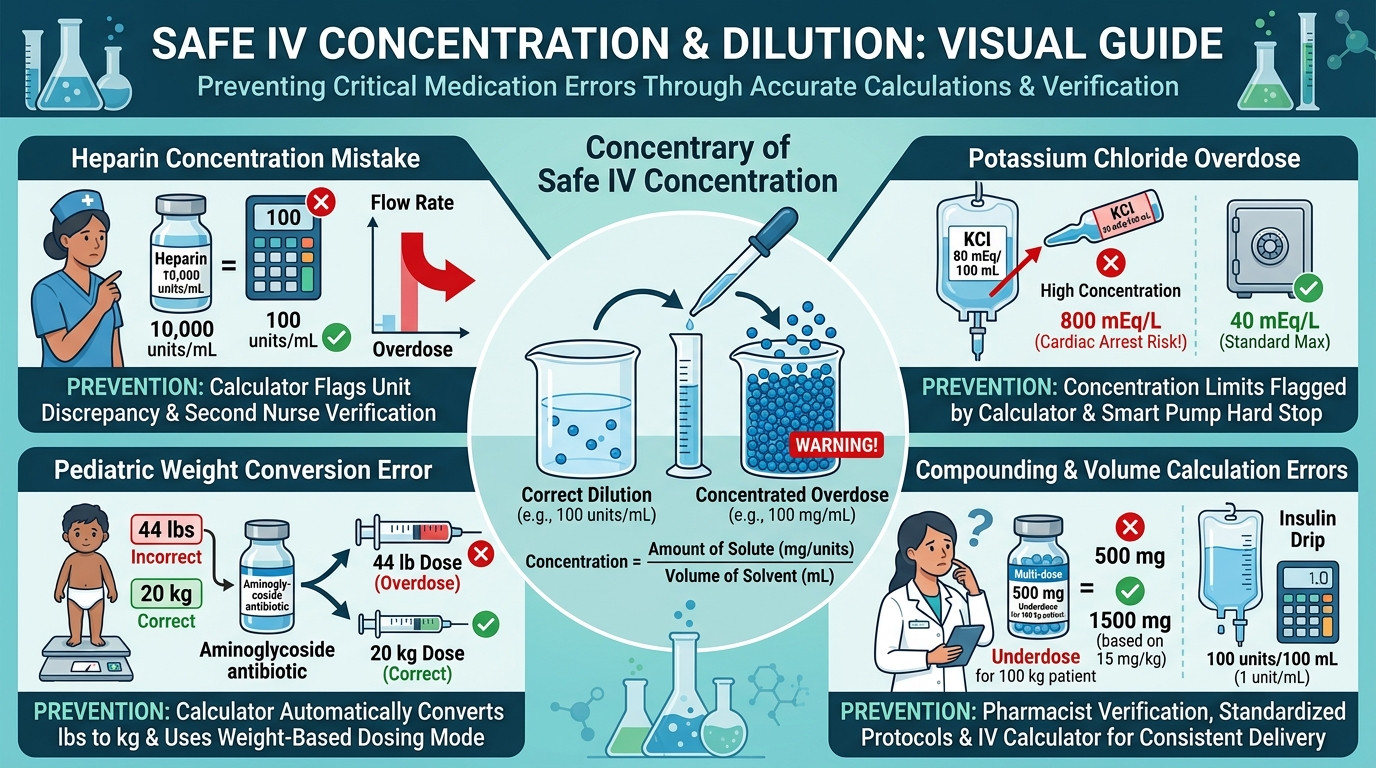
A nurse was preparing a heparin infusion and confused units/mL with mg/mL. She prepared the drip at 100 mg/mL instead of 100 units/mL, resulting in a massive heparin overdose. The patient developed severe bleeding requiring protamine reversal and blood transfusions. The IV dilution calculator’s Concentration mode would have flagged the unit discrepancy, and a second nurse verification would have caught the error before the infusion started.
Scenario 2: The Pharmacy Technician and the Vancomycin Error
A pharmacy technician was compounding vancomycin IV admixtures for multiple patients. He calculated the dilution incorrectly, using 500 mg instead of 1000 mg for a patient who weighed 100 kg (standard dose: 15 mg/kg = 1500 mg). The under-dosed vancomycin failed to achieve therapeutic levels, and the patient’s MRSA bacteremia worsened. The IV dilution calculator’s Weight-Based Dosing mode would have calculated the correct 1500 mg dose, and pharmacist verification would have caught the error.
Scenario 3: The ICU Nurse and the Potassium Chloride Error
An ICU nurse was adding potassium chloride to an IV bag and calculated the concentration incorrectly, adding 80 mEq to a 100 mL bag instead of the standard maximum of 40 mEq/L. The resulting 800 mEq/L concentration would have caused cardiac arrest if infused. The IV dilution calculator would have flagged the excessive concentration, and the smart pump drug library would have generated a hard stop alarm.
Scenario 4: The Pediatric Nurse and the Weight Conversion Error
A pediatric nurse was calculating a weight-based antibiotic dose for a 44 lb (20 kg) child. She used the weight in pounds (44) instead of kilograms (20), resulting in a dose 2.2 times higher than intended. The child developed nephrotoxicity from the aminoglycoside overdose. The IV dilution calculator’s Weight-Based Dosing mode automatically converts lb to kg, preventing this common and dangerous error.
Scenario 5: The Pharmacist and the Insulin Drip Error
A pharmacist was preparing an insulin drip and calculated the concentration as 1 unit/mL in 250 mL (250 units total). However, the physician ordered 100 units in 100 mL (also 1 unit/mL). The pharmacist used the wrong total volume, and when the nurse programmed the pump at 5 mL/hr, the patient received 5 units/hr instead of the intended 5 units/hr—but from a bag that would run out in 50 hours instead of 20 hours, causing inconsistent delivery. The IV dilution calculator would have calculated the correct volumes, and a standardized concentration protocol would have prevented the error.
Scenario 6: The ER Nurse and the Infusion Rate Error
An ER nurse was setting up a vancomycin infusion ordered at 1000 mg over 60 minutes in 250 mL. She calculated the infusion rate as 250 mL/hr but accidentally programmed the pump at 250 mL/min (15,000 mL/hr), causing a massive vancomycin overdose and Red Man Syndrome within minutes. The IV dilution calculator’s Infusion Rate mode would have calculated the correct 250 mL/hr rate, and a smart pump drug library would have prevented the programming error.
Scenario 7: The Oncology Nurse and the Chemotherapy Dilution
An oncology nurse was preparing a chemotherapy infusion and confused the stock concentration (10 mg/mL) with a different formulation (2 mg/mL). The patient received 5 times the intended dose of the cytotoxic drug, resulting in severe bone marrow suppression requiring G-CSF support and hospitalization. The IV dilution calculator would have used the correct stock concentration, and the mandatory independent double-check for chemotherapy would have caught the error.
Scenario 8: The Pharmacy Technician and the Diluent Selection Error
A pharmacy technician was compounding IV amiodarone and used Normal Saline instead of the required D5W. Amiodarone precipitates in Normal Saline at concentrations above 2 mg/mL, and the precipitate caused phlebitis and line occlusion in the patient. The IV dilution calculator’s documentation emphasizes diluent compatibility, and a pharmacist verification would have caught the incorrect diluent selection.
Common IV Dilution Mistakes
The errors healthcare professionals make with IV dilution calculations cluster around a few predictable points. Understanding why they happen prevents them.
Mistake 1: Confusing Units (mg vs units vs mEq)
The single most dangerous error is confusing milligrams (mg) with units (for heparin, insulin) or milliequivalents (mEq, for potassium). A 1000-fold difference between these units can produce lethal overdoses. Always verify the unit of measurement before calculating. The IV dilution calculator prompts users to select the correct unit for every parameter.
Mistake 2: Not Converting Weight to Kilograms
Using a patient’s weight in pounds instead of kilograms for mg/kg dosing produces a dose 2.2 times higher than intended. Always convert lb to kg (divide by 2.205) before calculating weight-based doses. The IV dilution calculator automatically converts lb to kg when selected.
Mistake 3: Incorrect Infusion Rate Programming
Confusing mL/hr with mL/min on an infusion pump can deliver medication 60 times faster than intended. Always verify the pump is set to mL/hr unless specifically ordered otherwise. The IV dilution calculator’s Infusion Rate mode calculates the rate in mL/hr, mL/min, and drops/min for verification.
Mistake 4: Not Checking Drug Compatibility
Adding incompatible drugs to the same IV line can cause precipitation, inactivation, or dangerous chemical reactions. Always check compatibility using Trissel’s or a hospital formulary before mixing. The IV dilution calculator reminds users to verify compatibility.
Mistake 5: Using the Wrong Diluent
Some medications require specific diluents (e.g., amiodarone requires D5W, not NS; phenytoin requires NS only). Using the wrong diluent can cause precipitation, inactivation, or patient harm. Always check the manufacturer’s prescribing information for the correct diluent. The IV dilution calculator includes common diluent options.
Mistake 6: Not Performing Independent Double-Checks
High-alert medications (heparin, insulin, potassium chloride, chemotherapy, opioids) require independent double-checks by two licensed healthcare professionals. Skipping this step is one of the most common causes of IV medication errors. Always perform independent double-checks for high-alert medications.
Mistake 7: Not Labeling IV Bags Properly
Failing to label IV bags with drug name, concentration, patient name, date/time, and preparer initials can result in wrong-patient or wrong-drug errors. Always label IV bags immediately after preparation. The IV dilution calculator reminds users to label all prepared IV solutions.
💡 Rule of Thumb: Always verify units before calculating, convert weight to kilograms, check drug compatibility, use the correct diluent, program infusion rates in mL/hr, perform independent double-checks for high-alert medications, and label all IV bags immediately. The IV dilution calculator handles the arithmetic, but clinical verification by licensed healthcare professionals is always required before administration.
Expert Perspectives on IV Medication Safety
The professionals who work with IV medication calculations daily share consistent advice about what separates safe IV preparation from dangerous errors.
“In 15 years of clinical pharmacy, I have investigated dozens of IV medication errors that traced back to simple calculation mistakes. The margin between a therapeutic dose and a toxic dose is often razor-thin—10 mEq vs 40 mEq of potassium can mean the difference between correcting hypokalemia and causing cardiac arrest. The IV dilution calculator has prevented countless errors in our hospital by standardizing every IV calculation.”
“The most common mistake I see in new nurses is not converting weight from pounds to kilograms before calculating weight-based doses. This single error produces a dose 2.2 times higher than intended. The IV dilution calculator automatically converts lb to kg, preventing this dangerous and surprisingly common error.”
“For high-alert medications like heparin and insulin, independent double-checks are not optional—they are a patient safety requirement. The IV dilution calculator shows every step of the calculation, making the double-check process faster and more reliable. This single practice has prevented multiple near-miss events in our ICU.”
Frequently Asked Questions About IV Dilution Calculations
These questions come from nurses, pharmacists, pharmacy technicians, and healthcare students who use IV dilution calculations in their daily practice.
The IV dilution calculator performs this calculation automatically for any stock concentration, desired concentration, and final volume.
The IV dilution calculator uses this formula for all IV dilution calculations, showing every step of the working.
The IV dilution calculator’s Weight-Based Dosing mode handles all these calculations automatically, including lb to kg conversion.
The IV dilution calculator’s Infusion Rate mode calculates mL/hr, mL/min, dose rate, and drop rate automatically.
The IV dilution calculator includes common diluent options and reminds users to verify compatibility.
Potassium chloride is a high-alert medication—always perform independent double-checks and use smart pump drug libraries.
The IV dilution calculator automatically converts lb to kg when the lb unit is selected.
Never prepare chemotherapy without specialized training and institutional protocols. The calculator handles the math, but chemotherapy safety requires far more than accurate calculations.
Always have IV medication calculations verified by a pharmacist or second licensed professional before administration.
The clinical accuracy depends on correct input values, proper technique, pharmacist verification, and adherence to institutional protocols.
Trusted Reference Resources
These are authoritative references for accurate IV dilution calculations and medication safety.
Institute for Safe Medication Practices (ISMP) — ismp.org — Leading nonprofit organization dedicated to preventing medication errors, including IV medication safety guidelines, high-alert medication lists, and independent double-check recommendations.
American Society of Health-System Pharmacists (ASHP) — ashp.org — Professional organization for pharmacists with guidelines on IV admixture preparation, sterile compounding (USP 797), and medication safety practices.
Infusion Nurses Society (INS) — ins1.org — Professional organization for infusion nurses with evidence-based standards for IV therapy, including dilution guidelines, infusion rate standards, and patient safety protocols.
FDA MedWatch — fda.gov — FDA’s safety information and adverse event reporting program for reporting IV medication errors and safety concerns.
The Joint Commission — jointcommission.org — Healthcare accreditation organization with National Patient Safety Goals including medication safety, high-alert medication management, and independent double-check requirements.
On our platform, related calculation tools include: drug dose dilution calculator, infusion rate calculator, drip rate calculator, medication dilution calculator, pediatric dose calculator, pharmaceutical dilution calculator, solution dilution calculator, mg/mL calculator, and dilution calculator (all-in-one).
Leave a Review
Used this IV dilution calculator in your hospital, pharmacy, or clinical practice? Share your experience below. Your review helps other healthcare professionals decide if this calculator fits their needs. Every review is stored locally on your device and appears instantly.
📝 Share Your Experience
Final Thoughts on IV Dilution Calculations
IV dilution calculation is one of those tasks where the arithmetic is straightforward but the stakes are life-or-death. The formula C₁V₁ = C₂V₂ is simple, but a single error in the stock concentration, desired concentration, patient weight, or infusion rate can deliver a dangerous dose directly into a patient’s bloodstream with no opportunity to “take it back.” The IV dilution calculator exists to remove the arithmetic risk, handling every calculation internally and showing every step so the result can be verified by a second licensed healthcare professional, documented in the patient’s medical record, and used with confidence at the bedside.
What separates safe IV medication preparation from dangerous errors is discipline, not genius. Verifying units before calculating, converting weight to kilograms, checking drug compatibility, using the correct diluent, programming infusion rates in mL/hr, performing independent double-checks for high-alert medications, and labeling all IV bags immediately: these are the habits that catch the errors the human brain makes under fatigue, interruption, and time pressure. The IV dilution calculator does the maths perfectly every time, but it cannot verify the patient’s identity, check for allergies, assess clinical appropriateness, or replace the clinical judgment of a licensed healthcare professional.
The framework is short: verify units, convert to kg, check compatibility, use correct diluent, set rate in mL/hr, double-check high-alert meds, and label immediately. That sequence gives safe IV medication preparation every time. From emergency departments and intensive care units to medical-surgical floors and outpatient infusion centers, IV dilution calculation is everywhere a precise intravenous medication dose is needed, and getting it right is one of the most consequential calculations in healthcare.
Keep this IV dilution calculator handy as your starting point for every IV calculation, and use the related dilution tools in the sidebar whenever you need to plan or verify a dilution before preparing an IV medication.
🔒 Privacy Guarantee: Every calculation on this page runs entirely within your browser. No data—IV concentrations, patient weights, medication doses, or any other inputs—is sent to any server, stored, or shared. Your calculations are completely private and HIPAA-compliant by design.
Pingback: Pediatric Dose Calculator | Calculate Child Medication Doses
Pingback: ABV Calculator – Calculate Alcohol by Volume Instantly
Pingback: Fertilizer Calculator – Calculate Fertilizer Amount Instantly
Pingback: Common Lab Solutions | Preparation Guide & Calculator