
C1V1 Dilution Calculator — C1V1 = C2V2 Formula Solver
A C1V1 dilution calculator solves the most fundamental equation in solution chemistry — C₁V₁ = C₂V₂ — to tell you exactly how much stock solution to mix with diluent to reach a target concentration. Here C₁ is the stock concentration, V₁ is the stock volume you need, C₂ is the desired final concentration, and V₂ is the final volume. The C1V1 dilution calculator rearranges the equation to solve for any unknown: V₁ = (C₂ × V₂) ÷ C₁. It also calculates dilution factors, handles serial dilutions, converts between molarity and mg/mL, and generates multi-step concentration series. Enter any three of the four C1V1 values below and the C1V1 dilution calculator returns the fourth instantly, with every step shown.
Key facts at a glance
- The C1V1 equation: C₁V₁ = C₂V₂ — the amount of solute is conserved during dilution.
- Solve for V₁: V₁ = (C₂ × V₂) ÷ C₁ — how much stock to pipette.
- Diluent to add: V₂ − V₁ — make up to volume, do not over-add.
- Dilution factor: C₁ ÷ C₂ (or V₂ ÷ V₁).
- Serial dilution: each step multiplies the factor; five 1:10 steps = 105.
- Keep units matched: both concentrations in one unit, both volumes in one unit.
📋 Table of Contents
▼
- What a C1V1 Dilution Calculator Does
- C1V1 Dilution Calculator — Five Modes
- How the C1V1 Formula Works
- Real Scenarios Where C1V1 Math Mattered
- Common C1V1 Calculation Mistakes
- Lab Safety Essentials
- Which Mode Fits Your Situation
- Frequently Asked Questions
- C1V1 Dilution Best Practices Checklist
- Trusted Reference Resources
- User Reviews & Ratings
What a C1V1 Dilution Calculator Does
A C1V1 dilution calculator solves the dilution equation C₁V₁ = C₂V₂ for any one of the four variables, telling you exactly how much stock solution to pipette and how much diluent to add to reach a target concentration. This single equation, first derived from the law of conservation of mass applied to solutions, governs every dilution performed in every laboratory in the world — from a first-year chemistry student making a salt solution to a pharmaceutical scientist preparing a clinical-grade standard. The C1V1 dilution calculator exists to handle this equation reliably, transparently, and fast, because although the formula itself is simple, the unit conversions, dilution-factor calculations, serial-step multiplications, and the critical distinction between “add diluent” and “make up to volume” create layered arithmetic that invites errors under time pressure.
In chemistry, biochemistry, molecular biology, clinical diagnostics, pharmaceutical manufacturing, food science, and environmental testing, diluting a concentrated stock to a precise working concentration is the single most frequently performed calculation. Whether you are preparing a buffer from a 10× stock, diluting an antibiotic from a concentrated solution, making a calibration standard from a certified reference material, or setting up a serial dilution for an ELISA, the C1V1 equation is the tool you reach for. A single error — a misplaced decimal, a mismatched unit, or a confused “add” versus “make up to” — changes the concentration by a factor of ten or more, and that error then propagates into every assay, every measurement, and every conclusion drawn from that solution. The C1V1 dilution calculator eliminates that risk by performing the arithmetic internally and showing each step, so you can verify, document, and teach the reasoning rather than trusting mental maths.
This C1V1 dilution calculator handles the five most common dilution tasks in one place: the core C1V1 solver (find V₁ from the other three values), the reverse solver (find C₂ from C₁, V₁, and V₂), the serial dilution planner (generates a concentration series), the dilution factor calculator, and the molarity-to-mg/mL converter. Each mode shows the answer and every step of the working, so you can trace the logic from inputs to result. Whether you are a student learning the C1V1 equation for the first time or a senior scientist performing a critical dilution under pressure, the goal is the same: a defensible, reproducible concentration that your experiment can rely on.
Because the C1V1 dilution calculator and serial dilution share the same underlying conservation principles, the tools in the sidebar — including our dilution calculator, dilution factor calculator, and molarity dilution calculator — are useful companions for any solution-preparation task.
C1V1 Dilution Calculator
Five modes — solve V₁, find C₂, serial plan, factor & molarity
Calculation Result
⚠️ Safety first: This C1V1 dilution calculator handles concentrations and volumes only. Always check chemical compatibility, read the Safety Data Sheet (SDS), wear appropriate PPE, and follow your laboratory’s safety protocols before preparing any solution.
How the C1V1 Formula Works
Every dilution calculation comes down to one idea: the amount of solute is conserved when you add diluent. Whether you are diluting a buffer, an antibiotic, a dye, or a chemical standard, the total quantity of dissolved substance does not change — only the volume increases and the concentration decreases. The C1V1 dilution calculator captures this conservation principle in a single, elegant equation. Understanding why the equation works, not just how to plug numbers into it, is the difference between a technician who follows a recipe and a scientist who can design and troubleshoot any dilution.
The Physics Behind C1V1 = C2V2
The C1V1 dilution calculator is built on the law of conservation of mass. When you take a volume V₁ of a stock solution at concentration C₁, the total amount of solute in that volume is C₁ × V₁ (concentration multiplied by volume gives amount). When you add diluent to bring the total volume to V₂, the solute spreads through a larger volume, so the new concentration C₂ must be lower. But the total amount of solute has not changed — it is now C₂ × V₂. Setting these two expressions for the same amount of solute equal gives C₁V₁ = C₂V₂, the master equation that the C1V1 dilution calculator solves. This derivation matters because it tells you the equation works for any consistent set of concentration and volume units — molarity, mg/mL, percent, ppm, or any other — as long as both concentrations share one unit and both volumes share one.
The History and Derivation of the C1V1 Equation
The dilution equation C₁V₁ = C₂V₂ is a direct consequence of the law of conservation of mass, first articulated by Antoine Lavoisier in the late eighteenth century. When a solute is dissolved in a solvent, its total amount (in moles, grams, or any unit of amount) is the product of its concentration and the volume of the solution. If you take a portion of that solution and add more solvent, the total amount of solute does not change — only the volume increases and the concentration decreases proportionally. Setting the initial amount (C₁ × V₁) equal to the final amount (C₂ × V₂) gives the master dilution equation that the C1V1 dilution calculator solves. This derivation is worth understanding because it reveals two important properties of the equation: first, it works for any consistent set of concentration and volume units, because the units cancel on both sides; and second, it assumes ideal behaviour — no chemical reaction, no volume change on mixing, and a homogeneous distribution of solute. For most laboratory applications these assumptions hold well, but for precise analytical work at high concentrations or with non-ideal solutions, small corrections may be needed. The C1V1 dilution calculator gives the theoretical starting point; the pH meter, spectrophotometer, or balance gives the measured reality.
C1V1 in Different Scientific Disciplines
The C1V1 dilution calculator is not limited to one field — it is used across virtually every quantitative science. In analytical chemistry, it prepares calibration standards from certified reference materials, where accuracy at the 0.1% level matters for regulatory compliance. In biochemistry and molecular biology, it dilutes buffers, enzymes, DNA, and reagents for assays where a twofold concentration error can change a kinetic parameter by 100%. In clinical diagnostics, it prepares calibrators and controls for patient testing, where a dilution error can misclassify a patient as healthy or diseased. In pharmaceutical manufacturing, it adjusts drug concentrations for formulation, where a 5% error can mean the difference between a therapeutic and a toxic dose. In environmental monitoring, it dilutes samples for trace analysis, where the dilution factor directly affects the detection limit. In food science, it prepares standard solutions for quality control and contamination testing. Every one of these applications relies on the same C1V1 equation, and every one benefits from the speed, accuracy, and transparency of the C1V1 dilution calculator.
1. Solving for V₁ — How Much Stock to Take
The most-used calculation: V₁ = (C₂ × V₂) ÷ C₁. For example, to make 500 mL of a 100 mM solution from a 1000 mM stock: V₁ = (100 × 500) ÷ 1000 = 50 mL of stock, diluted to 500 mL total. The C1V1 dilution calculator also reports the diluent volume (V₂ − V₁ = 450 mL) and the dilution factor (C₁ ÷ C₂ = 10). This is the calculation you will perform most often at the bench, and the tool’s step-by-step output lets you verify each multiplication and division before you pick up a pipette.
2. Finding C₂ — What Concentration Resulted
Sometimes you know the stock concentration and the volumes but need to find the final concentration: C₂ = (C₁ × V₁) ÷ V₂. For example, if you pipetted 10 mL of a 500 mM stock into a 100 mL volumetric flask and made up to volume, the final concentration is (500 × 10) ÷ 100 = 50 mM. The Find C₂ mode of the C1V1 dilution calculator performs this directly and shows the dilution factor, so you can verify the result against your expectations.
Solve C₂: C₂ = (C₁ × V₁) ÷ V₂
Diluent to add: V₂ − V₁ (make up to volume)
Dilution factor: C₁ ÷ C₂ = V₂ ÷ V₁
Serial: concentration at step n = stock ÷ (factor)n
3. Serial Dilution Planning
When you need a series of concentrations (for a standard curve, for example), serial dilution applies the C1V1 equation repeatedly. Each step takes a volume from the previous tube and dilutes it by a fixed factor. The concentration at step n is C₀ ÷ Fn, where C₀ is the stock and F is the per-step dilution factor. The Serial mode of the C1V1 dilution calculator generates the full series in a table, showing the concentration and total dilution at each step, so you can plan which tubes to plate or use before you start pipetting.
4. Dilution Factor Calculation
The dilution factor tells you how many-fold the stock has been diluted: factor = C₁ ÷ C₂ (or equivalently V₂ ÷ V₁). For example, diluting a 1000 mM stock to 10 mM is a factor of 100 (a 1:100 dilution). The Factor mode of the C1V1 dilution calculator computes this directly and shows the ratio, so you can cross-check against tube labels and planning notes.
5. Molarity to mg/mL Conversion
Many protocols give concentrations in molarity (mol/L) while stock labels are in mg/mL, or vice versa. The conversion uses the molar mass: mg/mL = molarity (mol/L) × molar mass (g/mol). The Molarity mode of the C1V1 dilution calculator handles this conversion in either direction, supporting g/L, mg/mL, and µg/mL outputs, so you can standardise units before applying the C1V1 equation. This is essential when protocols use mixed unit systems — for example, a clinical protocol may specify a drug concentration in mmol/L while the stock ampoule is labelled in mg/mL. Without converting first, the C1V1 dilution calculator will give a wrong answer because the units on C₁ and C₂ do not match.
Advanced C1V1 Applications
Beyond simple one-step dilutions, the C1V1 dilution calculator supports several advanced applications that are common in research and industry. Multi-component dilutions — where several stock solutions are combined into one working solution — can be calculated by applying C1V1 independently to each component, as long as the final volume is shared. Dilution-to-target calculations work backwards from a desired concentration to find what stock to prepare or purchase. Titrations and neutralisations use C1V1 with equivalents instead of moles for acid-base and redox reactions. Serial dilutions for MIC testing in clinical microbiology apply C1V1 repeatedly across a two-fold or ten-fold series to generate a concentration gradient for antimicrobial susceptibility testing. The C1V1 dilution calculator’s five modes cover the most common of these applications, and the step-by-step output makes it easy to extend the logic to more complex scenarios manually or in a spreadsheet.
How to Choose the Right Dilution Strategy
A common question is whether to perform a single large dilution or a series of smaller serial steps. The answer depends on the dilution factor, the available glassware, and the required precision. For dilution factors up to about 100, a single C1V1 dilution is usually practical and accurate if you have a pipette that can measure the small V₁ precisely. For factors between 100 and 10,000, a two-step serial dilution gives better precision because each step uses a more manageable volume. For factors above 10,000, a full serial series of 1:10 or 1:100 steps is the standard approach, because pipetting 1 µL into 9999 µL in a single step is beyond the accuracy of most laboratory equipment. The C1V1 dilution calculator supports both strategies: the Solve mode for single dilutions and the Serial mode for multi-step series.
Common Unit Conversions Before Using C1V1
Before entering values into the C1V1 dilution calculator, you often need to convert between unit systems. The most common conversions are: 1 M (mol/L) = 1000 mM = 1,000,000 µM; 1 g/L = 1 mg/mL = 1000 µg/mL; 1% w/v = 10 mg/mL = 10 g/L; and 1 ppm = 1 mg/L = 1 µg/mL. For molarity-to-mass conversions, multiply molarity by the molar mass: for example, 0.5 M NaCl (MW 58.44) = 0.5 × 58.44 = 29.22 g/L = 29.22 mg/mL. The Molarity mode of the C1V1 dilution calculator handles this conversion automatically, supporting g/L, mg/mL, and µg/mL outputs. Always perform unit conversions before entering values into the C1V1 equation — mixing units is the single most common source of dilution errors, and the C1V1 dilution calculator cannot detect a mismatch because the equation is formally valid with any consistent units, even if those units do not match each other.
Quick Reference Values
Remember: Keep both concentrations in one unit and both volumes in one unit before applying the C1V1 dilution calculator. Always make up to the final volume rather than over-adding diluent. For serial dilutions, use a fresh tip for each transfer to avoid carryover. The C1V1 dilution calculator handles the arithmetic; good technique gives you an accurate solution.

Real Scenarios Where C1V1 Math Mattered
These scenarios reflect real situations in chemistry, biochemistry, clinical labs, and manufacturing where the C1V1 dilution calculator — or a missing step — made a tangible difference to the outcome.
Scenario 1: The Tenfold Buffer Error
A technician needed 500 mL of 100 mM Tris from a 1 M stock. The correct V₁ is (100 × 500) ÷ 1000 = 50 mL. Instead, she added 500 mL of stock to a flask and topped up — a tenfold error producing a 1 M solution. Every downstream assay failed until the error was traced. The C1V1 dilution calculator would have returned 50 mL instantly, preventing the error.
Scenario 2: Mismatched Units
A student used molarity for the stock (1 M) but micromolar for the target (100 µM) without converting. The C1V1 dilution calculator gave a result 10,000 times off. The lesson: always convert both concentrations to the same unit (e.g., both in mM) before entering them into the C1V1 equation.
Scenario 3: Adding Instead of Making Up To Volume
A researcher calculated 5 mL of stock for a 100 mL solution. He added the 5 mL and then poured in 100 mL of diluent — giving 105 mL total. The C1V1 dilution calculator explicitly states “make up to” to prevent this common mistake.
Scenario 4: A Standard Curve via Serial Dilution
A biochemist needed a 7-point standard curve from 1000 µM to ~1 µM. Using the Serial mode of the C1V1 dilution calculator with 1:3 steps, she generated concentrations of 333, 111, 37, 12.3, 4.1, and 1.4 µM — a clean logarithmic series covering three orders of magnitude.
Scenario 5: Molarity to mg/mL Confusion
A protocol called for 50 mM NaCl but the stock was labelled 5.84 mg/mL (0.1 M). Using the Molarity mode of the C1V1 dilution calculator, the student converted 0.1 M = 5.84 mg/mL and then applied C1V1 to reach 50 mM, avoiding the unit mismatch that had previously caused a fivefold error.
Scenario 6: A Multi-Component Buffer
A biochemist needed to prepare a reaction buffer containing three components at different final concentrations: 50 mM Tris, 5 mM MgCl₂, and 1 mM DTT, in 100 mL total. Each was prepared from a 10× concentrated stock. Using the C1V1 dilution calculator independently for each component, she calculated V₁ = 5 mL of Tris stock, 0.5 mL of MgCl₂ stock, and 0.1 mL of DTT stock, then combined them and made up to 100 mL.
Scenario 7: A Clinical Calibrator
A clinical lab needed to prepare a glucose calibrator at 5.55 mM (100 mg/dL) from a 55.5 mM (1000 mg/dL) certified standard, in 50 mL total. Using the Solve mode of the C1V1 dilution calculator: V₁ = (5.55 × 50) ÷ 55.5 = 5 mL of standard, diluted to 50 mL. The documented steps provided the audit trail required for ISO 15189 accreditation.
Scenario 8: Serial Dilution for an ELISA Standard Curve
An immunologist needed a 6-point standard curve for an ELISA, starting at 100 ng/mL and going down by 2-fold dilutions. Using the Serial mode of the C1V1 dilution calculator with a 100 ng/mL stock and 1:2 steps, she generated concentrations of 50, 25, 12.5, 6.25, and 3.125 ng/mL — a clean two-fold series ready for plate loading without manual calculation.

Common C1V1 Calculation Mistakes
The errors people make with the C1V1 equation cluster around a few predictable points. Understanding why they happen prevents them.
Mistake 1: Mismatched Units
C1V1 = C2V2 only works when both concentrations share a unit and both volumes share a unit. Mixing mM with µM, or mL with L, silently produces a wrong answer. Always convert everything to one unit first — the C1V1 dilution calculator does not convert for you, so you must supply matched units.
Mistake 2: Adding Diluent Instead of Making Up To Volume
The formula gives V₁, the stock volume. The diluent is V₂ − V₁, but the correct technique is to add the stock to a volumetric vessel and top up to the V₂ mark — not to add V₂ of diluent on top of the stock, which overshoots the final volume.
Mistake 3: Confusing Stock and Final
Swapping C₁ with C₂ inverts the dilution factor and gives a nonsensical V₁ (often larger than V₂). Remember: C₁ is always the more concentrated stock, C₂ is always the more dilute target. If your calculated V₁ exceeds V₂, you have swapped them.
Mistake 4: Not Using Volumetric Glassware
Even a perfect C1V1 calculation is wasted if you measure volumes with a beaker instead of a volumetric flask or calibrated pipette. The precision of the final concentration depends on the precision of the volume measurement.
Mistake 5: Serial Dilution Carryover
In serial dilutions, using the same tip for every transfer carries concentrated solution into the next tube, inflating lower concentrations and distorting the series. Always use a fresh sterile tip for each step, and mix each tube thoroughly before transferring to the next.
💡 Rule of Thumb: Match all units, use the C1V1 dilution calculator for every dilution, make up to the final volume, use volumetric glassware, and use fresh tips for serial dilutions. That sequence gives an accurate, reproducible solution every time.
Lab Safety Essentials
Accurate math does not make a solution safe — proper handling does. Before preparing any solution using the C1V1 dilution calculator, run through these essentials.
Always check compatibility: confirm that the solute and solvent are compatible (some combinations react violently), read the Safety Data Sheet (SDS) for every chemical, and add acid to water — never water to acid — for exothermic dissolutions.
- Wear appropriate PPE — lab coat, safety glasses, and gloves suited to the chemical.
- Read the SDS for every substance before handling it.
- Work in a fume hood for volatile, toxic, or strong-smelling chemicals.
- Add acid to water, never the reverse, to avoid exothermic splashing.
- Label every vessel with chemical name, concentration, solvent, date, and initials.
- Store and dispose correctly — follow institutional and regulatory guidelines.
This C1V1 dilution calculator is an arithmetic aid for solution preparation. It is not a substitute for chemical compatibility checks, safety training, or the SDS. Always verify the final concentration independently when accuracy is critical, especially for clinical, pharmaceutical, or regulatory applications where a dilution error could affect patient safety or product quality.
Which Mode Fits Your Situation
The five modes of the C1V1 dilution calculator map to five distinct dilution tasks. Choosing the right one applies the correct logic.
C1V1 Mode Comparison Table
| Mode | Use Case | Key Formula | Inputs Needed | Typical Applications |
|---|---|---|---|---|
| Solve V₁ | How much stock to take | V₁=(C₂V₂)÷C₁ | C₁, C₂, V₂ | Buffers, reagents, standards |
| Find C₂ | What concentration resulted | C₂=(C₁V₁)÷V₂ | C₁, V₁, V₂ | Checking a dilution |
| Serial | Multi-step series | C₀÷Fn | stock, per-step, steps | Standard curves, ELISA |
| Factor | How many-fold diluted | C₁÷C₂ | C₁, C₂ | Verifying dilution ratios |
| Mol↔mg/mL | Convert concentration units | M×MW | molarity, MW | Unit standardisation |
Practical Decision Guide
Need to dilute a stock to a target concentration? Use the Solve V₁ mode.
Want to check what concentration you ended up with? Use the Find C₂ mode.
Planning a serial dilution series? Use the Serial mode for a full table.
Need to verify a dilution factor? Use the Factor mode.
Need to convert molarity to mg/mL? Use the Molarity mode before applying C1V1.
Worked Examples
To make the formulas concrete, here are five worked examples. Each corresponds to a mode of the C1V1 dilution calculator. The C1V1 dilution calculator shows these steps automatically, so you can verify each multiplication and division at the bench.
Example 1 — Solve V₁: Make 500 mL of 100 mM from 1000 mM stock. V₁ = (100 × 500) ÷ 1000 = 50 mL stock, make up to 500 mL. The dilution factor is 10 (a 1:10 dilution).
Example 2 — Find C₂: 10 mL of 500 mM stock diluted to 100 mL. C₂ = (500 × 10) ÷ 100 = 50 mM. The dilution factor is 10.
Example 3 — Serial: From 1000 µM stock, 1:10 steps, 5 steps: 100, 10, 1, 0.1, 0.01 µM. The total dilution factor after 5 steps is 105 = 100,000.
Example 4 — Factor: 1000 mM to 10 mM. Factor = 1000 ÷ 10 = 100 (a 1:100 dilution). So V₁ = 500 ÷ 100 = 5 mL for a 500 mL final volume.
Example 5 — Molarity: 0.5 M NaCl (MW 58.44) = 0.5 × 58.44 = 29.22 g/L = 29.22 mg/mL. You can then use 29.22 mg/mL as C₁ in the C1V1 dilution calculator to dilute to any target concentration you need. For instance, if your protocol calls for 50 mM NaCl in 100 mL, convert 50 mM = 0.05 M = 0.05 × 58.44 = 2.922 mg/mL, then use C1V1: V₁ = (2.922 × 100) ÷ 29.22 = 10 mL of stock.
These examples show that the underlying maths is always simple multiplication or division. The difficulty lies entirely in keeping units consistent and choosing the right formula. The C1V1 dilution calculator removes that difficulty by asking for each input separately and applying the correct conversion internally.
Frequently Asked Questions About the C1V1 Dilution Calculator
These questions come from chemistry students, lab technicians, research scientists, and pharmacists who use a C1V1 dilution calculator in their daily work. Click any question to expand the answer.
1. What is a C1V1 dilution calculator?
A C1V1 dilution calculator is a laboratory tool that solves the dilution equation C₁V₁ = C₂V₂ for any one of the four variables. This C1V1 dilution calculator provides five modes covering the core solver, reverse solver, serial dilution, dilution factor, and molarity-to-mg/mL conversion — all with worked steps for verification and teaching.
2. What does C1V1 = C2V2 mean?
C1V1 = C2V2 means the amount of solute before dilution equals the amount after dilution. C₁ is the stock concentration, V₁ is the stock volume, C₂ is the final concentration, and V₂ is the final volume. Adding diluent changes the concentration and volume but not the total amount of dissolved substance. This conservation principle is the foundation of the C1V1 dilution calculator.
3. How do you solve for V1 using the C1V1 equation?
Rearrange to V₁ = (C₂ × V₂) ÷ C₁. For example, to make 500 mL of 100 mM from a 1000 mM stock: V₁ = (100 × 500) ÷ 1000 = 50 mL of stock. The C1V1 dilution calculator performs this instantly and reports the diluent volume (V₂ − V₁) and the dilution factor.
4. What is a dilution factor and how is it calculated?
The dilution factor is how many-fold the stock has been diluted: factor = C₁ ÷ C₂ (or equivalently V₂ ÷ V₁). For example, diluting 1000 mM to 10 mM is a factor of 100 (a 1:100 dilution). The C1V1 dilution calculator computes this directly in the Factor mode.
5. What does “make up to volume” mean?
“Make up to volume” means adding diluent until the total reaches the final volume mark on a volumetric flask — not adding that volume of diluent on top of the stock. For example, for 50 mL stock diluted to 500 mL, you add the 50 mL stock and then top up to the 500 mL line, not add 500 mL of diluent (which would give 550 mL). The C1V1 dilution calculator always states “make up to” to reinforce correct technique.
6. Can the C1V1 dilution calculator handle molarity and mg/mL?
Yes. The Molarity mode converts between molarity (mol/L) and mass concentration (mg/mL, g/L, or µg/mL) using the molar mass. Convert first, then use the same units for C₁ and C₂ in the C1V1 dilution calculator. The equation works with any consistent concentration unit.
7. How do you set up a serial dilution?
Transfer a fixed volume from one tube into a known volume of diluent in the next tube (e.g., 1 mL into 9 mL for a 1:10 step), mix thoroughly, then repeat for each step. Each step multiplies the dilution factor. The Serial mode of the C1V1 dilution calculator generates the full concentration series in a table.
8. Why do units need to match in C1V1 = C2V2?
The equation assumes both concentrations are in the same unit (e.g., both mM) and both volumes are in the same unit (e.g., both mL). Mixing units — mM with µM, or mL with L — produces a silently wrong answer. Always convert everything to one unit before entering into the C1V1 dilution calculator.
9. Can I use C1V1 for percents and ppm?
Yes. The C1V1 dilution calculator works with any concentration unit — molarity, mg/mL, percent, ppm, or any other — as long as both C₁ and C₂ use the same unit. The conservation-of-mass principle is independent of the unit system.
10. Is this C1V1 dilution calculator free and private?
Yes. This C1V1 dilution calculator is completely free, runs entirely in your browser, and requires no sign-up. All calculations are private — no concentrations, volumes, or any other inputs are sent to a server or stored. Your data never leaves your device.
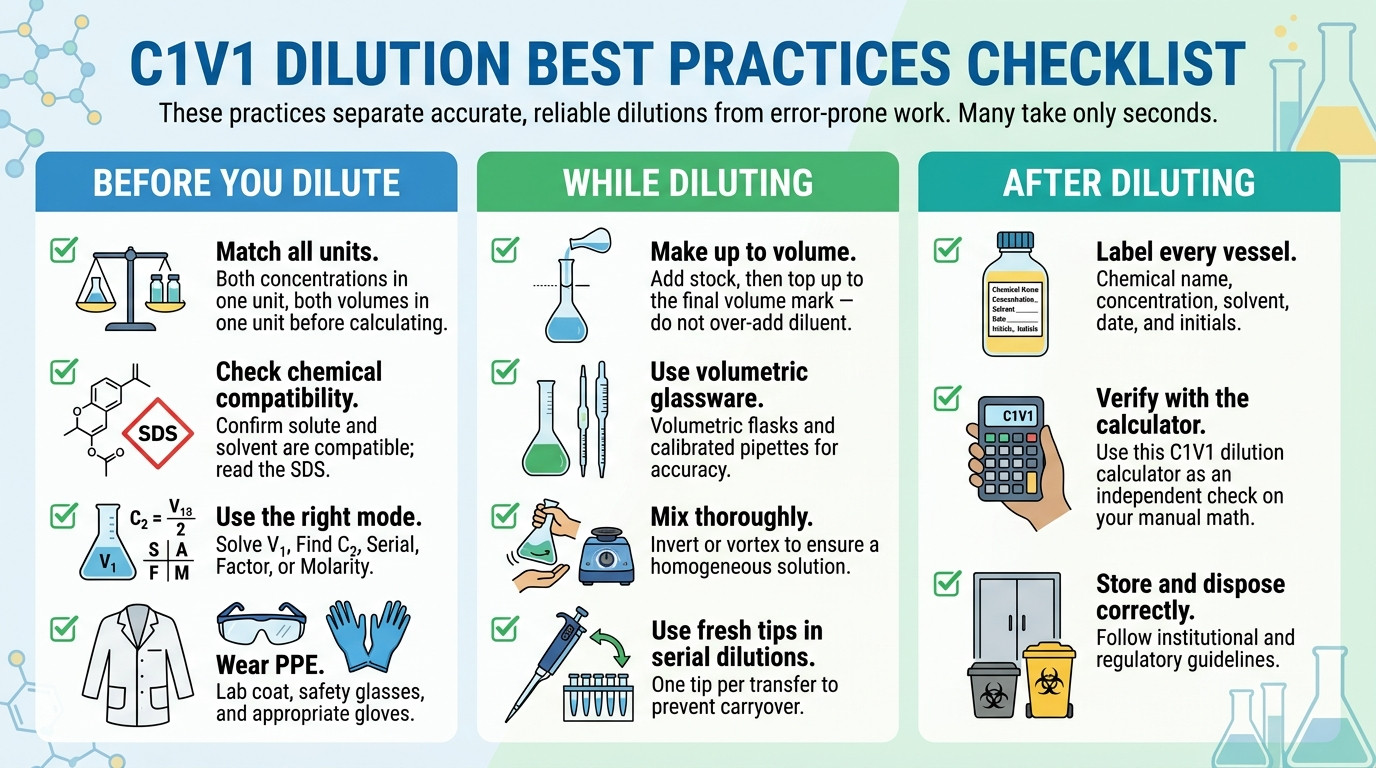
C1V1 Dilution Best Practices Checklist
These practices separate accurate, reliable dilutions from error-prone work. Many take only seconds.
Before You Dilute
While Diluting
After Diluting
For the dilution math behind solution preparation, see our dilution calculator, dilution factor calculator, and molarity dilution calculator.
Trusted Reference Resources for C1V1 Dilution
These are authoritative references for accurate, standardised dilution methods.
NIST — nist.gov — Reference data on units, molar masses, and measurement traceability for solution preparation.
LibreTexts Chemistry — chem.libretexts.org — Free, peer-reviewed explanations of the C1V1 equation, dilution factors, and serial dilution math.
Sigma-Aldrich — sigmaaldrich.com — Technical bulletins, molar masses, and solution-preparation guides for laboratory chemicals.
NCBI / PMC — ncbi.nlm.nih.gov/pmc — Peer-reviewed protocols for reagent preparation and standard-curve generation.
OSHA Laboratory Standard — osha.gov — Laboratory chemical safety, SDS requirements, and handling guidance.
User Reviews & Ratings
📝 Share Your Experience with This C1V1 Dilution Calculator
Final Thoughts on the C1V1 Dilution Calculator
The C1V1 equation is the most fundamental calculation in solution chemistry, and the C1V1 dilution calculator exists to handle it flawlessly every time. The arithmetic is simple in principle — multiply and divide using C₁V₁ = C₂V₂ — but a single mismatched unit, a confused “add diluent” with “make up to volume,” or a swapped stock and target can produce a solution at the wrong concentration, and that error then propagates into every assay, calibration, and experimental conclusion drawn from that solution. Worse, a wrongly prepared solution usually looks identical to the correct one, so the error goes unnoticed until results fail to reproduce or standards give inconsistent readings.
The difference between a lab that produces reliable data and one that struggles often comes down to discipline in dilution: always matching units, always using volumetric glassware, always making up to the final volume rather than over-adding diluent, and always running the numbers through the C1V1 dilution calculator rather than trusting a mental estimate. A systematic approach transforms solution preparation from a source of variability into a reliable foundation for every experiment. The C1V1 dilution calculator removes the arithmetic risk by handling every conversion internally, but good laboratory technique remains essential — the tool gives you the right number only when you supply the right inputs.
It is worth appreciating that the C1V1 equation sits at the heart of almost every quantitative experiment in chemistry and biology. Standard curves, calibration standards, reaction buffers, staining solutions, mobile phases, drug formulations, and QC controls are all prepared using C1V1, and their accuracy determines the accuracy of everything measured downstream. A tenfold error in a dilution becomes a tenfold error in every sample quantified against that standard, and because the error is systematic, it is invisible within a single experiment — it only reveals itself when results are compared across labs or over time. This is why investing a few seconds in the C1V1 dilution calculator, for every dilution, pays dividends in reproducibility that compound across an entire research programme.
From a practical standpoint, the C1V1 dilution calculator is designed to be used at the bench, in real time, alongside your pipetting. You can open it on your phone, enter the values as you label your tubes, and verify each step before you transfer. The serial-dilution table serves as a ready-made worksheet, and the step-by-step output lets you trace the logic from inputs to result without trusting a black box. In a busy lab where multiple people perform dilutions, the C1V1 dilution calculator serves as a standardised reference point: everyone uses the same tool, the same formulas, and the same worked steps, which reduces inter-operator variability and makes results more comparable across the team.
The framework is short: match your units, choose the right mode of the C1V1 dilution calculator — Solve V₁, Find C₂, Serial, Factor, or Molarity — make up to the final volume, and label every vessel. That sequence gives an accurate, reproducible dilution every time. From routine buffer preparation and reagent dilution to multi-point standard curves and pharmaceutical QC, the C1V1 equation is everywhere a concentrated solution becomes a working solution, and getting it right is one of the most fundamental calculations in the laboratory.
Keep this C1V1 dilution calculator handy as your starting point for every dilution. It runs entirely in your browser, so it works on any phone or tablet at the bench without sending any data anywhere. By making the calculation fast, transparent, and private, the tool removes the most common source of laboratory error — arithmetic mistakes under time pressure — and lets you focus on what matters most: choosing the right dilution scheme, handling chemicals safely, using proper volumetric technique, and documenting your work for reproducibility.
🔒 Privacy Guarantee: Every calculation on this page runs entirely within your browser. No data — concentrations, volumes, molar masses, or any other inputs — is sent to any server, stored, or shared. Your calculations are completely private.
Pingback: Percent Concentration Calculator – Calculate Solution Strength Fast
Pingback: Stoichiometry Calculator – Solve Chemical Reactions Instantly
Pingback: Titration Calculator – Calculate Titration Results Instantly
Pingback: Brix Calculator – Calculate °Brix Instantly & Accurately
Pingback: Aliquot Calculator – Calculate Aliquot Volumes Instantly
Pingback: DNA Dilution Calculator – Calculate DNA Dilutions Instantly
Pingback: TDS Calculator – Calculate Total Dissolved Solids Instantly
Pingback: Protein Concentration Calculator – Calculate Protein Levels Instantly
Pingback: PCR Master Mix Calculator – Calculate PCR Reagents Instantly
Pingback: Primer Dilution Calculator – Calculate Primer Dilutions Instantly
Pingback: Cell Seeding Calculator – Calculate Cell Seeding Density Fast
Pingback: Enzyme Activity Calculator – Calculate Enzyme Activity Instantly
Pingback: Solubility Calculator – Calculate Solubility Instantly
Pingback: Saturation Calculator – Calculate Saturation Instantly
Pingback: Spike Solution Calculator – Calculate Spike Solutions Instantly
Pingback: Standard Addition Calculator – Calculate Standard Additions Instantly
Pingback: Matrix Dilution Calculator – Calculate Matrix Dilutions Instantly
Pingback: TCID50 Calculator – Calculate TCID50 Values Instantly
Pingback: Oligo Concentration Calculator – Calculate Oligo Concentration Instantly
Pingback: How to Dilute 12 Hydrogen Peroxide to 3 Calculator
Pingback: How to Dilute Omnia 2.0 Interior Cleaner Calculator
Pingback: Antibody Dilution Calculator – Calculate Antibody Dilutions Instantly
Pingback: PCR Master Mix Calculator – Calculate PCR Mix Instantly
Pingback: DNA Copy Number Calculator – Calculate DNA Copies Instantly
Pingback: How Do You Calculate the Dilution Factor? Free Calculator -
Pingback: How to Calculate a Dilution? Free Dilution Calculator
Pingback: How to Calculate Equity Dilution? Free Equity Dilution Calculator
Pingback: How to Calculate Molarity of a Diluted Solution? Free Calculator
Pingback: Viscosity Calculator – Calculate Fluid Viscosity Instantly
Pingback: Molarity Calculator – Calculate Molar Concentration Instantly
Pingback: How to Calculate the Dilution Factor: 7 Simple Steps to Success
Pingback: Mixing Ratio Calculator: Exact Volumes for Any Ratio (Free Tool)
Pingback: Pool Shock Calculator | Calculate Shock Dosage Instantly
Pingback: Baking Soda Pool Calculator | Calculate How Much to Add
Pingback: Muriatic Acid Pool Calculator – Calculate Acid Dosage
Pingback: Pool Chlorine Dilution Calculator | Calculate Chlorine Dosage
Pingback: Pool Acid Dilution Calculator | Calculate Acid & Water Amounts
Pingback: Cyanuric Acid Calculator | Calculate CYA Levels Instantly
Pingback: Spa Chemical Calculator | Calculate Spa Chemicals Instantly
Pingback: Bromine Spa Calculator | Calculate Bromine Dosage Instantly