
Working Solution Calculator — Prepare Solutions from Stock or Solid
A working solution calculator works out exactly how to prepare a working solution — the concentration you actually use in an experiment — either by diluting a more concentrated stock solution or by weighing out a solid. The core rule is C₁V₁ = C₂V₂, where C₁ is the stock concentration, V₁ is the stock volume needed, C₂ is the desired working concentration, and V₂ is the final volume. For solids, the working solution calculator uses mass = molarity × volume × molar mass, or grams = (percent ÷ 100) × volume for % w/v. Enter your values below and the working solution calculator returns the exact volumes and masses, with every step shown.
Key facts at a glance
- Dilution formula: C₁V₁ = C₂V₂ — stock concentration × stock volume = working concentration × final volume.
- Stock volume: V₁ = (C₂ × V₂) ÷ C₁ — rearrange to find how much stock to take.
- Diluent to add: V₂ − V₁ — make up to the final volume, do not over-add.
- From solid (molar): grams = molarity (mol/L) × volume (L) × molar mass (g/mol).
- From solid (% w/v): grams = (target % ÷ 100) × volume (mL).
- Keep units consistent: match all concentrations to one unit and all volumes to one unit before calculating.
📋 Table of Contents
▼
- What a Working Solution Calculator Does
- Working Solution Calculator — Five Modes
- How a Working Solution Is Calculated
- Real Scenarios Where Working Solution Math Mattered
- Common Working Solution Mistakes
- Lab Safety Essentials
- Which Mode Fits Your Situation
- Frequently Asked Questions
- Working Solution Best Practices Checklist
- Trusted Reference Resources
- User Reviews & Ratings
What a Working Solution Calculator Does
A working solution calculator tells you exactly how to prepare a working solution at a target concentration, either by diluting a concentrated stock solution or by weighing out a solid chemical. It eliminates the multi-step arithmetic — the C₁V₁ = C₂V₂ dilution equation, unit conversions between molarity and percent, molar-mass lookups, and the distinction between making up to volume and over-adding solvent — that turns a simple laboratory task into a sequence of error-prone calculations. In analytical chemistry, biochemistry, microbiology, clinical diagnostics, quality control, and any laboratory that prepares reagents, getting the working concentration right is the foundation of every downstream measurement, because every assay, standard, and calibration curve traces back to it.
The reason working-solution math trips people up is not the chemistry; it is the layered bookkeeping. You must decide whether you are diluting from a stock or weighing from a solid, keep all concentrations in one unit and all volumes in one unit, and remember that the amount of solute is conserved no matter how much solvent you add. A single mismatched unit — molarity mixed with percent, or mL with L — silently produces a wrong number, and that error then propagates into every assay, calibration, and experimental conclusion drawn from that solution. Worse, a working solution prepared at the wrong concentration often looks identical to the correct one, so the error goes unnoticed until results fail to reproduce or standards give inconsistent readings.
This working solution calculator handles the five most common preparation tasks in one place: the stock-dilution solver (how much stock to take and how much diluent to add), the stock-concentration finder (what stock concentration you need to achieve a given working concentration), the molar-from-solid calculator (grams of powder for a molar working solution), the percent-from-solid calculator (grams for a % w/v working solution), and the serial-dilution planner that generates a series of working concentrations from a single stock. Each mode shows the answer and every step of the working, so you can verify the reasoning, teach a student, or document the preparation for an audit trail.
Because working-solution and dilution math share the same underlying conservation principles, the tools in the sidebar — including our dilution calculator, molarity dilution calculator, and percentage dilution calculator — are useful companions for any solution-preparation task.
Working Solution Calculator
Five modes — stock dilution, stock finder, molar from solid, % from solid & serial
Calculation Result
⚠️ Safety first: This working solution calculator handles concentrations and volumes only. Always check chemical compatibility before mixing, read the Safety Data Sheet (SDS) for every substance, wear appropriate PPE, and follow your institution’s laboratory safety protocols.
How a Working Solution Is Calculated
Every working-solution calculation comes down to one idea: the amount of solute is conserved. Whether you are diluting a concentrated stock or weighing out a solid, the quantity of dissolved substance does not change when you add solvent — only the volume and the concentration shift. From that single conservation principle, a handful of formulas cover almost every solution-preparation task in the laboratory. The working solution calculator exists to handle those formulas reliably and transparently, because in practice the arithmetic is layered with unit conversions, molar-mass lookups, and the critical distinction between adding solvent and making up to a final volume.
Stock Solutions vs. Working Solutions
It helps to understand the relationship between the two. A stock solution is a concentrated, stable solution prepared in advance and stored for repeated use. It saves time because you prepare a large batch once and dilute from it whenever a working solution is needed, rather than weighing and dissolving the solid each time. A working solution is the lower-concentration solution you actually use in an experiment or assay — for example, a 1 M stock might be diluted to a 10 mM working solution for a reaction buffer. The working solution is always more dilute than the stock, and the dilution factor (stock concentration ÷ working concentration) tells you how many-fold the stock has been diluted. The working solution calculator handles the conversion from stock to working in either direction: given a stock and a target, it tells you how much to take; given a target and a volume, it tells you what stock concentration you need.
The Critical Distinction: Make Up To Volume
One of the most common errors in preparing a working solution is confusing “add diluent” with “make up to volume.” The C₁V₁ = C₂V₂ equation gives you the stock volume V₁, and the diluent to add is V₂ − V₁. But the correct laboratory technique is to measure the stock volume V₁ into a volumetric flask, then add diluent until the total reaches V₂ — not to add V₂ worth of diluent on top of the stock, which would overshoot the final volume. For small dilutions the difference is minor, but for large dilutions (e.g., 5 mL stock into 1000 mL) the error can be significant. The working solution calculator always reports both the stock volume and the diluent volume, and the steps remind you to “make up to” the final volume.
1. Diluting a Stock to a Working Concentration (C₁V₁ = C₂V₂)
The foundational calculation: V₁ = (C₂ × V₂) ÷ C₁, where C₁ is the stock concentration, C₂ is the desired working concentration, V₂ is the final volume, and V₁ is the volume of stock you need to take. For example, to make 500 mL of a 100 mM working solution from a 1000 mM stock: V₁ = (100 × 500) ÷ 1000 = 50 mL of stock, diluted to 500 mL total. The dilution factor here is 10 (1000 ÷ 100), meaning the stock is ten times more concentrated than the working solution. The Stock Dilute mode of the working solution calculator performs this and reports the diluent volume (V₂ − V₁), the overall dilution factor, and the step-by-step working so you can verify the logic and document the calculation for your lab notebook or audit trail.
2. Finding the Required Stock Concentration
Sometimes you know the working concentration and the volumes available, and you need to find what stock concentration to prepare. Rearranging the formula: C₁ = (C₂ × V₂) ÷ V₁. For example, to make 100 mL of a 50 mM working solution using 5 mL of stock: C₁ = (50 × 100) ÷ 5 = 1000 mM. The Stock Finder mode of the working solution calculator solves this directly.
Diluent to add: V₂ − V₁ (make up to volume)
Molar from solid: grams = M × V (L) × molar mass (g/mol)
% w/v from solid: grams = (percent ÷ 100) × volume (mL)
Serial working: concentration at step n = stock ÷ (factor)n
3. Preparing a Molar Working Solution from a Solid
When no stock is available, you weigh the solid directly: grams = molarity (mol/L) × volume (L) × molar mass (g/mol). For example, to make 1 L of 0.5 M NaCl (molar mass 58.44 g/mol): 0.5 × 1 × 58.44 = 29.22 g. The Molar Solid mode of the working solution calculator computes the moles and the grams needed, with the molar mass as an explicit input.
4. Preparing a Percent (w/v) Working Solution from a Solid
For percent weight/volume solutions: grams = (target % ÷ 100) × volume (mL). A 10% w/v solution in 500 mL needs (10 ÷ 100) × 500 = 50 g of solute, dissolved and made up to 500 mL. Percent w/v is common in clinical, food, and industrial laboratories because it is intuitive and does not require a molar mass. The Percent Solid mode of the working solution calculator performs this directly and shows each step for documentation and verification.
5. Serial Working Solutions
When you need a series of working concentrations (e.g., for a standard curve), serial dilution is the most efficient method. Starting from a stock, each step dilutes by a fixed factor: concentration at step n = stock ÷ (factor)n. For example, from a 1000 mM stock with 1:10 steps: step 1 = 100 mM, step 2 = 10 mM, step 3 = 1 mM. The Serial mode of the working solution calculator generates the full series in a table. Serial dilutions are especially useful for creating logarithmic standard curves that span several orders of magnitude, which are common in analytical chemistry, immunoassays, and microbiology (MIC determinations). The key technique points are to use a fresh pipette tip for each transfer (to avoid carryover of concentrated solution into the next tube), to mix thoroughly between steps (vortex or invert), and to transfer a precise volume at each step. Small pipetting errors compound across the series, so accuracy at the first step matters most.
Quick Reference Values
The Role of Working Solutions in Quantitative Analysis
It is worth emphasising just how central working solutions are to quantitative work. In analytical chemistry, a working solution serves as the calibration standard against which unknown samples are measured — if the standard is wrong, every result derived from it is wrong in the same direction, and the error is invisible within a single run. In biochemistry, enzyme assays depend on substrate working solutions prepared at exact concentrations; a 20% error in substrate concentration alters the measured kinetics and can lead to incorrect conclusions about enzyme mechanism or drug inhibition. In microbiology, antibiotic working solutions must be precise to determine minimum inhibitory concentrations (MIC), and a dilution error can shift an MIC by a whole doubling dilution, changing the clinical interpretation from susceptible to resistant. In clinical diagnostics, calibrator and control working solutions underpin every patient result, and regulatory standards such as ISO 15189 require documented, traceable preparation. The working solution calculator supports all of these applications by providing a fast, transparent, and auditable calculation that can be verified independently.
How to Choose Between Stock Dilution and Solid Weighing
A common practical question is whether to prepare a working solution by diluting a stock or by weighing the solid directly. The answer depends on frequency, stability, and convenience. If you use the same working solution repeatedly (e.g., a daily running buffer), it is more efficient to prepare a concentrated stock once, store it, and dilute from it each time — this saves weighing time and reduces variability between preparations. If the working solution is needed only once, or if the chemical is unstable in concentrated form, weighing the solid directly for each preparation may be better. Some chemicals are hygroscopic (absorb water from the air) and difficult to weigh accurately; for these, a verified commercial stock may be more reliable than weighing. The working solution calculator supports both approaches, so you can choose the method that best fits your chemical, your application, and your workflow, and document the reasoning for your audit trail.
The Importance of Traceability and Documentation
In regulated environments such as GLP, GMP, and ISO 17025 laboratories, every working solution must be traceable: the calculation, the chemicals used (with lot numbers), the equipment (with calibration dates), the preparer, and the date must all be recorded. The working solution calculator supports this by producing a clear, step-by-step calculation that can be printed or screenshot for the preparation record. The worked steps show not just the final answer but the entire chain of reasoning, so an auditor or a colleague can verify each conversion and follow the logic from inputs to result. For multi-step preparations such as serial dilutions, the table output serves as a ready-made preparation worksheet. Even in non-regulated academic labs, documenting your working-solution calculations saves time when troubleshooting unexpected results — if an assay fails, the first question is often “was the working solution prepared correctly?”, and a recorded calculation answers it immediately.
Remember: Keep all concentrations in one unit and all volumes in one unit before calculating. Always make up to the final volume rather than over-adding diluent. For serial dilutions, use a fresh tip for each transfer to avoid carryover. The working solution calculator gives you the arithmetic; good technique gives you an accurate solution.

Real Scenarios Where Working Solution Math Mattered
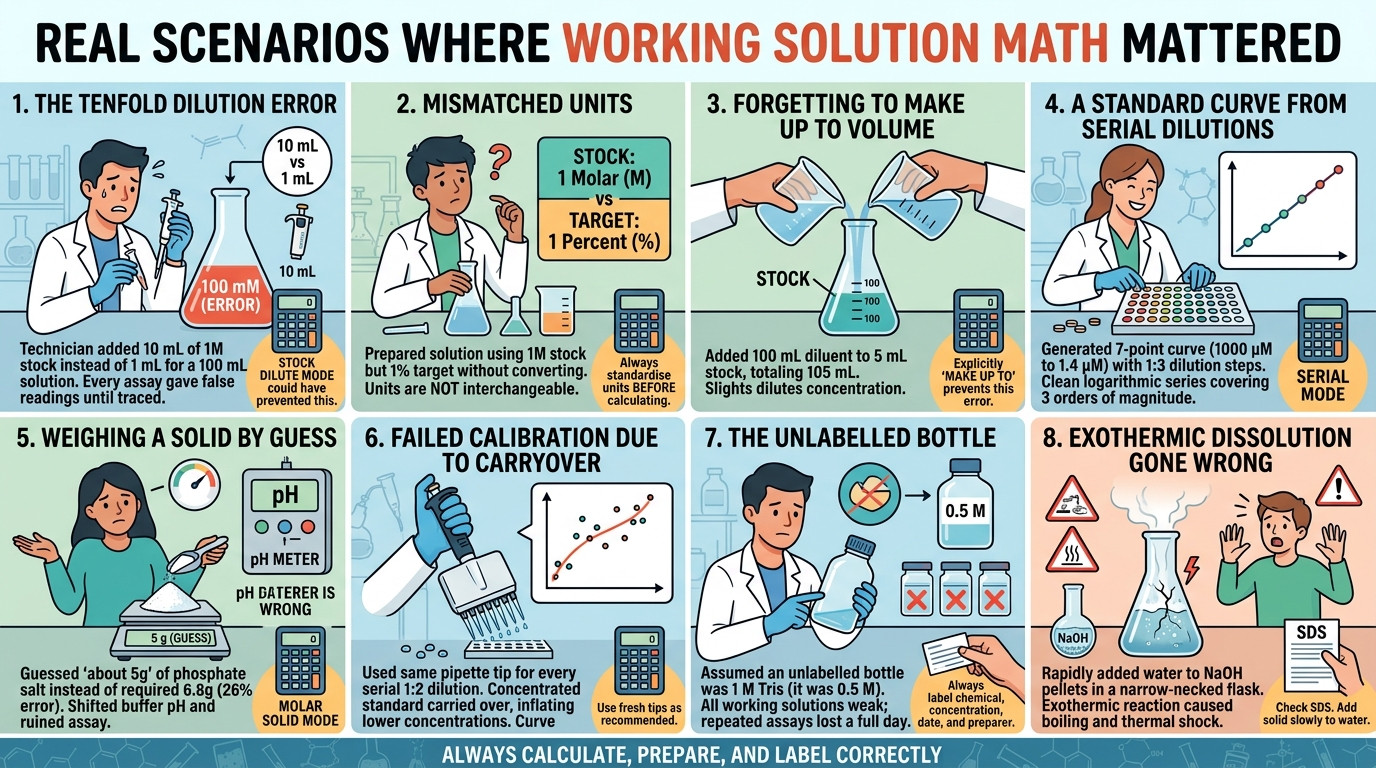
These five scenarios reflect real situations in research, clinical, and QC laboratories where working-solution arithmetic — or a missing step — made a tangible difference to the outcome.
Scenario 1: The Tenfold Dilution Error
A technician needed 100 mL of a 10 mM working solution from a 1 M stock. The correct volume is (10 × 100) ÷ 1000 = 1 mL of stock diluted to 100 mL. Instead, she added 10 mL of stock — a tenfold error producing a 100 mM solution. Every assay run from that batch gave false readings until the error was traced back to the working solution. The Stock Dilute mode of the working solution calculator would have returned 1 mL instantly, preventing the error.
Scenario 2: Mismatched Units
A student prepared a working solution using molarity for the stock (1 M) but percent for the working target (1%), without converting. The two units are not interchangeable, so the resulting solution was at neither the intended molarity nor the intended percent. The lesson: always convert all concentrations to one unit before using the working solution calculator. Our molarity dilution calculator can help standardise units.
Scenario 3: Forgetting to Make Up To Volume
A researcher calculated that 5 mL of stock was needed for a 100 mL working solution. He added the 5 mL of stock to a flask and then poured in 100 mL of diluent — giving 105 mL total, slightly diluting the working concentration. The correct method is to add the 5 mL of stock and then make up to the 100 mL mark with diluent. The working solution calculator explicitly states “make up to” to prevent this.
Scenario 4: A Standard Curve from Serial Dilutions
A biochemist needed a 7-point standard curve from 1000 µM down to about 1 µM. Using the Serial mode of the working solution calculator with a 1000 µM stock and 1:3 dilution steps, she generated concentrations of 333, 111, 37, 12.3, 4.1, and 1.4 µM — a clean logarithmic series covering three orders of magnitude, ready for plate loading.
Scenario 5: Weighing a Solid by Guess
A student preparing 500 mL of 0.1 M phosphate buffer guessed “about 5 g” of the salt. The correct mass, computed by the working solution calculator, was 6.8 g — a 26% error that shifted the buffer pH and ruined the downstream assay. The Molar Solid mode gives the precise mass every time.
Scenario 6: A Failed Calibration Due to Carryover
An analyst prepared a 6-point standard curve by serial 1:2 dilution but used the same pipette tip for every transfer. Concentrated standard carried over into each subsequent tube, inflating the lower concentrations and producing a non-linear calibration curve that could not pass the system-suitability check. Re-preparing with fresh tips for each transfer (as the working solution calculator’s serial steps recommend) gave a clean, linear curve on the first try.
Scenario 7: The Unlabelled Bottle
A technician found an unlabelled bottle of clear liquid on the bench and assumed it was the 1 M Tris stock. It was actually 0.5 M — half the expected concentration — and every working solution diluted from it that day was 50% too weak. The assays had to be repeated, losing a full day of work. Always label every working solution and stock with the chemical name, concentration, solvent, date, and preparer’s initials, no matter how “obvious” it seems at the time.
Scenario 8: Exothermic Dissolution Gone Wrong
A student dissolved NaOH pellets in a narrow-necked flask by adding water rapidly. The strongly exothermic reaction caused the solution to boil and splash, and the flask cracked from thermal shock. The correct technique is to add the solid slowly to a larger volume of water (never water to solid for exothermic dissolutions), stir gently, and allow the heat to dissipate. Always check the SDS for exothermic or hazardous dissolution behaviour before preparing a working solution from a reactive solid.
Common Working Solution Mistakes
The errors people make when preparing working solutions cluster around a few predictable points. Understanding why they happen prevents them.
Mistake 1: Mismatched Units
C₁V₁ = C₂V₂ only works when both concentrations share a unit and both volumes share a unit. Mixing molarity with percent, or mL with L, silently produces a wrong number. Always convert everything to one unit first.
Mistake 2: Adding Diluent Instead of Making Up To Volume
The formula gives you V₁, the stock volume. The diluent is V₂ − V₁, but the correct technique is to add the stock to a volumetric vessel and top up to the V₂ mark — not to add V₂ of diluent on top of the stock.
Mistake 3: Ignoring Molar Mass
You cannot weigh a molar working solution without the correct molar mass. Skipping or guessing it gives a meaningless mass. Always look up the molar mass for the exact chemical formula and hydration state.
Mistake 4: Serial Dilution Carryover
In serial dilutions, using the same tip for every transfer carries concentrated solution into the next tube, inflating the lower concentrations. Use a fresh tip for each step.
Mistake 5: Not Labelling Working Solutions
An unlabelled working solution is a hazard. Always label every vessel with the chemical name, concentration, date, solvent, and your initials. A wrongly identified working solution can invalidate days of experimental work.
Mistake 6: Using the Wrong Molar Mass
Many chemicals exist in hydrated and anhydrous forms with different molar masses — for example, CuSO₄ (159.6 g/mol) vs CuSO₄·5H₂O (249.7 g/mol). Using the wrong molar mass gives a systematically wrong mass and therefore a wrong concentration. Always check the exact formula on the bottle (including waters of hydration) and use the corresponding molar mass in the Molar Solid mode of the working solution calculator.
Mistake 7: Ignoring Temperature Effects on Volume
Volumetric glassware is calibrated at a specific temperature (usually 20°C). Preparing a working solution with hot solvent or in a warm room introduces a small volume error because liquids expand with temperature. For most routine work this is negligible, but for high-precision analytical standards, prepare and measure at the calibration temperature.
💡 Rule of Thumb: Match all units before calculating, use the working solution calculator for every preparation, make up to the final volume rather than over-adding diluent, use fresh tips for serial dilutions, and label every vessel. That sequence gives an accurate, reproducible working solution every time.
Lab Safety Essentials
Accurate math does not make a solution safe — proper handling does. Before preparing any working solution, run through these essentials.
Always check compatibility: confirm that the solute and solvent are compatible (some combinations react violently), read the Safety Data Sheet (SDS) for every chemical, and work in a fume hood for volatile or toxic substances.
- Wear appropriate PPE — lab coat, safety glasses, and gloves suited to the chemical.
- Read the SDS for every substance before handling it.
- Work in a fume hood for volatile, toxic, or strong-smelling chemicals.
- Label every vessel with chemical name, concentration, solvent, date, and initials.
- Add acid to water, never water to acid, for exothermic dissolutions.
- Store and dispose correctly — follow institutional and regulatory guidelines.
This working solution calculator is an arithmetic aid for solution preparation. It is not a substitute for chemical compatibility checks, safety training, or the SDS.
Which Mode Fits Your Situation
The five modes of the working solution calculator map to the five distinct preparation tasks. Choosing the right one applies the correct logic.
Working Solution Mode Comparison Table
| Mode | Use Case | Key Formula | Inputs Needed | Typical Applications |
|---|---|---|---|---|
| Stock Dilute | Dilute stock to working | V₁=(C₂V₂)÷C₁ | C₁, C₂, V₂ | Buffers, reagents, standards |
| Stock Finder | Find required stock conc | C₁=(C₂V₂)÷V₁ | C₂, V₁, V₂ | Planning stock preparation |
| Molar Solid | Weigh powder for molar | M×V×MW | molarity, vol, MW | Standards, buffers |
| % w/v Solid | Weigh powder for % | (%÷100)×mL | percent, volume | Cleaning, lab solutions |
| Serial | Series of working concs | stock÷Fn | stock, factor, steps | Standard curves, assays |
Practical Decision Guide
Diluting from a concentrated stock? Use the Stock Dilute mode.
Need to know what stock to prepare? Use the Stock Finder mode.
Weighing a solid for a molar solution? Use the Molar Solid mode.
Weighing a solid for a % w/v solution? Use the Percent Solid mode.
Need a series of concentrations? Use the Serial mode for a full table.
Worked Examples
To make the formulas concrete, here are five worked examples that mirror common laboratory situations. Each one corresponds to a mode of the working solution calculator, and entering the same numbers into the tool will reproduce the result with full step-by-step working.
Example 1 — Stock dilution: Make 500 mL of 100 mM Tris from a 1 M stock. V₁ = (100 × 500) ÷ 1000 = 50 mL stock, dilute to 500 mL.
Example 2 — Stock finder: Make 100 mL of 50 mM using 5 mL of stock. C₁ = (50 × 100) ÷ 5 = 1000 mM stock needed.
Example 3 — Molar from solid: Make 1 L of 0.5 M NaCl (MW 58.44). grams = 0.5 × 1 × 58.44 = 29.22 g.
Example 4 — % w/v from solid: Make 500 mL of 10% w/v. grams = (10 ÷ 100) × 500 = 50 g.
Example 5 — Serial dilution: From 1000 µM stock, 1:10 steps, 5 steps: 100, 10, 1, 0.1, 0.01 µM.
These examples show that the underlying maths is always simple multiplication or division — the difficulty is entirely in keeping the units straight and applying the correct formula. The working solution calculator removes that difficulty by asking for each input in its own field.
Frequently Asked Questions About the Working Solution Calculator
These questions come from lab technicians, graduate students, research scientists, and QC analysts who use a working solution calculator in their daily work. Click any question to expand the answer.
1. What is a working solution calculator?
A working solution calculator is a laboratory tool that determines how to prepare a working solution — the concentration you actually use in an experiment — either by diluting a concentrated stock solution (C₁V₁ = C₂V₂) or by weighing out a solid (mass = molarity × volume × molar mass, or % × volume). This working solution calculator provides five modes covering stock dilution, stock finding, molar-from-solid, percent-from-solid, and serial dilution.
2. How do you calculate a working solution from a stock?
Use C₁V₁ = C₂V₂. The stock volume needed is V₁ = (C₂ × V₂) ÷ C₁, where C₁ is the stock concentration, C₂ is the desired working concentration, and V₂ is the final volume. For example, to make 500 mL of 100 mM from a 1000 mM stock: V₁ = (100 × 500) ÷ 1000 = 50 mL of stock. The Stock Dilute mode of the working solution calculator performs this automatically.
3. What is the difference between a stock solution and a working solution?
A stock solution is a concentrated, stable solution prepared in advance and stored for repeated use, saving the effort of weighing solids each time. A working solution is the lower-concentration solution you actually use in an experiment, prepared by diluting the stock. The working solution is always more dilute than the stock, and the dilution factor is the stock concentration divided by the working concentration.
4. How do you calculate grams of solid for a molar working solution?
grams = molarity (mol/L) × volume (L) × molar mass (g/mol). For example, to make 1 L of 0.5 M NaCl (molar mass 58.44 g/mol): 0.5 × 1 × 58.44 = 29.22 g. The Molar Solid mode of the working solution calculator computes the moles and grams with the molar mass as an explicit input.
5. How do you calculate grams for a percent (w/v) working solution?
grams = (target % ÷ 100) × volume (mL). A 10% w/v solution in 500 mL needs (10 ÷ 100) × 500 = 50 g of solute, dissolved and made up to 500 mL. The Percent Solid mode of the working solution calculator performs this directly.
6. What does “make up to volume” mean and why does it matter?
“Make up to volume” means adding diluent until the total reaches the final volume mark on a volumetric flask — not adding that volume of diluent on top of the stock. For example, for 50 mL stock diluted to 500 mL, you add the 50 mL stock and then top up to the 500 mL line, not add 500 mL of diluent (which would give 550 mL total). The working solution calculator always states “make up to” to reinforce correct technique.
7. How do you prepare a series of working concentrations?
Use serial dilution: each step dilutes by a fixed factor. Concentration at step n = stock ÷ (factor)n. For example, from 1000 µM with 1:10 steps: step 1 = 100, step 2 = 10, step 3 = 1 µM. Use a fresh tip for each transfer to avoid carryover. The Serial mode of the working solution calculator generates the full series in a table.
8. Why do units need to match in C₁V₁ = C₂V₂?
The dilution equation assumes both concentrations are in the same unit (e.g., both mM) and both volumes are in the same unit (e.g., both mL). Mixing units — molarity with percent, or mL with L — produces a silently wrong answer. Always convert everything to one unit before calculating.
9. How do you find the dilution factor?
The dilution factor = stock concentration ÷ working concentration. For example, a 1000 mM stock diluted to 100 mM is a 10-fold (10:1) dilution. The Stock Dilute mode of the working solution calculator reports this factor alongside the volumes.
10. Is this working solution calculator free and private?
Yes. This working solution calculator is completely free, runs entirely in your browser, and requires no sign-up. All calculations are private — no concentrations, volumes, or any other inputs are sent to a server or stored. Your data never leaves your device.
Working Solution Best Practices Checklist
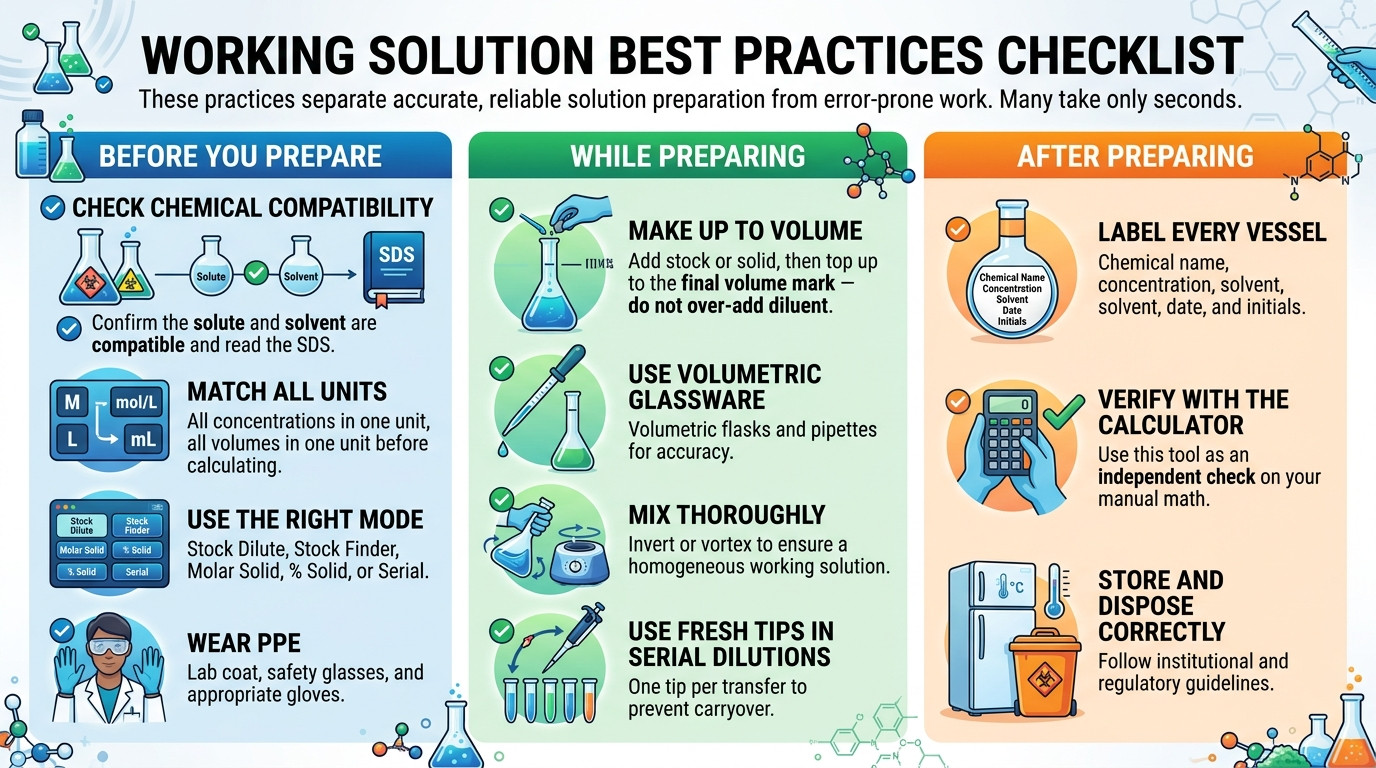
These practices separate accurate, reliable solution preparation from error-prone work. Many take only seconds.
Before You Prepare
While Preparing
After Preparing
For the dilution math behind solution preparation, see our dilution calculator, molarity dilution calculator, and percentage dilution calculator.
Trusted Reference Resources for Working Solution Preparation
These are authoritative references for accurate, standardised solution preparation.
NIST (National Institute of Standards and Technology) — nist.gov — Reference data on units, molar masses, and measurement accuracy relevant to solution preparation.
Sigma-Aldrich / MilliporeSigma — sigmaaldrich.com — Technical bulletins, molar masses, and solution-preparation guides for laboratory chemicals.
LibreTexts Chemistry — chem.libretexts.org — Free, peer-reviewed explanations of molarity, percent solutions, dilution, and working-solution math.
NCBI / PMC — ncbi.nlm.nih.gov/pmc — Peer-reviewed protocols for reagent preparation and standard-curve generation.
OSHA Laboratory Standard — osha.gov — Laboratory chemical safety, SDS requirements, and handling guidance.
On our platform, related calculation tools include: dilution calculator, molarity dilution calculator, percentage dilution calculator, dilution ratio calculator, and chemical mixing calculator.
User Reviews & Ratings
📝 Share Your Experience with This Working Solution Calculator
Final Thoughts on Working Solution Calculation
Working solution calculation is one of those tasks that seems simple until the unit conversions, the molar masses, the dilution factors, and the make-up-to-volume distinction all meet in a single preparation. The arithmetic is, in principle, straightforward — multiply and divide using C₁V₁ = C₂V₂ or mass = molarity × volume × molar mass — but a single mismatched unit or a confused “add diluent” with “make up to volume” can produce a solution at the wrong concentration, and that error then propagates into every assay, calibration, and experimental conclusion drawn from that solution. Worse, a wrongly prepared working solution usually looks identical to the correct one, so the error goes unnoticed until results fail to reproduce.
The difference between a laboratory that produces reliable data and one that struggles often comes down to discipline in solution preparation: always matching units, always using volumetric glassware, always making up to the final volume rather than over-adding diluent, always using fresh tips for serial dilutions, and always running the numbers through a working solution calculator rather than trusting a mental estimate. A systematic approach transforms solution preparation from a source of variability into a reliable foundation for every experiment. The working solution calculator removes the arithmetic risk by handling every conversion internally, but good laboratory technique remains essential — the tool gives you the right number only when you supply the right inputs.
It is also worth appreciating that working solutions sit at the heart of almost every quantitative experiment. Standard curves, calibration standards, reaction buffers, staining solutions, mobile phases, and QC controls are all working solutions, and their accuracy determines the accuracy of everything measured downstream. A 10% error in a standard concentration becomes a 10% error in every sample quantified against that standard, and because the error is systematic (it shifts every result in the same direction), it is invisible within a single experiment — it only reveals itself when results are compared across labs or over time. This is why investing a few seconds in the working solution calculator, for every preparation, pays dividends in reproducibility that compound across an entire research programme.
The framework is short: confirm chemical compatibility, match all units, choose the right mode of the working solution calculator — Stock Dilute, Stock Finder, Molar Solid, % Solid, or Serial — make up to the final volume, and label every vessel. That sequence gives an accurate, reproducible working solution every time, and the worked steps let you verify the reasoning rather than trusting a black box. From routine buffer preparation and reagent dilution to multi-point standard curves and QC controls, working-solution math is everywhere a laboratory meets a quantitative experiment.
Keep this working solution calculator handy as your starting point for every preparation, and use the related dilution and concentration tools in the sidebar whenever you need to convert between units or plan a serial series. By making the calculation fast, transparent, and private, the tool removes the most common source of laboratory error — arithmetic mistakes under time pressure — and lets you focus your attention on the things that matter most: choosing the right method, handling chemicals safely, using proper volumetric technique, and documenting your work for reproducibility. In a world where experimental reproducibility is under increasing scrutiny, the humble act of calculating a working solution correctly is a small but meaningful contribution to the integrity of science.
🔒 Privacy Guarantee: Every calculation on this page runs entirely within your browser. No data — concentrations, volumes, molar masses, or any other inputs — is sent to any server, stored, or shared. Your calculations are completely private.
Pingback: Buffer Calculator – Calculate Buffer Solutions Instantly
Pingback: How to Calculate the Dilution Factor: 7 Simple Steps to Success
Pingback: Mixing Ratio Calculator – Instantly Calculate 2:1, 3:1 & Custom Ratios
Pingback: Star San Sanitizer Multi-Unit Tool | Free No-Rinse Brewing Sanitizer
Pingback: Neem Oil Dilution Ratio Calculator | Mix Neem Oil Correctly -
Pingback: Percentage Dilution Calculator | Calculate Dilutions Instantly
Pingback: Proof Calculator | Calculate Alcohol Proof Instantly
Pingback: Paint Thinner Calculator | Calculate Mixing Ratios Instantly
Pingback: Pediatric Dose Calculator | Calculate Child Medication Doses
Pingback: Ethanol Dilution Calculator | Calculate Ethanol Dilutions Instantly
Pingback: Fertilizer Calculator – Calculate Fertilizer Amount Instantly
Pingback: Micromolar Calculator | Calculate µM Concentrations Instantly
Pingback: Neem Oil Emulsifier Calculator | Calculate Soap & Neem Ratios
Pingback: Antibiotic Dose Calculator | Calculate Accurate Dosages