
molarity calculator — Moles, Mass, Molecular Weight, Volume, Dilution & Solution Preparation
A molarity calculator helps calculate molar concentration from moles and volume, prepare a solution from mass and molecular weight, convert molarity units, calculate required mass for a target molarity, and plan dilution with C₁V₁ = C₂V₂. Molarity is moles of solute per liter of final solution, written as mol/L or M. The core formula is M = n ÷ V, where n is moles and V is volume in liters. This molarity calculator is useful for chemistry labs, biology buffers, analytical standards, reagent preparation, titration, teaching, and quality-control documentation.
Key facts at a glance
- Core formula: molarity = moles ÷ liters.
- Mass to moles: moles = grams ÷ molecular weight.
- Mass needed: grams = molarity × liters × molecular weight.
- Dilution: C₁V₁ = C₂V₂.
- Common units: M, mM, µM, nM, mol/L.
- Best practice: use final solution volume, correct molecular weight, hydration state, purity, and temperature where relevant.
📋 Table of Contents
▼
- What a molarity calculator Does
- molarity calculator — Advanced Tool
- How Molarity Calculations Work
- Real Scenarios Where Molarity Matters
- Common Molarity Mistakes
- Safety, Handling & Quality Essentials
- Which Mode Fits Your Workflow
- Frequently Asked Questions
- Molar Solution Preparation Checklist
- Trusted Reference Resources
- User Reviews & Ratings
What a molarity calculator Does
A molarity calculator converts moles, mass, molecular weight, final volume, concentration units, and dilution ratios into practical solution-preparation instructions. Molarity is one of the most important concentration units in chemistry and biology because it describes the number of solute particles relative to final solution volume. A 1 M solution contains one mole of solute in one liter of final solution, not one mole added to one liter of solvent.
The molarity calculator is helpful because molarity work often combines several steps. A user may need to weigh sodium chloride for a 0.5 M solution, prepare 100 mL of 10 mM buffer component, dilute a 1 M stock to 50 mM, convert µM to mM, or calculate moles from a weighed compound. The calculator keeps units visible and gives step-by-step output so the result can be copied into a lab notebook or worksheet.
The tool below includes five practical modes: moles and volume to molarity, mass and molecular weight to molarity, required mass for a target molarity, C₁V₁ dilution planning, and unit conversion among M, mM, µM, and nM. The design follows the same blue pattern as the previous calculator pages, with the same hero card, mode buttons, input grid, result card, sidebar, FAQ, reviews, formula boxes, and schema structure.
Use the molarity calculator as a calculation and documentation aid. It does not replace a validated SOP, reagent certificate, safety data sheet, calibrated balance, volumetric glassware, purity correction, hydration-state correction, pH adjustment, or regulatory requirement. Molarity calculations are only as accurate as the molecular weight, purity, final volume, and unit conversions entered.
molarity calculator
Calculate molarity from moles, mass, molecular weight, final volume, dilution, and unit conversions with step-by-step working.
Calculation Result
Step-by-step working
How Molarity Calculations Work
Molarity is the number of moles of solute in one liter of final solution. A molarity calculator uses this definition to calculate concentration, mass, moles, or dilution volumes depending on which values are known. The most important detail is final solution volume. If a protocol calls for one liter of 1 M solution, the solute is dissolved and then the solution is brought to one liter total volume. It is not correct to add solute to one liter of water and ignore volume change.
A molarity calculator also connects mass and molarity through molecular weight. A compound’s molecular weight tells how many grams equal one mole. If sodium chloride has a molecular weight of about 58.44 g/mol, then 58.44 g in one liter gives 1 M NaCl. If the final volume is 0.5 L, half that mass gives 1 M. Hydrated salts, purity corrections, and assay-specific forms can change the required mass.
Moles and Volume
The direct formula is M = n ÷ V. A molarity calculator divides moles by liters to produce mol/L. If 0.1 mol is dissolved to a final volume of 1 L, the concentration is 0.1 M. If the same moles are dissolved to 0.5 L, the concentration is 0.2 M. The amount is the same, but the final volume changes concentration.
Mass and Molecular Weight
Many laboratory solutions are prepared by weighing a solid. A molarity calculator first converts grams to moles by dividing by molecular weight, then divides by final volume in liters. This workflow is common for salts, buffers, standards, acids, bases, dyes, and biochemical reagents. The molecular weight should match the actual compound form, including hydration state if relevant.
Required Mass
When target molarity and final volume are known, a molarity calculator calculates grams needed using grams = M × L × molecular weight. This is the standard solution-preparation equation. It is useful for making 100 mL, 250 mL, 500 mL, or 1 L batches without manually rearranging the formula each time.
Dilution Planning
Dilution uses C₁V₁ = C₂V₂. A molarity calculator calculates the stock volume needed to prepare a lower concentration. If 100 mL of 0.1 M solution is needed from a 1 M stock, V₁ = 0.1 × 100 ÷ 1 = 10 mL stock, plus 90 mL diluent. This relationship works when units are consistent.
Unit Conversions
Molarity may be written as M, mM, µM, nM, or mol/L. A molarity calculator converts among these units so values can be compared. One M equals 1000 mM, 1,000,000 µM, and 1,000,000,000 nM. These unit jumps are large, so careful conversion prevents thousand-fold or million-fold mistakes.
grams = molarity × liters × molecular weight
C₁V₁ = C₂V₂
1 M = 1000 mM = 1,000,000 µM
final volume means total solution volume
Remember: the molarity calculator provides arithmetic. Reagent purity, hydration state, pH adjustment, temperature, safety, and validated preparation procedure remain method-specific.

Real Scenarios Where Molarity Matters
Scenario 1: Preparing NaCl Solution
A lab needs 1 L of 0.5 M sodium chloride. A molarity calculator calculates grams from molarity, volume, and molecular weight so the correct amount is weighed before bringing to final volume.
Scenario 2: Buffer Component Preparation
A biology protocol needs 100 mL of 10 mM buffer component. The molarity calculator converts 10 mM to 0.010 M and calculates mass or dilution volume.
Scenario 3: Diluting a Stock Solution
A 1 M stock must be diluted to 50 mM. A molarity calculator uses C₁V₁ = C₂V₂ to calculate stock and diluent volumes.
Scenario 4: Analytical Standard
Analytical standards often require molar concentration from a weighed reference material. A molarity calculator supports clear documentation of mass, molecular weight, final volume, and resulting molarity.
Scenario 5: Teaching Chemistry
Students can use a molarity calculator to see how moles, liters, grams, and molecular weight connect in solution preparation.

Common Molarity Mistakes
Mistake 1: Using Solvent Volume Instead of Final Volume
Molarity is based on final solution volume. A molarity calculator assumes the final volume entered is the total solution volume after dissolving and bringing to mark.
Mistake 2: Wrong Molecular Weight
Hydrated salts and anhydrous salts have different molecular weights. A molarity calculator can only be correct if the entered molecular weight matches the actual reagent.
Mistake 3: Unit Confusion
M, mM, µM, and nM differ by factors of 1000. A molarity calculator reduces the risk of large conversion errors.
Mistake 4: Ignoring Purity
If a reagent is not 100% pure, the weighed mass may need correction. A molarity calculator gives the theoretical mass, but certificate purity may change preparation.
Mistake 5: Forgetting Dilution Consistency
C₁ and C₂ must use the same concentration units, and V₁ and V₂ must use the same volume units. A molarity calculator assumes consistent input units.
💡 Rule of Thumb: write units before calculating, use final volume, verify molecular weight, and check hydration state.
Safety, Handling & Quality Essentials
Safety: Molar solutions may involve acids, bases, oxidizers, solvents, toxic compounds, allergens, drugs, or biological reagents. The molarity calculator provides math only. Follow SDS guidance, PPE requirements, ventilation rules, and institutional SOPs.
- Confirm reagent identity and molecular weight before weighing.
- Use suitable PPE for the chemical hazard.
- Use calibrated balances and volumetric glassware where accuracy matters.
- Dissolve fully before bringing to final volume.
- Label solution with concentration, date, preparer, solvent, and hazard.
- Store correctly according to stability and safety requirements.
Which Mode Fits Your Workflow
| Mode | Use Case | Formula | Inputs | Output |
|---|---|---|---|---|
| Moles Volume | Known moles and liters | M=n/V | moles, liters | M |
| Mass to Molarity | Weighed solute | g/MW/L | grams, MW, liters | M |
| Mass Needed | Prepare target solution | M×L×MW | M, L, MW | grams |
| Dilution | Stock to target | C₁V₁=C₂V₂ | stock, target, final | stock volume |
| Unit Convert | M, mM, µM, nM | powers of 1000 | value, units | converted value |
Solution Preparation
A molarity calculator is most useful when preparing a known concentration from solid reagent or stock solution.
Biology Workflows
Biology protocols often use mM and µM. A molarity calculator helps convert and document those values.
Analytical Standards
Analytical chemistry requires traceable calculations. A molarity calculator helps record mass, molecular weight, final volume, and dilution.
Advanced Guide to Molarity Planning
Molecular weight
A molarity calculator supports molecular weight decisions by connecting the target concentration with mass, moles, and final solution volume. Record reagent name, formula, molecular weight, purity, hydration state, mass weighed, final volume, solvent, date, and preparer. If the solution is used for regulated work, attach certificate information and method references. If a result seems wrong, check units first, then molecular weight, decimal placement, final volume, dilution factor, and whether the solute was fully dissolved before bringing to volume.
Hydration state
A molarity calculator supports hydration state decisions by connecting the target concentration with mass, moles, and final solution volume. Record reagent name, formula, molecular weight, purity, hydration state, mass weighed, final volume, solvent, date, and preparer. If the solution is used for regulated work, attach certificate information and method references. If a result seems wrong, check units first, then molecular weight, decimal placement, final volume, dilution factor, and whether the solute was fully dissolved before bringing to volume.
Purity correction
A molarity calculator supports purity correction decisions by connecting the target concentration with mass, moles, and final solution volume. Record reagent name, formula, molecular weight, purity, hydration state, mass weighed, final volume, solvent, date, and preparer. If the solution is used for regulated work, attach certificate information and method references. If a result seems wrong, check units first, then molecular weight, decimal placement, final volume, dilution factor, and whether the solute was fully dissolved before bringing to volume.
Final volume
A molarity calculator supports final volume decisions by connecting the target concentration with mass, moles, and final solution volume. Record reagent name, formula, molecular weight, purity, hydration state, mass weighed, final volume, solvent, date, and preparer. If the solution is used for regulated work, attach certificate information and method references. If a result seems wrong, check units first, then molecular weight, decimal placement, final volume, dilution factor, and whether the solute was fully dissolved before bringing to volume.
Volumetric flasks
A molarity calculator supports volumetric flasks decisions by connecting the target concentration with mass, moles, and final solution volume. Record reagent name, formula, molecular weight, purity, hydration state, mass weighed, final volume, solvent, date, and preparer. If the solution is used for regulated work, attach certificate information and method references. If a result seems wrong, check units first, then molecular weight, decimal placement, final volume, dilution factor, and whether the solute was fully dissolved before bringing to volume.
Temperature
A molarity calculator supports temperature decisions by connecting the target concentration with mass, moles, and final solution volume. Record reagent name, formula, molecular weight, purity, hydration state, mass weighed, final volume, solvent, date, and preparer. If the solution is used for regulated work, attach certificate information and method references. If a result seems wrong, check units first, then molecular weight, decimal placement, final volume, dilution factor, and whether the solute was fully dissolved before bringing to volume.
pH adjustment
A molarity calculator supports ph adjustment decisions by connecting the target concentration with mass, moles, and final solution volume. Record reagent name, formula, molecular weight, purity, hydration state, mass weighed, final volume, solvent, date, and preparer. If the solution is used for regulated work, attach certificate information and method references. If a result seems wrong, check units first, then molecular weight, decimal placement, final volume, dilution factor, and whether the solute was fully dissolved before bringing to volume.
Stock solutions
A molarity calculator supports stock solutions decisions by connecting the target concentration with mass, moles, and final solution volume. Record reagent name, formula, molecular weight, purity, hydration state, mass weighed, final volume, solvent, date, and preparer. If the solution is used for regulated work, attach certificate information and method references. If a result seems wrong, check units first, then molecular weight, decimal placement, final volume, dilution factor, and whether the solute was fully dissolved before bringing to volume.
Serial dilutions
A molarity calculator supports serial dilutions decisions by connecting the target concentration with mass, moles, and final solution volume. Record reagent name, formula, molecular weight, purity, hydration state, mass weighed, final volume, solvent, date, and preparer. If the solution is used for regulated work, attach certificate information and method references. If a result seems wrong, check units first, then molecular weight, decimal placement, final volume, dilution factor, and whether the solute was fully dissolved before bringing to volume.
Analytical standards
A molarity calculator supports analytical standards decisions by connecting the target concentration with mass, moles, and final solution volume. Record reagent name, formula, molecular weight, purity, hydration state, mass weighed, final volume, solvent, date, and preparer. If the solution is used for regulated work, attach certificate information and method references. If a result seems wrong, check units first, then molecular weight, decimal placement, final volume, dilution factor, and whether the solute was fully dissolved before bringing to volume.
Buffer preparation
A molarity calculator supports buffer preparation decisions by connecting the target concentration with mass, moles, and final solution volume. Record reagent name, formula, molecular weight, purity, hydration state, mass weighed, final volume, solvent, date, and preparer. If the solution is used for regulated work, attach certificate information and method references. If a result seems wrong, check units first, then molecular weight, decimal placement, final volume, dilution factor, and whether the solute was fully dissolved before bringing to volume.
Teaching examples
A molarity calculator supports teaching examples decisions by connecting the target concentration with mass, moles, and final solution volume. Record reagent name, formula, molecular weight, purity, hydration state, mass weighed, final volume, solvent, date, and preparer. If the solution is used for regulated work, attach certificate information and method references. If a result seems wrong, check units first, then molecular weight, decimal placement, final volume, dilution factor, and whether the solute was fully dissolved before bringing to volume.
Troubleshooting
A molarity calculator supports troubleshooting decisions by connecting the target concentration with mass, moles, and final solution volume. Record reagent name, formula, molecular weight, purity, hydration state, mass weighed, final volume, solvent, date, and preparer. If the solution is used for regulated work, attach certificate information and method references. If a result seems wrong, check units first, then molecular weight, decimal placement, final volume, dilution factor, and whether the solute was fully dissolved before bringing to volume.
Documentation
A molarity calculator supports documentation decisions by connecting the target concentration with mass, moles, and final solution volume. Record reagent name, formula, molecular weight, purity, hydration state, mass weighed, final volume, solvent, date, and preparer. If the solution is used for regulated work, attach certificate information and method references. If a result seems wrong, check units first, then molecular weight, decimal placement, final volume, dilution factor, and whether the solute was fully dissolved before bringing to volume.
Storage stability
A molarity calculator supports storage stability decisions by connecting the target concentration with mass, moles, and final solution volume. Record reagent name, formula, molecular weight, purity, hydration state, mass weighed, final volume, solvent, date, and preparer. If the solution is used for regulated work, attach certificate information and method references. If a result seems wrong, check units first, then molecular weight, decimal placement, final volume, dilution factor, and whether the solute was fully dissolved before bringing to volume.
Labeling
A molarity calculator supports labeling decisions by connecting the target concentration with mass, moles, and final solution volume. Record reagent name, formula, molecular weight, purity, hydration state, mass weighed, final volume, solvent, date, and preparer. If the solution is used for regulated work, attach certificate information and method references. If a result seems wrong, check units first, then molecular weight, decimal placement, final volume, dilution factor, and whether the solute was fully dissolved before bringing to volume.
Batch records
A molarity calculator supports batch records decisions by connecting the target concentration with mass, moles, and final solution volume. Record reagent name, formula, molecular weight, purity, hydration state, mass weighed, final volume, solvent, date, and preparer. If the solution is used for regulated work, attach certificate information and method references. If a result seems wrong, check units first, then molecular weight, decimal placement, final volume, dilution factor, and whether the solute was fully dissolved before bringing to volume.
Quality review
A molarity calculator supports quality review decisions by connecting the target concentration with mass, moles, and final solution volume. Record reagent name, formula, molecular weight, purity, hydration state, mass weighed, final volume, solvent, date, and preparer. If the solution is used for regulated work, attach certificate information and method references. If a result seems wrong, check units first, then molecular weight, decimal placement, final volume, dilution factor, and whether the solute was fully dissolved before bringing to volume.
Unit conversion
A molarity calculator supports unit conversion decisions by connecting the target concentration with mass, moles, and final solution volume. Record reagent name, formula, molecular weight, purity, hydration state, mass weighed, final volume, solvent, date, and preparer. If the solution is used for regulated work, attach certificate information and method references. If a result seems wrong, check units first, then molecular weight, decimal placement, final volume, dilution factor, and whether the solute was fully dissolved before bringing to volume.
Safety review
A molarity calculator supports safety review decisions by connecting the target concentration with mass, moles, and final solution volume. Record reagent name, formula, molecular weight, purity, hydration state, mass weighed, final volume, solvent, date, and preparer. If the solution is used for regulated work, attach certificate information and method references. If a result seems wrong, check units first, then molecular weight, decimal placement, final volume, dilution factor, and whether the solute was fully dissolved before bringing to volume.
Frequently Asked Questions
1. What is a molarity calculator?
A molarity calculator calculates mol/L from moles and volume, mass and molecular weight, dilution data, or unit conversions.
2. What is molarity?
Molarity is moles of solute per liter of final solution.
3. How do I calculate mass needed?
Use grams = molarity × liters × molecular weight.
4. What is C1V1 = C2V2 used for?
It is used to dilute a stock solution to a lower target concentration.
5. Does molarity use solvent volume or final solution volume?
Molarity uses final solution volume.
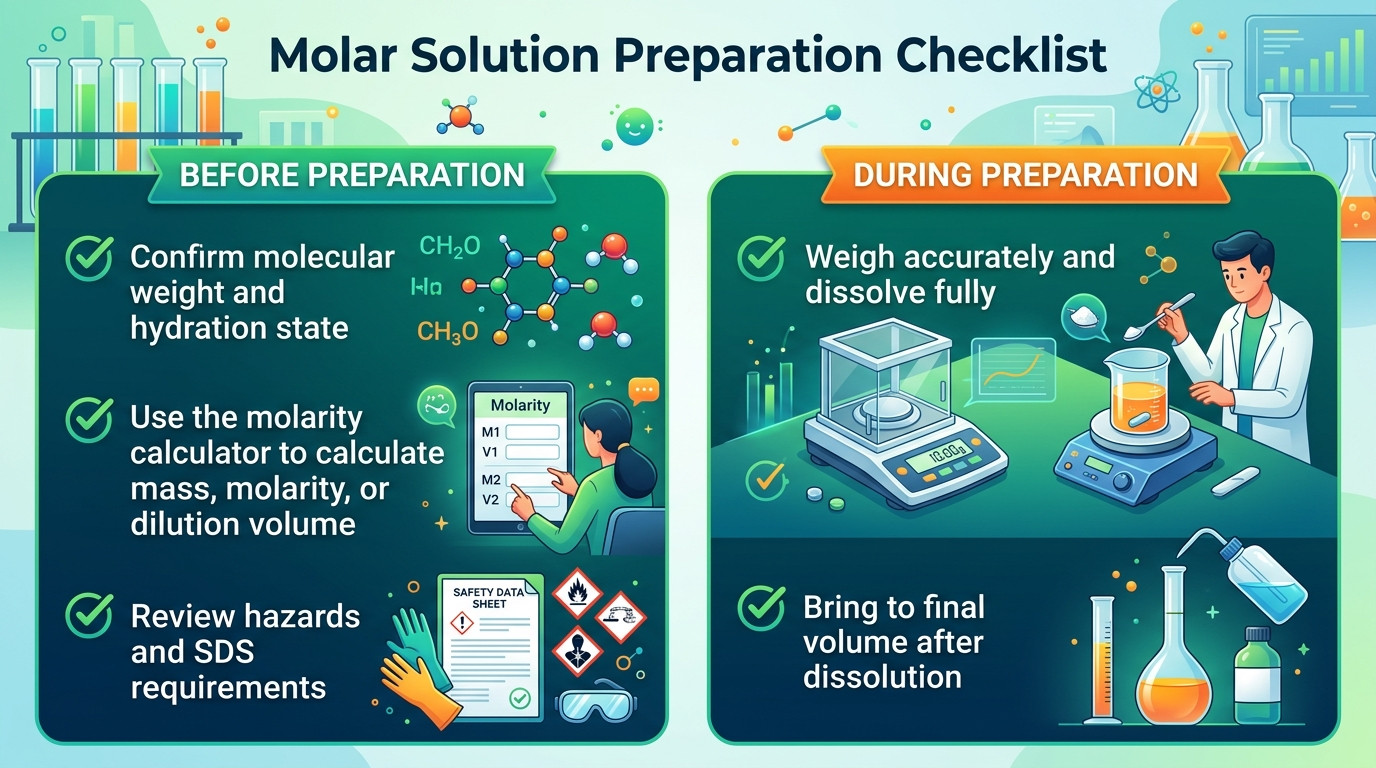
Molar Solution Preparation Checklist
Before Preparation
During Preparation
Trusted Reference Resources
NIST Chemistry WebBook — NIST Chemistry WebBook provides chemical formula and molecular property references.
PubChem — PubChem compound records can help verify formula, molecular weight, and identifiers.
User Reviews & Ratings
Share Your Experience with This molarity calculator
Additional Molarity Reference Notes
Hydrated salts
Hydrated salts can change how a molar solution is prepared or interpreted. Record reagent form, supplier lot, purity, molecular weight, weighing method, final volume, solvent, pH adjustment, date, and storage condition. If a prepared solution does not perform as expected, review decimal placement, unit conversion, hydration state, volumetric technique, and whether the material was fully dissolved before the final volume was set. Clear records help repeat the preparation and support future review.
Purity correction
Purity correction can change how a molar solution is prepared or interpreted. Record reagent form, supplier lot, purity, molecular weight, weighing method, final volume, solvent, pH adjustment, date, and storage condition. If a prepared solution does not perform as expected, review decimal placement, unit conversion, hydration state, volumetric technique, and whether the material was fully dissolved before the final volume was set. Clear records help repeat the preparation and support future review.
Volumetric technique
Volumetric technique can change how a molar solution is prepared or interpreted. Record reagent form, supplier lot, purity, molecular weight, weighing method, final volume, solvent, pH adjustment, date, and storage condition. If a prepared solution does not perform as expected, review decimal placement, unit conversion, hydration state, volumetric technique, and whether the material was fully dissolved before the final volume was set. Clear records help repeat the preparation and support future review.
pH adjustment
pH adjustment can change how a molar solution is prepared or interpreted. Record reagent form, supplier lot, purity, molecular weight, weighing method, final volume, solvent, pH adjustment, date, and storage condition. If a prepared solution does not perform as expected, review decimal placement, unit conversion, hydration state, volumetric technique, and whether the material was fully dissolved before the final volume was set. Clear records help repeat the preparation and support future review.
Temperature and expansion
Temperature and expansion can change how a molar solution is prepared or interpreted. Record reagent form, supplier lot, purity, molecular weight, weighing method, final volume, solvent, pH adjustment, date, and storage condition. If a prepared solution does not perform as expected, review decimal placement, unit conversion, hydration state, volumetric technique, and whether the material was fully dissolved before the final volume was set. Clear records help repeat the preparation and support future review.
Storage labels
Storage labels can change how a molar solution is prepared or interpreted. Record reagent form, supplier lot, purity, molecular weight, weighing method, final volume, solvent, pH adjustment, date, and storage condition. If a prepared solution does not perform as expected, review decimal placement, unit conversion, hydration state, volumetric technique, and whether the material was fully dissolved before the final volume was set. Clear records help repeat the preparation and support future review.
Teaching worksheets
Teaching worksheets can change how a molar solution is prepared or interpreted. Record reagent form, supplier lot, purity, molecular weight, weighing method, final volume, solvent, pH adjustment, date, and storage condition. If a prepared solution does not perform as expected, review decimal placement, unit conversion, hydration state, volumetric technique, and whether the material was fully dissolved before the final volume was set. Clear records help repeat the preparation and support future review.
Quality review
Quality review can change how a molar solution is prepared or interpreted. Record reagent form, supplier lot, purity, molecular weight, weighing method, final volume, solvent, pH adjustment, date, and storage condition. If a prepared solution does not perform as expected, review decimal placement, unit conversion, hydration state, volumetric technique, and whether the material was fully dissolved before the final volume was set. Clear records help repeat the preparation and support future review.
Serial dilution records
Serial dilution records can change how a molar solution is prepared or interpreted. Record reagent form, supplier lot, purity, molecular weight, weighing method, final volume, solvent, pH adjustment, date, and storage condition. If a prepared solution does not perform as expected, review decimal placement, unit conversion, hydration state, volumetric technique, and whether the material was fully dissolved before the final volume was set. Clear records help repeat the preparation and support future review.
Troubleshooting concentration errors
Troubleshooting concentration errors can change how a molar solution is prepared or interpreted. Record reagent form, supplier lot, purity, molecular weight, weighing method, final volume, solvent, pH adjustment, date, and storage condition. If a prepared solution does not perform as expected, review decimal placement, unit conversion, hydration state, volumetric technique, and whether the material was fully dissolved before the final volume was set. Clear records help repeat the preparation and support future review.
Extended Laboratory Notes for Molar Solution Work
Balance selection
Balance selection can affect how a solution is prepared, checked, and used in a real laboratory. A calculation may identify the theoretical mass or stock volume, but the final preparation depends on how the reagent behaves, how accurately the volume is set, and how well the preparation is documented. Good practice is to write the reagent name, formula, lot, molecular weight, hydration state, purity, mass weighed, final volume, solvent, date, preparer, storage condition, and intended use. If the solution is pH adjusted, record whether the final volume was set before or after adjustment according to the protocol. If the solution is filtered, autoclaved, or stored frozen, record that treatment as well.
When a prepared solution gives unexpected results, troubleshoot the simple things first. Check whether grams, milligrams, liters, milliliters, M, mM, and micromolar values were entered correctly. Confirm that the final solution volume was used rather than the starting solvent volume. Verify the compound form, because an anhydrous salt and a hydrate can require different masses. Review whether the reagent dissolved completely, whether material was lost during transfer, and whether the balance or volumetric flask was appropriate for the required accuracy. Clear preparation notes reduce repeated work and make it easier for another person to reproduce the same solution.
Volumetric flask use
Volumetric flask use can affect how a solution is prepared, checked, and used in a real laboratory. A calculation may identify the theoretical mass or stock volume, but the final preparation depends on how the reagent behaves, how accurately the volume is set, and how well the preparation is documented. Good practice is to write the reagent name, formula, lot, molecular weight, hydration state, purity, mass weighed, final volume, solvent, date, preparer, storage condition, and intended use. If the solution is pH adjusted, record whether the final volume was set before or after adjustment according to the protocol. If the solution is filtered, autoclaved, or stored frozen, record that treatment as well.
When a prepared solution gives unexpected results, troubleshoot the simple things first. Check whether grams, milligrams, liters, milliliters, M, mM, and micromolar values were entered correctly. Confirm that the final solution volume was used rather than the starting solvent volume. Verify the compound form, because an anhydrous salt and a hydrate can require different masses. Review whether the reagent dissolved completely, whether material was lost during transfer, and whether the balance or volumetric flask was appropriate for the required accuracy. Clear preparation notes reduce repeated work and make it easier for another person to reproduce the same solution.
Rinsing transfer vessels
Rinsing transfer vessels can affect how a solution is prepared, checked, and used in a real laboratory. A calculation may identify the theoretical mass or stock volume, but the final preparation depends on how the reagent behaves, how accurately the volume is set, and how well the preparation is documented. Good practice is to write the reagent name, formula, lot, molecular weight, hydration state, purity, mass weighed, final volume, solvent, date, preparer, storage condition, and intended use. If the solution is pH adjusted, record whether the final volume was set before or after adjustment according to the protocol. If the solution is filtered, autoclaved, or stored frozen, record that treatment as well.
When a prepared solution gives unexpected results, troubleshoot the simple things first. Check whether grams, milligrams, liters, milliliters, M, mM, and micromolar values were entered correctly. Confirm that the final solution volume was used rather than the starting solvent volume. Verify the compound form, because an anhydrous salt and a hydrate can require different masses. Review whether the reagent dissolved completely, whether material was lost during transfer, and whether the balance or volumetric flask was appropriate for the required accuracy. Clear preparation notes reduce repeated work and make it easier for another person to reproduce the same solution.
Meniscus reading
Meniscus reading can affect how a solution is prepared, checked, and used in a real laboratory. A calculation may identify the theoretical mass or stock volume, but the final preparation depends on how the reagent behaves, how accurately the volume is set, and how well the preparation is documented. Good practice is to write the reagent name, formula, lot, molecular weight, hydration state, purity, mass weighed, final volume, solvent, date, preparer, storage condition, and intended use. If the solution is pH adjusted, record whether the final volume was set before or after adjustment according to the protocol. If the solution is filtered, autoclaved, or stored frozen, record that treatment as well.
When a prepared solution gives unexpected results, troubleshoot the simple things first. Check whether grams, milligrams, liters, milliliters, M, mM, and micromolar values were entered correctly. Confirm that the final solution volume was used rather than the starting solvent volume. Verify the compound form, because an anhydrous salt and a hydrate can require different masses. Review whether the reagent dissolved completely, whether material was lost during transfer, and whether the balance or volumetric flask was appropriate for the required accuracy. Clear preparation notes reduce repeated work and make it easier for another person to reproduce the same solution.
Solvent choice
Solvent choice can affect how a solution is prepared, checked, and used in a real laboratory. A calculation may identify the theoretical mass or stock volume, but the final preparation depends on how the reagent behaves, how accurately the volume is set, and how well the preparation is documented. Good practice is to write the reagent name, formula, lot, molecular weight, hydration state, purity, mass weighed, final volume, solvent, date, preparer, storage condition, and intended use. If the solution is pH adjusted, record whether the final volume was set before or after adjustment according to the protocol. If the solution is filtered, autoclaved, or stored frozen, record that treatment as well.
When a prepared solution gives unexpected results, troubleshoot the simple things first. Check whether grams, milligrams, liters, milliliters, M, mM, and micromolar values were entered correctly. Confirm that the final solution volume was used rather than the starting solvent volume. Verify the compound form, because an anhydrous salt and a hydrate can require different masses. Review whether the reagent dissolved completely, whether material was lost during transfer, and whether the balance or volumetric flask was appropriate for the required accuracy. Clear preparation notes reduce repeated work and make it easier for another person to reproduce the same solution.
Solubility limits
Solubility limits can affect how a solution is prepared, checked, and used in a real laboratory. A calculation may identify the theoretical mass or stock volume, but the final preparation depends on how the reagent behaves, how accurately the volume is set, and how well the preparation is documented. Good practice is to write the reagent name, formula, lot, molecular weight, hydration state, purity, mass weighed, final volume, solvent, date, preparer, storage condition, and intended use. If the solution is pH adjusted, record whether the final volume was set before or after adjustment according to the protocol. If the solution is filtered, autoclaved, or stored frozen, record that treatment as well.
When a prepared solution gives unexpected results, troubleshoot the simple things first. Check whether grams, milligrams, liters, milliliters, M, mM, and micromolar values were entered correctly. Confirm that the final solution volume was used rather than the starting solvent volume. Verify the compound form, because an anhydrous salt and a hydrate can require different masses. Review whether the reagent dissolved completely, whether material was lost during transfer, and whether the balance or volumetric flask was appropriate for the required accuracy. Clear preparation notes reduce repeated work and make it easier for another person to reproduce the same solution.
Heat of dissolution
Heat of dissolution can affect how a solution is prepared, checked, and used in a real laboratory. A calculation may identify the theoretical mass or stock volume, but the final preparation depends on how the reagent behaves, how accurately the volume is set, and how well the preparation is documented. Good practice is to write the reagent name, formula, lot, molecular weight, hydration state, purity, mass weighed, final volume, solvent, date, preparer, storage condition, and intended use. If the solution is pH adjusted, record whether the final volume was set before or after adjustment according to the protocol. If the solution is filtered, autoclaved, or stored frozen, record that treatment as well.
When a prepared solution gives unexpected results, troubleshoot the simple things first. Check whether grams, milligrams, liters, milliliters, M, mM, and micromolar values were entered correctly. Confirm that the final solution volume was used rather than the starting solvent volume. Verify the compound form, because an anhydrous salt and a hydrate can require different masses. Review whether the reagent dissolved completely, whether material was lost during transfer, and whether the balance or volumetric flask was appropriate for the required accuracy. Clear preparation notes reduce repeated work and make it easier for another person to reproduce the same solution.
Acid and base dilution
Acid and base dilution can affect how a solution is prepared, checked, and used in a real laboratory. A calculation may identify the theoretical mass or stock volume, but the final preparation depends on how the reagent behaves, how accurately the volume is set, and how well the preparation is documented. Good practice is to write the reagent name, formula, lot, molecular weight, hydration state, purity, mass weighed, final volume, solvent, date, preparer, storage condition, and intended use. If the solution is pH adjusted, record whether the final volume was set before or after adjustment according to the protocol. If the solution is filtered, autoclaved, or stored frozen, record that treatment as well.
When a prepared solution gives unexpected results, troubleshoot the simple things first. Check whether grams, milligrams, liters, milliliters, M, mM, and micromolar values were entered correctly. Confirm that the final solution volume was used rather than the starting solvent volume. Verify the compound form, because an anhydrous salt and a hydrate can require different masses. Review whether the reagent dissolved completely, whether material was lost during transfer, and whether the balance or volumetric flask was appropriate for the required accuracy. Clear preparation notes reduce repeated work and make it easier for another person to reproduce the same solution.
Hygroscopic reagents
Hygroscopic reagents can affect how a solution is prepared, checked, and used in a real laboratory. A calculation may identify the theoretical mass or stock volume, but the final preparation depends on how the reagent behaves, how accurately the volume is set, and how well the preparation is documented. Good practice is to write the reagent name, formula, lot, molecular weight, hydration state, purity, mass weighed, final volume, solvent, date, preparer, storage condition, and intended use. If the solution is pH adjusted, record whether the final volume was set before or after adjustment according to the protocol. If the solution is filtered, autoclaved, or stored frozen, record that treatment as well.
When a prepared solution gives unexpected results, troubleshoot the simple things first. Check whether grams, milligrams, liters, milliliters, M, mM, and micromolar values were entered correctly. Confirm that the final solution volume was used rather than the starting solvent volume. Verify the compound form, because an anhydrous salt and a hydrate can require different masses. Review whether the reagent dissolved completely, whether material was lost during transfer, and whether the balance or volumetric flask was appropriate for the required accuracy. Clear preparation notes reduce repeated work and make it easier for another person to reproduce the same solution.
Deliquescent salts
Deliquescent salts can affect how a solution is prepared, checked, and used in a real laboratory. A calculation may identify the theoretical mass or stock volume, but the final preparation depends on how the reagent behaves, how accurately the volume is set, and how well the preparation is documented. Good practice is to write the reagent name, formula, lot, molecular weight, hydration state, purity, mass weighed, final volume, solvent, date, preparer, storage condition, and intended use. If the solution is pH adjusted, record whether the final volume was set before or after adjustment according to the protocol. If the solution is filtered, autoclaved, or stored frozen, record that treatment as well.
When a prepared solution gives unexpected results, troubleshoot the simple things first. Check whether grams, milligrams, liters, milliliters, M, mM, and micromolar values were entered correctly. Confirm that the final solution volume was used rather than the starting solvent volume. Verify the compound form, because an anhydrous salt and a hydrate can require different masses. Review whether the reagent dissolved completely, whether material was lost during transfer, and whether the balance or volumetric flask was appropriate for the required accuracy. Clear preparation notes reduce repeated work and make it easier for another person to reproduce the same solution.
Light sensitive reagents
Light sensitive reagents can affect how a solution is prepared, checked, and used in a real laboratory. A calculation may identify the theoretical mass or stock volume, but the final preparation depends on how the reagent behaves, how accurately the volume is set, and how well the preparation is documented. Good practice is to write the reagent name, formula, lot, molecular weight, hydration state, purity, mass weighed, final volume, solvent, date, preparer, storage condition, and intended use. If the solution is pH adjusted, record whether the final volume was set before or after adjustment according to the protocol. If the solution is filtered, autoclaved, or stored frozen, record that treatment as well.
When a prepared solution gives unexpected results, troubleshoot the simple things first. Check whether grams, milligrams, liters, milliliters, M, mM, and micromolar values were entered correctly. Confirm that the final solution volume was used rather than the starting solvent volume. Verify the compound form, because an anhydrous salt and a hydrate can require different masses. Review whether the reagent dissolved completely, whether material was lost during transfer, and whether the balance or volumetric flask was appropriate for the required accuracy. Clear preparation notes reduce repeated work and make it easier for another person to reproduce the same solution.
Long term storage
Long term storage can affect how a solution is prepared, checked, and used in a real laboratory. A calculation may identify the theoretical mass or stock volume, but the final preparation depends on how the reagent behaves, how accurately the volume is set, and how well the preparation is documented. Good practice is to write the reagent name, formula, lot, molecular weight, hydration state, purity, mass weighed, final volume, solvent, date, preparer, storage condition, and intended use. If the solution is pH adjusted, record whether the final volume was set before or after adjustment according to the protocol. If the solution is filtered, autoclaved, or stored frozen, record that treatment as well.
When a prepared solution gives unexpected results, troubleshoot the simple things first. Check whether grams, milligrams, liters, milliliters, M, mM, and micromolar values were entered correctly. Confirm that the final solution volume was used rather than the starting solvent volume. Verify the compound form, because an anhydrous salt and a hydrate can require different masses. Review whether the reagent dissolved completely, whether material was lost during transfer, and whether the balance or volumetric flask was appropriate for the required accuracy. Clear preparation notes reduce repeated work and make it easier for another person to reproduce the same solution.
Working standards
Working standards can affect how a solution is prepared, checked, and used in a real laboratory. A calculation may identify the theoretical mass or stock volume, but the final preparation depends on how the reagent behaves, how accurately the volume is set, and how well the preparation is documented. Good practice is to write the reagent name, formula, lot, molecular weight, hydration state, purity, mass weighed, final volume, solvent, date, preparer, storage condition, and intended use. If the solution is pH adjusted, record whether the final volume was set before or after adjustment according to the protocol. If the solution is filtered, autoclaved, or stored frozen, record that treatment as well.
When a prepared solution gives unexpected results, troubleshoot the simple things first. Check whether grams, milligrams, liters, milliliters, M, mM, and micromolar values were entered correctly. Confirm that the final solution volume was used rather than the starting solvent volume. Verify the compound form, because an anhydrous salt and a hydrate can require different masses. Review whether the reagent dissolved completely, whether material was lost during transfer, and whether the balance or volumetric flask was appropriate for the required accuracy. Clear preparation notes reduce repeated work and make it easier for another person to reproduce the same solution.
Stock verification
Stock verification can affect how a solution is prepared, checked, and used in a real laboratory. A calculation may identify the theoretical mass or stock volume, but the final preparation depends on how the reagent behaves, how accurately the volume is set, and how well the preparation is documented. Good practice is to write the reagent name, formula, lot, molecular weight, hydration state, purity, mass weighed, final volume, solvent, date, preparer, storage condition, and intended use. If the solution is pH adjusted, record whether the final volume was set before or after adjustment according to the protocol. If the solution is filtered, autoclaved, or stored frozen, record that treatment as well.
When a prepared solution gives unexpected results, troubleshoot the simple things first. Check whether grams, milligrams, liters, milliliters, M, mM, and micromolar values were entered correctly. Confirm that the final solution volume was used rather than the starting solvent volume. Verify the compound form, because an anhydrous salt and a hydrate can require different masses. Review whether the reagent dissolved completely, whether material was lost during transfer, and whether the balance or volumetric flask was appropriate for the required accuracy. Clear preparation notes reduce repeated work and make it easier for another person to reproduce the same solution.
Documentation language
Documentation language can affect how a solution is prepared, checked, and used in a real laboratory. A calculation may identify the theoretical mass or stock volume, but the final preparation depends on how the reagent behaves, how accurately the volume is set, and how well the preparation is documented. Good practice is to write the reagent name, formula, lot, molecular weight, hydration state, purity, mass weighed, final volume, solvent, date, preparer, storage condition, and intended use. If the solution is pH adjusted, record whether the final volume was set before or after adjustment according to the protocol. If the solution is filtered, autoclaved, or stored frozen, record that treatment as well.
When a prepared solution gives unexpected results, troubleshoot the simple things first. Check whether grams, milligrams, liters, milliliters, M, mM, and micromolar values were entered correctly. Confirm that the final solution volume was used rather than the starting solvent volume. Verify the compound form, because an anhydrous salt and a hydrate can require different masses. Review whether the reagent dissolved completely, whether material was lost during transfer, and whether the balance or volumetric flask was appropriate for the required accuracy. Clear preparation notes reduce repeated work and make it easier for another person to reproduce the same solution.
Training examples
Training examples can affect how a solution is prepared, checked, and used in a real laboratory. A calculation may identify the theoretical mass or stock volume, but the final preparation depends on how the reagent behaves, how accurately the volume is set, and how well the preparation is documented. Good practice is to write the reagent name, formula, lot, molecular weight, hydration state, purity, mass weighed, final volume, solvent, date, preparer, storage condition, and intended use. If the solution is pH adjusted, record whether the final volume was set before or after adjustment according to the protocol. If the solution is filtered, autoclaved, or stored frozen, record that treatment as well.
When a prepared solution gives unexpected results, troubleshoot the simple things first. Check whether grams, milligrams, liters, milliliters, M, mM, and micromolar values were entered correctly. Confirm that the final solution volume was used rather than the starting solvent volume. Verify the compound form, because an anhydrous salt and a hydrate can require different masses. Review whether the reagent dissolved completely, whether material was lost during transfer, and whether the balance or volumetric flask was appropriate for the required accuracy. Clear preparation notes reduce repeated work and make it easier for another person to reproduce the same solution.
Audit readiness
Audit readiness can affect how a solution is prepared, checked, and used in a real laboratory. A calculation may identify the theoretical mass or stock volume, but the final preparation depends on how the reagent behaves, how accurately the volume is set, and how well the preparation is documented. Good practice is to write the reagent name, formula, lot, molecular weight, hydration state, purity, mass weighed, final volume, solvent, date, preparer, storage condition, and intended use. If the solution is pH adjusted, record whether the final volume was set before or after adjustment according to the protocol. If the solution is filtered, autoclaved, or stored frozen, record that treatment as well.
When a prepared solution gives unexpected results, troubleshoot the simple things first. Check whether grams, milligrams, liters, milliliters, M, mM, and micromolar values were entered correctly. Confirm that the final solution volume was used rather than the starting solvent volume. Verify the compound form, because an anhydrous salt and a hydrate can require different masses. Review whether the reagent dissolved completely, whether material was lost during transfer, and whether the balance or volumetric flask was appropriate for the required accuracy. Clear preparation notes reduce repeated work and make it easier for another person to reproduce the same solution.
Waste handling
Waste handling can affect how a solution is prepared, checked, and used in a real laboratory. A calculation may identify the theoretical mass or stock volume, but the final preparation depends on how the reagent behaves, how accurately the volume is set, and how well the preparation is documented. Good practice is to write the reagent name, formula, lot, molecular weight, hydration state, purity, mass weighed, final volume, solvent, date, preparer, storage condition, and intended use. If the solution is pH adjusted, record whether the final volume was set before or after adjustment according to the protocol. If the solution is filtered, autoclaved, or stored frozen, record that treatment as well.
When a prepared solution gives unexpected results, troubleshoot the simple things first. Check whether grams, milligrams, liters, milliliters, M, mM, and micromolar values were entered correctly. Confirm that the final solution volume was used rather than the starting solvent volume. Verify the compound form, because an anhydrous salt and a hydrate can require different masses. Review whether the reagent dissolved completely, whether material was lost during transfer, and whether the balance or volumetric flask was appropriate for the required accuracy. Clear preparation notes reduce repeated work and make it easier for another person to reproduce the same solution.
Label durability
Label durability can affect how a solution is prepared, checked, and used in a real laboratory. A calculation may identify the theoretical mass or stock volume, but the final preparation depends on how the reagent behaves, how accurately the volume is set, and how well the preparation is documented. Good practice is to write the reagent name, formula, lot, molecular weight, hydration state, purity, mass weighed, final volume, solvent, date, preparer, storage condition, and intended use. If the solution is pH adjusted, record whether the final volume was set before or after adjustment according to the protocol. If the solution is filtered, autoclaved, or stored frozen, record that treatment as well.
When a prepared solution gives unexpected results, troubleshoot the simple things first. Check whether grams, milligrams, liters, milliliters, M, mM, and micromolar values were entered correctly. Confirm that the final solution volume was used rather than the starting solvent volume. Verify the compound form, because an anhydrous salt and a hydrate can require different masses. Review whether the reagent dissolved completely, whether material was lost during transfer, and whether the balance or volumetric flask was appropriate for the required accuracy. Clear preparation notes reduce repeated work and make it easier for another person to reproduce the same solution.
Batch reproducibility
Batch reproducibility can affect how a solution is prepared, checked, and used in a real laboratory. A calculation may identify the theoretical mass or stock volume, but the final preparation depends on how the reagent behaves, how accurately the volume is set, and how well the preparation is documented. Good practice is to write the reagent name, formula, lot, molecular weight, hydration state, purity, mass weighed, final volume, solvent, date, preparer, storage condition, and intended use. If the solution is pH adjusted, record whether the final volume was set before or after adjustment according to the protocol. If the solution is filtered, autoclaved, or stored frozen, record that treatment as well.
When a prepared solution gives unexpected results, troubleshoot the simple things first. Check whether grams, milligrams, liters, milliliters, M, mM, and micromolar values were entered correctly. Confirm that the final solution volume was used rather than the starting solvent volume. Verify the compound form, because an anhydrous salt and a hydrate can require different masses. Review whether the reagent dissolved completely, whether material was lost during transfer, and whether the balance or volumetric flask was appropriate for the required accuracy. Clear preparation notes reduce repeated work and make it easier for another person to reproduce the same solution.
Final Thoughts on Molarity Calculation
Molarity is a foundational concentration unit for chemistry and biology. A molarity calculator makes the arithmetic reliable by connecting moles, mass, molecular weight, final volume, dilution, and unit conversion in one workflow.
Before preparing or reporting a solution, verify reagent identity, hydration state, purity, final volume, and safety requirements. The molarity calculator gives the number, but careful technique makes the solution accurate.
Tip: Document mass, final volume, molecular weight, preparation date, and preparer for every important molar solution.