
Mole Calculator — Moles, Mass, Molar Mass, Molecules & Molarity
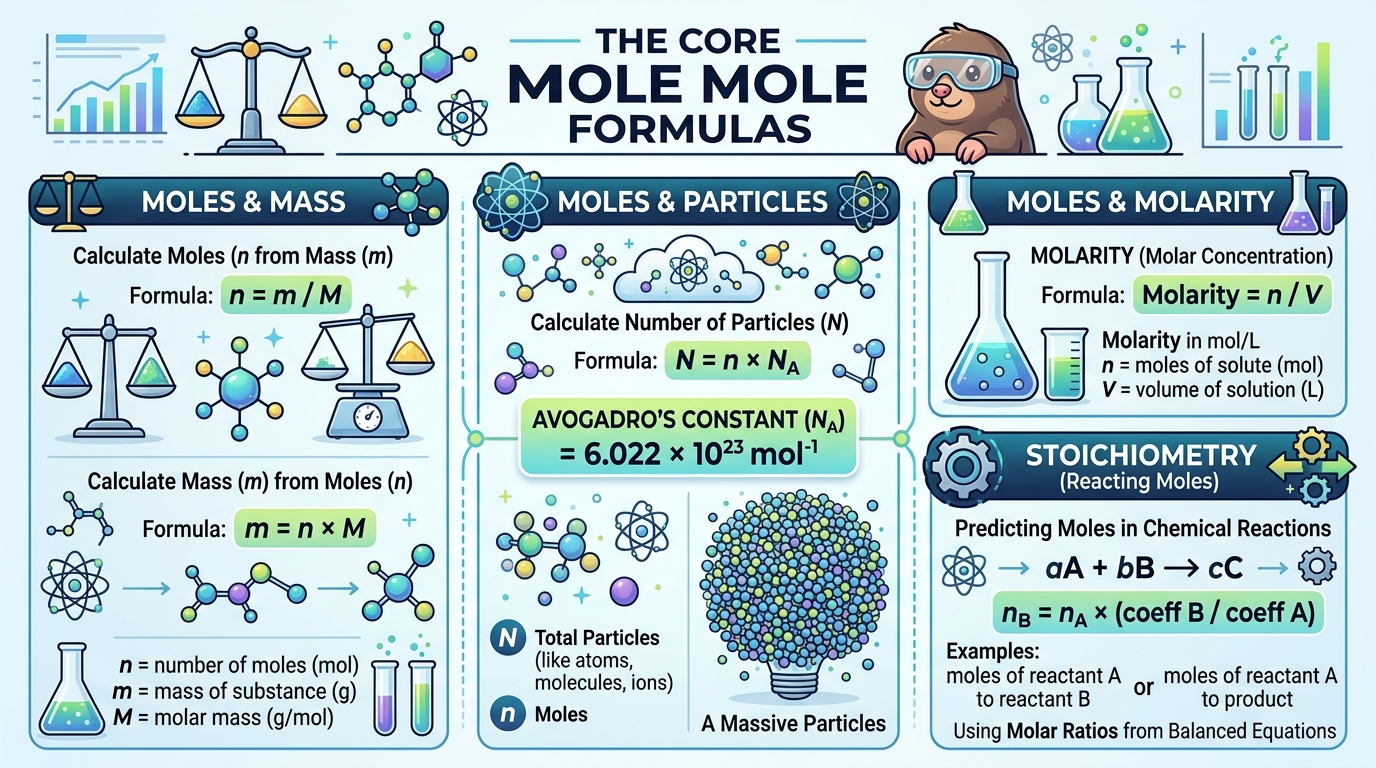
A mole calculator converts between the four fundamental quantities that define how much of a substance you have: moles (n), mass (m), molar mass (M), and number of particles (N). The core formula is n = m ÷ M (moles = mass in grams ÷ molar mass in g/mol). One mole = 6.022 × 10²³ particles (Avogadro’s number). The mole calculator handles five modes: moles from mass, mass from moles, number of particles, moles to molarity (concentration), and stoichiometry (mole ratios in chemical reactions). Enter any two known values below and the mole calculator computes everything else with full step-by-step working.
Key facts at a glance
- Mole formula: n = m ÷ M (moles = mass ÷ molar mass)
- Avogadro’s number: NA = 6.022 × 10²³ particles/mol
- Particles: N = n × NA
- Molarity: M = n ÷ V (mol/L = moles ÷ volume in litres)
- Mass from moles: m = n × M
- Common examples: NaCl MW = 58.44, H₂O MW = 18.015, glucose MW = 180.16 g/mol
📋 Table of Contents
▼
- What a Mole Calculator Does
- Mole Calculator — Five Modes
- How Mole Calculations Work
- Real Scenarios Where Mole Math Mattered
- Common Mole Calculation Mistakes
- Lab Safety Essentials
- Which Mode Fits Your Situation
- Frequently Asked Questions
- Mole Calculation Best Practices Checklist
- Trusted Reference Resources
- User Reviews & Ratings
What a Mole Calculator Does
A mole calculator converts between the mass you can weigh on a balance, the number of moles that determine how substances react, the number of molecules or atoms in a sample, and the molar concentration when dissolved in a known volume. The mole is the bridge between the macroscopic world (grams on a balance) and the molecular world (atoms, molecules, ions). Without the mole concept, you cannot predict how much product a reaction will yield, how much reagent to weigh for a specific concentration, or how many molecules are in a sample. The mole calculator handles every direction of conversion and shows the working at each step.
The reason mole calculations trip people up is that molar mass is different for every substance, and forgetting to look up the correct molar mass — or using the atomic mass when you need the molecular mass — is the single most common error. NaCl has a molar mass of 58.44 g/mol (not 23 for Na or 35.45 for Cl alone). CaCl₂·2H₂O has a molar mass of 147.01 g/mol (not 110.98 for anhydrous CaCl₂). Glucose has a molar mass of 180.16 g/mol. The mole calculator asks you to enter the molar mass explicitly, ensuring you use the correct value for the exact form of the substance you are weighing.
This mole calculator handles five modes: moles from mass (n = m/M), mass from moles (m = n×M), number of particles (N = n×NA), moles to molarity (Molarity = n/V), and stoichiometry (mole ratios between reactants and products). Each mode shows every step of the working, making it suitable for teaching, laboratory notebooks, exam revision, and professional documentation.
[mole_calculator]
How Mole Calculations Work
The mole is chemistry’s counting unit — it bridges the gap between the atomic scale (individual atoms and molecules too small to see or weigh) and the laboratory scale (grams on a balance, millilitres in a flask). One mole of any substance contains exactly 6.02214076 × 10²³ particles (Avogadro’s number, NA). This enormous number was chosen so that one mole of atoms of any element has a mass in grams equal to its atomic mass number: one mole of carbon-12 atoms weighs exactly 12 grams, one mole of sodium atoms weighs 22.99 grams, and one mole of NaCl formula units weighs 58.44 grams.
The Core Formula: n = m ÷ M
The fundamental mole equation is: n = m ÷ M, where n is the number of moles, m is the mass in grams, and M is the molar mass in grams per mole (g/mol). This equation rearranges to: m = n × M (mass from moles) and M = m ÷ n (molar mass from mass and moles). The mole calculator handles all three rearrangements and adds unit conversions (mg, µg, kg) so you can work in whatever mass unit your balance reads.
Molar Mass — The Key Number
The molar mass (M) is the mass of one mole of a substance, and it must be calculated from the molecular formula by summing the atomic masses of all atoms. For NaCl: M = 22.99 (Na) + 35.45 (Cl) = 58.44 g/mol. For glucose (C₆H₁₂O₆): M = 6(12.01) + 12(1.008) + 6(16.00) = 180.16 g/mol. For hydrated salts, include the water of crystallisation: CaCl₂·2H₂O = 40.08 + 2(35.45) + 2(18.015) = 147.01 g/mol. Using the wrong molar mass is the most common mole calculation error, and the mole calculator requires you to enter M explicitly to prevent this.
Avogadro’s Number and Particle Counting
The number of particles in a sample is: N = n × NA, where NA = 6.022 × 10²³ mol⁻¹. “Particles” can mean atoms (for elements), molecules (for molecular compounds), formula units (for ionic compounds), or ions (for dissolved salts). One mole of H₂O contains 6.022 × 10²³ water molecules — but also contains 2 × 6.022 × 10²³ hydrogen atoms and 6.022 × 10²³ oxygen atoms. The mole calculator’s Particles mode converts between moles and number of particles in both directions.
Moles to Molarity
When you dissolve a known number of moles in a known volume of solution, the resulting concentration is the molarity: Molarity (M) = n ÷ V, where V is in litres. The mole calculator’s Molarity mode handles all four rearrangements: molarity from moles and volume, moles from molarity and volume, volume from moles and molarity, and mass to weigh for a target molarity and volume (combining n = M×V and m = n×MM in one step).
Stoichiometry — Mole Ratios in Reactions
In balanced chemical equations, the coefficients give the mole ratios between reactants and products. For 2H₂ + O₂ → 2H₂O, the ratio is 2:1:2, meaning 2 moles of H₂ react with 1 mole of O₂ to produce 2 moles of H₂O. If you have 0.5 mol of O₂, you need 1.0 mol of H₂ and will produce 1.0 mol of H₂O. The mole calculator’s Stoichiometry mode computes the moles (and optionally mass) of any substance from the moles of another using the balanced equation coefficients.
N = n × NA (particles from moles)
NA = 6.022 × 10²³ mol⁻¹
Molarity = n ÷ V (mol/L)
Stoichiometry: nB = nA × (coeff B ÷ coeff A)
Quick Reference Values
Remember: The molar mass must match the exact form of the substance you are weighing — including hydration waters. NaCl anhydrous (58.44 g/mol) vs Na₂SO₄·10H₂O (322.20 g/mol) — using the wrong molar mass gives the wrong number of moles. The mole calculator requires you to enter M explicitly to prevent this error.
Real Scenarios Where Mole Math Mattered
Scenario 1: Weighing NaCl for a Molar Solution
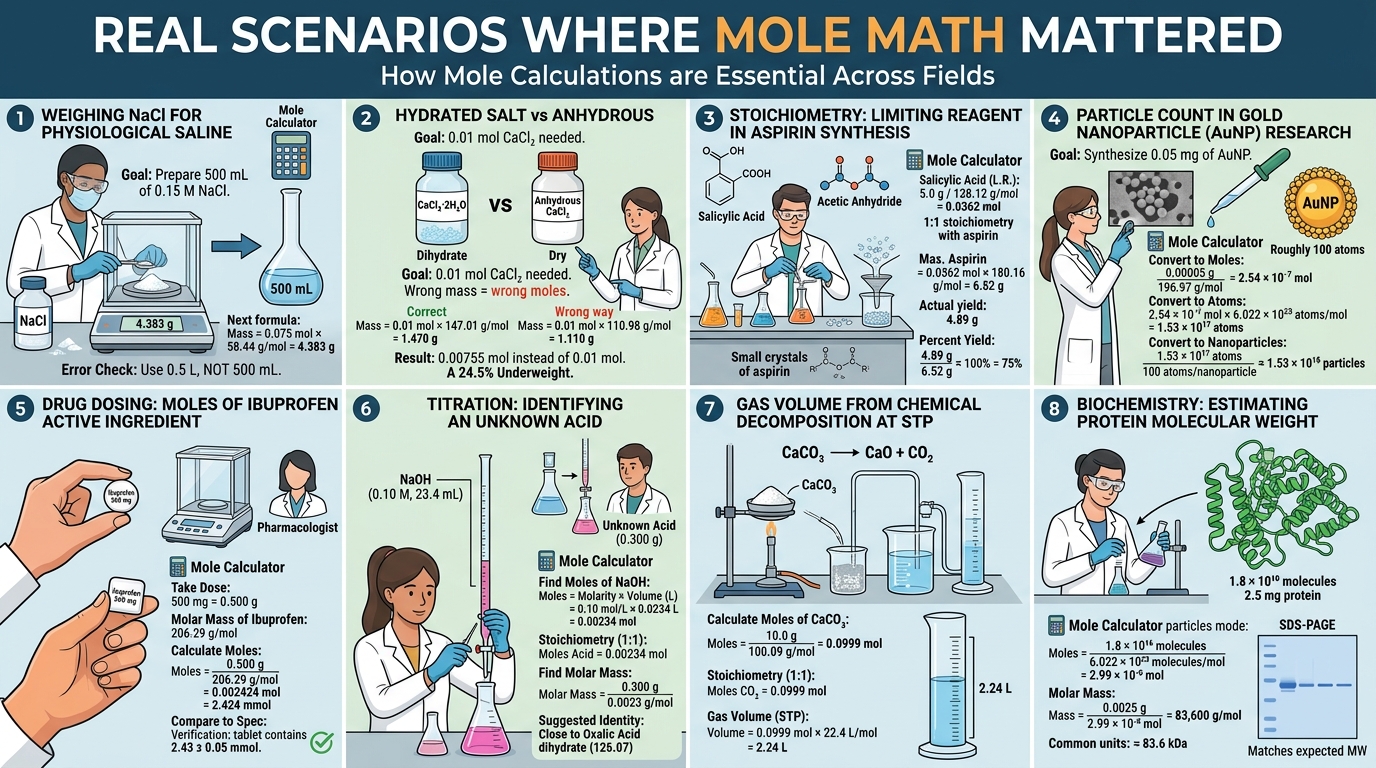
A laboratory technician needed to prepare 500 mL of 0.15 M NaCl (physiological saline). Using the mole calculator’s Molarity mode (mass to weigh): moles = 0.15 × 0.5 = 0.075 mol. Mass = 0.075 × 58.44 = 4.383 g. Dissolve 4.383 g NaCl in water and make up to 500 mL. Without the calculator, the technician might have used the wrong volume (500 mL vs 0.5 L) or forgotten to convert mL to L, giving a 1000× error.
Scenario 2: Hydrated Salt — CaCl₂·2H₂O vs Anhydrous CaCl₂
A researcher needed 0.01 mol of CaCl₂ for an experiment. The reagent bottle contained CaCl₂·2H₂O (not anhydrous). Using the mole calculator: mass = 0.01 × 147.01 = 1.470 g of the dihydrate. If the researcher had used the anhydrous molar mass (110.98 g/mol), they would have weighed only 1.110 g — providing only 0.00755 mol instead of 0.01 mol, a 24.5% underweight that would have skewed the experimental results.
Scenario 3: Stoichiometry — Limiting Reagent in a Synthesis
An organic chemist reacted 5.0 g of salicylic acid (MW 138.12) with excess acetic anhydride to synthesise aspirin (MW 180.16). Using the mole calculator: moles of salicylic acid = 5.0 ÷ 138.12 = 0.0362 mol. The 1:1 stoichiometry means 0.0362 mol of aspirin is the theoretical maximum. Mass of aspirin = 0.0362 × 180.16 = 6.52 g theoretical yield. The actual yield was 4.89 g, giving a percent yield of 75%.
Scenario 4: Particle Count for Nanoparticle Research
A nanotechnology researcher synthesised 0.05 mg of gold nanoparticles (each approximately 1.5 nm diameter, containing about 100 Au atoms). Using the mole calculator: moles of Au = 0.00005 g ÷ 196.97 g/mol = 2.54 × 10⁻⁷ mol. Number of Au atoms = 2.54 × 10⁻⁷ × 6.022 × 10²³ = 1.53 × 10¹⁷ atoms. Number of nanoparticles ≈ 1.53 × 10¹⁷ ÷ 100 = 1.53 × 10¹⁵ particles.
Scenario 5: Drug Dosing — Moles of Active Ingredient
A pharmacologist needed to verify that a 500 mg ibuprofen tablet contained approximately 2.43 mmol of active ingredient (MW 206.29). Using the mole calculator: moles = 0.500 g ÷ 206.29 g/mol = 0.002424 mol = 2.424 mmol. This confirmed the tablet contained the expected amount within analytical tolerance (2.43 ± 0.05 mmol).
Scenario 6: Titration — Moles of Unknown Acid
A student titrated an unknown acid with 0.10 M NaOH and used 23.4 mL to reach the endpoint. Using the mole calculator’s Molarity mode: moles of NaOH = 0.10 × 0.0234 = 0.00234 mol. For a monoprotic acid (1:1 stoichiometry), moles of acid = 0.00234 mol. If the acid sample weighed 0.300 g: molar mass = 0.300 ÷ 0.00234 = 128.2 g/mol, suggesting the acid is oxalic acid or a similar compound.
Scenario 7: Gas Volume at STP
A chemistry student decomposed 10.0 g of calcium carbonate (CaCO₃, MW 100.09) by heating: CaCO₃ → CaO + CO₂. Using the mole calculator: moles of CaCO₃ = 10.0 ÷ 100.09 = 0.0999 mol. By stoichiometry (1:1), moles of CO₂ = 0.0999 mol. At STP, volume of CO₂ = 0.0999 × 22.4 L/mol = 2.24 L.
Scenario 8: Biochemistry — Protein Molecular Weight Estimation
A biochemist measured that 2.5 mg of a purified protein contained 1.8 × 10¹⁶ molecules (determined by single-molecule counting). Using the mole calculator’s Particles mode: moles = 1.8 × 10¹⁶ ÷ 6.022 × 10²³ = 2.99 × 10⁻⁸ mol. Molar mass = 0.0025 g ÷ 2.99 × 10⁻⁸ mol = 83,600 g/mol ≈ 83.6 kDa. This matched the expected molecular weight from SDS-PAGE.
Common Mole Calculation Mistakes
Mistake 1: Using the Wrong Molar Mass
The most common and most consequential mole error. Using the atomic mass of an element instead of the molecular mass of a compound, or forgetting hydration waters, gives the wrong number of moles. Always check the reagent bottle label for the exact formula.
Mistake 2: Confusing g and mg in Mass
The formula n = m/M requires m in grams. Entering 500 mg as “500” without converting to 0.5 g gives a result 1000× too high. The mole calculator accepts mass in g, mg, µg, and kg and converts internally.
Mistake 3: Confusing Moles with Molarity
Moles (n, in mol) and molarity (M, in mol/L) are different quantities. 0.1 moles is a fixed amount. 0.1 M is a concentration — the amount depends on the volume.
Mistake 4: Forgetting Volume Units in Molarity
Molarity = n/V requires V in litres. Using mL instead of L gives a result 1000× wrong. 100 mL = 0.1 L.
Mistake 5: Using Atomic Mass Instead of Molecular Mass
For diatomic gases (H₂, O₂, N₂, Cl₂), the molar mass is twice the atomic mass. H₂ = 2.016 g/mol (not 1.008). O₂ = 32.00 g/mol (not 16.00).
Mistake 6: Not Balancing the Equation for Stoichiometry
Stoichiometry calculations require a balanced equation. Using the wrong coefficients gives the wrong mole ratio. The mole calculator takes coefficients as inputs, but you must ensure the equation is balanced first.
Mistake 7: Confusing Number of Particles with Moles
One mole = 6.022 × 10²³ particles. 6.022 × 10²³ is NOT “6 moles” — it is ONE mole. The mole calculator’s Particles mode makes the direction of conversion explicit.
💡 Rule of Thumb: Always verify the molar mass from the reagent bottle or a reliable database (PubChem, NIST). Include hydration waters. Convert mass to grams and volume to litres before using the formulas. The mole calculator handles conversions automatically — use it to prevent unit errors.
Lab Safety Essentials
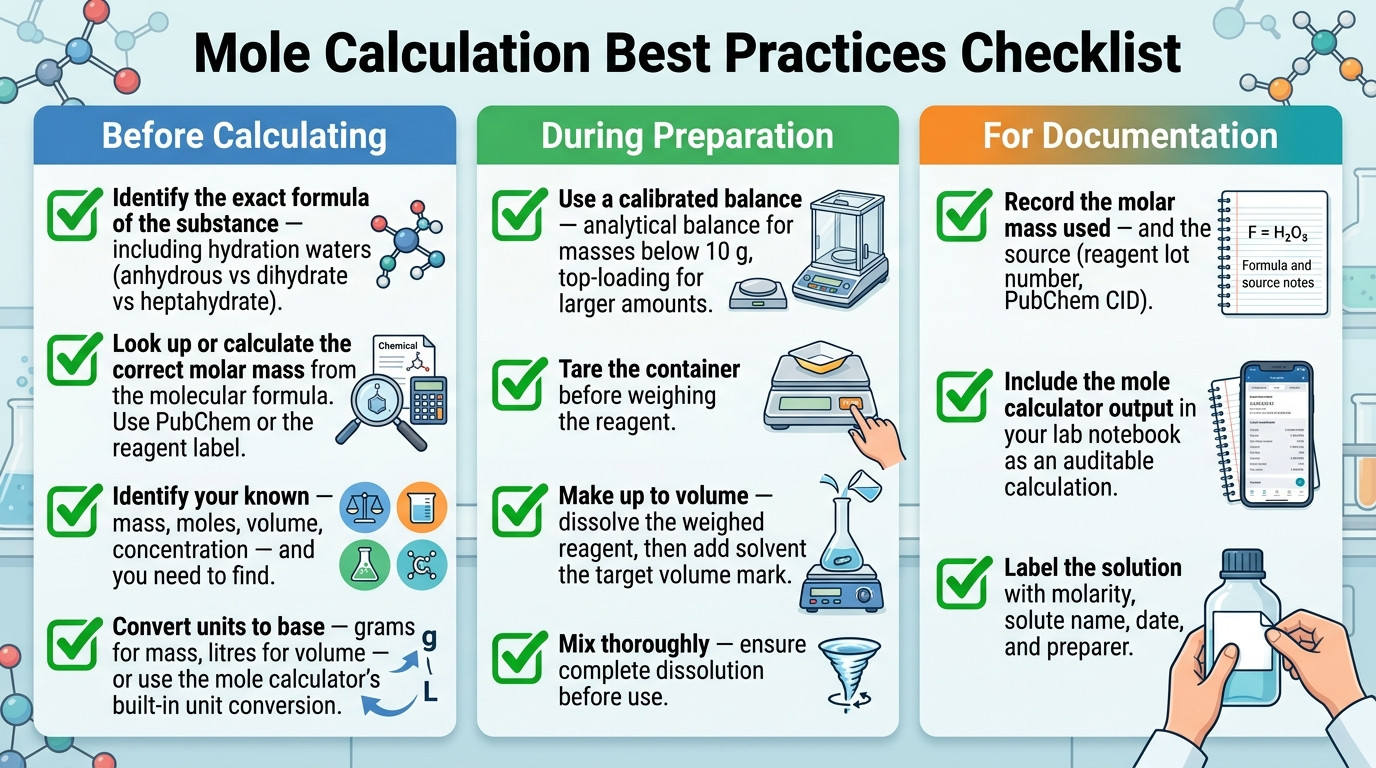
Accurate weighing: Mole calculations are only as accurate as the mass you measure. Use a calibrated analytical balance (±0.001 g for routine work, ±0.0001 g for precise work), tare the container, and weigh in a draft-free environment.
- Verify the molar mass — check the reagent bottle for the exact formula including hydration.
- Use the correct mass unit — convert mg to g before manual calculations.
- Label all solutions — include molarity, solute name, molar mass used, date, and preparer.
- Document the calculation — use the mole calculator step-by-step output for your lab notebook.
- Double-check stoichiometry — verify the balanced equation before computing mole ratios.
- Handle reagents safely — consult the SDS for each chemical, wear appropriate PPE.
Which Mode Fits Your Situation
| Mode | Use Case | Key Formula | Inputs | Applications |
|---|---|---|---|---|
| Moles | How many moles from a mass | n = m ÷ M | Mass, molar mass | Weighing reagents, yield calc |
| Mass | How much to weigh | m = n × M | Moles, molar mass | Solution prep, synthesis |
| Particles | Count molecules/atoms | N = n × NA | Moles or particles | Nanotech, molecular biology |
| Molarity | Concentration calculations | M = n ÷ V | Moles, volume, or target M | Solution prep, titration |
| Stoichiometry | Reaction mole ratios | nB = nA×(b/a) | Moles of A, coefficients | Synthesis, yield prediction |
Moles in General Chemistry
The mole is the central concept in quantitative chemistry. Every stoichiometry problem, every concentration calculation, every gas law application, and every thermodynamic quantity is expressed per mole. The mole calculator bridges the gap between the mass you weigh and the moles that determine how substances react.
Moles in Analytical Chemistry
Analytical chemists use moles in titration calculations, gravimetric analysis, and spectrophotometry. The mole calculator’s Molarity mode supports titration calculations directly, and the Stoichiometry mode handles the mole ratios in analytical reactions.
Moles in Biochemistry and Molecular Biology
Biochemists express enzyme activity in units per mole (kcat), protein concentration in moles per litre, and DNA/RNA quantities in moles (pmol, fmol for PCR primers). The mole calculator handles these extremely small quantities by accepting mass in µg and computing moles in pmol or fmol range.
Moles in Pharmacy and Drug Development
Pharmacists use moles to express drug doses in mmol, to calculate the mass of active ingredient from a target molar concentration, and to determine the number of moles of drug in a dosage form for quality control.
Moles in Environmental Science
Environmental scientists express pollutant concentrations in µmol/L, atmospheric gas concentrations in ppmv (related to mole fraction), and chemical oxygen demand in mmol O₂/L. The mole calculator supports these conversions by handling mass in µg and mg.
Worked Examples
Example 1 — Moles from mass: 5.844 g NaCl (MW 58.44). n = 5.844 ÷ 58.44 = 0.1 mol.
Example 2 — Mass from moles: 0.25 mol glucose (MW 180.16). m = 0.25 × 180.16 = 45.04 g.
Example 3 — Particles: 2 mol H₂O. N = 2 × 6.022 × 10²³ = 1.204 × 10²⁴ molecules.
Example 4 — Molarity: Dissolve 5.844 g NaCl in 1 L. M = 0.1 mol ÷ 1 L = 0.1 mol/L.
Example 5 — Stoichiometry: 2H₂ + O₂ → 2H₂O. Given 0.5 mol O₂, moles H₂O = 0.5 × (2/1) = 1.0 mol.
Frequently Asked Questions
1. What is a mole calculator?
A mole calculator converts between moles, mass, molar mass, number of particles, and molarity. This mole calculator provides five modes with step-by-step working for each calculation.
2. What is the formula for moles?
n = m ÷ M, where n is moles, m is mass in grams, and M is molar mass in g/mol.
3. What is Avogadro’s number?
NA = 6.02214076 × 10²³ particles per mole. One mole of any substance contains this many particles.
4. How do I find molar mass?
Sum the atomic masses of all atoms in the molecular formula. For hydrated salts, include water molecules. Check PubChem or the reagent bottle label.
5. What is the difference between moles and molarity?
Moles (n) = amount of substance. Molarity (M) = concentration = moles per litre of solution. 0.1 mol is a fixed amount; 0.1 M depends on the volume.
6. How do I calculate mass to weigh for a molar solution?
Mass = Molarity × Volume (L) × Molar Mass. The mole calculator’s Molarity mode (mass to weigh) does this in one step.
7. What is stoichiometry?
Stoichiometry uses the balanced equation coefficients to calculate the mole ratio between reactants and products.
8. Why must I include hydration waters in molar mass?
The reagent you weigh includes the water of crystallisation. CaCl₂·2H₂O weighs 147.01 g/mol, not 110.98. Using the wrong molar mass gives a 24.5% error.
9. How many moles are in 1 gram of a substance?
n = 1 ÷ M. For water (M = 18.015): 0.0555 mol. For NaCl (M = 58.44): 0.0171 mol. The higher the molar mass, the fewer moles per gram.
10. Is this mole calculator free?
Yes. Completely free, browser-based, no sign-up, fully private. No data sent to any server.
Mole Calculation Best Practices Checklist
Before Calculating
During Preparation
For Documentation
Trusted Reference Resources
PubChem — pubchem.ncbi.nlm.nih.gov — Free database of molecular formulas, molar masses, and chemical properties.
NIST Chemistry WebBook — webbook.nist.gov — Authoritative atomic masses, thermodynamic data, and physical constants.
IUPAC Periodic Table — iupac.org — Official atomic masses for all elements.
LibreTexts Chemistry — chem.libretexts.org — Free explanations of the mole concept, stoichiometry, and solution preparation.
Khan Academy Chemistry — khanacademy.org — Video tutorials on mole calculations, stoichiometry, and molarity.
User Reviews & Ratings
Share Your Experience with This Mole Calculator
Final Thoughts on Mole Calculation
The mole is the single most important concept in quantitative chemistry. It connects the mass on your balance to the number of atoms, molecules, or ions that determine how substances react, dissolve, and interact. The formula n = m ÷ M is simple, but the potential for errors — wrong molar mass, wrong mass units, confusion between moles and molarity, forgotten hydration waters, unbalanced stoichiometry — makes a systematic calculation tool essential for anyone working with chemical quantities.
The mole calculator eliminates these errors by requiring explicit input of the molar mass, handling all mass and volume unit conversions internally, extending to particle counting and molarity calculations, and computing stoichiometric mole ratios from balanced equation coefficients. The step-by-step output provides auditable documentation for laboratory notebooks, teaching assessments, batch records, and regulatory submissions.
🔒 Privacy Guarantee: Every calculation runs entirely within your browser. No data is sent to any server. Reviews are saved in your browser’s local storage only.
Pingback: Stoichiometry Calculator – Solve Chemical Reactions Instantly
Pingback: Titration Calculator – Calculate Titration Results Instantly
Pingback: Redox Calculator – Calculate Oxidation & Reduction Instantly
Pingback: PCR Master Mix Calculator – Calculate PCR Reagents Instantly
Pingback: Solubility Calculator – Calculate Solubility Instantly
Pingback: Standard Addition Calculator – Calculate Standard Additions Instantly
Pingback: Molarity Calculator – Calculate Molar Concentration Instantly
Pingback: Dilution Calculator mg/ml: 5 Easy Steps to Success
Pingback: PPM Calculator - Water Quality, Soil & Trace Analysis | Free Tool
Pingback: Acid Dilution Calculator - Safe Lab & Industrial Use | Free Tool
Pingback: Pharmaceutical Dilution Calculator - IV & Pediatric Dosing | Free
Pingback: Serial Dilution Calculation Table – Step-by-Step Guide & Free Calculator
Pingback: How to Calculate Dilution Factor: 5 Steps to Flawless Results
Pingback: How to Do a Dilution Calculation: Step-by-Step Guide (C1V1=C2V2)
Pingback: Infusion Rate Calculator – Calculate IV Infusion Rates Instantly
Pingback: Star San Sanitizer Multi-Unit Tool | Free No-Rinse Brewing Sanitizer
Pingback: MIC Dilution Calculator | Calculate MIC Dilutions Instantly
Pingback: Micromolar Calculator | Calculate µM Concentrations Instantly
Pingback: Muriatic Acid Pool Calculator – Calculate Acid Dosage
Pingback: Pool Chlorine Dilution Calculator | Calculate Chlorine Dosage
Pingback: Spa Alkalinity Calculator | Calculate Alkalinity Adjustment
Pingback: Pool Calcium Hardness Calculator | Calculate Calcium Adjustment
Pingback: Bromine Spa Calculator | Calculate Bromine Dosage Instantly