
Buffer Calculator — pH, Henderson-Hasselbalch & Buffer Recipes
A buffer calculator works out the pH, composition, and capacity of a buffer solution — the mixture of a weak acid and its conjugate base that resists pH change when acid or base is added. The core rule is the Henderson-Hasselbalch equation: pH = pKa + log([A⁻] ÷ [HA]), where pKa is the acid dissociation constant and [A⁻] and [HA] are the concentrations of the conjugate base and acid. A buffer calculator also computes buffer capacity, prepares a recipe from a solid, finds the ratio needed for a target pH, and converts a stock buffer into a working concentration. Enter your values below and the buffer calculator returns the exact result, with every step shown.
Key facts at a glance
- Henderson-Hasselbalch: pH = pKa + log([A⁻] ÷ [HA]) — the master equation of buffer design.
- Effective range: a buffer works best within pKa ± 1 pH unit — choose a buffer whose pKa is close to your target pH.
- Buffer capacity: β = 2.303 × C × Kₐ[H⁺] ÷ (Kₐ + [H⁺])2, measuring resistance to pH change.
- Ratio rule: [A⁻] ÷ [HA] = 10(pH − pKa) — equal parts give pH = pKa.
- From solid: grams = molarity × volume × molar mass; then adjust with acid or base to the target pH.
- Always verify pH with a meter — the calculator gives the theoretical starting point; ionic strength and temperature shift it.
📋 Table of Contents
▼
- What a Buffer Calculator Does
- Buffer Calculator — Five Modes
- How a Buffer Is Calculated
- Real Scenarios Where Buffer Math Mattered
- Common Buffer Preparation Mistakes
- Lab Safety Essentials
- Which Mode Fits Your Situation
- Frequently Asked Questions
- Buffer Preparation Best Practices Checklist
- Trusted Reference Resources
- User Reviews & Ratings
What a Buffer Calculator Does
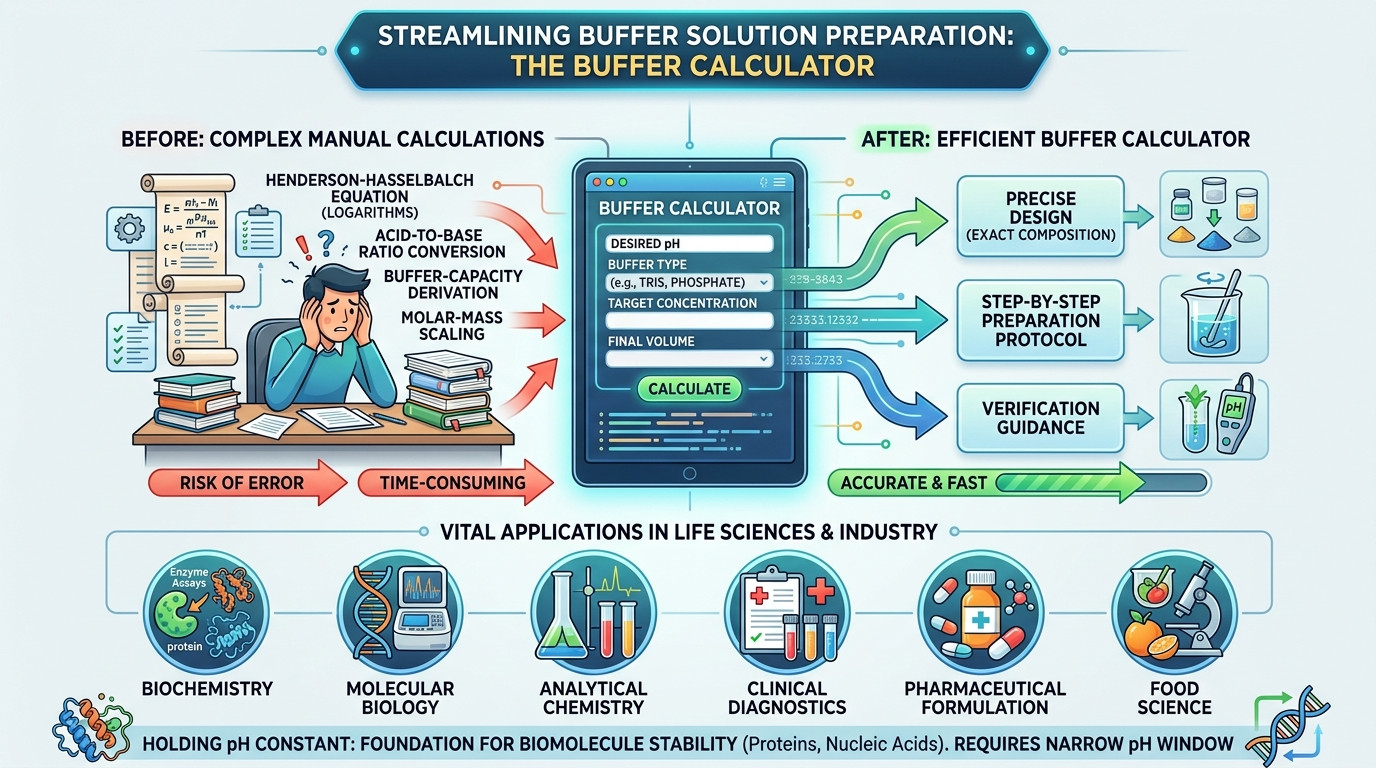
A buffer calculator tells you exactly how to design, prepare, and verify a buffer solution that holds a target pH steady against the acid or base that an experiment produces. It eliminates the layered arithmetic — the Henderson-Hasselbalch logarithm, the acid-to-base ratio conversion, the buffer-capacity derivation, and the molar-mass scaling — that turns a simple pH target into a sequence of error-prone calculations. In biochemistry, molecular biology, analytical chemistry, clinical diagnostics, pharmaceutical formulation, and food science, holding the pH constant is the foundation of every enzyme assay, protein purification, PCR reaction, cell-culture medium, and calibration standard, because proteins, nucleic acids, and most biomolecules only behave as expected within a narrow pH window.
The reason buffer math trips people up is not the chemistry; it is the logarithmic bookkeeping. The Henderson-Hasselbalch equation is deceptively short, but it hides three moving parts: the pKa of the chosen weak acid, the ratio of conjugate base to acid, and the total buffer concentration. To design a buffer you must first pick a weak acid whose pKa is close to the target pH (because a buffer is effective only within pKa ± 1), then compute the base-to-acid ratio that produces the desired pH, then scale the total concentration to deliver enough buffering capacity for the experiment, and finally weigh out the salts and add acid or base to hit the exact pH at the bench. A single error — using log₁₀ instead of log, or confusing [HA] with [A⁻], or forgetting that the ratio is 10(pH−pKa) not 10(pKa−pH) — shifts the buffer by a full pH unit or more, and that error then propagates into every downstream measurement.
This buffer calculator handles the five most common buffer tasks in one place: the Henderson-Hasselbalch pH solver (pH from pKa and the acid/base ratio), the ratio finder (the base-to-acid ratio needed for a target pH), the buffer-capacity calculator (how strongly the solution resists pH change), the molar-recipe builder (grams of buffer salt for a given molarity and volume), and the buffer-dilution solver (making a working buffer from a concentrated stock). Each mode shows the answer and every step of the working, so you can verify the reasoning, teach a student, or document the preparation for reproducibility.
Because buffer and dilution math share the same underlying concentration principles, the tools in the sidebar — including our dilution calculator, molarity dilution calculator, and working solution calculator — are useful companions for any solution-preparation task.
Buffer Calculator
Five modes — pH (Henderson-Hasselbalch), ratio, capacity, recipe & dilution
Calculation Result
⚠️ Safety first: This buffer calculator handles concentrations and pH arithmetic only. Always check chemical compatibility, read the Safety Data Sheet (SDS) for every substance, wear appropriate PPE, and verify the final pH with a calibrated pH meter before use. Add acid to water, never the reverse.
How a Buffer Is Calculated
Every buffer calculation comes down to one idea: a buffer is a mixture of a weak acid and its conjugate base that resists pH change when small amounts of acid or base are added. The resistance arises because the weak acid (HA) can neutralise added base by donating a proton, while the conjugate base (A⁻) can neutralise added acid by accepting one. The equilibrium between these two forms is governed by the acid dissociation constant, Ka, and the relationship between pH, pKa, and the ratio of base to acid is captured by the Henderson-Hasselbalch equation. The buffer calculator exists to handle that equation and its derivatives reliably and transparently, because in practice the arithmetic is layered with logarithms, concentration conversions, and the critical choice of a buffer whose pKa matches the target pH.
Choosing the Right Buffer for Your pH
The single most important decision in buffer design is selecting a weak acid whose pKa is close to the target pH. A buffer is effective only within approximately pKa ± 1 pH unit, because outside that range the ratio of base to acid becomes extreme (greater than 10:1 or less than 1:10) and one form is depleted, so the solution can no longer resist pH change in one direction. For example, phosphate buffer (pKa₂ ≈ 6.8) is excellent for pH 5.8–7.8 but useless at pH 4 or pH 9. HEPES (pKa ≈ 7.5) is ideal for physiological pH around 7.4. Tris (pKa ≈ 8.1) suits pH 7.1–9.1. Acetate (pKa ≈ 4.8) covers pH 3.8–5.8. Always match the buffer to the pH rather than forcing a mismatched buffer to do the job, and the buffer calculator confirms whether your target pH falls within the effective range of the chosen pKa.
The Henderson-Hasselbalch Equation Explained
The Henderson-Hasselbalch equation is the master equation of buffer design: pH = pKa + log([A⁻] ÷ [HA]). It tells you that the pH of a buffer depends on two things — the intrinsic pKa of the weak acid, and the ratio of conjugate base to acid. When the two are equal ([A⁻] = [HA]), the ratio is 1, log(1) = 0, and pH = pKa. This is the point of maximum buffering capacity, because both forms are present in equal amounts and the solution can neutralise added acid or base equally well. Move away from this point by changing the ratio, and the pH shifts up or down, but the capacity gradually decreases. The buffer calculator handles this equation in both directions: given pKa and the ratio, it finds pH; given pKa and a target pH, it finds the ratio.
1. pH from pKa and the Acid/Base Ratio
The foundational calculation: pH = pKa + log([A⁻] ÷ [HA]). For example, a buffer with pKa 7.2, [A⁻] = 50 mM and [HA] = 50 mM gives pH = 7.2 + log(1) = 7.2 + 0 = 7.2. If the base is doubled to 100 mM (acid still 50 mM), pH = 7.2 + log(2) = 7.2 + 0.30 = 7.50. The pH Solver mode of the buffer calculator performs this and warns you when the pH falls outside the pKa ± 1 effective range.
2. Finding the Acid/Base Ratio for a Target pH
Rearranging the equation: [A⁻] ÷ [HA] = 10(pH − pKa). For example, to achieve pH 7.4 with a buffer whose pKa is 7.2: ratio = 10(7.4−7.2) = 100.2 = 1.585. So the base must be 1.585 times the acid. If the total concentration is 100 mM, base = 100 × 1.585 ÷ 2.585 = 61.3 mM and acid = 100 ÷ 2.585 = 38.7 mM. The Ratio Finder mode of the buffer calculator returns both the ratio and the individual concentrations for a given total.
Buffer capacity: β = 2.303 × C × Ka × [H⁺] ÷ (Ka + [H⁺])2
Recipe from solid: grams = M × V (L) × molar mass
Dilution: C₁V₁ = C₂V₂ (verify pH after dilution)
3. Buffer Capacity
Buffer capacity (β) quantifies how strongly a buffer resists pH change — the higher the capacity, the more acid or base must be added to shift the pH by one unit. The formula is β = 2.303 × C × Ka × [H⁺] ÷ (Ka + [H⁺])2, where C is the total buffer concentration, Ka is the acid dissociation constant, and [H⁺] is the hydrogen-ion concentration at the current pH. Capacity is maximised when pH = pKa (equal acid and base) and increases with total concentration. A 100 mM buffer has ten times the capacity of a 10 mM buffer at the same pH. The Capacity mode of the buffer calculator computes β directly.
4. Buffer Recipe from a Solid
To prepare a buffer from a solid salt, use grams = molarity (mol/L) × volume (L) × molar mass (g/mol). For example, to make 1 L of 0.1 M HEPES (molar mass 238.3 g/mol): 0.1 × 1 × 238.3 = 23.83 g. Dissolve the solid in about 800 mL of distilled water, then adjust the pH with NaOH or HCl to the target, and finally make up to 1 L in a volumetric flask. The order matters: always adjust pH before the final make-up to volume, because adding acid or base changes the volume. The Recipe mode of the buffer calculator computes the mass and reminds you to adjust pH after dissolution and before the final volume adjustment.
5. Buffer Dilution
Diluting a concentrated buffer stock to a working concentration follows C₁V₁ = C₂V₂, the same as any dilution. However, because pH depends on the ratio of acid to base (not the absolute concentration), dilution preserves the ratio and therefore the pH — in theory. In practice, extreme dilution can shift the pH slightly due to ionic strength changes, so always verify with a pH meter after dilution. The Dilute mode of the buffer calculator returns the stock and diluent volumes.
Quick Reference Values
Good’s Buffers: A Brief Guide
In the 1960s, Norman Good and colleagues developed a set of zwitterionic buffers specifically designed for biological research, now known as Good’s buffers. These buffers share several desirable properties: their pKa values span the physiological range (pH 6–9), they are highly water-soluble, they do not permeate cell membranes, they are chemically stable, and they do not chelate metal ions or interfere with common biochemical assays. Common Good’s buffers include MES (pKa 6.1), MOPS (pKa 7.2), HEPES (pKa 7.5), MOPSO (pKa 6.9), PIPES (pKa 6.8), and Tricine (pKa 8.15). When selecting a buffer for cell culture, protein crystallography, or electrophysiology, Good’s buffers are often the first choice because of their low toxicity and minimal interference. The buffer calculator works with any buffer system — simply enter the pKa of your chosen weak acid, whether it is a Good’s buffer, phosphate, citrate, acetate, or bicarbonate, and the Henderson-Hasselbalch equation applies equally. The key is always to match the pKa to the target pH, and the calculator confirms whether you are within the effective range.
The Effect of Ionic Strength and Activity Coefficients
The Henderson-Hasselbalch equation is an idealisation that assumes infinite dilution — in other words, that the activity of each species equals its concentration. In real laboratory solutions, especially at concentrations above about 50 mM, ions interact with each other and with water, reducing their effective activity below their nominal concentration. This is captured by the activity coefficient (γ), which is always less than 1 in non-ideal solutions. The practical consequence is that the measured pH of a buffer at high ionic strength can differ from the theoretical Henderson-Hasselbalch prediction by 0.05–0.2 pH units. For most routine applications, this is corrected by simply adjusting the pH with acid or base to the meter reading. For precise analytical work, the Debye-Hückel theory can estimate activity coefficients, and the buffer calculator’s capacity mode uses the idealised formula. The takeaway: treat the calculator result as the theoretical starting point, and always confirm with a calibrated pH meter.
How Temperature Affects Buffer pH
The pKa of a weak acid is temperature-dependent, because the dissociation equilibrium shifts with thermal energy. For most buffers, the temperature coefficient is small (less than 0.01 pH units per degree), and the effect is negligible for routine work. However, some buffers have exceptionally large coefficients. Tris is the classic example: its pKa decreases by approximately 0.031 units for every degree Celsius increase in temperature. This means a Tris buffer adjusted to pH 8.0 at 25°C will read approximately pH 7.63 at 37°C — a difference that can significantly affect enzyme kinetics and cell culture. Other temperature-sensitive buffers include borate and some amine buffers. In contrast, phosphate, HEPES, and MOPS are relatively temperature-insensitive. Always check the temperature coefficient of your chosen buffer, and adjust the pH at the temperature of use rather than at room temperature. The buffer calculator gives the theoretical pH at the stated pKa; the pH meter at the working temperature gives the true value.
Remember: Choose a buffer whose pKa is within 1 unit of your target pH. Use the Henderson-Hasselbalch equation to find the acid/base ratio, and the buffer calculator to do the arithmetic. Always verify the final pH with a calibrated meter, because ionic strength, temperature, and dilution all shift the theoretical value slightly.
Real Scenarios Where Buffer Math Mattered
These five scenarios reflect real situations in biochemistry, molecular biology, and analytical chemistry where buffer arithmetic — or a missing step — made a tangible difference to the outcome.
Scenario 1: An Enzyme Assay at the Wrong pH
A biochemist ran a kinetic assay in a phosphate buffer prepared at pH 7.0, but the enzyme’s optimum is pH 7.6. The measured activity was 40% lower than expected, leading to a mistaken conclusion about inhibitor potency. The root cause was a buffer whose pKa (6.8) was poorly matched to the target pH, giving weak buffering at 7.6. The buffer calculator would have flagged that pH 7.6 is outside the effective range of phosphate and suggested HEPES (pKa 7.5) instead.
Scenario 2: Tris Temperature Sensitivity
A molecular biologist prepared a Tris buffer at pH 8.0 at room temperature (25°C), then moved it to a 37°C incubator. The pH dropped to 7.6 because Tris has a large temperature coefficient (ΔpK/°C ≈ −0.031). The DNA restriction digest performed differently than expected. The lesson: Tris pH must be set at the temperature of use, and the buffer calculator gives the starting point, but the pH meter at the working temperature gives the true value.
Scenario 3: A Dilution That Shifted pH
A technician diluted a 1 M HEPES stock (pH 7.4) tenfold to 100 mM and assumed the pH would be unchanged. The pH meter read 7.35 — a small but meaningful shift for a sensitive assay. While dilution preserves the acid/base ratio, ionic strength changes can nudge the pH. The Dilute mode of the buffer calculator reminds you to verify pH after dilution, which is exactly what caught this shift.
Scenario 4: Insufficient Buffer Capacity
A cell-culture experiment used only 5 mM HEPES to buffer against the acid produced by actively growing cells. The pH drifted from 7.4 to 6.9 within hours, because 5 mM was too dilute to resist the metabolic load. The Capacity mode of the buffer calculator showed β ≈ 2.9 mM/pH — far too low for the application. Raising the concentration to 25 mM gave β ≈ 14.4 mM/pH and held the pH steady.
Scenario 5: Weighing the Wrong Hydrate
A student prepared a sodium phosphate buffer using the molar mass of anhydrous Na₂HPO₄ (142.0 g/mol) but the bottle actually contained the dihydrate (Na₂HPO₄·2H₂O, 178.0 g/mol). The weighed mass was 25% too low, giving a buffer at 75% of the intended concentration. Always check the exact formula (including waters of hydration) on the bottle and use the corresponding molar mass.
Scenario 6: A Contaminated Buffer Inhibited the Assay
A researcher used phosphate buffer for a calcium-dependent enzyme assay. Phosphate precipitates calcium as insoluble calcium phosphate, sequestering the ion and inhibiting the enzyme. The assay gave no activity, and days were lost before the phosphate was identified as the culprit. HEPES or Tris would have been compatible. Always check whether your buffer’s chemistry interferes with the assay — phosphate chelates divalent cations, Tris reacts with some aldehydes, and citrate binds metals.
Scenario 7: Forgetting to Recalibrate the pH Meter
A technician prepared a batch of running buffer for HPLC, adjusted the pH to 7.4, and filtered it — all without checking that the pH meter had been calibrated that morning. The meter was reading 0.3 units low, so the buffer was actually at pH 7.7. The HPLC retention times shifted, and the assay had to be repeated. Always calibrate the pH meter with fresh standards before measuring a buffer, and the buffer calculator’s result should agree with the meter within about 0.05 units.
Scenario 8: A Microbially Degraded Buffer
A lab used the same bottle of dilute Tris buffer for two weeks. By day 10, the buffer had become cloudy and the pH had drifted from 8.0 to 7.5 due to microbial growth consuming the amine. Dilute buffers without antimicrobial preservatives are susceptible to contamination, especially at room temperature. Always store buffers at 4°C, aliquot rather than repeatedly dipping into a master bottle, and discard any buffer that shows turbidity or an unexpected pH shift.

Common Buffer Preparation Mistakes
The errors people make when preparing buffers cluster around a few predictable points. Understanding why they happen prevents them.
Mistake 1: Choosing the Wrong pKa
The most fundamental error is using a buffer whose pKa is more than 1 pH unit from the target. Outside pKa ± 1, the buffer has little capacity to resist pH change. Always match the buffer to the pH, and let the buffer calculator confirm the effective range.
Mistake 2: Using log₁₀ Instead of log
The Henderson-Hasselbalch equation uses base-10 log, not natural log (ln). Using ln introduces a factor of 2.303 error. The buffer calculator uses the correct log internally, eliminating this mistake.
Mistake 3: Not Verifying pH with a Meter
Theoretical pH calculations assume ideal behaviour. In reality, ionic strength, temperature, and the presence of salts shift the measured pH by 0.1–0.3 units. Always verify with a calibrated pH meter after preparation.
Mistake 4: Ignoring Temperature Effects
Some buffers, especially Tris, have large temperature coefficients. A buffer set to pH 8.0 at 25°C may read 7.6 at 37°C. Always adjust pH at the temperature of use.
Mistake 5: Confusing Acid and Base Forms
It is easy to swap [HA] and [A⁻] in the ratio, which inverts the result. Remember: [A⁻] is the conjugate base (deprotonated), [HA] is the acid (protonated). The buffer calculator labels each input clearly.
Mistake 6: Not Matching the Temperature of Calibration
A pH meter calibrated at 25°C gives accurate readings only at 25°C. If you then measure a warm buffer at 37°C, the electrode response shifts and the reading is wrong. For buffers used at non-standard temperatures, calibrate the meter at that temperature using standards equilibrated to the same temperature. This is especially important for Tris and other temperature-sensitive buffers.
Mistake 7: Overlooking Buffer Incompatibility with the Experiment
Some buffers chemically interfere with downstream steps. Phosphate precipitates with calcium and inhibits some enzymes; Tris reacts with aldehydes and glutaraldehyde (a problem in electron microscopy fixation); citrate and EDTA chelate metal ions that may be essential cofactors. Always check whether your buffer’s chemistry is compatible with your assay, your substrate, and your detection method. The buffer calculator handles the arithmetic; chemical compatibility is a separate check you must perform.
💡 Rule of Thumb: Choose a pKa within 1 unit of your target pH, use the Henderson-Hasselbalch equation via the buffer calculator, weigh the correct hydrate, make up to volume, and verify pH with a calibrated meter at the working temperature. That sequence gives a reliable buffer every time.
Lab Safety Essentials
Accurate math does not make a buffer safe — proper handling does. Before preparing any buffer, run through these essentials.
Always check compatibility: confirm that the buffer components are compatible with your experiment (some buffers chelate metals, inhibit enzymes, or interfere with assays), read the SDS for every chemical, and add acid to water — never water to acid.
- Wear appropriate PPE — lab coat, safety glasses, and gloves.
- Read the SDS for every buffer component before handling.
- Add acid to water, never the reverse, to avoid exothermic splashing.
- Use a fume hood when adjusting pH with concentrated HCl or NaOH.
- Label every vessel with buffer name, pH, concentration, date, and initials.
- Store correctly — some buffers degrade or grow microbes; follow storage guidelines.
This buffer calculator is an arithmetic aid for buffer design. It is not a substitute for chemical compatibility checks, safety training, or the SDS.
Which Mode Fits Your Situation
The five modes of the buffer calculator map to the five distinct buffer tasks. Choosing the right one applies the correct logic.
Buffer Mode Comparison Table
| Mode | Use Case | Key Formula | Inputs Needed | Typical Applications |
|---|---|---|---|---|
| pH Solver | Find pH from ratio | pH=pKa+log(B/A) | pKa, [A⁻], [HA] | Verify buffer composition |
| Ratio Finder | Find ratio for target pH | B/A=10(pH−pKa) | pKa, pH, total conc | Design a new buffer |
| Capacity | Resistance to pH change | β=2.303CKaH/(Ka+H)² | C, pKa, pH | Check if buffer is strong enough |
| Recipe | Weigh solid for buffer | M×V×MW | molarity, vol, MW | Prepare from powder |
| Dilute | Dilute stock buffer | C₁V₁=C₂V₂ | C₁, C₂, V₂ | Make working from stock |
Practical Decision Guide
Want to know the pH of a given acid/base mixture? Use the pH Solver mode.
Designing a buffer for a target pH? Use the Ratio Finder mode.
Checking if your buffer is strong enough? Use the Capacity mode.
Weighing a buffer salt from powder? Use the Recipe mode.
Diluting a concentrated buffer stock? Use the Dilute mode (and verify pH after).
Worked Examples
To make the formulas concrete, here are five worked examples that mirror common laboratory situations. Each one corresponds to a mode of the buffer calculator.
Example 1 — pH Solver: Phosphate buffer with pKa 6.8, [A⁻] = 50 mM, [HA] = 50 mM. pH = 6.8 + log(1) = 6.8.
Example 2 — Ratio Finder: HEPES (pKa 7.5) for pH 7.4, total 100 mM. Ratio = 10(7.4−7.5) = 0.794. Base = 44.3 mM, acid = 55.7 mM.
Example 3 — Capacity: 50 mM HEPES at pH 7.5 (pKa 7.5). β = 2.303 × 0.05 × 0.25 = 0.0288 mol/(L·pH).
Example 4 — Recipe: 1 L of 0.1 M HEPES (MW 238.3). grams = 0.1 × 1 × 238.3 = 23.83 g.
Example 5 — Dilute: Make 500 mL of 100 mM from 1 M stock. V₁ = (100 × 500) ÷ 1000 = 50 mL stock + 450 mL water.
These examples show that the underlying maths is always logarithm or multiplication — the difficulty is choosing the right buffer and applying the formula correctly. The buffer calculator removes that difficulty.
Frequently Asked Questions About the Buffer Calculator
These questions come from biochemists, molecular biologists, students, and analytical chemists who use a buffer calculator in their daily work. Click any question to expand the answer.
1. What is a buffer calculator?
A buffer calculator is a laboratory tool that computes the pH, acid-to-base ratio, buffer capacity, recipe, and dilution of a buffer solution. This buffer calculator provides five modes covering the Henderson-Hasselbalch equation, ratio finding, capacity calculation, recipe preparation from a solid, and buffer dilution — all with worked steps for verification and teaching.
2. What is the Henderson-Hasselbalch equation?
The Henderson-Hasselbalch equation is pH = pKa + log([A⁻] ÷ [HA]), where pKa is the acid dissociation constant, [A⁻] is the conjugate base concentration, and [HA] is the weak acid concentration. It relates the pH of a buffer to the pKa of the acid and the ratio of its two forms. When [A⁻] = [HA], pH = pKa.
3. How do I choose the right buffer for my pH?
Choose a weak acid whose pKa is within 1 pH unit of your target pH. A buffer is effective only within pKa ± 1 because outside that range the ratio becomes extreme and one form is depleted. For pH 7.4 use HEPES (pKa 7.5); for pH 8.0 use Tris (pKa 8.1); for pH 6.8 use phosphate (pKa 6.8); for pH 5.0 use acetate (pKa 4.8). The buffer calculator confirms whether your pH is within range.
4. How do I calculate buffer capacity?
Buffer capacity β = 2.303 × C × Ka × [H⁺] ÷ (Ka + [H⁺])2, where C is the total buffer concentration, Ka = 10−pKa, and [H⁺] = 10−pH. Capacity is maximised when pH = pKa and increases with total concentration. The Capacity mode of the buffer calculator computes β directly.
5. What is the effective buffer range?
The effective buffer range is pKa ± 1 pH unit. Within this range, both the acid and base forms are present in sufficient quantities to neutralise added base or acid. Outside this range, the ratio exceeds 10:1 or falls below 1:10, and the buffer loses its ability to resist pH change in one direction.
6. Does dilution change buffer pH?
In theory, no — dilution preserves the acid/base ratio and therefore the pH. In practice, extreme dilution can shift the pH slightly due to changes in ionic strength and activity coefficients. Always verify the pH with a calibrated meter after dilution, especially for critical applications.
7. Why does Tris pH change with temperature?
Tris has a large temperature coefficient (ΔpKa/°C ≈ −0.031), meaning its pKa drops as temperature rises. A Tris buffer set to pH 8.0 at 25°C will read approximately pH 7.63 at 37°C. Always adjust the pH of Tris buffers at the temperature at which they will be used.
8. How do I weigh a buffer salt correctly?
grams = molarity (mol/L) × volume (L) × molar mass (g/mol). Always check the exact chemical formula on the bottle, including waters of hydration (e.g., Na₂HPO₄ vs Na₂HPO₄·2H₂O), because the molar mass differs. The Recipe mode of the buffer calculator computes the mass and reminds you to adjust pH after dissolution.
9. What is the difference between pKa and pH?
pKa is an intrinsic property of a weak acid — the negative log of its dissociation constant, which measures how readily it gives up a proton. pH is a property of a solution — the negative log of the hydrogen-ion concentration. In a buffer, the pH is determined by the pKa and the ratio of base to acid. When pH = pKa, the buffer is at its most effective.
10. Is this buffer calculator free and private?
Yes. This buffer calculator is completely free, runs entirely in your browser, and requires no sign-up. All calculations are private — no pH values, pKa values, concentrations, or any other inputs are sent to a server or stored. Your data never leaves your device.
Buffer Preparation Best Practices Checklist
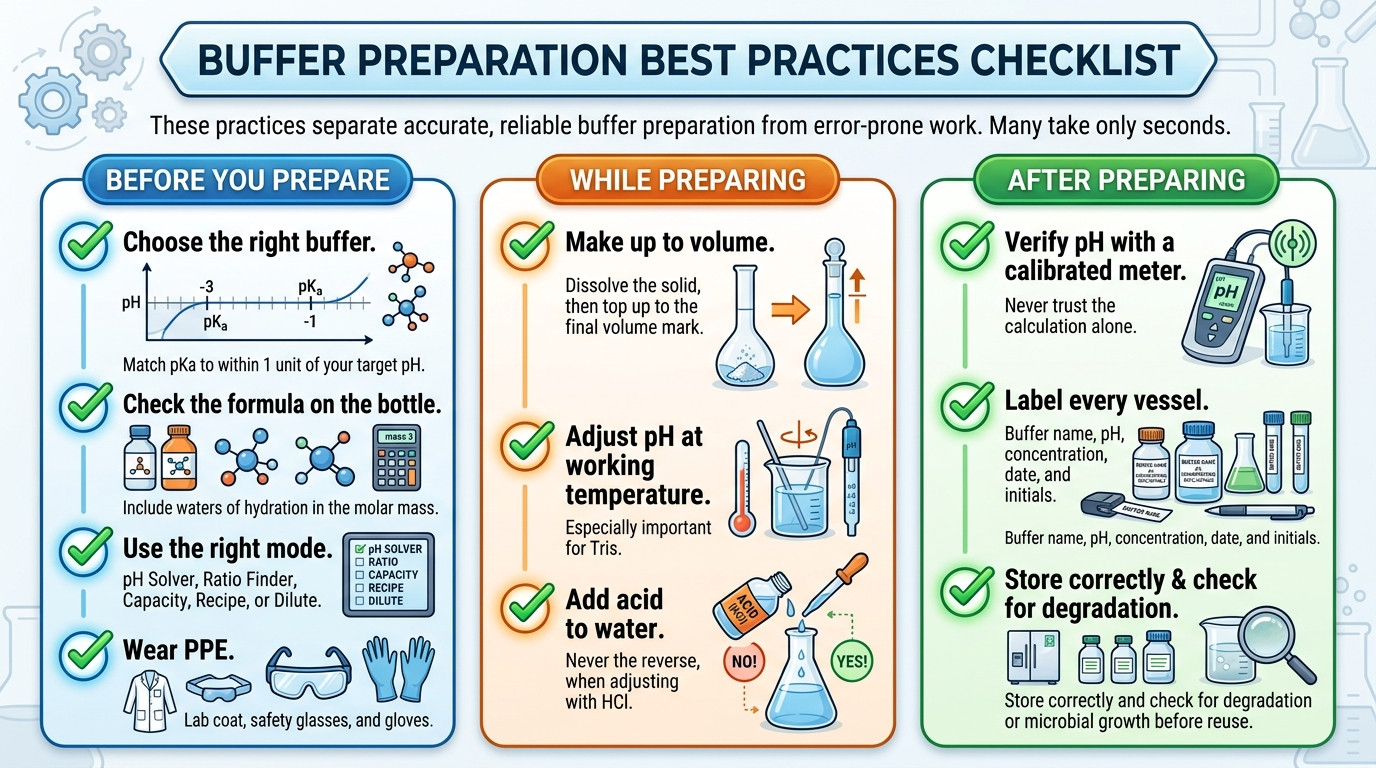
These practices separate accurate, reliable buffer preparation from error-prone work. Many take only seconds.
Before You Prepare
While Preparing
After Preparing
For the dilution math behind buffer preparation, see our dilution calculator, molarity dilution calculator, and working solution calculator.
Trusted Reference Resources for Buffer Preparation
These are authoritative references for accurate, standardised buffer preparation.
NIST (National Institute of Standards and Technology) — nist.gov — Reference data on pKa values, buffer standards, and pH measurement traceability.
Sigma-Aldrich / MilliporeSigma — sigmaaldrich.com — Buffer preparation guides, pKa tables, and recipes for common biological buffers.
LibreTexts Chemistry — chem.libretexts.org — Free, peer-reviewed explanations of the Henderson-Hasselbalch equation, buffer capacity, and pH calculations.
NCBI / PMC — ncbi.nlm.nih.gov/pmc — Peer-reviewed protocols for buffer preparation in biochemistry and molecular biology.
Good’s Buffers Reference — Norman Good’s seminal papers on zwitterionic buffers for biological research, with pKa tables and compatibility notes.
On our platform, related calculation tools include: dilution calculator, molarity dilution calculator, working solution calculator, percentage dilution calculator, and dilution ratio calculator.
User Reviews & Ratings
📝 Share Your Experience with This Buffer Calculator
Final Thoughts on Buffer Calculation
Buffer calculation is one of those tasks that seems simple until the Henderson-Hasselbalch logarithm, the acid-to-base ratio, the capacity derivation, and the temperature coefficient all meet in a single preparation. The arithmetic is, in principle, straightforward — take a pKa, apply a log, find a ratio — but choosing the wrong buffer, confusing log with ln, or ignoring temperature can shift the pH by a full unit, and for enzymes, cells, and analytical methods that depend on a narrow pH window, that can mean the difference between a successful experiment and a wasted day. The buffer calculator exists to remove that arithmetic risk, handling every conversion internally and showing each step so the result can be verified, taught, and documented.
What separates reliable buffer practice from error-prone practice is discipline, not genius. Choosing a buffer whose pKa is within 1 unit of the target, running the numbers through the buffer calculator rather than trusting a mental estimate, checking the exact hydrate formula on the bottle, making up to volume rather than over-adding water, adjusting pH at the working temperature, and — above all — verifying the final pH with a calibrated meter: these are the habits that catch the errors the human brain makes under fatigue and time pressure. The buffer calculator does the maths perfectly every time, but it cannot read a label, calibrate an electrode, or notice that a buffer has degraded — that remains the scientist’s responsibility.
It is also worth appreciating that buffers sit at the heart of almost every biological and chemical experiment. Enzyme kinetics, protein purification, DNA restriction digests, PCR, cell culture, electrophoresis, HPLC mobile phases, clinical calibrators, and pharmaceutical formulations all depend on buffers holding their pH steady, and a 0.2-unit error in buffer pH can shift an enzyme activity by 20%, change a retention time, or alter a cell’s growth rate. Because the error is systematic within a single experiment, it is invisible until results are compared across labs or over time — which is exactly when reproducibility crises emerge. This is why investing a few seconds in the buffer calculator, for every preparation, pays dividends in reproducibility that compound across an entire research programme.
The framework is short: choose the right pKa, use the right mode of the buffer calculator — pH Solver, Ratio Finder, Capacity, Recipe, or Dilute — weigh the correct hydrate, make up to volume, adjust pH at the working temperature, and verify with a calibrated meter. That sequence gives a reliable buffer every time. From routine running buffers and enzyme assay buffers to clinical calibrators and pharmaceutical formulations, buffer math is everywhere a solution must hold its pH, and getting it right is one of the most fundamental calculations in the laboratory.
Keep this buffer calculator handy as your starting point for every buffer preparation, and use the related dilution and concentration tools in the sidebar whenever you need to convert between units or scale a buffer from stock to working concentration. The tool runs entirely in your browser, so it works on any phone or tablet at the bench without sending any data anywhere — a practical advantage in laboratory settings where data privacy and connectivity cannot always be guaranteed. By making the calculation fast, transparent, and private, the buffer calculator removes the most common source of preparation error — arithmetic mistakes under time pressure — and lets you focus on what matters most: choosing the right buffer, handling chemicals safely, using proper volumetric technique, and verifying the result with a calibrated pH meter.
🔒 Privacy Guarantee: Every calculation on this page runs entirely within your browser. No data — pH values, pKa values, concentrations, molar masses, or any other inputs — is sent to any server, stored, or shared. Your calculations are completely private.
Pingback: Ratio Dilution Calculator - Convert 1:10, 1:32 to Volumes | Free
Pingback: Bleach Dilution Calculator - CDC Ratios, PPM & % | Free Tool
Pingback: Essential Oil Dilution Calculator - Face, Body & Bath | Free
Pingback: Dilution Calculator mg/mL - Protein, Drug & Lab Solutions | Free
Pingback: PPM Calculator - Water Quality, Soil & Trace Analysis | Free Tool
Pingback: Pharmaceutical Dilution Calculator - IV & Pediatric Dosing | Free
Pingback: How to Calculate the Dilution Factor: 7 Simple Steps to Success
Pingback: Weight by Volume Dilution Calculator (W/V %) – Free Lab Tool
Pingback: Serial Dilution Calculation Table – Step-by-Step Guide & Free Calculator
Pingback: How to Do a Dilution Calculation: Step-by-Step Guide (C1V1=C2V2)
Pingback: Mixing Ratio Calculator: Exact Volumes for Any Ratio (Free Tool)
Pingback: Infusion Rate Calculator | Free IV Flow Rate & Drip Rate Tool
Pingback: Neem Oil Dilution Ratio Calculator | Mix Neem Oil Correctly -
Pingback: Common Lab Solutions | Preparation Guide & Calculator
Pingback: Antibiotic Dose Calculator | Calculate Accurate Dosages
Pingback: Pool Alkalinity Calculator | Calculate Alkalinity Adjustment