
Dilution Calculator Percent — Complete Guide for Percentage-Based Dilutions
📋 Table of Contents
▼- Why Percentage Dilutions Cause So Many Preparation Errors
- Percentage Dilution Calculator — Five Practical Modes
- Understanding Percentage Concentrations and Dilution Math
- Real Lab Scenarios Where Percentage Dilutions Mattered
- Common Percentage Dilution Mistakes and How to Avoid Them
- Expert Perspectives from Lab Managers and Prep Chemists
- Which Percentage Dilution Method Fits Your Situation
Why Percentage Dilutions Cause So Many Preparation Errors
Here is a common laboratory mistake: a technician needs to prepare 500 mL of 70% ethanol from a 95% ethanol stock. They calculate 0.70 × 500 = 350 mL and pour 350 mL of 95% ethanol into a graduated cylinder, then add water until the total volume reaches 500 mL. The resulting solution is actually 66.5% ethanol, not 70%. The correct calculation is V₁ = (70 × 500) ÷ 95 = 368.4 mL of 95% ethanol plus 131.6 mL water. The technician confused the percentage of the final solution with the volume of stock needed, treating 70% as if it were simply 70% of the final volume.
Percentage dilutions are everywhere in laboratories: ethanol for sterilization, bleach for disinfection, sulfuric acid for pH adjustment, hydrogen peroxide for cleaning, glycerol for cryopreservation, and serum for cell culture. They are also one of the most error-prone types of dilution because the word “percent” hides several different ways of expressing concentration. Percent by weight, percent by volume, percent weight/volume, and percent volume/volume are not interchangeable. A 10% w/v NaCl solution contains 10 g of NaCl per 100 mL of solution, while a 10% w/w NaCl solution contains 10 g of NaCl per 90 g of water (for a total mass of 100 g). The same number means different things.
This guide is written for anyone who routinely prepares percentage solutions: laboratory technicians diluting concentrated acids and bases, microbiologists making bleach solutions, cell culture workers adding serum, histology technicians preparing alcohol series, and students learning the difference between percent by weight and percent by volume. The five calculator modes cover the most common percentage dilution workflows: percent-to-percent dilution, percent-to-molarity conversion, percent-to-mass-per-volume conversion, dilution factor from percentage, and serial percentage dilution.
For the underlying concentration calculations that feed into percentage dilutions, our molarity dilution calculator handles molar concentration adjustments. When you need to convert between mass and volume concentration units, our mg/mL dilution calculator bridges that gap. And for general dilution planning, our solution dilution calculator covers the C₁V₁ = C₂V₂ workflow cleanly.
Percentage Dilution Calculator
Five modes — percent→percent, percent→molarity, percent→mg/mL, factor, and serial
Calculation Result

Understanding Percentage Concentrations and Dilution Math
Percentage concentration is a way of expressing how much solute is present relative to the total amount of solution. It is convenient because it avoids units and works well for liquids that are commonly bought and sold by percent. However, the convenience comes at a cost: “percent” does not specify whether the comparison is by mass, by volume, or by mass relative to volume. Each interpretation leads to a different calculation, and using the wrong one can produce a solution that is off by a significant margin.
Percent by Weight (w/w): Mass of Solute per Total Mass
A weight/weight percentage, written as % w/w, expresses the mass of solute as a percentage of the total mass of the solution. A 10% w/w NaCl solution contains 10 g of NaCl for every 90 g of water, giving a total solution mass of 100 g. This is the most physically precise way to express percentage concentration because mass does not change with temperature. For solid solutes dissolved in liquids, % w/w is the standard in many pharmaceutical and industrial formulations.
To prepare a % w/w solution, you weigh the solute and the solvent. For a 10% w/w solution, you weigh 10 g of solute and 90 g of solvent. If you need a specific total mass, the calculation is straightforward: total mass × percentage = mass of solute. The rest is solvent. This approach is preferred when accuracy matters and when the solution components are not easily measured by volume.
Percent by Volume (v/v): Volume of Liquid per Total Volume
A volume/volume percentage, written as % v/v, expresses the volume of one liquid as a percentage of the total volume of the mixture. A 70% v/v ethanol solution contains 70 mL of ethanol in 100 mL of final solution. This is the standard for liquid-in-liquid mixtures such as ethanol-water, methanol-water, and glycerol-water solutions.
There is an important subtlety with % v/v: the volumes of liquids are not always strictly additive. When you mix 70 mL of ethanol with 30 mL of water, the final volume is slightly less than 100 mL due to molecular packing. For most laboratory purposes, this contraction is negligible, and the C₁V₁ = C₂V₂ calculation gives an acceptable result. For high-precision work, prepare % v/v solutions by diluting to the final total volume in a volumetric flask rather than by adding exact volumes together.
Percent Weight/Volume (w/v): Mass of Solute per Volume of Solution
A weight/volume percentage, written as % w/v, expresses the mass of solute in grams per 100 mL of solution. A 10% w/v NaCl solution contains 10 g of NaCl dissolved in enough water to make 100 mL of solution. This is the most common percentage expression in biological and chemical laboratories because it is easy to weigh a solid and dilute to a volume.
The conversion to mass concentration is direct: % w/v = g/100 mL. Therefore, 10% w/v = 100 mg/mL = 100 g/L. This makes % w/v convenient for converting to molarity or mg/mL. For example, a 10% w/v NaCl solution (MW = 58.44 g/mol) has a molarity of 100 g/L ÷ 58.44 g/mol = 1.71 M.
C₂ = final percentage · V₂ = final total volume
V stock = (C₂ × V₂) / C₁
V diluent = V₂ − V stock
% w/v = g solute / 100 mL solution
% w/w = g solute / 100 g total solution
% v/v = mL solute / 100 mL total solution
Converting Percentage to Molarity and mg/mL
Often a percentage concentration must be converted to molarity or mg/mL before it can be used in a stoichiometric calculation or a dosage calculation. For % w/v, the conversion is simple: divide the percentage by 100 to get g/100 mL, then multiply by 10 to get g/L, then divide by molecular weight to get molarity, or multiply by 1000 to get mg/mL.
For % w/w, you need the density of the solution. A 37% w/w HCl solution with density 1.18 g/mL has a mass of 1180 g per liter. The mass of HCl in one liter is 0.37 × 1180 = 436.6 g. With MW = 36.46 g/mol, the molarity is 436.6 ÷ 36.46 = 11.97 M. This is the standard approximate concentration of concentrated hydrochloric acid found in most laboratories.
For % v/v, you also need density if you want to convert to mass concentration. A 70% v/v ethanol solution has 700 mL ethanol per liter. Ethanol density is 0.789 g/mL at 20°C, so the mass of ethanol is 700 × 0.789 = 552.3 g. The molarity is 552.3 ÷ 46.07 = 11.99 M. These conversions are why the percent-to-molarity and percent-to-mg/mL calculator modes are included in this guide.
Common Percentage Reference Values
700 mL ethanol + water to 1 L
Common concentrated reagent
Strong acid dilutions
Dilute 1:10 for lab use
Biological buffer salt
Strong oxidizer dilutions
For converting percentage-based stock concentrations to molarity before dilution, our molarity dilution calculator is the focused tool. For mass-per-volume conversions, our mg/mL dilution calculator handles the same math in a dedicated interface.

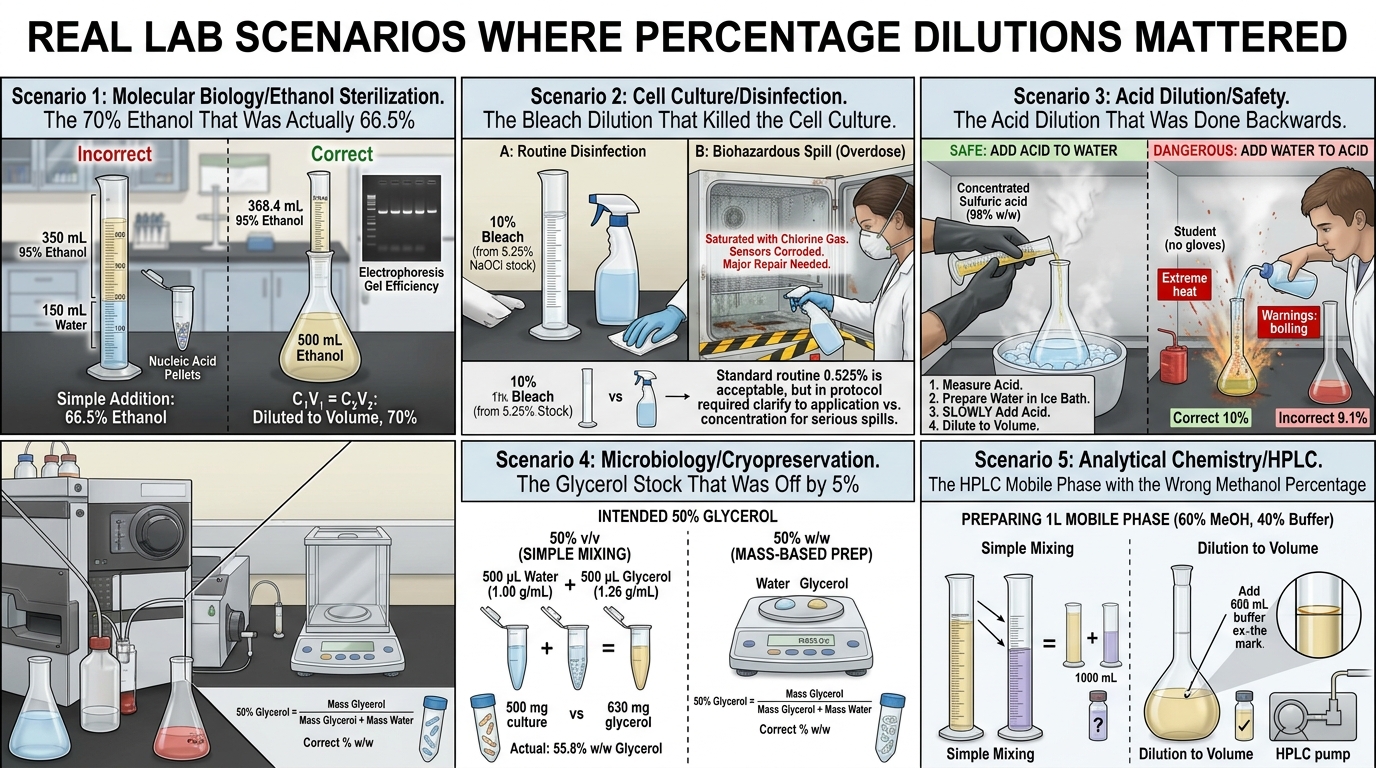
Real Lab Scenarios Where Percentage Dilutions Mattered
The theoretical distinction between % w/w and % v/v becomes vivid when you see it in practice. These five scenarios reflect actual situations from clinical, microbiological, analytical, and manufacturing laboratories where percentage dilution calculations had real consequences.
Scenario 1: The 70% Ethanol That Was Actually 66.5%
A molecular biology laboratory prepared 70% ethanol for surface sterilization by adding 350 mL of 95% ethanol to 150 mL of water. They assumed that 70% meant 700 mL of ethanol per liter and that 350 mL of 95% ethanol would somehow give 70% final concentration. The actual calculation: to make 500 mL of 70% ethanol from 95% stock, you need (70 × 500) ÷ 95 = 368.4 mL of 95% ethanol. The solution they prepared had (350 × 0.95) ÷ 500 = 66.5% ethanol.
For surface sterilization, 66.5% ethanol still works, so the error was not catastrophic. But in a protocol that specified 70% ethanol for a specific precipitation step or for preserving nucleic acids, the lower concentration could have reduced efficiency. The underlying error was treating the target percentage as a simple volume fraction of the stock rather than applying the dilution equation. This is the most common percentage dilution mistake.
Scenario 2: The Bleach Dilution That Killed the Cell Culture
A cell culture technician needed to disinfect the biosafety cabinet and prepared a 10% bleach solution by adding 100 mL of household bleach to 900 mL of water. The bleach bottle was labeled 5.25% sodium hypochlorite. The final concentration was 0.525% NaOCl, which is appropriate for routine disinfection. However, another technician saw the bottle and used the same 10% dilution to treat a cell culture spill inside the incubator. The incubator was saturated with chlorine gas, corroding the sensors and requiring weeks of repair.
The dilution itself was correct, but the protocol failed to specify when a higher concentration was needed. For biohazardous spills, a 1:10 dilution of 5.25% bleach (0.525% final) is standard. For some viral inactivation protocols, a stronger 0.5% to 1% working solution is used. The important point is that percentage dilution must be paired with the intended application. A bottle labeled only “10% bleach” does not communicate whether the starting bleach was 5.25% or 8.25%, or what the final concentration is meant to be.
Scenario 3: The Acid Dilution That Was Done Backwards
A student needed to prepare 1 L of 10% sulfuric acid from concentrated sulfuric acid (approximately 98% w/w, density 1.84 g/mL). They calculated the volume of concentrated acid needed: (10 × 1000) ÷ 98 = 102 mL of concentrated acid. Then they added the 102 mL of concentrated acid to 1000 mL of water, producing a final volume of about 1100 mL and a final concentration of roughly 9.1%. The correct method is to add the concentrated acid to approximately 800 mL of water, mix, cool, and then dilute to the final 1000 mL mark in a volumetric flask.
The error combined two problems: using the diluent volume as the final volume, and adding water to concentrated acid rather than acid to water. The second problem is a safety issue. Sulfuric acid dilution is highly exothermic. Adding water to concentrated acid can cause the water to boil and spatter acid. The correct procedure is always “add acid to water.” The first problem is a concentration error that would have affected any subsequent calculation using the prepared acid.
Scenario 4: The Glycerol Stock That Was Off by 5%
A microbiology laboratory prepared bacterial cryopreservation stocks by mixing 500 μL of culture with 500 μL of 100% glycerol. They assumed this produced a 50% glycerol stock. The actual percentage depends on whether the calculation is by volume or by mass. Glycerol has a density of 1.26 g/mL, while bacterial culture medium is approximately 1.00 g/mL. The 500 μL of glycerol has a mass of 630 mg, and the 500 μL of culture has a mass of 500 mg. The total mass is 1130 mg, and the glycerol percentage by mass is 630 ÷ 1130 = 55.8% w/w.
The difference between 50% v/v and 55.8% w/w matters for cryopreservation because glycerol concentration affects cell viability during freezing and thawing. Many protocols specify 50% glycerol stocks without clarifying whether they mean v/v or w/w. A laboratory that switches from one interpretation to the other without realizing it may notice unexplained changes in recovery rates. The solution is to specify the preparation in terms of mass or final volume explicitly.
Scenario 5: The HPLC Mobile Phase with the Wrong Methanol Percentage
An analytical chemist was preparing an HPLC mobile phase that required 60% methanol and 40% buffer. They measured 600 mL of methanol and 400 mL of buffer separately and mixed them. The protocol was written in a way that suggested v/v, but the laboratory’s standard practice was to prepare mobile phases by mixing the two components in a 1 L volumetric flask and then making the final volume to 1 L. The difference between the two approaches is small: 600 + 400 = 1000 mL, but the actual volume after mixing methanol and water is slightly less than 1000 mL due to contraction. The practical concentration difference is usually less than 1% and is often negligible for routine HPLC.
However, the more serious issue was that the buffer was prepared at a specific concentration and then mixed with methanol. The buffer concentration in the final mobile phase is the original buffer concentration multiplied by the dilution factor. If the buffer was 100 mM and the final mobile phase is 40% buffer, the buffer concentration in the mobile phase is 40 mM, not 100 mM. This is a percentage dilution that affects the chemistry of the separation, not just the organic solvent concentration. The protocol must specify whether the buffer concentration is given before or after mixing with the organic modifier.
Common Percentage Dilution Mistakes and How to Avoid Them
The mistakes people make when preparing percentage dilutions cluster around a few specific failure points. Understanding why these errors happen is more useful than memorizing the formula because the errors often involve confusing one percentage type with another.
Mistake 1: Confusing % w/w, % w/v, and % v/v
The most fundamental error is using the wrong type of percentage. A 10% w/v NaCl solution and a 10% w/w NaCl solution are not the same. The w/v solution contains 10 g per 100 mL, while the w/w solution contains 10 g per 100 g total. Because the density of the w/w solution is greater than 1 g/mL, the same mass of NaCl is dissolved in a smaller volume, making the w/w solution more concentrated than the w/v solution.
Prevention: always check the units on the label or protocol. If the type is not specified, assume the most common convention for that substance: w/v for solid solutes in biological work, v/v for liquid-liquid mixtures, and w/w for industrial or concentrated reagents. When in doubt, specify the type explicitly in your own protocols.
Mistake 2: Treating the Final Percentage as the Stock Volume
This is the 70% ethanol error. The final percentage is not the volume of stock to use unless the stock is 100%. When the stock is 95%, the volume of stock needed is (target % × final volume) ÷ stock %. The difference is small when the stock is nearly pure, but it becomes significant at lower stock percentages.
Prevention: always write the dilution equation C₁V₁ = C₂V₂ before calculating. Identify C₁ as the stock percentage, C₂ as the target percentage, and V₂ as the final total volume. Solve for V₁. This applies whether the stock is 95% ethanol, 37% HCl, or 5.25% bleach.
Mistake 3: Adding the Diluent Volume Equal to the Final Volume
This error is the same as in general dilutions but is especially common with percentage solutions because people often think in terms of “add water to 1 L” versus “add 1 L of water.” Adding a specific volume of diluent rather than diluting to a final volume changes the concentration. For a 1:10 dilution into 1 L, you need 100 mL of stock and 900 mL of diluent. Adding 100 mL of stock to 1 L of diluent gives 1.1 L total and a 1:11 dilution factor.
Prevention: use the phrase “dilute to” for final volume instructions, and use a volumetric flask when accuracy matters. If the protocol says “dilute with,” verify whether the final volume is supposed to be the diluent volume plus the stock volume or whether the protocol is using informal language for “dilute to.”
Mistake 4: Ignoring Density in w/w and v/v Conversions
When converting a % w/w solution to molarity or mg/mL, you need the solution density. Without it, you cannot know the mass of solution in a given volume. For concentrated acids, bases, and organic solvents, the density is significantly different from 1 g/mL. A 37% w/w HCl solution is not 370 g/L unless you account for density; it is actually 436 g/L because the solution is denser than water.
Prevention: look up the density of the stock solution from the bottle label or a reference table. Use the percent-to-molarity or percent-to-mg/mL calculator mode to verify the conversion. For dilute aqueous solutions near 1 g/mL, the density approximation is acceptable, but for concentrated reagents, it is not.
Mistake 5: Not Accounting for Volume Contraction in v/v Mixtures
When two liquids are mixed, the final volume is often not exactly the sum of the individual volumes. Ethanol and water contract when mixed. This means that adding 700 mL of ethanol to 300 mL of water does not give exactly 1000 mL of 70% ethanol. The final volume is slightly less, and the final concentration is slightly higher than 70% if calculated by assuming additive volumes.
For most laboratory work, this contraction is negligible. For high-precision analytical work, prepare % v/v solutions by adding the calculated volume of the solute to a volumetric flask and then diluting to the mark with the solvent. The final volume is defined by the flask, not by adding two volumes together. This is the standard practice for HPLC mobile phases and other precision mixtures.
💡 Rule of Thumb: Before any percentage dilution, identify the percentage type (w/w, w/v, or v/v), write the dilution equation with the stock percentage as C₁ and the target percentage as C₂, solve for V₁, and then add diluent to reach the final total volume V₂. For concentrated reagents, always look up the density before converting to molarity or mg/mL. Use the mg/mL dilution calculator and molarity dilution calculator as independent checks when converting percentage to other units.
Expert Perspectives from Lab Managers and Prep Chemists
Percentage dilutions generate plenty of practical disagreement about how protocols should be written and how stock bottles should be labeled. These perspectives come from people who prepare and supervise percentage solutions daily.
“I have seen 70% ethanol prepared wrong at least once in every lab I have worked in. The error is almost always the same: someone treats 70% as the volume of stock when the stock is 95%. I now require all percentage dilution protocols to show the calculation: V stock = (C final × V final) / C stock. No calculation on the prep sheet, no reagent released.”
“The w/w versus w/v distinction is the thing I hammer into my students. They see ‘10% NaCl’ and think it is unambiguous. It is not. In my teaching lab, every percentage solution must be labeled with the type: 10% w/v, 10% w/w, or 10% v/v. That one label prevents most of the concentration errors I used to see.”
“In cell culture, serum percentages are usually v/v, but serum is not water. It has a density around 1.03 g/mL and contains proteins. If someone is doing precise metabolite experiments, the w/v versus v/v distinction matters. For routine passaging, it does not. The key is knowing when precision matters and when a quick v/v estimate is good enough.”
“Concentrated acid dilutions are where the percentage math and the safety protocol collide. I do not care how good someone is at the calculation if they add water to acid. The rule is: acid to water, always. And never trust a handwritten percentage label on a secondary bottle. If the bottle does not show the original stock percentage, the preparation date, and the preparer, it goes in the waste.”
Which Percentage Dilution Method Fits Your Situation
The five calculator modes above correspond to the five distinct ways percentage dilutions are encountered in laboratory work. Choosing the right mode ensures you are applying the correct unit conversion and avoiding the type ambiguities that cause errors.
Percentage Dilution Method Comparison Table
| Mode | Use Case | Core Equation | Common Examples | Best For |
|---|---|---|---|---|
| % → % | Dilute a percentage stock to a lower percentage | C₁V₁ = C₂V₂ | 95% → 70% ethanol, 37% HCl → 10% HCl | Routine percentage dilutions |
| % → M | Convert percentage to molarity | M = (% × 10 × density) / MW | Concentrated acid/base molarity | Stoichiometric calculations |
| % → mg/mL | Convert percentage to mass per volume | mg/mL = % × 10 × density (for w/w) | Drug solutions, saline, buffers | Dosing and formulation |
| Factor | Calculate stock volume from a target percentage | V stock = (C₂ × V₂) / C₁ | Bleach, disinfectants, alcohol series | Protocol-specified percentages |
| Serial % | Sequence of percentage dilutions | %ₙ = %₀ / (DF)ⁿ | Alcohol dehydration series, gradient standards | Percentage gradients |
Practical Decision Guide
You have a concentrated percentage solution and need a lower percentage solution of a specific volume? Use % → % mode. Enter the stock percentage, the target percentage, and the final volume. The calculator returns the stock volume and the diluent volume. This is the most common daily percentage dilution task.
You need to know the molarity of a concentrated acid, base, or organic solution for a stoichiometric calculation? Use % → M mode. Enter the percentage, the molecular weight, and the density. The calculator handles the w/w conversion correctly. For further dilution from that molarity, our molarity dilution calculator takes over.
You are working with drug formulations, saline solutions, or protein preparations where the concentration is expressed in mg/mL? Use % → mg/mL mode. Enter the percentage and the density (for w/w) or leave density as 1 (for w/v). The calculator converts to mg/mL directly.
The protocol gives a target percentage and a stock percentage, and you want to know the dilution factor? Use Factor mode. Enter the stock percentage, target percentage, and final volume. The calculator returns the dilution factor and the stock volume. This is useful for verifying protocol calculations.
You need to prepare a percentage gradient, such as an alcohol dehydration series for histology or a sucrose gradient for ultracentrifugation? Use Serial % mode. Enter the starting percentage, the dilution factor per step, the number of steps, and the transfer volume. The calculator generates a table of percentages at each step. For related serial dilution work, our dilution factor calculator provides an alternative verification path.
Advanced Applications of Percentage Dilutions Across Laboratory Disciplines
Percentage dilutions are not limited to making ethanol solutions for bench wiping. They appear in specialized forms across histology, microbiology, cell culture, pharmaceutical manufacturing, food safety, and environmental testing. In each discipline, the percentage concentration has a specific meaning, and the dilution protocol is tied to a specific application. Understanding these contexts helps prevent the kind of errors that arise when a percentage value is treated as a generic number.
1. Histology and Microscopy — Alcohol Dehydration Series
Histological tissue processing requires a graded series of alcohol concentrations to dehydrate tissue before embedding in paraffin. A typical ethanol series is 50%, 70%, 80%, 95%, and 100% ethanol. Each step removes water progressively without causing the tissue to shrink or crack from osmotic shock. The steps are usually performed by transferring the tissue through a sequence of ethanol solutions of increasing concentration.
Preparing these series by serial dilution from 100% ethanol is a common teaching exercise, but in practice, histology laboratories often buy the intermediate concentrations ready-made. When they do prepare them, the calculation is straightforward: to make 100 mL of 70% ethanol from 100% ethanol, mix 70 mL ethanol with 30 mL water. However, if the starting stock is 95% ethanol rather than 100%, the calculation becomes (70 × 100) ÷ 95 = 73.7 mL of 95% ethanol plus 26.3 mL water. Many laboratories do not notice this difference because they assume the stock is absolute ethanol.
For xylene and other clearing agents, the same principle applies but with different solvents. The percentage concentration in a dehydration or clearing series is usually v/v, and the preparation must be done in a fume hood with appropriate safety equipment. The dilution equation is simple; the safety considerations are not.
2. Microbiology — Disinfectant and Sanitizer Dilutions
Disinfectants are almost always sold as concentrated solutions that must be diluted before use. Sodium hypochlorite bleach is typically sold as 5.25% to 8.25% NaOCl. A laboratory disinfectant might be prepared at 0.5% to 1% NaOCl by diluting bleach 1:10 to 1:20. The exact dilution depends on the intended use: 0.5% for routine surface disinfection, 1% for biohazardous spills, and higher concentrations for some viral inactivation protocols.
Quaternary ammonium compounds, phenolic disinfectants, and hydrogen peroxide solutions are also used at diluted percentages. The key detail is that the working percentage is calculated from the concentrated stock percentage. A 1:10 dilution of 5.25% bleach is not 0.525% if the technician adds 1 part bleach to 10 parts water instead of 1 part bleach to 9 parts water. The same 1:10 ambiguity that affects all dilutions affects disinfectant preparation as well.
Food safety laboratories use percentage dilutions for sanitizers in processing areas. The concentration must be high enough to be effective but low enough to avoid residue issues. Verification is often done with test strips that measure the active concentration directly, bypassing the dilution calculation. However, the initial preparation still requires the correct dilution math, and the test strips are used as a check rather than a substitute for proper preparation.
3. Cell Culture — Serum and Reagent Additions
Cell culture media are often supplemented with serum at a specific percentage, commonly 10% fetal bovine serum (FBS). This means 10% v/v: 10 mL of serum per 100 mL of final medium. The serum is typically added to a basal medium that already contains salts, amino acids, and other nutrients. The percentage is relative to the final total volume of the medium, not to the basal medium volume alone.
Other cell culture reagents are also added as percentages. A 1% antibiotic-antimycotic solution means 1 mL of the concentrated antibiotic mixture per 100 mL of medium. A 0.25% trypsin-EDTA solution is a working concentration used for cell detachment. In each case, the percentage is a v/v dilution of a concentrated stock, and the calculation is straightforward once the percentage type is confirmed.
One subtlety is that serum is not a simple liquid. It contains proteins, lipids, and other components that affect density and osmolality. For most cell culture work, v/v is the accepted convention, and precise density corrections are unnecessary. For experiments where the exact concentration of a serum component matters, the w/v or w/w calculation may be more appropriate.
4. Pharmaceutical Manufacturing — Buffer and Cleaning Agent Concentrates
Pharmaceutical manufacturing relies heavily on concentrates that are diluted to working strength before use. Cleaning agents, buffer solutions, and some reagents are prepared as 10× or 20× concentrates to save storage space and reduce preparation time. A 10× phosphate-buffered saline (PBS) concentrate is diluted 1:10 with water for injection (WFI) to make 1× PBS. The dilution factor is 10, meaning 1 part concentrate plus 9 parts WFI to make 10 parts total.
Clean-in-place (CIP) systems use percentage dilutions of caustic soda, phosphoric acid, and other cleaning agents. The concentration must be sufficient to remove residues but not so high that it damages equipment or leaves unacceptable residues. The percentage is usually w/w or w/v, and the dilution is controlled by automated systems that meter the concentrate and the diluent. Manual verification of these dilutions is an important part of pharmaceutical quality control.
The regulatory environment in pharmaceutical manufacturing means that percentage dilutions must be documented in batch records. The stock concentration, the target concentration, the volumes used, and the verification method are all recorded. This documentation is reviewed during audits and inspections, making accuracy in percentage dilutions a compliance issue as well as a technical one.
5. Food and Beverage Testing — Sugar, Salt, and Acid Percentages
Food laboratories routinely express concentrations as percentages. Brix is a percentage scale for sugar concentration in solution, measured as grams of sucrose per 100 grams of solution. Salt content is often expressed as % w/w. Titratable acidity is expressed as a percentage of a reference acid, such as citric acid or acetic acid. These percentages are used for quality control, regulatory compliance, and product formulation.
When preparing standards or reagents for food testing, the percentage dilution calculation is the same as in any other laboratory. A 10% w/v sucrose standard is prepared by dissolving 10 g of sucrose in water and diluting to 100 mL total. A 1% w/w salt solution is prepared by mixing 1 g of salt with 99 g of water. The percentage type must be specified because the density of sugar solutions is significantly different from water, and v/v would not be appropriate for solid solutes.
Alcohol content in beverages is another area where percentage dilutions appear. The alcohol by volume (ABV) is a v/v percentage. Distilled spirits at 40% ABV contain 40 mL of ethanol per 100 mL of beverage. Dilution calculations for beverage blending and quality control use the same C₁V₁ = C₂V₂ equation as laboratory dilutions, but the regulatory context adds requirements for labeling accuracy and tax reporting.
For related dilution factor calculations in manufacturing and testing contexts, our dilution factor calculator provides a quick verification tool for percentage-based dilution factors.

Frequently Asked Questions About Dilution Calculator Percent
These questions come from students, technicians, and professionals who routinely work with percentage dilutions. The answers focus on the practical problems that cause errors, rather than repeating definitions.
Use the percentage dilution equation C₁V₁ = C₂V₂, where C₁ is the stock percentage (95%), C₂ is the target percentage (70%), and V₂ is the final total volume. Solve for V₁, the volume of stock ethanol needed.
For 500 mL of 70% ethanol: V₁ = (70 × 500) ÷ 95 = 368.4 mL. Add 368.4 mL of 95% ethanol to a 500 mL volumetric flask, then add water to the mark. The diluent volume is 500 − 368.4 = 131.6 mL.
The common mistake is to add 350 mL of 95% ethanol to 150 mL of water. That gives 500 mL total, but the final concentration is (350 × 0.95) ÷ 500 = 66.5%, not 70%. Always calculate the stock volume from the equation, not by taking the target percentage as the stock volume.
% w/w means weight per weight: grams of solute per 100 grams of total solution. A 10% w/w NaCl solution has 10 g NaCl and 90 g water. This is the most temperature-independent form because mass does not change with temperature.
% w/v means weight per volume: grams of solute per 100 mL of solution. A 10% w/v NaCl solution has 10 g NaCl dissolved in enough water to make 100 mL total. This is the most common form in biological and chemical labs because it is easy to weigh a solid and dilute to a volume.
% v/v means volume per volume: milliliters of liquid solute per 100 mL of total solution. A 70% v/v ethanol solution has 70 mL ethanol diluted to 100 mL total with water. This is the standard for liquid-liquid mixtures.
The three are not interchangeable. For example, 10% w/v NaCl is more concentrated than 10% w/w NaCl because 100 mL of solution weighs more than 100 g. Always check the type specified in the protocol.
For % w/v solutions, the conversion is direct. % w/v means grams per 100 mL. So 10% w/v = 100 g/L. Molarity = (100 g/L) ÷ molecular weight (g/mol). For NaCl (MW = 58.44 g/mol), 10% w/v = 100 ÷ 58.44 = 1.71 M.
For % w/w solutions, you need the density of the solution. First, calculate the mass of solute per liter: mass per liter = (% ÷ 100) × density × 1000. Then divide by molecular weight. For 37% w/w HCl with density 1.18 g/mL: mass of HCl per liter = 0.37 × 1.18 × 1000 = 436.6 g/L. Molarity = 436.6 ÷ 36.46 = 11.97 M.
For % v/v solutions, you need the density of the solute to convert volume to mass. For 70% v/v ethanol, the volume of ethanol is 700 mL per liter. Ethanol density is 0.789 g/mL, so mass = 700 × 0.789 = 552.3 g. Molarity = 552.3 ÷ 46.07 = 11.99 M.
For % w/v, the conversion is simple: % w/v × 10 = mg/mL. A 1% w/v solution = 10 mg/mL. A 10% w/v solution = 100 mg/mL. This is because 1% w/v means 1 g per 100 mL, which equals 10 mg per mL.
For % w/w, multiply by density: mg/mL = (% ÷ 100) × density × 1000. For a 10% w/w solution with density 1.05 g/mL, the concentration is 0.10 × 1.05 × 1000 = 105 mg/mL.
For % v/v, you need the density of the solute. mg/mL = (% ÷ 100) × density of solute × 1000. For 10% v/v ethanol, mg/mL = 0.10 × 0.789 × 1000 = 78.9 mg/mL.
Always add acid to water, never water to acid. Sulfuric acid dilution releases a large amount of heat, and adding water to concentrated acid can cause the water to boil and spatter concentrated acid. Use a heat-resistant container, wear appropriate PPE, and work in a fume hood.
Example: to make 1 L of 10% H₂SO₄ from 98% H₂SO₄ (density 1.84 g/mL). First, calculate the mass of H₂SO₄ needed: 10% of 1000 g ≈ 100 g (assuming density near 1 g/mL for dilute acid). The volume of 98% acid needed is 100 ÷ (0.98 × 1.84) = 55.5 mL. Add about 800 mL of water to a 1 L beaker, slowly add 55.5 mL of concentrated H₂SO₄ while stirring, allow to cool, then transfer to a volumetric flask and make to 1 L.
The final concentration depends on whether the percentage is w/w or w/v. Most dilute acid percentages are w/w, but some protocols use w/v. Verify the percentage type before calculating. After preparation, standardize the acid against a primary standard if it will be used for quantitative work.
A 1:10 dilution means the final concentration is 1/10 of the stock concentration. If the stock is 5.25% NaOCl, the final concentration is 5.25 ÷ 10 = 0.525% NaOCl. To prepare 1 L, mix 100 mL of 5.25% bleach with 900 mL of water, giving 1 L total.
The interpretation of “1:10” matters. If you add 100 mL of bleach to 1000 mL of water, the final volume is 1100 mL and the dilution factor is 1:11, giving a final concentration of 0.477% NaOCl. The difference is small but can matter in regulated disinfection protocols. Use explicit volumes: 100 mL bleach + 900 mL water = 1000 mL total.
Store diluted bleach in a closed, opaque container because it degrades with light and heat. Prepare fresh solutions frequently, and verify concentration with test strips if required by your protocol.
Concentrated hydrochloric acid is typically 37% w/w with a density of about 1.18 g/mL. The molarity is calculated as follows:
Mass of HCl per liter = 0.37 × 1.18 g/mL × 1000 mL = 436.6 g/L. Molecular weight of HCl = 36.46 g/mol. Molarity = 436.6 ÷ 36.46 = 11.97 M. So 37% HCl is approximately 12 M.
This value varies slightly between manufacturers and batches. The bottle label usually gives the exact percentage and density, which should be used for precise calculations. For diluting 12 M HCl to 1 M, use C₁V₁ = C₂V₂: 12 × V₁ = 1 × V₂. To make 100 mL of 1 M HCl, take 8.33 mL of 12 M HCl and dilute to 100 mL total.
A 10% w/v solution contains 10 g of solute per 100 mL of final solution. To make 100 mL of 10% w/v NaCl, weigh 10 g of NaCl and dissolve it in water, then dilute to a final total volume of 100 mL in a volumetric flask.
Do not add 10 g of NaCl to 100 mL of water. That would give a final volume greater than 100 mL and a concentration lower than 10% w/v. The correct procedure is to dissolve the solute in a smaller volume of water first, then add water to reach the final mark.
For larger volumes, scale linearly. To make 500 mL of 10% w/v NaCl, weigh 50 g of NaCl and dilute to 500 mL total. The mass of solute is always (% × final volume in mL) ÷ 100.
Percentage by weight (% w/w) is prepared by weighing the solute and the solvent. For a 10% w/w solution, you need 10 g of solute for every 90 g of solvent, giving 100 g of total solution. If you need a specific total mass, calculate solute mass = total mass × (% ÷ 100), and solvent mass = total mass − solute mass.
Example: to make 250 g of 10% w/w NaCl, weigh 25 g of NaCl and 225 g of water. Mix until dissolved. This is more accurate than volume-based preparation because mass is not affected by temperature or volume contraction.
For dilute aqueous solutions, % w/w and % w/v are numerically close because the density is near 1 g/mL. For concentrated solutions, they diverge. Always specify the type in your protocol and on your label.
When ethanol and water are mixed, the final volume is slightly less than the sum of the individual volumes due to hydrogen bonding between the molecules. This contraction is usually less than 4% for common concentrations and is negligible for most laboratory work.
For routine 70% ethanol preparation, the contraction is small enough that mixing 70 mL ethanol with 30 mL water gives a solution that is effectively 70% v/v. For high-precision work, use a volumetric flask: add approximately 70 mL of ethanol to a 100 mL volumetric flask, then add water to the 100 mL mark. This defines the final volume as 100 mL, and the concentration is exactly 70% v/v regardless of contraction.
If you need to know the exact mass concentration, use the density of the final mixture at the desired temperature. Density tables for ethanol-water mixtures are available in chemistry handbooks.
A percentage series can be prepared by serial dilution just like a concentration series. For example, to make a 2-fold dilution series starting at 80%, transfer 1 mL of the previous solution into 1 mL of diluent at each step. The percentages will be 80%, 40%, 20%, 10%, and 5%.
For a linear percentage series, such as 10%, 20%, 30%, 40%, 50%, it is easier to prepare each solution directly from the highest concentration stock rather than by serial dilution. Use the C₁V₁ = C₂V₂ equation for each step. For a 20% solution from 50% stock: V stock = (20 × 100) ÷ 50 = 40 mL, then add 60 mL of diluent to make 100 mL total.
Serial dilution is most useful when you need a logarithmic or geometric progression, such as an alcohol dehydration series or a dose-response curve. Direct dilution is better for linear progressions or when each concentration needs to be independent of the others.
The verification method depends on the substance. For acids and bases, titration against a primary standard is the most reliable method. For example, standardize a prepared HCl solution by titrating a known mass of sodium carbonate with it. For ethanol solutions, a hydrometer or refractometer can give a quick approximate concentration. For bleach, commercial test strips are widely used.
For solutions that cannot be easily titrated, calculate the concentration from the mass or volume used and verify that the preparation steps match the calculation. If the solute was weighed, check the balance calibration and the weighing record. If the solvent was measured volumetrically, confirm the glassware calibration and the meniscus reading.
Document the verification result and the method used. For regulated work, this documentation is part of the batch record. For research work, it provides confidence in the experiment and helps troubleshoot if results are unexpected.
Dilution Calculator Percent — Best Practices Checklist
These practices distinguish reliable percentage dilutions from error-prone ones. Most take only a few seconds to implement and prevent the concentration errors that can invalidate experiments, manufacturing batches, or quality control results.
Before Preparing Any Percentage Solution
During the Preparation
After the Preparation
For the complete set of dilution tools that support percentage-based work: molarity dilution calculator, solution dilution calculator, dilution ratio calculator, mg/mL dilution calculator, calculate the dilution factor, cell dilution calculator, and alcohol dilution calculator.

Trusted Reference Resources for Percentage Dilutions
These are the authoritative references and standards that laboratory professionals rely on when percentage dilution accuracy intersects with regulatory, safety, or manufacturing requirements.
IUPAC (International Union of Pure and Applied Chemistry) — iupac.org — The Green Book provides the definitive guidance on quantities, units, and concentration expressions, including the proper use of percentage-based concentrations in scientific work.
ACS (American Chemical Society) — acs.org — ACS publications and reagent guides provide information on the preparation and standardization of percentage solutions, including common acids, bases, and organic solvents used in analytical chemistry.
USP (United States Pharmacopeia) — usp.org — The USP sets standards for pharmaceutical reagents, percentage solutions, and dilution procedures. It is the authoritative reference for percentage-based preparations in pharmaceutical quality control.
CDC (Centers for Disease Control and Prevention) — cdc.gov — CDC guidelines provide recommendations for disinfectant dilutions, including bleach solutions, for laboratory and healthcare settings. These guidelines specify the percentages and contact times needed for effective disinfection.
OSHA (Occupational Safety and Health Administration) — osha.gov — OSHA provides safety guidance for handling and diluting concentrated chemicals, including acids, bases, and organic solvents. The safe dilution practices described here align with OSHA recommendations for chemical hazard control.
AOAC International — aoac.org — AOAC publishes standardized methods for food, beverage, and pharmaceutical testing, many of which involve percentage dilutions and percentage concentration reporting. These methods are widely used in regulatory and commercial laboratories.
On our platform, the full suite of related calculation tools includes: molarity dilution calculator, solution dilution calculator, dilution ratio calculator, mg/mL dilution calculator, calculate the dilution factor, cell dilution calculator, and alcohol dilution calculator.
User Reviews & Ratings
📝 Share Your Experience with This Percentage Dilution Calculator
Final Thoughts on Dilution Calculator Percent
Percentage dilutions are deceptively simple. The equation C₁V₁ = C₂V₂ is easy to learn, and the concept of percentage is familiar from everyday life. Yet laboratories consistently make errors with percentage solutions because the word “percent” hides important distinctions. Weight per weight, weight per volume, and volume per volume are not the same thing. A stock percentage that is not 100% cannot be treated as if it were pure. The diluent volume is not the final volume. These details separate a correct preparation from a failed experiment or an unsafe working solution.
The five calculator modes in this guide address the most common percentage dilution workflows. The % to % mode handles the everyday task of diluting a concentrated percentage stock to a lower percentage. The % to molarity and % to mg/mL modes bridge the gap between percentage labeling and the units needed for stoichiometric or dosing calculations. The factor mode removes ambiguity from ratio-based percentage instructions. The serial % mode supports gradient and series preparation. Together, they cover the practical range of percentage dilution work in research, clinical, manufacturing, and teaching laboratories.
Beyond the calculator, the deeper lesson is that percentage solutions must be labeled and documented with the same care as molarity-based solutions. A bottle labeled only “10%” is incomplete and potentially dangerous. A complete label specifies the percentage type, the stock used, the date of preparation, and the preparer. For concentrated acids, bases, and disinfectants, the label also carries safety information. In regulated environments, this documentation is required; in research environments, it is what makes work reproducible and safe.
Mastering percentage dilutions is a foundational laboratory skill. It connects the abstract concentration units learned in chemistry class to the practical preparation of reagents used every day. Whether you are making 70% ethanol for a cell culture hood, 10% sulfuric acid for a titration, or 0.5% bleach for a biosafety cabinet, the same principles apply: identify the percentage type, apply the dilution equation, control the final volume, and verify the result when accuracy matters.
Explore our complete calculation toolkit for percentage and concentration dilution work: molarity dilution calculator, solution dilution calculator, dilution ratio calculator, mg/mL dilution calculator, calculate the dilution factor, cell dilution calculator, and alcohol dilution calculator.
🔒 Privacy Guarantee: Every calculation on this page runs entirely within your browser. No data — percentages, volumes, densities, molecular weights, or any other inputs — is transmitted to any external server, stored in any database, or shared with any third party. Your calculations are completely private.
Pingback: Serial Dilution Calculation – Free Online Tool for Fast & Accurate Results
Pingback: Pool Chlorine Calculator – Calculate Exact Chlorine for Your Pool
Pingback: Essential Oil Dilution Calculator – Free Online Tool for Safe Blending
Pingback: bleach dilution calculator
Pingback: Mole Fraction Calculator – Calculate Mole Fractions Instantly
Pingback: How to Do Dilutions in the Lab: Step-by-Step Guide
Pingback: Dilution Calculator Molarity: 3 Steps to Flawless Solutions
Pingback: Cell Dilution Calculator: 7 Steps to Perfect Results
Pingback: Diluted EPS Calculation: 5 Steps to Ultimate Clarity
Pingback: Dilution Calculator mg/ml: 5 Easy Steps to Success
Pingback: Solution Dilution Calculator: 3 Steps to Flawless Results
Pingback: Water Hardness Calculator – Calculate Hard Water Levels Instantly
Pingback: Working Solution Calculator – Calculate Solution Preparations Fast
Pingback: Percent Concentration Calculator – Calculate Solution Strength Fast
Pingback: How to Calculate the Dilution Factor: 7 Simple Steps to Success
Pingback: Serial Dilution Calculation Table – Step-by-Step Guide & Free Calculator
Pingback: How to Calculate Dilution Factor: Formula + Free Calculator
Pingback: Mixing Ratio Calculator: Exact Volumes for Any Ratio (Free Tool)
Pingback: Infusion Rate Calculator | Free IV Flow Rate & Drip Rate Tool
Pingback: Star San Sanitizer Multi-Unit Tool | Free No-Rinse Brewing Sanitizer
Pingback: Neem Oil Dilution Ratio Calculator | Mix Neem Oil Correctly -
Pingback: Proof Calculator | Calculate Alcohol Proof Instantly
Pingback: Cleaning Solution Calculator | Calculate Dilution Instantly
Pingback: Pesticide Calculator | Calculate Spray Mix Instantly
Pingback: Paint Thinner Calculator | Calculate Mixing Ratios Instantly
Pingback: Antibiotic Dose Calculator | Calculate Accurate Dosages