
Percent Concentration Calculator — % w/v, % w/w, % v/v & ppm
A percent concentration calculator converts between the four most common concentration expressions used in chemistry, pharmacy, and laboratory science. % w/v (weight/volume) = grams of solute per 100 mL of solution — the standard for IV fluids and drug solutions. % w/w (weight/weight) = grams of solute per 100 g of solution — used for creams, ointments, and solid mixtures. % v/v (volume/volume) = mL of solute per 100 mL of solution — used for alcohol and liquid mixtures. ppm (parts per million) = mg of solute per litre of solution — used for trace-level concentrations in environmental and analytical chemistry. The percent concentration calculator also converts between all four expressions and derives molarity from percent concentration. Enter your values below and get the result with every calculation step shown.
Key facts at a glance
- % w/v formula: (mass of solute g ÷ volume of solution mL) × 100
- % w/w formula: (mass of solute g ÷ mass of solution g) × 100
- % v/v formula: (volume of solute mL ÷ volume of solution mL) × 100
- ppm formula: (mass of solute mg ÷ volume of solution L) = mg/L
- % w/v to molarity: (% w/v × 10) ÷ molar mass (g/mol)
- Common examples: 0.9% NaCl w/v, 70% ethanol v/v, 5% glucose w/v
📋 Table of Contents
▼
- What a Percent Concentration Calculator Does
- Percent Concentration Calculator — Five Modes
- How Percent Concentration Is Calculated
- Real Scenarios Where Percent Concentration Mattered
- Common Percent Concentration Mistakes
- Clinical & Lab Safety Essentials
- Which Mode Fits Your Situation
- Frequently Asked Questions
- Percent Concentration Best Practices Checklist
- Trusted Reference Resources
- User Reviews & Ratings
What a Percent Concentration Calculator Does
A percent concentration calculator eliminates the unit-conversion arithmetic that sits between a concentration label on a bottle and the actual quantity of solute you need to weigh or measure. Whether you are preparing a 0.9% w/v saline solution for IV infusion, diluting a 70% v/v ethanol stock for surface disinfection, calculating the molarity of a 5% w/v glucose solution for a pharmacokinetic model, or converting a trace-level environmental measurement from percent to ppm, the percent concentration calculator handles every step and shows you the working so you can verify or document the calculation.
The reason percent concentration trips up even experienced scientists and clinicians is that the word “percent” hides three fundamentally different definitions. A 10% solution means something completely different depending on whether the label says w/v, w/w, or v/v — and most labels in clinical settings default to % w/v without stating it, while most food and cosmetic labels default to % w/w, and most alcohol labels use % v/v (ABV). Using the wrong definition can mean preparing a solution that is two to three times too concentrated or too dilute, depending on the density of the solute. The percent concentration calculator forces you to choose the correct type and then applies the right formula internally, preventing this category of error entirely.
This percent concentration calculator handles the five most common tasks in one place: the % w/v calculator (mass of solute from volume and percent), the % w/w calculator (mass of solute from total mass and percent), the % v/v calculator (volume of solute from total volume and percent), the ppm calculator (mg/L conversions), and the % to molarity converter (from percent concentration and molar mass). Each mode shows the answer and every step of the working, making it suitable for clinical documentation, teaching, or laboratory records where the calculation must be auditable.
Percent Concentration Calculator
Five modes — % w/v, % w/w, % v/v, ppm & % to Molarity
Calculation Result
⚠️ Clinical safety: This percent concentration calculator is an educational decision-support tool, not a substitute for professional clinical judgement. Always verify concentrations independently for patient care.
How Percent Concentration Is Calculated
Every percent concentration calculation comes down to one idea: percent concentration expresses how much solute is present relative to the total amount of solution, multiplied by 100 to give a percentage. The word “percent” literally means “per hundred” — so a 5% solution contains 5 units of solute per 100 units of solution. The challenge is that “units” can mean grams, millilitres, or a combination, which is why the three types — % w/v, % w/w, and % v/v — exist. The percent concentration calculator forces you to specify which type you mean, then applies the correct formula internally, eliminating the most common source of concentration errors in laboratory and clinical practice.
% w/v — Weight per Volume (the Clinical Standard)
% w/v (weight per volume) is the most common concentration expression in clinical and pharmaceutical settings. It is defined as grams of solute per 100 millilitres of solution. A 0.9% w/v NaCl solution contains 0.9 g of NaCl in every 100 mL of solution — or equivalently, 9 g in 1000 mL (1 litre). A 5% w/v glucose solution contains 5 g of glucose per 100 mL. A 2% w/v lidocaine solution contains 2 g of lidocaine per 100 mL, which is 20 mg per mL — the unit clinicians usually work with for dosing. The percent concentration calculator’s % w/v mode rearranges this formula in all three directions: given percent and volume, it calculates the mass of solute; given mass and volume, it calculates the percent; given percent and mass, it calculates the volume of solution required.
% w/w — Weight per Weight (the Formulation Standard)
% w/w (weight per weight) is used when both solute and solution are measured by mass — most commonly for creams, ointments, pastes, concentrated acids, and solid mixtures. It is defined as grams of solute per 100 grams of solution. A 5% w/w hydrocortisone cream contains 5 g of hydrocortisone in every 100 g of cream. A 37% w/w hydrochloric acid (concentrated HCl) contains 37 g of HCl in every 100 g of acid solution. The key difference from % w/v is that the denominator is the mass of the entire solution (solute + solvent), not just the volume. To convert between % w/w and % w/v, you need the density of the solution, which the percent concentration calculator does not assume — it simply calculates within the chosen framework.
% v/v — Volume per Volume (the Alcohol Standard)
% v/v (volume per volume) is used when both solute and solution are liquids, most famously for alcohol content (ABV — alcohol by volume). It is defined as millilitres of solute per 100 millilitres of solution. A 70% v/v ethanol solution contains 70 mL of pure ethanol in every 100 mL of solution. A 40% v/v whisky contains 40 mL of pure ethanol per 100 mL. A 30% v/v hydrogen peroxide contains 30 mL of H₂O₂ per 100 mL. The percent concentration calculator’s % v/v mode handles all three rearrangements: volume of solute, percent, or total volume of solution.
ppm — Parts Per Million (the Trace-Level Standard)
For very dilute solutions, percent concentration becomes unwieldy — a 0.0001% w/v solution is more clearly expressed as 1 ppm. Parts per million (ppm) is defined as milligrams of solute per litre of solution (mg/L) for aqueous solutions, which is numerically equivalent to micrograms per millilitre (µg/mL). The conversion between ppm and % w/v is: 1% w/v = 10,000 ppm. The percent concentration calculator’s ppm mode converts between ppm, ppb (parts per billion, µg/L), % w/v, and mg/L, which covers the most common unit conversions in environmental chemistry, food safety testing, and analytical laboratory work.
% w/v to Molarity — The Bridge Between Concentration Types
Molarity (mol/L) and percent concentration (% w/v) are both common in chemistry, and converting between them requires the molar mass of the solute. The formula is: Molarity (mol/L) = (% w/v × 10) ÷ molar mass (g/mol). For example, a 5% w/v glucose solution (molar mass 180.16 g/mol): Molarity = (5 × 10) ÷ 180.16 = 0.278 mol/L. The reverse — % w/v from molarity — rearranges to: % w/v = (Molarity × molar mass) ÷ 10. The percent concentration calculator’s % to Molarity mode handles both directions, which is particularly useful when a protocol specifies molarity but a reagent bottle is labelled in percent, or vice versa.
% v/v = (mL solute ÷ mL solution) × 100
ppm (mg/L) = % w/v × 10,000
Molarity (mol/L) = (% w/v × 10) ÷ molar mass (g/mol)
Quick Reference Values
Remember: Always specify the type of percent concentration — % w/v, % w/w, or % v/v. In clinical settings, unlabelled percent concentrations are assumed to be % w/v for solids in liquids and % v/v for liquids in liquids. The percent concentration calculator forces this choice to prevent ambiguity.

Real Scenarios Where Percent Concentration Math Mattered
These scenarios reflect real situations in clinical medicine, pharmaceutical manufacturing, environmental testing, and laboratory work where percent concentration arithmetic — or a missing step in it — made a tangible difference to outcomes.
Scenario 1: The 10× Concentration Error in a Paediatric Drug
A hospital pharmacy technician prepared a morphine solution for a paediatric patient, misreading a 10% w/v stock as a 1% w/v solution. The preparation was 10 times too concentrated and the error was caught only when the second pharmacist performed an independent double-check before dispensing. The percent concentration calculator, used as a verification tool, would have shown instantly that 10% w/v = 100 mg/mL, not 10 mg/mL — a difference that in paediatric dosing is life-threatening. This type of error is among the most commonly reported in hospital pharmacy incident databases and is entirely preventable with a systematic percent concentration calculation step.
Scenario 2: Preparing 70% v/v Ethanol from 96% Stock
A microbiology laboratory needed to prepare 1 litre of 70% v/v ethanol for surface disinfection from a 96% v/v ethanol stock. Using the percent concentration calculator’s % v/v mode: volume of stock needed = (70 × 1000) ÷ 96 = 729 mL of 96% ethanol, made up to 1000 mL with water. This is a C1V1 = C2V2 calculation, and using the wrong concentration type (% w/v instead of % v/v) would have given the wrong volume. At 70% v/v, ethanol is maximally effective against bacteria and viruses; at 96%, it is actually less effective because the water is needed to denature bacterial proteins.
Scenario 3: ppm in Environmental Water Testing
An environmental scientist measured a pesticide concentration of 0.005% w/v in a water sample. The regulatory limit was 50 ppm. Using the percent concentration calculator’s ppm mode: 0.005% w/v × 10,000 = 50 ppm — exactly at the regulatory limit. Without the conversion, the scientist would have had to manually convert and risk an arithmetic error that could lead to a false pass or fail of the sample, with significant regulatory and public health consequences.
Scenario 4: % w/w to % w/v for a Concentrated Acid
A chemistry student needed to prepare a 1 mol/L HCl solution from concentrated HCl (37% w/w, density 1.19 g/mL). First, converting % w/w to % w/v: (37 g HCl ÷ 100 g solution) × (1.19 g/mL × 1000 mL/L) = 440.3 g/L = 44.03% w/v. Then using the percent concentration calculator’s % to Molarity mode: Molarity = (44.03 × 10) ÷ 36.46 (molar mass HCl) = 12.07 mol/L. To make 1 L of 1 mol/L HCl: dilute 82.8 mL of concentrated HCl to 1 litre. This two-step conversion is exactly the type of multi-step conversion the percent concentration calculator handles in the molarity mode.
Scenario 5: TPN Glucose Concentration Check
A clinical pharmacist formulating a total parenteral nutrition (TPN) bag needed to verify that the final glucose concentration would not exceed 10% w/v in the peripheral line (to avoid vein irritation). The TPN contained 200 mL of 50% w/v dextrose in a total volume of 1000 mL. Using the percent concentration calculator: final glucose = (50% × 200 mL) ÷ 1000 mL = 10% w/v — exactly at the peripheral limit. The pharmacist noted this in the clinical record and the prescriber was informed to consider central line administration.
Scenario 6: Skin Cream Formulation — % w/w Calculation
A compounding pharmacist was asked to prepare 200 g of a 2.5% w/w betamethasone cream. Using the percent concentration calculator’s % w/w mode: mass of betamethasone = (2.5 × 200) ÷ 100 = 5 g. The pharmacist weighed 5 g of betamethasone and incorporated it into 195 g of cream base to give 200 g total. Using % w/v instead of % w/w would have given a different — and incorrect — mass, because cream bases have densities greater than 1 g/mL.
Scenario 7: Antibiotic Stock Solution for Cell Culture
A cell biologist needed to add penicillin-streptomycin to cell culture medium at a final concentration of 100 units/mL penicillin and 100 µg/mL streptomycin. The stock solution was labelled as 1% w/v streptomycin. Using the percent concentration calculator to verify: 1% w/v = 10 mg/mL = 10,000 µg/mL — matching the label claim. A 1:100 dilution gave the correct working concentration, and the calculator output was included in the lab notebook as documentation.
Scenario 8: Hydrogen Peroxide Safety Dilution
A wound care nurse received a 30% w/v hydrogen peroxide concentrate by error instead of the standard 3% w/v wound irrigation solution. Using the percent concentration calculator, the nurse verified that the concentrate was 10× too strong and calculated the dilution needed: mix 1 part 30% H₂O₂ with 9 parts sterile water to get 3% w/v. The calculation prevented a severe chemical burn to the patient and prompted a pharmacy dispensing error report.

Common Percent Concentration Calculation Mistakes
Mistake 1: Confusing % w/v with % w/w
The most common error in pharmaceutical compounding and laboratory preparation is using the % w/v formula when the concentration is actually % w/w, or vice versa. For solutions with densities close to 1 g/mL (dilute aqueous solutions), the error is small. For concentrated solutions, creams, ointments, or dense liquids, the error can be significant — a 37% w/w HCl solution is not 37% w/v. Always check the label and use the percent concentration calculator with the correct mode selected.
Mistake 2: Forgetting the ÷ 100 Step
A surprisingly common arithmetic error is writing the formula correctly but forgetting to divide by 100. If you need 5 g of solute to make 100 mL of 5% w/v solution, some people calculate 5% × 500 mL = 2500 instead of 25 g, because they forget to convert 5% to 0.05. The percent concentration calculator handles this division internally.
Mistake 3: Using Volume of Solvent Instead of Volume of Solution
In % w/v calculations, the denominator is the total volume of the final solution, not the volume of solvent added. You do not add 0.9 g of NaCl to 100 mL of water — you dissolve 0.9 g of NaCl in water and then make the total volume up to 100 mL. For dilute solutions the difference is small, but for concentrated solutions where the solute displaces significant volume, it matters.
Mistake 4: Confusing ppm with % in Environmental Reporting
Regulatory limits are often stated in ppm while laboratory results may be reported in % w/v or mg/L. Failing to convert correctly can lead to a sample incorrectly classified as passing or failing a limit. The percent concentration calculator’s ppm mode converts between all relevant units in a single step.
Mistake 5: Wrong Molar Mass in % to Molarity Conversion
When converting % w/v to molarity, the molar mass of the solute must be correct. Using the molecular weight of NaCl (58.44 g/mol) instead of the formula weight, or forgetting hydration waters (e.g., using CaCl₂ 111 g/mol instead of CaCl₂·2H₂O 147 g/mol), gives a wrong molarity. Always verify the molar mass before entering it into the percent concentration calculator.
Mistake 6: Mixing Up % ABV with Proof
In the United States, alcohol “proof” is twice the % v/v: 80 proof = 40% v/v. In the United Kingdom, proof historically used a different system. When converting alcohol concentrations, always confirm which system is being used. The percent concentration calculator uses % v/v (the internationally recognised standard), not proof.
Mistake 7: Not Accounting for Solution Density in w/w Calculations
To convert between % w/w and % w/v, you need the solution density. Many scientists assume density = 1 g/mL and proceed with % w/w as if it were % w/v — an assumption that is valid only for very dilute aqueous solutions. For concentrated solutions, the density can be 1.1–1.8 g/mL, making % w/v significantly higher than % w/w for the same solution.
💡 Rule of Thumb: Always state the type of percent concentration — % w/v, % w/w, or % v/v. Never assume. In clinical practice, if no type is stated, % w/v is the default for solid solutes in liquid solvents and % v/v for liquid-in-liquid mixtures. The percent concentration calculator prompts you to choose, preventing the ambiguity at the source.
Clinical & Lab Safety Essentials
Accurate percent concentration math does not make a preparation safe — proper verification, labelling, and storage do. Before preparing any drug or chemical solution, run through these essentials.
High-alert preparations: concentrated electrolyte solutions, chemotherapy agents, high-concentration opioids, and strong acids/bases require independent double-check of percent concentration. Never prepare a high-alert solution from a concentrated stock without a second qualified person verifying the calculation.
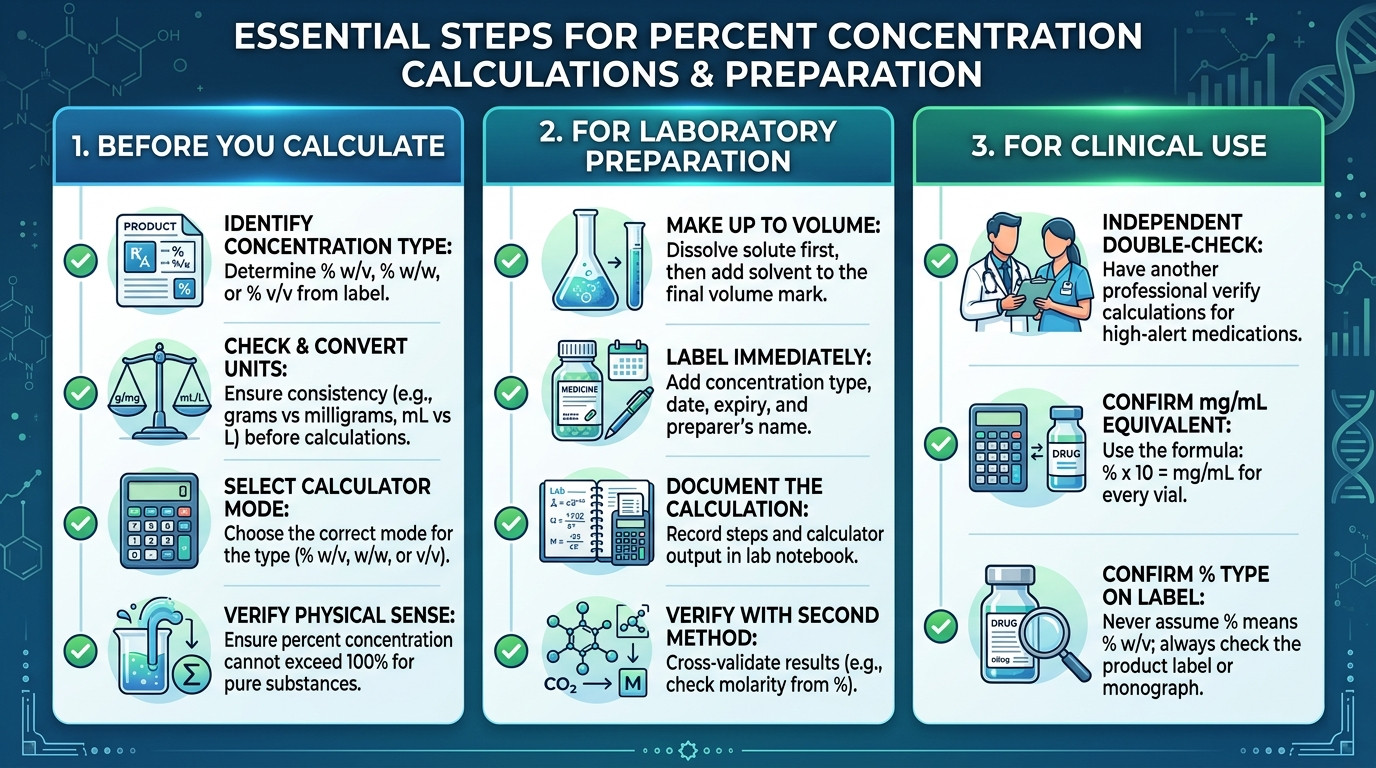
- Verify the concentration type — % w/v, % w/w, or % v/v — before calculating.
- Check units throughout — grams, milligrams, millilitres, litres must be consistent.
- Use a volumetric flask — make up to volume, do not add solvent to volume.
- Label immediately — include concentration type, preparation date, and expiry.
- Independent double-check — for all patient-care and high-hazard preparations.
- Document the calculation — use the percent concentration calculator output for the record.
Which Mode Fits Your Situation
| Mode | Use Case | Key Formula | Inputs Needed | Typical Applications |
|---|---|---|---|---|
| % w/v | Solid in liquid solutions | (g÷mL)×100 | mass, volume, % | IV fluids, drug solutions, standards |
| % w/w | Solid in solid/dense liquid | (g÷g)×100 | mass solute, mass solution, % | Creams, ointments, concentrated acids |
| % v/v | Liquid in liquid | (mL÷mL)×100 | vol solute, vol solution, % | Alcohol, disinfectants, organic solvents |
| ppm | Trace-level conversions | mg/L = ppm | value, from unit, to unit | Environmental, food safety, analytics |
| % to M | Percent ↔ molarity | M=(% w/v×10)÷MM | %, molar mass, or M | Chemistry, biochemistry, formulation |
The Chemistry Behind Percent Concentration
To truly master percent concentration, it helps to understand what is happening at the molecular level. When you dissolve a solute in a solvent, the solute particles distribute themselves among the solvent molecules, and the resulting solution has properties determined by both the identity of the solute and its concentration. Percent concentration is a practical, everyday way of expressing this — how much solute per unit of solution — that avoids the need for molar mass knowledge (unlike molarity). This makes it particularly useful in clinical settings where nurses and technicians prepare solutions from labelled concentrations without needing to know the molar mass of every drug.
The reason there are three types of percent concentration rather than one is that mass and volume behave differently when mixed. When you mix 70 mL of ethanol with 30 mL of water, the total volume is not exactly 100 mL — it is about 96.5 mL, because the ethanol and water molecules interact and pack more efficiently together than either component alone. This “volume contraction” means that % v/v is defined as volume of solute per volume of final mixture, not per sum of component volumes. Similarly, when you dissolve 37 g of HCl gas in 63 g of water, the density of the resulting solution is 1.19 g/mL, not 1.0 g/mL, so the volume of 100 g of solution is 84 mL, not 100 mL — which is why 37% w/w HCl is approximately 440 g/L (44% w/v), not 370 g/L. The percent concentration calculator handles each type separately to avoid conflating these fundamentally different measurements.
Percent Concentration in Pharmaceutical Manufacturing
In pharmaceutical manufacturing, percent concentration is a regulatory expression controlled by the United States Pharmacopeia (USP), the European Pharmacopoeia (Ph. Eur.), and national compendia. The USP defines % w/v as grams of solute per 100 mL of solution, % w/w as grams per 100 g, and % v/v as millilitres per 100 mL, and specifies which expression to use for each type of preparation. Formulators use the percent concentration calculator to convert between these expressions during development, scale-up, and quality control — where the calculation must be documented and auditable.
Percent Concentration in Clinical Pharmacy
Clinical pharmacists encounter percent concentration daily — in the labelling of IV infusions, in the preparation of oral liquids for paediatric patients, in the formulation of topical preparations, and in the calculation of drug doses from stock solutions. The most dangerous context is high-alert drug preparation, where a concentration error can be lethal. The Institute for Safe Medication Practices (ISMP) lists concentrated electrolytes and concentrated opioids as high-alert medications, meaning errors with these drugs are disproportionately likely to cause harm. The percent concentration calculator provides a fast, auditable, step-by-step calculation that supports the independent double-check process required for these preparations.
Percent Concentration in Environmental Chemistry
In environmental chemistry and water quality monitoring, concentrations are almost always expressed in ppm (mg/L) or ppb (µg/L) rather than percent, because the values are too small to express conveniently as percent. A drinking water limit of 10 ppm for nitrates would be expressed as 0.001% w/v — a number that obscures the meaning. The percent concentration calculator’s ppm mode converts between all of these instantly, supporting compliance reporting and quality assurance in environmental laboratories.
Percent Concentration in Food Science
Food scientists use percent concentration to specify sugar, salt, fat, protein, and preservative levels in food products. Brine solutions for curing and pickling are typically 2–25% w/v NaCl. Sugar syrups for confectionery are 50–70% w/w sucrose. Ethanol in wine is 9–16% v/v; in spirits, 37–60% v/v. Food preservatives like sodium benzoate are used at 0.1–0.25% w/v — very low concentrations where the distinction between % w/v and ppm is important: 0.1% w/v = 1000 ppm. The percent concentration calculator bridges these units for food technologists working across regulatory frameworks.
Percent Concentration in Cell Culture and Biochemistry
Cell biology and biochemistry laboratories routinely prepare solutions whose concentrations are expressed in percent: polyacrylamide gels for protein electrophoresis are 4–15% w/v acrylamide; agarose gels for DNA electrophoresis are 0.8–3% w/v agarose; sucrose gradients for ultracentrifugation are 5–60% w/w sucrose; trichloroacetic acid (TCA) for protein precipitation is 10–20% w/v. Each of these requires accurate percent concentration calculation, and errors can invalidate experiments or make gels too rigid or too soft to run properly. The percent concentration calculator handles all of these scenarios, and the step-by-step output supports laboratory notebook documentation required for reproducible science.
Worked Examples
Example 1 — % w/v: How much NaCl to weigh for 500 mL of 0.9% w/v saline? Mass = (0.9 × 500) ÷ 100 = 4.5 g.
Example 2 — % w/w: A 5% w/w cream is needed in a 100 g batch. Mass of active = (5 × 100) ÷ 100 = 5 g active, 95 g base.
Example 3 — % v/v: How much ethanol to measure for 250 mL of 70% v/v? Volume = (70 × 250) ÷ 100 = 175 mL of 100% ethanol, make up to 250 mL.
Example 4 — ppm: 0.005% w/v = 0.005 × 10,000 = 50 ppm.
Example 5 — % to Molarity: 5% w/v glucose (MM = 180.16 g/mol): Molarity = (5 × 10) ÷ 180.16 = 0.278 mol/L = 278 mmol/L.
Frequently Asked Questions About the Percent Concentration Calculator
These questions come from clinicians, pharmacists, chemists, and laboratory scientists who use a percent concentration calculator in their daily work. Click any question to expand the answer.
1. What is a percent concentration calculator?
A percent concentration calculator computes the relationship between the amount of solute and the amount of solution, expressed as a percentage. This percent concentration calculator provides five modes: % w/v, % w/w, % v/v, ppm converter, and % w/v to molarity converter. Each mode shows every step of the calculation for documentation and teaching.
2. What is the difference between % w/v, % w/w, and % v/v?
% w/v = grams of solute per 100 mL of solution (clinical standard). % w/w = grams of solute per 100 g of solution (formulation standard). % v/v = mL of solute per 100 mL of solution (alcohol standard). The percent concentration calculator handles all three types in separate modes to prevent confusion.
3. How do I calculate % w/v concentration?
% w/v = (mass of solute in grams ÷ volume of solution in mL) × 100. For example, 9 g NaCl dissolved and made up to 1000 mL: % w/v = (9 ÷ 1000) × 100 = 0.9% w/v. The percent concentration calculator’s % w/v mode solves for any of the three variables given the other two.
4. How do I convert % w/v to molarity?
Molarity (mol/L) = (% w/v × 10) ÷ molar mass (g/mol). For 5% w/v glucose (molar mass 180.16 g/mol): Molarity = (5 × 10) ÷ 180.16 = 0.278 mol/L. The percent concentration calculator’s % to Molarity mode performs this conversion in both directions.
5. What does ppm mean and how does it relate to percent?
ppm stands for parts per million and equals milligrams per litre (mg/L) for aqueous solutions. 1% w/v = 10,000 ppm. So 0.001% w/v = 10 ppm, and 500 ppm = 0.05% w/v. The percent concentration calculator’s ppm mode converts between ppm, ppb, % w/v, and mg/L automatically.
6. What is 0.9% NaCl in mg/mL?
0.9% w/v NaCl = 0.9 g per 100 mL = 9 g per 1000 mL = 9 mg/mL. This is the most commonly used IV fluid (normal saline). The percent concentration calculator’s % w/v mode shows this mg/mL equivalent alongside the percent result.
7. How much ethanol do I need for 70% v/v solution?
Volume of ethanol = (70 ÷ 100) × total volume. For 1000 mL of 70% v/v: 700 mL of pure ethanol made up to 1000 mL with water. If starting from 96% stock: V1 = (70 × 1000) ÷ 96 = 729 mL of 96% stock, made up to 1000 mL.
8. Why is percent concentration labelling on drug vials important?
Drug vials use percent concentration to express the drug amount. Converting to mg/mL requires the percent concentration calculation: 1% w/v = 10 mg/mL. For example, 2% lidocaine = 20 mg/mL. Errors in this conversion can cause overdose or underdose.
9. Is this percent concentration calculator free and private?
Yes. This percent concentration calculator is completely free, runs entirely in your browser, and requires no sign-up. All calculations are private — no data is sent to any server. Reviews are saved in your browser’s local storage only.
10. Can I use this for food and cosmetic formulations?
Yes. The percent concentration calculator works for any application involving % w/v, % w/w, % v/v, or ppm — including food science, cosmetics, environmental chemistry, and industrial chemistry. Choose the mode that matches your concentration type.
Percent Concentration Best Practices Checklist
Understanding Concentration Labels
Correctly reading a concentration label is the first step in any percent concentration calculation, and errors at this stage propagate through every subsequent step. Pharmaceutical labels in most countries follow the convention that % without qualification means % w/v for solid-in-liquid preparations and % v/v for liquid-in-liquid preparations — but this is a convention, not a law. The percent concentration calculator requires you to select the type explicitly, which forces you to confirm the label type before calculating.
Converting mg/mL to % w/v and Back
The conversion between mg/mL and % w/v is one of the most frequently needed in clinical pharmacy: 1% w/v = 10 mg/mL. This is because 1% w/v = 1 g per 100 mL = 1000 mg per 100 mL = 10 mg per mL. So 2% lidocaine = 20 mg/mL; 0.5% bupivacaine = 5 mg/mL; 5% glucose = 50 mg/mL. This simple relationship — multiply % by 10 to get mg/mL, divide mg/mL by 10 to get % — is worth memorising for clinical practice.
Percent Concentration in Analytical Chemistry
In analytical chemistry, standard solutions are prepared at precisely known concentrations and used to calibrate instruments and construct calibration curves. These standards may be prepared in % w/v, mg/L, or mol/L. The percent concentration calculator bridges all of these units, supporting the preparation of multi-point calibration standards from a single concentrated stock.
Before You Calculate
For Laboratory Preparation
For Clinical Use
Trusted Reference Resources for Percent Concentration
United States Pharmacopeia (USP) — usp.org — Official definitions of % w/v, % w/w, and % v/v for pharmaceutical preparations.
NIST Chemistry WebBook — webbook.nist.gov — Molar masses, densities, and physicochemical data for percent concentration conversions.
LibreTexts Chemistry — chem.libretexts.org — Free explanations of percent concentration, molarity, and solution preparation.
ISMP (Institute for Safe Medication Practices) — ismp.org — Guidance on safe concentration labelling and high-alert medications.
EPA Water Quality Standards — epa.gov/wqs-tech — Regulatory limits in ppm and ppb for water quality monitoring.
User Reviews & Ratings
Share Your Experience with This Percent Concentration Calculator
Final Thoughts on Percent Concentration Calculation
Percent concentration calculation is one of those tasks that appears straightforward until the three different definitions — % w/v, % w/w, and % v/v — all appear in the same protocol, each requiring a different formula and a different denominator. The arithmetic in each case is simple division and multiplication; the difficulty is entirely in choosing the right type and keeping the units consistent throughout. Forgetting that % w/v uses volume in the denominator while % w/w uses mass, or confusing ppm with percent by a factor of 10,000, are errors that occur routinely in busy laboratory and clinical environments — and their consequences range from failed experiments to patient harm.
The percent concentration calculator removes that arithmetic and unit-tracking burden by separating the five most common tasks into dedicated modes, each with its own validated formula, clear input labels, and step-by-step output. But the tool cannot replace sound laboratory technique — making up to volume rather than adding to volume, verifying results with a second calculation or measurement method, and always labelling preparations with the concentration type, not just the number. Keep this percent concentration calculator alongside your other reference tools, use the related dilution and molarity calculators in the sidebar for complementary calculations, and use the step-by-step output for documentation in your laboratory record, pharmacy batch record, or clinical note.
🔒 Privacy Guarantee: Every calculation runs entirely within your browser. No data is sent to any server. Reviews you submit are saved in your browser’s local storage only — they persist across reloads but are never transmitted anywhere.
Pingback: Stoichiometry Calculator – Solve Chemical Reactions Instantly
Pingback: Titration Calculator – Calculate Titration Results Instantly
Pingback: Specific Gravity Calculator – Calculate Specific Gravity Instantly
Pingback: Brix Calculator – Calculate °Brix Instantly & Accurately
Pingback: Aliquot Calculator – Calculate Aliquot Volumes Instantly
Pingback: TDS Calculator – Calculate Total Dissolved Solids Instantly
Pingback: Solubility Calculator – Calculate Solubility Instantly
Pingback: Spike Solution Calculator – Calculate Spike Solutions Instantly
Pingback: Standard Addition Calculator – Calculate Standard Additions Instantly
Pingback: TCID50 Calculator – Calculate TCID50 Values Instantly
Pingback: How to Dilute 12 Hydrogen Peroxide to 3 Calculator
Pingback: How to Dilute Omnia 2.0 Interior Cleaner Calculator
Pingback: Antibody Dilution Calculator – Calculate Antibody Dilutions Instantly
Pingback: Cell Seeding Density Calculator – Calculate Cells per Well Instantly
Pingback: How Do You Calculate the Dilution Factor? Free Calculator -
Pingback: How to Calculate a Dilution? Free Dilution Calculator
Pingback: How to Calculate Equity Dilution? Free Equity Dilution Calculator
Pingback: Bleach Dilution Calculator - CDC Ratios, PPM & % | Free Tool
Pingback: Essential Oil Dilution Calculator - Face, Body & Bath | Free
Pingback: Acid Dilution Calculator - Safe Lab & Industrial Use | Free Tool
Pingback: Pharmaceutical Dilution Calculator - IV & Pediatric Dosing | Free
Pingback: How to Calculate the Dilution Factor: 7 Simple Steps to Success
Pingback: How to Calculate Dilution Factor: 5 Steps to Flawless Results
Pingback: Serial Dilution Calculation Table: Free Generator + Examples
Pingback: Mixing Ratio Calculator: Exact Volumes for Any Ratio (Free Tool)
Pingback: Sodium Hypochlorite Dilution Calculator | Free CDC Bleach Tool
Pingback: Herbicide Calculator | Calculate Spray Mix Instantly
Pingback: Pesticide Calculator | Calculate Spray Mix Instantly
Pingback: Micromolar Calculator | Calculate µM Concentrations Instantly
Pingback: Percent by Mass Calculator | Calculate Mass Percentage Instantly