
how to dilute 12 hydrogen peroxide to 3 — Safe 12% to 3% Hydrogen Peroxide Dilution Guide & Calculator
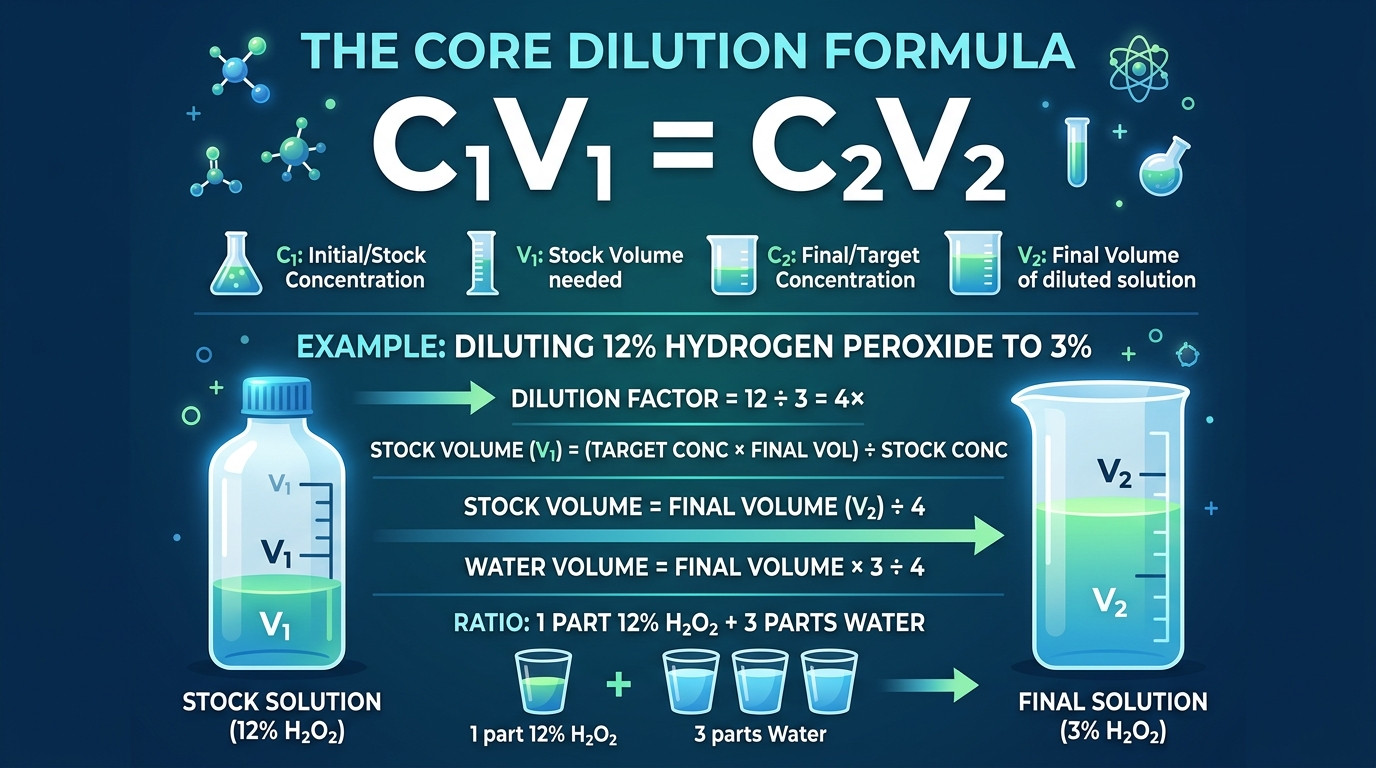
If you are asking how to dilute 12 hydrogen peroxide to 3, the dilution is simple: mix 1 part of 12% hydrogen peroxide with 3 parts clean water to make 4 parts of 3% hydrogen peroxide. For example, use 250 mL of 12% hydrogen peroxide plus 750 mL water to make 1,000 mL of 3% solution. The formula is C₁V₁ = C₂V₂, so stock volume = target concentration × final volume ÷ stock concentration. Always dilute carefully, wear eye and skin protection, use a clean compatible container, avoid contamination, label the diluted solution, and store it away from heat, light, metals, organics, children, and pets.
Key facts at a glance
- Ratio: 1 part 12% hydrogen peroxide + 3 parts water = 3% hydrogen peroxide.
- Dilution factor: 12% ÷ 3% = 4× dilution.
- Formula: C₁V₁ = C₂V₂.
- Stock volume: final volume ÷ 4 when diluting 12% to 3%.
- Water volume: final volume × 3 ÷ 4.
- Safety: 12% hydrogen peroxide can irritate or burn skin and eyes; handle it as a chemical, not as ordinary water.
📋 Table of Contents
▼
- What This Dilution Calculator Does
- Hydrogen Peroxide Dilution Calculator
- How the 12% to 3% Dilution Works
- Common Batch Examples
- Common Dilution Mistakes
- Safety, Storage & Handling Essentials
- Which Mode Fits Your Workflow
- Frequently Asked Questions
- Dilution Preparation Checklist
- Trusted Reference Resources
- User Reviews & Ratings
What This Dilution Calculator Does
This page answers the practical question how to dilute 12 hydrogen peroxide to 3 with a simple calculator, ratio guide, safety notes, batch examples, and reporting-style dilution steps. Hydrogen peroxide concentration is usually expressed as percent by weight or approximate household percentage, and the common calculation for reducing concentration is the dilution equation C₁V₁ = C₂V₂. In this case, C₁ is 12%, C₂ is 3%, and the final solution is one quarter original peroxide and three quarters water.
The calculator is helpful because people often know the target strength but not the exact volumes. If you need 100 mL, 500 mL, 1 liter, or 1 gallon of 3% hydrogen peroxide from 12% stock, the same ratio applies. The tool also checks final concentration if you already mixed a volume, calculates dilution factor, scales batches, and helps convert between percent concentrations. It follows the same blue design pattern as the previous calculator pages.
When using this guide for how to dilute 12 hydrogen peroxide to 3, remember that 12% hydrogen peroxide is stronger than typical household 3% solution. It may irritate skin, damage eyes, bleach materials, and react with contaminants. Use clean containers, compatible materials, cool conditions, and clear labels. Do not mix hydrogen peroxide with vinegar, bleach, ammonia, metals, organic solvents, or unknown chemicals. If a product label gives different instructions, follow the product label and safety data sheet.
This calculator gives arithmetic only. It does not provide medical, dental, food-processing, cosmetic, veterinary, aquarium, laboratory, or disinfection approval. Use diluted hydrogen peroxide only for purposes allowed by the product label, local rules, and relevant professional guidance. If you are unsure about a use case, ask a qualified professional before preparing or applying the solution.
Hydrogen Peroxide Dilution Calculator
Calculate 12% to 3% hydrogen peroxide dilution, batch volumes, final concentration checks, dilution factor, and custom percent dilutions.
Calculation Result
Step-by-step working
How the 12% to 3% Dilution Works
The question how to dilute 12 hydrogen peroxide to 3 is answered by comparing starting concentration with target concentration. Twelve percent is four times stronger than three percent, so the original solution must be diluted fourfold. A fourfold dilution means the final mixture contains one part of the original 12% hydrogen peroxide and three parts water. If the final volume is 400 mL, use 100 mL of 12% stock and 300 mL water. If the final volume is 1 liter, use 250 mL stock and 750 mL water.
The formula is C₁V₁ = C₂V₂. C₁ is the starting concentration, V₁ is the stock volume required, C₂ is the target concentration, and V₂ is the final volume. For how to dilute 12 hydrogen peroxide to 3, C₁ is 12 and C₂ is 3. V₁ = 3 × final volume ÷ 12, which simplifies to final volume ÷ 4. Water volume is final volume minus stock volume, so it is three quarters of the final batch.
The 1:3 Ratio
For how to dilute 12 hydrogen peroxide to 3, the easiest memory rule is 1:3. Use one part 12% hydrogen peroxide and three parts water. This gives four total parts, and one quarter of 12% equals 3%. The ratio works for any measuring unit as long as both parts use the same unit: teaspoons, tablespoons, mL, cups, or liters. For more accurate work, mL or grams measured with clean lab equipment are better than kitchen measures.
Batch Size Examples
A how to dilute 12 hydrogen peroxide to 3 calculation can be scaled to any practical batch size. For 100 mL final, use 25 mL stock and 75 mL water. For 500 mL final, use 125 mL stock and 375 mL water. For 1,000 mL final, use 250 mL stock and 750 mL water. For 1 gallon final, use 1 quart stock and 3 quarts water if using the same volume system.
Why Final Volume Matters
Dilution calculations are based on final volume, not just how much water is added. For how to dilute 12 hydrogen peroxide to 3, the final solution should be four total parts. If someone adds 3 parts water to 1 part stock, the final volume is 4 parts. If someone adds 4 parts water to 1 part stock, the final concentration becomes 2.4%, not 3%. That difference matters when a specific concentration is required.
Water Quality
Clean water is normally used for basic dilution, but the best water type depends on the product label and use case. Distilled or deionized water is preferred when long storage, laboratory work, or residue control matters. Tap water may contain minerals or contaminants that can accelerate hydrogen peroxide decomposition. A how to dilute 12 hydrogen peroxide to 3 gives the volume ratio, but water quality and container cleanliness affect stability.
Stability After Dilution
Hydrogen peroxide decomposes to water and oxygen over time, especially when exposed to heat, light, metals, dirt, organic material, or alkaline contamination. After how to dilute 12 hydrogen peroxide to 3, store the diluted solution in a clean, compatible, labeled container away from light and heat. Do not return unused diluted solution to the original stock bottle because contamination can reduce stability and create pressure from oxygen release.
for 12% to 3%: stock volume = final volume ÷ 4
water volume = final volume × 3 ÷ 4
ratio = 1 part 12% hydrogen peroxide + 3 parts water
dilution factor = 12 ÷ 3 = 4×
Remember: how to dilute 12 hydrogen peroxide to 3 is a dilution calculation, not a use approval. Always follow the hydrogen peroxide product label, safety data sheet, and any professional instructions for your specific purpose.
Common Batch Examples
Example 1: Small 100 mL Bottle
For how to dilute 12 hydrogen peroxide to 3 in a small 100 mL bottle, measure 25 mL of 12% hydrogen peroxide and 75 mL of clean water. Mix gently in a clean compatible container and label it as 3% hydrogen peroxide with the date.
Example 2: 500 mL Household Batch
For a 500 mL batch, use 125 mL of 12% hydrogen peroxide and 375 mL of water. This is the same 1:3 stock-to-water ratio. The how to dilute 12 hydrogen peroxide to 3 rule is useful because it scales without changing the math.
Example 3: One Liter Preparation
For 1 liter final volume, use 250 mL stock and 750 mL water. If you are using a graduated cylinder, measure carefully and avoid splashing. The phrase how to dilute 12 hydrogen peroxide to 3 simply means a fourfold dilution.
Example 4: One Gallon Equivalent
For gallon-style measuring, one quart of 12% hydrogen peroxide plus three quarts water makes one gallon of 3% solution. This is another way to apply how to dilute 12 hydrogen peroxide to 3 with the same 1:3 ratio.
Example 5: Checking a Mixed Batch
If a batch was made with 200 mL stock and 600 mL water, the total volume is 800 mL and the final concentration is 12 × 200 ÷ 800 = 3%. A calculator helps verify how to dilute 12 hydrogen peroxide to 3 after mixing.
Example 6: Custom Final Volume
If a user needs 750 mL final, stock volume is 750 ÷ 4 = 187.5 mL and water is 562.5 mL. That example shows why a calculator is convenient for how to dilute 12 hydrogen peroxide to 3 when the batch size is not a round number.

Common Dilution Mistakes
Mistake 1: Adding the Wrong Amount of Water
The most common error in how to dilute 12 hydrogen peroxide to 3 is adding four parts water to one part stock instead of three parts water. One part stock plus three parts water gives four total parts and the correct 3% final concentration.
Mistake 2: Using Dirty Containers
Hydrogen peroxide decomposes faster when contaminated with dirt, metals, organic residue, or old chemicals. The how to dilute 12 hydrogen peroxide to 3 math may be correct, but stability can be poor if the container is not clean and compatible.
Mistake 3: Skipping Eye Protection
Twelve percent hydrogen peroxide is stronger than common 3% household solution. When learning how to dilute 12 hydrogen peroxide to 3, people sometimes focus only on the ratio and forget that the starting liquid can irritate or injure skin and eyes.
Mistake 4: Mixing with Other Chemicals
Do not mix hydrogen peroxide with vinegar, bleach, ammonia, drain cleaner, alcohol, unknown cleaners, or metal powders. A how to dilute 12 hydrogen peroxide to 3 calculation is only for water dilution, not chemical mixing.
Mistake 5: Forgetting to Label the Bottle
After how to dilute 12 hydrogen peroxide to 3, the diluted liquid should be labeled with concentration, date, and contents. An unlabeled clear liquid can be mistaken for water or another chemical.
Mistake 6: Storing in Heat or Sunlight
Light and heat accelerate decomposition. A how to dilute 12 hydrogen peroxide to 3 batch should be stored cool and dark in a vent-safe compatible container according to the product label.
💡 Rule of Thumb: for how to dilute 12 hydrogen peroxide to 3, remember 1 part 12% plus 3 parts water. Measure carefully, label immediately, and do not mix hydrogen peroxide with other chemicals.
Safety, Storage & Handling Essentials
Safety: how to dilute 12 hydrogen peroxide to 3 involves handling 12% hydrogen peroxide, which can irritate or burn skin and eyes and can bleach fabrics or surfaces. Wear suitable eye protection and gloves, work slowly, avoid splashes, and follow the product label and safety data sheet.
- Wear eye protection because splashes can injure eyes.
- Use gloves and rinse skin promptly if contact occurs.
- Use clean plastic or glass equipment that is compatible with hydrogen peroxide.
- Keep away from metals, dirt, organics, and other chemicals because contamination can speed decomposition.
- Do not seal gas buildup in an unsuitable container; decomposition releases oxygen.
- Keep out of reach of children, pets, and anyone who may mistake it for water.
For how to dilute 12 hydrogen peroxide to 3, add and mix slowly to reduce splashing. Use only water as the diluent unless a product label or qualified professional gives different instructions. Store diluted hydrogen peroxide in a labeled container away from light and heat. Do not use it internally, medically, cosmetically, in food, in aquariums, or for disinfection unless the product label and relevant guidance specifically allow that use.
Which Mode Fits Your Workflow
| Mode | Use Case | Key Formula | Inputs | Output |
|---|---|---|---|---|
| 12% to 3% | Direct answer | final ÷ 4 | final volume | stock + water |
| Custom Dilution | Other peroxide strengths | C₁V₁ = C₂V₂ | stock %, target %, final | stock + water |
| Final Check | Verify a mixture | Cfinal = Cstock × Vstock/Vtotal | stock volume, water volume | final % |
| Batch Scale | Multiple bottles | bottles × volume × overage | count, volume, overage | total stock + water |
| Dilution Factor | Ratio planning | start/target | start %, target % | parts water |
Direct 12% to 3% Planning
The most common use is simply how to dilute 12 hydrogen peroxide to 3. Enter the final volume, and the calculator returns one quarter as stock and three quarters as water. This is useful for bottles, spray containers, or lab-style batch records when the product label permits dilution.
Custom Percent Dilutions
The same calculator can dilute other hydrogen peroxide concentrations to lower targets. The equation is still C₁V₁ = C₂V₂. If the target is not lower than the stock, dilution with water cannot achieve it.
Final Concentration Check
If a mixture has already been made, the final-check mode verifies the approximate concentration. This helps identify whether how to dilute 12 hydrogen peroxide to 3 was done correctly or whether too much water was added.
Batch Scaling
Batch mode is useful when preparing several labeled bottles. It includes optional overage so a small transfer loss does not leave the last bottle short. Keep the same 1:3 ratio for how to dilute 12 hydrogen peroxide to 3.
Advanced Guide to Diluting 12% Hydrogen Peroxide
Measuring Volumes
how to dilute 12 hydrogen peroxide to 3 requires attention to measuring volumes, not only the 1:3 ratio. Measuring Volumes matters because hydrogen peroxide is reactive and concentration-sensitive. The user should record starting concentration, final volume, stock volume, water volume, container type, preparation date, and intended labeled concentration. If the solution changes appearance, vents gas, contacts contaminants, or is stored warm or bright, stability may be reduced. Good practice is to prepare only what is needed, keep the stock bottle clean, never return unused diluted liquid to the stock, and follow the product label for storage and allowed use.
Water Quality
how to dilute 12 hydrogen peroxide to 3 requires attention to water quality, not only the 1:3 ratio. Water Quality matters because hydrogen peroxide is reactive and concentration-sensitive. The user should record starting concentration, final volume, stock volume, water volume, container type, preparation date, and intended labeled concentration. If the solution changes appearance, vents gas, contacts contaminants, or is stored warm or bright, stability may be reduced. Good practice is to prepare only what is needed, keep the stock bottle clean, never return unused diluted liquid to the stock, and follow the product label for storage and allowed use.
Container Compatibility
how to dilute 12 hydrogen peroxide to 3 requires attention to container compatibility, not only the 1:3 ratio. Container Compatibility matters because hydrogen peroxide is reactive and concentration-sensitive. The user should record starting concentration, final volume, stock volume, water volume, container type, preparation date, and intended labeled concentration. If the solution changes appearance, vents gas, contacts contaminants, or is stored warm or bright, stability may be reduced. Good practice is to prepare only what is needed, keep the stock bottle clean, never return unused diluted liquid to the stock, and follow the product label for storage and allowed use.
Labeling
how to dilute 12 hydrogen peroxide to 3 requires attention to labeling, not only the 1:3 ratio. Labeling matters because hydrogen peroxide is reactive and concentration-sensitive. The user should record starting concentration, final volume, stock volume, water volume, container type, preparation date, and intended labeled concentration. If the solution changes appearance, vents gas, contacts contaminants, or is stored warm or bright, stability may be reduced. Good practice is to prepare only what is needed, keep the stock bottle clean, never return unused diluted liquid to the stock, and follow the product label for storage and allowed use.
Storage Temperature
how to dilute 12 hydrogen peroxide to 3 requires attention to storage temperature, not only the 1:3 ratio. Storage Temperature matters because hydrogen peroxide is reactive and concentration-sensitive. The user should record starting concentration, final volume, stock volume, water volume, container type, preparation date, and intended labeled concentration. If the solution changes appearance, vents gas, contacts contaminants, or is stored warm or bright, stability may be reduced. Good practice is to prepare only what is needed, keep the stock bottle clean, never return unused diluted liquid to the stock, and follow the product label for storage and allowed use.
Light Exposure
how to dilute 12 hydrogen peroxide to 3 requires attention to light exposure, not only the 1:3 ratio. Light Exposure matters because hydrogen peroxide is reactive and concentration-sensitive. The user should record starting concentration, final volume, stock volume, water volume, container type, preparation date, and intended labeled concentration. If the solution changes appearance, vents gas, contacts contaminants, or is stored warm or bright, stability may be reduced. Good practice is to prepare only what is needed, keep the stock bottle clean, never return unused diluted liquid to the stock, and follow the product label for storage and allowed use.
Contamination Control
how to dilute 12 hydrogen peroxide to 3 requires attention to contamination control, not only the 1:3 ratio. Contamination Control matters because hydrogen peroxide is reactive and concentration-sensitive. The user should record starting concentration, final volume, stock volume, water volume, container type, preparation date, and intended labeled concentration. If the solution changes appearance, vents gas, contacts contaminants, or is stored warm or bright, stability may be reduced. Good practice is to prepare only what is needed, keep the stock bottle clean, never return unused diluted liquid to the stock, and follow the product label for storage and allowed use.
PPE
how to dilute 12 hydrogen peroxide to 3 requires attention to ppe, not only the 1:3 ratio. PPE matters because hydrogen peroxide is reactive and concentration-sensitive. The user should record starting concentration, final volume, stock volume, water volume, container type, preparation date, and intended labeled concentration. If the solution changes appearance, vents gas, contacts contaminants, or is stored warm or bright, stability may be reduced. Good practice is to prepare only what is needed, keep the stock bottle clean, never return unused diluted liquid to the stock, and follow the product label for storage and allowed use.
Skin Contact
how to dilute 12 hydrogen peroxide to 3 requires attention to skin contact, not only the 1:3 ratio. Skin Contact matters because hydrogen peroxide is reactive and concentration-sensitive. The user should record starting concentration, final volume, stock volume, water volume, container type, preparation date, and intended labeled concentration. If the solution changes appearance, vents gas, contacts contaminants, or is stored warm or bright, stability may be reduced. Good practice is to prepare only what is needed, keep the stock bottle clean, never return unused diluted liquid to the stock, and follow the product label for storage and allowed use.
Eye Splash Risk
how to dilute 12 hydrogen peroxide to 3 requires attention to eye splash risk, not only the 1:3 ratio. Eye Splash Risk matters because hydrogen peroxide is reactive and concentration-sensitive. The user should record starting concentration, final volume, stock volume, water volume, container type, preparation date, and intended labeled concentration. If the solution changes appearance, vents gas, contacts contaminants, or is stored warm or bright, stability may be reduced. Good practice is to prepare only what is needed, keep the stock bottle clean, never return unused diluted liquid to the stock, and follow the product label for storage and allowed use.
Batch Records
how to dilute 12 hydrogen peroxide to 3 requires attention to batch records, not only the 1:3 ratio. Batch Records matters because hydrogen peroxide is reactive and concentration-sensitive. The user should record starting concentration, final volume, stock volume, water volume, container type, preparation date, and intended labeled concentration. If the solution changes appearance, vents gas, contacts contaminants, or is stored warm or bright, stability may be reduced. Good practice is to prepare only what is needed, keep the stock bottle clean, never return unused diluted liquid to the stock, and follow the product label for storage and allowed use.
Final Volume
how to dilute 12 hydrogen peroxide to 3 requires attention to final volume, not only the 1:3 ratio. Final Volume matters because hydrogen peroxide is reactive and concentration-sensitive. The user should record starting concentration, final volume, stock volume, water volume, container type, preparation date, and intended labeled concentration. If the solution changes appearance, vents gas, contacts contaminants, or is stored warm or bright, stability may be reduced. Good practice is to prepare only what is needed, keep the stock bottle clean, never return unused diluted liquid to the stock, and follow the product label for storage and allowed use.
Ratio Notation
how to dilute 12 hydrogen peroxide to 3 requires attention to ratio notation, not only the 1:3 ratio. Ratio Notation matters because hydrogen peroxide is reactive and concentration-sensitive. The user should record starting concentration, final volume, stock volume, water volume, container type, preparation date, and intended labeled concentration. If the solution changes appearance, vents gas, contacts contaminants, or is stored warm or bright, stability may be reduced. Good practice is to prepare only what is needed, keep the stock bottle clean, never return unused diluted liquid to the stock, and follow the product label for storage and allowed use.
Custom Strengths
how to dilute 12 hydrogen peroxide to 3 requires attention to custom strengths, not only the 1:3 ratio. Custom Strengths matters because hydrogen peroxide is reactive and concentration-sensitive. The user should record starting concentration, final volume, stock volume, water volume, container type, preparation date, and intended labeled concentration. If the solution changes appearance, vents gas, contacts contaminants, or is stored warm or bright, stability may be reduced. Good practice is to prepare only what is needed, keep the stock bottle clean, never return unused diluted liquid to the stock, and follow the product label for storage and allowed use.
Overage
how to dilute 12 hydrogen peroxide to 3 requires attention to overage, not only the 1:3 ratio. Overage matters because hydrogen peroxide is reactive and concentration-sensitive. The user should record starting concentration, final volume, stock volume, water volume, container type, preparation date, and intended labeled concentration. If the solution changes appearance, vents gas, contacts contaminants, or is stored warm or bright, stability may be reduced. Good practice is to prepare only what is needed, keep the stock bottle clean, never return unused diluted liquid to the stock, and follow the product label for storage and allowed use.
Shelf Life
how to dilute 12 hydrogen peroxide to 3 requires attention to shelf life, not only the 1:3 ratio. Shelf Life matters because hydrogen peroxide is reactive and concentration-sensitive. The user should record starting concentration, final volume, stock volume, water volume, container type, preparation date, and intended labeled concentration. If the solution changes appearance, vents gas, contacts contaminants, or is stored warm or bright, stability may be reduced. Good practice is to prepare only what is needed, keep the stock bottle clean, never return unused diluted liquid to the stock, and follow the product label for storage and allowed use.
Decomposition
how to dilute 12 hydrogen peroxide to 3 requires attention to decomposition, not only the 1:3 ratio. Decomposition matters because hydrogen peroxide is reactive and concentration-sensitive. The user should record starting concentration, final volume, stock volume, water volume, container type, preparation date, and intended labeled concentration. If the solution changes appearance, vents gas, contacts contaminants, or is stored warm or bright, stability may be reduced. Good practice is to prepare only what is needed, keep the stock bottle clean, never return unused diluted liquid to the stock, and follow the product label for storage and allowed use.
Gas Release
how to dilute 12 hydrogen peroxide to 3 requires attention to gas release, not only the 1:3 ratio. Gas Release matters because hydrogen peroxide is reactive and concentration-sensitive. The user should record starting concentration, final volume, stock volume, water volume, container type, preparation date, and intended labeled concentration. If the solution changes appearance, vents gas, contacts contaminants, or is stored warm or bright, stability may be reduced. Good practice is to prepare only what is needed, keep the stock bottle clean, never return unused diluted liquid to the stock, and follow the product label for storage and allowed use.
Surface Compatibility
Surface Compatibility matters because hydrogen peroxide is reactive and concentration-sensitive. The user should record starting concentration, final volume, stock volume, water volume, container type, preparation date, and intended labeled concentration. If the solution changes appearance, vents gas, contacts contaminants, or is stored warm or bright, stability may be reduced. Good practice is to prepare only what is needed, keep the stock bottle clean, never return unused diluted liquid to the stock, and follow the product label for storage and allowed use.
Product Label
Product Label matters because hydrogen peroxide is reactive and concentration-sensitive. The user should record starting concentration, final volume, stock volume, water volume, container type, preparation date, and intended labeled concentration. If the solution changes appearance, vents gas, contacts contaminants, or is stored warm or bright, stability may be reduced. Good practice is to prepare only what is needed, keep the stock bottle clean, never return unused diluted liquid to the stock, and follow the product label for storage and allowed use.
SDS Review
SDS Review matters because hydrogen peroxide is reactive and concentration-sensitive. The user should record starting concentration, final volume, stock volume, water volume, container type, preparation date, and intended labeled concentration. If the solution changes appearance, vents gas, contacts contaminants, or is stored warm or bright, stability may be reduced. Good practice is to prepare only what is needed, keep the stock bottle clean, never return unused diluted liquid to the stock, and follow the product label for storage and allowed use.
No Chemical Mixing
No Chemical Mixing matters because hydrogen peroxide is reactive and concentration-sensitive. The user should record starting concentration, final volume, stock volume, water volume, container type, preparation date, and intended labeled concentration. If the solution changes appearance, vents gas, contacts contaminants, or is stored warm or bright, stability may be reduced. Good practice is to prepare only what is needed, keep the stock bottle clean, never return unused diluted liquid to the stock, and follow the product label for storage and allowed use.
Disposal
Disposal matters because hydrogen peroxide is reactive and concentration-sensitive. The user should record starting concentration, final volume, stock volume, water volume, container type, preparation date, and intended labeled concentration. If the solution changes appearance, vents gas, contacts contaminants, or is stored warm or bright, stability may be reduced. Good practice is to prepare only what is needed, keep the stock bottle clean, never return unused diluted liquid to the stock, and follow the product label for storage and allowed use.
Child Safety
Child Safety matters because hydrogen peroxide is reactive and concentration-sensitive. The user should record starting concentration, final volume, stock volume, water volume, container type, preparation date, and intended labeled concentration. If the solution changes appearance, vents gas, contacts contaminants, or is stored warm or bright, stability may be reduced. Good practice is to prepare only what is needed, keep the stock bottle clean, never return unused diluted liquid to the stock, and follow the product label for storage and allowed use.
Pet Safety
Pet Safety matters because hydrogen peroxide is reactive and concentration-sensitive. The user should record starting concentration, final volume, stock volume, water volume, container type, preparation date, and intended labeled concentration. If the solution changes appearance, vents gas, contacts contaminants, or is stored warm or bright, stability may be reduced. Good practice is to prepare only what is needed, keep the stock bottle clean, never return unused diluted liquid to the stock, and follow the product label for storage and allowed use.
Transport
Transport matters because hydrogen peroxide is reactive and concentration-sensitive. The user should record starting concentration, final volume, stock volume, water volume, container type, preparation date, and intended labeled concentration. If the solution changes appearance, vents gas, contacts contaminants, or is stored warm or bright, stability may be reduced. Good practice is to prepare only what is needed, keep the stock bottle clean, never return unused diluted liquid to the stock, and follow the product label for storage and allowed use.
Cleaning Equipment
Cleaning Equipment matters because hydrogen peroxide is reactive and concentration-sensitive. The user should record starting concentration, final volume, stock volume, water volume, container type, preparation date, and intended labeled concentration. If the solution changes appearance, vents gas, contacts contaminants, or is stored warm or bright, stability may be reduced. Good practice is to prepare only what is needed, keep the stock bottle clean, never return unused diluted liquid to the stock, and follow the product label for storage and allowed use.
Troubleshooting
Troubleshooting matters because hydrogen peroxide is reactive and concentration-sensitive. The user should record starting concentration, final volume, stock volume, water volume, container type, preparation date, and intended labeled concentration. If the solution changes appearance, vents gas, contacts contaminants, or is stored warm or bright, stability may be reduced. Good practice is to prepare only what is needed, keep the stock bottle clean, never return unused diluted liquid to the stock, and follow the product label for storage and allowed use.
Concentration Verification
Concentration Verification matters because hydrogen peroxide is reactive and concentration-sensitive. The user should record starting concentration, final volume, stock volume, water volume, container type, preparation date, and intended labeled concentration. If the solution changes appearance, vents gas, contacts contaminants, or is stored warm or bright, stability may be reduced. Good practice is to prepare only what is needed, keep the stock bottle clean, never return unused diluted liquid to the stock, and follow the product label for storage and allowed use.
Use Limitations
Use Limitations matters because hydrogen peroxide is reactive and concentration-sensitive. The user should record starting concentration, final volume, stock volume, water volume, container type, preparation date, and intended labeled concentration. If the solution changes appearance, vents gas, contacts contaminants, or is stored warm or bright, stability may be reduced. Good practice is to prepare only what is needed, keep the stock bottle clean, never return unused diluted liquid to the stock, and follow the product label for storage and allowed use.
how to dilute 12 hydrogen peroxide to 3 should therefore be treated as a measured chemical dilution. The arithmetic is easy, but safe handling, clean containers, labeling, and product-label compliance are what make the prepared 3% solution practical and less likely to be misused.
Complete Reference Guide for 12% to 3% Hydrogen Peroxide Dilution
how to dilute 12 hydrogen peroxide to 3 is useful for small bottles because it turns a concentration question into exact volumes. The user can choose a final amount, measure one quarter as 12% hydrogen peroxide, add three quarters water, and label the final mixture as 3% if the product and use case allow dilution. Planned values should be separated from actual measured values. If a batch seems wrong, check whether final volume or added water volume was used, whether the ratio was 1:3 or 1:4, and whether the starting concentration was truly 12%.
how to dilute 12 hydrogen peroxide to 3 is useful for one liter batches because it turns a concentration question into exact volumes. The user can choose a final amount, measure one quarter as 12% hydrogen peroxide, add three quarters water, and label the final mixture as 3% if the product and use case allow dilution. Planned values should be separated from actual measured values. If a batch seems wrong, check whether final volume or added water volume was used, whether the ratio was 1:3 or 1:4, and whether the starting concentration was truly 12%.
how to dilute 12 hydrogen peroxide to 3 is useful for gallon batches because it turns a concentration question into exact volumes. The user can choose a final amount, measure one quarter as 12% hydrogen peroxide, add three quarters water, and label the final mixture as 3% if the product and use case allow dilution. Planned values should be separated from actual measured values. If a batch seems wrong, check whether final volume or added water volume was used, whether the ratio was 1:3 or 1:4, and whether the starting concentration was truly 12%.
how to dilute 12 hydrogen peroxide to 3 is useful for final checks because it turns a concentration question into exact volumes. The user can choose a final amount, measure one quarter as 12% hydrogen peroxide, add three quarters water, and label the final mixture as 3% if the product and use case allow dilution. Planned values should be separated from actual measured values. If a batch seems wrong, check whether final volume or added water volume was used, whether the ratio was 1:3 or 1:4, and whether the starting concentration was truly 12%.
how to dilute 12 hydrogen peroxide to 3 is useful for custom percentages because it turns a concentration question into exact volumes. The user can choose a final amount, measure one quarter as 12% hydrogen peroxide, add three quarters water, and label the final mixture as 3% if the product and use case allow dilution. Planned values should be separated from actual measured values. If a batch seems wrong, check whether final volume or added water volume was used, whether the ratio was 1:3 or 1:4, and whether the starting concentration was truly 12%.
how to dilute 12 hydrogen peroxide to 3 is useful for storage notes because it turns a concentration question into exact volumes. The user can choose a final amount, measure one quarter as 12% hydrogen peroxide, add three quarters water, and label the final mixture as 3% if the product and use case allow dilution. Planned values should be separated from actual measured values. If a batch seems wrong, check whether final volume or added water volume was used, whether the ratio was 1:3 or 1:4, and whether the starting concentration was truly 12%.
how to dilute 12 hydrogen peroxide to 3 is useful for labeling records because it turns a concentration question into exact volumes. The user can choose a final amount, measure one quarter as 12% hydrogen peroxide, add three quarters water, and label the final mixture as 3% if the product and use case allow dilution. Planned values should be separated from actual measured values. If a batch seems wrong, check whether final volume or added water volume was used, whether the ratio was 1:3 or 1:4, and whether the starting concentration was truly 12%.
how to dilute 12 hydrogen peroxide to 3 is useful for safety review because it turns a concentration question into exact volumes. The user can choose a final amount, measure one quarter as 12% hydrogen peroxide, add three quarters water, and label the final mixture as 3% if the product and use case allow dilution. Planned values should be separated from actual measured values. If a batch seems wrong, check whether final volume or added water volume was used, whether the ratio was 1:3 or 1:4, and whether the starting concentration was truly 12%.
how to dilute 12 hydrogen peroxide to 3 is useful for clean container selection because it turns a concentration question into exact volumes. The user can choose a final amount, measure one quarter as 12% hydrogen peroxide, add three quarters water, and label the final mixture as 3% if the product and use case allow dilution. Planned values should be separated from actual measured values. If a batch seems wrong, check whether final volume or added water volume was used, whether the ratio was 1:3 or 1:4, and whether the starting concentration was truly 12%.
how to dilute 12 hydrogen peroxide to 3 is useful for water choice because it turns a concentration question into exact volumes. The user can choose a final amount, measure one quarter as 12% hydrogen peroxide, add three quarters water, and label the final mixture as 3% if the product and use case allow dilution. Planned values should be separated from actual measured values. If a batch seems wrong, check whether final volume or added water volume was used, whether the ratio was 1:3 or 1:4, and whether the starting concentration was truly 12%.
For batch overage, it turns a concentration question into exact volumes. The user can choose a final amount, measure one quarter as 12% hydrogen peroxide, add three quarters water, and label the final mixture as 3% if the product and use case allow dilution. Planned values should be separated from actual measured values. If a batch seems wrong, check whether final volume or added water volume was used, whether the ratio was 1:3 or 1:4, and whether the starting concentration was truly 12%.
For workplace procedures, it turns a concentration question into exact volumes. The user can choose a final amount, measure one quarter as 12% hydrogen peroxide, add three quarters water, and label the final mixture as 3% if the product and use case allow dilution. Planned values should be separated from actual measured values. If a batch seems wrong, check whether final volume or added water volume was used, whether the ratio was 1:3 or 1:4, and whether the starting concentration was truly 12%.
For household caution, it turns a concentration question into exact volumes. The user can choose a final amount, measure one quarter as 12% hydrogen peroxide, add three quarters water, and label the final mixture as 3% if the product and use case allow dilution. Planned values should be separated from actual measured values. If a batch seems wrong, check whether final volume or added water volume was used, whether the ratio was 1:3 or 1:4, and whether the starting concentration was truly 12%.
For training notes, it turns a concentration question into exact volumes. The user can choose a final amount, measure one quarter as 12% hydrogen peroxide, add three quarters water, and label the final mixture as 3% if the product and use case allow dilution. Planned values should be separated from actual measured values. If a batch seems wrong, check whether final volume or added water volume was used, whether the ratio was 1:3 or 1:4, and whether the starting concentration was truly 12%.
For final reporting, it turns a concentration question into exact volumes. The user can choose a final amount, measure one quarter as 12% hydrogen peroxide, add three quarters water, and label the final mixture as 3% if the product and use case allow dilution. Planned values should be separated from actual measured values. If a batch seems wrong, check whether final volume or added water volume was used, whether the ratio was 1:3 or 1:4, and whether the starting concentration was truly 12%.
For troubleshooting, it turns a concentration question into exact volumes. The user can choose a final amount, measure one quarter as 12% hydrogen peroxide, add three quarters water, and label the final mixture as 3% if the product and use case allow dilution. Planned values should be separated from actual measured values. If a batch seems wrong, check whether final volume or added water volume was used, whether the ratio was 1:3 or 1:4, and whether the starting concentration was truly 12%.
Frequently Asked Questions
1. What is the simple answer for how to dilute 12 hydrogen peroxide to 3?
Mix 1 part 12% hydrogen peroxide with 3 parts clean water. That makes 4 total parts at 3% concentration.
2. How much 12% hydrogen peroxide makes 1 liter of 3%?
Use 250 mL of 12% hydrogen peroxide and 750 mL water.
3. What formula is used for how to dilute 12 hydrogen peroxide to 3?
Use C₁V₁ = C₂V₂. For 12% to 3%, stock volume equals final volume divided by 4.
4. Can I use tap water?
Distilled or deionized water is preferred for cleaner dilution and better stability. Follow the product label for your use case.
5. Is 12% hydrogen peroxide dangerous?
It is stronger than common 3% household solution and can irritate or injure skin and eyes. Use gloves, eye protection, and careful handling.
6. Can I mix hydrogen peroxide with vinegar or bleach?
No. This guide is for dilution with water only. Do not mix hydrogen peroxide with vinegar, bleach, ammonia, or other chemicals.
7. How should I label the diluted solution?
Label it as 3% hydrogen peroxide, include the preparation date, and keep it away from children, pets, heat, and light.
8. Does this calculator approve a medical or cleaning use?
No. It only calculates dilution volumes. Use the product only as allowed by the label and relevant professional guidance.
Dilution Preparation Checklist
Before Dilution
During Dilution
After Dilution

Trusted Reference Resources
CDC Chemical Safety — NIOSH chemical safety resources for general chemical handling concepts.
PubChem Hydrogen Peroxide — PubChem hydrogen peroxide information for chemical identity and safety references.
Product Label and SDS — Always follow the specific hydrogen peroxide product label and safety data sheet.
Local Regulations — Use and disposal rules can vary by concentration, purpose, workplace, and location.
User Reviews & Ratings
Share Your Experience with This Dilution Calculator
Final Thoughts on Diluting 12% Hydrogen Peroxide to 3%
The safest simple answer to how to dilute 12 hydrogen peroxide to 3 is to use one part 12% hydrogen peroxide and three parts water. That creates four total parts, and 12% divided by four equals 3%. The calculator makes the same relationship easy for any final volume, from a small bottle to a larger batch.
Before using the diluted solution, confirm that the starting product really is 12%, the container is clean and compatible, and the final bottle is labeled. If the solution is for a regulated, medical, dental, food, agricultural, laboratory, or disinfection purpose, do not rely on dilution math alone. Follow the product label, safety data sheet, and relevant professional instructions.
Use this guide for how to dilute 12 hydrogen peroxide to 3 as a volume-planning tool. Measure carefully, wear protection, avoid contaminants, store cool and dark, and never mix hydrogen peroxide with other chemicals. A simple dilution can be reliable when the ratio, safety steps, and labeling are handled correctly.
🔒 Review Storage Note: Calculations run in your browser. When you submit a review, the review is saved to the WordPress site database through the shortcode AJAX handler.
how to dilute 12 hydrogen peroxide to 3 can be documented safely when starting concentration, stock volume, water volume, final volume, and label date are recorded together.
how to dilute 12 hydrogen peroxide to 3 can be documented safely when starting concentration, stock volume, water volume, final volume, and label date are recorded together.
how to dilute 12 hydrogen peroxide to 3 can be documented safely when starting concentration, stock volume, water volume, final volume, and label date are recorded together.