
Buffer Preparation Calculator — Henderson-Hasselbalch, pH & Recipe Builder
A buffer preparation calculator computes the exact amounts of acid and conjugate base (or base and conjugate acid) needed to prepare a buffer solution at a target pH, concentration, and volume. It uses the Henderson-Hasselbalch equation: pH = pKa + log([A⁻]/[HA]) to calculate the ratio of conjugate base to acid, then converts that ratio into grams or millilitres of each component. The buffer preparation calculator handles five modes: Henderson-Hasselbalch solver (compute pH or ratio), buffer recipe builder (grams/mL for a target pH and volume), buffer capacity calculator (β = how much acid/base the buffer can neutralise), pKa temperature correction, and common buffer lookup with pre-loaded pKa values. Enter your target pH and buffer system below and get the complete recipe with every step shown.
Key facts at a glance
- Henderson-Hasselbalch: pH = pKa + log([A⁻]/[HA])
- Effective buffer range: pKa ± 1 (where buffer capacity is significant)
- Buffer capacity: β = 2.303 × C × Ka × [H⁺] / (Ka + [H⁺])²
- Maximum capacity: at pH = pKa (equal concentrations of acid and base forms)
- Common buffers: Phosphate (pKa 7.2), Tris (pKa 8.1), Acetate (pKa 4.76), HEPES (pKa 7.5)
- Temperature effect: pKa changes with temperature — Tris shifts −0.028/°C
📋 Table of Contents
▼
- What a Buffer Preparation Calculator Does
- Buffer Preparation Calculator — Five Modes
- How Buffer Calculations Work
- Real Scenarios Where Buffer Math Mattered
- Common Buffer Preparation Mistakes
- Lab Safety Essentials
- Which Mode Fits Your Situation
- Frequently Asked Questions
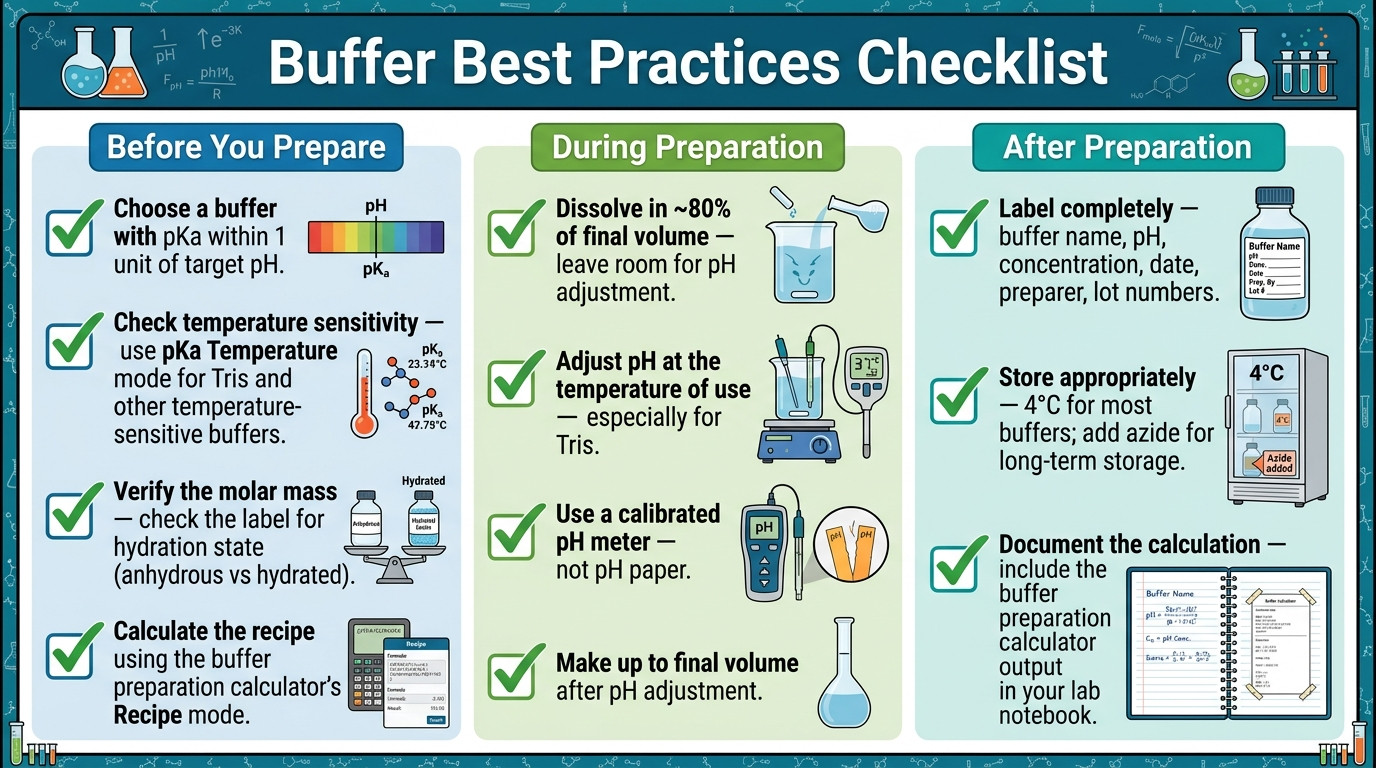
- Buffer Best Practices Checklist
- Trusted Reference Resources
- User Reviews & Ratings
What a Buffer Preparation Calculator Does
A buffer preparation calculator converts a target pH, buffer concentration, and volume into the exact masses or volumes of acid and conjugate base you need to weigh or pipette. Buffers are solutions that resist pH changes when small amounts of acid or base are added — they are essential in virtually every area of chemistry, biochemistry, molecular biology, cell culture, clinical chemistry, and environmental science. The Henderson-Hasselbalch equation tells you the ratio of conjugate base to acid needed for a target pH, but converting that ratio into a practical recipe (grams of sodium phosphate monobasic and dibasic, millilitres of Tris base and HCl, or grams of acetic acid and sodium acetate) requires additional arithmetic involving molar masses, solution volumes, and sometimes density corrections. The buffer preparation calculator handles all of this in one step.
The reason buffer preparation trips people up is not the Henderson-Hasselbalch equation itself — it is the multi-step conversion from pH target to weighable quantities. You must choose a buffer system with a pKa near your target pH (effective range pKa ± 1), calculate the ratio [A⁻]/[HA] from the Henderson-Hasselbalch equation, convert that ratio into moles of each component for your target concentration and volume, then convert moles to grams using the molar mass of each specific salt or acid form (which may include hydration waters). Missing any step — using the wrong pKa, the wrong molar mass, or the wrong sign in the Henderson-Hasselbalch equation — gives a buffer at the wrong pH, which can invalidate an entire experiment. The buffer preparation calculator eliminates every one of these errors.
This buffer preparation calculator handles five modes: the Henderson-Hasselbalch solver (calculate pH from ratio, or ratio from pH), the buffer recipe builder (complete recipe in grams and mL for a target pH, concentration, and volume), the buffer capacity calculator (β, the quantitative resistance to pH change), the pKa temperature correction (for buffers like Tris that have large temperature coefficients), and the common buffer lookup (pre-loaded pKa and molar mass data for 12 common buffer systems). Each mode shows every step of the working, making it suitable for laboratory notebooks, SOPs, teaching, and regulatory documentation.
Buffer Preparation Calculator
Five modes — Henderson-Hasselbalch, recipe builder, capacity, pKa correction & buffer lookup
Calculation Result
⚠️ Note: This buffer preparation calculator assumes ideal behaviour. Always verify pH with a calibrated pH meter after preparation and adjust with acid/base as needed.
How Buffer Calculations Work
Every buffer calculation begins with the Henderson-Hasselbalch equation: pH = pKa + log([A⁻]/[HA]), where [A⁻] is the concentration of the conjugate base and [HA] is the concentration of the weak acid. This equation tells you the ratio of base to acid forms needed for any target pH. A buffer works best within pKa ± 1 pH units — outside this range, the buffer capacity drops below 10% of its maximum and the solution no longer effectively resists pH changes.
From Ratio to Recipe
The Henderson-Hasselbalch equation gives you a ratio, not a recipe. To convert the ratio into grams: (1) calculate total moles = concentration × volume, (2) split into moles of base = total × fraction_base and moles of acid = total × fraction_acid, where fraction_base = ratio/(1+ratio) and fraction_acid = 1/(1+ratio), (3) multiply each by its molar mass to get grams. The buffer preparation calculator performs all three steps automatically for 12 common buffer systems with pre-loaded molar masses.
Buffer Capacity (β)
Buffer capacity quantifies how much acid or base the buffer can absorb before the pH changes significantly. The formula is: β = 2.303 × C × Ka × [H⁺] / (Ka + [H⁺])², where C is the total buffer concentration and Ka = 10^(−pKa). Maximum capacity occurs at pH = pKa, where β_max = 2.303 × C / 4. Higher concentration = higher capacity. The buffer preparation calculator’s Capacity mode computes β for any combination of C, pKa, and pH.
Temperature Effects on pKa
The pKa of a buffer changes with temperature. This is particularly important for Tris buffer, which has a large temperature coefficient of −0.028 per °C. A Tris buffer adjusted to pH 7.40 at 25°C will have pH 7.74 at 4°C and pH 7.06 at 37°C — a shift of nearly 0.7 pH units across the common laboratory temperature range. The buffer preparation calculator’s pKa Temperature mode corrects for this, showing the pKa at any temperature so you can prepare the buffer at the temperature of use rather than room temperature.
Fraction base: [A⁻]/(C) = ratio/(1+ratio)
Buffer capacity: β = 2.303 C Ka [H⁺] / (Ka+[H⁺])²
pKa at T: pKa(T) = pKa(25°C) + dpKa/dT × (T−25)
Quick Reference Values
Remember: Choose a buffer with pKa within 1 unit of your target pH. Always verify final pH with a calibrated pH meter and adjust with HCl or NaOH as needed. The buffer preparation calculator gives the starting recipe — the pH meter gives the final verification.

Real Scenarios Where Buffer Math Mattered
Scenario 1: Tris Buffer pH Shift at 37°C
A cell biologist prepared a Tris-HCl buffer at pH 7.40 at room temperature (25°C) for cell culture experiments at 37°C. Using the buffer preparation calculator’s pKa Temperature mode: Tris pKa shifts from 8.06 at 25°C to 8.06 + (−0.028 × 12) = 7.72 at 37°C. The Henderson-Hasselbalch ratio changes accordingly, meaning the buffer that was pH 7.40 at 25°C is approximately pH 7.06 at 37°C — too acidic for most mammalian cells. The calculator showed that the buffer should be adjusted to pH 7.74 at 25°C to achieve pH 7.40 at 37°C, or preferably adjusted at 37°C directly.
Scenario 2: Phosphate Buffer for Enzyme Assay
A biochemist needed 500 mL of 50 mM sodium phosphate buffer at pH 7.4 for an enzyme kinetics assay. Using the buffer preparation calculator’s Recipe mode: pKa = 7.20, ratio = 10^(7.4−7.2) = 1.585, fraction base = 0.613, fraction acid = 0.387. Total moles = 0.025. Base (Na₂HPO₄) = 0.01533 mol × 141.96 = 2.176 g. Acid (NaH₂PO₄·H₂O) = 0.00967 mol × 137.99 = 1.334 g. Dissolve in ~400 mL water, check pH, adjust to 7.4 with NaOH or HCl, make up to 500 mL.
Scenario 3: Acetate Buffer for Protein Purification
A protein biochemist needed 1 L of 20 mM sodium acetate buffer at pH 5.0 for ion exchange chromatography. Using the buffer preparation calculator: pKa = 4.76, ratio = 10^(5.0−4.76) = 1.738, fraction base = 0.635, fraction acid = 0.365. Total moles = 0.02. Sodium acetate trihydrate = 0.0127 mol × 136.08 = 1.728 g. Acetic acid = 0.0073 mol × 60.05 = 0.438 g (or 0.417 mL glacial). The calculator output was included in the chromatography method documentation.
Scenario 4: HEPES Buffer for Cell Culture
A tissue culture facility prepared 10 L of 25 mM HEPES buffer at pH 7.4 for serum-free medium. Using the buffer preparation calculator: HEPES pKa = 7.50, ratio = 10^(7.4−7.5) = 0.794, fraction base = 0.443, fraction acid = 0.557. HEPES sodium salt = 0.1107 mol × 260.29 = 28.81 g. HEPES free acid = 0.1393 mol × 238.30 = 33.19 g. The calculator also flagged that HEPES has minimal temperature sensitivity (dpKa/dT = −0.014), making it ideal for 37°C incubators compared to Tris.
Scenario 5: Citrate Buffer for Histology Antigen Retrieval
A histology laboratory prepared 2 L of 10 mM citrate buffer at pH 6.0 for heat-induced antigen retrieval. Using the buffer preparation calculator: citrate pKa₂ = 4.76, but for pH 6.0, the relevant pKa₃ = 6.40. The calculator computed the ratio between citrate²⁻ and citrate³⁻ forms, giving citric acid = 0.684 g and trisodium citrate dihydrate = 5.098 g for 2 L. The precise pH is critical for antigen retrieval — off by 0.5 pH units can dramatically affect staining quality.
Scenario 6: Carbonate Buffer for ELISA Coating
An immunologist prepared 500 mL of 50 mM carbonate-bicarbonate buffer at pH 9.6 for ELISA plate coating. Using the buffer preparation calculator: carbonate pKa = 10.33, ratio = 10^(9.6−10.33) = 0.186. NaHCO₃ = 0.02126 mol × 84.01 = 1.786 g. Na₂CO₃ = 0.003735 mol × 105.99 = 0.396 g. The high pH is essential for protein adsorption to polystyrene microplates.
Scenario 7: Buffer Capacity Calculation for Fermentation
A biotechnologist needed to determine whether a 100 mM phosphate buffer at pH 7.0 would maintain pH during a fermentation run producing 5 mmol/L of organic acid per hour. Using the buffer preparation calculator’s Capacity mode: β = 2.303 × 0.1 × (6.31×10⁻⁸) × (10⁻⁷) / (6.31×10⁻⁸ + 10⁻⁷)² = 0.0575 mol/(L·pH). This means the buffer can absorb ~57.5 mmol of acid per litre per pH unit — sufficient for the 5 mmol/L/hour acid production over a 10-hour run without pH dropping more than ~0.9 units.
Scenario 8: Good’s Buffer (MOPS) for Electrophysiology
An electrophysiologist prepared a MOPS-based intracellular solution at pH 7.2, which is exactly at the pKa. Using the buffer preparation calculator: at pH = pKa, the ratio [A⁻]/[HA] = 1.0, so equal moles of MOPS free acid and MOPS sodium salt are needed. For 500 mL of 10 mM MOPS: each = 2.5 mmol = 0.523 g MOPS acid + 0.578 g MOPS sodium salt. The equal proportion maximises buffer capacity, which is critical for maintaining stable intracellular pH during patch-clamp recordings.

Common Buffer Preparation Mistakes
Mistake 1: Ignoring Temperature Dependence of pKa
The most impactful buffer error, especially with Tris. A Tris buffer adjusted to pH 7.4 at 25°C is pH 7.06 at 37°C — 0.34 units too low. Always use the buffer preparation calculator’s pKa Temperature mode and adjust pH at the temperature of use.
Mistake 2: Choosing a Buffer Outside Its Effective Range
A buffer with pKa 7.2 (phosphate) is ineffective at pH 5.0 (more than 2 units from pKa). At pH 5.0, less than 1% of the phosphate is in the H₂PO₄⁻/HPO₄²⁻ form — use an acetate buffer (pKa 4.76) instead. The buffer preparation calculator warns when pH is more than 2 units from pKa.
Mistake 3: Using the Wrong Molar Mass
Na₂HPO₄ (anhydrous) = 141.96 g/mol, but Na₂HPO₄·7H₂O = 268.07 g/mol. Using the anhydrous molar mass when you have the heptahydrate gives a buffer nearly 2× too dilute. Always check the label for hydration state and use the correct molar mass in the buffer preparation calculator.
Mistake 4: Not Verifying pH After Preparation
The Henderson-Hasselbalch equation assumes ideal behaviour. Real solutions have activity coefficient effects, ionic strength influences, and CO₂ absorption (for alkaline buffers). Always verify the final pH with a calibrated pH meter and adjust with dilute HCl or NaOH as needed.
Mistake 5: Making Up to Volume Before pH Adjustment
Adding NaOH or HCl to adjust pH changes the volume. Add the buffer components to ~80% of the target volume, adjust pH, THEN make up to final volume. The buffer preparation calculator’s recipe shows this sequence in the step-by-step output.
Mistake 6: Confusing pKa with pH
pKa is a fixed property of the buffer acid; pH is the target you want to achieve. A phosphate buffer with pKa 7.20 can be prepared at any pH between about 5.8 and 8.0 — the pKa does not change (at a given temperature). The Henderson-Hasselbalch equation connects pKa (known) to pH (target) via the ratio (calculated).
Mistake 7: Ignoring Buffer-Metal Interactions
Phosphate buffers chelate divalent metals (Ca²⁺, Mg²⁺, Mn²⁺), which can inhibit metalloenzymes and cause precipitation. HEPES, MOPS, and other Good’s buffers have minimal metal chelation and are preferred for metalloenzyme assays and cell culture. The buffer preparation calculator’s Lookup mode includes this information for each buffer system.
💡 Rule of Thumb: Choose a buffer with pKa within 1 unit of target pH. Adjust pH at the temperature of use. Use the buffer preparation calculator for the starting recipe, then verify with a pH meter. For cell culture and metalloenzyme work, prefer HEPES or MOPS over phosphate or Tris.
Lab Safety Essentials
Concentrated acids and bases: pH adjustment with concentrated HCl (12 M) or NaOH (10 M) requires extreme care — add dropwise with stirring, wear gloves and goggles, and work at a fume hood. Never pipette concentrated acid by mouth.
- Calibrate the pH meter — use fresh pH 4, 7, and 10 standards before every session.
- Adjust pH at the temperature of use — especially for Tris buffers.
- Use analytical-grade reagents — impurities can shift pH and affect experiments.
- Label the buffer — include name, pH, concentration, date, preparer, and lot numbers.
- Store properly — buffers are susceptible to microbial growth; add azide (0.02%) for long-term storage or autoclave if compatible.
- Document the preparation — use the buffer preparation calculator output for your lab notebook.
Which Mode Fits Your Situation
| Mode | Use Case | Key Formula | Inputs | Applications |
|---|---|---|---|---|
| H-H Solver | pH↔ratio conversion | pH = pKa + log(ratio) | pKa, pH or ratio | Teaching, quick checks |
| Recipe | Complete preparation recipe | Grams of each component | Buffer, pH, conc, vol | Lab prep, SOPs |
| Capacity | Resistance to pH change | β formula | C, pKa, pH | Fermentation, process control |
| pKa Temp | Temperature correction | pKa(T) = pKa + dpKa×ΔT | Buffer, temperature | Tris at 37°C, cold room |
| Lookup | Reference data | Pre-loaded database | Buffer name | Quick reference, teaching |
Buffer Systems in Biochemistry
Biochemists choose buffer systems based on pKa (must be near target pH), temperature sensitivity (Tris is problematic; HEPES is stable), metal chelation (phosphate chelates metals; Good’s buffers do not), UV absorbance (HEPES absorbs below 230 nm, interfering with UV protein quantification), and biological compatibility (some buffers inhibit specific enzymes). The buffer preparation calculator’s Lookup mode provides all of this information for 12 common buffer systems, supporting informed buffer selection before calculation.
Buffer Systems in Cell Culture
Cell culture media typically use bicarbonate/CO₂ buffering (maintained by a 5% CO₂ incubator at pH 7.4) supplemented with HEPES (10–25 mM) for additional pH stability during medium changes and transport. The buffer preparation calculator supports HEPES recipe building for cell culture applications, and the pKa Temperature mode shows that HEPES is much more stable than Tris across the 4–37°C range used in cell biology.
Buffer Systems in Analytical Chemistry
Analytical buffers for HPLC mobile phases, capillary electrophoresis, and electrochemistry require known ionic strength, UV transparency, and volatility (for mass spectrometry). Ammonium formate and ammonium acetate are volatile buffers compatible with LC-MS. Phosphate buffers are excellent for HPLC but incompatible with MS. The buffer preparation calculator handles all of these systems and provides the molar masses needed for weighing.
Worked Examples
Example 1 — H-H pH: pKa = 7.20, ratio = 1.585. pH = 7.20 + log(1.585) = 7.20 + 0.20 = 7.40.
Example 2 — H-H Ratio: pKa = 7.20, pH = 7.40. Ratio = 10^(0.20) = 1.585. Base = 61.3%, acid = 38.7%.
Example 3 — Recipe: 50 mM phosphate pH 7.4 in 1 L: Na₂HPO₄ = 4.352 g, NaH₂PO₄·H₂O = 2.669 g.
Example 4 — Capacity: 0.1 M phosphate at pH 7.2 (= pKa): β = 2.303 × 0.1/4 = 0.0576 mol/(L·pH).
Example 5 — pKa Temp: Tris at 37°C: pKa = 8.06 + (−0.028 × 12) = 7.72.
Frequently Asked Questions
1. What is a buffer preparation calculator?
A buffer preparation calculator uses the Henderson-Hasselbalch equation to compute the exact amounts of acid and base forms needed to prepare a buffer at a target pH, concentration, and volume. This calculator provides five modes: H-H solver, recipe builder, capacity, pKa temperature correction, and buffer lookup.
2. What is the Henderson-Hasselbalch equation?
pH = pKa + log([A⁻]/[HA]), where [A⁻] is the conjugate base concentration and [HA] is the weak acid concentration. It relates the pH of a buffer to the pKa and the ratio of base to acid forms.
3. What is the effective range of a buffer?
pKa ± 1 pH unit. Within this range, the buffer has significant capacity to resist pH changes. Outside this range, capacity drops below ~10% of maximum and the buffer is ineffective.
4. Why does Tris pH change with temperature?
Tris has a large temperature coefficient (dpKa/dT = −0.028/°C), meaning its pKa drops 0.028 per degree rise. A Tris buffer pH-adjusted at 25°C will be ~0.34 pH units lower at 37°C. Always adjust Tris buffers at the temperature of use.
5. What is buffer capacity?
Buffer capacity (β) quantifies the amount of acid or base (in moles) a buffer can absorb per litre per unit pH change. Maximum capacity occurs at pH = pKa. Higher buffer concentration = higher capacity.
6. Which buffer is best for pH 7.4?
Phosphate (pKa 7.20) and HEPES (pKa 7.50) are both excellent for pH 7.4. HEPES is preferred for cell culture and metalloenzyme work because it does not chelate metals. Phosphate is preferred for general biochemistry due to lower cost.
7. How do I adjust pH after preparing the buffer?
Add dilute HCl (to lower pH) or NaOH (to raise pH) dropwise while stirring and monitoring with a calibrated pH meter. Add acid/base to ~80% of target volume, adjust pH, then make up to final volume.
8. Why should I use the correct molar mass for hydrated salts?
Hydrated salts (e.g., Na₂HPO₄·7H₂O) have higher molar mass than anhydrous forms. Using the wrong molar mass gives the wrong mass of salt, resulting in the wrong buffer concentration and pH.
9. Can phosphate buffer be autoclaved?
Yes. Phosphate buffers are heat-stable and can be autoclaved at 121°C for 15–20 minutes. Tris buffers can also be autoclaved but may shift pH slightly. HEPES can be autoclaved but is light-sensitive — store in amber bottles.
10. Is this buffer preparation calculator free?
Yes. Completely free, browser-based, no sign-up, fully private. No data sent to any server. Reviews are saved in your browser only.
Buffer Best Practices Checklist
Before You Prepare
During Preparation
After Preparation
Trusted Reference Resources
Good et al. (1966) — The original paper defining Good’s buffers (HEPES, MOPS, MES, PIPES, etc.) for biological research. Biochemistry 5:467–477.
Sigma-Aldrich Buffer Reference — sigmaaldrich.com — Buffer preparation tables, pKa values, and temperature coefficients.
LibreTexts Chemistry — chem.libretexts.org — Free explanations of Henderson-Hasselbalch equation, buffer capacity, and buffer preparation.
NIST Standard pH Buffer Solutions — nist.gov — Primary pH standards for pH meter calibration.
Stoll & Bhatt (2015) — Current Methods in Biochemistry and Cell Biology. Comprehensive buffer preparation protocols for modern biological research.
User Reviews & Ratings
Share Your Experience with This Buffer Preparation Calculator
Final Thoughts on Buffer Preparation
Buffer preparation is one of the most common and most critical tasks in any chemistry or biology laboratory. The Henderson-Hasselbalch equation is simple, but the multi-step conversion from target pH to weighable grams — accounting for molar mass, hydration state, concentration, volume, and temperature — creates multiple opportunities for error. A wrong molar mass doubles or halves the buffer concentration. A forgotten temperature correction shifts the pH by 0.3–0.7 units. A buffer chosen outside its effective range provides no pH resistance at all.
The buffer preparation calculator eliminates these errors by handling every step: choosing the right buffer system (Lookup mode), computing the ratio and recipe (H-H Solver and Recipe modes), quantifying the buffer’s resistance (Capacity mode), and correcting for temperature (pKa Temp mode). The pre-loaded database of 12 buffer systems covers the vast majority of laboratory needs, and the step-by-step output provides auditable documentation for SOPs, lab notebooks, and publications.
🔒 Privacy Guarantee: Every calculation runs entirely within your browser. No data is sent to any server. Reviews are saved in your browser’s local storage only.
Pingback: Stoichiometry Calculator – Solve Chemical Reactions Instantly
Pingback: Solubility Calculator – Calculate Solubility Instantly
Pingback: How to Calculate a Dilution? Free Dilution Calculator
Pingback: Essential Oil Dilution Calculator - Face, Body & Bath | Free
Pingback: Dilution Calculator mg/ml: 5 Easy Steps to Success
Pingback: How to Calculate Dilution Factor: 5 Steps to Flawless Results
Pingback: Mixing Ratio Calculator: Exact Volumes for Any Ratio (Free Tool)
Pingback: Infusion Rate Calculator – Calculate IV Infusion Rates Instantly
Pingback: Star San Sanitizer Multi-Unit Tool | Free No-Rinse Brewing Sanitizer
Pingback: Neem Oil Dilution Ratio Calculator | Mix Neem Oil Correctly -
Pingback: Pediatric Dose Calculator | Calculate Child Medication Doses
Pingback: ABV Calculator – Calculate Alcohol by Volume Instantly
Pingback: Common Lab Solutions | Preparation Guide & Calculator
Pingback: USP Chapters | Complete Guide to USP General Chapters
Pingback: Solution Stability | Complete Guide to Chemical Stability
Pingback: GMP Guidelines | Good Manufacturing Practice Guide
Pingback: Pool Chemistry Calculator | Calculate Pool Water Balance
Pingback: Pool Salt Calculator | Calculate Salt for Your Pool Instantly
Pingback: Pool Volume Calculator | Calculate Your Pool's Water Volume
Pingback: Antifreeze Dilution Calculator | Calculate Coolant & Water Ratio
Pingback: Coolant Mix Ratio Calculator | Calculate Coolant & Water Ratio
Pingback: Coolant Dilution Calculator | Calculate Coolant & Water Amounts