
Volume Concentration Calculator — % v/v, mL/L, Dilution & ABV Converter
A volume concentration calculator computes the ratio of solute volume to total solution volume — the standard way to express concentration when both solute and solvent are liquids. Volume concentration = (volume of solute ÷ volume of solution) × 100, expressed as % v/v. The volume concentration calculator handles five tasks: computing % v/v from volumes, finding the volume of solute needed for a target concentration, finding the total solution volume required, converting between volume concentration units (% v/v, mL/L, µL/mL, ppm v/v), and converting % v/v to mass concentration using solute density. This is the go-to calculator for alcohol (ABV), disinfectant dilutions, organic solvent mixtures, flavouring extracts, and any liquid-in-liquid preparation. Enter your values below and get the result with every step shown.
Key facts at a glance
- % v/v formula: (volume of solute ÷ volume of solution) × 100
- Key equivalence: 1% v/v = 10 mL/L = 10,000 µL/L = 10,000 ppm v/v
- To mass concentration: g/L = % v/v × 10 × density of pure solute (g/mL)
- ABV (alcohol by volume): identical to % v/v
- Volume contraction: 70 mL ethanol + 30 mL water ≠ 100 mL (≈ 96.5 mL)
- Common examples: 70% v/v ethanol, 5% v/v acetic acid, 40% v/v whisky
📋 Table of Contents
▼
- What a Volume Concentration Calculator Does
- Volume Concentration Calculator — Five Modes
- How Volume Concentration Is Calculated
- Real Scenarios Where Volume Concentration Mattered
- Common Volume Concentration Mistakes
- Lab & Clinical Safety Essentials
- Which Mode Fits Your Situation
- Frequently Asked Questions
- Volume Concentration Best Practices Checklist
- Trusted Reference Resources
- User Reviews & Ratings
What a Volume Concentration Calculator Does
A volume concentration calculator computes the proportion of a liquid solute in a liquid solution, expressed as a percentage of volume (% v/v) or in related units such as mL/L, µL/mL, or ppm v/v. Volume concentration is the standard expression whenever both the solute and the solvent are liquids — alcohol content (ABV), disinfectant dilutions, organic solvent mixtures, flavouring extracts, essential oil formulations, and liquid reagent preparations in chemistry and biochemistry laboratories. The volume concentration calculator handles every rearrangement of the formula and every unit conversion, showing the working at each step so you can verify, document, or teach the calculation.
The reason volume concentration calculations cause errors is not the arithmetic — it is the assumption that volumes are additive. When you mix 70 mL of ethanol with 30 mL of water, the total volume is not 100 mL — it is approximately 96.5 mL, because the ethanol and water molecules interact and pack more tightly than either liquid alone. This phenomenon, called volume contraction, means that % v/v is defined as the volume of solute per volume of the final mixture, not per sum of the component volumes. Preparing a 70% v/v ethanol solution therefore requires measuring 70 mL of ethanol and making the total up to 100 mL in a volumetric flask, not simply mixing 70 mL + 30 mL. The volume concentration calculator uses the correct definition internally, and the step-by-step output reminds you of this distinction.
This volume concentration calculator handles the five most common tasks: computing % v/v from solute and solution volumes, finding the volume of solute needed for a target concentration, finding the total solution volume required for a given amount of solute, converting between volume concentration units (% v/v ↔ mL/L ↔ µL/mL ↔ ppm v/v), and converting % v/v to mass concentration (g/L) using the density of the pure solute. Each mode shows the answer and every step of the working, making it suitable for clinical documentation, laboratory notebooks, teaching, quality control, and regulatory records.
Volume Concentration Calculator
Five modes — % v/v, find solute volume, find solution volume, unit converter & to mass concentration
Calculation Result
⚠️ Safety: This volume concentration calculator is an educational tool, not a substitute for professional judgement. Always verify concentrations independently and follow institutional protocols.
How Volume Concentration Is Calculated
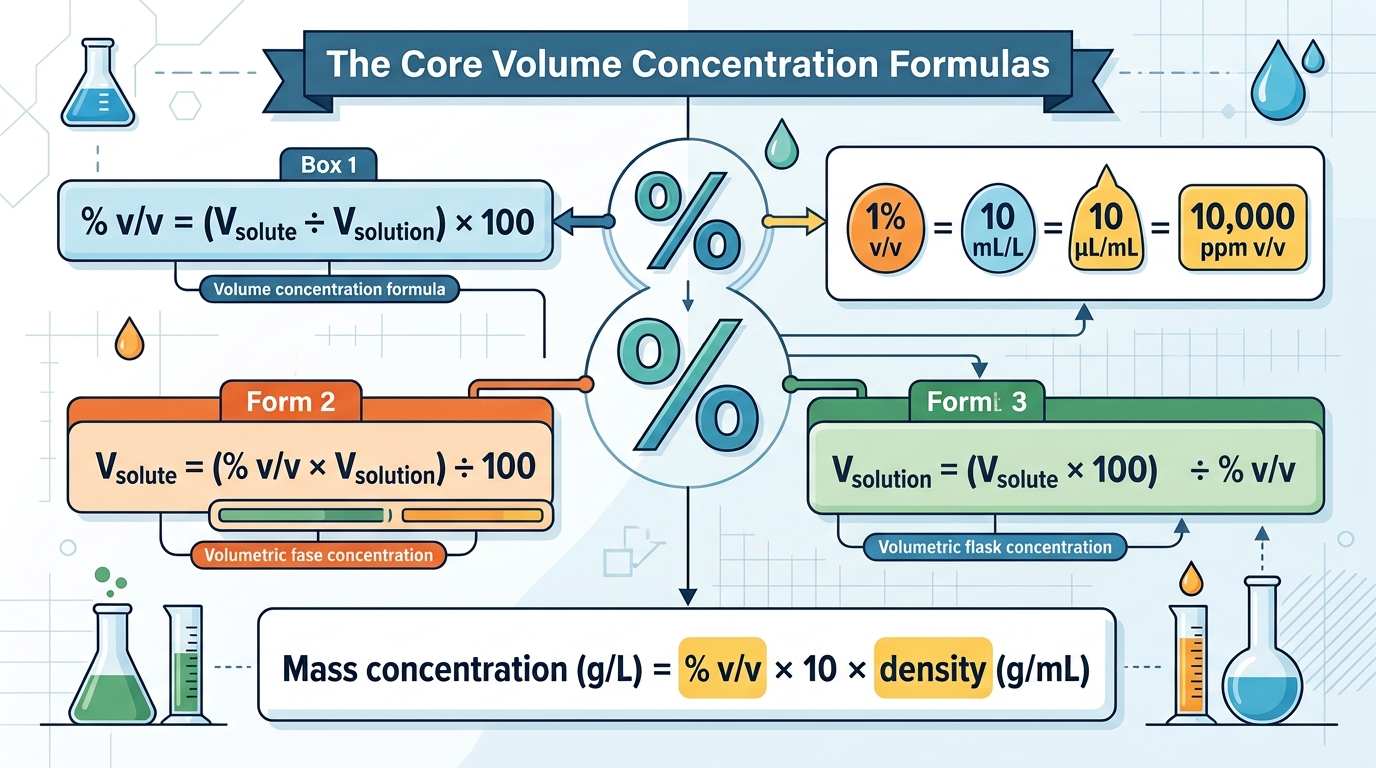
Every volume concentration calculation starts from one formula: % v/v = (volume of solute ÷ volume of solution) × 100. This expression tells you what fraction of the final solution is composed of the solute liquid. A 70% v/v ethanol solution means that in every 100 mL of the final solution, 70 mL came from pure ethanol. The volume concentration calculator applies this formula in all three directions — finding % v/v, finding solute volume, or finding total solution volume — and handles unit conversions between mL, L, and µL automatically.
Understanding Volume Contraction
The single most important concept in volume concentration that most people get wrong is volume contraction. When two miscible liquids are mixed, the total volume of the mixture is almost always less than the sum of the individual volumes. For ethanol and water, mixing 70 mL of ethanol with 30 mL of water gives approximately 96.5 mL of solution, not 100 mL. This happens because ethanol molecules fit into the spaces between water molecules, resulting in a denser packing. The practical consequence is that to prepare a 70% v/v ethanol solution, you measure 70 mL of ethanol and then add water until the total volume reaches 100 mL in a volumetric flask — you do NOT simply add 30 mL of water. The volume concentration calculator uses this correct definition internally, and the step-by-step output reminds you to “make up to volume” rather than “add solvent volume”.
% v/v vs % w/v vs % w/w
Volume concentration (% v/v) is only one of three types of percent concentration. % v/v uses volume of solute per volume of solution — appropriate when both components are liquids. % w/v uses mass of solute per volume of solution — appropriate for solids dissolved in liquids. % w/w uses mass of solute per mass of solution — appropriate for solid-in-solid or dense liquid mixtures. A 70% v/v ethanol solution is NOT the same as 70% w/v ethanol — because ethanol has a density of 0.789 g/mL, 70% v/v ethanol corresponds to approximately 55.2% w/v (70 × 0.789 = 55.23 g per 100 mL). The volume concentration calculator’s “To g/L” mode handles this conversion using the density of the pure solute.
Volume Concentration Units
Volume concentration can be expressed in several units: % v/v (mL per 100 mL — the most common), mL/L (millilitres per litre — 1% v/v = 10 mL/L), µL/mL (microlitres per millilitre — numerically equal to mL/L), and ppm v/v (parts per million by volume — 1% v/v = 10,000 ppm v/v). The volume concentration calculator’s Convert mode handles all of these interconversions.
ABV — Alcohol by Volume
ABV (alcohol by volume) is identical to % v/v and is the internationally standard way to express the alcohol content of beverages. A wine at 13% ABV contains 13 mL of pure ethanol per 100 mL of wine. A spirit at 40% ABV contains 40 mL of pure ethanol per 100 mL. The volume concentration calculator works directly with ABV values — enter the ABV as % v/v and compute any related quantity.
Vsolution = (Vsolute × 100) ÷ % v/v
1% v/v = 10 mL/L = 10 µL/mL = 10,000 ppm v/v
Mass concentration (g/L) = % v/v × 10 × density (g/mL)
Quick Reference Values
Remember: % v/v is volume of solute per volume of FINAL SOLUTION, not per volume of solvent added. Always make up to volume in a volumetric flask — never simply add the calculated solvent volume.
Real Scenarios Where Volume Concentration Mattered
Scenario 1: Hospital Disinfectant at Wrong Concentration
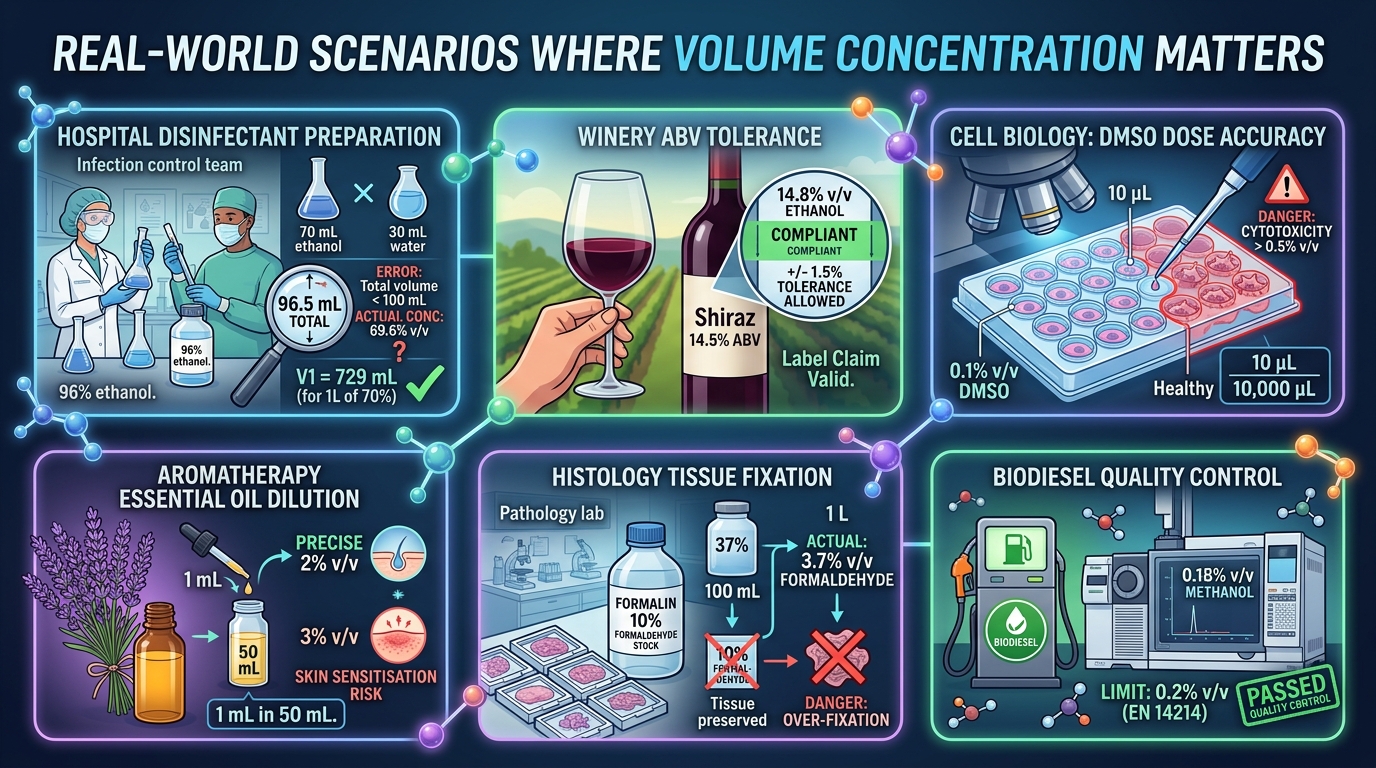
An infection control team prepared ethanol hand sanitiser by mixing 70 mL of 96% ethanol with 30 mL of water, assuming the result was 70% v/v ethanol. However, they made two errors: first, 70 mL of 96% ethanol contains only 67.2 mL of pure ethanol (70 × 0.96); second, the total volume after mixing was not 100 mL but approximately 96.5 mL due to volume contraction. The actual concentration was (67.2 ÷ 96.5) × 100 = 69.6% v/v — close but not exactly right. The volume concentration calculator would have shown the correct calculation from the start: to get 70% v/v from 96% stock, use C1V1=C2V2: V1 = (70 × 1000) ÷ 96 = 729 mL of 96% ethanol, made up to 1000 mL total.
Scenario 2: Wine Alcohol Content for Labelling
A winery needed to verify that their Shiraz was within the legal ABV tolerance for the label claim of 14.5% ABV. Laboratory analysis measured the ethanol concentration at 14.8% v/v. Using the volume concentration calculator’s Convert mode: 14.8% v/v = 148 mL/L = 116.8 g/L (using ethanol density 0.789 g/mL). The result was within the ±1.5% tolerance allowed by most jurisdictions, so the label claim was valid.
Scenario 3: DMSO Stock for Cell Culture
A cell biologist needed to prepare 10 mL of 0.1% v/v DMSO in cell culture medium for a drug solubility experiment. Using the volume concentration calculator’s Find Solute mode: volume of DMSO = (0.1 × 10,000) ÷ 100 = 10 µL of pure DMSO, made up to 10 mL with medium. At concentrations above 0.5% v/v, DMSO is cytotoxic to most cell lines, so the precise calculation prevented inadvertent cell death.
Scenario 4: Essential Oil Dilution for Aromatherapy
An aromatherapist needed to prepare a 2% v/v lavender essential oil blend in a carrier oil. For a 50 mL bottle: volume of essential oil = (2 × 50) ÷ 100 = 1 mL of pure lavender oil, topped up with carrier oil to 50 mL total. Using 3% instead of 2% (a common error when estimating drops) would have increased the concentration by 50%, potentially causing skin sensitisation.
Scenario 5: Acetic Acid for Histology
A histology laboratory prepared a 5% v/v acetic acid solution for tissue fixation. Using the volume concentration calculator: volume of glacial acetic acid (99.7% v/v) needed for 500 mL of 5% solution = (5 × 500) ÷ 99.7 = 25.1 mL, made up to 500 mL with water. The step-by-step output was recorded in the lab notebook as part of the SOP documentation.
Scenario 6: Glycerol Cryoprotectant for Bacterial Stocks
A microbiologist prepared glycerol stocks for long-term bacterial storage at -80°C. The standard is 15% v/v glycerol. For 1 mL stocks: volume of glycerol = (15 × 1000) ÷ 100 = 150 µL of pure glycerol, added to 850 µL of overnight bacterial culture. Using the volume concentration calculator confirmed the volumes and prevented the common error of using 15% w/v (which would require density correction since glycerol is denser than water at 1.26 g/mL).
Scenario 7: Methanol in Biodiesel Quality Control
A biodiesel producer needed to verify that residual methanol in the final product was below the EN 14214 limit of 0.2% v/v. Laboratory GC analysis reported 0.18% v/v. Using the volume concentration calculator’s Convert mode: 0.18% v/v = 1.8 mL/L = 1800 ppm v/v. The result was below the 0.2% limit (2000 ppm), so the batch passed quality control.
Scenario 8: Formaldehyde Dilution for Fixation
A pathology laboratory diluted 37% v/v formaldehyde stock to prepare 10% neutral buffered formalin (which is actually 3.7% v/v formaldehyde — “10% formalin” means 10% of the 37% stock). Using the volume concentration calculator: for 1 L of 10% formalin, volume of 37% stock = (3.7 × 1000) ÷ 37 = 100 mL, made up to 1000 mL with phosphate buffer. This calculation prevents the dangerous confusion between “10% formalin” and “10% formaldehyde” — the latter is 2.7× more concentrated and can over-fix tissue.
Common Volume Concentration Mistakes
Mistake 1: Adding Volumes Instead of Making Up to Volume
The most common error: mixing 70 mL solute + 30 mL solvent and calling it 70% v/v. Due to volume contraction, the total is less than 100 mL, so the actual concentration is higher than 70%. Always measure solute first, then add solvent to reach the target total volume in a volumetric flask.
Mistake 2: Confusing % v/v with % w/v
For solutes with density ≠ 1 g/mL, % v/v and % w/v are different. 70% v/v ethanol ≠ 70% w/v ethanol. The volume concentration calculator’s “To g/L” mode converts between them using the solute density.
Mistake 3: Using Stock Concentration as If It Were 100%
If your ethanol stock is 96% v/v (not 100%), you must account for this. 70 mL of 96% ethanol contains only 67.2 mL of pure ethanol. Use C1V1=C2V2 to calculate the correct stock volume.
Mistake 4: Ignoring Temperature Effects
Liquid volumes change with temperature — ethanol expands more than water when heated. A solution prepared at 20°C may have a different % v/v at 4°C or 37°C. For regulatory work (ABV labelling), measurements are standardised to 20°C.
Mistake 5: Confusing “10% Formalin” with “10% Formaldehyde”
In histology, “10% formalin” means 10% of the stock (37% formaldehyde), which is 3.7% formaldehyde. “10% formaldehyde” would be 10% of pure formaldehyde — 2.7× more concentrated. The volume concentration calculator prevents this by requiring explicit input of the actual concentration.
Mistake 6: Not Accounting for Immiscible Liquids
% v/v only applies to miscible liquids (liquids that mix completely). Oil and water are immiscible — you cannot express an oil-water mixture as % v/v in the same way. For emulsions, % v/v refers to the dispersed phase volume fraction, which requires different handling.
Mistake 7: Converting Units Without Checking the Base
1% v/v = 10 mL/L = 10,000 ppm v/v. Confusing these conversions (e.g., treating 1% as 1000 ppm instead of 10,000 ppm) gives a 10× error. The volume concentration calculator’s Convert mode handles all conversions correctly.
💡 Rule of Thumb: Always measure the solute volume first, then make up to the target total volume. Never add a calculated volume of solvent — volume contraction means the total will be wrong. The volume concentration calculator shows this in every step.
Lab & Clinical Safety Essentials
Flammable solvents: ethanol, methanol, isopropanol, and acetone are flammable. Prepare dilutions away from open flames, in a fume hood for volatile solvents, and store in approved containers. Never heat flammable solvents on a hot plate — use a water bath.
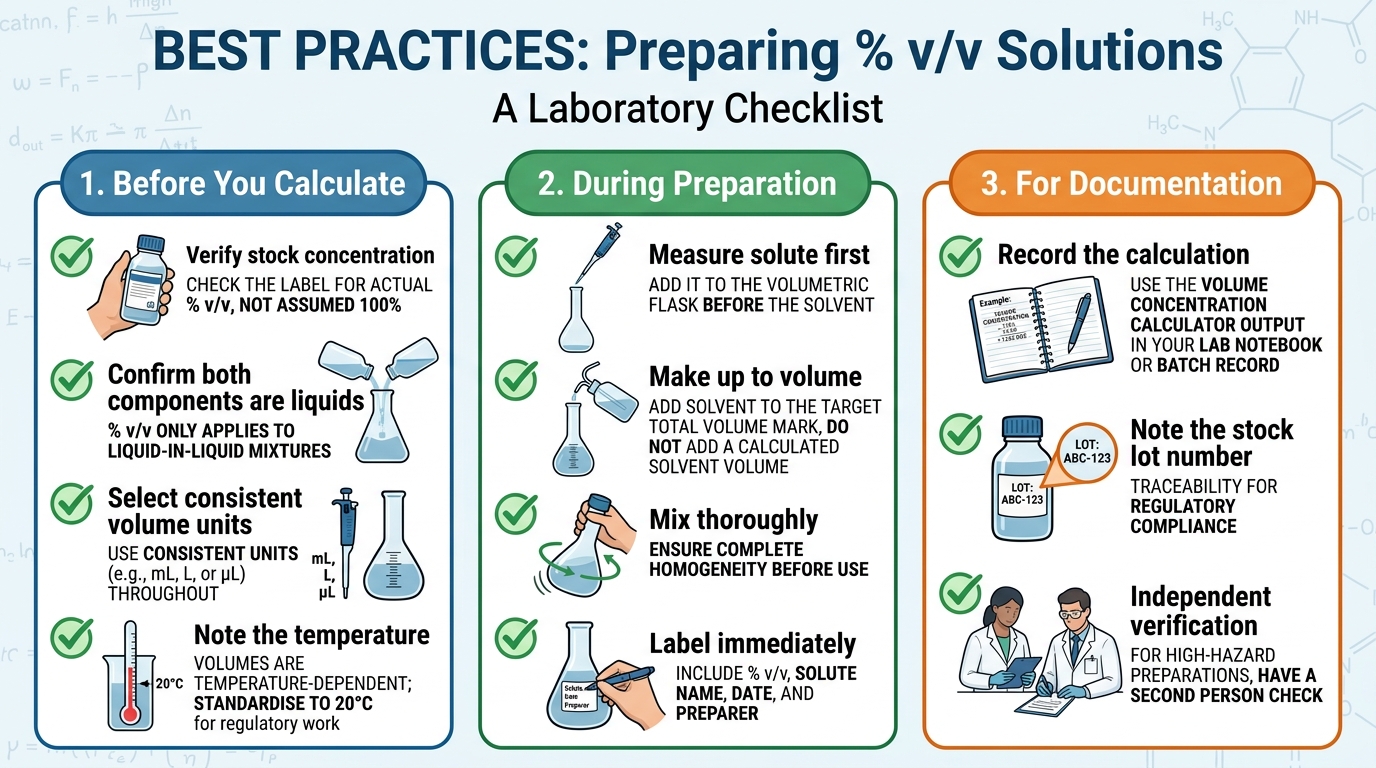
- Use a volumetric flask — make up to volume, never add calculated solvent.
- Verify stock concentration — check the label for actual % v/v before calculating.
- Label immediately — include % v/v, solute name, date, and preparer.
- Document the calculation — use the volume concentration calculator output.
- Check compatibility — some solvents react (e.g., concentrated acids + water = exothermic).
- Temperature control — standardise to 20°C for regulatory measurements.
Which Mode Fits Your Situation
| Mode | Use Case | Key Formula | Inputs | Applications |
|---|---|---|---|---|
| % v/v | Find concentration | (Vs÷Vt)×100 | solute vol, solution vol | QC, verification |
| Find Solute | How much liquid to measure | (pct×Vt)÷100 | target %, total vol | Solution prep, dilution |
| Find Total | How much solution to make | (Vs×100)÷pct | target %, solute vol | Scale-up, batch planning |
| Convert | % v/v ↔ mL/L ↔ ppm | unit factors | value, from, to | Reporting, compliance |
| To g/L | Volume → mass concentration | %×10×density | % v/v, density | Labelling, formulation |
Volume Concentration in Beverage Industry
The beverage industry uses % v/v (ABV) as the legal standard for alcohol content worldwide. Beer ranges from 3–12% ABV, wine from 9–16% ABV, and spirits from 37–60% ABV. Accurate ABV measurement and calculation is a regulatory requirement — mislabelling alcohol content can result in fines, product recalls, and loss of licence. The volume concentration calculator supports ABV calculations directly, and the “To g/L” mode converts ABV to mass concentration for nutritional labelling purposes (ethanol density 0.789 g/mL).
Volume Concentration in Pharmaceutical Compounding
Pharmaceutical compounding uses % v/v for liquid-in-liquid preparations: oral elixirs containing alcohol, liquid flavouring concentrates, and liquid drug formulations in organic solvents. The USP specifies that % v/v is the standard expression when both components are liquids at the preparation temperature. Compounding pharmacists use the volume concentration calculator to determine the volume of stock solution needed for a given concentration and batch size, and the step-by-step output provides the documentation required by compounding regulations (USP 795 and 797).
Volume Concentration in Environmental Testing
Environmental laboratories express volatile organic compound (VOC) concentrations in gas or liquid phases using ppm v/v. For aqueous samples, ppm v/v and ppm w/v are approximately equal when the solute density is close to 1 g/mL, but for volatile organic solvents (density < 1 g/mL) the two differ significantly. The volume concentration calculator’s Convert mode handles ppm v/v conversions, supporting compliance reporting against EPA and WHO limits.
Volume Concentration in Cosmetics and Personal Care
Essential oils, fragrances, and active ingredients in cosmetics are expressed in % v/v when they are liquids. The International Fragrance Association (IFRA) sets maximum use levels for fragrance ingredients in % v/v — for example, certain allergens must be below 0.001% v/v in leave-on products. The volume concentration calculator helps cosmetic formulators verify compliance with these limits and calculate the volume of concentrate needed for each batch size.
Worked Examples
Example 1 — % v/v: 70 mL ethanol in 100 mL total = (70 ÷ 100) × 100 = 70% v/v.
Example 2 — Find Solute: For 500 mL of 70% v/v: solute = (70 × 500) ÷ 100 = 350 mL ethanol, make up to 500 mL.
Example 3 — Find Total: You have 350 mL ethanol and want 70% v/v: total = (350 × 100) ÷ 70 = 500 mL.
Example 4 — Convert: 70% v/v = 700 mL/L = 700,000 ppm v/v.
Example 5 — To g/L: 70% v/v ethanol (density 0.789 g/mL) = 70 × 10 × 0.789 = 552.3 g/L = 55.23% w/v.
Frequently Asked Questions About the Volume Concentration Calculator
1. What is a volume concentration calculator?
A volume concentration calculator computes the ratio of solute volume to solution volume, expressed as % v/v or equivalent units (mL/L, ppm v/v). This volume concentration calculator provides five modes: compute % v/v, find solute volume, find total volume, convert units, and convert to mass concentration.
2. What is the formula for % v/v?
% v/v = (volume of solute ÷ volume of solution) × 100. For example, 70 mL ethanol in 100 mL total solution = 70% v/v.
3. Is ABV the same as % v/v?
Yes. ABV (alcohol by volume) is identical to % v/v. A wine at 13% ABV contains 13 mL of pure ethanol per 100 mL of wine.
4. Why can’t I just add solute + solvent volumes?
Because of volume contraction — when miscible liquids mix, the total volume is less than the sum of individual volumes. You must make up to the target total volume in a volumetric flask.
5. How do I convert % v/v to % w/v?
% w/v = % v/v × density of pure solute (g/mL) ÷ 1. For ethanol: 70% v/v × 0.789 = 55.2% w/v. The volume concentration calculator’s “To g/L” mode does this conversion.
6. What does ppm v/v mean?
ppm v/v = parts per million by volume = µL/L. 1% v/v = 10,000 ppm v/v. Used for trace-level concentrations of liquid solutes.
7. How do I prepare 70% ethanol from 96% stock?
Use C1V1 = C2V2: V1 = (70 × 1000) ÷ 96 = 729 mL of 96% ethanol, made up to 1000 mL with water. The volume concentration calculator confirms this.
8. What is “10% formalin” in % v/v formaldehyde?
10% formalin = 10% of 37% formaldehyde stock = 3.7% v/v formaldehyde. This is a common source of confusion in histology.
9. Is this volume concentration calculator free?
Yes. Completely free, browser-based, no sign-up, fully private. No data sent to any server.
10. Can I use this for essential oil dilutions?
Yes. Essential oils in carrier oils are expressed in % v/v. The Find Solute mode calculates the exact volume of essential oil needed for any target concentration and total volume.
Volume Concentration Best Practices Checklist
Before You Calculate
During Preparation
For Documentation
Trusted Reference Resources
IUPAC Gold Book — goldbook.iupac.org — Official definition of volume fraction and volume concentration.
USP (United States Pharmacopeia) — usp.org — Standards for % v/v in pharmaceutical compounding.
TTB (Alcohol and Tobacco Tax and Trade Bureau) — ttb.gov — US regulations for ABV labelling on alcoholic beverages.
IFRA (International Fragrance Association) — ifrafragrance.org — Maximum use levels for fragrance ingredients in % v/v.
LibreTexts Chemistry — chem.libretexts.org — Free explanations of volume concentration, dilution, and solution preparation.
User Reviews & Ratings
Share Your Experience with This Volume Concentration Calculator
Final Thoughts on Volume Concentration Calculation
Volume concentration is the natural way to express how much of one liquid is mixed into another — and the formula is as simple as it gets: volume of solute divided by volume of solution, times 100. But two hidden complications cause most of the errors: volume contraction (the total volume of a mixture is less than the sum of its parts) and the confusion between % v/v and % w/v (which differ by the density factor). The volume concentration calculator addresses both: it uses the correct definition of % v/v (per volume of final solution, not per sum of component volumes), and it converts to mass concentration using the solute density when needed.
Keep this volume concentration calculator alongside your other laboratory and formulation tools. Use the Find Solute mode to prepare solutions, the Convert mode for regulatory reporting, and the “To g/L” mode for labelling. The step-by-step output provides auditable documentation for laboratory notebooks, batch records, and regulatory submissions. The tool runs entirely in your browser with no data sent anywhere.
🔒 Privacy Guarantee: Every calculation runs entirely within your browser. No data is sent to any server. Reviews are saved in your browser’s local storage only.
Pingback: Ratio Dilution Calculator - Convert 1:10, 1:32 to Volumes | Free
Pingback: PPM Calculator - Water Quality, Soil & Trace Analysis | Free Tool
Pingback: Acid Dilution Calculator - Safe Lab & Industrial Use | Free Tool
Pingback: Weight by Volume Dilution Calculator (W/V %) – Free Lab Tool
Pingback: Serial Dilution Calculation Table – Step-by-Step Guide & Free Calculator
Pingback: How to Calculate Dilution Factor: 5 Steps to Flawless Results
Pingback: Infusion Rate Calculator – Calculate IV Infusion Rates Instantly
Pingback: Neem Oil Dilution Ratio Calculator | Mix Neem Oil Correctly -
Pingback: Star San Sanitizer Multi-Unit Tool | Free No-Rinse Brewing Sanitizer
Pingback: Percentage Dilution Calculator | Calculate Dilutions Instantly
Pingback: Proof Calculator | Calculate Alcohol Proof Instantly
Pingback: IV Dilution Calculator | Calculate IV Drug Dilutions Instantly
Pingback: Pesticide Calculator | Calculate Spray Mix Instantly
Pingback: Common Lab Solutions | Preparation Guide & Calculator
Pingback: Isopropyl Alcohol Calculator | Calculate IPA Dilutions Instantly
Pingback: ABV Calculator – Calculate Alcohol by Volume Instantly