
Volume by Volume Calculator — v/v Ratio, Dilution & Mixing
A volume by volume calculator computes the exact volumes of two or more liquids needed to prepare a mixture at a specified v/v ratio. Whether you need a 1:10 v/v dilution (1 part solute + 9 parts solvent = 10 parts total), a 3:1 mixing ratio (3 parts A to 1 part B), or need to scale a v/v recipe to a specific final volume, the volume by volume calculator handles the arithmetic and shows every step. It covers five modes: v/v ratio solver, v/v dilution from stock, multi-component mixing, v/v to % v/v converter, and scale-up/scale-down for batch resizing. Enter your values below and get precise volumes with full working shown.
Key facts at a glance
- v/v ratio formula: Volume A : Volume B = Parts A : Parts B
- v/v dilution: Vsolute = (ratio part ÷ total parts) × final volume
- 1:10 dilution: 1 part solute + 9 parts solvent = 10 parts total (not 1+10)
- Ratio to % v/v: % v/v = (part of solute ÷ total parts) × 100
- Multi-component: each volume = (its parts ÷ total parts) × final volume
- Common examples: 1:10 bleach dilution, 3:1 chloroform-methanol, 70:30 ethanol-water
📋 Table of Contents
▼
- What a Volume by Volume Calculator Does
- Volume by Volume Calculator — Five Modes
- How v/v Ratios Are Calculated
- Real Scenarios Where v/v Math Mattered
- Common v/v Ratio Mistakes
- Lab & Clinical Safety Essentials
- Which Mode Fits Your Situation
- Frequently Asked Questions
- v/v Best Practices Checklist
- Trusted Reference Resources
- User Reviews & Ratings
What a Volume by Volume Calculator Does
A volume by volume calculator converts v/v ratios into actual volumes you can measure with a graduated cylinder, pipette, or volumetric flask. In laboratory, clinical, and industrial settings, recipes and protocols are often written as ratios — “mix in a 3:1 ratio,” “prepare a 1:10 dilution,” or “use 70:30 ethanol:water.” These shorthand expressions are compact and convenient, but converting them into millilitres or litres for a specific batch size requires arithmetic that is easy to get wrong, especially when the ratio has three or more components, when the total volume is not a round number, or when the ratio notation is ambiguous (does “1:10” mean 1 part in 10 parts total, or 1 part to 10 parts of the other?). The volume by volume calculator eliminates every ambiguity by asking you to define the parts and the final volume, then computing each component’s volume with full step-by-step working.
The reason v/v ratio arithmetic trips people up is that the word “ratio” is used in two incompatible ways. In chemistry and clinical dilutions, “1:10” typically means 1 part solute made up to 10 parts total (so 1 part solute + 9 parts solvent), giving a 10% v/v solution. But in everyday mixing and some industrial contexts, “1:10” means 1 part of A to 10 parts of B, giving 11 parts total and a 9.1% v/v solution. The volume by volume calculator handles both conventions explicitly — you enter the parts and it calculates accordingly, preventing the single most common v/v error.
This volume by volume calculator handles five modes: the v/v ratio solver (compute individual volumes from a ratio and total volume), the v/v dilution calculator (dilute a stock using a specified ratio), the multi-component mixer (up to 4 liquids at any ratio), the v/v to % v/v converter (convert ratios to percent and back), and the batch scaler (resize a recipe up or down). Each mode shows every step of the working, making it suitable for SOPs, lab notebooks, clinical records, and teaching.
Volume by Volume Calculator
Five modes — v/v ratio, dilution, multi-mix, % converter & batch scaler
Calculation Result
⚠️ Safety: This volume by volume calculator is an educational tool. Always verify volumes independently and follow your institution's protocols for solution preparation.
How v/v Ratios Are Calculated
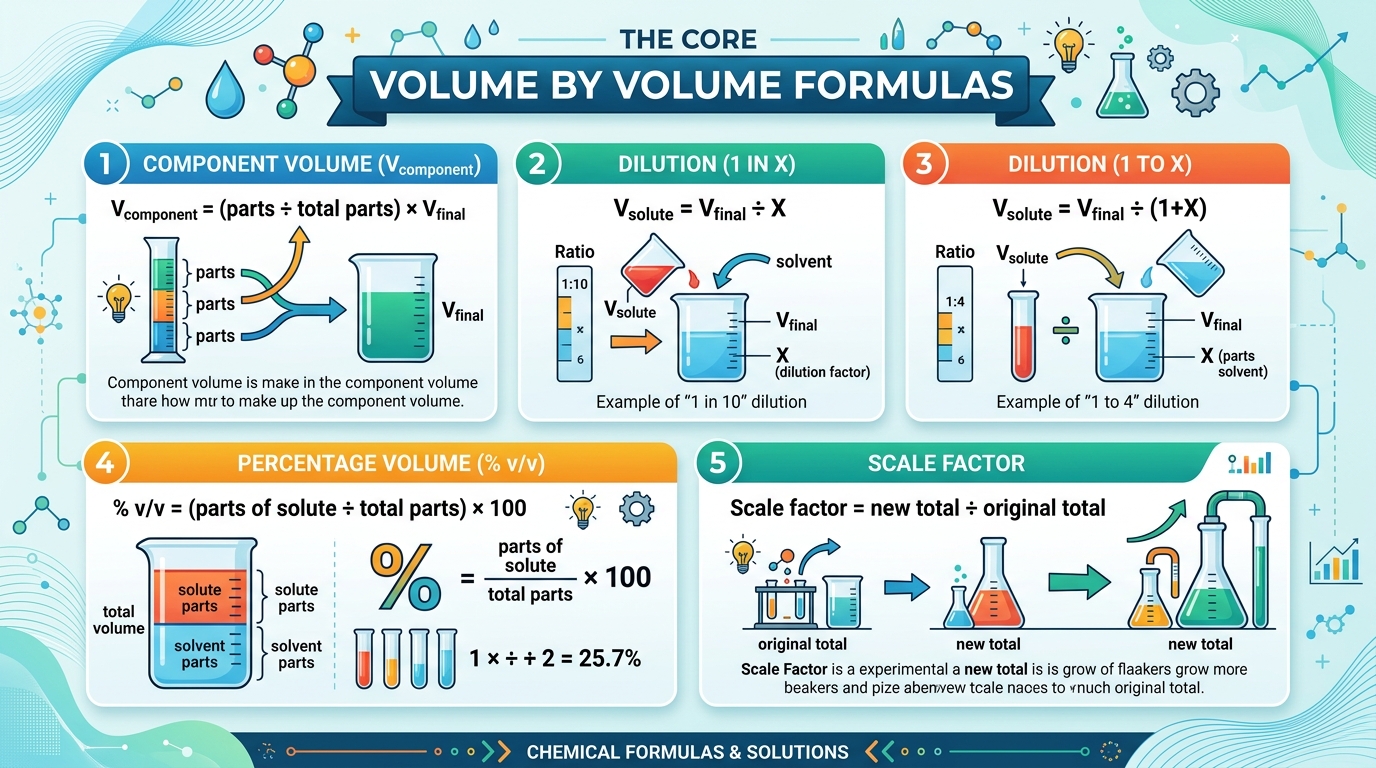
Every volume by volume calculation starts from one principle: a v/v ratio tells you how many parts of each liquid to combine, and each component’s actual volume is its share of the total parts multiplied by the desired final volume. For a 3:1 ratio of A:B in 100 mL total: total parts = 3+1 = 4, so Volume A = (3/4)×100 = 75 mL and Volume B = (1/4)×100 = 25 mL. The volume by volume calculator performs this computation for any ratio and any target volume, handling two-component and multi-component systems up to four liquids.
The Dilution Ratio Ambiguity
The single biggest source of error in v/v work is the ambiguity of ratio notation. “1:10” can mean two different things depending on context. In clinical and microbiological dilutions, “1:10” almost always means 1 part in 10 total (1 part solute + 9 parts diluent), giving a dilution factor of 1/10 and a 10% v/v solution. In some industrial and everyday contexts, “1:10” means 1 part to 10 parts (1+10 = 11 total), giving a dilution factor of 1/11 and a 9.09% v/v solution. The volume by volume calculator’s Dilution mode explicitly asks which convention you intend, preventing this error at the source.
Multi-Component Mixing
Many laboratory solvents are ternary or quaternary mixtures specified as v/v/v or v/v/v/v ratios. For example, the classic chloroform:methanol:water extraction uses a 25:24:1 ratio (Folch method). For 500 mL total: total parts = 50, chloroform = (25/50)×500 = 250 mL, methanol = (24/50)×500 = 240 mL, water = (1/50)×500 = 10 mL. The volume by volume calculator’s Multi-Mix mode handles up to 4 components, showing each volume and its % v/v contribution.
Converting Between Ratios and % v/v
A v/v ratio and % v/v express the same information in different formats. A 7:3 ratio of A:B means A is 7 out of 10 total parts = 70% v/v. The reverse: 70% v/v = 70 parts out of 100 = 70:30 = 7:3 simplified. The volume by volume calculator’s converter mode handles both directions, including simplification of ratios to their lowest terms.
Batch Scaling
Scaling a v/v recipe up or down requires multiplying every component by the same scale factor: scale factor = new total ÷ original total. If a protocol calls for 70 mL ethanol + 30 mL water (100 mL total) and you need 500 mL, the scale factor is 5: ethanol = 350 mL, water = 150 mL. The volume by volume calculator’s Scale mode does this for two-component systems, preserving the original ratio exactly.
Dilution (1 to X): Vsolute = Vfinal ÷ (1+X)
% v/v = (parts of solute ÷ total parts) × 100
Scale factor = new total ÷ original total
Quick Reference Values
Remember: Always clarify whether a ratio means “X in Y total” or “X to Y.” The volume by volume calculator asks explicitly, preventing the most common v/v error.
Real Scenarios Where v/v Math Mattered
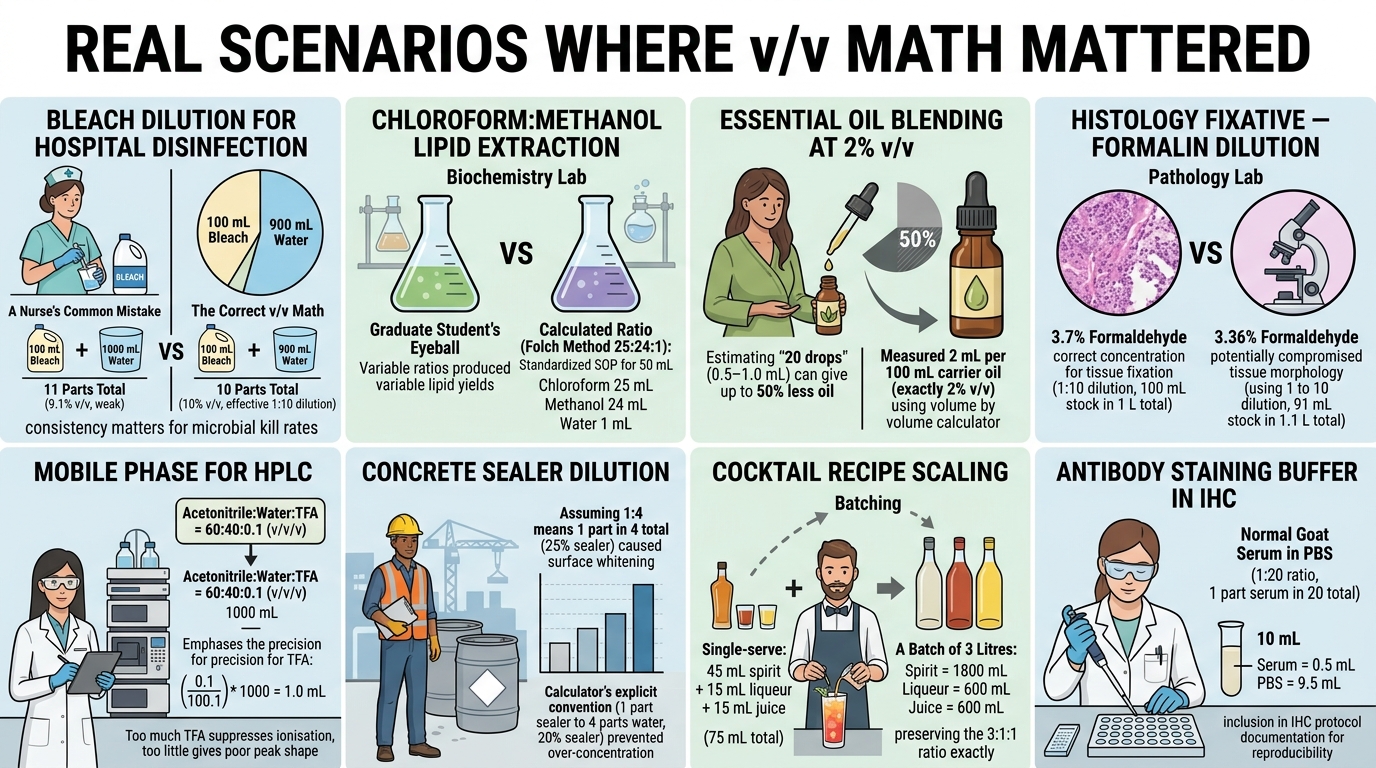
Scenario 1: Bleach Dilution for Hospital Disinfection
Hospital infection control protocols specify sodium hypochlorite (bleach) dilutions as v/v ratios — typically 1:10 (general disinfection) or 1:100 (routine cleaning). A nurse prepared a 1:10 dilution by mixing 100 mL bleach with 1000 mL water, resulting in 11 parts total — actually a 1 to 10 dilution (9.1% v/v), not 1 in 10 (10% v/v). The volume by volume calculator’s Dilution mode with the “1 in X” convention would have shown: for 1000 mL total at 1:10, solute = 100 mL, diluent = 900 mL. The difference seems small but over thousands of preparations, consistency matters for microbial kill rates.
Scenario 2: Chloroform:Methanol Lipid Extraction
A biochemistry lab performed lipid extraction using the Folch method (chloroform:methanol:water = 25:24:1). For a 50 mL preparation, the volume by volume calculator’s Multi-Mix mode computed: chloroform = 25 mL, methanol = 24 mL, water = 1 mL. A graduate student had previously prepared this by eyeballing “roughly equal parts chloroform and methanol plus a splash of water” — the resulting inconsistent ratios produced variable lipid yields across experiments. The calculator output was standardised into the lab SOP.
Scenario 3: Essential Oil Blending at 2% v/v
An aromatherapist needed to blend tea tree oil at 2% v/v in a 100 mL carrier oil bottle. Using the volume by volume calculator’s Ratio mode with parts 2:98 in 100 mL total: tea tree = 2 mL, carrier = 98 mL. The therapist had previously used “20 drops” as an estimate, but drop size varies between 0.025–0.05 mL per drop depending on the dropper, giving 0.5–1.0 mL — up to 50% less than the intended 2 mL.
Scenario 4: Histology Fixative — Formalin Dilution
A pathology technician prepared 10% neutral buffered formalin by diluting 37% formaldehyde stock 1:10 (1 part stock in 10 parts total). Using the volume by volume calculator: for 1 L total, stock = 100 mL, buffer = 900 mL. This gives 3.7% formaldehyde — the correct concentration for tissue fixation. Using “1 to 10” instead (1+10 = 11 parts, stock = 91 mL) would have given 3.36% — below the optimal range and potentially compromising tissue morphology.
Scenario 5: Mobile Phase for HPLC
An analytical chemist prepared an HPLC mobile phase at acetonitrile:water:trifluoroacetic acid = 60:40:0.1 (v/v/v). Using the volume by volume calculator’s Multi-Mix mode for 1000 mL: total parts = 100.1, acetonitrile = (60/100.1)×1000 = 599.4 mL, water = (40/100.1)×1000 = 399.6 mL, TFA = (0.1/100.1)×1000 = 1.0 mL. The precise TFA volume is critical — too much suppresses ionisation, too little gives poor peak shape.
Scenario 6: Concrete Sealer Dilution
A construction site worker needed to dilute a concrete sealer at a 1:4 ratio (1 part sealer to 4 parts water) for 20 litres. Using the volume by volume calculator: total parts = 5, sealer = 4 L, water = 16 L. The worker had initially assumed “1:4” meant 1 part in 4 total (25% sealer), but the manufacturer meant 1 to 4 (20% sealer). The volume by volume calculator’s explicit convention selection prevented a 25% over-concentration that would have caused surface whitening.
Scenario 7: Cocktail Recipe Scaling
A bartender needed to scale a cocktail recipe from single-serve (45 mL spirit + 15 mL liqueur + 15 mL juice = 75 mL) to a batch of 3 litres. Using the volume by volume calculator’s Scale mode: scale factor = 3000/75 = 40, so spirit = 1800 mL, liqueur = 600 mL, juice = 600 mL. The ratio 45:15:15 = 3:1:1 was preserved exactly.
Scenario 8: Antibody Staining Buffer in Immunohistochemistry
A histology lab prepared a blocking buffer by mixing normal goat serum and PBS at a 1:20 ratio (1 part serum in 20 total). For 10 mL: serum = 0.5 mL, PBS = 9.5 mL. Using the volume by volume calculator confirmed these volumes and the step-by-step output was included in the IHC protocol documentation, ensuring reproducibility across multiple technicians.
Common v/v Ratio Mistakes
Mistake 1: Confusing “1 in X” with “1 to X”
The most dangerous v/v error. “1 in 10” means 1 part solute in 10 parts total (10% v/v). “1 to 10” means 1 part solute + 10 parts diluent = 11 parts total (9.1% v/v). The volume by volume calculator asks which convention you intend, preventing this ambiguity.
Mistake 2: Adding Volumes Instead of Making Up to Volume
For a 1:10 dilution in 100 mL total, you need 10 mL solute made up to 100 mL (not 10 mL + 100 mL = 110 mL). Due to volume contraction with miscible liquids, adding calculated volumes may not give exactly 100 mL total.
Mistake 3: Incorrect Multi-Component Part Summing
For a 25:24:1 ratio, total parts = 50, not 25 or 24. Each component’s volume fraction uses this total. The volume by volume calculator sums all parts automatically.
Mistake 4: Not Simplifying Ratios
70:30 = 7:3 = 2.33:1. While mathematically equivalent, unsimplified ratios can lead to measurement errors with large numbers. The volume by volume calculator shows both the ratio and the % v/v for clarity.
Mistake 5: Scaling by the Wrong Factor
When scaling from 100 mL to 500 mL, the scale factor is 5, not 4. Every component is multiplied by 5. The volume by volume calculator computes the scale factor as new total ÷ original total.
Mistake 6: Ignoring Volume Contraction in Precise Work
When ethanol and water mix, volumes contract by 3–4%. A 70:30 ethanol:water mixture by volume addition gives less than 100 mL total. For precise work, make up to volume in a volumetric flask rather than adding calculated volumes.
Mistake 7: Using Weight Ratios as Volume Ratios
A 1:1 w/w mixture of glycerol (density 1.26 g/mL) and water (1.00 g/mL) is NOT a 1:1 v/v mixture. Equal masses of glycerol and water give unequal volumes. The volume by volume calculator works strictly in volume units.
💡 Rule of Thumb: Always clarify the convention (in vs to), always make up to volume rather than adding volumes, and always record the actual volumes used. The volume by volume calculator handles the arithmetic; your job is the technique.
Lab & Clinical Safety Essentials
Chemical compatibility: Before mixing any liquids, verify they are compatible. Mixing concentrated acids with water generates heat — always add acid to water, never water to acid. Some organic solvents are immiscible (oil + water) and cannot form true v/v solutions.
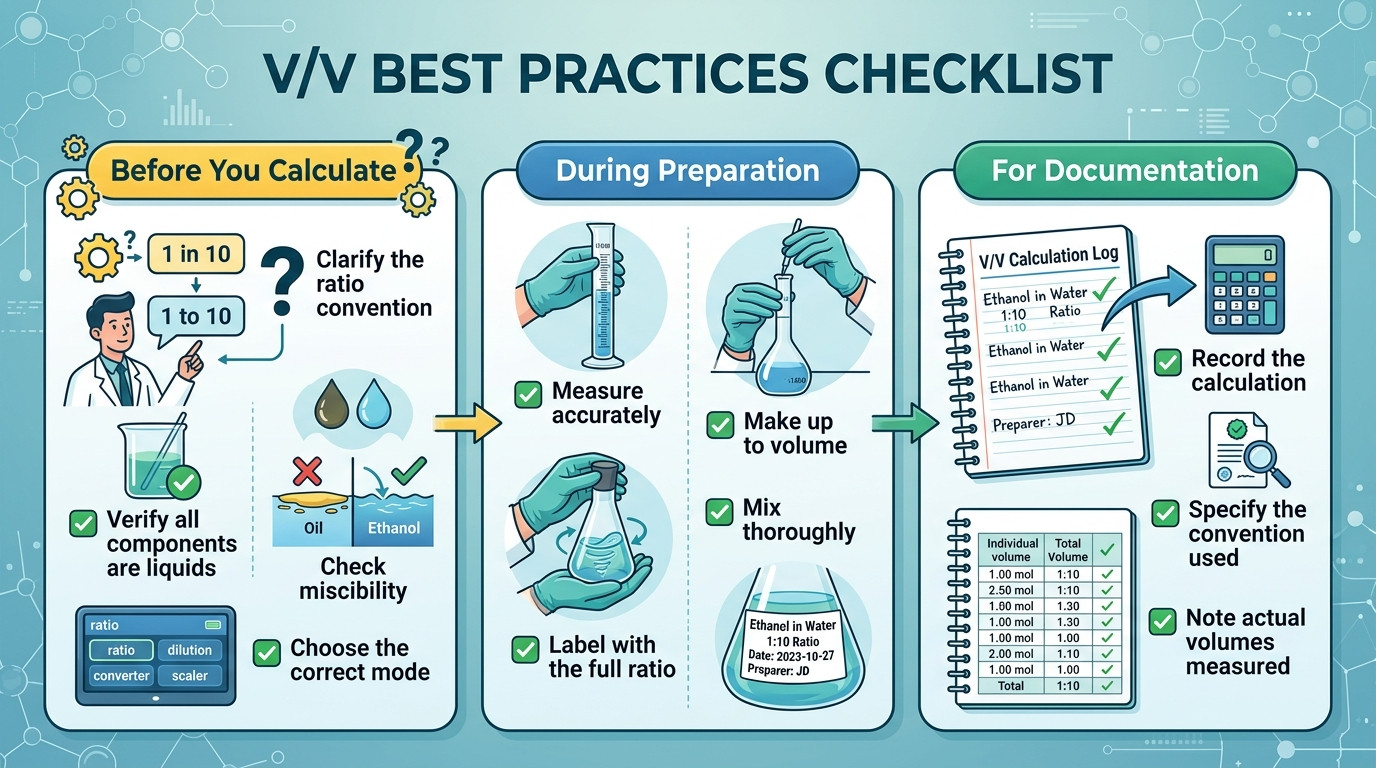
- Clarify the ratio convention — “in” vs “to” — before preparing any dilution.
- Use appropriate glassware — volumetric flasks for precise work, graduated cylinders for routine.
- Work in a fume hood for volatile or toxic solvents (chloroform, methanol, formaldehyde).
- Label immediately — include the v/v ratio, component names, date, and preparer.
- Document the calculation — use the volume by volume calculator output for traceability.
- Wear appropriate PPE — gloves, goggles, lab coat for all solvent handling.
Which Mode Fits Your Situation
| Mode | Use Case | Key Formula | Inputs | Applications |
|---|---|---|---|---|
| v/v Ratio | 2-component mixing | V=(parts/total)×Vt | parts A, parts B, total vol | Ethanol:water, acid dilution |
| Dilution | 1:X dilution from stock | Vs=Vt÷X or Vt÷(1+X) | ratio, total vol, convention | Bleach, serum, staining |
| Multi-Mix | 3-4 component systems | V=(parts/total)×Vt | parts A-D, total vol | HPLC mobile phase, extraction |
| To % v/v | Ratio ↔ percent | %=(parts/total)×100 | parts or % | Protocol conversion, labelling |
| Scale | Resize a recipe | SF=new/original | original vols, new total | Batch scale-up/down |
v/v Ratios in Clinical Laboratory
Clinical laboratories use v/v ratios extensively for preparing reagents, stains, and dilutions. Wright’s stain for blood smears uses a 1:1 v/v mixture of stain and buffer. Gram staining protocols specify crystal violet, iodine, decolouriser, and counterstain at defined v/v ratios. Serum dilutions for antibody titrations use serial 1:2 v/v dilutions (doubling dilutions). The volume by volume calculator handles all of these, and the step-by-step output satisfies CLIA documentation requirements for laboratory quality assurance.
v/v Ratios in Organic Chemistry
Organic chemists specify solvent mixtures for chromatography, extraction, and recrystallisation as v/v or v/v/v ratios. HPLC mobile phases (acetonitrile:water, methanol:water:acid), TLC developing solvents (hexane:ethyl acetate), and extraction solvents (chloroform:methanol:water) all use v/v ratios. The volume by volume calculator’s Multi-Mix mode supports up to 4 components, covering the vast majority of laboratory solvent systems.
v/v Ratios in Food and Beverage Industry
Food-grade dilutions — cleaning solutions, sanitiser concentrations, flavour extracts, and beverage recipes — are routinely specified as v/v ratios. A concentrated cleaning solution at 1:50 dilution for 10 litres requires 200 mL concentrate + 9800 mL water. The volume by volume calculator’s Dilution mode handles this directly, and the Scale mode supports batch resizing for production runs.
v/v Ratios in Cosmetics and Personal Care
Essential oil dilutions, fragrance blends, and active ingredient preparations in cosmetics use v/v ratios. A 2% v/v essential oil blend is a 2:98 ratio. A massage oil at 5% blend is 5:95. The IFRA guidelines specify maximum concentrations in % v/v for each fragrance ingredient, and the volume by volume calculator converts between ratio notation and % v/v for compliance verification.
Worked Examples
Example 1 — Ratio: 3:1 ratio of A:B in 200 mL. Total parts = 4. A = 150 mL, B = 50 mL.
Example 2 — Dilution (1 in 10): For 500 mL total. Solute = 50 mL, diluent = 450 mL. Result = 10% v/v.
Example 3 — Dilution (1 to 10): For 500 mL total. Total parts = 11. Solute = 45.5 mL, diluent = 454.5 mL. Result = 9.09% v/v.
Example 4 — Multi-Mix: 25:24:1 in 500 mL. Total = 50. A = 250 mL, B = 240 mL, C = 10 mL.
Example 5 — Scale: 70 mL + 30 mL → 500 mL. Factor = 5. New: 350 mL + 150 mL.
Frequently Asked Questions
1. What is a volume by volume calculator?
A volume by volume calculator converts v/v ratios into actual volumes (mL or L) for a specified total volume. It handles 2-component ratios, dilutions, multi-component mixes, ratio-to-percent conversion, and batch scaling.
2. What does “1:10 dilution” mean?
It depends on context. In clinical/lab use, “1:10” usually means 1 part in 10 total (10% v/v). In some industrial contexts, it means 1 part to 10 parts (11 total, 9.1% v/v). The volume by volume calculator asks which convention you intend.
3. How do I convert a ratio to % v/v?
% v/v = (parts of solute ÷ total parts) × 100. For a 7:3 ratio: 7/(7+3) × 100 = 70% v/v. The volume by volume calculator’s converter mode does this automatically.
4. How do I scale a v/v recipe?
Scale factor = new total volume ÷ original total volume. Multiply each component by this factor. The volume by volume calculator’s Scale mode does this for you.
5. Can I mix more than 2 liquids?
Yes. The Multi-Mix mode handles up to 4 components (A, B, C, D) at any ratio. Enter 0 for unused components.
6. Why do mixed volumes not add up exactly?
Volume contraction — when miscible liquids mix, molecules pack more tightly, reducing the total volume. Always make up to volume in a volumetric flask for precision.
7. Is v/v the same as ABV?
Yes. ABV (alcohol by volume) is identical to % v/v for ethanol in beverages.
8. What is the Folch ratio?
The Folch lipid extraction uses chloroform:methanol:water at 25:24:1 (v/v/v). The Multi-Mix mode computes exact volumes for any batch size.
9. Is this calculator free?
Yes. Completely free, browser-based, no sign-up, fully private. No data sent anywhere.
10. Can I use this for cleaning product dilutions?
Yes. The Dilution mode handles any 1:X dilution and clarifies the “in” vs “to” convention that is often ambiguous on cleaning product labels.
v/v Best Practices Checklist
Before You Calculate
During Preparation
For Documentation
Trusted Reference Resources
IUPAC Gold Book — goldbook.iupac.org — Official definitions of volume fraction and dilution terminology.
CLSI (Clinical Laboratory Standards Institute) — clsi.org — Standards for clinical laboratory dilution preparation and documentation.
USP (United States Pharmacopeia) — usp.org — Standards for pharmaceutical v/v preparations.
LibreTexts Chemistry — chem.libretexts.org — Free explanations of dilution ratios, volume fractions, and solution preparation.
CDC Disinfection Guidelines — cdc.gov — Recommended bleach and disinfectant dilution ratios for healthcare facilities.
User Reviews & Ratings
Share Your Experience with This Volume by Volume Calculator
Final Thoughts on Volume by Volume Calculation
Volume by volume ratios are deceptively simple — “mix 3 parts A with 1 part B” seems straightforward until you need to compute the actual millilitres for a specific batch size, until you realise that “1:10” means different things in different contexts, or until you need to scale a 4-component solvent system from 50 mL to 5 litres. The arithmetic is just division and multiplication, but the ambiguities, the volume contraction phenomenon, and the multi-component bookkeeping make it error-prone in practice.
The volume by volume calculator resolves every ambiguity by asking explicit questions (which convention? how many components? what total volume?), performing the arithmetic with full unit awareness, and showing every step of the working. Use it for disinfectant dilutions, HPLC mobile phases, essential oil blends, histology fixatives, extraction solvents, or any liquid mixing task — and use the step-by-step output for your SOP, lab notebook, or clinical record.
🔒 Privacy Guarantee: Every calculation runs entirely within your browser. No data is sent to any server. Reviews are saved in your browser’s local storage only.