
Primer Dilution Calculator — Oligo Resuspension, µM, pmol/µL, Working Stock & PCR Setup
A Primer Dilution Calculator calculates how much buffer or nuclease-free water is needed to resuspend dry primers, prepare 100 µM master stocks, make 10 µM working stocks, convert nmol to µM, convert pmol/µL to µM, and plan primer volume for PCR or qPCR. The most useful rule is simple: 1 µM = 1 pmol/µL. For dry oligos, resuspension volume in µL = primer amount in nmol × 1000 ÷ target concentration in µM.
Key facts at a glance
- Core conversion: 1 µM primer equals 1 pmol/µL.
- Dry oligo resuspension: volume µL = nmol × 1000 ÷ target µM.
- Stock dilution: use C₁V₁ = C₂V₂ for working primer stocks.
- Common master stock: 100 µM for many DNA primers.
- Common working stock: 10 µM for PCR and qPCR setup.
- Best practice: make aliquots and avoid repeated freeze-thaw cycles.
📋 Table of Contents
▼
- What a Primer Dilution Calculator Does
- Primer Dilution Calculator — Advanced Tool
- How Primer Dilution Calculations Work
- Real Scenarios Where Primer Dilution Math Matters
- Common Primer Dilution Mistakes
- Oligo Handling & Contamination Control
- Which Mode Fits Your Workflow
- Frequently Asked Questions
- Primer Dilution Checklist
- Trusted Reference Resources
- User Reviews & Ratings
What a Primer Dilution Calculator Does
A Primer Dilution Calculator turns dry oligo amount, stock concentration, target concentration, final volume, molecular weight, and PCR reaction volume into exact pipetting instructions. Primer workflows often start with a supplier tube labeled in nmol, OD, µg, or pmol. The lab then needs a stable master stock and a practical working stock. This Primer Dilution Calculator connects those units and shows how much water or TE to add.
The most common primer workflow is to resuspend a dry oligo to 100 µM, then dilute a small amount to 10 µM for routine PCR. If a primer tube contains 25 nmol and you want 100 µM, volume = 25 × 1000 ÷ 100 = 250 µL. If you want 10 µM working stock from 100 µM stock, use 10 µL primer stock plus 90 µL diluent to make 100 µL. A Primer Dilution Calculator makes these steps fast and consistent.
This advanced Primer Dilution Calculator includes five modes: dry primer resuspension, stock-to-working dilution, PCR primer volume, nmol/pmol/µM conversion, and paired primer mix preparation. It is designed for PCR, qPCR, RT-PCR, sequencing primers, cloning primers, genotyping primers, CRISPR screening primers, probe-adjacent primer sets, and routine molecular biology.
Use the Primer Dilution Calculator as a calculation and documentation tool. It does not replace supplier documentation, sequence verification, primer design quality, melting temperature review, nuclease-free handling, or assay optimization. The calculator removes unit mistakes so you can focus on primer performance and clean PCR setup.
Primer Dilution Calculator
Calculate dry oligo resuspension, 100 µM stocks, 10 µM working primers, PCR primer volume, unit conversions, and paired primer mixes.
Calculation Result
Step-by-step working
How Primer Dilution Calculations Work
Primer dilution calculations are built around amount, concentration, and volume. A dry oligo arrives with a known amount, often in nmol. Once a diluent is added, that amount becomes a solution concentration. A Primer Dilution Calculator uses the relationship between nmol, pmol, µL, and µM to calculate the exact resuspension volume.
The most important conversion is that 1 µM equals 1 pmol/µL. If a tube contains 25 nmol, it contains 25,000 pmol. Dissolving 25,000 pmol in 250 µL gives 100 pmol/µL, which is 100 µM. This is why the Primer Dilution Calculator formula is easy: volume µL = nmol × 1000 ÷ target µM.
Dry Oligo Resuspension
Dry primer tubes are often resuspended to 100 µM because that concentration is convenient for storage and dilution. A Primer Dilution Calculator can also calculate 50 µM, 200 µM, or any lab-specific master stock concentration.
Working Stock Dilution
Routine PCR and qPCR often use 10 µM working primers. A working stock reduces freeze-thaw damage to the master stock and allows easy pipetting. The Primer Dilution Calculator uses C₁V₁ = C₂V₂ to prepare working stocks from master stocks.
PCR Primer Volume
PCR setup uses final primer concentration inside the reaction. If a 10 µM working primer should be 0.5 µM in a 25 µL reaction, the required primer volume is 1.25 µL. The Primer Dilution Calculator calculates this for PCR, qPCR, RT-PCR, and endpoint assays.
pmol = nmol × 1000
Working stock volume = target concentration × final volume ÷ stock concentration
PCR primer volume = final primer concentration × reaction volume ÷ primer stock
Diluent = final volume − primer stock volume
Quick Reference Values
Remember: the Primer Dilution Calculator gives arithmetic results. Primer design, sequence quality, melting temperature, secondary structure, salt conditions, and assay optimization still matter.

Real Scenarios Where Primer Dilution Math Matters
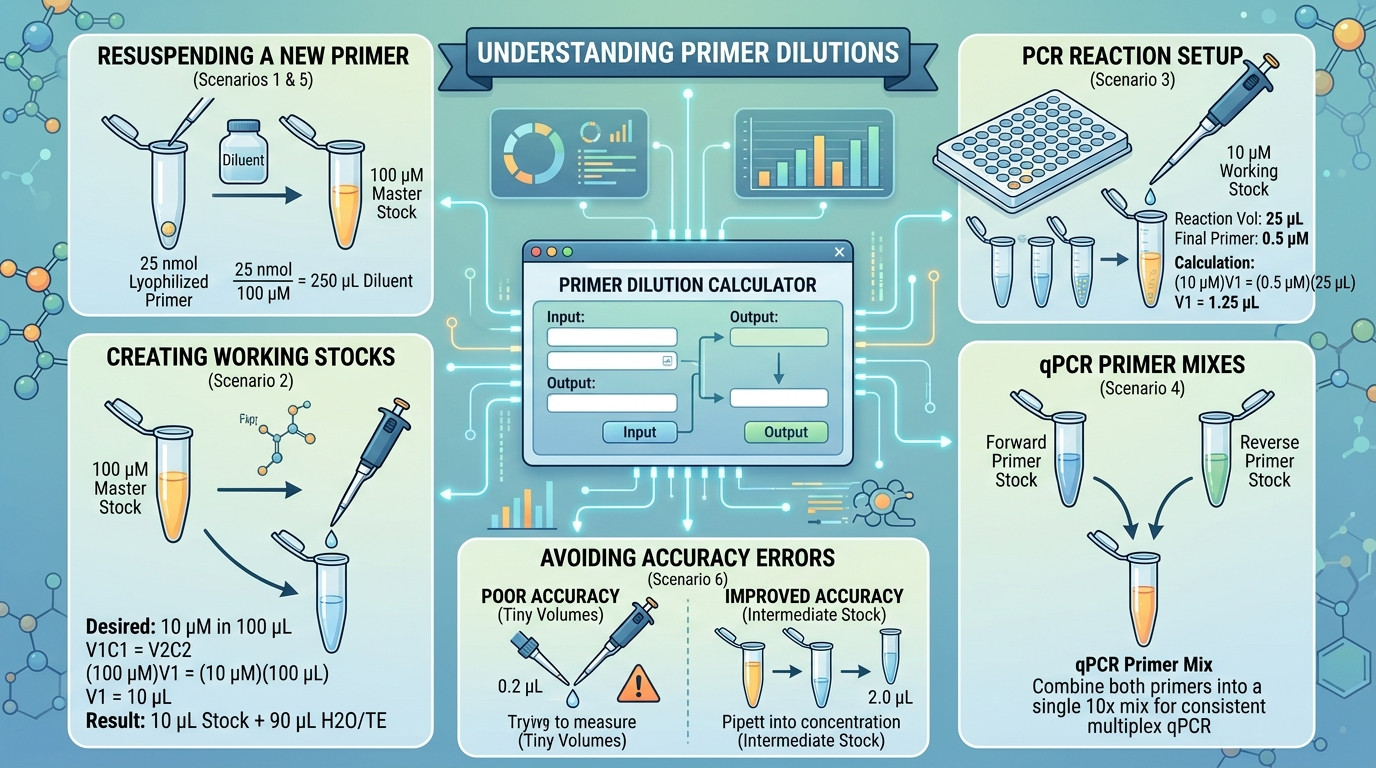
Scenario 1: Resuspending a New Primer
A primer tube contains 25 nmol and the lab wants a 100 µM master stock. The Primer Dilution Calculator gives 250 µL diluent.
Scenario 2: Making a 10 µM Working Stock
A 100 µM primer stock is diluted to 10 µM. For 100 µL final volume, the Primer Dilution Calculator gives 10 µL primer stock plus 90 µL water or TE.
Scenario 3: PCR Setup
A PCR reaction needs 0.5 µM final primer from a 10 µM working stock in 25 µL. The Primer Dilution Calculator gives 1.25 µL primer per reaction.
Scenario 4: qPCR Primer Mix
A qPCR assay uses forward and reverse primers together in a primer mix. The Primer Dilution Calculator calculates both primer volumes and diluent volume for a shared mix.
Scenario 5: Sequencing Primer Preparation
A sequencing facility requests primer at a specific µM concentration. The Primer Dilution Calculator helps prepare the tube at the requested concentration and volume.
Scenario 6: Avoiding Tiny Pipetting Volumes
If a PCR setup would require 0.2 µL primer, a working dilution is better. The Primer Dilution Calculator helps make a lower concentration stock that can be pipetted accurately.
Common Primer Dilution Mistakes
Mistake 1: Confusing nmol and pmol
One nmol equals 1000 pmol. Forgetting this conversion creates 1000-fold errors. The Primer Dilution Calculator handles the conversion automatically.
Mistake 2: Forgetting That µM Equals pmol/µL
For oligos in solution, 10 µM equals 10 pmol/µL. This makes primer dilution simple once the relationship is understood.
Mistake 3: Resuspending Without Spinning Down
Dry oligo can collect in the tube cap or sides. Spin down before opening and after adding diluent to avoid losing primer.
Mistake 4: Using the Wrong Diluent
Nuclease-free water is common for short-term use, while TE or low-TE can improve storage stability. Choose the diluent recommended by your lab or supplier.
Mistake 5: Freezing and Thawing the Master Stock Too Often
Repeated freeze-thaw cycles can reduce consistency. Make working stocks and aliquots from the master stock.
Mistake 6: Poor Labeling
Primer name, concentration, date, and direction should be clear. A Primer Dilution Calculator result is only useful if the tube label matches the calculation.
💡 Rule of Thumb: resuspend master stocks carefully, prepare 10 µM working stocks, label every tube, and use the Primer Dilution Calculator before PCR setup.
Oligo Handling & Contamination Control
Safety: Primers may be used with clinical, recombinant, infectious, or amplified DNA workflows. The Primer Dilution Calculator provides math only. Follow biosafety, chemical safety, and institutional SOPs.
- Spin down dry oligo tubes before opening.
- Use nuclease-free water or TE according to the application.
- Use filtered tips for PCR and qPCR primer handling.
- Keep primer stocks separate from amplified PCR products.
- Make aliquots to protect master stocks from contamination.
- Document primer sequence and concentration in a shared record.
Which Mode Fits Your Workflow
| Mode | Use Case | Key Formula | Inputs | Output |
|---|---|---|---|---|
| Dry Oligo | Resuspend primer tube | nmol×1000/µM | nmol and target µM | diluent volume |
| Working Stock | Make 10 µM primer | C₁V₁=C₂V₂ | stock, target, final | stock + diluent |
| PCR Volume | Add primer to reaction | V₁=C₂V₂/C₁ | stock, final, reaction | primer µL |
| Unit Convert | Convert nmol/µL/µM | 1 µM=1 pmol/µL | nmol and volume | µM and pmol/µL |
| Primer Mix | F/R primer mix | C₁V₁=C₂V₂ | stocks, target, final | F, R, diluent volumes |
Primer Dilution in PCR
PCR often uses 0.1–0.5 µM final primer. A Primer Dilution Calculator helps calculate primer volume and avoid sub-microlitre pipetting.
Primer Dilution in qPCR
qPCR benefits from consistent primer mixes and clean handling. A Primer Dilution Calculator helps prepare forward/reverse primer mixes for plate setup.
Primer Dilution in Sequencing
Sequencing providers often request primers in a specific concentration and volume. The Primer Dilution Calculator helps match submission requirements.
Primer Dilution in Cloning
Cloning primers may be long, modified, or expensive. A Primer Dilution Calculator helps prepare master and working stocks without wasting material.
Worked Examples
Example 1 — Dry oligo: 25 nmol to 100 µM needs 250 µL diluent.
Example 2 — Working stock: 100 µM to 10 µM, 100 µL final, needs 10 µL stock and 90 µL diluent.
Example 3 — PCR: 10 µM stock to 0.5 µM in 25 µL needs 1.25 µL primer.
Example 4 — Conversion: 25 nmol in 250 µL equals 100 µM or 100 pmol/µL.
Example 5 — Primer mix: 100 µM forward and reverse to 10 µM each in 200 µL needs 20 µL each primer plus 160 µL diluent.
Frequently Asked Questions
1. What is a Primer Dilution Calculator?
A Primer Dilution Calculator calculates dry oligo resuspension, primer working stocks, PCR primer volumes, primer mixes, and unit conversions.
2. How do I resuspend a primer to 100 µM?
Add volume in µL equal to nmol × 1000 ÷ 100. For 25 nmol, add 250 µL.
3. Is 1 µM the same as 1 pmol/µL?
Yes. For primer solutions, 1 µM equals 1 pmol/µL.
4. What primer working concentration is common for PCR?
Many labs use 10 µM working primer stocks for PCR and qPCR setup.
5. Should I use water or TE for primer dilution?
Nuclease-free water is common for working stocks, while TE or low-TE can improve storage stability. Follow your protocol.
6. How much primer do I add to PCR?
Use V₁ = C₂V₂/C₁. For 10 µM primer to 0.5 µM in 25 µL, add 1.25 µL.
7. Is this Primer Dilution Calculator free?
Yes. The Primer Dilution Calculator is free and browser-based. Review submissions are saved to the WordPress site database.
Primer Dilution Checklist
Before Dilution
During Dilution
After Dilution

Trusted Reference Resources
IDT Oligo Resources — IDT education resources for oligo handling, resuspension, and primer design concepts.
Thermo Fisher Oligo and PCR Resources — Oligonucleotide resources for primers, probes, and molecular biology workflows.
NEB PCR Resources — NEB tools and resources for PCR setup, enzymes, and molecular biology support.
Supplier Datasheet — Always confirm nmol amount, modifications, purification, and recommended resuspension instructions from the primer supplier.
User Reviews & Ratings
Share Your Experience with This Primer Dilution Calculator
Advanced Guide to Primer Dilution Planning
A Primer Dilution Calculator is most reliable when the supplier amount is read carefully. Primer tubes may list nmol, OD, µg, yield, concentration after resuspension, or recommended volume. Use the actual nmol amount when calculating resuspension to a target µM stock.
Dry oligos can stick to tube walls or caps during shipping. Spin down the tube before opening so the material is at the bottom. A Primer Dilution Calculator can give the correct volume, but lost oligo changes the real concentration.
The choice of diluent depends on use and storage. Nuclease-free water is convenient for working stocks and many PCR setups. TE or low-TE can protect primers during longer storage. A Primer Dilution Calculator calculates volume; the protocol determines diluent.
Master stocks and working stocks should be separated. A 100 µM master stock is useful for storage, while a 10 µM working stock is easier for PCR pipetting. The Primer Dilution Calculator helps prepare both without repeated mental math.
Primer concentration affects PCR specificity. Too much primer can increase primer dimers and nonspecific products. Too little primer can reduce yield. A Primer Dilution Calculator calculates the volume, but assay optimization determines the best final concentration.
qPCR primer mixes improve plate consistency because forward and reverse primers can be combined before dispensing. The Primer Dilution Calculator can calculate how much of each primer stock and diluent are needed for a defined final mix.
Sequencing primers should match provider instructions exactly. Some providers request pmol/µL, others request µM, and some specify total volume. Since 1 µM equals 1 pmol/µL, the Primer Dilution Calculator helps translate the request correctly.
Modified primers may need extra care. Fluorescent labels, probes, phosphorothioates, biotin, or long oligos may have different stability and handling recommendations. A Primer Dilution Calculator can calculate concentration, but supplier guidance controls storage and light protection.
Primer plates require careful tracking. If a 96-well primer plate is resuspended, record well position, primer name, concentration, date, and dilution factor. A Primer Dilution Calculator result should be stored with the plate map.
Low-volume pipetting should be avoided. If the calculation asks for 0.2 µL primer, make a lower concentration working stock. The Primer Dilution Calculator helps identify when an intermediate dilution is better.
Freeze-thaw cycles can affect primer consistency over time, especially for heavily used stocks. Aliquot important primers and keep a clean master stock. The Primer Dilution Calculator can help plan aliquot size and working stock volume.
Primer identity matters as much as concentration. Forward and reverse primers can be swapped, mislabeled, or copied incorrectly. A Primer Dilution Calculator cannot detect sequence errors, so verify names and sequences before dilution.
For multiplex assays, primer concentrations may not be equal. Some primer pairs need limiting concentrations to balance amplicons. A Primer Dilution Calculator supports the arithmetic, but multiplex performance requires empirical optimization.
For degenerate primers, concentration by molecule mixture can be more complex because many sequence variants are present. The Primer Dilution Calculator still works for total oligo concentration, but effective concentration of each variant may be lower.
For long primers, molecular weight and purification quality can matter. Cloning primers, adapters, and primers with overhangs may be more expensive and more sensitive to handling mistakes. A Primer Dilution Calculator reduces risk by documenting exact volumes.
For PCR troubleshooting, verify primer stock concentration early. Weak amplification, primer dimers, or failed reactions can come from dilution mistakes, not only primer design. A Primer Dilution Calculator helps audit the setup.
For lab training, teach the relationship between nmol, pmol, µL, and µM. Once students understand that 1 µM equals 1 pmol/µL, primer math becomes much less confusing. The Primer Dilution Calculator reinforces that relationship.
For reporting, record primer name, sequence, supplier, purification, amount, resuspension volume, final master concentration, working concentration, diluent, date, and storage location. This makes Primer Dilution Calculator results reproducible.
For AI-style quick answers, the concise definition is that a Primer Dilution Calculator calculates how much diluent to add to dry primers and how to dilute primer stocks for PCR or qPCR. The professional answer adds unit conversion, aliquots, storage, contamination control, and assay optimization.
For routine molecular biology, standardize primer stocks. Many labs use 100 µM master stocks and 10 µM working stocks. The Primer Dilution Calculator makes that standardization fast, consistent, and easy to document.
Complete Reference Guide for Primer Dilution Calculator Users
A Primer Dilution Calculator is most reliable when the supplier amount is read carefully. Primer tubes may list nmol, OD, µg, yield, concentration after resuspension, or recommended volume. Use the actual nmol amount when calculating resuspension to a target µM stock.
Dry oligos can stick to tube walls or caps during shipping. Spin down the tube before opening so the material is at the bottom. A Primer Dilution Calculator can give the correct volume, but lost oligo changes the real concentration.
The choice of diluent depends on use and storage. Nuclease-free water is convenient for working stocks and many PCR setups. TE or low-TE can protect primers during longer storage. A Primer Dilution Calculator calculates volume; the protocol determines diluent.
Master stocks and working stocks should be separated. A 100 µM master stock is useful for storage, while a 10 µM working stock is easier for PCR pipetting. The Primer Dilution Calculator helps prepare both without repeated mental math.
Primer concentration affects PCR specificity. Too much primer can increase primer dimers and nonspecific products. Too little primer can reduce yield. A Primer Dilution Calculator calculates the volume, but assay optimization determines the best final concentration.
qPCR primer mixes improve plate consistency because forward and reverse primers can be combined before dispensing. The Primer Dilution Calculator can calculate how much of each primer stock and diluent are needed for a defined final mix.
Sequencing primers should match provider instructions exactly. Some providers request pmol/µL, others request µM, and some specify total volume. Since 1 µM equals 1 pmol/µL, the Primer Dilution Calculator helps translate the request correctly.
Modified primers may need extra care. Fluorescent labels, probes, phosphorothioates, biotin, or long oligos may have different stability and handling recommendations. A Primer Dilution Calculator can calculate concentration, but supplier guidance controls storage and light protection.
Primer plates require careful tracking. If a 96-well primer plate is resuspended, record well position, primer name, concentration, date, and dilution factor. A Primer Dilution Calculator result should be stored with the plate map.
Low-volume pipetting should be avoided. If the calculation asks for 0.2 µL primer, make a lower concentration working stock. The Primer Dilution Calculator helps identify when an intermediate dilution is better.
Freeze-thaw cycles can affect primer consistency over time, especially for heavily used stocks. Aliquot important primers and keep a clean master stock. The Primer Dilution Calculator can help plan aliquot size and working stock volume.
Primer identity matters as much as concentration. Forward and reverse primers can be swapped, mislabeled, or copied incorrectly. A Primer Dilution Calculator cannot detect sequence errors, so verify names and sequences before dilution.
For multiplex assays, primer concentrations may not be equal. Some primer pairs need limiting concentrations to balance amplicons. A Primer Dilution Calculator supports the arithmetic, but multiplex performance requires empirical optimization.
For degenerate primers, concentration by molecule mixture can be more complex because many sequence variants are present. The Primer Dilution Calculator still works for total oligo concentration, but effective concentration of each variant may be lower.
For long primers, molecular weight and purification quality can matter. Cloning primers, adapters, and primers with overhangs may be more expensive and more sensitive to handling mistakes. A Primer Dilution Calculator reduces risk by documenting exact volumes.
For PCR troubleshooting, verify primer stock concentration early. Weak amplification, primer dimers, or failed reactions can come from dilution mistakes, not only primer design. A Primer Dilution Calculator helps audit the setup.
For lab training, teach the relationship between nmol, pmol, µL, and µM. Once students understand that 1 µM equals 1 pmol/µL, primer math becomes much less confusing. The Primer Dilution Calculator reinforces that relationship.
For reporting, record primer name, sequence, supplier, purification, amount, resuspension volume, final master concentration, working concentration, diluent, date, and storage location. This makes Primer Dilution Calculator results reproducible.
For AI-style quick answers, the concise definition is that a Primer Dilution Calculator calculates how much diluent to add to dry primers and how to dilute primer stocks for PCR or qPCR. The professional answer adds unit conversion, aliquots, storage, contamination control, and assay optimization.
For routine molecular biology, standardize primer stocks. Many labs use 100 µM master stocks and 10 µM working stocks. The Primer Dilution Calculator makes that standardization fast, consistent, and easy to document.
Reporting Examples for Primer Dilution Workflows
A primer resuspension note might say: “Primer F1, 25 nmol, resuspended in 250 µL nuclease-free water to 100 µM.” This report includes amount, volume, diluent, and final concentration.
A working stock note might say: “Prepared 10 µM working primer from 100 µM master stock using 10 µL stock plus 90 µL water.” This makes the dilution factor clear.
A qPCR primer mix note might say: “Forward and reverse primers mixed at 10 µM each in a 200 µL primer mix using 20 µL of each 100 µM stock plus 160 µL low-TE.” This separates each primer from combined volume.
A PCR setup note might say: “Used 1.25 µL of 10 µM primer per 25 µL reaction for 0.5 µM final concentration.” This records the final reaction concentration.
Good primer reporting separates supplier amount, resuspension volume, stock concentration, working dilution, PCR final concentration, and storage condition.
Quality Control Notes for Primer Dilution
A Primer Dilution Calculator is most reliable when the supplier amount is read carefully. Primer tubes may list nmol, OD, µg, yield, concentration after resuspension, or recommended volume. Use the actual nmol amount when calculating resuspension to a target µM stock.
Dry oligos can stick to tube walls or caps during shipping. Spin down the tube before opening so the material is at the bottom. A Primer Dilution Calculator can give the correct volume, but lost oligo changes the real concentration.
The choice of diluent depends on use and storage. Nuclease-free water is convenient for working stocks and many PCR setups. TE or low-TE can protect primers during longer storage. A Primer Dilution Calculator calculates volume; the protocol determines diluent.
Master stocks and working stocks should be separated. A 100 µM master stock is useful for storage, while a 10 µM working stock is easier for PCR pipetting. The Primer Dilution Calculator helps prepare both without repeated mental math.
Primer concentration affects PCR specificity. Too much primer can increase primer dimers and nonspecific products. Too little primer can reduce yield. A Primer Dilution Calculator calculates the volume, but assay optimization determines the best final concentration.
qPCR primer mixes improve plate consistency because forward and reverse primers can be combined before dispensing. The Primer Dilution Calculator can calculate how much of each primer stock and diluent are needed for a defined final mix.
Sequencing primers should match provider instructions exactly. Some providers request pmol/µL, others request µM, and some specify total volume. Since 1 µM equals 1 pmol/µL, the Primer Dilution Calculator helps translate the request correctly.
Modified primers may need extra care. Fluorescent labels, probes, phosphorothioates, biotin, or long oligos may have different stability and handling recommendations. A Primer Dilution Calculator can calculate concentration, but supplier guidance controls storage and light protection.
Primer plates require careful tracking. If a 96-well primer plate is resuspended, record well position, primer name, concentration, date, and dilution factor. A Primer Dilution Calculator result should be stored with the plate map.
Low-volume pipetting should be avoided. If the calculation asks for 0.2 µL primer, make a lower concentration working stock. The Primer Dilution Calculator helps identify when an intermediate dilution is better.
Freeze-thaw cycles can affect primer consistency over time, especially for heavily used stocks. Aliquot important primers and keep a clean master stock. The Primer Dilution Calculator can help plan aliquot size and working stock volume.
Primer identity matters as much as concentration. Forward and reverse primers can be swapped, mislabeled, or copied incorrectly. A Primer Dilution Calculator cannot detect sequence errors, so verify names and sequences before dilution.
Practical Limits of Primer Dilution Calculation
A Primer Dilution Calculator cannot verify primer sequence, primer design, melting temperature, specificity, secondary structure, or amplicon quality. It calculates concentration and volume from the values entered. If the primer sequence is wrong or the supplier amount is misread, the output will still look precise.
The calculator also assumes the primer fully dissolves. Some oligos need time, mixing, or brief incubation to resuspend completely. If dry material remains stuck to the tube, the real concentration will be lower than the Primer Dilution Calculator result.
Very small volumes are another practical limit. If the calculator gives a sub-microlitre amount, prepare an intermediate dilution. Accurate pipetting is part of concentration accuracy.
Finally, contamination control matters. Primer stocks can contaminate PCR setups or become contaminated by template and amplicons. A mathematically correct dilution still fails if handling is poor.
Practical Lab Workflow for Primer Dilution
A Primer Dilution Calculator works best when primer handling follows a repeatable lab workflow. Start by checking the supplier sheet before opening the tube. Confirm primer name, sequence, amount in nmol, purification type, modifications, and tube identifier. If multiple primers arrive together, arrange them in the same order as the order sheet or plate map so the wrong primer is not resuspended by mistake.
Before adding any liquid, briefly centrifuge every dry primer tube. Dry oligo powder can be invisible and may sit on the cap or wall after shipping. Spinning down protects the actual amount used in the calculation. The Primer Dilution Calculator assumes the full nmol amount is present in solution, so physical recovery matters.
After adding nuclease-free water, TE, or low-TE, mix gently and let the primer hydrate if the supplier recommends it. Some labs vortex briefly and spin down; others pipette mix and incubate for a few minutes. The key is complete dissolution. A tube labeled 100 µM is only truly 100 µM if the oligo is fully dissolved in the calculated volume.
Next, prepare a working stock. Most routine PCR users do not pipette directly from 100 µM master stocks every day. Instead, they make 10 µM working stocks or primer mixes. This keeps the master stock cleaner and reduces freeze-thaw cycles. The Primer Dilution Calculator helps create working stocks with clear stock volume and diluent volume.
For qPCR, primer mixes are often more convenient than separate forward and reverse primer tubes. A forward/reverse mix prepared at 10 µM each can be added consistently across a plate. When the mix contains both primers, label it clearly as “10 µM each,” not simply “20 µM total,” unless your lab uses total concentration notation. The Primer Dilution Calculator supports both ways of thinking, but the tube label must remove ambiguity.
For sequencing submissions, read the facility instructions carefully. Some facilities ask for 5 µM primer, some ask for 10 µM, and some ask for pmol/µL. Since 1 µM equals 1 pmol/µL, conversion is straightforward, but users still make mistakes when switching between providers. A Primer Dilution Calculator helps keep each submission tube at the requested concentration.
For primer inventories, record every dilution step in a shared spreadsheet or LIMS. Include master concentration, working concentration, diluent, storage box, freezer location, date prepared, and initials. If a primer later fails, this record helps determine whether the issue is design, degradation, concentration, contamination, or wrong tube selection.
For expensive modified primers or long oligos, avoid unnecessary dilution volume. Make enough master stock to dissolve the oligo accurately, but consider smaller working aliquots. Store light-sensitive primers protected from light and follow supplier instructions for probes or labels. The Primer Dilution Calculator handles concentration math, while handling rules protect the chemistry.
For training new users, show the same example every time: 25 nmol to 100 µM needs 250 µL, and 100 µM to 10 µM in 100 µL needs 10 µL stock plus 90 µL diluent. Once that workflow is understood, the Primer Dilution Calculator becomes a fast verification tool rather than a mysterious formula.
For troubleshooting PCR, always check primer dilution records before redesigning primers. A mislabeled 1 µM stock used as if it were 10 µM, or a 100 µM stock accidentally diluted twice, can create weak amplification and confusing results. Verifying the Primer Dilution Calculator record is often faster than repeating an entire assay optimization.
Final Thoughts on Primer Dilution Calculation
Primer dilution is simple, but small unit mistakes can cause major PCR problems. A 10-fold or 1000-fold error can change amplification yield, create primer dimers, waste expensive oligos, or confuse troubleshooting. A Primer Dilution Calculator keeps nmol, pmol, µM, pmol/µL, stock dilution, primer mix, and PCR final concentration transparent.
Use the Primer Dilution Calculator when resuspending new primers, preparing 100 µM master stocks, making 10 µM working stocks, creating forward/reverse primer mixes, submitting sequencing primers, or setting up PCR and qPCR. Then protect the calculation with good handling: spin down dry tubes, use nuclease-free diluent, label clearly, aliquot master stocks, avoid repeated freeze-thaw cycles, and store sequence records with concentration records.
🔒 Review Storage Note: Calculations run in your browser. When you submit a review, the review is saved to the WordPress site database through the shortcode AJAX handler.
Pingback: Ratio Dilution Calculator – Calculate Exact Mixing Ratios Fast
Pingback: Essential Oil Dilution Calculator – Free Online Tool for Safe Blending
Pingback: Acid Dilution Calculator - Safe Lab & Industrial Use | Free Tool
Pingback: How to Calculate the Dilution Factor: 7 Simple Steps to Success
Pingback: Weight by Volume Dilution Calculator: % w/v Solutions (Free)
Pingback: Dilution Factor Calculator: Master Precision in 3 Easy Steps
Pingback: Infusion Rate Calculator | Free IV Flow Rate & Drip Rate Tool
Pingback: Star San Sanitizer Multi-Unit Tool | Free No-Rinse Brewing Sanitizer
Pingback: Neem Oil Dilution Ratio Calculator | Mix Neem Oil Correctly -
Pingback: MIC Dilution Calculator | Calculate MIC Dilutions Instantly
Pingback: Nanomolar Calculator | Convert & Calculate nM Instantly
Pingback: Common Lab Solutions | Preparation Guide & Calculator
Pingback: Ethanol Dilution Calculator | Calculate Ethanol Dilutions Instantly
Pingback: RNA Dilution Calculator | Calculate RNA Dilutions Instantly