
DNA Dilution Calculator — ng/µL, nM, Copy Number, Working Stock & PCR Setup
A DNA Dilution Calculator calculates how much DNA stock and buffer or water are needed to prepare a target DNA concentration, working stock, PCR template dilution, sequencing input, cloning insert amount, plasmid copy number, or molar concentration. The core formula is C₁V₁ = C₂V₂, where stock concentration times stock volume equals target concentration times final volume. This DNA Dilution Calculator also converts DNA mass concentration into molarity using length in base pairs, estimates copy number, and helps plan serial dilutions for qPCR or low-input workflows.
Key facts at a glance
- Core dilution: V₁ = C₂V₂ ÷ C₁.
- DNA mass units: ng/µL is equivalent to µg/mL.
- dsDNA molar mass: approximately 660 g/mol per base pair.
- Copy number: copies = moles × Avogadro’s number.
- Best diluent: nuclease-free water, TE, low-TE, or assay buffer depending on protocol.
- Best practice: avoid pipetting below reliable volume range; make an intermediate dilution when needed.
📋 Table of Contents
▼
- What a DNA Dilution Calculator Does
- DNA Dilution Calculator — Advanced Tool
- How DNA Dilution Calculations Work
- Real Scenarios Where DNA Dilution Math Matters
- Common DNA Dilution Mistakes
- Nuclease-Free Handling & Safety
- Which Mode Fits Your Workflow
- Frequently Asked Questions
- DNA Dilution Checklist
- Trusted Reference Resources
- User Reviews & Ratings
What a DNA Dilution Calculator Does
A DNA Dilution Calculator turns DNA concentration, target concentration, final volume, fragment length, and desired copy number into exact pipetting instructions. DNA workflows often use different units at different stages. A Nanodrop or fluorometer may report ng/µL. A sequencing provider may request ng total input. A qPCR standard curve may require copies/µL. A cloning protocol may use insert-to-vector molar ratio. A synthetic gene or primer stock may be reported in nM or pmol. This DNA Dilution Calculator connects those units and shows the working.
The simplest DNA dilution uses C₁V₁ = C₂V₂. If stock DNA is 100 ng/µL and you need 50 µL at 10 ng/µL, stock volume = 10 × 50 ÷ 100 = 5 µL, and diluent = 45 µL. A DNA Dilution Calculator becomes more valuable when the stock is too concentrated, the target volume is small, the pipetting volume is below 1 µL, or the protocol needs molarity rather than mass concentration.
This advanced DNA Dilution Calculator includes five modes: standard DNA dilution, required DNA mass input, ng/µL to nM conversion, copy-number calculation, and serial dilution planning. It is designed for PCR, qPCR, NGS library preparation, Sanger sequencing, restriction digestion, ligation, Gibson assembly, transfection, CRISPR templates, plasmid standards, amplicon standards, and routine molecular biology bench work.
Use the DNA Dilution Calculator as a calculation and documentation tool. It does not replace sample quantification quality, A260/280 review, fluorometric accuracy, gel integrity checks, nuclease-free technique, or your protocol’s specific input requirements. The calculator removes arithmetic errors so you can focus on sample quality and experimental design.
DNA Dilution Calculator
Calculate DNA stock volume, diluent volume, mass input, molarity, copy number, and serial dilutions with step-by-step molecular biology math.
Calculation Result
Step-by-step working
How DNA Dilution Calculations Work
DNA dilution calculations are based on conservation of amount. When DNA is diluted, the total mass or number of molecules transferred from the stock does not change; only the final volume changes. A DNA Dilution Calculator uses this relationship to determine the exact stock volume and diluent volume needed for PCR, qPCR, sequencing, cloning, restriction digestion, ligation, and transfection workflows.
The simplest equation is C₁V₁ = C₂V₂. C₁ is the stock DNA concentration, V₁ is the stock volume to pipette, C₂ is the target DNA concentration, and V₂ is the final volume. A DNA Dilution Calculator rearranges this to V₁ = C₂V₂/C₁. The remaining volume is nuclease-free water, TE, low-TE, elution buffer, or assay buffer.
Mass Concentration vs Molar Concentration
DNA concentration is often measured in ng/µL, but many molecular biology workflows need molarity or copy number. A 100 ng amount of a 500 bp fragment contains many more molecules than 100 ng of a 10,000 bp plasmid. The DNA Dilution Calculator uses DNA length and approximate molecular weight to convert mass concentration into nM or copies.
DNA Molecular Weight
Double-stranded DNA is commonly approximated as 660 g/mol per base pair. Single-stranded DNA or oligos are often approximated as 330 g/mol per base. Exact oligo molecular weight depends on sequence, modifications, and salts, but the approximation is useful for planning. A DNA Dilution Calculator should always state which approximation it uses.
Copy Number
Copy number is important for qPCR standards, viral vector work, plasmid standards, and synthetic controls. Copies = moles × Avogadro’s number. A DNA Dilution Calculator can convert ng of DNA into copies when DNA length is known. This makes it easier to prepare standards such as 10⁶, 10⁵, 10⁴, or 10³ copies/µL.
Serial Dilution
Serial dilution reduces concentration stepwise, often by 10-fold at each step. A DNA Dilution Calculator can plan transfer volume, diluent volume, final concentration per tube, and number of steps. This is useful for qPCR standard curves and low-copy template preparation.
dsDNA molecular weight ≈ bp × 660 g/mol
nM = (ng/µL × 10⁶) ÷ molecular weight
copies = moles × 6.022 × 10²³
copies/µL = total copies ÷ final volume
Quick Reference Values
Remember: the DNA Dilution Calculator gives arithmetic results. DNA quality, inhibitors, shearing, fluorometer accuracy, nuclease contamination, and protocol-specific input limits still matter.

Real Scenarios Where DNA Dilution Math Matters
Scenario 1: PCR Template Dilution
A genomic DNA stock is 100 ng/µL, and a PCR protocol needs 2 µL at 10 ng/µL. The DNA Dilution Calculator can prepare 50 µL of working template: 5 µL DNA stock plus 45 µL nuclease-free water. This avoids pipetting 0.2 µL directly into each PCR tube.
Scenario 2: Sanger Sequencing Input
A sequencing provider requests 100 ng plasmid DNA in a 10 µL submission. If plasmid stock is 50 ng/µL, the required stock volume is 2 µL, and the remaining 8 µL is water or provider-approved buffer. The DNA Dilution Calculator mass mode handles this directly.
Scenario 3: Plasmid Copy Number Standard
A 3,000 bp plasmid standard contains 1 ng DNA in 100 µL. The DNA Dilution Calculator copy-number mode calculates total copies and copies/µL using the dsDNA molecular weight approximation. This supports qPCR standard preparation.
Scenario 4: Amplicon Molarity for Ligation
A 500 bp insert at 20 ng/µL contains a much higher molar concentration than a 5,000 bp vector at the same mass concentration. The DNA Dilution Calculator molarity mode helps compare fragments by molecule count rather than mass.
Scenario 5: qPCR Serial Dilution
A lab needs a 10-fold serial dilution from 100 ng/µL down to 0.001 ng/µL. The DNA Dilution Calculator serial mode generates tube-by-tube instructions such as 10 µL transfer into 90 µL diluent for each step.
Scenario 6: NGS Library Normalization
An NGS library is quantified in nM, but another instrument reports ng/µL. With library length known, the DNA Dilution Calculator can convert mass concentration to molarity so libraries can be normalized before pooling.

Common DNA Dilution Mistakes
Mistake 1: Pipetting Below Reliable Volume
If the calculated stock volume is 0.3 µL, direct pipetting is unreliable. Prepare an intermediate dilution. The DNA Dilution Calculator flags very small volumes.
Mistake 2: Confusing ng/µL and nM
ng/µL is mass concentration; nM is molar concentration. DNA length is required for conversion. A DNA Dilution Calculator uses bp length to connect the two.
Mistake 3: Ignoring DNA Type
dsDNA, ssDNA, RNA, and modified oligos have different molecular weights. Use the correct approximation or exact molecular weight when precision matters.
Mistake 4: Using Nanodrop When Fluorometry Is Needed
Absorbance can overestimate DNA when RNA, phenol, salts, or free nucleotides are present. Fluorometric assays may be better for low-input NGS or qPCR standards.
Mistake 5: Diluting in the Wrong Buffer
Water, TE, low-TE, and elution buffer differ in stability and downstream compatibility. EDTA in TE may inhibit some enzymatic reactions if too concentrated.
Mistake 6: Forgetting Adsorption and Low-Copy Loss
Very dilute DNA can adsorb to tube walls. Low-binding tubes or carrier nucleic acid may be needed for some workflows.
💡 Rule of Thumb: quantify accurately, avoid sub-microlitre pipetting, choose the correct diluent, and document DNA length when using copy number or molarity. The DNA Dilution Calculator handles the math.
Nuclease-Free Handling & Safety
Safety: DNA samples may be biological, clinical, genetically modified, infectious, or chemically treated. The DNA Dilution Calculator provides math only. Follow biosafety, chemical safety, and institutional SOPs.
- Use nuclease-free tubes and tips for sensitive DNA workflows.
- Wear gloves to protect samples from nuclease and contamination.
- Keep DNA cold when required by the protocol.
- Avoid repeated freeze-thaw cycles by preparing working aliquots.
- Use aerosol-resistant tips for qPCR standards and low-copy templates.
- Separate pre-PCR and post-PCR areas to avoid amplicon contamination.
Which Mode Fits Your Workflow
| Mode | Use Case | Key Formula | Inputs | Output |
|---|---|---|---|---|
| DNA Dilution | Prepare target ng/µL | C₁V₁ = C₂V₂ | stock, target, final volume | DNA + diluent volumes |
| Mass Input | Add required ng DNA | volume = mass/concentration | stock ng/µL, required ng | µL DNA stock |
| ng/µL to nM | Normalize by molecules | molarity = mass/MW | concentration, bp, DNA type | nM |
| Copy Number | qPCR/plasmid standards | copies = moles × Nₐ | mass, bp, volume | copies and copies/µL |
| Serial Dilution | Standard curves | stepwise dilution factor | start, factor, steps | tube instructions |
DNA Dilution in PCR
PCR often requires a narrow DNA input range. Too much template can inhibit amplification; too little may fail. The DNA Dilution Calculator helps prepare a working stock that can be pipetted reliably.
DNA Dilution in qPCR
qPCR standards require accurate serial dilution and contamination control. A DNA Dilution Calculator helps plan the dilution series, but careful mixing and aerosol control are equally important.
DNA Dilution in NGS
Library pooling often uses molarity rather than mass concentration because molecules, not mass, determine cluster or read contribution. The DNA Dilution Calculator converts ng/µL and length into nM for normalization.
DNA Dilution in Cloning
Insert-to-vector ratios depend on moles of DNA ends. A DNA Dilution Calculator helps convert mass concentration into molar concentration so fragments of different lengths can be compared.
Advanced DNA Dilution Notes
The DNA Dilution Calculator assumes concentration is accurate. For low DNA amounts, fluorometric quantification is usually more reliable than absorbance. For plasmids, supercoiling, RNA contamination, salts, and residual ethanol can affect measurements.
For copy-number standards, DNA length must include the full molecule being counted. A plasmid standard should use full plasmid length, not insert length alone. An amplicon standard should use the amplicon length. The DNA Dilution Calculator output depends directly on this length.
For oligos, exact molecular weight from the supplier is better than an approximation when precision matters. The DNA Dilution Calculator uses a practical average, but modified bases, fluorescent labels, phosphorothioates, and salts change the exact value.
For serial dilutions, mixing is critical. Vortex or pipette-mix according to the protocol, spin down droplets, and change tips between steps. Carryover errors compound through the series.
For very dilute DNA, adsorption to plastic can be significant. Low-bind tubes and carrier may improve recovery. The DNA Dilution Calculator gives the target concentration, but tube chemistry can affect the real concentration.
Worked Examples
Example 1 — Standard dilution: 100 ng/µL stock to 10 ng/µL, 50 µL final. Use 5 µL stock and 45 µL diluent.
Example 2 — Mass input: 50 ng/µL stock, 100 ng needed. Use 2 µL DNA.
Example 3 — Molarity: 10 ng/µL of 3,000 bp dsDNA is about 5.05 nM.
Example 4 — Copy number: 1 ng of 3,000 bp plasmid contains approximately 3.04 × 10⁸ copies.
Example 5 — Serial dilution: 10 µL into 90 µL gives a 10-fold dilution at each step.
Frequently Asked Questions
1. What is a DNA Dilution Calculator?
A DNA Dilution Calculator calculates DNA stock volume, diluent volume, mass input, molarity, copy number, and serial dilution steps.
2. What formula does DNA dilution use?
The main formula is C₁V₁ = C₂V₂. Stock volume = target concentration × final volume ÷ stock concentration.
3. How do I convert ng/µL DNA to nM?
Use DNA length and molecular weight. For dsDNA, molecular weight is approximately bp × 660 g/mol.
4. How do I calculate plasmid copy number?
Convert DNA mass to moles using full plasmid length, then multiply by Avogadro’s number.
5. What if my DNA volume is below 1 µL?
Make an intermediate dilution so you can pipette a larger, more accurate volume.
6. Should I dilute DNA in water or TE?
Use the diluent recommended by your protocol. TE improves stability, but EDTA may inhibit some enzymatic reactions.
7. Is this DNA Dilution Calculator free?
Yes. The DNA Dilution Calculator is free and browser-based. Review submissions are saved to the WordPress site database.
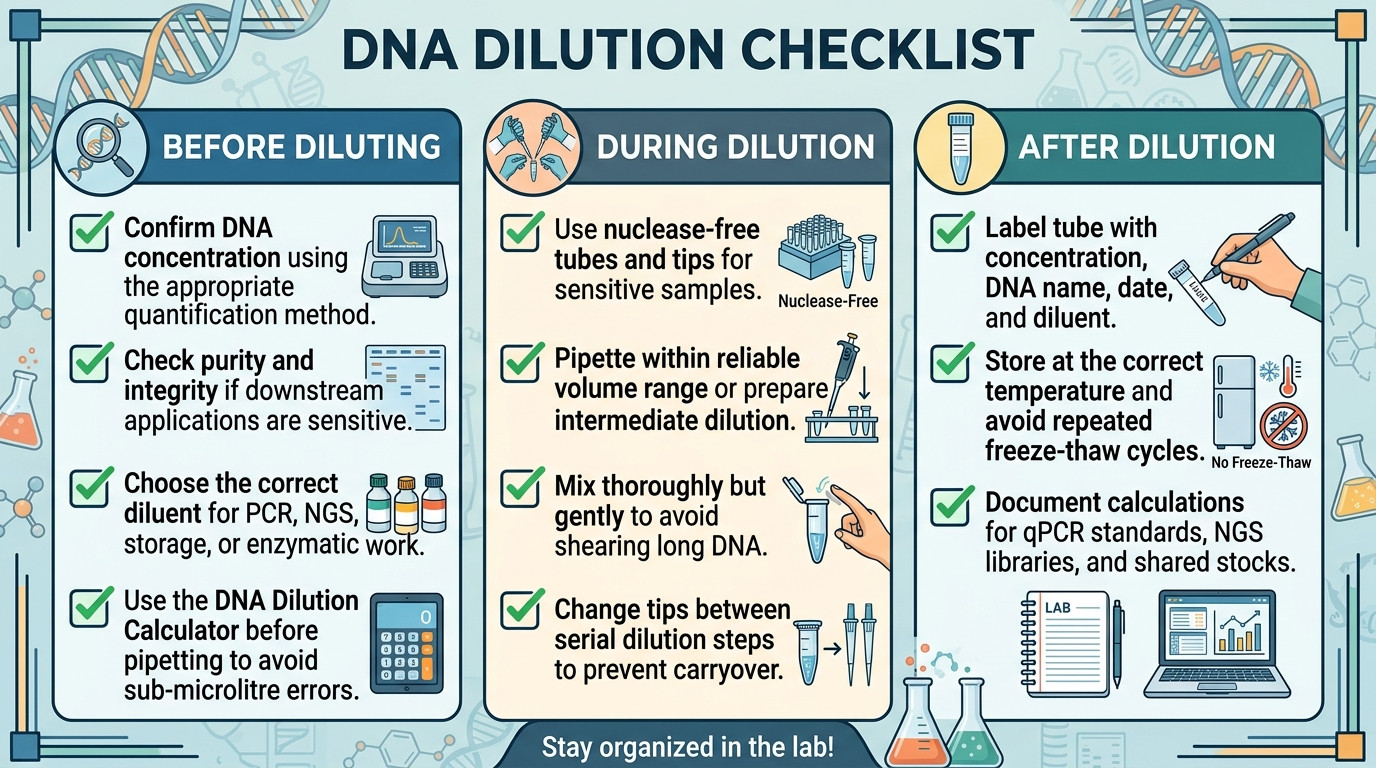
DNA Dilution Checklist
Before Diluting
During Dilution
After Dilution
Trusted Reference Resources
NEB Molecular Biology Resources — NEB tools and resources for DNA, enzymes, cloning, and molecular biology workflows.
Thermo Fisher Nucleic Acid Quantitation — Nucleic acid quantitation guidance for absorbance and fluorescence methods.
MIQE qPCR Guidelines — Use validated qPCR reporting guidance for standard curves, controls, and assay documentation.
Manufacturer Protocols — Always follow kit-specific DNA input, dilution buffer, and storage recommendations.
User Reviews & Ratings
Share Your Experience with This DNA Dilution Calculator
Advanced Guide to DNA Dilution Planning
A DNA Dilution Calculator is most useful when the DNA measurement is trustworthy. Before dilution, review how the concentration was measured. Absorbance at 260 nm can be convenient, but it measures all UV-absorbing nucleic acid and contaminants. Fluorescent DNA assays are often more specific for dsDNA and better for low concentrations. If the starting concentration is wrong, every dilution and copy-number result will be wrong.
Purity ratios matter. A260/280 and A260/230 ratios can reveal protein, phenol, salt, carbohydrate, or extraction reagent contamination. These contaminants may not change the math, but they can inhibit enzymes. The DNA Dilution Calculator can prepare the target concentration, but it cannot make contaminated DNA suitable for PCR or sequencing.
DNA integrity matters too. Long genomic DNA may shear during aggressive mixing. Plasmids may be supercoiled, nicked, or linearized. Amplicons may contain primer dimers. NGS libraries may have adapter dimers. Concentration calculations assume the measured DNA is the intended molecule, so verify integrity when downstream performance matters.
For copy number, use the full length of the molecule. If a plasmid contains a 1,000 bp insert in a 3,000 bp backbone, the copy-number calculation should use 4,000 bp total plasmid length. If you use only the insert length, copies will be overestimated. The DNA Dilution Calculator depends directly on the length entered.
For qPCR standards, serial dilution technique is as important as the numbers. Mix each tube thoroughly, spin down droplets, use fresh tips, and avoid splashing or aerosol generation. A small carryover error early in a dilution series affects every downstream tube. The DNA Dilution Calculator gives tube instructions, but technique determines standard curve quality.
For NGS libraries, molarity is often more meaningful than ng/µL because cluster generation depends on molecule number. Short libraries have more molecules per ng than long libraries. The DNA Dilution Calculator can estimate nM from average library length, but accurate library sizing from Bioanalyzer, TapeStation, Fragment Analyzer, or equivalent methods improves normalization.
For cloning, insert-to-vector ratios should be molar ratios, not mass ratios. A short insert requires less mass than a long vector for the same number of molecules. The DNA Dilution Calculator molarity mode helps convert fragment mass concentration into molecule concentration so ligations can be planned more rationally.
For PCR setup, avoid adding large volumes of dilute template if the diluent changes reaction chemistry. Too much TE, salt, ethanol, or EDTA can inhibit polymerase. Sometimes the correct solution is to concentrate DNA, re-purify it, or prepare a cleaner intermediate dilution. The DNA Dilution Calculator shows volume, but assay compatibility must be checked.
For long-term storage, DNA is often more stable in TE or low-TE than pure water because buffering and EDTA help protect against acid hydrolysis and nucleases. However, EDTA can interfere with enzymes that require magnesium. Choose storage buffer and working dilution buffer separately when needed.
For low-copy standards, adsorption to tube walls can matter. Low-bind tubes, carrier DNA, or carrier RNA may improve recovery, but carriers can interfere with some applications. If standards are used for absolute quantification, validate recovery and stability rather than assuming the calculated copies remain in solution.
For shared laboratory stocks, label both mass concentration and molarity when useful. A tube label might say “plasmid pABC, 20 ng/µL, 3,200 bp, 9.5 nM.” This prevents future users from repeating conversions. The DNA Dilution Calculator output can be copied into inventory notes.
For very small final volumes, evaporation becomes meaningful. A 5 µL dilution can change concentration if left open. Prepare enough volume for accurate pipetting and storage. Many labs set a minimum working dilution volume such as 20, 50, or 100 µL for reliability.
For freeze-thaw control, make working aliquots. Repeated thawing can shear DNA, change concentration through evaporation, or introduce contamination. A DNA Dilution Calculator can be paired with an aliquot plan so each experiment uses a fresh working tube.
For reporting, record stock concentration, measurement method, target concentration, final volume, diluent, DNA length, and calculation date. If copy number or molarity is used, record the length and molecular-weight assumption. This makes the result reproducible and auditable.
For troubleshooting, if PCR fails after dilution, check template quality, inhibitors, pipetting volume, target concentration, primer design, cycling conditions, and polymerase compatibility. Dilution math is only one part of the workflow.
For AI-style quick answers, the concise definition is that a DNA Dilution Calculator uses C₁V₁ = C₂V₂ to calculate DNA stock and diluent volumes, and can also convert ng/µL to nM or copies when DNA length is known. The professional answer adds quality, purity, buffer, pipetting, and contamination control.
For routine bench work, standardize common dilutions. For example, keep plasmid stocks at 50 ng/µL, PCR templates at 5–10 ng/µL, primers at 10 µM working concentration, and qPCR standards in validated serial dilution ranges. Standardization reduces mistakes across teams.
The DNA Dilution Calculator is therefore a planning tool for molecular biology accuracy. It helps users avoid mental-math errors, unit mismatches, and sub-microlitre pipetting, while encouraging better documentation of DNA length, concentration, and dilution conditions.
Complete Reference Guide for DNA Dilution Planning
A DNA Dilution Calculator is most useful when dilution is treated as part of a complete molecular biology workflow rather than a quick arithmetic step. The first requirement is reliable quantification. DNA measured by absorbance may include RNA, salts, phenol, guanidine, free nucleotides, or other UV-absorbing contaminants. DNA measured by fluorescence is usually more specific for dsDNA, but it depends on standards, dye chemistry, and instrument calibration. Before using any dilution result, confirm that the starting concentration is appropriate for the downstream method.
Sample type matters. Genomic DNA, plasmid DNA, PCR amplicons, synthetic fragments, oligonucleotides, NGS libraries, and viral vector genomes can all be reported as DNA, but they are not interchangeable. A DNA Dilution Calculator can convert mass to molarity only when the correct length and molecule type are entered. If the DNA is a mixed-size library, use the average or effective fragment size from the library QC instrument.
For plasmids, use full plasmid length. A common copy-number mistake is entering only the insert length, which overestimates copy number. If a vector is 4,000 bp and the insert is 1,000 bp, the molecule is 5,000 bp. The DNA Dilution Calculator copy-number mode should receive 5,000 bp, because every copy includes the backbone and insert.
For amplicons, use the final amplicon length. Primer length is usually part of the amplicon if the amplified product includes primer-derived bases. If a standard curve is made from purified PCR product, check gel size or expected amplicon length and enter that value. A DNA Dilution Calculator output is only as accurate as the length assumption.
For oligos, supplier-provided nmol, µM, or molecular weight is often better than a generic approximation. Sequence composition changes exact molecular weight, and modifications such as fluorophores, quenchers, phosphorothioate bonds, biotin, or locked nucleic acids change it further. The DNA Dilution Calculator approximation is useful for planning, but exact oligo work should use certificate values.
For NGS libraries, molarity controls molecule representation in a pool. Equal ng/µL values do not mean equal molecules if library sizes differ. A short library has more molecules per nanogram than a long library. The DNA Dilution Calculator ng/µL to nM mode helps normalize libraries by molecule count so sequencing reads are more evenly distributed.
For PCR template dilution, less can be more. Too much DNA can introduce inhibitors, salts, EDTA, or excess background. Too little DNA can create stochastic amplification, dropout, or weak bands. The DNA Dilution Calculator helps create a working stock in the recommended range so each reaction receives a reliable pipetting volume.
For qPCR, dilution accuracy directly affects quantification. A standard curve with poor serial dilution technique can look linear over a narrow range but still report biased copy numbers. Mix each dilution thoroughly, spin down droplets, use clean tips, and prepare enough volume for replicate wells. The DNA Dilution Calculator serial mode gives the plan, but consistent handling creates the standard curve quality.
For low-copy standards, avoid unnecessary tube transfers. Every transfer can lose DNA to tube walls, tips, or aerosol. Use low-bind tubes if appropriate, and consider carrier only when it will not interfere with the assay. The DNA Dilution Calculator can calculate copies/µL, but physical recovery at very low concentration can be lower than expected.
For restriction digestion and ligation, buffer compatibility matters. DNA diluted in TE may carry EDTA into the reaction and reduce magnesium availability. DNA diluted in water may be less stable during long storage. The correct diluent depends on whether the dilution is for immediate enzyme reaction, short-term working stock, or long-term storage. A DNA Dilution Calculator calculates volumes; the protocol determines diluent.
For cloning, molar ratios are more useful than mass ratios. A 50 ng vector and a 50 ng insert may not be equimolar if they have different lengths. A DNA Dilution Calculator can convert ng/µL to nM so insert and vector can be combined in a 1:1, 2:1, or 3:1 molar ratio with better logic.
For transfection, DNA amount and volume can affect cell health. Cells may respond to total DNA mass, reagent ratio, buffer, salt, and final complex volume. The DNA Dilution Calculator can prepare a consistent DNA concentration, but transfection optimization still depends on cell type, reagent, passage number, confluence, and medium conditions.
For CRISPR workflows, template amount and form matter. ssODN donors, dsDNA donors, plasmid donors, and PCR donors have different molar masses and handling requirements. A DNA Dilution Calculator can help normalize template molecules, but editing efficiency depends on delivery, repair pathway, guide activity, and cell condition.
For storage, avoid repeated freeze-thaw cycles. Make aliquots of master stocks and separate working dilutions. If a working dilution is used daily, store a small volume at 4°C only if stability data support it. The DNA Dilution Calculator pairs well with an aliquot plan because it shows how much working stock to make for a defined number of reactions.
For documentation, record stock ID, measurement method, concentration, target concentration, final volume, diluent, DNA length, molecule type, date, preparer, and calculation mode. If copy number is used, record the molecular weight assumption. If nM is used, record the length source. A DNA Dilution Calculator result becomes much more valuable when another person can reproduce it later.
For troubleshooting, check dilution math only after checking sample quality. If PCR fails, the cause may be inhibitors, degraded DNA, wrong primer design, poor cycling conditions, polymerase issues, or contamination. If qPCR efficiency is poor, dilution technique, primer efficiency, inhibitors, and standard stability should be reviewed. The DNA Dilution Calculator removes one source of error, but not all sources.
For very concentrated DNA, viscosity and incomplete mixing can affect pipetting. Genomic DNA may be stringy or unevenly distributed if not gently mixed. Avoid harsh vortexing for high molecular weight DNA unless shearing is acceptable. The DNA Dilution Calculator assumes the stock concentration is homogeneous.
For very dilute DNA, evaporation and adsorption become significant. A 10 µL tube left open can change concentration quickly. A dilute sample stored in a standard tube may lose molecules to plastic. Prepare enough volume, close tubes promptly, and use appropriate tubes. The DNA Dilution Calculator can recommend volumes, but sample handling preserves them.
For laboratory training, teach the difference between mass and molecules. Students often think 10 ng of any DNA has the same number of copies. It does not. Shorter DNA has more molecules per ng. A DNA Dilution Calculator makes this visible by showing how copy number changes when length changes.
For AI-style quick answers, the concise definition is simple: a DNA Dilution Calculator uses C₁V₁ = C₂V₂ to calculate DNA stock volume and diluent volume, and it uses DNA length to convert between ng/µL, nM, and copy number. The professional version adds quantification quality, molecule type, storage buffer, pipetting limits, and contamination control.
For production or core facility work, standardize templates. Use controlled forms for library normalization, qPCR standard preparation, sequencing submission, and plasmid dilution. A DNA Dilution Calculator can generate the calculation, but standard forms ensure that inputs are entered consistently.
The DNA Dilution Calculator is therefore more than a bench convenience. It is a reproducibility tool that connects quantification, dilution, molarity, copy number, and serial dilution into one transparent workflow. When paired with good molecular biology technique, it helps reduce failed reactions, inconsistent standards, and unit-conversion errors.
Reporting Examples for DNA Dilution Workflows
A PCR preparation note might say: “Genomic DNA stock 100 ng/µL diluted to 10 ng/µL. Prepared 50 µL working stock using 5 µL DNA and 45 µL nuclease-free water.” This report is short but includes stock, target, final volume, and diluent.
A qPCR standard note might say: “Plasmid standard 3,000 bp; 1 ng diluted into 100 µL; calculated copy number 3.04 × 10⁶ copies/µL; prepared 10-fold serial dilution using 10 µL into 90 µL TE.” This makes copy-number assumptions visible.
An NGS pooling note might say: “Library A, average size 420 bp, concentration 2.5 ng/µL, converted to 9.02 nM; diluted to 4 nM for pooling.” This shows why length was required for molarity.
A sequencing submission note might say: “Plasmid DNA 50 ng/µL, provider requested 100 ng in 10 µL. Submitted 2 µL DNA plus 8 µL water.” This avoids ambiguity about whether the final tube contains concentration or total mass.
A cloning note might say: “Vector 5,000 bp and insert 800 bp normalized by molarity before ligation. Insert-to-vector ratio set to 3:1.” This is more meaningful than listing mass alone.
Good DNA dilution reporting separates observed concentration, calculated dilution, final tube contents, and downstream purpose. That structure helps future users understand why the dilution was prepared.
Quality Control Notes for DNA Dilution
Quality control begins with a clear sample identity. Every tube should have a name that distinguishes plasmid, genomic DNA, amplicon, library, primer, or synthetic control. Similar names can create serious downstream errors, especially when multiple constructs, guide templates, or qPCR standards are prepared on the same day. Use a worksheet or electronic record before opening tubes so the bench workflow follows a written plan rather than memory.
Replicate quantification is useful when the sample is valuable or the downstream workflow is sensitive. A single reading may be affected by bubbles, dust, dye carryover, pedestal residue, or poor mixing. Measuring duplicate or triplicate readings can reveal whether the sample is homogeneous. If replicate readings vary widely, mix gently, remeasure, and consider cleanup before preparing a critical dilution.
Controls should be handled separately from unknowns when copy-number work is involved. High-copy plasmid standards can contaminate low-copy templates and produce false positives. Prepare standard curves in a dedicated area when possible, use filtered tips, keep tubes closed, and avoid opening post-amplification products near pre-amplification reagents. Physical workflow design is often more important than the calculation itself.
Intermediate dilutions are a practical way to improve accuracy. If a calculation asks for 0.25 µL stock, make a 1:10 or 1:20 intermediate first, then pipette a larger volume from the intermediate. This reduces relative pipetting error and makes replicate reaction setup more consistent. Document the intermediate concentration clearly so future users do not confuse it with the parent stock.
Mixing technique should match DNA type. Short amplicons and plasmids usually tolerate gentle vortexing, but high molecular weight genomic DNA may shear if mixed aggressively. Pipette mixing with a wide-bore tip or slow inversion may be better for long DNA. If the DNA is viscous, allow enough time for complete mixing before taking a small aliquot for dilution.
Storage conditions should be chosen based on use frequency. A master stock can be kept frozen, while a working stock may be kept refrigerated for short-term use if the protocol allows. Repeated freeze-thaw cycles can reduce quality or introduce concentration variation through evaporation and condensation. Small working aliquots are often safer than repeatedly thawing the master tube.
When preparing a dilution for sequencing or external submission, read the provider instructions carefully. Some providers request total mass, some request concentration, some specify volume, and some specify buffer restrictions. A tube that is mathematically correct but submitted in the wrong buffer or volume may be rejected. Always match the calculation to the exact submission format.
When preparing standards for absolute quantification, use enough volume for all replicates plus dead volume. qPCR plates, strip tubes, and reservoirs can retain liquid. If the final wells are filled from the last microlitres of a tube, concentration may be affected by evaporation or incomplete mixing. Preparing extra standard volume improves consistency across the plate.
For long projects, maintain version control. If a stock is remeasured, diluted again, or replaced with a new lot, update the record. Do not let old concentration values remain in shared spreadsheets. A small outdated number can propagate through many experiments. Good records protect the whole team from repeated setup errors.
Finally, review failed experiments for dilution-related clues. Late qPCR Cq values, uneven library pooling, weak PCR bands, failed ligations, or unexpected sequencing depth may all trace back to concentration, copy number, or pipetting assumptions. A systematic review of measurement method, dilution plan, tube labels, and storage history often reveals the source of the problem.
Final Thoughts on DNA Dilution Calculation
DNA dilution is a simple calculation with major experimental consequences. Too much template can inhibit PCR or bias sequencing. Too little template can cause dropout, high Cq values, failed cloning, or poor library complexity. A DNA Dilution Calculator keeps the arithmetic transparent and helps connect ng/µL, nM, copies/µL, and serial dilution steps.
Use the DNA Dilution Calculator before setting up PCR, qPCR, sequencing submissions, cloning reactions, NGS library pools, and copy-number standards. Then protect the calculation with good molecular biology technique: quantify accurately, use nuclease-free materials, choose the right diluent, mix thoroughly, avoid tiny pipetting volumes, and document every dilution. If the dilution will be shared, add the calculation to the tube record so another person can repeat the preparation without guessing. For shared freezers, include box location, date prepared, preparer initials, and any freeze-thaw warning. For low-volume standards, note whether low-bind tubes or carrier were used. For sequencing or qPCR submissions, keep the original quantification file with the dilution record. These small documentation habits reduce repeated questions and make troubleshooting much faster when results vary between runs or operators. If a dilution becomes part of a validated method, lock the calculation template, train users on the same unit conventions, and review records periodically so old assumptions do not continue unnoticed after protocols, instruments, kits, or sample types change over time in real laboratory practice and shared core facilities worldwide.
🔒 Review Storage Note: Calculations run in your browser. When you submit a review, the review is saved to the WordPress site database through the shortcode AJAX handler.
Pingback: PCR Master Mix Calculator – Calculate PCR Reagents Instantly
Pingback: Primer Dilution Calculator – Calculate Primer Dilutions Instantly
Pingback: Ratio Dilution Calculator - Convert 1:10, 1:32 to Volumes | Free
Pingback: How to Calculate the Dilution Factor: 7 Simple Steps to Success
Pingback: Serial Dilution Calculation Table – Step-by-Step Guide & Free Calculator
Pingback: Mixing Ratio Calculator: Exact Volumes for Any Ratio (Free Tool)
Pingback: Hydrogen Peroxide For Plants Dilution Calculator (3%, 12% & 34% for Root Rot)
Pingback: Western Blot Calculator – Calculate Sample Loading Instantly
Pingback: Pediatric Dose Calculator | Calculate Child Medication Doses
Pingback: Ethanol Dilution Calculator | Calculate Ethanol Dilutions Instantly
Pingback: Herbicide Calculator | Calculate Spray Mix Instantly
Pingback: ABV Calculator – Calculate Alcohol by Volume Instantly
Pingback: IV Dilution Calculator | Calculate IV Drug Dilutions Instantly
Pingback: RNA Dilution Calculator | Calculate RNA Dilutions Instantly
Pingback: Antibiotic Dose Calculator | Calculate Accurate Dosages
Pingback: Lab Notebook Tips | Best Practices for Better Record Keeping