
Ionic Strength Calculator — Multi-Ion, Activity Coefficient & Debye-Hückel
An ionic strength calculator computes the total ionic strength of a solution from the concentrations and charges of all dissolved ions using the formula I = ½ Σ(ci × zi²), where ci is the molar concentration and zi is the charge of each ion. Ionic strength determines how ions interact in solution, affecting activity coefficients, solubility, reaction rates, and electrode potentials. The ionic strength calculator handles five modes: multi-ion solver (up to 6 ions), quick salt calculator (auto-dissociation for common salts), activity coefficient calculator (Debye-Hückel limiting law), Debye length calculator, and ionic strength from conductivity estimator. Enter your ion concentrations and charges below and get the ionic strength with every step shown.
Key facts at a glance
- Ionic strength formula: I = ½ Σ(ci × zi²) in mol/L
- NaCl example: 0.1 M NaCl → I = ½(0.1×1² + 0.1×1²) = 0.1 M
- CaCl₂ example: 0.1 M CaCl₂ → I = ½(0.1×2² + 0.2×1²) = 0.3 M
- Activity coefficient: log γ = −A z² √I (Debye-Hückel limiting law, A ≈ 0.509 at 25°C)
- Debye length: κ⁻¹ = 0.304 / √I nm (in water at 25°C)
- Physiological: blood plasma I ≈ 0.15 M, PBS I ≈ 0.17 M
📋 Table of Contents
▼
- What an Ionic Strength Calculator Does
- Ionic Strength Calculator — Five Modes
- How Ionic Strength Is Calculated
- Real Scenarios Where Ionic Strength Mattered
- Common Ionic Strength Mistakes
- Lab Safety Essentials
- Which Mode Fits Your Situation
- Frequently Asked Questions
- Ionic Strength Best Practices Checklist
- Trusted Reference Resources
- User Reviews & Ratings
What an Ionic Strength Calculator Does
An ionic strength calculator tells you the effective “ion intensity” of a solution — a single number that captures the combined effect of every ion’s concentration and charge on the solution’s electrostatic environment. Ionic strength (I) is not the same as total ion concentration: a 0.1 M CaCl₂ solution has a higher ionic strength (I = 0.3 M) than a 0.1 M NaCl solution (I = 0.1 M) because Ca²⁺ carries twice the charge of Na⁺, and charge enters the formula squared. This squared-charge weighting makes ionic strength the critical parameter for predicting how ions behave in solution — their activity coefficients, solubility products, electrode potentials, protein stability, enzyme kinetics, and electrostatic screening.
The reason ionic strength calculations trip people up is the bookkeeping: every ion contributes separately, you must account for the stoichiometry of dissociation (CaCl₂ gives 1 Ca²⁺ and 2 Cl⁻), and the charge is squared before multiplying by concentration. For a buffer containing NaCl, KH₂PO₄, and Na₂HPO₄, tracking six or more ions with different charges and concentrations is tedious and error-prone by hand. The ionic strength calculator handles this bookkeeping automatically, accepts up to six ions simultaneously, and shows every step of the working so you can verify or document the calculation.
This ionic strength calculator handles five modes: the multi-ion solver (enter up to 6 ions with concentrations and charges), the quick salt calculator (enter a common salt and its molarity — the calculator auto-dissociates), the activity coefficient calculator (Debye-Hückel limiting law from ionic strength), the Debye length calculator (electrostatic screening distance), and the ionic strength from conductivity estimator. Each mode shows the answer and every step, making it suitable for research, teaching, analytical chemistry, biochemistry, and environmental science.
Ionic Strength Calculator
Five modes — multi-ion solver, salt calculator, activity coefficient, Debye length & conductivity
Enter each ion's molar concentration (mol/L) and its charge. Leave unused rows at 0.
Calculation Result
⚠️ Note: This ionic strength calculator assumes complete dissociation and is an educational tool. For precise thermodynamic work, use measured activity coefficients and account for ion pairing and incomplete dissociation.
How Ionic Strength Is Calculated
Ionic strength (I) is a measure of the total electrostatic environment created by all ions in a solution. It was introduced by Gilbert Newton Lewis and Merle Randall in 1921 to explain why the thermodynamic behaviour of electrolyte solutions depends not just on the concentration of individual ions but on the combined effect of all ions weighted by the square of their charge. The formula is: I = ½ Σ(ci × zi²), where the sum runs over every distinct ionic species in solution, ci is its molar concentration (mol/L), and zi is its charge number (the magnitude of its electric charge in units of the elementary charge).
Why Charge Is Squared
The squared charge weighting is the most important feature of the ionic strength formula, and it is also the most commonly misunderstood. A Ca²⁺ ion at 0.1 mol/L contributes 0.1 × 2² = 0.4 to the sum — four times the contribution of Na⁺ at the same concentration (0.1 × 1² = 0.1). This is not arbitrary: the electrostatic potential around an ion scales with its charge, and the energy of interaction between ions scales with the product of their charges. A divalent ion distorts the surrounding solvent and ion atmosphere far more than a monovalent ion. The ionic strength formula captures this by squaring the charge, so that higher-charge ions have a disproportionately large effect on solution behaviour.
Stoichiometry of Dissociation
When calculating ionic strength from salt concentrations, you must account for the stoichiometry of dissociation. A 0.1 mol/L CaCl₂ solution dissociates into 0.1 mol/L Ca²⁺ and 0.2 mol/L Cl⁻. The ionic strength is therefore: I = ½(0.1 × 4 + 0.2 × 1) = ½(0.4 + 0.2) = 0.3 mol/L — not 0.1 mol/L. The ionic strength calculator’s Salt mode handles this stoichiometry automatically for 15 common salts. For complex mixtures, the Multi-Ion mode lets you enter each ion’s concentration and charge separately.
Ionic Strength Factors for Common Salt Types
For a salt of formula Mν+Xν− where the cation has charge z+ and the anion has charge z−, the ionic strength is: I = ½ × c × (ν+z+² + ν−z−²). This gives characteristic factors: 1:1 salts (NaCl, KCl) → I = c; 2:1 salts (CaCl₂, MgCl₂) → I = 3c; 1:2 salts (Na₂SO₄) → I = 3c; 2:2 salts (MgSO₄, CaSO₄) → I = 4c; 3:1 salts (AlCl₃, FeCl₃) → I = 6c. These factors explain why multivalent salts dramatically increase ionic strength even at low concentrations.
Activity Coefficients and the Debye-Hückel Law
The primary practical use of ionic strength is calculating activity coefficients — the correction factors that convert molar concentrations into thermodynamically effective concentrations (activities). The Debye-Hückel limiting law (valid for I < 0.01 mol/L) gives: log γ = −A z² √I, where A ≈ 0.509 for water at 25°C. At physiological ionic strength (I ≈ 0.15 mol/L), the activity coefficient for monovalent ions is approximately 0.77 — meaning ions are 23% less effective than their nominal concentration would suggest. For divalent ions, the effect is much larger: γ ≈ 0.35 at I = 0.15 mol/L, meaning divalent ions are 65% less effective. The ionic strength calculator’s Activity mode computes γ for any ion charge and ionic strength.
Debye Length
The Debye length (κ⁻¹) is the characteristic distance over which electrostatic interactions are screened in an electrolyte solution. Beyond one Debye length, the electric field of an ion is mostly shielded by the surrounding ion atmosphere. It is given by: κ⁻¹ = 0.304 / √I nm (for water at 25°C, I in mol/L). At physiological ionic strength (I = 0.15 mol/L), the Debye length is 0.304/√0.15 ≈ 0.79 nm — smaller than most protein domains. This short screening length explains why electrostatic interactions between proteins are highly sensitive to salt concentration at physiological conditions.
Activity: log γ = −A z² √I (A ≈ 0.509 at 25°C)
Debye length: κ¹ = 0.304 / √I nm (water, 25°C)
γ = 10^(logγ)
Quick Reference Values
Remember: Charge enters as z² — divalent ions contribute 4× more per mole than monovalent ions, and trivalent ions contribute 9×. Small amounts of multivalent salts can dominate ionic strength. The ionic strength calculator handles the z² weighting automatically.

Real Scenarios Where Ionic Strength Mattered
Scenario 1: Protein Precipitation — Salting Out
A biochemist was attempting to precipitate an antibody from cell culture supernatant using ammonium sulphate. At 60% saturation, precipitation was incomplete. Using the ionic strength calculator to check: a fully saturated ammonium sulphate solution (≈ 4.1 mol/L (NH₄)₂SO₄) has an ionic strength of ½(8.2×1² + 4.1×2²) = ½(8.2+16.4) = 12.3 mol/L. At 60%, I ≈ 7.4 mol/L — extremely high. The calculation confirmed that the ionic strength was more than sufficient for salting out, and the incomplete precipitation was due to a pH mismatch rather than insufficient ionic strength.
Scenario 2: DNA Electrophoresis Buffer — Optimising Band Resolution
A molecular biologist was running agarose gel electrophoresis of DNA fragments in TAE buffer (40 mM Tris-acetate, 1 mM EDTA). Using the ionic strength calculator: Tris⁺ ≈ 20 mM (z=1), acetate⁻ ≈ 20 mM (z=1), giving I ≈ 0.02 mol/L. The low ionic strength was intentional — it allows efficient DNA migration. Switching to 1× TBE (89 mM Tris, 89 mM borate, 2 mM EDTA) gives I ≈ 0.09 mol/L — higher ionic strength, slower migration but better resolution for small fragments. The ionic strength calculator supported the buffer choice decision.
Scenario 3: Enzyme Kinetics — Salt Inhibition of a Restriction Enzyme
A researcher noticed that a restriction enzyme was inhibited above 100 mM NaCl. Using the ionic strength calculator, they computed that 100 mM NaCl gives I = 0.1 mol/L, at which the Debye length is 0.96 nm — short enough to screen the DNA-protein electrostatic interactions that are essential for restriction enzyme binding. By substituting 50 mM NaCl + 50 mM KCl (both 1:1 salts), the ionic strength remained 0.1 mol/L but the K⁺ stabilised the enzyme conformation. This confirmed that the inhibition was an ionic strength effect rather than a specific NaCl effect.
Scenario 4: Capillary Electrophoresis — Controlling Electroosmotic Flow
An analytical chemist was optimising a capillary electrophoresis method for pharmaceutical impurity analysis. Electroosmotic flow (EOF) is suppressed at high ionic strength because the Debye length decreases, compressing the electrical double layer at the capillary wall. Using the ionic strength calculator, the chemist computed that increasing the buffer from 25 mM phosphate (I ≈ 0.05 M) to 100 mM phosphate (I ≈ 0.2 M) reduced the Debye length from 1.36 nm to 0.68 nm — halving the double layer thickness and significantly suppressing EOF, improving peak shape for the analytes of interest.
Scenario 5: Environmental Water Analysis — Speciation Modelling
An environmental scientist needed to model the speciation of heavy metals in river water. The river water contained 5 mM NaCl, 2 mM CaCl₂, 1 mM MgSO₄, and 0.5 mM Na₂SO₄. Using the ionic strength calculator’s multi-ion mode: I = ½(5×1 + 5×1 + 2×4 + 4×1 + 1×4 + 1×4 + 1×1 + 1×4) = 0.018 mol/L. At this ionic strength, the activity coefficient for Pb²⁺ (z=2) is γ = 10^(−0.509×4×√0.018) = 0.56 — meaning only 56% of the lead concentration is thermodynamically active. Ignoring this correction would overestimate lead bioavailability by 44%.
Scenario 6: HPLC Ion-Pair Chromatography
A pharmaceutical analyst was developing an ion-pair HPLC method for a basic drug using 10 mM heptanesulphonate (z=1) as the ion-pair reagent in 50 mM ammonium formate mobile phase. The ionic strength calculator showed: I = ½(10×1 + 10×1 + 50×1 + 50×1) = 60 mM. The relatively low ionic strength was intentional — it allowed the heptanesulphonate to associate with the positively charged drug without excessive electrostatic screening. Increasing to 100 mM ammonium formate increased ionic strength to 110 mM, reducing retention by compressing the double layer on the stationary phase.
Scenario 7: Protein Crystallisation — Optimising Salt Conditions
A structural biologist was screening crystallisation conditions for a membrane protein. Previous attempts with 100 mM MgSO₄ (I = 0.4 mol/L, factor 4×) produced no crystals. Switching to 100 mM NaCl (I = 0.1 mol/L) produced small crystals. The ionic strength calculator confirmed the 4-fold difference in ionic strength between the two conditions, guiding a systematic screen across I = 0.1–0.5 mol/L using mixtures of NaCl and MgSO₄, which eventually produced diffraction-quality crystals at I = 0.25 mol/L.
Scenario 8: Electrochemistry — Correcting Standard Electrode Potentials
An electrochemist was measuring the reduction potential of a Fe³⁺/Fe²⁺ redox couple in a buffer containing 150 mM NaCl, 10 mM phosphate buffer (pH 7), and 2 mM FeCl₃. The ionic strength calculator gave: I ≈ ½(150×1 + 150×1 + 10×1 + 10×1 + 2×9 + 6×1) = ½(370) ≈ 0.185 mol/L. At this ionic strength, the activity coefficients for Fe³⁺ (z=3, γ ≈ 0.18) and Fe²⁺ (z=2, γ ≈ 0.40) are very different, shifting the observed potential by approximately +30 mV from the standard value. The ionic strength calculator’s activity mode quantified this correction.

Common Ionic Strength Calculation Mistakes
Mistake 1: Forgetting to Square the Charge
The most common ionic strength error is using z instead of z². For Ca²⁺ at 0.1 mol/L, the correct contribution is 0.1 × 2² = 0.4, not 0.1 × 2 = 0.2. Forgetting the square doubles the error for divalent ions and triples it for trivalent ions. The ionic strength calculator squares the charge automatically.
Mistake 2: Ignoring the Stoichiometry of Dissociation
CaCl₂ at 0.1 mol/L gives 0.1 mol/L Ca²⁺ AND 0.2 mol/L Cl⁻. Both must be included in the sum. Using only the nominal salt concentration (0.1 mol/L) instead of both ion concentrations would give I = ½(0.1×4) = 0.2 instead of the correct ½(0.1×4 + 0.2×1) = 0.3.
Mistake 3: Forgetting the ½ Factor
The ionic strength formula has a factor of one-half (½) that is easy to omit. Forgetting it doubles the calculated ionic strength. The ionic strength calculator always applies the ½ factor correctly.
Mistake 4: Confusing Ionic Strength with Total Ion Concentration
Total ion concentration (TIC) is the sum of all ion concentrations. Ionic strength is ½ × sum of (c × z²). For NaCl, TIC = 2c and I = c — they are related by a factor of 2. For CaCl₂, TIC = 3c and I = 3c — numerically equal by coincidence. For MgSO₄, TIC = 2c but I = 4c — they differ by a factor of 2. Never substitute TIC for ionic strength in thermodynamic calculations.
Mistake 5: Applying the Debye-Hückel Limiting Law Outside Its Range
The Debye-Hückel limiting law (log γ = −Az²√I) is only accurate for I < 0.01 mol/L. At physiological ionic strength (I ≈ 0.15 mol/L), the limiting law underestimates activity coefficients significantly. Use the extended Debye-Hückel equation or Davies equation for I > 0.01 mol/L. The ionic strength calculator’s Activity mode displays a warning about this range limitation.
Mistake 6: Using Concentration Instead of Activity
Many equilibrium constants (Ka, Ksp, Keq) are defined in terms of activities, not concentrations. At ionic strengths above 0.01 mol/L, using concentrations directly in equilibrium calculations introduces significant errors. The activity coefficient from the ionic strength calculator corrects for this: a = γ × c.
Mistake 7: Not Including Buffer Ions
Buffers contribute significantly to ionic strength. A 50 mM phosphate buffer at pH 7 contains HPO₄²⁻ (z=2) and H₂PO₄⁻ (z=1) in a ratio determined by pH, plus the counter-ion (Na⁺ or K⁺). These ions can contribute 0.05–0.15 mol/L to the total ionic strength. Always include buffer ions in the ionic strength calculator when preparing solutions for electrochemical or binding measurements.
💡 Rule of Thumb: For 1:1 salts (NaCl), I = c. For 2:1 salts (CaCl₂), I = 3c. For 2:2 salts (MgSO₄), I = 4c. For 3:1 salts (AlCl₃), I = 6c. Multivalent ions dominate ionic strength. The ionic strength calculator handles every case with the correct z² weighting and stoichiometry.
Lab Safety Essentials
High-ionic-strength solutions: Concentrated salt solutions can be corrosive (high-concentration HCl, H₂SO₄), oxidising (concentrated ammonium persulphate), or toxic (heavy metal salts). Always consult the SDS for each salt and use appropriate PPE — gloves, goggles, lab coat.
- Assume complete dissociation for strong electrolytes (NaCl, KCl, MgCl₂) in dilute solution. For weak electrolytes, use the degree of dissociation.
- Account for all ionic species — including buffer counter-ions and trace salts.
- Temperature matters — ionic strength calculations are valid at the temperature specified; the Debye-Hückel constant A changes with temperature.
- Use the ionic strength calculator output for documentation in protocols, publications, and regulatory submissions.
- Verify with conductivity measurement for complex solutions where incomplete dissociation may occur.
Which Mode Fits Your Situation
| Mode | Use Case | Key Formula | Inputs | Applications |
|---|---|---|---|---|
| Multi-Ion | Complex mixed solutions | I = ½Σcz² | Up to 6 ions (c, z) | Buffers, physiological fluids |
| Salt | Single salt quick check | I = ½Σcz² (auto) | Salt type, molarity | NaCl, CaCl₂, MgSO₄ etc. |
| Activity | Activity coefficient γ | log γ = −Az²√I | I, |z|, temperature | Equilibria, electrochemistry |
| Debye | Electrostatic screening | κ⁻¹ = 0.304/√I nm | I, temperature, solvent | Protein interactions, colloids |
| Conductivity | Estimate I from κ | I ≈ κ/factor | Conductivity, salt type | Field measurements, QC |
Ionic Strength in Biochemistry and Structural Biology
Ionic strength is one of the most critical variables in biochemical experiments. Enzyme kinetics, protein-protein interactions, protein-DNA binding, antibody-antigen binding, and ligand-receptor interactions all depend strongly on ionic strength because electrostatic interactions contribute significantly to binding energies. Many published binding affinities (Kd values) are measured at a specific ionic strength (typically 0.1–0.15 mol/L), and extrapolating to different ionic strengths requires activity coefficient corrections. The ionic strength calculator supports both the calculation of ionic strength from solution composition and the activity coefficient correction needed for this extrapolation.
Ionic Strength in Analytical Chemistry
In analytical chemistry, ionic strength affects electrode potentials, chromatographic retention, electrophoretic mobility, and the accuracy of pH measurements. The ionic strength adjuster (ISA) technique — adding a high concentration of an inert salt (typically 0.5 M NaNO₃ or KNO₃) to all standards and samples — ensures that all solutions have the same ionic strength, eliminating activity coefficient variations across the calibration range. The ionic strength calculator helps analytical chemists verify that the ISA effectively dominates the ionic strength by showing the contribution of each ionic species.
Ionic Strength in Environmental Science
Environmental scientists use ionic strength to model ion speciation, metal bioavailability, and contaminant transport in natural waters. The ionic strength of freshwater is typically 0.001–0.01 mol/L; estuarine water varies from 0.01–0.5 mol/L depending on salinity; seawater is approximately 0.7 mol/L. These large variations in ionic strength dramatically affect the speciation of trace metals, the flocculation of colloids, and the transport of charged contaminants through soils and sediments.
Ionic Strength in Electrochemistry
In electrochemistry, ionic strength affects the Nernst equation through activity coefficients, the double-layer capacitance through the Debye length, and the mass transport of ions through solution. The formal potential (E°’) of a redox couple — the reduction potential at the specific ionic strength and pH of the experiment — differs from the standard potential (E°) by the activity coefficient ratio of oxidised and reduced forms.
Ionic Strength in Food Science
Food scientists use ionic strength to control protein gelation, emulsification, and flavour release. Many food processing operations — cheese making, meat processing, tofu preparation, plant-based protein formulation — involve manipulating the ionic strength of aqueous phases to control protein solubility, aggregation, and texture.
Worked Examples
Example 1 — NaCl: 0.15 mol/L NaCl → Na⁺ = 0.15 M (z=1), Cl⁻ = 0.15 M (z=1). I = ½(0.15×1 + 0.15×1) = 0.15 mol/L.
Example 2 — CaCl₂: 0.1 mol/L CaCl₂ → Ca²⁺ = 0.1 M (z=2), Cl⁻ = 0.2 M (z=1). I = ½(0.1×4 + 0.2×1) = ½(0.6) = 0.3 mol/L.
Example 3 — Activity: γ for Na⁺ (z=1) at I = 0.15 mol/L: log γ = −0.509×1×√0.15 = −0.197, γ = 0.635.
Example 4 — Debye length: At I = 0.15 mol/L in water at 25°C: κ⁻¹ = 0.304/√0.15 = 0.785 nm.
Example 5 — PBS: PBS (137 mM NaCl + 2.7 mM KCl + 10 mM Na₂HPO₄ + 1.8 mM KH₂PO₄). I ≈ 0.172 mol/L.
Frequently Asked Questions About the Ionic Strength Calculator
1. What is an ionic strength calculator?
An ionic strength calculator computes I = ½ Σ(ci × zi²) for all ions in solution, showing each ion’s contribution and the total. This calculator provides five modes: multi-ion solver, salt calculator, activity coefficient, Debye length, and conductivity estimator.
2. What is the formula for ionic strength?
I = ½ Σ(ci × zi²), where ci is the molar concentration of ion i and zi is its charge number. The sum runs over all ionic species in solution, and the result is divided by 2.
3. What is the ionic strength of 0.15 M NaCl?
I = ½(0.15×1² + 0.15×1²) = 0.15 mol/L. For 1:1 salts (NaCl, KCl), ionic strength equals the salt molarity.
4. Why is CaCl₂ ionic strength 3× the molarity?
CaCl₂ → Ca²⁺ (z=2) + 2Cl⁻ (z=1). I = ½(c×4 + 2c×1) = ½(6c) = 3c. The Ca²⁺ contributes 4× per mole (charge squared = 4) and there are 2 Cl⁻ ions per formula unit.
5. What is the activity coefficient at physiological ionic strength?
For monovalent ions (z=1) at I = 0.15 mol/L: log γ = −0.509×1×√0.15 = −0.197, γ ≈ 0.635. For divalent ions (z=2): log γ = −0.509×4×√0.15 = −0.788, γ ≈ 0.163 (limiting law; actual value higher due to short-range interactions).
6. What is the Debye length at physiological ionic strength?
At I = 0.15 mol/L in water at 25°C: κ⁻¹ = 0.304/√0.15 ≈ 0.785 nm. This means electrostatic interactions are screened within about 0.8 nm.
7. How do I calculate ionic strength of a PBS buffer?
Enter each ion separately in Multi-Ion mode. For 1× PBS: Na⁺ ≈ 157 mM (z=1), K⁺ ≈ 4.5 mM (z=1), Cl⁻ ≈ 140 mM (z=1), HPO₄²⁻ ≈ 10 mM (z=2), H₂PO₄⁻ ≈ 1.8 mM (z=1). Total I ≈ 0.17 mol/L.
8. Is the Debye-Hückel limiting law accurate at physiological I?
No. The limiting law is only accurate for I < 0.01 mol/L. At I ≈ 0.15 mol/L, it underestimates activity coefficients. Use the extended Debye-Hückel or Davies equation for higher ionic strengths.
9. Can I use conductivity to estimate ionic strength?
Yes, approximately. For NaCl-type solutions, I ≈ conductivity(mS/cm)/100. The Conductivity mode provides this estimate with a clear accuracy warning.
10. Is this ionic strength calculator free?
Yes. Completely free, browser-based, no sign-up, fully private. No data sent to any server.
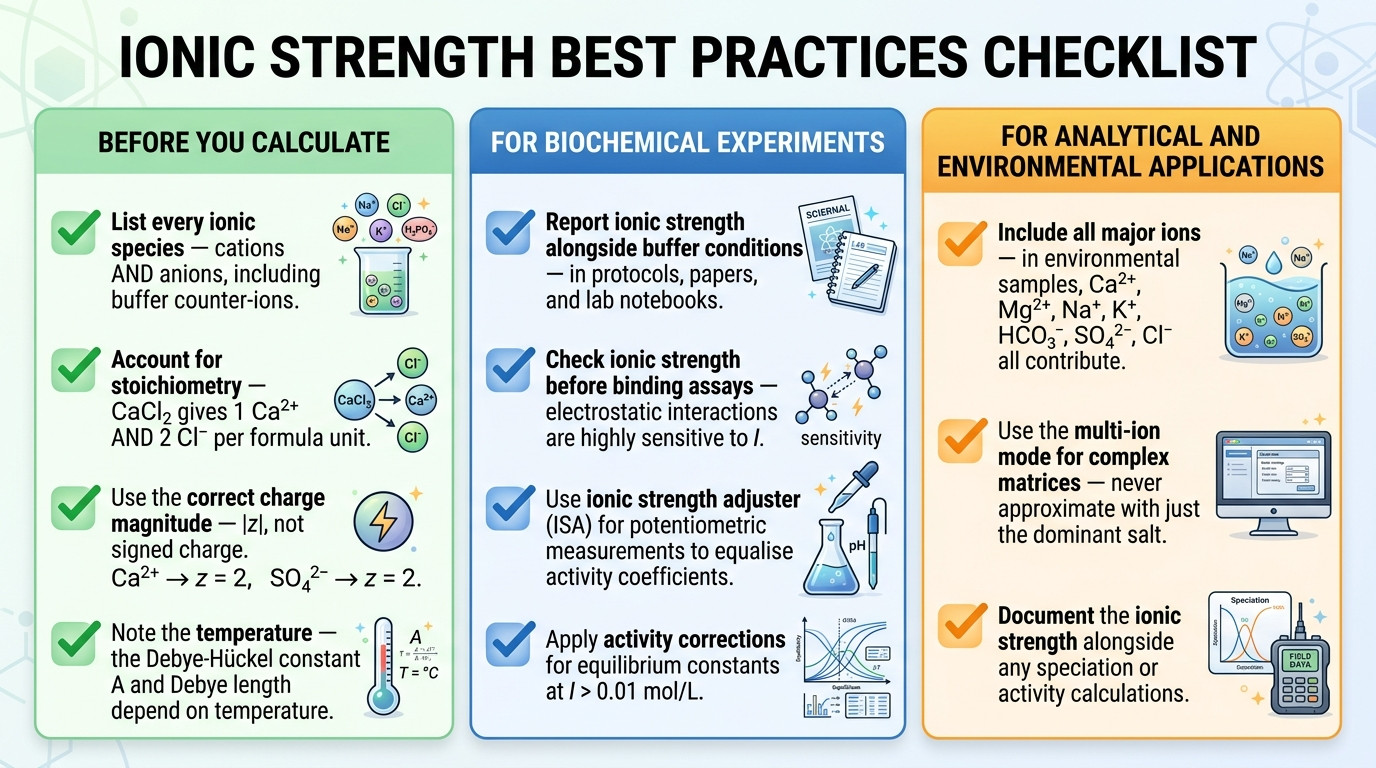
Ionic Strength Best Practices Checklist
Before You Calculate
For Biochemical Experiments
For Analytical and Environmental Applications
Trusted Reference Resources for Ionic Strength
IUPAC Gold Book — goldbook.iupac.org — Official definition of ionic strength and related thermodynamic quantities.
NIST Chemistry WebBook — webbook.nist.gov — Thermodynamic data, activity coefficients, and Debye-Hückel parameters.
LibreTexts Chemistry — chem.libretexts.org — Free explanations of ionic strength, activity coefficients, and Debye-Hückel theory.
PHREEQC (USGS) — usgs.gov — Free geochemical modelling software for ionic strength and speciation calculations.
Robinson & Stokes — Electrolyte Solutions — The definitive reference for ionic strength, activity coefficients, and electrolyte thermodynamics.
User Reviews & Ratings
Share Your Experience with This Ionic Strength Calculator
Final Thoughts on Ionic Strength Calculation
Ionic strength is one of those parameters that seems simple — it is just a weighted sum of concentrations — but the squared-charge weighting, the stoichiometry of dissociation, the dependence on every ionic species in solution, and the downstream effects on activity coefficients, Debye lengths, and electrode potentials make it a surprisingly rich and important quantity. Getting it right matters: a factor-of-3 underestimate in ionic strength changes the activity coefficient for divalent ions by 30–50%, shifts electrode potentials by 20–40 mV, and alters the Debye length by a factor of √3.
The ionic strength calculator removes the arithmetic burden of tracking every ion, squaring every charge, and summing every term. The salt mode handles the most common case with a single dropdown. The multi-ion mode handles complex buffers, physiological fluids, and environmental samples. The activity and Debye modes provide the downstream quantities most needed in thermodynamic and biophysical applications. Use the step-by-step output for your lab notebook, your paper’s methods section, or your regulatory submission.
🔒 Privacy Guarantee: Every calculation runs entirely within your browser. No data is sent to any server. Reviews are saved in your browser’s local storage only.
Pingback: Acid Dilution Calculator - Safe Lab & Industrial Use | Free Tool
Pingback: How to Calculate the Dilution Factor: 7 Simple Steps to Success
Pingback: How to Calculate Dilution Factor: Formula + Free Calculator
Pingback: Weight by Volume Dilution Calculator: % w/v Solutions (Free)
Pingback: Sodium Hypochlorite Dilution Calculator | Free CDC Bleach Tool
Pingback: Neem Oil Dilution Ratio Calculator | Mix Neem Oil Correctly -
Pingback: Star San Sanitizer Multi-Unit Tool | Free No-Rinse Brewing Sanitizer
Pingback: IV Dilution Calculator | Calculate IV Drug Dilutions Instantly
Pingback: Star San Sanitizer Tool | Calculate Dilution Instantly
Pingback: Brewing Calculator | Calculate Beer Brewing Values Instantly
Pingback: Percent by Mass Calculator | Calculate Mass Percentage Instantly