
Molecular Weight Calculator — Formula Parser, Element Composition & Mass Analysis
A molecular weight calculator computes the molar mass (molecular weight) of any chemical compound by parsing its molecular formula and summing the atomic masses of all constituent atoms. Enter a formula like C₆H₁₂O₆ (glucose) and the calculator returns 180.16 g/mol, along with a complete element-by-element breakdown showing each atom’s contribution, mass percentage, and total count. The molecular weight calculator handles five modes: formula parser (type any formula), element composition (% by mass), hydrated salt calculator (includes water of crystallisation), mass-to-moles converter (using the calculated MW), and common compound lookup (pre-loaded database of 50+ compounds). Enter your formula below and get the molecular weight with every step shown.
Key facts at a glance
- Molecular weight formula: MW = Σ(atomic mass × number of atoms) for each element
- Units: g/mol (grams per mole) = Da (Daltons) = amu (atomic mass units)
- H₂O: 2(1.008) + 16.00 = 18.015 g/mol
- NaCl: 22.99 + 35.45 = 58.44 g/mol
- Glucose (C₆H₁₂O₆): 6(12.011) + 12(1.008) + 6(16.00) = 180.16 g/mol
- Proteins: expressed in kDa (kilodaltons); 1 kDa = 1000 Da
📋 Table of Contents
▼
- What a Molecular Weight Calculator Does
- Molecular Weight Calculator — Five Modes
- How Molecular Weight Is Calculated
- Real Scenarios Where Molecular Weight Mattered
- Common Molecular Weight Mistakes
- Lab Safety Essentials
- Which Mode Fits Your Situation
- Frequently Asked Questions
- Molecular Weight Best Practices Checklist
- Trusted Reference Resources
- User Reviews & Ratings
What a Molecular Weight Calculator Does
A molecular weight calculator takes a chemical formula — like NaCl, C₆H₁₂O₆, CaCl₂·2H₂O, or (NH₄)₂SO₄ — and computes the molar mass by looking up the atomic mass of each element and multiplying by the number of atoms of that element in the formula. This is the most fundamental calculation in chemistry: you cannot convert between mass and moles, prepare a molar solution, calculate stoichiometric yields, or determine percent composition without knowing the molecular weight. The molecular weight calculator automates this by parsing the formula, handling subscripts, parentheses, hydration dots, and multi-element formulas, and showing the element-by-element breakdown so you can verify the result.
The reason molecular weight calculations cause errors is that chemical formulas are compact and information-dense. The formula Ca(NO₃)₂ contains 1 Ca, 2 N, and 6 O atoms — but the parentheses and subscripts make it easy to miscount. CaCl₂·2H₂O means 1 Ca + 2 Cl + 4 H + 2 O (not 2 H and 1 O). (NH₄)₂SO₄ contains 2 N + 8 H + 1 S + 4 O. Miscounting atoms gives the wrong molecular weight, which propagates through every subsequent mole, concentration, and stoichiometry calculation. The molecular weight calculator parses the formula correctly every time, preventing these counting errors.
This molecular weight calculator handles five modes: the formula parser (enter any molecular formula and get the MW with element breakdown), the element composition analyser (mass percentage of each element), the hydrated salt calculator (automatically adds water of crystallisation to the base formula), the mass-to-moles converter (using the calculated MW), and the common compound lookup (instant MW from a database of 50+ frequently used compounds). Each mode shows every step of the working, making it suitable for teaching, laboratory notebooks, quality control, and regulatory documentation.
Molecular Weight Calculator
Five modes — formula parser, composition, hydrated salts, mass ↔ moles & compound lookup
Calculation Result
⚠️ Note: This molecular weight calculator uses IUPAC 2021 standard atomic weights. For isotopically enriched or depleted samples, use the exact isotopic mass instead. Always verify the molecular formula from the reagent label or PubChem.
How Molecular Weight Is Calculated
Molecular weight (also called molar mass, formula weight, or molecular mass) is the sum of the atomic masses of every atom in a molecular formula. The formula is: MW = Σ(atomic mass × number of atoms) for each element in the compound. For water (H₂O): MW = 2(1.008) + 1(15.999) = 18.015 g/mol. For glucose (C₆H₁₂O₆): MW = 6(12.011) + 12(1.008) + 6(15.999) = 180.156 g/mol. The molecular weight calculator parses any formula — including parentheses, subscripts, and hydration dots — and performs this summation automatically, showing each element’s contribution.
Atomic Mass vs Molecular Weight vs Formula Weight
These terms are often used interchangeably but have precise definitions. Atomic mass is the mass of a single atom of an element, expressed in atomic mass units (amu) or Daltons (Da). Molecular weight is the sum of atomic masses for a molecular compound (like H₂O, C₆H₁₂O₆). Formula weight is the equivalent for ionic compounds (like NaCl, CaCl₂) that don’t form discrete molecules. Molar mass is the mass of one mole of any substance, expressed in g/mol — numerically equal to the molecular or formula weight but with different units. The molecular weight calculator uses “molecular weight” and “molar mass” interchangeably, reporting the result in g/mol.
Handling Parentheses and Subscripts
Complex formulas require careful atom counting. Ca(NO₃)₂ contains 1 Ca, 2 N, and 6 O (the subscript 2 multiplies everything inside the parentheses: 2×N = 2 N, 2×3O = 6 O). (NH₄)₂SO₄ contains 2 N, 8 H (2×4), 1 S, 4 O. Fe₂(SO₄)₃ contains 2 Fe, 3 S, 12 O (3×4). The molecular weight calculator’s formula parser handles nested parentheses and arbitrary subscripts, eliminating counting errors.
Hydrated Salts
Many laboratory reagents are hydrated — they contain water molecules incorporated into their crystal structure. CaCl₂·2H₂O has MW = 110.98 (CaCl₂) + 2(18.015) = 147.01 g/mol. Na₂SO₄·10H₂O (Glauber’s salt) has MW = 142.04 + 10(18.015) = 322.19 g/mol. Using the anhydrous MW when you have the hydrated salt gives the wrong number of moles — a 33% error for CaCl₂·2H₂O and a 127% error for Na₂SO₄·10H₂O. The molecular weight calculator’s Hydrate mode adds the water contribution automatically.
Element Composition (Percent by Mass)
Percent composition tells you what fraction of the total molecular weight comes from each element: % element = (atomic mass × count ÷ MW) × 100. For NaCl: Na = 22.99/58.44 × 100 = 39.3%, Cl = 35.45/58.44 × 100 = 60.7%. This is essential for empirical formula determination, nutritional labelling (% sodium, % iron), environmental reporting (% phosphorus), and analytical verification. The molecular weight calculator’s Composition mode shows the mass percentage of every element.
Units: g/mol, Da, kDa, amu
Molecular weight can be expressed in several equivalent units: g/mol (grams per mole — the practical chemistry unit), Da or amu (Daltons or atomic mass units — numerically identical to g/mol), and kDa (kilodaltons — used for proteins and large molecules; 1 kDa = 1000 Da). A small molecule like NaCl has MW = 58.44 g/mol = 58.44 Da. A protein like BSA has MW ≈ 66,430 g/mol = 66.43 kDa. The molecular weight calculator reports in g/mol and notes kDa for values above 1000.
NaCl: 22.990 + 35.450 = 58.440 g/mol
% element = (contribution ÷ MW) × 100
Hydrate MW = base MW + n × 18.015
1 g/mol = 1 Da = 1 amu | 1 kDa = 1000 Da
Quick Reference Values
Remember: Always use the molar mass that matches the exact form of the reagent you are weighing — anhydrous vs hydrated, free acid vs sodium salt, monobasic vs dibasic. The molecular weight calculator’s Hydrate mode and Lookup database help you get the right value for the right form.

Real Scenarios Where Molecular Weight Mattered
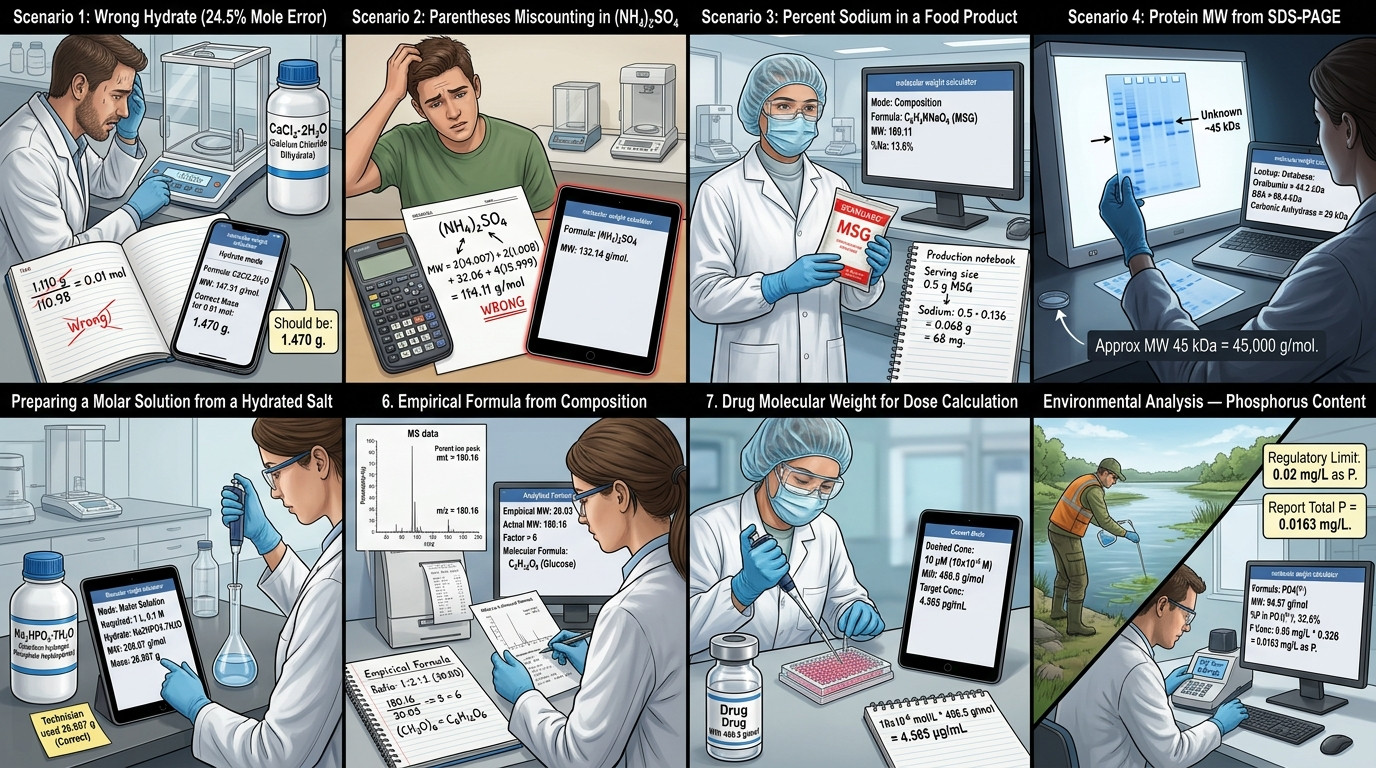
Scenario 1: Wrong Hydrate — 24.5% Mole Error
A researcher weighed 1.110 g of CaCl₂·2H₂O intending to prepare 0.01 mol of CaCl₂ — but used the anhydrous MW (110.98 g/mol) instead of the hydrate MW (147.01 g/mol). Actual moles = 1.110/147.01 = 0.00755 mol — a 24.5% underestimate. The molecular weight calculator’s Hydrate mode would have shown 147.01 g/mol and computed the correct mass: 0.01 × 147.01 = 1.470 g.
Scenario 2: Parentheses Miscounting in (NH₄)₂SO₄
A student calculated the MW of ammonium sulphate as 114.11 g/mol by counting only 2 H atoms instead of 8 (forgetting to multiply the 4 H inside the parentheses by the subscript 2). The correct MW is 132.14 g/mol: 2(14.007) + 8(1.008) + 32.06 + 4(15.999). The molecular weight calculator’s formula parser handles parentheses correctly, preventing this counting error.
Scenario 3: Percent Sodium in a Food Product
A food scientist needed to calculate the sodium content of MSG (monosodium glutamate, C₅H₈NNaO₄, MW = 169.11). Using the molecular weight calculator’s Composition mode: % Na = 22.99/169.11 × 100 = 13.6%. For a serving containing 0.5 g of MSG: sodium = 0.5 × 0.136 = 0.068 g = 68 mg. This calculation is required for nutritional labelling in many countries.
Scenario 4: Protein MW from SDS-PAGE
A biochemist estimated a protein band at approximately 45 kDa on an SDS-PAGE gel. Using the molecular weight calculator’s Lookup mode for reference: BSA = 66.43 kDa, ovalbumin = 44.3 kDa, carbonic anhydrase = 29 kDa. The unknown band migrated between ovalbumin and carbonic anhydrase markers, confirming an approximate MW of 45 kDa = 45,000 g/mol. This MW was used to calculate molar concentration from mass concentration: 1 mg/mL = 1/45,000 mol/L = 22.2 µM.
Scenario 5: Preparing a Molar Solution from a Hydrated Salt
A technician needed 1 L of 0.1 M Na₂HPO₄. The reagent bottle contained Na₂HPO₄·7H₂O (not anhydrous). Using the molecular weight calculator: anhydrous MW = 141.96, hydrate MW = 141.96 + 7(18.015) = 268.07 g/mol. Mass to weigh = 0.1 × 268.07 = 26.807 g of the heptahydrate. Using the anhydrous MW would have given 14.196 g — providing only 0.053 mol instead of 0.1 mol, nearly half the intended concentration.
Scenario 6: Empirical Formula from Composition
An analytical chemist measured a compound containing 40.0% C, 6.7% H, and 53.3% O by mass. Using the molecular weight calculator’s principles: moles of C = 40.0/12.011 = 3.33, H = 6.7/1.008 = 6.65, O = 53.3/15.999 = 3.33. Ratio = 1:2:1, giving empirical formula CH₂O (MW = 30.03). The actual MW measured by mass spectrometry was 180.16 — so the molecular formula is 180.16/30.03 = 6 × CH₂O = C₆H₁₂O₆ (glucose).
Scenario 7: Drug Molecular Weight for Dose Calculation
A pharmacologist needed to convert a 10 µM drug concentration to µg/mL for a cell culture experiment. The drug MW was 456.5 g/mol. Using the molecular weight calculator’s Convert mode: mass concentration = 10 × 10⁻⁶ mol/L × 456.5 g/mol = 4.565 × 10⁻³ g/L = 4.565 µg/mL. Without the correct MW, this conversion would give the wrong mass concentration.
Scenario 8: Environmental Analysis — Phosphorus Content
An environmental scientist measured total phosphorus in a lake water sample as 0.05 mg/L PO₄³⁻. Using the molecular weight calculator: MW of PO₄³⁻ = 30.974 + 4(15.999) = 94.97 g/mol. % P in PO₄³⁻ = 30.974/94.97 × 100 = 32.6%. P concentration = 0.05 × 0.326 = 0.0163 mg/L as P. This conversion from phosphate to elemental phosphorus is required for regulatory reporting under EPA and EU water quality standards.
Common Molecular Weight Mistakes
Mistake 1: Using Anhydrous MW for a Hydrated Salt
The most consequential MW error. CaCl₂ (110.98) vs CaCl₂·2H₂O (147.01) — a 33% difference. Na₂SO₄ (142.04) vs Na₂SO₄·10H₂O (322.20) — a 127% difference. Always check the reagent bottle for the exact formula including hydration. The molecular weight calculator’s Hydrate mode handles this automatically.
Mistake 2: Miscounting Atoms with Parentheses
Ca(OH)₂ has 2 O and 2 H (not 1 O and 1 H). (NH₄)₂SO₄ has 8 H (not 4). Fe₂(SO₄)₃ has 12 O (not 4). The parentheses subscript multiplies ALL atoms inside. The molecular weight calculator’s formula parser handles parentheses correctly.
Mistake 3: Using Atomic Number Instead of Atomic Mass
Sodium has atomic number 11 but atomic mass 22.99. Using 11 instead of 22.99 halves the sodium contribution to any MW calculation. Always use atomic mass from the periodic table, not atomic number.
Mistake 4: Confusing Molecular Weight with Molecular Formula
The formula C₂H₆O could be ethanol (CH₃CH₂OH) or dimethyl ether (CH₃OCH₃) — they have the same MW (46.07 g/mol) but completely different properties. MW tells you the mass, not the structure.
Mistake 5: Rounding Atomic Masses Too Early
Using C = 12 instead of 12.011, or Cl = 35 instead of 35.45, introduces rounding errors that accumulate for large molecules. For analytical work, use the full IUPAC atomic masses. The molecular weight calculator uses 4-decimal-place IUPAC 2021 values.
Mistake 6: Forgetting Polyatomic Ions in Ionic Compounds
NaHCO₃ has 1 Na, 1 H, 1 C, 3 O (not 1 Na, 1 H, 1 C, 1 O). The “CO₃” is a polyatomic carbonate ion with 3 oxygen atoms. The molecular weight calculator parses the formula character by character and counts every atom correctly.
Mistake 7: Confusing Free Acid with Salt Form
HEPES free acid (MW = 238.30 g/mol) vs HEPES sodium salt (MW = 260.29 g/mol). Using the free acid MW when you have the sodium salt gives 8.4% too few moles. The molecular weight calculator’s Lookup mode lists both forms for common buffer reagents.
💡 Rule of Thumb: Always check three things before calculating: (1) the exact molecular formula on the reagent bottle, (2) whether it is anhydrous or hydrated, (3) whether it is the free acid/base or a salt form. The molecular weight calculator’s Lookup database shows the correct MW for each form of 50+ common reagents.
Lab Safety Essentials
Correct MW = correct dose: In pharmaceutical compounding and drug development, using the wrong molecular weight gives the wrong molar concentration, which gives the wrong dose. For narrow therapeutic index drugs, a MW error can cause toxicity or treatment failure. Always verify the MW from the reagent certificate of analysis.
- Verify the formula from the bottle — do not assume anhydrous when the reagent may be hydrated.
- Use IUPAC standard atomic weights — not rounded values for analytical work.
- Check salt form vs free acid/base — different MW for different forms of the same compound.
- Cross-reference with PubChem or the CoA — the certificate of analysis provides the exact MW.
- Document the MW used — include the molecular weight calculator output in your lab notebook.
- Label solutions with the MW used — so subsequent calculations use the same value.
Which Mode Fits Your Situation
| Mode | Use Case | Key Output | Inputs | Applications |
|---|---|---|---|---|
| Formula | MW from any formula | MW in g/mol + breakdown | Chemical formula | General chemistry, all uses |
| Composition | % by mass of each element | Mass % per element | Chemical formula | Nutrition, environmental, analytical |
| Hydrate | Hydrated salt MW | Base + n×18.015 | Base formula, n waters | Solution prep from hydrated reagents |
| Mass↔Mol | Convert mass to moles or vice versa | Moles or grams | Formula or MW, mass or mol | Weighing, solution prep |
| Lookup | Instant MW for common compounds | MW + practical info | Select from 50+ compounds | Quick reference |
Molecular Weight in General Chemistry
Every quantitative chemistry calculation starts with knowing the molecular weight. Stoichiometry, limiting reagent problems, percent yield, empirical and molecular formula determination, gas law calculations, and colligative properties all require the MW. The molecular weight calculator provides the MW instantly from any formula, supporting all of these calculations.
Molecular Weight in Biochemistry
Biochemists express protein concentrations in both mg/mL (mass concentration) and µM (molar concentration). Converting between them requires the MW: µM = (mg/mL × 1000) ÷ MW. For a 1 mg/mL solution of BSA (MW 66,430): µM = 1000/66430 = 15.1 µM. The molecular weight calculator’s Convert mode and Lookup mode (which includes BSA and ATP) support these conversions directly.
Molecular Weight in Pharmaceutical Science
Drug development uses MW at every stage: calculating molar doses from mass doses, determining the molecular formula from mass spectrometry data, computing the rule-of-five descriptors (Lipinski’s rules: MW < 500 for oral bioavailability), and preparing molar stock solutions from solid reagents.
Molecular Weight in Environmental Science
Environmental regulations often require reporting contaminant concentrations as the element rather than the compound. Phosphorus is reported as mg/L P, nitrogen as mg/L N, and sulphur as mg/L S. The molecular weight calculator’s Composition mode shows the mass fraction of each element, enabling these conversions directly.
Molecular Weight in Food Science
Nutritional labelling requires conversion between compound amounts and elemental amounts: mg of sodium from mg of NaCl (Na% = 39.3%), mg of calcium from mg of CaCO₃ (Ca% = 40.0%), mg of iron from mg of FeSO₄ (Fe% = 36.8%). The molecular weight calculator’s Composition mode computes these percentages instantly.
Worked Examples
Example 1 — Formula: C₆H₁₂O₆ → 6(12.011) + 12(1.008) + 6(15.999) = 180.156 g/mol.
Example 2 — Parentheses: Ca(NO₃)₂ → 40.078 + 2(14.007) + 6(15.999) = 164.086 g/mol.
Example 3 — Hydrate: CuSO₄·5H₂O → 159.61 + 5(18.015) = 249.685 g/mol.
Example 4 — Composition: NaCl → Na% = 22.99/58.44 = 39.3%, Cl% = 35.45/58.44 = 60.7%.
Example 5 — Convert: 5.844 g NaCl (MW 58.44) → 5.844/58.44 = 0.1 mol = 100 mmol.
Frequently Asked Questions
1. What is a molecular weight calculator?
A molecular weight calculator computes the molar mass of a chemical compound by summing the atomic masses of all atoms in the molecular formula. This calculator provides five modes: formula parser, element composition, hydrated salt calculator, mass-to-moles converter, and common compound lookup.
2. How do I calculate molecular weight?
MW = sum of (atomic mass × number of atoms) for each element. For NaCl: 22.99 + 35.45 = 58.44 g/mol. The molecular weight calculator parses any formula and does this summation automatically.
3. What units is molecular weight expressed in?
g/mol (grams per mole), Da (Daltons), amu (atomic mass units) — all numerically identical. Proteins use kDa (kilodaltons). 1 kDa = 1000 g/mol.
4. Why does the hydrated form have a different MW?
Hydrated salts contain water molecules in their crystal structure. Each H₂O adds 18.015 g/mol. CaCl₂·2H₂O = 110.98 + 2(18.015) = 147.01 g/mol. Using the anhydrous MW when you have the hydrate gives the wrong number of moles.
5. How do I handle parentheses in formulas?
The subscript after the closing parenthesis multiplies everything inside. Ca(OH)₂ = 1 Ca + 2 O + 2 H. (NH₄)₂SO₄ = 2 N + 8 H + 1 S + 4 O. The molecular weight calculator’s parser handles this automatically.
6. What is percent composition?
The mass percentage of each element in a compound. % element = (atomic mass × count ÷ MW) × 100. For NaCl: %Na = 22.99/58.44 × 100 = 39.3%.
7. What is the difference between MW and molar mass?
Numerically identical. MW is expressed in Da or amu. Molar mass is expressed in g/mol. NaCl has MW = 58.44 Da and molar mass = 58.44 g/mol.
8. How do I know if my reagent is hydrated?
Check the reagent bottle label — it will state the formula including hydration (e.g., CaCl₂·2H₂O). The certificate of analysis (CoA) also lists the exact form and MW. Never assume anhydrous unless the label explicitly says so.
9. Can I calculate MW of proteins?
For small peptides, enter the amino acid formula. For large proteins, use the published MW from UniProt or the literature. The Lookup mode includes BSA (66,430 g/mol) as a reference.
10. Is this molecular weight calculator free?
Yes. Completely free, browser-based, no sign-up, fully private. No data sent to any server.
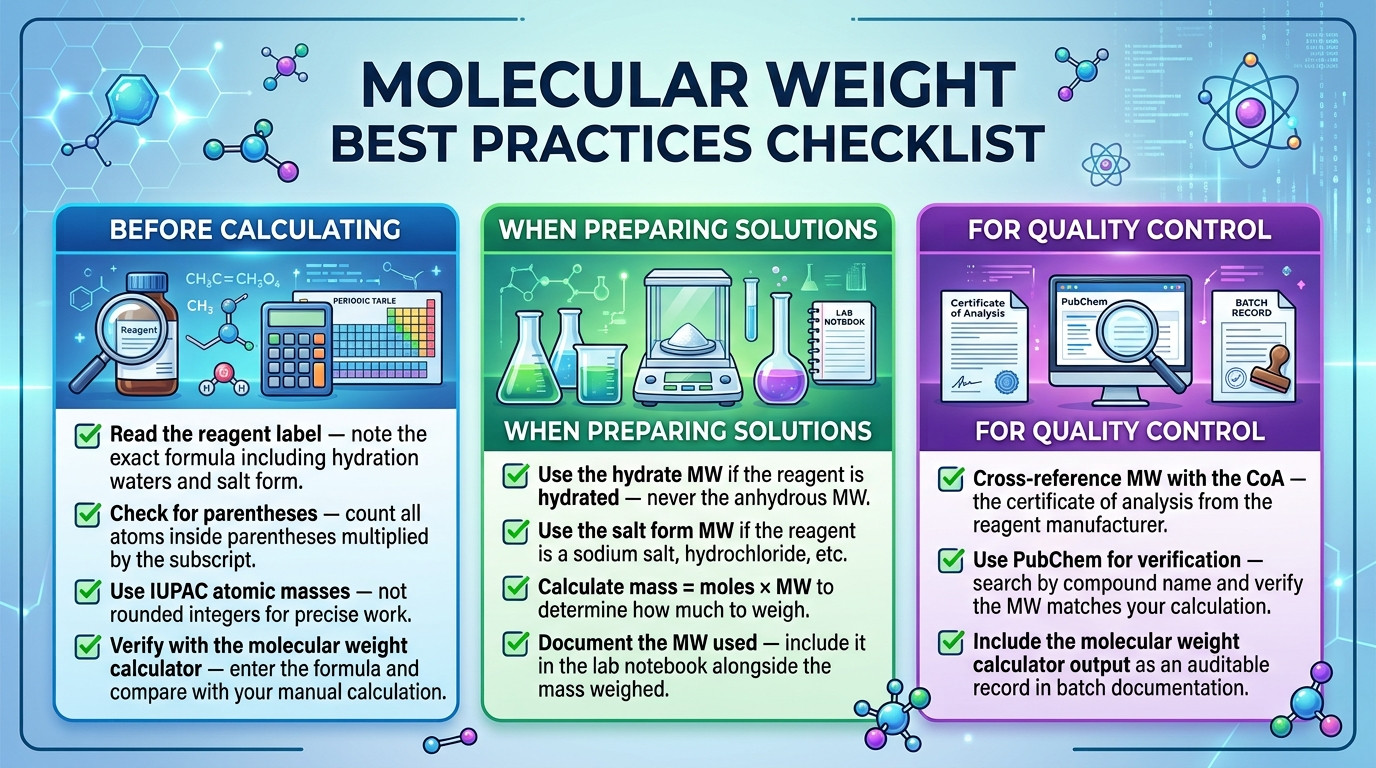
Molecular Weight Best Practices Checklist
Before Calculating
When Preparing Solutions
For Quality Control
Trusted Reference Resources
PubChem — pubchem.ncbi.nlm.nih.gov — Free database of molecular formulas, molecular weights, and chemical properties for millions of compounds.
IUPAC Standard Atomic Weights — iupac.org — Official atomic masses for all elements, updated regularly.
NIST Chemistry WebBook — webbook.nist.gov — Authoritative molecular weights, thermodynamic data, and spectral information.
ChemSpider (RSC) — chemspider.com — Free chemical structure database with molecular weight data from the Royal Society of Chemistry.
UniProt — uniprot.org — Protein molecular weight database with sequence-based MW calculations for all characterised proteins.
User Reviews & Ratings
Share Your Experience with This Molecular Weight Calculator
Final Thoughts on Molecular Weight Calculation
Molecular weight is the single most looked-up chemical property — and the single most common source of laboratory errors when miscalculated. The formula itself is simple (sum of atomic masses × counts), but the pitfalls are numerous: miscounting atoms in complex formulas with parentheses and nested groups, using the anhydrous MW when the reagent is hydrated, confusing the free acid MW with the salt form, and rounding atomic masses prematurely. Each of these errors propagates through every subsequent mole, concentration, and stoichiometry calculation.
The molecular weight calculator eliminates these errors by parsing any molecular formula, using IUPAC 2021 standard atomic weights, and showing the element-by-element breakdown so every step is verifiable. The Hydrate mode ensures you use the correct MW for hydrated reagents. The Composition mode computes mass percentages for nutritional and environmental reporting. The Convert mode bridges between mass and moles. And the Lookup mode provides instant access to the MW of 50+ common laboratory compounds.
🔒 Privacy Guarantee: Every calculation runs entirely within your browser. No data is sent to any server. Reviews are saved in your browser’s local storage only.
Pingback: Ratio Dilution Calculator - Convert 1:10, 1:32 to Volumes | Free
Pingback: Bleach Dilution Calculator - CDC Ratios, PPM & % | Free Tool
Pingback: Essential Oil Dilution Calculator - Face, Body & Bath | Free
Pingback: Dilution Calculator mg/mL - Protein, Drug & Lab Solutions | Free
Pingback: Pharmaceutical Dilution Calculator - IV & Pediatric Dosing | Free
Pingback: How to Calculate the Dilution Factor: 7 Simple Steps to Success
Pingback: Weight by Volume Dilution Calculator (W/V %) – Free Lab Tool
Pingback: Mixing Ratio Calculator: Exact Volumes for Any Ratio (Free Tool)
Pingback: Infusion Rate Calculator – Calculate IV Infusion Rates Instantly
Pingback: Neem Oil Dilution Ratio Calculator | Mix Neem Oil Correctly -
Pingback: Percentage Dilution Calculator | Calculate Dilutions Instantly
Pingback: Ethanol Dilution Calculator | Calculate Ethanol Dilutions Instantly
Pingback: Paint Thinner Calculator | Calculate Mixing Ratios Instantly
Pingback: Micromolar Calculator | Calculate µM Concentrations Instantly
Pingback: ABV Calculator – Calculate Alcohol by Volume Instantly
Pingback: Hot Tub Chemical Calculator | Balance Your Water Instantly
Pingback: Pool Shock Calculator | Calculate Shock Dosage Instantly
Pingback: Baking Soda Pool Calculator | Calculate How Much to Add
Pingback: Pool Acid Dilution Calculator | Calculate Acid & Water Amounts
Pingback: Cyanuric Acid Calculator | Calculate CYA Levels Instantly
Pingback: Spa Chemical Calculator | Calculate Spa Chemicals Instantly