
Reconstitution Calculator — Diluent Volume, Final Concentration & Dose Volume
A reconstitution calculator determines the exact volume of diluent (sterile water, saline, or bacteriostatic water) to add to a lyophilised (freeze-dried) powder to achieve a target concentration, and then calculates the volume to withdraw for a specific dose. The core formula is Diluent Volume = Total Drug Mass ÷ Target Concentration. For a vial containing 1 g of ceftriaxone reconstituted to 250 mg/mL: add 1000 mg ÷ 250 mg/mL = 4 mL of diluent. To give a 500 mg dose: withdraw 500 ÷ 250 = 2 mL. The reconstitution calculator handles five modes: diluent volume, final concentration, dose volume, displacement volume correction, and multi-dose vial tracking. Enter your vial details below and get the result with every step shown.
Key facts at a glance
- Reconstitution formula: Diluent Volume = Drug Mass ÷ Target Concentration
- Dose volume: Volume to Withdraw = Dose ÷ Final Concentration
- Displacement volume: powder occupies space — actual diluent = target total − displacement
- Common diluents: Sterile Water for Injection (SWFI), 0.9% NaCl, Bacteriostatic Water
- Stability: reconstituted drugs have limited stability (hours to days) — check manufacturer data
- Clinical example: 1 g ceftriaxone + 3.6 mL SWFI = 250 mg/mL (displacement 0.4 mL)
📋 Table of Contents
▼
- What a Reconstitution Calculator Does
- Reconstitution Calculator — Five Modes
- How Reconstitution Is Calculated
- Real Scenarios Where Reconstitution Math Mattered
- Common Reconstitution Mistakes
- Clinical Safety Essentials
- Which Mode Fits Your Situation
- Frequently Asked Questions
- Reconstitution Best Practices Checklist
- Trusted Reference Resources
- User Reviews & Ratings
What a Reconstitution Calculator Does
A reconstitution calculator converts the information on a drug vial label — the total mass of lyophilised powder and the target final concentration — into the exact volume of diluent to add and the exact volume to withdraw for a patient-specific dose. Reconstitution is the process of adding a liquid (diluent) to a dried powder to create a solution for injection, infusion, or oral administration. It is one of the most common and most error-prone calculations in hospital pharmacy, nursing, veterinary medicine, and research laboratory work. The reconstitution calculator eliminates arithmetic errors by handling every step — from diluent volume to dose volume — and showing the working so it can be verified by a second clinician.
The reason reconstitution math causes errors is that it involves multiple sequential calculations, each depending on the previous one. First, you must determine how much diluent to add (total mass ÷ target concentration). Then you must account for displacement volume — the space the powder itself occupies in the vial, which means the actual diluent to add is less than the calculated total volume. Then you must calculate the volume to withdraw for a specific dose (dose ÷ final concentration). Finally, for multi-dose vials, you must track remaining volume and remaining doses. Each step is a simple division, but the chain of dependencies means an error in step 1 propagates through every subsequent calculation. The reconstitution calculator handles every step in sequence and shows the intermediate values, making the chain transparent and auditable.
This reconstitution calculator handles five modes: diluent volume calculator (how much liquid to add), final concentration calculator (what concentration results from a given diluent volume), dose volume calculator (how much to withdraw for a specific dose), displacement volume correction (accounting for powder volume), and multi-dose vial tracker (remaining doses and expiry). Each mode shows every step of the working, making it suitable for clinical documentation, pharmacy records, nursing education, and veterinary practice.
Reconstitution Calculator
Five modes — diluent volume, concentration, dose volume, displacement & multi-dose tracking
Calculation Result
⚠️ Clinical safety: This reconstitution calculator is an educational decision-support tool. Always verify calculations independently, use aseptic technique, check drug compatibility with diluent, and follow manufacturer reconstitution instructions. Never administer without a second check for high-alert medications.
How Reconstitution Is Calculated
Reconstitution is the process of dissolving a lyophilised (freeze-dried) drug powder in a liquid diluent to create a solution ready for injection or infusion. The core calculation is straightforward: Diluent Volume = Total Drug Mass ÷ Target Concentration. However, a critical correction — displacement volume — makes the real-world calculation more nuanced. The powder itself occupies space in the vial, so the actual volume of diluent to add is less than the calculated total volume. The reconstitution calculator accounts for displacement automatically when you enter the displacement value from the manufacturer’s product information.
The Displacement Volume Concept
When you add 4 mL of diluent to a vial containing 1 g of ceftriaxone powder, the final volume is NOT 4 mL — it is approximately 4.4 mL, because the powder itself displaces 0.4 mL of volume. If you intended to make 250 mg/mL (1000 mg ÷ 4 mL), the actual concentration is 1000 mg ÷ 4.4 mL = 227 mg/mL — nearly 10% too dilute. The correct approach: to achieve a total volume of 4 mL at 250 mg/mL, add 4 − 0.4 = 3.6 mL of diluent. The reconstitution calculator’s Diluent mode performs this correction when you enter the displacement volume, and the Displacement mode helps you determine the displacement volume by comparing diluent added with the measured final volume.
Dose Volume Calculation
Once the vial is reconstituted, calculating the volume to withdraw for a specific dose is a simple division: Volume to Withdraw = Dose ÷ Reconstituted Concentration. For a 500 mg dose from a 250 mg/mL solution: 500 ÷ 250 = 2 mL. This seems trivial, but in paediatric dosing (where doses are weight-based and often small fractions of a vial) and in high-alert medications (where a tenfold error can be lethal), the systematic verification provided by the reconstitution calculator is a genuine safety feature.
Multi-Dose Vial Tracking
Some reconstituted drugs are supplied in multi-dose vials containing enough drug for several patients. The reconstitution calculator’s Multi-Dose mode tracks how many full doses can be drawn from a vial, the volume withdrawn per dose, the remaining volume after each dose, and the stability window (how many hours the reconstituted drug remains usable before it must be discarded). This prevents both drug waste and the inadvertent administration of expired reconstituted medication.
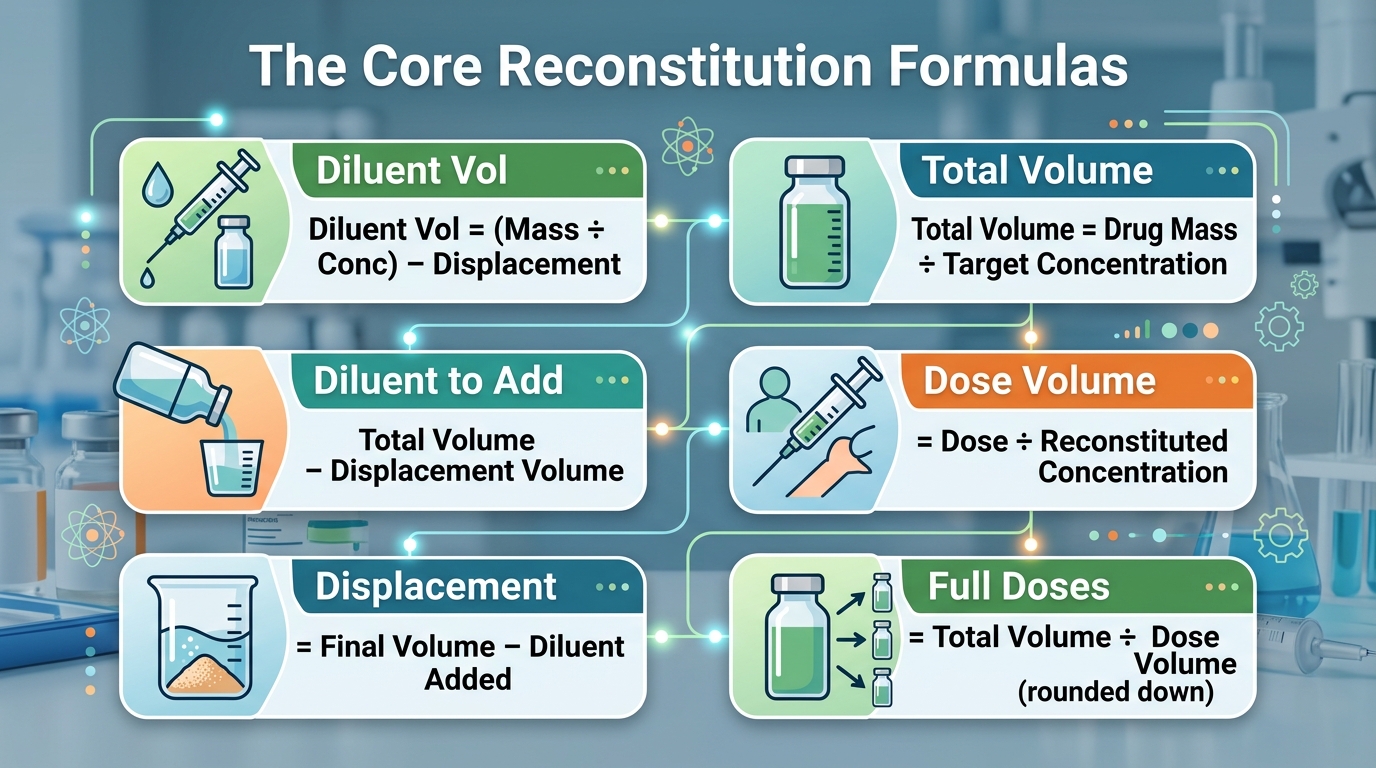
Diluent to Add = Total Volume − Displacement Volume
Dose Volume = Dose ÷ Reconstituted Concentration
Displacement = Final Volume − Diluent Added
Full Doses = Total Volume ÷ Dose Volume (rounded down)
Quick Reference Values
Remember: Always check the manufacturer’s product information for the specific displacement volume, recommended diluent, and stability after reconstitution. The reconstitution calculator uses the values you enter — the accuracy of the result depends on the accuracy of your inputs.
Real Scenarios Where Reconstitution Math Mattered
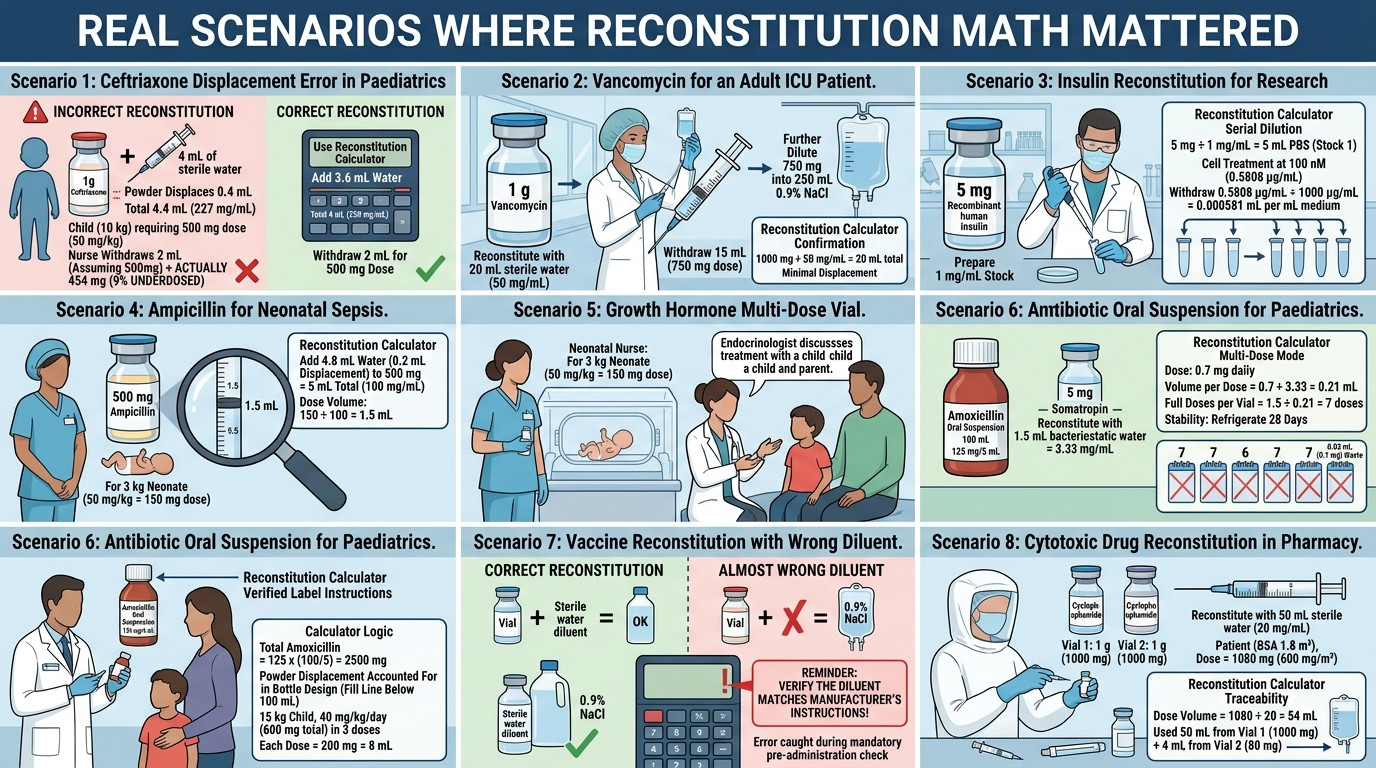
Scenario 1: Ceftriaxone Displacement Error in Paediatrics
A paediatric nurse reconstituted a 1 g ceftriaxone vial by adding 4 mL of sterile water, assuming this would give 250 mg/mL. However, the powder displaced 0.4 mL, giving a total volume of 4.4 mL and a concentration of 227 mg/mL. For a child weighing 10 kg requiring 50 mg/kg (500 mg dose), the nurse withdrew 2 mL (intending 500 mg) but actually administered only 454 mg — 9% underdosed. The reconstitution calculator would have shown: add 3.6 mL (not 4 mL) to get 4 mL total at 250 mg/mL, preventing the underdose.
Scenario 2: Vancomycin for an Adult ICU Patient
A pharmacist prepared vancomycin 1 g for IV infusion. The product information specifies: reconstitute with 20 mL of sterile water to give 50 mg/mL, then further dilute in 250 mL of 0.9% NaCl. The reconstitution calculator confirmed: 1000 mg ÷ 50 mg/mL = 20 mL total, displacement approximately 0 (vancomycin has minimal displacement). For a 750 mg dose: withdraw 750 ÷ 50 = 15 mL from the reconstituted vial. The step-by-step output was included in the clinical pharmacy record.
Scenario 3: Insulin Reconstitution for Research
A research laboratory reconstituted recombinant human insulin (5 mg vial) in sterile PBS to prepare a 1 mg/mL stock. Using the reconstitution calculator: 5 mg ÷ 1 mg/mL = 5 mL of PBS. For a cell treatment at 100 nM (MW 5808 g/mol, so 100 nM = 0.5808 µg/mL): withdraw 0.5808 µg/mL ÷ 1000 µg/mL = 0.000581 mL per mL of culture medium — requiring a serial dilution. The reconstitution calculator’s step-by-step output documented the initial reconstitution for the lab notebook.
Scenario 4: Ampicillin for Neonatal Sepsis
A neonatal nurse prepared ampicillin 500 mg for a 3 kg neonate requiring 50 mg/kg (150 mg). The reconstitution calculator showed: add 4.8 mL of sterile water to the 500 mg vial (displacement 0.2 mL) to get 5 mL total at 100 mg/mL. Dose volume: 150 ÷ 100 = 1.5 mL. This small volume is critical in neonates — withdrawing 1.5 mL accurately requires a 3 mL syringe with 0.1 mL graduations. The calculator output was verified by a second nurse before administration.
Scenario 5: Growth Hormone Multi-Dose Vial
An endocrinologist prescribed somatropin 0.7 mg daily for a child. The vial contains 5 mg of lyophilised somatropin, reconstituted with 1.5 mL of bacteriostatic water to give 3.33 mg/mL. Using the reconstitution calculator’s Multi-Dose mode: dose volume = 0.7 ÷ 3.33 = 0.21 mL per injection. Full doses per vial = 1.5 ÷ 0.21 = 7 doses. Stability: 28 days refrigerated. The calculator tracked that after 7 doses, 0.03 mL (0.1 mg) remains as waste — within acceptable limits.
Scenario 6: Antibiotic Oral Suspension for Paediatrics
A community pharmacist reconstituted amoxicillin powder for oral suspension (125 mg/5 mL, 100 mL bottle). The label stated: “Add water to the mark” — but the reconstitution calculator was used to verify: total amoxicillin = 125 × (100/5) = 2500 mg. For 100 mL at 125 mg/5 mL = 25 mg/mL, the powder displacement was accounted for in the bottle design (the fill line is below the 100 mL mark). The calculator confirmed the dispensing instructions for a 15 kg child needing 40 mg/kg/day in 3 divided doses: each dose = 200 mg = 8 mL.
Scenario 7: Vaccine Reconstitution with Wrong Diluent
A vaccination clinic nearly reconstituted a live vaccine with 0.9% NaCl instead of the manufacturer-supplied diluent (sterile water with stabilisers). The reconstitution calculator cannot prevent wrong diluent selection, but the step-by-step output includes a reminder to “verify the diluent matches the manufacturer’s instructions” — a safety prompt that caught the error during the mandatory pre-administration check.
Scenario 8: Cytotoxic Drug Reconstitution in Pharmacy
A chemotherapy pharmacist reconstituted cyclophosphamide 1 g with 50 mL of sterile water to give 20 mg/mL for a patient requiring 600 mg/m² (BSA 1.8 m², dose = 1080 mg). Using the reconstitution calculator: dose volume = 1080 ÷ 20 = 54 mL. Since only 50 mL was available from one vial (1000 mg), a second vial was needed for the remaining 80 mg (4 mL). The calculator’s step-by-step output documented both vials, ensuring traceability for the cytotoxic drug preparation record.
Common Reconstitution Mistakes
Mistake 1: Ignoring Displacement Volume
The most common reconstitution error. Adding the full calculated diluent volume without subtracting displacement gives a final volume that is too large, making the concentration too low. For a 1 g drug with 0.4 mL displacement, this error reduces the concentration by approximately 10%. In paediatric dosing, this 10% difference can be clinically significant. The reconstitution calculator accounts for displacement when you enter the manufacturer’s displacement value.
Mistake 2: Using the Wrong Diluent
Different drugs require different diluents. Some require Sterile Water for Injection (SWFI), others require 0.9% NaCl, and some (like certain vaccines and growth hormones) require manufacturer-specific diluents containing stabilisers or preservatives. Using the wrong diluent can cause precipitation, loss of potency, or adverse reactions. Always check the product information before reconstitution.
Mistake 3: Confusing mg with mL
A 250 mg/mL solution means 250 mg in EACH mL, not 250 mg total. Confusing these gives a dose that is either massively overdosed (if you withdraw 250 mL thinking it is 250 mg) or underdosed (if you withdraw 1 mL thinking the entire dose is in 1 mL of a multi-dose vial). The reconstitution calculator’s Dose mode makes the dose-to-volume conversion explicit.
Mistake 4: Not Accounting for Overfill in Multi-Dose Vials
Many multi-dose vials contain a small overfill (extra volume) to ensure that the labelled number of doses can be withdrawn. This overfill should not be treated as an additional dose — it compensates for the dead space in syringes and needles. The reconstitution calculator’s Multi-Dose mode calculates doses based on the total usable volume and flags any remainder as waste.
Mistake 5: Exceeding Stability After Reconstitution
Reconstituted drugs have limited stability — typically 24 hours at room temperature or 72 hours refrigerated, but this varies widely by drug. Using a reconstituted drug past its stability period risks administering a degraded, potentially toxic product. The reconstitution calculator’s Multi-Dose mode includes a stability field to track the discard time.
Mistake 6: Incorrect Unit Conversion
Drug vials may be labelled in mg, g, units, or IU, while doses are prescribed in different units. A vial labelled “1 g” reconstituted to “250 mg/mL” requires converting g to mg (1 g = 1000 mg) before dividing. The reconstitution calculator handles all unit conversions automatically, preventing this class of error.
Mistake 7: Shaking Instead of Swirling
While not a calculation error, vigorous shaking of reconstituted protein drugs (antibodies, growth hormones, insulin) causes denaturation, aggregation, and loss of potency. The correct technique is gentle swirling or rolling. The reconstitution calculator’s step-by-step output includes a technique reminder: “Dissolve by gentle swirling — do not shake.”
💡 Rule of Thumb: Always check (1) the correct diluent, (2) the displacement volume, (3) the stability after reconstitution, and (4) the dose-to-volume conversion BEFORE reconstituting. The reconstitution calculator handles the arithmetic; your job is to verify the inputs against the product information.
Clinical Safety Essentials
High-alert medications: Cytotoxic drugs, concentrated electrolytes, insulin, and opioids require reconstitution by trained personnel in a designated area (biological safety cabinet for cytotoxics, laminar flow hood for sterile products). Independent double-check of all calculations is mandatory before administration.
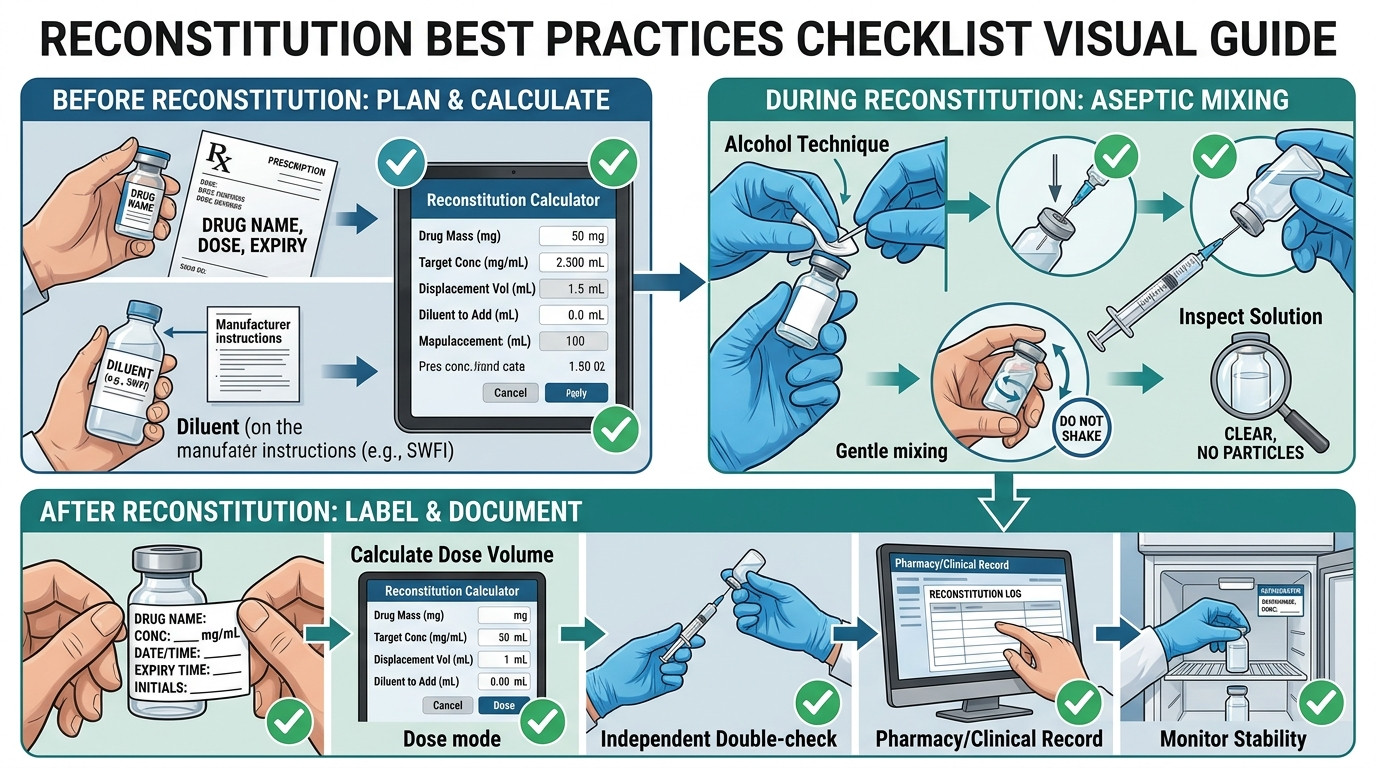
- Verify the diluent — check the product information for the correct diluent before reconstituting.
- Account for displacement — use the manufacturer’s displacement volume in the reconstitution calculator.
- Use aseptic technique — reconstitution must be performed under sterile conditions.
- Label immediately — include drug name, concentration after reconstitution, date/time of reconstitution, expiry time, and preparer’s initials.
- Independent double-check — for all high-alert drugs, a second qualified person must verify the calculation, the diluent, and the dose volume.
- Document the calculation — use the reconstitution calculator output for the pharmacy/clinical record.
- Monitor stability — discard reconstituted drugs after the manufacturer’s stated stability period.
- Gentle mixing — swirl, do not shake, especially for protein drugs.
Which Mode Fits Your Situation
| Mode | Use Case | Key Formula | Inputs | Applications |
|---|---|---|---|---|
| Diluent | How much liquid to add | Vol = Mass/Conc − Disp | Drug mass, target conc, displacement | First reconstitution step |
| Concentration | What conc results | Conc = Mass/Total Vol | Drug mass, diluent added, displacement | Verification after reconstitution |
| Dose Vol | How much to withdraw | Vol = Dose/Conc | Dose, reconstituted conc | Dose preparation |
| Displacement | Find powder volume | Disp = Total − Diluent | Diluent added, total measured vol | Calibrating displacement |
| Multi-Dose | Track doses from 1 vial | Doses = Vol/Dose Vol | Mass, conc, vol, dose, stability | Multi-dose vials, cost tracking |
Reconstitution in Hospital Pharmacy
Hospital pharmacists reconstitute hundreds of drugs daily — antibiotics, antivirals, antifungals, chemotherapy agents, monoclonal antibodies, and vaccines. Each drug has unique reconstitution requirements: specific diluent, specific volume, specific displacement, specific stability, and sometimes specific temperature requirements (some drugs must be reconstituted with cold diluent or warmed to room temperature first). The reconstitution calculator provides a systematic, documented calculation for each preparation, supporting the pharmacy workflow and the mandatory documentation required by accreditation standards (Joint Commission, ASHP).
Reconstitution in Paediatric and Neonatal Care
Paediatric and neonatal patients receive weight-based doses that are often tiny fractions of an adult vial — 25 mg from a 1000 mg vial, or 0.3 mL from a 4 mL reconstituted volume. The margin for error is extremely small: a 10% concentration error that is clinically insignificant in an adult can cause toxicity or treatment failure in a 2 kg neonate. The reconstitution calculator provides the precision needed for these critical calculations, and the step-by-step output supports the mandatory independent double-check required for all paediatric medication preparation.
Reconstitution in Veterinary Medicine
Veterinary clinicians face the same reconstitution challenges as human medicine, with the additional complexity of enormous dose ranges (a drug dosed at 10 mg/kg for a 2 kg cat requires 20 mg, while the same drug for a 500 kg horse requires 5000 mg). The reconstitution calculator handles any mass, any concentration, and any dose — from microgram research peptides to gram-scale large-animal antibiotics.
Reconstitution in Research Laboratories
Research laboratories reconstitute proteins, peptides, cytokines, growth factors, enzymes, and antibodies from lyophilised stocks. These are typically expensive reagents ($50–$500 per vial), making accurate reconstitution essential to avoid waste. The reconstitution calculator’s Diluent mode ensures the correct concentration is achieved on the first attempt, and the Multi-Dose mode tracks aliquots from a single reconstituted stock.
Reconstitution of Vaccines
Vaccine reconstitution requires strict adherence to manufacturer instructions — using the specific diluent supplied with the vaccine, the specific volume, and the specific technique (some vaccines must not be shaken). Reconstituted vaccines have very short stability (typically 6–8 hours for reconstituted MMR, and 24 hours for some COVID-19 vaccines). The reconstitution calculator’s Multi-Dose mode tracks doses and expiry time, which is particularly important during mass vaccination campaigns where vial management directly affects wastage rates.
Worked Examples
Example 1 — Diluent: 1 g ceftriaxone, target 250 mg/mL, displacement 0.4 mL. Total vol = 1000/250 = 4 mL. Diluent = 4 − 0.4 = 3.6 mL.
Example 2 — Concentration: 500 mg drug, added 4.5 mL diluent, displacement 0.5 mL. Total vol = 5 mL. Conc = 500/5 = 100 mg/mL.
Example 3 — Dose Volume: Dose 350 mg from 100 mg/mL solution. Volume = 350/100 = 3.5 mL.
Example 4 — Displacement: Added 3.6 mL diluent, measured 4.0 mL total. Displacement = 4.0 − 3.6 = 0.4 mL.
Example 5 — Multi-Dose: 5 mg vial at 3.33 mg/mL in 1.5 mL. Dose 0.7 mg = 0.21 mL. Full doses = 7. Stability 28 days.
Frequently Asked Questions
1. What is a reconstitution calculator?
A reconstitution calculator computes the volume of diluent to add to a lyophilised drug powder, the resulting concentration, and the volume to withdraw for a specific dose. This calculator provides five modes: diluent volume, concentration, dose volume, displacement correction, and multi-dose tracking.
2. What is the formula for reconstitution?
Diluent Volume = (Total Drug Mass ÷ Target Concentration) − Displacement Volume. Dose Volume = Dose ÷ Reconstituted Concentration.
3. What is displacement volume?
Displacement volume is the space occupied by the drug powder itself in the vial. When you add diluent, the total solution volume equals diluent + displacement. To achieve the correct concentration, subtract displacement from the total target volume to determine how much diluent to add.
4. Where do I find the displacement volume?
Check the manufacturer’s product information (package insert, SmPC, or PI). If not listed, you can measure it: add a known volume of diluent, then measure the total final volume — the difference is the displacement. The reconstitution calculator’s Displacement mode performs this calculation.
5. What diluent should I use?
Always use the diluent specified by the manufacturer. Common options: Sterile Water for Injection (SWFI), 0.9% NaCl, Bacteriostatic Water (for multi-dose vials), or manufacturer-supplied diluent (for vaccines and some biologics). Using the wrong diluent can cause precipitation or loss of potency.
6. How long is a reconstituted drug stable?
Stability varies by drug — typically 24 hours at room temperature and 48–72 hours refrigerated, but some drugs are stable for only 1–2 hours. Always check the product information. The reconstitution calculator’s Multi-Dose mode tracks stability time.
7. How many doses can I get from a multi-dose vial?
Number of full doses = Total reconstituted volume ÷ Volume per dose (rounded down). The reconstitution calculator’s Multi-Dose mode computes this and tracks the remainder as waste.
8. Why is displacement important in paediatrics?
Paediatric doses are small and weight-based. A 10% concentration error from ignoring displacement can cause clinically significant under- or overdosing in a neonate. The reconstitution calculator ensures the correct concentration by accounting for displacement.
9. Can I reconstitute insulin with saline?
It depends on the formulation. Most commercial insulin vials are pre-reconstituted in a specific buffer. Lyophilised research-grade insulin should be reconstituted per the manufacturer’s instructions — typically in dilute HCl or the recommended buffer. Always check the product information.
10. Is this reconstitution calculator free?
Yes. Completely free, browser-based, no sign-up, fully private. No data is sent to any server. Reviews are saved in your browser only.
Reconstitution Best Practices Checklist
Before Reconstitution
During Reconstitution
After Reconstitution
Trusted Reference Resources
ASHP (American Society of Health-System Pharmacists) — ashp.org — Guidelines for sterile compounding, reconstitution, and drug preparation.
ISMP (Institute for Safe Medication Practices) — ismp.org — High-alert medication lists and safe reconstitution practices.
Lexicomp / UpToDate — Drug-specific reconstitution instructions, displacement volumes, stability data, and compatibility information.
USP 797 & 800 — usp.org — Standards for sterile compounding (797) and hazardous drug handling (800).
BNF (British National Formulary) — bnf.nice.org.uk — UK drug monographs with reconstitution directions and displacement volumes.
User Reviews & Ratings
Share Your Experience with This Reconstitution Calculator
Final Thoughts on Reconstitution Calculation
Reconstitution is one of the most critical drug preparation steps in clinical practice. The arithmetic is simple — dividing mass by concentration — but the chain of calculations (diluent volume → displacement correction → dose volume → multi-dose tracking → stability monitoring) creates multiple points where errors can enter and propagate. A 10% error from ignoring displacement, compounded by a unit conversion error in the dose calculation, can result in a patient receiving 80% or 120% of the intended dose — clinically significant for narrow therapeutic index drugs, potentially lethal for high-alert medications.
The reconstitution calculator breaks this chain into explicit, verified steps. Each mode handles one part of the calculation, shows every intermediate value, and produces auditable output for clinical documentation. But the calculator cannot replace the clinical skills that surround the calculation: verifying the correct drug and diluent, using aseptic technique, inspecting the reconstituted solution, labelling the vial, and performing the independent double-check that is the last line of defence against medication errors.
🔒 Privacy Guarantee: Every calculation runs entirely within your browser. No data is sent to any server. Reviews are saved in your browser’s local storage only.
Pingback: Aliquot Calculator – Calculate Aliquot Volumes Instantly
Pingback: DNA Dilution Calculator – Calculate DNA Dilutions Instantly
Pingback: Solubility Calculator – Calculate Solubility Instantly
Pingback: Saturation Calculator – Calculate Saturation Instantly
Pingback: Spike Solution Calculator – Calculate Spike Solutions Instantly
Pingback: Standard Addition Calculator – Calculate Standard Additions Instantly
Pingback: Matrix Dilution Calculator – Calculate Matrix Dilutions Instantly
Pingback: TCID50 Calculator – Calculate TCID50 Values Instantly
Pingback: Oligo Concentration Calculator – Calculate Oligo Concentration Instantly
Pingback: Antibody Dilution Calculator – Calculate Antibody Dilutions Instantly
Pingback: PCR Master Mix Calculator – Calculate PCR Mix Instantly
Pingback: How Do You Calculate the Dilution Factor? Free Calculator -
Pingback: Ratio Dilution Calculator – Calculate Exact Mixing Ratios Fast
Pingback: Essential Oil Dilution Calculator – Free Online Tool for Safe Blending
Pingback: Dilution Calculator mg/ml: 5 Easy Steps to Success
Pingback: Pharmaceutical Dilution Calculator - IV & Pediatric Dosing | Free
Pingback: How to Calculate the Dilution Factor: 7 Simple Steps to Success
Pingback: How to Do a Dilution Calculation – Step-by-Step Guide & Free Calculator
Pingback: Mixing Ratio Calculator: Exact Volumes for Any Ratio (Free Tool)
Pingback: Infusion Rate Calculator – Calculate IV Infusion Rates Instantly
Pingback: Star San Sanitizer Multi-Unit Tool | Free No-Rinse Brewing Sanitizer
Pingback: Hydrogen Peroxide For Plants Dilution Calculator (3%, 12% & 34% for Root Rot)
Pingback: Percentage Dilution Calculator | Calculate Dilutions Instantly
Pingback: MIC Dilution Calculator | Calculate MIC Dilutions Instantly
Pingback: IV Dilution Calculator | Calculate IV Drug Dilutions Instantly
Pingback: Ethanol Dilution Calculator | Calculate Ethanol Dilutions Instantly
Pingback: Pesticide Calculator | Calculate Spray Mix Instantly
Pingback: Common Lab Solutions | Preparation Guide & Calculator
Pingback: Percent by Mass Calculator | Calculate Mass Percentage Instantly
Pingback: Pool Chemical Calculator | Calculate Pool Chemicals Instantly