
Antibody Dilution Calculator — Primary Antibody, Secondary Antibody, Ratio, µg/mL, Titration & Assay Volume Planning
An Antibody Dilution Calculator helps convert antibody dilution ratios, stock concentration, final incubation volume, target working concentration, and number of wells or slides into exact antibody and diluent volumes. For a ratio such as 1:1000, total parts are usually 1000 and antibody volume = final volume ÷ 1000. For concentration-based preparation, use C₁V₁ = C₂V₂. This Antibody Dilution Calculator supports western blot, ELISA, immunofluorescence, immunohistochemistry, flow cytometry, blocking buffer preparation, secondary antibody dilution, and antibody titration planning while reminding users to follow datasheets and validated protocols.
Key facts at a glance
- Ratio formula: antibody volume = final volume ÷ dilution factor.
- Concentration formula: C₁V₁ = C₂V₂.
- Diluent volume: final volume − antibody volume.
- 1:1000 example: 1 µL antibody + 999 µL diluent = 1 mL working solution.
- Optimization: antibody dilution depends on assay, antigen abundance, incubation time, detection system, and background.
- Best practice: use the antibody datasheet as the starting point and titrate for your sample and protocol.
📋 Table of Contents
▼
- What an Antibody Dilution Calculator Does
- Antibody Dilution Calculator — Advanced Tool
- How Antibody Dilution Calculations Work
- Real Scenarios Where Antibody Dilution Matters
- Common Antibody Dilution Mistakes
- Handling, Storage & Quality Essentials
- Which Mode Fits Your Workflow
- Frequently Asked Questions
- Antibody Dilution Checklist
- Trusted Reference Resources
- User Reviews & Ratings
What an Antibody Dilution Calculator Does
An Antibody Dilution Calculator converts antibody ratios, stock concentrations, target concentrations, assay volumes, well counts, slide counts, overage, and titration series into practical pipetting instructions. Antibody dilution is routine in western blot, ELISA, immunocytochemistry, immunofluorescence, immunohistochemistry, flow cytometry, dot blot, and many binding assays. A dilution that is too concentrated can create high background, nonspecific staining, wasted reagent, and difficult interpretation. A dilution that is too weak can reduce signal and make real targets appear absent.
The Antibody Dilution Calculator is useful because antibody preparation is usually a mixture of ratio language and concentration language. A datasheet may recommend 1:1000 for western blot, 1:200 for immunofluorescence, or 0.5 µg/mL for ELISA coating or detection. A lab may need enough diluted antibody for 24 wells, 10 slides, a membrane bag, or a 96-well plate with overage. The calculator gives exact stock volume and diluent volume so the user can prepare only what is needed while keeping records clear.
The tool below includes five modes: ratio dilution, concentration-based dilution, multi-well or multi-slide volume planning, serial titration, and reverse ratio check. Each mode follows the same blue design pattern as the previous pages and returns step-by-step output. The result can be copied into a protocol note, antibody inventory record, plate map, or optimization worksheet.
Use the Antibody Dilution Calculator as a planning and documentation aid. It does not replace antibody datasheets, validated assay protocols, lot-specific testing, positive and negative controls, species cross-reactivity checks, or biosafety requirements. Antibody performance depends on antigen, fixation, blocking, incubation time, temperature, wash stringency, detection chemistry, sample type, and instrument settings. The calculation is only one part of a successful antibody assay.
Antibody Dilution Calculator
Calculate antibody ratio dilution, concentration-based dilution, assay volume planning, titration series, and reverse dilution checks.
Calculation Result
Step-by-step working
How Antibody Dilution Calculations Work
Antibody dilution calculations translate a recommended ratio or target concentration into pipetting volumes. An Antibody Dilution Calculator uses either ratio math or C₁V₁ = C₂V₂ depending on how the antibody recommendation is written. In ratio form, 1:1000 means one volume unit of antibody in 1000 total volume units. In concentration form, a 1 mg/mL stock diluted to 1 µg/mL requires a 1000-fold dilution. Both approaches can produce the same working solution when units are handled correctly.
A ratio such as 1:500 or 1:1000 is common for primary and secondary antibodies. An Antibody Dilution Calculator divides the final working volume by the dilution factor to find antibody volume. The diluent is the remaining volume. For example, 2 mL of antibody solution at 1:1000 requires 2 µL antibody and 1998 µL diluent. If the needed volume is very small, prepare a larger volume or an intermediate dilution to avoid pipetting below the reliable range.
Primary Antibody Dilution
Primary antibody dilution depends on antibody affinity, antigen abundance, fixation, blocking, sample type, and detection method. An Antibody Dilution Calculator can calculate a datasheet starting dilution such as 1:500, 1:1000, or 1:2000, but the optimal dilution should be determined experimentally. A concentrated primary antibody may give stronger signal, but it can also increase background and nonspecific binding.
Secondary Antibody Dilution
Secondary antibodies are often used at high dilution, especially for sensitive chemiluminescent or fluorescent detection. An Antibody Dilution Calculator helps prepare 1:5000, 1:10000, or other recommended dilutions. Light-sensitive fluorescent secondaries should be protected from light, and cross-adsorbed secondaries should be selected when multiplexing or staining complex samples.
Concentration-Based Dilution
Some protocols specify antibody concentration in µg/mL rather than a ratio. An Antibody Dilution Calculator uses C₁V₁ = C₂V₂ to calculate the antibody stock volume needed for a target concentration. This is useful when comparing lots, preparing ELISA coating antibodies, standardizing flow cytometry staining, or matching a validation protocol that defines mass concentration.
Titration Series
Antibody titration tests multiple dilutions side by side. An Antibody Dilution Calculator can create a dilution series such as 1:100, 1:200, 1:400, 1:800, and 1:1600. The best dilution is usually the one that gives strong specific signal with low background and good reproducibility. Titration is especially important when changing sample type, detection reagent, antibody lot, or imaging instrument.
Overage and Dead Volume
Assays often need extra working solution to cover pipetting loss, tube retention, membrane bags, slide coverage, or plate wells. An Antibody Dilution Calculator can include overage so the final well or blot is not short. Overage is usually small, such as 5–15%, but the exact amount depends on vessel shape, pipetting technique, and whether the solution will be reused according to the method.
C₁V₁ = C₂V₂ for concentration-based dilution
total assay volume = number of wells × volume per well + overage
actual dilution factor = total volume ÷ antibody volume
titration point = starting dilution × fold step
Remember: the Antibody Dilution Calculator gives volumes. Antibody specificity, controls, blocking, washing, incubation time, and validated assay conditions determine whether the staining or signal is meaningful.

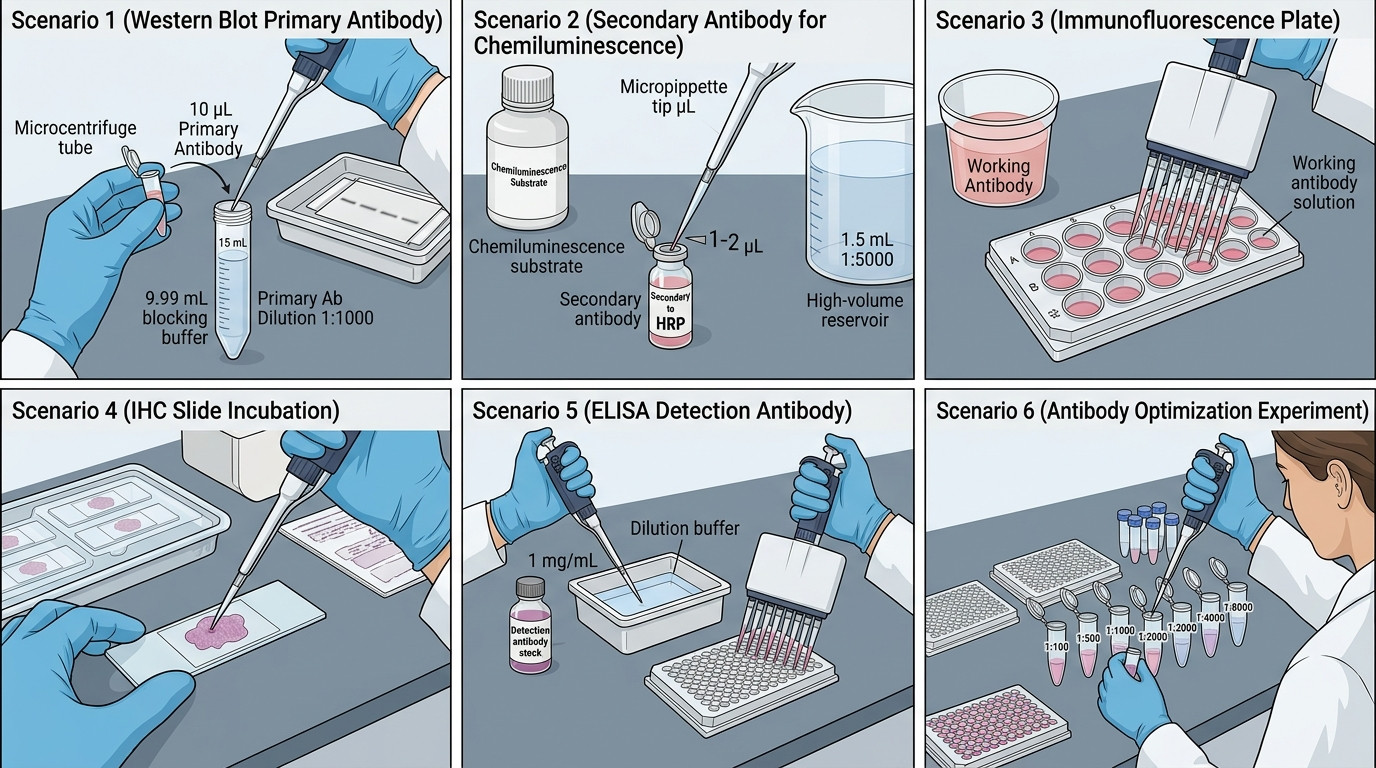
Real Scenarios Where Antibody Dilution Matters
Scenario 1: Western Blot Primary Antibody
A western blot protocol recommends primary antibody at 1:1000 in 10 mL blocking buffer. An Antibody Dilution Calculator calculates 10 µL antibody and 9,990 µL buffer, with optional overage if the membrane container needs extra volume.
Scenario 2: Secondary Antibody for Chemiluminescence
A secondary antibody may be used at 1:5000 or 1:10000 depending on substrate sensitivity. The Antibody Dilution Calculator calculates very small antibody volumes and can show when preparing a larger total volume is more practical.
Scenario 3: Immunofluorescence Plate
A 24-well plate may need 250 µL antibody solution per well. An Antibody Dilution Calculator multiplies well count by volume per well, then applies the chosen dilution so the user prepares enough staining solution.
Scenario 4: IHC Slide Incubation
Slides may require enough diluted antibody to cover tissue sections without drying. The Antibody Dilution Calculator helps calculate total volume for slide count and ratio, while the protocol controls antigen retrieval, blocking, humidity, and incubation time.
Scenario 5: ELISA Detection Antibody
ELISA methods may specify detection antibody in µg/mL. An Antibody Dilution Calculator uses stock concentration and target concentration to calculate the working solution and reduce lot-to-lot preparation differences.
Scenario 6: Antibody Optimization Experiment
A titration series compares several dilutions on the same sample. The Antibody Dilution Calculator generates the dilution series and helps record the ratios used for signal-to-background review.
Common Antibody Dilution Mistakes
Mistake 1: Misreading 1:1000
A 1:1000 dilution means antibody is one part in 1000 total parts. An Antibody Dilution Calculator prevents the common mistake of adding one part antibody to 1000 parts diluent, which makes the final dilution slightly different.
Mistake 2: Pipetting Too Little Antibody
Very small antibody volumes can be inaccurate. If an Antibody Dilution Calculator returns 0.2 µL, prepare a larger volume or an intermediate dilution instead of pipetting below the reliable range.
Mistake 3: Ignoring Datasheet Application
An antibody may work at different dilutions for western blot, IHC, IF, ELISA, or flow cytometry. An Antibody Dilution Calculator calculates the chosen ratio, but the recommended starting range should come from the datasheet and protocol.
Mistake 4: Not Including Overage
Preparing exactly the theoretical volume can leave the final well, slide, or blot short. An Antibody Dilution Calculator can add overage so the working solution is sufficient.
Mistake 5: Using the Wrong Diluent
Antibody diluent composition can affect background and signal. A Antibody Dilution Calculator cannot fix an incompatible buffer, missing blocker, wrong detergent, or preservative conflict.
Mistake 6: Skipping Controls
A dilution may look good but still be nonspecific. An Antibody Dilution Calculator supports the volume calculation, but positive controls, negative controls, no-primary controls, and isotype controls remain essential where appropriate.
💡 Rule of Thumb: start with the datasheet, calculate carefully, include overage, and titrate when background or weak signal appears. The Antibody Dilution Calculator handles volumes; assay controls validate interpretation.
Handling, Storage & Quality Essentials
Handling note: Antibodies may contain preservatives such as sodium azide, stabilizers, carrier proteins, serum, glycerol, or biological material. The Antibody Dilution Calculator provides math only. Follow the antibody datasheet, SDS, biosafety rules, PPE requirements, and institutional SOPs.
- Check the datasheet for recommended dilution, storage, host species, clonality, and application.
- Avoid repeated freeze-thaw by aliquoting concentrated antibody stocks when appropriate.
- Use the correct diluent such as blocking buffer, antibody diluent, PBS, TBS, or assay buffer specified by the protocol.
- Protect fluorophores from light and avoid unnecessary warming.
- Prevent contamination by using clean tips and not returning diluted antibody to the stock vial unless the SOP allows it.
- Label working solutions with antibody name, clone, dilution, date, diluent, and preparer.
An Antibody Dilution Calculator can make preparation consistent, but antibody performance depends on storage and handling. Some antibodies tolerate glycerol storage at −20°C, while others require 4°C, aliquots, or special stabilizers. Fluorescent conjugates can photobleach, HRP conjugates can lose activity, and azide-containing antibodies may be incompatible with some enzyme systems. Always read the product-specific instructions.
Which Mode Fits Your Workflow
| Mode | Use Case | Key Formula | Inputs | Output |
|---|---|---|---|---|
| Ratio Dilution | Prepare 1:x antibody solution | final/factor | dilution factor, final volume | antibody + diluent |
| µg/mL Dilution | Target mass concentration | C₁V₁ = C₂V₂ | stock, target, final volume | stock volume |
| Assay Volume | Wells, slides, blots | count × volume | count, volume, ratio | total working solution |
| Titration Series | Optimization | start × fold step | start, fold, points | dilution list |
| Reverse Check | Verify mixed solution | total/antibody | antibody, diluent | actual dilution |
Western Blot
For western blot, an Antibody Dilution Calculator helps prepare primary and secondary antibodies at datasheet-recommended ratios. Membrane size, incubation container, blocking buffer, and detection substrate influence the optimal amount and dilution.
Immunofluorescence and ICC
For immunofluorescence, antibody dilution must balance specific staining and background. The Antibody Dilution Calculator can calculate per-well volume, but fixation, permeabilization, blocking, and imaging settings must be optimized.
Immunohistochemistry
IHC often requires tissue-specific optimization. An Antibody Dilution Calculator helps prepare slide volumes and ratios, while antigen retrieval, section thickness, detection system, and counterstaining remain protocol-dependent.
ELISA
ELISA workflows may define coating, capture, detection, or secondary antibodies by concentration. The Antibody Dilution Calculator supports both ratio and µg/mL modes for plate preparation and reagent planning.
Flow Cytometry
Flow cytometry antibody use may be specified per test rather than simple dilution. An Antibody Dilution Calculator can help with buffer volume and concentration calculations, but staining index, compensation, Fc blocking, and titration are essential.
Advanced Guide to Antibody Dilution Planning
Datasheet Dilution
An Antibody Dilution Calculator supports datasheet dilution decisions, but the calculation should be linked to the antibody datasheet and assay protocol. Datasheet Dilution matters because antibody assays are sensitive to both reagent amount and biological context. The user should record antibody name, clone, host, lot, stock concentration, dilution factor, diluent, final volume, incubation time, temperature, sample type, and detection method. If signal is weak or background is high, review the dilution, blocking, washing, antigen abundance, fixation, secondary antibody specificity, and imaging or detection settings. Clear dilution records make optimization repeatable and help another analyst understand what was actually tested.
Primary Antibody
An Antibody Dilution Calculator supports primary antibody decisions, but the calculation should be linked to the antibody datasheet and assay protocol. Primary Antibody matters because antibody assays are sensitive to both reagent amount and biological context. The user should record antibody name, clone, host, lot, stock concentration, dilution factor, diluent, final volume, incubation time, temperature, sample type, and detection method. If signal is weak or background is high, review the dilution, blocking, washing, antigen abundance, fixation, secondary antibody specificity, and imaging or detection settings. Clear dilution records make optimization repeatable and help another analyst understand what was actually tested.
Secondary Antibody
An Antibody Dilution Calculator supports secondary antibody decisions, but the calculation should be linked to the antibody datasheet and assay protocol. Secondary Antibody matters because antibody assays are sensitive to both reagent amount and biological context. The user should record antibody name, clone, host, lot, stock concentration, dilution factor, diluent, final volume, incubation time, temperature, sample type, and detection method. If signal is weak or background is high, review the dilution, blocking, washing, antigen abundance, fixation, secondary antibody specificity, and imaging or detection settings. Clear dilution records make optimization repeatable and help another analyst understand what was actually tested.
Stock Concentration
An Antibody Dilution Calculator supports stock concentration decisions, but the calculation should be linked to the antibody datasheet and assay protocol. Stock Concentration matters because antibody assays are sensitive to both reagent amount and biological context. The user should record antibody name, clone, host, lot, stock concentration, dilution factor, diluent, final volume, incubation time, temperature, sample type, and detection method. If signal is weak or background is high, review the dilution, blocking, washing, antigen abundance, fixation, secondary antibody specificity, and imaging or detection settings. Clear dilution records make optimization repeatable and help another analyst understand what was actually tested.
Working Volume
An Antibody Dilution Calculator supports working volume decisions, but the calculation should be linked to the antibody datasheet and assay protocol. Working Volume matters because antibody assays are sensitive to both reagent amount and biological context. The user should record antibody name, clone, host, lot, stock concentration, dilution factor, diluent, final volume, incubation time, temperature, sample type, and detection method. If signal is weak or background is high, review the dilution, blocking, washing, antigen abundance, fixation, secondary antibody specificity, and imaging or detection settings. Clear dilution records make optimization repeatable and help another analyst understand what was actually tested.
Overage
An Antibody Dilution Calculator supports overage decisions, but the calculation should be linked to the antibody datasheet and assay protocol. Overage matters because antibody assays are sensitive to both reagent amount and biological context. The user should record antibody name, clone, host, lot, stock concentration, dilution factor, diluent, final volume, incubation time, temperature, sample type, and detection method. If signal is weak or background is high, review the dilution, blocking, washing, antigen abundance, fixation, secondary antibody specificity, and imaging or detection settings. Clear dilution records make optimization repeatable and help another analyst understand what was actually tested.
Pipette Range
An Antibody Dilution Calculator supports pipette range decisions, but the calculation should be linked to the antibody datasheet and assay protocol. Pipette Range matters because antibody assays are sensitive to both reagent amount and biological context. The user should record antibody name, clone, host, lot, stock concentration, dilution factor, diluent, final volume, incubation time, temperature, sample type, and detection method. If signal is weak or background is high, review the dilution, blocking, washing, antigen abundance, fixation, secondary antibody specificity, and imaging or detection settings. Clear dilution records make optimization repeatable and help another analyst understand what was actually tested.
Intermediate Dilution
An Antibody Dilution Calculator supports intermediate dilution decisions, but the calculation should be linked to the antibody datasheet and assay protocol. Intermediate Dilution matters because antibody assays are sensitive to both reagent amount and biological context. The user should record antibody name, clone, host, lot, stock concentration, dilution factor, diluent, final volume, incubation time, temperature, sample type, and detection method. If signal is weak or background is high, review the dilution, blocking, washing, antigen abundance, fixation, secondary antibody specificity, and imaging or detection settings. Clear dilution records make optimization repeatable and help another analyst understand what was actually tested.
Titration Design
An Antibody Dilution Calculator supports titration design decisions, but the calculation should be linked to the antibody datasheet and assay protocol. Titration Design matters because antibody assays are sensitive to both reagent amount and biological context. The user should record antibody name, clone, host, lot, stock concentration, dilution factor, diluent, final volume, incubation time, temperature, sample type, and detection method. If signal is weak or background is high, review the dilution, blocking, washing, antigen abundance, fixation, secondary antibody specificity, and imaging or detection settings. Clear dilution records make optimization repeatable and help another analyst understand what was actually tested.
Signal Background
An Antibody Dilution Calculator supports signal background decisions, but the calculation should be linked to the antibody datasheet and assay protocol. Signal Background matters because antibody assays are sensitive to both reagent amount and biological context. The user should record antibody name, clone, host, lot, stock concentration, dilution factor, diluent, final volume, incubation time, temperature, sample type, and detection method. If signal is weak or background is high, review the dilution, blocking, washing, antigen abundance, fixation, secondary antibody specificity, and imaging or detection settings. Clear dilution records make optimization repeatable and help another analyst understand what was actually tested.
Blocking Buffer
An Antibody Dilution Calculator supports blocking buffer decisions, but the calculation should be linked to the antibody datasheet and assay protocol. Blocking Buffer matters because antibody assays are sensitive to both reagent amount and biological context. The user should record antibody name, clone, host, lot, stock concentration, dilution factor, diluent, final volume, incubation time, temperature, sample type, and detection method. If signal is weak or background is high, review the dilution, blocking, washing, antigen abundance, fixation, secondary antibody specificity, and imaging or detection settings. Clear dilution records make optimization repeatable and help another analyst understand what was actually tested.
Wash Stringency
An Antibody Dilution Calculator supports wash stringency decisions, but the calculation should be linked to the antibody datasheet and assay protocol. Wash Stringency matters because antibody assays are sensitive to both reagent amount and biological context. The user should record antibody name, clone, host, lot, stock concentration, dilution factor, diluent, final volume, incubation time, temperature, sample type, and detection method. If signal is weak or background is high, review the dilution, blocking, washing, antigen abundance, fixation, secondary antibody specificity, and imaging or detection settings. Clear dilution records make optimization repeatable and help another analyst understand what was actually tested.
Incubation Time
An Antibody Dilution Calculator supports incubation time decisions, but the calculation should be linked to the antibody datasheet and assay protocol. Incubation Time matters because antibody assays are sensitive to both reagent amount and biological context. The user should record antibody name, clone, host, lot, stock concentration, dilution factor, diluent, final volume, incubation time, temperature, sample type, and detection method. If signal is weak or background is high, review the dilution, blocking, washing, antigen abundance, fixation, secondary antibody specificity, and imaging or detection settings. Clear dilution records make optimization repeatable and help another analyst understand what was actually tested.
Temperature
An Antibody Dilution Calculator supports temperature decisions, but the calculation should be linked to the antibody datasheet and assay protocol. Temperature matters because antibody assays are sensitive to both reagent amount and biological context. The user should record antibody name, clone, host, lot, stock concentration, dilution factor, diluent, final volume, incubation time, temperature, sample type, and detection method. If signal is weak or background is high, review the dilution, blocking, washing, antigen abundance, fixation, secondary antibody specificity, and imaging or detection settings. Clear dilution records make optimization repeatable and help another analyst understand what was actually tested.
Fluorescent Conjugates
An Antibody Dilution Calculator supports fluorescent conjugates decisions, but the calculation should be linked to the antibody datasheet and assay protocol. Fluorescent Conjugates matters because antibody assays are sensitive to both reagent amount and biological context. The user should record antibody name, clone, host, lot, stock concentration, dilution factor, diluent, final volume, incubation time, temperature, sample type, and detection method. If signal is weak or background is high, review the dilution, blocking, washing, antigen abundance, fixation, secondary antibody specificity, and imaging or detection settings. Clear dilution records make optimization repeatable and help another analyst understand what was actually tested.
HRP Conjugates
An Antibody Dilution Calculator supports hrp conjugates decisions, but the calculation should be linked to the antibody datasheet and assay protocol. HRP Conjugates matters because antibody assays are sensitive to both reagent amount and biological context. The user should record antibody name, clone, host, lot, stock concentration, dilution factor, diluent, final volume, incubation time, temperature, sample type, and detection method. If signal is weak or background is high, review the dilution, blocking, washing, antigen abundance, fixation, secondary antibody specificity, and imaging or detection settings. Clear dilution records make optimization repeatable and help another analyst understand what was actually tested.
Storage Buffer
An Antibody Dilution Calculator supports storage buffer decisions, but the calculation should be linked to the antibody datasheet and assay protocol. Storage Buffer matters because antibody assays are sensitive to both reagent amount and biological context. The user should record antibody name, clone, host, lot, stock concentration, dilution factor, diluent, final volume, incubation time, temperature, sample type, and detection method. If signal is weak or background is high, review the dilution, blocking, washing, antigen abundance, fixation, secondary antibody specificity, and imaging or detection settings. Clear dilution records make optimization repeatable and help another analyst understand what was actually tested.
Sodium Azide
An Antibody Dilution Calculator supports sodium azide decisions, but the calculation should be linked to the antibody datasheet and assay protocol. Sodium Azide matters because antibody assays are sensitive to both reagent amount and biological context. The user should record antibody name, clone, host, lot, stock concentration, dilution factor, diluent, final volume, incubation time, temperature, sample type, and detection method. If signal is weak or background is high, review the dilution, blocking, washing, antigen abundance, fixation, secondary antibody specificity, and imaging or detection settings. Clear dilution records make optimization repeatable and help another analyst understand what was actually tested.
Carrier Protein
Carrier Protein matters because antibody assays are sensitive to both reagent amount and biological context. The user should record antibody name, clone, host, lot, stock concentration, dilution factor, diluent, final volume, incubation time, temperature, sample type, and detection method. If signal is weak or background is high, review the dilution, blocking, washing, antigen abundance, fixation, secondary antibody specificity, and imaging or detection settings. Clear dilution records make optimization repeatable and help another analyst understand what was actually tested.
Glycerol Stocks
Glycerol Stocks matters because antibody assays are sensitive to both reagent amount and biological context. The user should record antibody name, clone, host, lot, stock concentration, dilution factor, diluent, final volume, incubation time, temperature, sample type, and detection method. If signal is weak or background is high, review the dilution, blocking, washing, antigen abundance, fixation, secondary antibody specificity, and imaging or detection settings. Clear dilution records make optimization repeatable and help another analyst understand what was actually tested.
Freeze-Thaw
Freeze-Thaw matters because antibody assays are sensitive to both reagent amount and biological context. The user should record antibody name, clone, host, lot, stock concentration, dilution factor, diluent, final volume, incubation time, temperature, sample type, and detection method. If signal is weak or background is high, review the dilution, blocking, washing, antigen abundance, fixation, secondary antibody specificity, and imaging or detection settings. Clear dilution records make optimization repeatable and help another analyst understand what was actually tested.
Lot Change
Lot Change matters because antibody assays are sensitive to both reagent amount and biological context. The user should record antibody name, clone, host, lot, stock concentration, dilution factor, diluent, final volume, incubation time, temperature, sample type, and detection method. If signal is weak or background is high, review the dilution, blocking, washing, antigen abundance, fixation, secondary antibody specificity, and imaging or detection settings. Clear dilution records make optimization repeatable and help another analyst understand what was actually tested.
Positive Control
Positive Control matters because antibody assays are sensitive to both reagent amount and biological context. The user should record antibody name, clone, host, lot, stock concentration, dilution factor, diluent, final volume, incubation time, temperature, sample type, and detection method. If signal is weak or background is high, review the dilution, blocking, washing, antigen abundance, fixation, secondary antibody specificity, and imaging or detection settings. Clear dilution records make optimization repeatable and help another analyst understand what was actually tested.
Negative Control
Negative Control matters because antibody assays are sensitive to both reagent amount and biological context. The user should record antibody name, clone, host, lot, stock concentration, dilution factor, diluent, final volume, incubation time, temperature, sample type, and detection method. If signal is weak or background is high, review the dilution, blocking, washing, antigen abundance, fixation, secondary antibody specificity, and imaging or detection settings. Clear dilution records make optimization repeatable and help another analyst understand what was actually tested.
No-Primary Control
No-Primary Control matters because antibody assays are sensitive to both reagent amount and biological context. The user should record antibody name, clone, host, lot, stock concentration, dilution factor, diluent, final volume, incubation time, temperature, sample type, and detection method. If signal is weak or background is high, review the dilution, blocking, washing, antigen abundance, fixation, secondary antibody specificity, and imaging or detection settings. Clear dilution records make optimization repeatable and help another analyst understand what was actually tested.
Isotype Control
Isotype Control matters because antibody assays are sensitive to both reagent amount and biological context. The user should record antibody name, clone, host, lot, stock concentration, dilution factor, diluent, final volume, incubation time, temperature, sample type, and detection method. If signal is weak or background is high, review the dilution, blocking, washing, antigen abundance, fixation, secondary antibody specificity, and imaging or detection settings. Clear dilution records make optimization repeatable and help another analyst understand what was actually tested.
Multiplexing
Multiplexing matters because antibody assays are sensitive to both reagent amount and biological context. The user should record antibody name, clone, host, lot, stock concentration, dilution factor, diluent, final volume, incubation time, temperature, sample type, and detection method. If signal is weak or background is high, review the dilution, blocking, washing, antigen abundance, fixation, secondary antibody specificity, and imaging or detection settings. Clear dilution records make optimization repeatable and help another analyst understand what was actually tested.
Cross-Reactivity
Cross-Reactivity matters because antibody assays are sensitive to both reagent amount and biological context. The user should record antibody name, clone, host, lot, stock concentration, dilution factor, diluent, final volume, incubation time, temperature, sample type, and detection method. If signal is weak or background is high, review the dilution, blocking, washing, antigen abundance, fixation, secondary antibody specificity, and imaging or detection settings. Clear dilution records make optimization repeatable and help another analyst understand what was actually tested.
Plate Maps
Plate Maps matters because antibody assays are sensitive to both reagent amount and biological context. The user should record antibody name, clone, host, lot, stock concentration, dilution factor, diluent, final volume, incubation time, temperature, sample type, and detection method. If signal is weak or background is high, review the dilution, blocking, washing, antigen abundance, fixation, secondary antibody specificity, and imaging or detection settings. Clear dilution records make optimization repeatable and help another analyst understand what was actually tested.
Documentation
Documentation matters because antibody assays are sensitive to both reagent amount and biological context. The user should record antibody name, clone, host, lot, stock concentration, dilution factor, diluent, final volume, incubation time, temperature, sample type, and detection method. If signal is weak or background is high, review the dilution, blocking, washing, antigen abundance, fixation, secondary antibody specificity, and imaging or detection settings. Clear dilution records make optimization repeatable and help another analyst understand what was actually tested.
An Antibody Dilution Calculator should therefore be used before antibody solutions are prepared and before optimization plates or blots are started. It gives accurate volumes, but reliable antibody data require controls, validated reagents, correct storage, and application-specific optimization.
Complete Reference Guide for Antibody Dilution Planning
The Antibody Dilution Calculator is useful for western blot primary dilution because it converts a recommended ratio or target concentration into exact reagent and diluent volumes. The user can prepare enough solution for wells, slides, blots, or tubes while documenting overage and dilution factor. Planned values should be separated from actual pipetted values. If assay performance changes, check lot number, storage history, dilution factor, diluent composition, incubation time, wash stringency, and whether the antibody was titrated for the current application.
The Antibody Dilution Calculator is useful for western blot secondary dilution because it converts a recommended ratio or target concentration into exact reagent and diluent volumes. The user can prepare enough solution for wells, slides, blots, or tubes while documenting overage and dilution factor. Planned values should be separated from actual pipetted values. If assay performance changes, check lot number, storage history, dilution factor, diluent composition, incubation time, wash stringency, and whether the antibody was titrated for the current application.
The Antibody Dilution Calculator is useful for ELISA coating antibody because it converts a recommended ratio or target concentration into exact reagent and diluent volumes. The user can prepare enough solution for wells, slides, blots, or tubes while documenting overage and dilution factor. Planned values should be separated from actual pipetted values. If assay performance changes, check lot number, storage history, dilution factor, diluent composition, incubation time, wash stringency, and whether the antibody was titrated for the current application.
The Antibody Dilution Calculator is useful for ELISA detection antibody because it converts a recommended ratio or target concentration into exact reagent and diluent volumes. The user can prepare enough solution for wells, slides, blots, or tubes while documenting overage and dilution factor. Planned values should be separated from actual pipetted values. If assay performance changes, check lot number, storage history, dilution factor, diluent composition, incubation time, wash stringency, and whether the antibody was titrated for the current application.
The Antibody Dilution Calculator is useful for immunofluorescence staining because it converts a recommended ratio or target concentration into exact reagent and diluent volumes. The user can prepare enough solution for wells, slides, blots, or tubes while documenting overage and dilution factor. Planned values should be separated from actual pipetted values. If assay performance changes, check lot number, storage history, dilution factor, diluent composition, incubation time, wash stringency, and whether the antibody was titrated for the current application.
The Antibody Dilution Calculator is useful for immunohistochemistry slides because it converts a recommended ratio or target concentration into exact reagent and diluent volumes. The user can prepare enough solution for wells, slides, blots, or tubes while documenting overage and dilution factor. Planned values should be separated from actual pipetted values. If assay performance changes, check lot number, storage history, dilution factor, diluent composition, incubation time, wash stringency, and whether the antibody was titrated for the current application.
The Antibody Dilution Calculator is useful for flow cytometry titration because it converts a recommended ratio or target concentration into exact reagent and diluent volumes. The user can prepare enough solution for wells, slides, blots, or tubes while documenting overage and dilution factor. Planned values should be separated from actual pipetted values. If assay performance changes, check lot number, storage history, dilution factor, diluent composition, incubation time, wash stringency, and whether the antibody was titrated for the current application.
The Antibody Dilution Calculator is useful for multiplex panels because it converts a recommended ratio or target concentration into exact reagent and diluent volumes. The user can prepare enough solution for wells, slides, blots, or tubes while documenting overage and dilution factor. Planned values should be separated from actual pipetted values. If assay performance changes, check lot number, storage history, dilution factor, diluent composition, incubation time, wash stringency, and whether the antibody was titrated for the current application.
The Antibody Dilution Calculator is useful for working solution records because it converts a recommended ratio or target concentration into exact reagent and diluent volumes. The user can prepare enough solution for wells, slides, blots, or tubes while documenting overage and dilution factor. Planned values should be separated from actual pipetted values. If assay performance changes, check lot number, storage history, dilution factor, diluent composition, incubation time, wash stringency, and whether the antibody was titrated for the current application.
The Antibody Dilution Calculator is useful for lot-to-lot comparison because it converts a recommended ratio or target concentration into exact reagent and diluent volumes. The user can prepare enough solution for wells, slides, blots, or tubes while documenting overage and dilution factor. Planned values should be separated from actual pipetted values. If assay performance changes, check lot number, storage history, dilution factor, diluent composition, incubation time, wash stringency, and whether the antibody was titrated for the current application.
For background troubleshooting, it converts a recommended ratio or target concentration into exact reagent and diluent volumes. The user can prepare enough solution for wells, slides, blots, or tubes while documenting overage and dilution factor. Planned values should be separated from actual pipetted values. If assay performance changes, check lot number, storage history, dilution factor, diluent composition, incubation time, wash stringency, and whether the antibody was titrated for the current application.
For weak signal review, it converts a recommended ratio or target concentration into exact reagent and diluent volumes. The user can prepare enough solution for wells, slides, blots, or tubes while documenting overage and dilution factor. Planned values should be separated from actual pipetted values. If assay performance changes, check lot number, storage history, dilution factor, diluent composition, incubation time, wash stringency, and whether the antibody was titrated for the current application.
For protocol training, it converts a recommended ratio or target concentration into exact reagent and diluent volumes. The user can prepare enough solution for wells, slides, blots, or tubes while documenting overage and dilution factor. Planned values should be separated from actual pipetted values. If assay performance changes, check lot number, storage history, dilution factor, diluent composition, incubation time, wash stringency, and whether the antibody was titrated for the current application.
For inventory notes, it converts a recommended ratio or target concentration into exact reagent and diluent volumes. The user can prepare enough solution for wells, slides, blots, or tubes while documenting overage and dilution factor. Planned values should be separated from actual pipetted values. If assay performance changes, check lot number, storage history, dilution factor, diluent composition, incubation time, wash stringency, and whether the antibody was titrated for the current application.
For final reporting, it converts a recommended ratio or target concentration into exact reagent and diluent volumes. The user can prepare enough solution for wells, slides, blots, or tubes while documenting overage and dilution factor. Planned values should be separated from actual pipetted values. If assay performance changes, check lot number, storage history, dilution factor, diluent composition, incubation time, wash stringency, and whether the antibody was titrated for the current application.
For audit records, it converts a recommended ratio or target concentration into exact reagent and diluent volumes. The user can prepare enough solution for wells, slides, blots, or tubes while documenting overage and dilution factor. Planned values should be separated from actual pipetted values. If assay performance changes, check lot number, storage history, dilution factor, diluent composition, incubation time, wash stringency, and whether the antibody was titrated for the current application.
Frequently Asked Questions
1. What is an Antibody Dilution Calculator?
An Antibody Dilution Calculator calculates antibody and diluent volumes for ratio dilutions, concentration-based dilutions, assay volumes, titration series, and reverse dilution checks.
2. How do I make a 1:1000 antibody dilution?
Divide the final volume by 1000 to get antibody volume, then add diluent to reach the final volume. For 1 mL, use 1 µL antibody and 999 µL diluent.
3. Can an Antibody Dilution Calculator calculate µg/mL dilutions?
Yes. Use the concentration mode with stock concentration, target concentration, and final volume.
4. How much overage should I add?
Many labs use 5–15% overage, but the amount depends on wells, slides, blots, pipetting loss, and container dead volume.
5. Should I follow the datasheet or calculator?
Follow the datasheet and validated protocol for the recommended starting range. The calculator only converts the chosen dilution into volumes.
6. Why titrate an antibody?
Titration finds the dilution that gives strong specific signal with low background for your sample and detection system.
7. Is this antibody dilution tool free?
Yes. The antibody dilution tool is free and browser-based. Review submissions are saved to the WordPress database through AJAX.
8. Can diluted antibody be reused?
Only if the protocol and antibody handling guidance allow it. Many workflows prepare fresh working solution to avoid contamination or activity loss.
Antibody Dilution Checklist
Before Dilution
During Dilution
After Dilution

Trusted Reference Resources
Thermo Fisher Western Blot Antibody Dilution — Thermo Fisher antibody dilution calculator provides recommended western blot antibody dilution context for different detection systems.
Abcam Western Blot Protocol — Abcam western blot protocol guidance includes antibody dilution and incubation notes that reinforce datasheet-led optimization.
Antibody Datasheets — Always follow the specific antibody datasheet for application, dilution range, host species, clone, conjugate, and storage.
Institutional SOPs — Use validated procedures for clinical, diagnostic, GMP, animal tissue, infectious sample, or regulated workflows.
User Reviews & Ratings
Share Your Experience with This antibody dilution tool
Final Thoughts on Antibody Dilution Calculation
Antibody dilution is a small preparation step that strongly affects signal, background, cost, and reproducibility. An antibody dilution tool makes the arithmetic reliable by calculating ratio dilutions, concentration-based dilutions, assay volumes, titration series, and reverse checks in one workflow.
Before interpreting data, confirm that controls worked, the antibody was suitable for the application, the dilution matched the datasheet or optimization plan, and the detection system was not saturated. If staining is weak, background is high, or bands are nonspecific, review dilution factor alongside blocking, washing, incubation time, sample preparation, and antibody lot.
Use the antibody dilution tool before preparing primary antibody, secondary antibody, ELISA reagents, staining solutions, or titration panels. Record actual volumes, antibody lot, diluent, final dilution, and assay context. Careful dilution planning turns an expensive reagent into a consistent, traceable part of the experiment.
🔒 Review Storage Note: Calculations run in your browser. When you submit a review, the review is saved to the WordPress site database through the shortcode AJAX handler.
Pingback: Ratio Dilution Calculator - Convert 1:10, 1:32 to Volumes | Free
Pingback: Bleach Dilution Calculator - CDC Ratios, PPM & % | Free Tool
Pingback: Dilution Calculator mg/mL - Protein, Drug & Lab Solutions | Free
Pingback: Weight by Volume Dilution Calculator (W/V %) – Free Lab Tool
Pingback: How to Do a Dilution Calculation: Step-by-Step Guide (C1V1=C2V2)
Pingback: Mixing Ratio Calculator – Instantly Calculate 2:1, 3:1 & Custom Ratios
Pingback: Infusion Rate Calculator – Calculate IV Infusion Rates Instantly
Pingback: Neem Oil Dilution Ratio Calculator | Mix Neem Oil Correctly -
Pingback: Hydrogen Peroxide For Plants Dilution Calculator (3%, 12% & 34% for Root Rot)
Pingback: Percentage Dilution Calculator | Calculate Dilutions Instantly
Pingback: Western Blot Calculator – Calculate Sample Loading Instantly
Pingback: Pesticide Calculator | Calculate Spray Mix Instantly
Pingback: Micromolar Calculator | Calculate µM Concentrations Instantly
Pingback: Common Lab Solutions | Preparation Guide & Calculator