
Buffer Capacity Calculator — β Value, Acid/Base Neutralisation & pH Stability
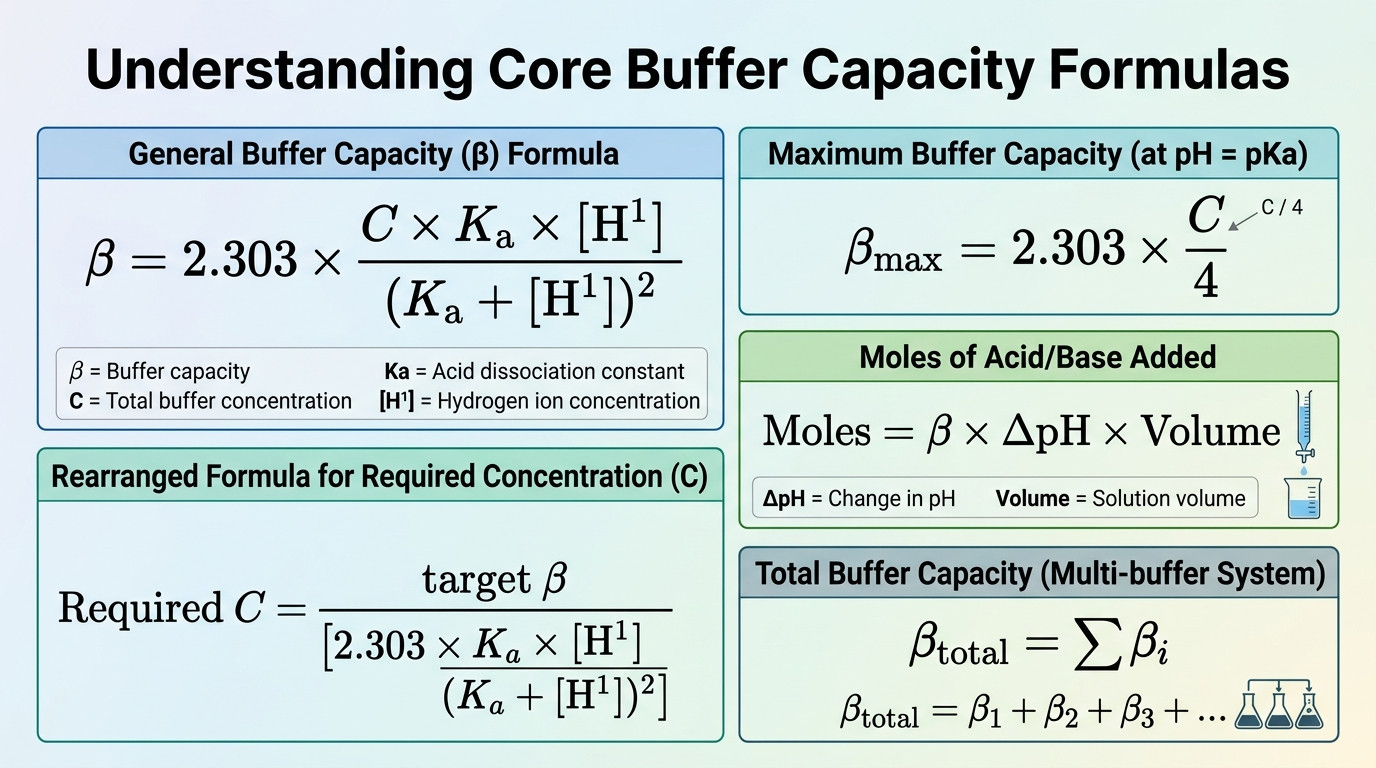
A buffer capacity calculator computes β (beta) — the quantitative measure of how much acid or base a buffer solution can absorb before its pH changes significantly. The formula is β = 2.303 × C × Ka × [H⁺] / (Ka + [H⁺])², where C is the total buffer concentration and Ka = 10^(−pKa). Buffer capacity is maximum at pH = pKa (βmax = 2.303C/4) and drops to near zero outside pKa ± 2. The buffer capacity calculator handles five modes: β from pKa and pH, required concentration for a target capacity, acid/base neutralisation volume, pH change prediction after adding acid or base, and multi-buffer system capacity. Enter your buffer parameters below and get the buffer capacity with every step shown.
Key facts at a glance
- Buffer capacity formula: β = 2.303 × C × Ka × [H⁺] / (Ka + [H⁺])²
- Maximum capacity: at pH = pKa, βmax = 2.303 × C / 4 ≈ 0.576 × C
- Units: mol/(L·pH) — moles of acid or base per litre per pH unit change
- Effective range: pKa ± 1 (β drops to ~33% of maximum at pKa ± 1)
- Higher C = higher β: doubling concentration doubles buffer capacity
- Example: 0.1 M phosphate at pH 7.2: βmax = 0.0576 mol/(L·pH)
📋 Table of Contents
▼
- What a Buffer Capacity Calculator Does
- Buffer Capacity Calculator — Five Modes
- How Buffer Capacity Is Calculated
- Real Scenarios Where Buffer Capacity Mattered
- Common Buffer Capacity Mistakes
- Lab Safety Essentials
- Which Mode Fits Your Situation
- Frequently Asked Questions
- Buffer Capacity Best Practices Checklist
- Trusted Reference Resources
- User Reviews & Ratings
What a Buffer Capacity Calculator Does
A buffer capacity calculator tells you the quantitative resistance of a buffer solution to pH change — how many moles of strong acid or strong base can be added per litre before the pH shifts by one unit. This number, called β (beta), is the single most important property of a buffer beyond its pH: two buffers can have the same pH but vastly different capacities, and using a buffer with insufficient capacity is one of the most common causes of unexpected pH drift in fermentation, cell culture, enzyme assays, and electrochemical measurements. The buffer capacity calculator computes β from the fundamental parameters (total buffer concentration C, pKa, and pH), and extends the calculation to practical questions: how much concentrated acid or base to add to shift the pH by a specific amount, what buffer concentration is needed to resist a known acid load, and how multiple buffer systems combine to give a total capacity.
The reason buffer capacity calculations matter is that buffer concentration and buffer pH are independent variables that both affect capacity. A 10 mM phosphate buffer at pH 7.2 (exactly at pKa) has β = 0.00576 mol/(L·pH) — it can absorb only 5.76 µmol of acid per mL before the pH drops by 1 unit. A 100 mM phosphate buffer at the same pH has 10× the capacity: β = 0.0576 mol/(L·pH). But a 100 mM phosphate buffer at pH 5.2 (2 units from pKa) has β = only 0.00049 — barely 1% of maximum. The buffer capacity calculator makes these dependencies visible, allowing you to choose the right concentration and verify that your buffer can handle the acid or base load your experiment produces.
This buffer capacity calculator handles five modes: the β calculator (compute buffer capacity from C, pKa, and pH), the required concentration calculator (what C gives a target β at a given pH), the neutralisation volume calculator (how much strong acid or base shifts the pH by a specified amount), the pH change predictor (what pH results after adding a known amount of acid or base), and the multi-buffer capacity calculator (total β from two or more buffer components at different pKa values). Each mode shows every step of the working, making it suitable for research, process development, teaching, and regulatory documentation.
Buffer Capacity Calculator
Five modes — β calculator, required concentration, neutralisation, pH change & multi-buffer
Enter up to 3 buffer components. Total β = sum of individual β values at the given pH.
Calculation Result
⚠️ Note: This buffer capacity calculator assumes ideal monoprotic buffer behaviour. For polyprotic buffers, real solutions may deviate. Always verify pH with a calibrated pH meter after adding acid or base.
How Buffer Capacity Is Calculated
Buffer capacity (β) is defined as the number of moles of strong acid or strong base that must be added to one litre of buffer solution to change its pH by one unit. It is the quantitative measure of a buffer’s resistance to pH change — a high β means the buffer can absorb a large amount of acid or base without significant pH drift, while a low β means even a small acid or base addition will shift the pH dramatically. The formula is: β = 2.303 × C × Ka × [H⁺] / (Ka + [H⁺])², where C is the total buffer concentration (the sum of the acid and conjugate base forms), Ka is the acid dissociation constant (Ka = 10^(−pKa)), and [H⁺] is the hydrogen ion concentration (10^(−pH)).
Why Buffer Capacity Matters More Than pH
Two buffers can have exactly the same pH but very different capacities. A 10 mM phosphate buffer at pH 7.2 and a 100 mM phosphate buffer at pH 7.2 have identical pH values, but the 100 mM buffer has 10× the capacity to resist pH change. In a fermentation producing 5 mmol/L/hour of organic acid, the 10 mM buffer would be overwhelmed in less than an hour, while the 100 mM buffer could maintain pH for over 10 hours. The buffer capacity calculator quantifies this difference, allowing you to choose the right concentration for your application before preparing the buffer rather than discovering the problem after the experiment has failed.
Maximum Capacity at pH = pKa
Buffer capacity is maximum when pH equals pKa — at this point, the acid and conjugate base are present in equal concentrations, and the buffer has maximum capacity to absorb both added acid and added base. The maximum capacity is: βmax = 2.303 × C / 4 ≈ 0.576 × C. So a 100 mM buffer has βmax = 0.0576 mol/(L·pH). At one pH unit away from pKa (pH = pKa ± 1), the capacity drops to about 33% of maximum. At two pH units away, it drops to about 4% — essentially no useful buffering. This is why buffers are only effective within pKa ± 1, and the buffer capacity calculator shows both the current β and the percentage of maximum to help you assess whether your buffer is operating within its useful range.
Effect of Concentration on Capacity
Buffer capacity scales linearly with concentration: doubling C doubles β at every pH. This makes concentration the primary lever for increasing buffer capacity. If a 50 mM buffer is insufficient for your application (β too low to resist the expected acid or base load), the first solution is to increase concentration to 100 mM or 200 mM. The buffer capacity calculator’s Required Concentration mode works backwards from a target β to tell you exactly what concentration is needed, accounting for the reduced capacity when pH is away from pKa.
Practical Applications of Buffer Capacity
Buffer capacity determines the success or failure of pH-sensitive processes: fermentation (microbial acid production must be neutralised by the buffer), cell culture (metabolic CO₂ and lactic acid production lower the pH), enzyme assays (product or substrate may be acidic or basic), electrochemistry (electrode reactions produce or consume H⁺), drug formulation (buffer must maintain pH over the product shelf life despite CO₂ absorption and oxidation), and environmental remediation (natural water buffering capacity determines acid rain sensitivity). The buffer capacity calculator supports all of these applications by computing β, predicting pH shifts, and calculating neutralisation volumes.
Required C = target β / [2.303 × Ka × [H¹] / (Ka + [H¹])²]
Moles acid/base = β × ΔpH × Volume
Multi-buffer: βtotal = Σβi
Quick Reference Values
Remember: Buffer capacity depends on BOTH concentration AND distance from pKa. A high-concentration buffer at the wrong pH has low capacity. A low-concentration buffer at the right pH also has low capacity. The buffer capacity calculator shows both the absolute β and the percentage of maximum to help you optimise both variables.
Real Scenarios Where Buffer Capacity Mattered
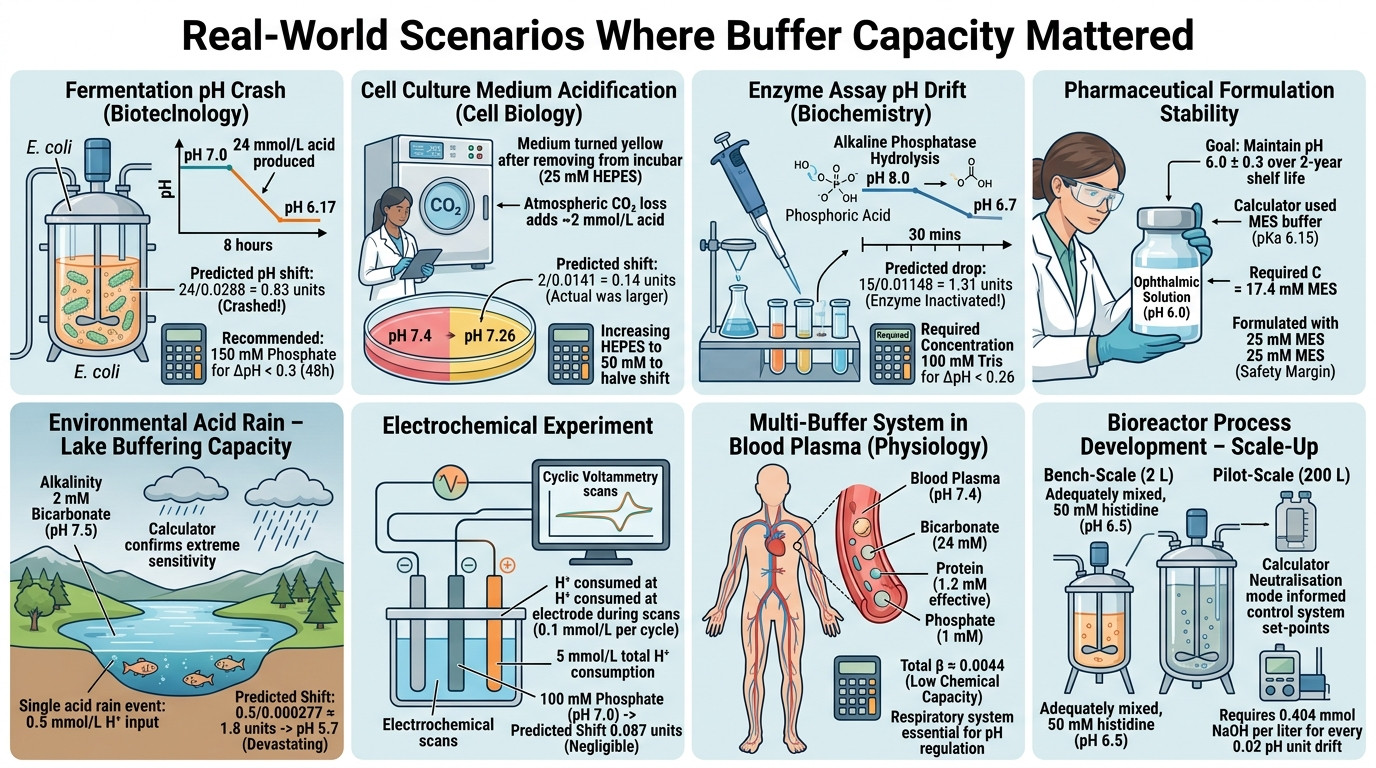
Scenario 1: Fermentation pH Crash
A biotechnologist ran a 48-hour E. coli fermentation in 50 mM phosphate buffer at pH 7.0. The bacteria produced 3 mmol/L/hour of organic acids (acetate, lactate). Using the buffer capacity calculator: β = 0.0288 mol/(L·pH) at pH 7.0 (which is 0.2 units from phosphate pKa 7.2). After 8 hours, the total acid produced was 24 mmol/L. Predicted pH drop: ΔpH = 24/1000 / 0.0288 = 0.83 pH units — the pH crashed to 6.17, inhibiting the bacteria. The calculator showed that increasing to 150 mM phosphate would have kept ΔpH below 0.3 over 48 hours.
Scenario 2: Cell Culture Medium Acidification
A cell biologist noticed that cell culture medium turned yellow (acid) within hours of removing it from the CO₂ incubator. The medium contained 25 mM HEPES (pKa 7.5) as a supplementary buffer. Using the buffer capacity calculator: β at pH 7.4 = 0.0141 mol/(L·pH). The atmospheric CO₂ loss shifted the bicarbonate equilibrium, adding approximately 2 mmol/L of effective acid. Predicted pH shift: 2/1000 / 0.0141 = 0.14 pH units — from 7.4 to 7.26. The actual shift was larger because the HEPES buffer was not the only system changing. The calculator showed that increasing HEPES to 50 mM would halve the pH shift.
Scenario 3: Enzyme Assay pH Drift
A biochemist ran an alkaline phosphatase assay in 20 mM Tris buffer at pH 8.0 (0.06 units from Tris pKa 8.06). The enzyme hydrolysis produced phosphoric acid at 0.5 mmol/L/minute. Using the buffer capacity calculator: β = 0.01148 mol/(L·pH). After a 30-minute reaction, 15 mmol/L of acid was produced. Predicted pH drop: 15/1000 / 0.01148 = 1.31 pH units — the pH would drop to 6.7, completely inactivating the enzyme. The calculator’s Required Concentration mode showed that 100 mM Tris would keep ΔpH below 0.26 over 30 minutes.
Scenario 4: Pharmaceutical Formulation Stability
A pharmaceutical formulator needed a buffer with β ≥ 0.01 mol/(L·pH) to maintain pH 6.0 ± 0.3 over a 2-year shelf life for an ophthalmic solution. Using the buffer capacity calculator’s Required Concentration mode with MES buffer (pKa 6.15): required C = 0.01 / [2.303 × Ka × H / (Ka+H)²] = 0.0174 mol/L = 17.4 mM. The formulator rounded up to 25 mM MES for a safety margin, giving β = 0.0143 — sufficient to absorb the estimated 3 mmol/L of acid produced by oxidative degradation over 2 years.
Scenario 5: Environmental Acid Rain — Lake Buffering Capacity
An environmental scientist assessed whether a lake could resist acid rain. The lake water had alkalinity of 2 mM bicarbonate (pKa 6.35) at pH 7.5. Using the buffer capacity calculator: β = 0.000277 mol/(L·pH) — very low. A single acid rain event depositing 0.5 mmol/L of H⁺ would shift the pH by 0.5/0.000277 ≈ 1.8 units — from 7.5 to 5.7, devastating to aquatic life. The calculator confirmed the lake’s extreme sensitivity to acid input.
Scenario 6: Electrochemical Experiment — Maintaining pH at Electrode
An electrochemist was running cyclic voltammetry in 100 mM phosphate buffer at pH 7.0. Each scan cycle consumed approximately 0.1 mmol/L of H⁺ at the electrode. After 50 cycles, 5 mmol/L of H⁺ was consumed. Using the buffer capacity calculator: β = 0.0576 mol/(L·pH) at pH 7.0 (near pKa 7.2). Predicted pH shift: 5/1000 / 0.0576 = 0.087 pH units — negligible, confirming that 100 mM phosphate was adequate for the experiment.
Scenario 7: Multi-Buffer System in Blood Plasma
A physiology student used the buffer capacity calculator’s Multi-Buffer mode to understand blood pH homeostasis. Blood contains bicarbonate (C ≈ 24 mM, pKa 6.1), phosphate (C ≈ 1 mM, pKa 7.2), and proteins (C ≈ 1.2 mM effective, pKa ≈ 7.4) as buffer systems. At pH 7.4: β(bicarbonate) = 0.0030, β(phosphate) = 0.000535, β(protein) = 0.000688. Total β ≈ 0.0044 mol/(L·pH). This low value explains why the respiratory system (controlling CO₂) is essential for pH regulation — the chemical buffers alone have limited capacity.
Scenario 8: Bioreactor Process Development — Scale-Up
A process engineer scaled up a monoclonal antibody production bioreactor from 2 L bench-scale to 200 L pilot-scale. The bench-scale used 50 mM histidine buffer (pKa 6.0) at pH 6.5. Using the buffer capacity calculator: β at pH 6.5 = 0.0202 mol/(L·pH). At bench scale, this was adequate because the small volume meant rapid mixing and pH control via automated acid/base addition. At 200 L, mixing is slower, and the calculator’s Neutralisation mode showed that maintaining pH within ±0.1 required adding 0.404 mmol of NaOH per litre for every 0.02 pH unit drift — informing the control system set-points.
Common Buffer Capacity Mistakes
Mistake 1: Confusing Buffer pH with Buffer Capacity
The most common conceptual error. A buffer can have the correct pH but inadequate capacity — meaning it will not maintain that pH when acid or base is added. Two 50 mM buffers at pH 7.4 may have very different capacities depending on their pKa values: phosphate (pKa 7.2, |ΔpH| = 0.2) has β = 0.0279, while Tris (pKa 8.06, |ΔpH| = 0.66) has β = 0.0195 — 30% less capacity despite the same pH. The buffer capacity calculator shows β alongside pH to prevent this confusion.
Mistake 2: Using Too Low a Buffer Concentration
A 10 mM buffer at pKa has βmax = 0.00576 mol/(L·pH) — barely enough to absorb 5.76 µmol of acid per mL. In most biological experiments, metabolic acid production exceeds this within minutes to hours. The buffer capacity calculator’s Required Concentration mode tells you exactly what concentration is needed for your expected acid or base load.
Mistake 3: Operating Outside the Effective Range
A buffer more than 1 pH unit from its pKa has less than 33% of maximum capacity. At 2 pH units away, it has less than 4%. Using a phosphate buffer (pKa 7.2) at pH 5.0 is effectively using unbuffered solution. The buffer capacity calculator flags when |pH − pKa| > 1 and shows the percentage of maximum capacity.
Mistake 4: Ignoring Water’s Intrinsic Buffer Capacity
Pure water has its own (very low) buffer capacity from the autoionisation equilibrium. At pH 7, βwater ≈ 4.6 × 10⁻⁷ mol/(L·pH) — negligible compared to any practical buffer. But at extreme pH (below 2 or above 12), water’s contribution becomes significant. The buffer capacity calculator does not include water’s contribution, which is a reasonable approximation for pH 3–11.
Mistake 5: Assuming Linear pH Change
β is the instantaneous rate of change (dC/dpH), not a linear constant over large pH ranges. Adding acid to a buffer does not change the pH linearly — β itself changes as the pH shifts. For small additions (ΔpH < 0.5), the linear approximation (moles = β × ΔpH × volume) is acceptable. For larger shifts, the buffer capacity calculator’s pH Shift mode uses the exact Henderson-Hasselbalch equation for accurate prediction.
Mistake 6: Not Accounting for CO₂ Absorption
Buffers at pH > 7 absorb atmospheric CO₂, which dissolves to form carbonic acid and slowly lowers the pH. A 50 mM Tris buffer left open on the bench at pH 8.0 can drop 0.1–0.3 pH units over 24 hours from CO₂ absorption alone. The buffer capacity calculator quantifies how much acid the buffer can absorb, but preventing CO₂ absorption requires physical measures: sealed containers, N₂ overlay, or freshly prepared buffers.
Mistake 7: Overlooking Multi-Buffer Contributions
Cell culture media, blood plasma, and environmental waters contain multiple buffer systems that contribute additively to total capacity. Ignoring the minor components and calculating only the major component underestimates the total β. The buffer capacity calculator’s Multi-Buffer mode sums contributions from up to 3 buffer systems at any pH.
💡 Rule of Thumb: βmax ≈ 0.576 × C at pH = pKa. If you need the buffer to resist X mmol of acid per litre, you need C ≥ X / (0.576 × acceptable ΔpH). The buffer capacity calculator computes this precisely — use the Required Concentration mode.
Lab Safety Essentials
Concentrated acid and base titrants: The Neutralisation mode may recommend adding concentrated HCl or NaOH. Always add dropwise with stirring, wear gloves and goggles, and use a calibrated pH meter to monitor the pH in real time. Never exceed the calculated volume without re-checking the pH.
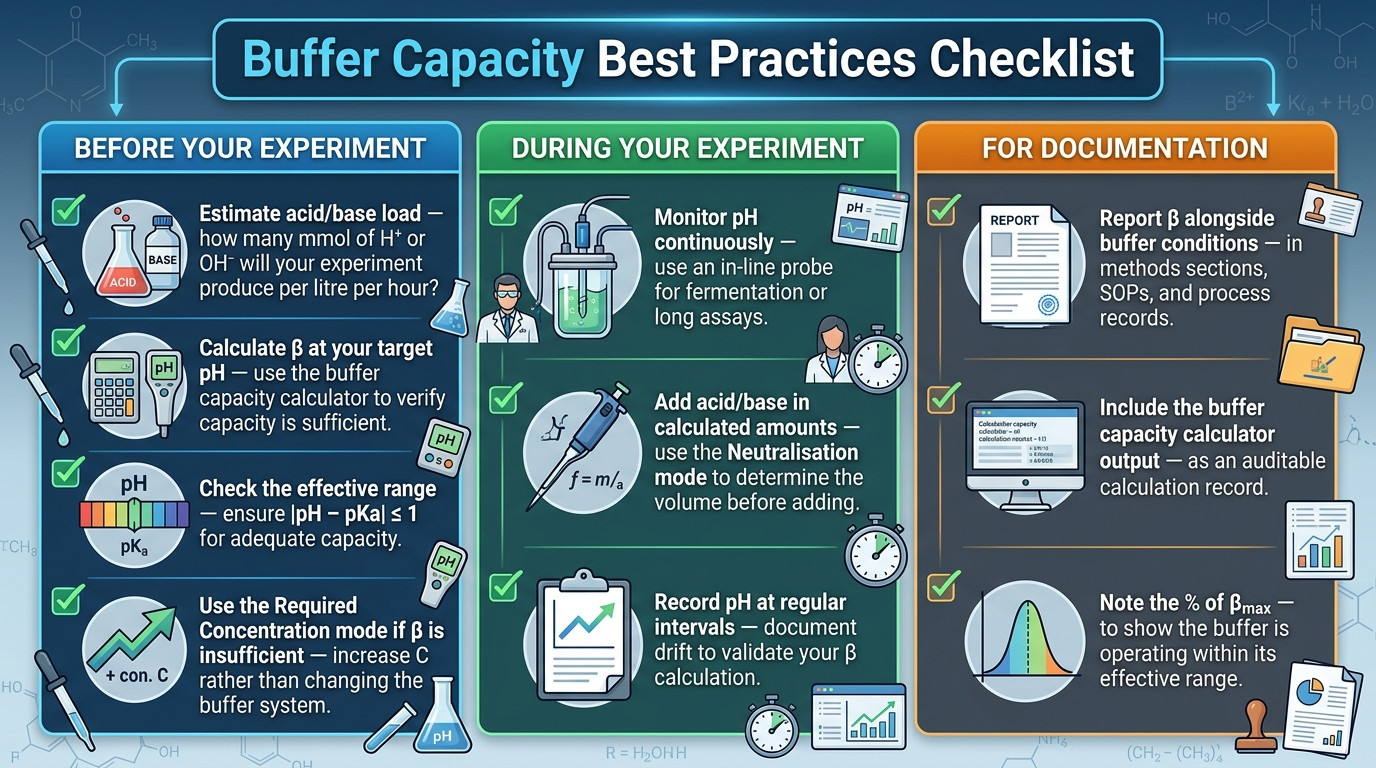
- Verify β is adequate — use the buffer capacity calculator before starting an experiment, not after pH has drifted.
- Use the correct pKa — at the correct temperature. Tris pKa changes by −0.028/°C.
- Monitor pH continuously — for fermentation and long-duration experiments, use an in-line pH probe.
- Account for metabolic acid/base production — estimate the total acid or base load over the experiment duration.
- Prepare fresh buffers — CO₂ absorption and microbial growth reduce buffer capacity over time.
- Document the β calculation — use the buffer capacity calculator output for your lab notebook or process record.
Which Mode Fits Your Situation
| Mode | Use Case | Key Formula | Inputs | Applications |
|---|---|---|---|---|
| β Value | Compute buffer capacity | β = 2.303CKaH/(Ka+H)² | C, pKa, pH | Buffer selection, verification |
| Req. Conc | What C gives target β | C = β/f(Ka,H) | Target β, pKa, pH | Process design, formulation |
| Neutralise | Volume of acid/base needed | mol = β×ΔpH×V | β, ΔpH, vol, titrant | pH adjustment, titration |
| pH Shift | Predict pH after addition | H-H equation | C, pKa, pH, amount added | Fermentation, stability |
| Multi-Buffer | Total β from multiple buffers | Σβi | Up to 3 buffers + pH | Blood, culture media, complex systems |
Buffer Capacity in Biochemistry
Biochemists need sufficient buffer capacity to maintain pH during enzyme-catalysed reactions that produce or consume protons. Kinase assays release H⁺ when ATP is hydrolysed. Phosphatase assays release phosphoric acid. Oxidase reactions consume O₂ and may shift pH indirectly through CO₂ changes. The buffer capacity calculator quantifies the acid or base load a buffer can handle, allowing the biochemist to choose a concentration that maintains pH within the acceptable range (typically ±0.1–0.2 pH units) over the assay duration.
Buffer Capacity in Fermentation and Bioprocessing
Fermentation produces organic acids (acetate, lactate, succinate) and CO₂ that lower the pH. In uncontrolled (batch) fermentations, the buffer capacity determines how long the pH remains in the optimal range. In controlled (fed-batch) fermentations, the buffer capacity determines the frequency and volume of acid or base additions. The buffer capacity calculator’s Neutralisation mode computes the exact volume of concentrated NaOH or HCl needed to correct pH drifts, informing the process control system set-points.
Buffer Capacity in Pharmaceutical Formulation
Pharmaceutical formulations must maintain pH over their shelf life (typically 2–5 years) despite degradation reactions that produce acidic or basic products, CO₂ absorption from the atmosphere, and temperature fluctuations. The buffer capacity calculator’s Required Concentration mode helps formulators determine the minimum buffer concentration that will maintain pH within specification over the product’s lifetime, accounting for the estimated degradation acid or base load.
Buffer Capacity in Environmental Science
The acid neutralising capacity (ANC) of natural waters is a form of buffer capacity that determines vulnerability to acid rain. Lakes with high bicarbonate alkalinity (high β) can absorb acid deposition without significant pH change, while lakes with low alkalinity (granitic bedrock, low β) can lose several pH units from a single acid rain event, killing fish and aquatic organisms. The buffer capacity calculator quantifies this vulnerability, supporting environmental risk assessment.
Worked Examples
Example 1 — β Value: 0.1 M phosphate at pH 7.2 (= pKa): β = 2.303 × 0.1 / 4 = 0.0576 mol/(L·pH). Maximum capacity.
Example 2 — β at pH ≠ pKa: 0.1 M phosphate at pH 7.4: β = 0.0555 mol/(L·pH) — 96% of maximum (only 0.2 units from pKa).
Example 3 — Required C: Need β = 0.05 at pH 7.4 with phosphate (pKa 7.2). Required C = 0.05 / 0.555 = 0.0901 M ≈ 90 mM.
Example 4 — Neutralisation: 1 L of buffer with β = 0.05 mol/(L·pH), shift pH by 0.3 units with 1 M HCl. Volume = (0.05 × 0.3 × 1) / 1 = 15 mL.
Example 5 — pH Shift: 0.1 M phosphate at pH 7.2, add 5 mmol/L HCl. [A⁻] drops from 50 to 45 mM, [HA] rises from 50 to 55 mM. New pH = 7.2 + log(45/55) = 7.2 − 0.087 = 7.11.
Frequently Asked Questions
1. What is buffer capacity?
Buffer capacity (β) is the number of moles of strong acid or base that must be added per litre of buffer to change the pH by one unit. Higher β means stronger resistance to pH change. The buffer capacity calculator computes β from buffer concentration, pKa, and pH.
2. What is the formula for buffer capacity?
β = 2.303 × C × Ka × [H⁺] / (Ka + [H⁺])², where C is total buffer concentration, Ka = 10^(−pKa), and [H⁺] = 10^(−pH). Maximum capacity occurs at pH = pKa: βmax = 2.303C/4.
3. What are the units of buffer capacity?
mol/(L·pH) — moles of acid or base per litre of solution per pH unit change.
4. When is buffer capacity maximum?
At pH = pKa, where the acid and conjugate base are in equal concentrations. βmax = 2.303 × C / 4 ≈ 0.576 × C.
5. How does concentration affect buffer capacity?
Buffer capacity scales linearly with concentration. Doubling C doubles β at every pH. If your buffer has insufficient capacity, increase the concentration.
6. What is the effective range of a buffer?
pKa ± 1 pH unit. Within this range, β is at least 33% of maximum. Outside this range, capacity drops rapidly.
7. How do I calculate the volume of acid or base to add?
Moles needed = β × ΔpH × buffer volume (in litres). Volume of titrant = moles / titrant concentration. The Neutralisation mode computes this directly.
8. Can multiple buffers increase total capacity?
Yes. Total β is the sum of individual β values at the given pH. The Multi-Buffer mode computes this for up to 3 buffer components.
9. What is blood plasma buffer capacity?
Approximately 0.025 mol/(L·pH) from the combined contributions of bicarbonate, phosphate, and plasma proteins.
10. Is this buffer capacity calculator free?
Yes. Completely free, browser-based, no sign-up, fully private. No data sent to any server.
Buffer Capacity Best Practices Checklist
Before Your Experiment
During Your Experiment
For Documentation
Trusted Reference Resources
Perrin & Dempsey — Buffers for pH and Metal Ion Control — The definitive reference for buffer capacity, buffer selection, and metal-buffer interactions.
Good et al. (1966) — Hydrogen ion buffers for biological research. Biochemistry 5:467–477. The original paper defining Good’s buffers with pKa and capacity data.
LibreTexts Chemistry — chem.libretexts.org — Free explanations of buffer capacity, Henderson-Hasselbalch equation, and titration curves.
Sigma-Aldrich Buffer Reference — sigmaaldrich.com — Buffer preparation tables, pKa values, and practical buffer capacity data.
EPA Acid Neutralizing Capacity — epa.gov — Methods for measuring the buffering capacity (ANC) of natural waters.
User Reviews & Ratings
Share Your Experience with This Buffer Capacity Calculator
Final Thoughts on Buffer Capacity Calculation
Buffer capacity is the most underappreciated parameter in buffer chemistry. Scientists routinely choose buffer systems based on pH and pKa, prepare them at standard concentrations (50 mM, 100 mM), and assume the buffer will maintain pH — only to discover pH drift hours or days later when the experiment has already failed. The buffer capacity calculator makes β visible and quantitative before the experiment starts, allowing you to verify that your buffer has sufficient capacity for the expected acid or base load, to compute the minimum concentration needed for a target capacity, and to predict exactly how much pH will shift when acid or base is added.
Use the β Value mode for verification, the Required Concentration mode for buffer design, the Neutralisation mode for pH adjustment calculations, the pH Shift mode for predicting the effect of metabolic acid production, and the Multi-Buffer mode for complex systems. The step-by-step output provides auditable documentation for laboratory notebooks, process records, methods sections, and regulatory submissions.
🔒 Privacy Guarantee: Every calculation runs entirely within your browser. No data is sent to any server. Reviews are saved in your browser’s local storage only.