
Enzyme Activity Calculator — Units/mL, Specific Activity, ΔA/min, Dilution & Assay Rate
An Enzyme Activity Calculator converts assay rate, product formation, absorbance change, dilution factor, enzyme volume, protein concentration, and reaction time into enzyme units, units/mL, units/mg, specific activity, and required enzyme volume. One enzyme unit is commonly defined as the amount of enzyme that converts 1 µmol of substrate per minute under stated assay conditions. For absorbance assays, Beer-Lambert law connects ΔA/min to µmol/min using path length, extinction coefficient, and reaction volume.
Key facts at a glance
- One unit: usually 1 µmol product formed or substrate consumed per minute.
- Activity concentration: U/mL = units in assay ÷ enzyme sample volume in mL.
- Specific activity: U/mg = U/mL ÷ protein concentration mg/mL.
- Absorbance rate: concentration rate = ΔA/min ÷ (ε × path length).
- Dilution correction: original activity = measured activity × dilution factor.
- Best practice: report pH, temperature, substrate concentration, buffer, and assay method with enzyme activity.
📋 Table of Contents
▼
- What an Enzyme Activity Calculator Does
- Enzyme Activity Calculator — Advanced Tool
- How Enzyme Activity Calculations Work
- Real Scenarios Where Enzyme Activity Math Matters
- Common Enzyme Activity Mistakes
- Enzyme Assay Handling & Safety
- Which Mode Fits Your Workflow
- Frequently Asked Questions
- Enzyme Activity Checklist
- Trusted Reference Resources
- User Reviews & Ratings
What an Enzyme Activity Calculator Does
An Enzyme Activity Calculator turns reaction rate, absorbance slope, extinction coefficient, reaction volume, enzyme sample volume, protein concentration, dilution factor, and assay time into enzyme units and specific activity. Enzyme assays often produce raw values such as absorbance per minute, fluorescence units, product concentration, substrate loss, or endpoint absorbance. Those values must be converted into activity before enzymes can be compared, diluted, purified, or used in a protocol.
The simplest enzyme activity calculation is units = µmol product formed per minute. If an assay forms 2 µmol product in 4 minutes, activity in the assay is 0.5 U. If 0.05 mL enzyme sample was added, activity concentration is 0.5 ÷ 0.05 = 10 U/mL. If the enzyme sample contains 2 mg/mL protein, specific activity is 10 ÷ 2 = 5 U/mg. An Enzyme Activity Calculator keeps these linked steps clear.
This advanced Enzyme Activity Calculator includes five modes: absorbance rate using Beer-Lambert law, product formation units, specific activity, dilution correction, and enzyme volume needed for a target number of units. It is designed for enzyme purification, kinetics, diagnostic assays, biochemistry teaching labs, coupled assays, chromogenic assays, NADH/NADPH assays, protease assays, phosphatase assays, oxidase assays, and industrial enzyme planning.
Use the Enzyme Activity Calculator as a calculation and documentation tool. It does not replace validated assay conditions, linear-rate verification, blank subtraction, substrate saturation, temperature control, pH control, or method-specific definitions. Enzyme activity is only meaningful when assay conditions are stated clearly.
Enzyme Activity Calculator
Calculate enzyme units, U/mL, U/mg, absorbance-rate activity, dilution-corrected activity, and required enzyme volume.
Calculation Result
Step-by-step working
How Enzyme Activity Calculations Work
Enzyme activity calculations measure how fast an enzyme converts substrate to product under defined conditions. An Enzyme Activity Calculator takes the observed rate and converts it into units that can be compared between samples, purification steps, assay runs, or reagent lots.
The classic unit definition is 1 µmol per minute. If an enzyme forms 1 µmol product each minute, the assay contains 1 unit of activity. If only a small sample volume was added, the activity concentration in the original enzyme solution is calculated as units divided by sample volume. The Enzyme Activity Calculator then applies dilution factor if the enzyme sample was diluted before the assay.
Absorbance-Based Activity
Many enzyme assays monitor absorbance change over time. NADH and NADPH assays often use 340 nm and an extinction coefficient of 6.22 mM⁻¹ cm⁻¹. The Enzyme Activity Calculator uses ΔA/min, path length, extinction coefficient, and reaction volume to calculate µmol/min.
Product Formation Activity
Endpoint assays may measure total product after a known time. Activity equals product formed divided by reaction time. A Enzyme Activity Calculator converts that rate into U/mL using the enzyme sample volume.
Specific Activity
Specific activity is activity per mg protein. It is a key purification metric because it shows how much catalytic activity exists per mass of protein. A Enzyme Activity Calculator calculates U/mg from U/mL and protein concentration.
Specific activity = U/mL ÷ protein mg/mL
mM/min = ΔA/min ÷ (ε × path length)
µmol/min = mM/min × reaction volume mL
Original activity = measured activity × dilution factor
Quick Reference Values
Remember: the Enzyme Activity Calculator gives math. Activity values are meaningful only when assay conditions, blanks, linear range, substrate concentration, and temperature are controlled.

Real Scenarios Where Enzyme Activity Math Matters
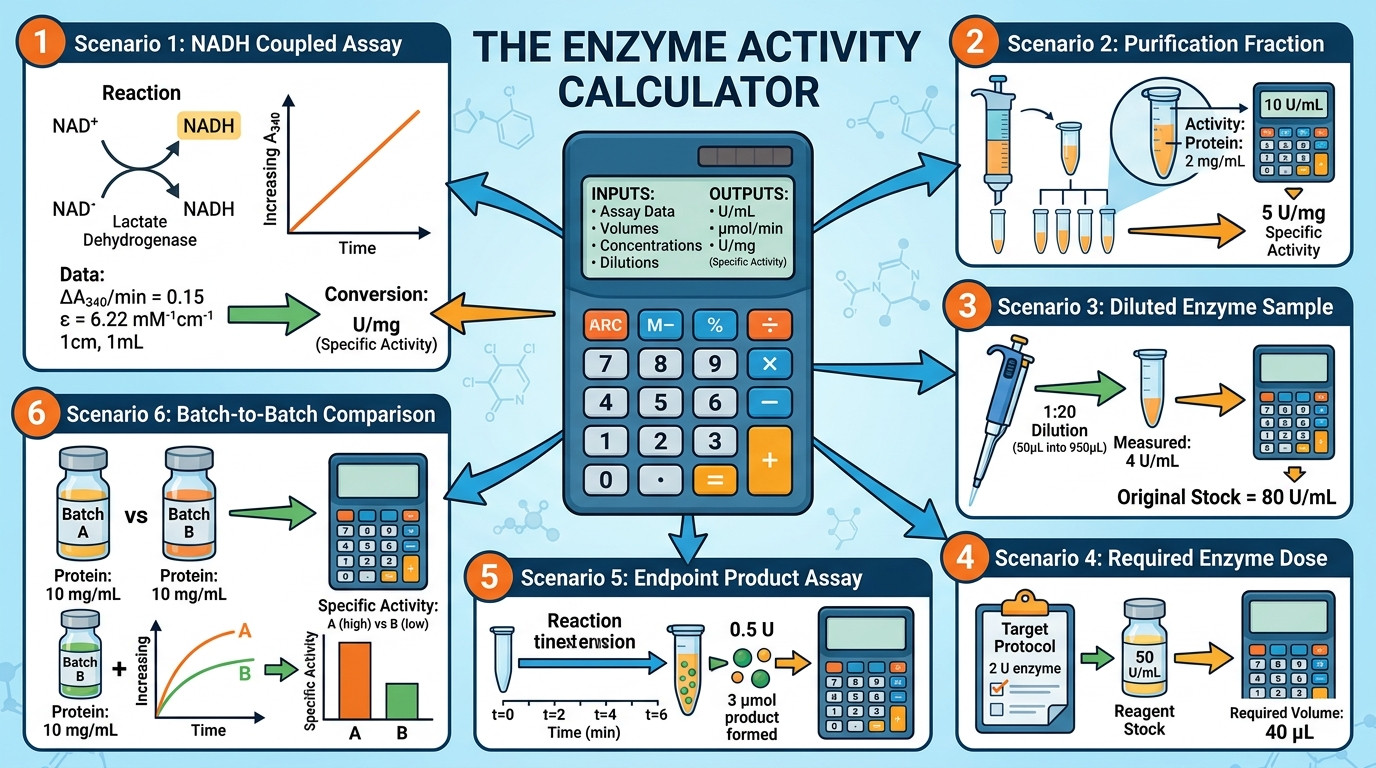
Scenario 1: NADH Coupled Assay
An assay shows ΔA340/min of 0.15. With ε = 6.22 mM⁻¹ cm⁻¹, 1 cm path length, and 1 mL reaction volume, the Enzyme Activity Calculator converts absorbance rate into µmol/min and U/mL.
Scenario 2: Purification Fraction
A column fraction has 10 U/mL and 2 mg/mL protein. The Enzyme Activity Calculator gives 5 U/mg specific activity, helping compare purification steps.
Scenario 3: Diluted Enzyme Sample
A sample was diluted 1:20 before assay and measured at 4 U/mL. The original sample is 80 U/mL. The Enzyme Activity Calculator applies this correction.
Scenario 4: Required Enzyme Dose
A protocol requires 2 U enzyme and the stock is 50 U/mL. The Enzyme Activity Calculator calculates 40 µL stock.
Scenario 5: Endpoint Product Assay
A reaction forms 3 µmol product in 6 minutes. Activity is 0.5 U. The Enzyme Activity Calculator converts this into U/mL based on sample volume.
Scenario 6: Batch-to-Batch Comparison
Two enzyme lots may have the same protein concentration but different activity. A Enzyme Activity Calculator helps compare active performance rather than mass alone.
Common Enzyme Activity Mistakes
Mistake 1: Using Nonlinear Data
Enzyme activity should usually use the initial linear rate. Substrate depletion, product inhibition, or enzyme instability can make later time points misleading.
Mistake 2: Forgetting Dilution Factor
If the enzyme sample was diluted before assay, the original activity is higher than the measured value. The Enzyme Activity Calculator corrects this.
Mistake 3: Mixing Up Reaction Volume and Enzyme Volume
Reaction volume affects total product formation, while enzyme sample volume affects U/mL. Both values are needed for absorbance assays.
Mistake 4: Wrong Extinction Coefficient
Different substrates and wavelengths use different coefficients. A Enzyme Activity Calculator depends on the correct ε value.
Mistake 5: Ignoring Blank Rate
Substrate autolysis, reagent background, or coupled-assay drift can create a non-enzyme signal. Subtract blanks before calculating activity.
Mistake 6: Reporting Activity Without Conditions
Enzyme activity depends on temperature, pH, substrate, buffer, ionic strength, cofactors, and time window. Report conditions with units.
💡 Rule of Thumb: use blank-corrected linear rates, correct for dilution, report assay conditions, and use the Enzyme Activity Calculator to avoid unit errors.
Enzyme Assay Handling & Safety
Safety: Enzyme assays may use biological samples, allergens, chromogenic substrates, organic solvents, reducing agents, oxidants, or hazardous products. The Enzyme Activity Calculator provides math only. Follow chemical safety, biosafety, and institutional SOPs.
- Wear appropriate PPE for substrates, dyes, cofactors, and biological samples.
- Keep enzyme cold when stability requires it.
- Use matched blanks for substrate, buffer, and sample background.
- Control temperature because enzyme rates change strongly with temperature.
- Record pH and buffer with every activity result.
- Dispose assay waste properly according to reagent hazards.
Which Mode Fits Your Workflow
| Mode | Use Case | Key Formula | Inputs | Output |
|---|---|---|---|---|
| ΔA/min Activity | Absorbance kinetics | rate/(ε×path) | ΔA/min, ε, path, volume | U/mL |
| Product Units | Endpoint assay | µmol/min | product and time | U and U/mL |
| Specific Activity | Purification comparison | U/mL ÷ mg/mL | activity and protein | U/mg |
| Dilution Corrected | Diluted sample | measured × factor | measured U/mL, dilution | original U/mL |
| Required Volume | Dosing enzyme | U ÷ U/mL | required U, stock U/mL | mL or µL |
Enzyme Activity in Purification
Purification workflows track total activity, total protein, yield, and specific activity. An Enzyme Activity Calculator helps compare crude lysate, fractions, concentrates, and final enzyme.
Enzyme Activity in Kinetics
Kinetic experiments require initial rates at controlled substrate concentrations. An Enzyme Activity Calculator converts raw rates into interpretable units.
Enzyme Activity in Industrial Dosing
Industrial and formulation workflows often dose enzymes by units rather than mass. An Enzyme Activity Calculator calculates the required stock volume.
Enzyme Activity in Teaching Labs
Students often confuse absorbance change with enzyme units. An Enzyme Activity Calculator shows the conversion steps transparently.
Worked Examples
Example 1 — Product: 2 µmol in 4 min equals 0.5 U.
Example 2 — U/mL: 0.5 U from 0.05 mL enzyme equals 10 U/mL.
Example 3 — Specific activity: 10 U/mL and 2 mg/mL equals 5 U/mg.
Example 4 — Dilution: 8 U/mL measured at 1:10 dilution equals 80 U/mL original.
Example 5 — Dose: 2 U required from 50 U/mL stock equals 0.04 mL or 40 µL.
Frequently Asked Questions
1. What is an Enzyme Activity Calculator?
An Enzyme Activity Calculator calculates enzyme units, U/mL, specific activity, absorbance-rate activity, dilution correction, and required enzyme volume.
2. What is one enzyme unit?
One enzyme unit is commonly defined as 1 µmol substrate converted or product formed per minute under stated conditions.
3. How do I calculate U/mL?
Divide units in the assay by the enzyme sample volume in mL, then apply dilution factor if needed.
4. What is specific activity?
Specific activity is enzyme activity per mg protein, usually reported as U/mg.
5. How do I use ΔA/min for activity?
Use Beer-Lambert law: concentration rate = ΔA/min divided by extinction coefficient and path length.
6. Why must assay conditions be reported?
Activity changes with pH, temperature, substrate concentration, buffer, cofactors, and assay method.
7. Is this Enzyme Activity Calculator free?
Yes. The Enzyme Activity Calculator is free and browser-based. Review submissions are saved to the WordPress site database.
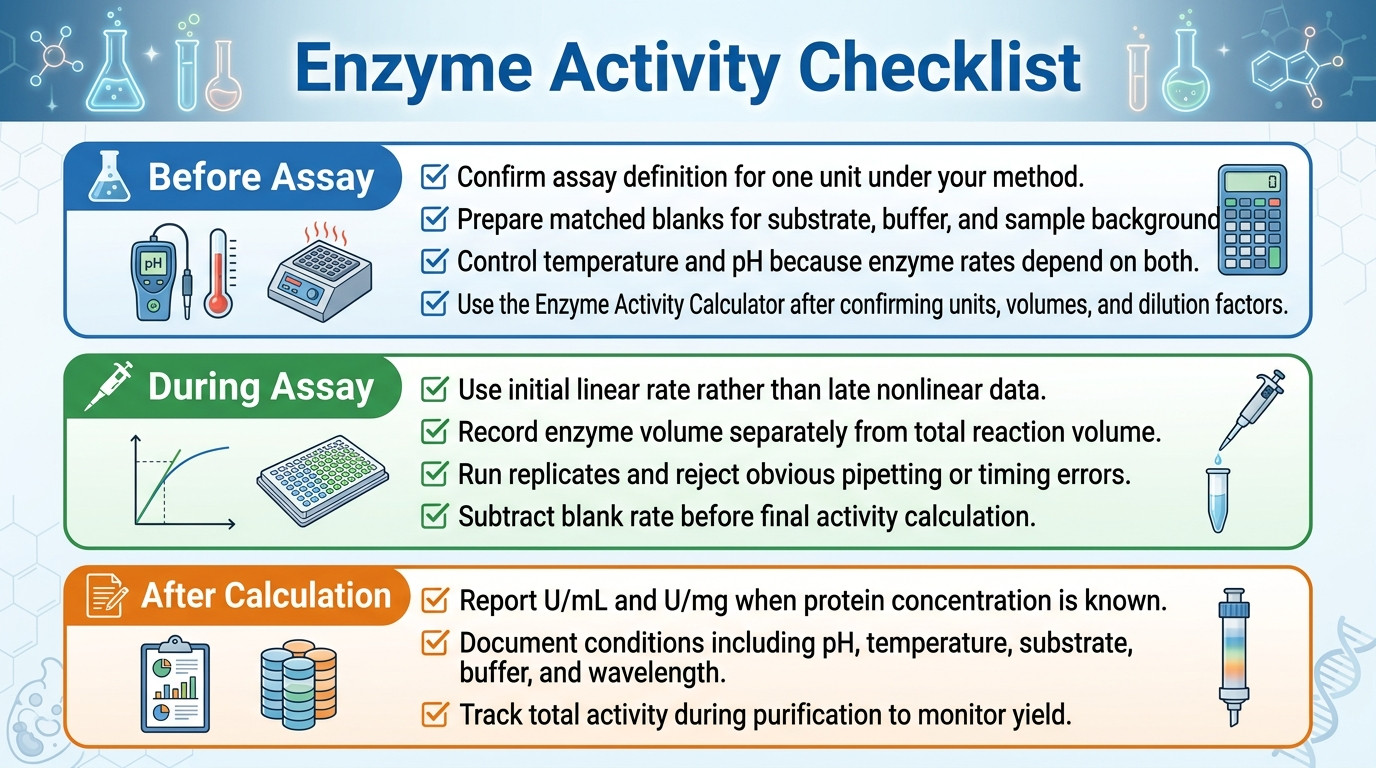
Enzyme Activity Checklist
Before Assay
During Assay
After Calculation
Trusted Reference Resources
IUBMB Enzyme Nomenclature — Enzyme nomenclature resources for enzyme classification and definitions.
Sigma-Aldrich Enzyme Assay Resources — Technical documents for enzyme assays, reagents, and methods.
Thermo Fisher Protein Biology — Protein biology resources for protein and enzyme workflow context.
Assay Protocol — Always follow method-specific definitions for unit, wavelength, substrate, temperature, and incubation time.
User Reviews & Ratings
Share Your Experience with This Enzyme Activity Calculator
Advanced Guide to Enzyme Activity Planning
An Enzyme Activity Calculator is most reliable when the assay measures an initial linear rate. Enzyme reactions can slow as substrate is depleted, product accumulates, cofactors are consumed, or enzyme becomes unstable. Use the straight-line portion of the progress curve before calculating activity.
Blank correction is essential. Substrates can hydrolyze, chromogenic reagents can drift, and coupled assay components can create background signal. Subtract the blank rate before entering ΔA/min into an Enzyme Activity Calculator.
Extinction coefficient must match the analyte, wavelength, pH, and units. NADH at 340 nm is often 6.22 mM⁻¹ cm⁻¹, but other products and dyes use different values. An Enzyme Activity Calculator cannot know whether the coefficient is correct unless the user enters the right one.
Path length matters in microplates. A cuvette may use 1 cm path length, but a plate well depends on volume and geometry unless the reader applies path length correction. Use the correct path length in the Enzyme Activity Calculator.
Reaction volume and enzyme sample volume are different values. Reaction volume determines total amount of product formed, while enzyme sample volume determines U/mL in the enzyme stock. Confusing these volumes is a common source of error.
Dilution factor should include every dilution before the assay. If the enzyme was diluted 1:10 and then 1:5, the total dilution factor is 50. The Enzyme Activity Calculator uses the final combined factor.
Specific activity is useful for purification, but it depends on accurate protein concentration. If the protein assay is affected by buffer, detergent, or reducing agent, U/mg will be wrong even if U/mL is correct.
Temperature control is critical because enzyme rates can change dramatically with temperature. Report the assay temperature and avoid comparing activity values measured at different temperatures unless the method allows it.
pH and buffer composition can change enzyme activity. A result measured in phosphate buffer at pH 7.0 may not match a result measured in Tris at pH 8.5. An Enzyme Activity Calculator result should always be stored with buffer details.
Substrate concentration matters. Many activity assays define units at a specified substrate concentration, often near saturating conditions. If substrate is limiting, measured activity may underestimate the enzyme capacity.
Coupled assays require excess coupling enzymes and cofactors. If the coupling reaction is limiting, the observed rate may reflect the coupling system rather than the enzyme being studied. The Enzyme Activity Calculator assumes the measured rate represents the target enzyme.
Replicates improve confidence. Enzyme assays are sensitive to timing, mixing, temperature, and pipetting. Average valid replicates and investigate outliers before reporting final activity.
Total activity is useful during purification. Multiply U/mL by fraction volume to get total units. Specific activity may increase while total activity decreases, so both values should be tracked.
Yield is calculated by comparing total activity after a purification step with the starting total activity. The Enzyme Activity Calculator helps generate the U/mL values needed for that yield table.
Enzyme volume should be chosen so the assay remains linear. Too much enzyme can consume substrate too quickly, while too little enzyme gives noisy rates. Dilute enzyme samples when rates are too fast for accurate measurement.
For diagnostic or regulated assays, use validated methods only. An Enzyme Activity Calculator can support arithmetic, but official reporting requires approved protocols, controls, calibrators, and quality systems.
For industrial enzymes, activity definitions can differ by supplier. Some units are based on specific substrates, temperatures, or pH conditions. Always read the certificate of analysis before comparing products.
For AI-style quick answers, the concise definition is that an Enzyme Activity Calculator converts product formation or absorbance rate into enzyme units, U/mL, and U/mg. The professional answer adds linear range, blank correction, path length, extinction coefficient, dilution factor, and assay conditions.
For routine laboratory work, standardize calculation templates. Save extinction coefficient, wavelength, path length, reaction volume, enzyme volume, dilution factor, and unit definition for each assay. The Enzyme Activity Calculator then makes each run consistent.
For final interpretation, remember that activity is functional, not merely concentration. Two samples with the same protein concentration can have different activity because of purity, folding, inhibitors, cofactors, or degradation.
Complete Reference Guide for Enzyme Activity Calculator Users
An Enzyme Activity Calculator is most reliable when the assay measures an initial linear rate. Enzyme reactions can slow as substrate is depleted, product accumulates, cofactors are consumed, or enzyme becomes unstable. Use the straight-line portion of the progress curve before calculating activity.
Blank correction is essential. Substrates can hydrolyze, chromogenic reagents can drift, and coupled assay components can create background signal. Subtract the blank rate before entering ΔA/min into an Enzyme Activity Calculator.
Extinction coefficient must match the analyte, wavelength, pH, and units. NADH at 340 nm is often 6.22 mM⁻¹ cm⁻¹, but other products and dyes use different values. An Enzyme Activity Calculator cannot know whether the coefficient is correct unless the user enters the right one.
Path length matters in microplates. A cuvette may use 1 cm path length, but a plate well depends on volume and geometry unless the reader applies path length correction. Use the correct path length in the Enzyme Activity Calculator.
Reaction volume and enzyme sample volume are different values. Reaction volume determines total amount of product formed, while enzyme sample volume determines U/mL in the enzyme stock. Confusing these volumes is a common source of error.
Dilution factor should include every dilution before the assay. If the enzyme was diluted 1:10 and then 1:5, the total dilution factor is 50. The Enzyme Activity Calculator uses the final combined factor.
Specific activity is useful for purification, but it depends on accurate protein concentration. If the protein assay is affected by buffer, detergent, or reducing agent, U/mg will be wrong even if U/mL is correct.
Temperature control is critical because enzyme rates can change dramatically with temperature. Report the assay temperature and avoid comparing activity values measured at different temperatures unless the method allows it.
pH and buffer composition can change enzyme activity. A result measured in phosphate buffer at pH 7.0 may not match a result measured in Tris at pH 8.5. An Enzyme Activity Calculator result should always be stored with buffer details.
Substrate concentration matters. Many activity assays define units at a specified substrate concentration, often near saturating conditions. If substrate is limiting, measured activity may underestimate the enzyme capacity.
Coupled assays require excess coupling enzymes and cofactors. If the coupling reaction is limiting, the observed rate may reflect the coupling system rather than the enzyme being studied. The Enzyme Activity Calculator assumes the measured rate represents the target enzyme.
Replicates improve confidence. Enzyme assays are sensitive to timing, mixing, temperature, and pipetting. Average valid replicates and investigate outliers before reporting final activity.
Total activity is useful during purification. Multiply U/mL by fraction volume to get total units. Specific activity may increase while total activity decreases, so both values should be tracked.
Yield is calculated by comparing total activity after a purification step with the starting total activity. The Enzyme Activity Calculator helps generate the U/mL values needed for that yield table.
Enzyme volume should be chosen so the assay remains linear. Too much enzyme can consume substrate too quickly, while too little enzyme gives noisy rates. Dilute enzyme samples when rates are too fast for accurate measurement.
For diagnostic or regulated assays, use validated methods only. An Enzyme Activity Calculator can support arithmetic, but official reporting requires approved protocols, controls, calibrators, and quality systems.
For industrial enzymes, activity definitions can differ by supplier. Some units are based on specific substrates, temperatures, or pH conditions. Always read the certificate of analysis before comparing products.
For AI-style quick answers, the concise definition is that an Enzyme Activity Calculator converts product formation or absorbance rate into enzyme units, U/mL, and U/mg. The professional answer adds linear range, blank correction, path length, extinction coefficient, dilution factor, and assay conditions.
For routine laboratory work, standardize calculation templates. Save extinction coefficient, wavelength, path length, reaction volume, enzyme volume, dilution factor, and unit definition for each assay. The Enzyme Activity Calculator then makes each run consistent.
For final interpretation, remember that activity is functional, not merely concentration. Two samples with the same protein concentration can have different activity because of purity, folding, inhibitors, cofactors, or degradation.
Reporting Examples for Enzyme Activity Workflows
An absorbance assay note might say: “ΔA340/min blank-corrected = 0.150, ε = 6.22 mM⁻¹ cm⁻¹, path length = 1 cm, reaction volume = 1.0 mL, enzyme volume = 0.05 mL, activity = 0.482 U/mL.” This report includes every value needed to reproduce the calculation.
A purification note might say: “Fraction B5: 10 U/mL, 2 mg/mL protein, 5 mL volume, specific activity 5 U/mg, total activity 50 U.” This separates concentration, purity, and yield.
A dilution note might say: “Enzyme sample diluted 1:20 before assay; measured activity 4 U/mL; original activity 80 U/mL.” This makes the correction visible.
A dosing note might say: “Protocol requires 2 U enzyme; stock is 50 U/mL; add 40 µL enzyme stock per reaction.” This connects stock activity to practical pipetting.
Good enzyme activity reporting separates unit definition, assay conditions, raw rate, blank correction, dilution factor, enzyme volume, reaction volume, protein concentration, and final activity.
Quality Control Notes for Enzyme Activity
An Enzyme Activity Calculator is most reliable when the assay measures an initial linear rate. Enzyme reactions can slow as substrate is depleted, product accumulates, cofactors are consumed, or enzyme becomes unstable. Use the straight-line portion of the progress curve before calculating activity.
Blank correction is essential. Substrates can hydrolyze, chromogenic reagents can drift, and coupled assay components can create background signal. Subtract the blank rate before entering ΔA/min into an Enzyme Activity Calculator.
Extinction coefficient must match the analyte, wavelength, pH, and units. NADH at 340 nm is often 6.22 mM⁻¹ cm⁻¹, but other products and dyes use different values. An Enzyme Activity Calculator cannot know whether the coefficient is correct unless the user enters the right one.
Path length matters in microplates. A cuvette may use 1 cm path length, but a plate well depends on volume and geometry unless the reader applies path length correction. Use the correct path length in the Enzyme Activity Calculator.
Reaction volume and enzyme sample volume are different values. Reaction volume determines total amount of product formed, while enzyme sample volume determines U/mL in the enzyme stock. Confusing these volumes is a common source of error.
Dilution factor should include every dilution before the assay. If the enzyme was diluted 1:10 and then 1:5, the total dilution factor is 50. The Enzyme Activity Calculator uses the final combined factor.
Specific activity is useful for purification, but it depends on accurate protein concentration. If the protein assay is affected by buffer, detergent, or reducing agent, U/mg will be wrong even if U/mL is correct.
Temperature control is critical because enzyme rates can change dramatically with temperature. Report the assay temperature and avoid comparing activity values measured at different temperatures unless the method allows it.
pH and buffer composition can change enzyme activity. A result measured in phosphate buffer at pH 7.0 may not match a result measured in Tris at pH 8.5. An Enzyme Activity Calculator result should always be stored with buffer details.
Substrate concentration matters. Many activity assays define units at a specified substrate concentration, often near saturating conditions. If substrate is limiting, measured activity may underestimate the enzyme capacity.
Coupled assays require excess coupling enzymes and cofactors. If the coupling reaction is limiting, the observed rate may reflect the coupling system rather than the enzyme being studied. The Enzyme Activity Calculator assumes the measured rate represents the target enzyme.
Replicates improve confidence. Enzyme assays are sensitive to timing, mixing, temperature, and pipetting. Average valid replicates and investigate outliers before reporting final activity.
Practical Limits of Enzyme Activity Calculation
An Enzyme Activity Calculator cannot prove that an assay is valid. It calculates from entered values, but invalid rates, poor blanks, wrong coefficients, unstable enzyme, or substrate limitation can produce misleading activity.
The calculator also cannot compare activity values measured under different conditions unless the method defines that comparison. Enzyme activity is conditional. Temperature, pH, substrate, ionic strength, cofactors, activators, and inhibitors can all change the result.
Very small enzyme volumes can create large pipetting error. If the required volume is below reliable pipetting range, prepare an intermediate dilution. The Enzyme Activity Calculator helps identify that problem.
Finally, specific activity depends on both activity and protein concentration. A protein assay interference can make a specific activity value look better or worse than it really is.
Practical Lab Workflow for Enzyme Activity
An Enzyme Activity Calculator works best when the assay workflow is planned before the first reagent is mixed. Start by defining the unit definition, reaction temperature, pH, substrate concentration, reaction volume, enzyme sample volume, and readout wavelength. If these conditions are not fixed, the activity number cannot be compared reliably between days, operators, or purification fractions.
Before measuring unknowns, run a pilot assay to find a linear rate range. Too much enzyme can create a steep curve that leaves the linear range quickly, while too little enzyme can create noisy slopes. Dilute the enzyme until the rate is measurable and linear. The Enzyme Activity Calculator can correct for dilution factor, but the raw rate must still be valid.
Prepare blanks and controls carefully. A substrate blank shows non-enzymatic background. A sample blank can show color, turbidity, or absorbance from the enzyme preparation itself. A coupled-assay blank can reveal drift from auxiliary enzymes or cofactors. Subtracting the right blank before using the Enzyme Activity Calculator prevents background from being reported as enzyme activity.
Timing matters. Endpoint assays should be stopped at a time where product formation is proportional to time and enzyme amount. Kinetic assays should use the early linear slope rather than a late averaged slope. The Enzyme Activity Calculator assumes that the entered rate represents true catalytic activity.
For microplate assays, path length can be a major source of error. A 200 µL well does not automatically equal a 1 cm cuvette. Some plate readers estimate path length, while others require a correction. If path length is wrong, the Enzyme Activity Calculator absorbance mode will give a biased U/mL result.
For purification workflows, calculate both total activity and specific activity at every step. Total activity shows recovery, while specific activity shows enrichment. A fraction can have high specific activity but low total yield. The Enzyme Activity Calculator helps build a complete purification table instead of reporting one isolated value.
For enzyme storage studies, activity should be measured under the same assay conditions at each time point. Freezing, thawing, proteolysis, oxidation, aggregation, or cofactor loss can reduce functional activity even when protein concentration stays similar. An Enzyme Activity Calculator helps convert each run into comparable units when the method is consistent.
For inhibitor screening, activity is often reported as percent activity relative to a control. First calculate U/mL or rate for the control and treated sample, then compare them. The Enzyme Activity Calculator supports the activity calculation, while assay design controls inhibitor concentration, solvent percentage, and incubation time.
For teaching labs, show students the difference between absorbance, concentration, rate, units, U/mL, and U/mg. These are related but not identical. A visible step-by-step Enzyme Activity Calculator helps students see why enzyme sample volume and reaction volume are both needed.
For final records, include raw data files, slope calculation, blank correction, dilution factor, reaction volume, enzyme volume, extinction coefficient, protein concentration, and final units. This documentation makes the Enzyme Activity Calculator output auditable and useful for future troubleshooting.
Final Thoughts on Enzyme Activity Calculation
Enzyme activity is a functional measurement. It tells you what the enzyme does under defined assay conditions, not just how much protein is present. An Enzyme Activity Calculator keeps units, U/mL, U/mg, dilution factor, absorbance rate, reaction volume, and enzyme volume transparent.
Use the Enzyme Activity Calculator when analyzing kinetic assays, purification fractions, enzyme stocks, diagnostic methods, product formation assays, coupled assays, and dosing protocols. Then protect the calculation with good assay design: use blank-corrected linear rates, control temperature, report pH, verify substrate concentration, use correct extinction coefficients, and document every dilution. If an assay becomes routine, save the full calculation template with method details so future runs are comparable.
🔒 Review Storage Note: Calculations run in your browser. When you submit a review, the review is saved to the WordPress site database through the shortcode AJAX handler.
Pingback: PPM Calculator - Water Quality, Soil & Trace Analysis | Free Tool
Pingback: Serial Dilution Calculation Table – Step-by-Step Guide & Free Calculator
Pingback: Dilution Factor Calculator: Master Precision in 3 Easy Steps
Pingback: Infusion Rate Calculator | Free IV Flow Rate & Drip Rate Tool
Pingback: Star San Sanitizer Multi-Unit Tool | Free No-Rinse Brewing Sanitizer
Pingback: Neem Oil Dilution Ratio Calculator | Mix Neem Oil Correctly -
Pingback: Proof Calculator | Calculate Alcohol Proof Instantly
Pingback: Western Blot Calculator – Calculate Sample Loading Instantly
Pingback: Nanomolar Calculator | Convert & Calculate nM Instantly
Pingback: ABV Calculator – Calculate Alcohol by Volume Instantly
Pingback: Paint Thinner Calculator | Calculate Mixing Ratios Instantly
Pingback: Herbicide Calculator | Calculate Spray Mix Instantly
Pingback: RNA Dilution Calculator | Calculate RNA Dilutions Instantly
Pingback: GMP Guidelines | Good Manufacturing Practice Guide
Pingback: Pool Chemistry Calculator | Calculate Pool Water Balance