
Solubility Calculator — Dissolved Mass, Solvent Volume, Saturation, Ksp & Temperature Estimate
A Solubility Calculator helps estimate how much solute can dissolve in a chosen amount of solvent, how much solvent is needed for a target mass, whether a mixture is unsaturated or saturated, and how solubility may change with temperature. The practical idea is simple: maximum dissolved mass = solubility × solvent amount. This Solubility Calculator also includes Ksp-based molar solubility and percent-saturation checks for chemistry, pharmacy, food science, water treatment, formulation, and lab preparation work.
Key facts at a glance
- Common unit: g/100 mL solvent is often used for solid solubility in water.
- Core formula: dissolved mass = solubility × solvent volume ÷ 100.
- Solvent need: solvent volume = target mass × 100 ÷ solubility.
- Saturation: percent saturation = added solute ÷ maximum soluble mass × 100.
- Ksp: for ionic salts, molar solubility depends on dissolution stoichiometry.
- Best practice: verify values from temperature-specific solubility tables or product data.
📋 Table of Contents
▼
- What a Solubility Calculator Does
- Solubility Calculator — Advanced Tool
- How Solubility Calculations Work
- Real Scenarios Where Solubility Math Matters
- Common Solubility Calculation Mistakes
- Safety, Handling & Quality Essentials
- Which Mode Fits Your Workflow
- Frequently Asked Questions
- Solubility Preparation Checklist
- Trusted Reference Resources
- User Reviews & Ratings
What a Solubility Calculator Does
A Solubility Calculator converts solubility data, solvent volume, solute mass, temperature assumptions, and Ksp values into practical preparation instructions. Solubility is the maximum amount of a substance that can dissolve in a solvent under defined conditions. Those conditions matter because temperature, solvent identity, pH, ionic strength, pressure, and formulation additives can change the answer. The calculator is useful when a user needs a quick estimate before preparing a solution or deciding whether a planned concentration is realistic.
In real laboratory work, solubility calculations are often mixed with dilution planning, stock preparation, assay design, crystallization screening, salt precipitation checks, and formulation feasibility. A Solubility Calculator reduces arithmetic mistakes by showing maximum dissolved mass, required solvent volume, saturation percentage, and likely excess solid if too much solute is added. It is especially helpful for students learning concentration relationships and for technicians preparing routine solutions.
The tool below includes five practical modes: mass soluble from a known solubility, solvent required for a target mass, percent saturation and undissolved excess, Ksp to molar solubility, and a simple temperature-adjusted estimate. Each mode follows the same blue calculator design pattern and returns step-by-step working so the result can be reviewed, documented, or copied into a preparation note.
Use the Solubility Calculator as a planning and education tool. It does not replace a validated solubility table, pharmacopeial method, safety data sheet, material certificate, formulation protocol, or temperature-controlled experiment. The calculation tells you whether the numbers are plausible; good chemistry practice confirms that the chosen solvent, temperature, mixing time, and analytical method are appropriate.
Solubility Calculator
Use this Solubility Calculator to estimate soluble mass, required solvent, saturation level, Ksp molar solubility, and temperature-adjusted solubility with step-by-step working.
Calculation Result
Step-by-step working
How Solubility Calculations Work
Solubility is the measured amount of solute that dissolves in a defined quantity of solvent at a defined temperature and pressure. A Solubility Calculator turns that property into preparation numbers. If sodium chloride has a solubility near 35.9 g per 100 mL water at room temperature, then 250 mL of water can dissolve about 89.75 g under ideal assumptions. If more is added, the extra solid may remain undissolved until the temperature, solvent system, or chemistry changes.
The most common calculation is proportional scaling. A Solubility Calculator multiplies the reported solubility by the solvent amount and divides by the reference volume. When solubility is listed as g/L, mg/mL, mol/L, or g/100 g solvent, the same logic applies after converting units. Clear unit choice is important because solubility tables may use solvent volume, solution volume, solvent mass, or molar concentration.
Core Solubility Relationship
When solubility is written as grams per 100 mL solvent, the equation is maximum mass = solubility × volume ÷ 100. A Solubility Calculator can also reverse the equation to find solvent volume. For example, dissolving 25 g of a compound with solubility 10 g/100 mL requires at least 250 mL solvent, and a practical method may add extra margin for mixing, temperature drift, or incomplete wetting.
Saturation and Excess Solute
Saturation describes how close the mixture is to its solubility limit. A Solubility Calculator compares added mass with the calculated capacity. Below 100% saturation, the mixture is estimated unsaturated. Around 100%, the mixture is saturated. Above 100%, the calculation predicts undissolved excess if equilibrium is reached and no chemical reaction, pH shift, complexation, or solvent change occurs.
Temperature Sensitivity
Many solids become more soluble in hot water, but not all do. Some salts show little change and some gases become less soluble as temperature rises. A Solubility Calculator can give a rough coefficient-based estimate, but accurate work should use real data at the actual temperature. Temperature matters because a solution prepared hot can crystallize when cooled, which is useful in recrystallization but problematic in storage.
Ksp and Molar Solubility
For sparingly soluble ionic compounds, a Solubility Calculator can estimate molar solubility from Ksp. The stoichiometry matters. A salt that dissolves as AB has Ksp = s², while A₂B or AB₂ has Ksp = (2s)²(s), which changes the result. Ksp calculations assume ideal equilibrium conditions and are affected by common ions, pH, complex formation, and ionic strength.
percent saturation = added mass ÷ maximum soluble mass × 100
Ksp = (x·s)x(y·s)y
temperature estimate = base solubility × (1 + coefficient × ΔT)
Remember: the Solubility Calculator provides arithmetic estimates. Confirm temperature, solvent grade, purity, polymorph, hydrate form, pH, and safety requirements before relying on the result for production or regulated work.

Real Scenarios Where Solubility Math Matters
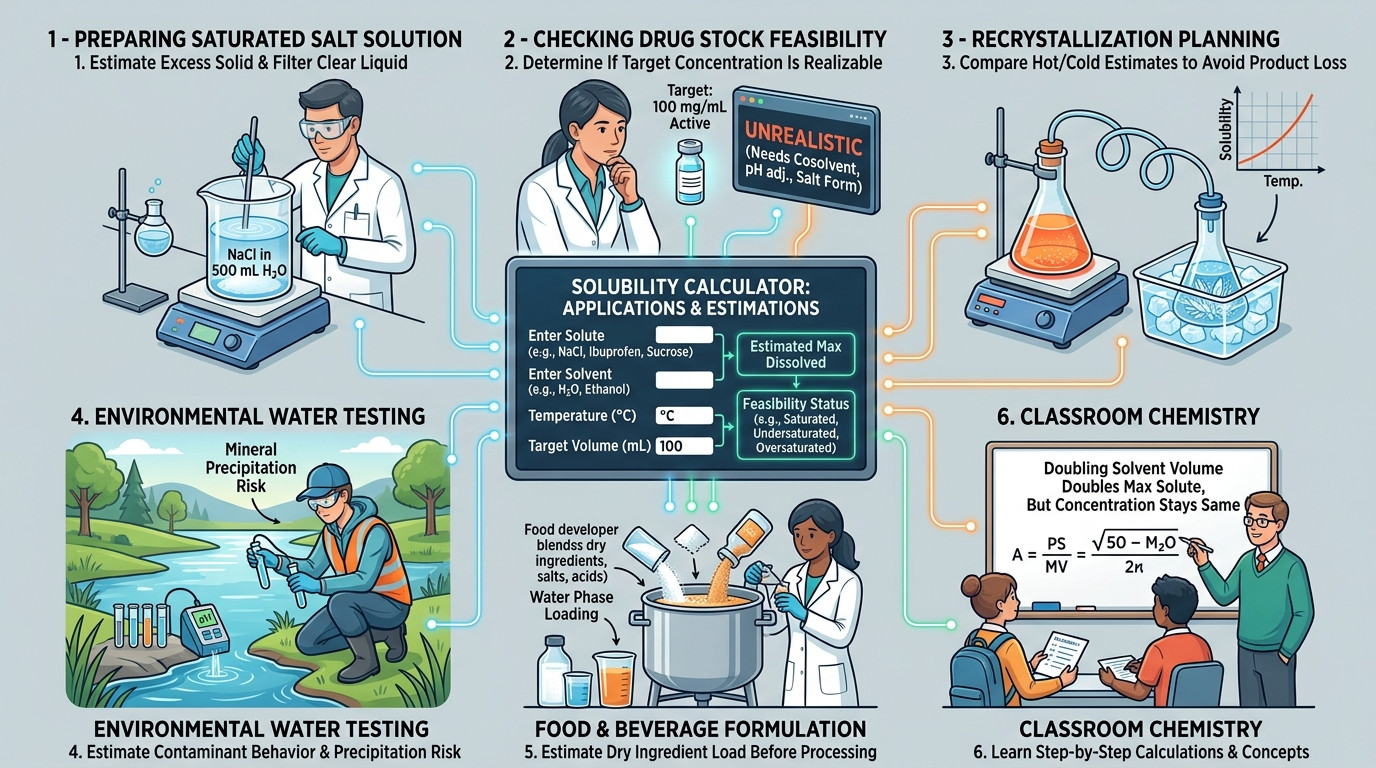
Scenario 1: Preparing a Saturated Salt Solution
A technician wants to prepare a saturated sodium chloride solution in 500 mL of water. A Solubility Calculator scales the solubility value from the table and estimates the mass that can dissolve. The technician can add a small excess solid, mix at controlled temperature, and decant or filter the clear saturated liquid after equilibrium.
Scenario 2: Checking Whether a Drug Stock Is Feasible
A formulation scientist may need 100 mg/mL of an active ingredient, but literature solubility may be far lower in water. A Solubility Calculator quickly shows that the target concentration is unrealistic without a cosolvent, pH adjustment, salt form, surfactant, or different route of preparation.
Scenario 3: Recrystallization Planning
In recrystallization, solubility is high in hot solvent and low in cold solvent. A Solubility Calculator can compare hot and cold solubility estimates to predict how much product may remain dissolved after cooling. This helps choose solvent volume and avoid losing too much product in the mother liquor.
Scenario 4: Environmental Water Testing
When evaluating mineral precipitation or contaminant behavior, a Solubility Calculator helps estimate whether a reported amount exceeds the water capacity under assumed conditions. Real environmental samples also require pH, complexation, suspended solids, temperature data, and analytical confirmation.
Scenario 5: Food and Beverage Formulation
Sugar, salts, acids, flavors, preservatives, and stabilizers all have practical solubility limits. A Solubility Calculator helps developers estimate whether a dry ingredient load can dissolve in the water phase before heating, blending, filtration, packaging, or changing syrup concentration.
Scenario 6: Classroom Chemistry
Students often confuse grams of solute with grams per 100 mL solvent. A Solubility Calculator gives step-by-step calculations so learners can see why doubling solvent volume doubles the maximum amount that can dissolve, while concentration at saturation stays based on the original solubility value.
Common Solubility Calculation Mistakes
Mistake 1: Ignoring Temperature
The most common error is using a room-temperature solubility value for hot or cold preparation. A Solubility Calculator can scale volume and mass, but it cannot make a 20°C table value valid at 80°C unless the underlying data support that change.
Mistake 2: Confusing Solvent Volume with Final Solution Volume
Some tables report g per 100 mL solvent, while a stock solution target may be g per final solution volume. A Solubility Calculator should be used with the same reference basis as the data source. If the basis changes, density or final volume measurement may be needed.
Mistake 3: Treating Slow Dissolution as Insolubility
A compound may dissolve slowly because of particle size, poor wetting, viscosity, or inadequate mixing. A Solubility Calculator estimates equilibrium capacity, not the time required to reach equilibrium. Grinding, heating, stirring, or changing addition order may affect practical preparation.
Mistake 4: Forgetting Chemical Reactions
Solubility can change when a solute reacts with acid, base, buffer, metal ions, or complexing agents. A Solubility Calculator assumes the solute remains the same chemical form unless the Ksp or formulation model accounts for reaction chemistry.
Mistake 5: Trusting Rough Estimates for Regulated Products
A Solubility Calculator is useful for planning, but pharmaceutical, clinical, food, and industrial specifications require validated procedures and analytical confirmation. Do not use an estimated solubility as a release test or stability claim.
💡 Rule of Thumb: calculate first, then verify by observation, filtration, assay, and temperature control. The Solubility Calculator removes arithmetic uncertainty, but material behavior still needs chemistry judgment.
Safety, Handling & Quality Essentials
Safety: Some solubility work involves acids, bases, solvents, oxidizers, salts, drugs, allergens, toxic metals, dusts, or pressurized gases. The Solubility Calculator provides math only. Follow SDS guidance, PPE requirements, ventilation rules, waste disposal instructions, and institutional SOPs.
- Review the SDS before weighing, dissolving, heating, or filtering any chemical.
- Use compatible containers because some solvents attack plastics or seals.
- Control temperature when solubility data are temperature-specific.
- Prevent dust exposure when handling powders with respiratory or sensitization hazards.
- Avoid sealed heating unless the vessel is rated for pressure.
- Label solutions with solute, solvent, concentration, date, hazard, and preparer.
A Solubility Calculator can make a preparation plan clearer, but safe practice starts before calculation. Choose the correct balance, spatula, solvent bottle, container, stirrer, temperature probe, and waste container. If the solute is reactive, hygroscopic, volatile, light sensitive, or controlled, prepare the workspace according to your approved method rather than improvising at the bench.
Which Mode Fits Your Workflow
| Mode | Use Case | Key Formula | Inputs | Output |
|---|---|---|---|---|
| Mass Soluble | Find maximum dissolved mass | S × V ÷ 100 | solubility, solvent volume | maximum grams |
| Solvent Needed | Dissolve target mass | mass × 100 ÷ S | mass, solubility, margin | recommended solvent |
| Percent Saturation | Check undissolved excess | added ÷ capacity × 100 | added mass, volume, solubility | saturation percentage |
| Ksp Solubility | Estimate ionic molar solubility | Ksp = (xs)x(ys)y | Ksp, stoichiometry | molar solubility |
| Temp Estimate | Rough temperature adjustment | base × (1 + coeff × ΔT) | base value, coefficient, ΔT | estimated solubility |
Solids in Water
For routine aqueous work, a Solubility Calculator is often used with g/100 mL or mg/mL data. This is practical for salts, sugars, buffers, and many laboratory reagents. Water temperature should be recorded because a handbook value at 25°C can differ from actual room conditions or heated preparation.
Organic Solvents and Cosolvents
Organic solvent systems may not behave like water-only systems. A Solubility Calculator can still scale a measured solubility value, but cosolvent percentage, polarity, viscosity, and evaporation risk become important. When a formulation uses ethanol, DMSO, PEG, propylene glycol, or surfactant, use data from that exact solvent mixture if available.
Sparingly Soluble Salts
Ksp mode is useful for conceptual chemistry and quick checks. A Solubility Calculator converts the Ksp expression into molar solubility for simple stoichiometries. Real samples may differ because common ions suppress solubility, complex ligands increase solubility, and activity coefficients change at higher ionic strength.
Crystallization and Precipitation
Crystallization planning compares hot and cold solubility. The Solubility Calculator can estimate dissolved amount at each condition, and the difference indicates possible crystal recovery. Supersaturation, nucleation, seed crystals, impurities, and cooling rate control the actual outcome.
Quality Control and Documentation
For controlled processes, record the source of solubility data, temperature, solvent identity, lot number, and calculation. A Solubility Calculator output can be pasted into a batch note, but final acceptance should come from observation, assay, filtration clarity, or validated quality checks.
Advanced Guide to Solubility Planning
Unit Basis
A Solubility Calculator supports unit basis decisions, but it should be paired with observation and source data. Unit Basis affects solubility work because the number entered into a tool is only one part of the real preparation. The user should record the solvent identity, temperature, material form, concentration basis, mixing time, and any filtration step. When the preparation is important, compare the calculated expectation with what is actually seen in the vessel: clear liquid, haze, crystals, floating particles, color change, or heat release. Good records make the next preparation faster and reduce repeated troubleshooting. If the solution will be stored, label the container with concentration, date, hazard, storage condition, and whether warming or mixing is required before use.
Temperature Control
A Solubility Calculator supports temperature control decisions, but it should be paired with observation and source data. Temperature Control affects solubility work because the number entered into a tool is only one part of the real preparation. The user should record the solvent identity, temperature, material form, concentration basis, mixing time, and any filtration step. When the preparation is important, compare the calculated expectation with what is actually seen in the vessel: clear liquid, haze, crystals, floating particles, color change, or heat release. Good records make the next preparation faster and reduce repeated troubleshooting. If the solution will be stored, label the container with concentration, date, hazard, storage condition, and whether warming or mixing is required before use.
Mixing Time
A Solubility Calculator supports mixing time decisions, but it should be paired with observation and source data. Mixing Time affects solubility work because the number entered into a tool is only one part of the real preparation. The user should record the solvent identity, temperature, material form, concentration basis, mixing time, and any filtration step. When the preparation is important, compare the calculated expectation with what is actually seen in the vessel: clear liquid, haze, crystals, floating particles, color change, or heat release. Good records make the next preparation faster and reduce repeated troubleshooting. If the solution will be stored, label the container with concentration, date, hazard, storage condition, and whether warming or mixing is required before use.
Particle Size
A Solubility Calculator supports particle size decisions, but it should be paired with observation and source data. Particle Size affects solubility work because the number entered into a tool is only one part of the real preparation. The user should record the solvent identity, temperature, material form, concentration basis, mixing time, and any filtration step. When the preparation is important, compare the calculated expectation with what is actually seen in the vessel: clear liquid, haze, crystals, floating particles, color change, or heat release. Good records make the next preparation faster and reduce repeated troubleshooting. If the solution will be stored, label the container with concentration, date, hazard, storage condition, and whether warming or mixing is required before use.
Purity and Hydrate Form
A Solubility Calculator supports purity and hydrate form decisions, but it should be paired with observation and source data. Purity and Hydrate Form affects solubility work because the number entered into a tool is only one part of the real preparation. The user should record the solvent identity, temperature, material form, concentration basis, mixing time, and any filtration step. When the preparation is important, compare the calculated expectation with what is actually seen in the vessel: clear liquid, haze, crystals, floating particles, color change, or heat release. Good records make the next preparation faster and reduce repeated troubleshooting. If the solution will be stored, label the container with concentration, date, hazard, storage condition, and whether warming or mixing is required before use.
pH Effects
A Solubility Calculator supports ph effects decisions, but it should be paired with observation and source data. pH Effects affects solubility work because the number entered into a tool is only one part of the real preparation. The user should record the solvent identity, temperature, material form, concentration basis, mixing time, and any filtration step. When the preparation is important, compare the calculated expectation with what is actually seen in the vessel: clear liquid, haze, crystals, floating particles, color change, or heat release. Good records make the next preparation faster and reduce repeated troubleshooting. If the solution will be stored, label the container with concentration, date, hazard, storage condition, and whether warming or mixing is required before use.
Common Ion Effect
A Solubility Calculator supports common ion effect decisions, but it should be paired with observation and source data. Common Ion Effect affects solubility work because the number entered into a tool is only one part of the real preparation. The user should record the solvent identity, temperature, material form, concentration basis, mixing time, and any filtration step. When the preparation is important, compare the calculated expectation with what is actually seen in the vessel: clear liquid, haze, crystals, floating particles, color change, or heat release. Good records make the next preparation faster and reduce repeated troubleshooting. If the solution will be stored, label the container with concentration, date, hazard, storage condition, and whether warming or mixing is required before use.
Complexation
A Solubility Calculator supports complexation decisions, but it should be paired with observation and source data. Complexation affects solubility work because the number entered into a tool is only one part of the real preparation. The user should record the solvent identity, temperature, material form, concentration basis, mixing time, and any filtration step. When the preparation is important, compare the calculated expectation with what is actually seen in the vessel: clear liquid, haze, crystals, floating particles, color change, or heat release. Good records make the next preparation faster and reduce repeated troubleshooting. If the solution will be stored, label the container with concentration, date, hazard, storage condition, and whether warming or mixing is required before use.
Ionic Strength
A Solubility Calculator supports ionic strength decisions, but it should be paired with observation and source data. Ionic Strength affects solubility work because the number entered into a tool is only one part of the real preparation. The user should record the solvent identity, temperature, material form, concentration basis, mixing time, and any filtration step. When the preparation is important, compare the calculated expectation with what is actually seen in the vessel: clear liquid, haze, crystals, floating particles, color change, or heat release. Good records make the next preparation faster and reduce repeated troubleshooting. If the solution will be stored, label the container with concentration, date, hazard, storage condition, and whether warming or mixing is required before use.
Cosolvent Systems
A Solubility Calculator supports cosolvent systems decisions, but it should be paired with observation and source data. Cosolvent Systems affects solubility work because the number entered into a tool is only one part of the real preparation. The user should record the solvent identity, temperature, material form, concentration basis, mixing time, and any filtration step. When the preparation is important, compare the calculated expectation with what is actually seen in the vessel: clear liquid, haze, crystals, floating particles, color change, or heat release. Good records make the next preparation faster and reduce repeated troubleshooting. If the solution will be stored, label the container with concentration, date, hazard, storage condition, and whether warming or mixing is required before use.
Surfactants
A Solubility Calculator supports surfactants decisions, but it should be paired with observation and source data. Surfactants affects solubility work because the number entered into a tool is only one part of the real preparation. The user should record the solvent identity, temperature, material form, concentration basis, mixing time, and any filtration step. When the preparation is important, compare the calculated expectation with what is actually seen in the vessel: clear liquid, haze, crystals, floating particles, color change, or heat release. Good records make the next preparation faster and reduce repeated troubleshooting. If the solution will be stored, label the container with concentration, date, hazard, storage condition, and whether warming or mixing is required before use.
Gas Solubility
A Solubility Calculator supports gas solubility decisions, but it should be paired with observation and source data. Gas Solubility affects solubility work because the number entered into a tool is only one part of the real preparation. The user should record the solvent identity, temperature, material form, concentration basis, mixing time, and any filtration step. When the preparation is important, compare the calculated expectation with what is actually seen in the vessel: clear liquid, haze, crystals, floating particles, color change, or heat release. Good records make the next preparation faster and reduce repeated troubleshooting. If the solution will be stored, label the container with concentration, date, hazard, storage condition, and whether warming or mixing is required before use.
Supersaturation
A Solubility Calculator supports supersaturation decisions, but it should be paired with observation and source data. Supersaturation affects solubility work because the number entered into a tool is only one part of the real preparation. The user should record the solvent identity, temperature, material form, concentration basis, mixing time, and any filtration step. When the preparation is important, compare the calculated expectation with what is actually seen in the vessel: clear liquid, haze, crystals, floating particles, color change, or heat release. Good records make the next preparation faster and reduce repeated troubleshooting. If the solution will be stored, label the container with concentration, date, hazard, storage condition, and whether warming or mixing is required before use.
Filtration
A Solubility Calculator supports filtration decisions, but it should be paired with observation and source data. Filtration affects solubility work because the number entered into a tool is only one part of the real preparation. The user should record the solvent identity, temperature, material form, concentration basis, mixing time, and any filtration step. When the preparation is important, compare the calculated expectation with what is actually seen in the vessel: clear liquid, haze, crystals, floating particles, color change, or heat release. Good records make the next preparation faster and reduce repeated troubleshooting. If the solution will be stored, label the container with concentration, date, hazard, storage condition, and whether warming or mixing is required before use.
Evaporation
A Solubility Calculator supports evaporation decisions, but it should be paired with observation and source data. Evaporation affects solubility work because the number entered into a tool is only one part of the real preparation. The user should record the solvent identity, temperature, material form, concentration basis, mixing time, and any filtration step. When the preparation is important, compare the calculated expectation with what is actually seen in the vessel: clear liquid, haze, crystals, floating particles, color change, or heat release. Good records make the next preparation faster and reduce repeated troubleshooting. If the solution will be stored, label the container with concentration, date, hazard, storage condition, and whether warming or mixing is required before use.
Density
A Solubility Calculator supports density decisions, but it should be paired with observation and source data. Density affects solubility work because the number entered into a tool is only one part of the real preparation. The user should record the solvent identity, temperature, material form, concentration basis, mixing time, and any filtration step. When the preparation is important, compare the calculated expectation with what is actually seen in the vessel: clear liquid, haze, crystals, floating particles, color change, or heat release. Good records make the next preparation faster and reduce repeated troubleshooting. If the solution will be stored, label the container with concentration, date, hazard, storage condition, and whether warming or mixing is required before use.
Documentation
A Solubility Calculator supports documentation decisions, but it should be paired with observation and source data. Documentation affects solubility work because the number entered into a tool is only one part of the real preparation. The user should record the solvent identity, temperature, material form, concentration basis, mixing time, and any filtration step. When the preparation is important, compare the calculated expectation with what is actually seen in the vessel: clear liquid, haze, crystals, floating particles, color change, or heat release. Good records make the next preparation faster and reduce repeated troubleshooting. If the solution will be stored, label the container with concentration, date, hazard, storage condition, and whether warming or mixing is required before use.
Instrument Calibration
A Solubility Calculator supports instrument calibration decisions, but it should be paired with observation and source data. Instrument Calibration affects solubility work because the number entered into a tool is only one part of the real preparation. The user should record the solvent identity, temperature, material form, concentration basis, mixing time, and any filtration step. When the preparation is important, compare the calculated expectation with what is actually seen in the vessel: clear liquid, haze, crystals, floating particles, color change, or heat release. Good records make the next preparation faster and reduce repeated troubleshooting. If the solution will be stored, label the container with concentration, date, hazard, storage condition, and whether warming or mixing is required before use.
Storage
Storage affects solubility work because the number entered into a tool is only one part of the real preparation. The user should record the solvent identity, temperature, material form, concentration basis, mixing time, and any filtration step. When the preparation is important, compare the calculated expectation with what is actually seen in the vessel: clear liquid, haze, crystals, floating particles, color change, or heat release. Good records make the next preparation faster and reduce repeated troubleshooting. If the solution will be stored, label the container with concentration, date, hazard, storage condition, and whether warming or mixing is required before use.
Scale-Up
Scale-Up affects solubility work because the number entered into a tool is only one part of the real preparation. The user should record the solvent identity, temperature, material form, concentration basis, mixing time, and any filtration step. When the preparation is important, compare the calculated expectation with what is actually seen in the vessel: clear liquid, haze, crystals, floating particles, color change, or heat release. Good records make the next preparation faster and reduce repeated troubleshooting. If the solution will be stored, label the container with concentration, date, hazard, storage condition, and whether warming or mixing is required before use.
Teaching
Teaching affects solubility work because the number entered into a tool is only one part of the real preparation. The user should record the solvent identity, temperature, material form, concentration basis, mixing time, and any filtration step. When the preparation is important, compare the calculated expectation with what is actually seen in the vessel: clear liquid, haze, crystals, floating particles, color change, or heat release. Good records make the next preparation faster and reduce repeated troubleshooting. If the solution will be stored, label the container with concentration, date, hazard, storage condition, and whether warming or mixing is required before use.
Troubleshooting
Troubleshooting affects solubility work because the number entered into a tool is only one part of the real preparation. The user should record the solvent identity, temperature, material form, concentration basis, mixing time, and any filtration step. When the preparation is important, compare the calculated expectation with what is actually seen in the vessel: clear liquid, haze, crystals, floating particles, color change, or heat release. Good records make the next preparation faster and reduce repeated troubleshooting. If the solution will be stored, label the container with concentration, date, hazard, storage condition, and whether warming or mixing is required before use.
Regulated Use
Regulated Use affects solubility work because the number entered into a tool is only one part of the real preparation. The user should record the solvent identity, temperature, material form, concentration basis, mixing time, and any filtration step. When the preparation is important, compare the calculated expectation with what is actually seen in the vessel: clear liquid, haze, crystals, floating particles, color change, or heat release. Good records make the next preparation faster and reduce repeated troubleshooting. If the solution will be stored, label the container with concentration, date, hazard, storage condition, and whether warming or mixing is required before use.
Waste Planning
Waste Planning affects solubility work because the number entered into a tool is only one part of the real preparation. The user should record the solvent identity, temperature, material form, concentration basis, mixing time, and any filtration step. When the preparation is important, compare the calculated expectation with what is actually seen in the vessel: clear liquid, haze, crystals, floating particles, color change, or heat release. Good records make the next preparation faster and reduce repeated troubleshooting. If the solution will be stored, label the container with concentration, date, hazard, storage condition, and whether warming or mixing is required before use.
Communication
Communication affects solubility work because the number entered into a tool is only one part of the real preparation. The user should record the solvent identity, temperature, material form, concentration basis, mixing time, and any filtration step. When the preparation is important, compare the calculated expectation with what is actually seen in the vessel: clear liquid, haze, crystals, floating particles, color change, or heat release. Good records make the next preparation faster and reduce repeated troubleshooting. If the solution will be stored, label the container with concentration, date, hazard, storage condition, and whether warming or mixing is required before use.
Analytical Verification
Analytical Verification affects solubility work because the number entered into a tool is only one part of the real preparation. The user should record the solvent identity, temperature, material form, concentration basis, mixing time, and any filtration step. When the preparation is important, compare the calculated expectation with what is actually seen in the vessel: clear liquid, haze, crystals, floating particles, color change, or heat release. Good records make the next preparation faster and reduce repeated troubleshooting. If the solution will be stored, label the container with concentration, date, hazard, storage condition, and whether warming or mixing is required before use.
Polymorph Screening
Polymorph Screening affects solubility work because the number entered into a tool is only one part of the real preparation. The user should record the solvent identity, temperature, material form, concentration basis, mixing time, and any filtration step. When the preparation is important, compare the calculated expectation with what is actually seen in the vessel: clear liquid, haze, crystals, floating particles, color change, or heat release. Good records make the next preparation faster and reduce repeated troubleshooting. If the solution will be stored, label the container with concentration, date, hazard, storage condition, and whether warming or mixing is required before use.
Buffer Compatibility
Buffer Compatibility affects solubility work because the number entered into a tool is only one part of the real preparation. The user should record the solvent identity, temperature, material form, concentration basis, mixing time, and any filtration step. When the preparation is important, compare the calculated expectation with what is actually seen in the vessel: clear liquid, haze, crystals, floating particles, color change, or heat release. Good records make the next preparation faster and reduce repeated troubleshooting. If the solution will be stored, label the container with concentration, date, hazard, storage condition, and whether warming or mixing is required before use.
Solvent Quality
Solvent Quality affects solubility work because the number entered into a tool is only one part of the real preparation. The user should record the solvent identity, temperature, material form, concentration basis, mixing time, and any filtration step. When the preparation is important, compare the calculated expectation with what is actually seen in the vessel: clear liquid, haze, crystals, floating particles, color change, or heat release. Good records make the next preparation faster and reduce repeated troubleshooting. If the solution will be stored, label the container with concentration, date, hazard, storage condition, and whether warming or mixing is required before use.
Batch Reproducibility
Batch Reproducibility affects solubility work because the number entered into a tool is only one part of the real preparation. The user should record the solvent identity, temperature, material form, concentration basis, mixing time, and any filtration step. When the preparation is important, compare the calculated expectation with what is actually seen in the vessel: clear liquid, haze, crystals, floating particles, color change, or heat release. Good records make the next preparation faster and reduce repeated troubleshooting. If the solution will be stored, label the container with concentration, date, hazard, storage condition, and whether warming or mixing is required before use.
A Solubility Calculator should therefore be seen as a bridge between handbook data and bench practice. It gives the first number, but the final decision depends on measured clarity, temperature control, chemical compatibility, storage behavior, and the purpose of the solution.
Complete Reference Guide for Solubility Planning
The Solubility Calculator is valuable for data source because the calculation turns a general solubility statement into a practical decision. A user can estimate maximum dissolved mass, required solvent, saturation level, or molar solubility before committing material. The preparation should still be checked against the actual solvent, temperature, pH, material grade, and purpose. If results will be shared, write the arithmetic in plain language so another person can follow the assumption and repeat the method without guessing.
The Solubility Calculator is valuable for problem type because the calculation turns a general solubility statement into a practical decision. A user can estimate maximum dissolved mass, required solvent, saturation level, or molar solubility before committing material. The preparation should still be checked against the actual solvent, temperature, pH, material grade, and purpose. If results will be shared, write the arithmetic in plain language so another person can follow the assumption and repeat the method without guessing.
The Solubility Calculator is valuable for stock solution planning because the calculation turns a general solubility statement into a practical decision. A user can estimate maximum dissolved mass, required solvent, saturation level, or molar solubility before committing material. The preparation should still be checked against the actual solvent, temperature, pH, material grade, and purpose. If results will be shared, write the arithmetic in plain language so another person can follow the assumption and repeat the method without guessing.
The Solubility Calculator is valuable for solvent margin because the calculation turns a general solubility statement into a practical decision. A user can estimate maximum dissolved mass, required solvent, saturation level, or molar solubility before committing material. The preparation should still be checked against the actual solvent, temperature, pH, material grade, and purpose. If results will be shared, write the arithmetic in plain language so another person can follow the assumption and repeat the method without guessing.
The Solubility Calculator is valuable for temperature-specific values because the calculation turns a general solubility statement into a practical decision. A user can estimate maximum dissolved mass, required solvent, saturation level, or molar solubility before committing material. The preparation should still be checked against the actual solvent, temperature, pH, material grade, and purpose. If results will be shared, write the arithmetic in plain language so another person can follow the assumption and repeat the method without guessing.
The Solubility Calculator is valuable for Ksp interpretation because the calculation turns a general solubility statement into a practical decision. A user can estimate maximum dissolved mass, required solvent, saturation level, or molar solubility before committing material. The preparation should still be checked against the actual solvent, temperature, pH, material grade, and purpose. If results will be shared, write the arithmetic in plain language so another person can follow the assumption and repeat the method without guessing.
The Solubility Calculator is valuable for sample matrices because the calculation turns a general solubility statement into a practical decision. A user can estimate maximum dissolved mass, required solvent, saturation level, or molar solubility before committing material. The preparation should still be checked against the actual solvent, temperature, pH, material grade, and purpose. If results will be shared, write the arithmetic in plain language so another person can follow the assumption and repeat the method without guessing.
The Solubility Calculator is valuable for pharmaceutical formulation because the calculation turns a general solubility statement into a practical decision. A user can estimate maximum dissolved mass, required solvent, saturation level, or molar solubility before committing material. The preparation should still be checked against the actual solvent, temperature, pH, material grade, and purpose. If results will be shared, write the arithmetic in plain language so another person can follow the assumption and repeat the method without guessing.
The Solubility Calculator is valuable for food formulation because the calculation turns a general solubility statement into a practical decision. A user can estimate maximum dissolved mass, required solvent, saturation level, or molar solubility before committing material. The preparation should still be checked against the actual solvent, temperature, pH, material grade, and purpose. If results will be shared, write the arithmetic in plain language so another person can follow the assumption and repeat the method without guessing.
The Solubility Calculator is valuable for environmental chemistry because the calculation turns a general solubility statement into a practical decision. A user can estimate maximum dissolved mass, required solvent, saturation level, or molar solubility before committing material. The preparation should still be checked against the actual solvent, temperature, pH, material grade, and purpose. If results will be shared, write the arithmetic in plain language so another person can follow the assumption and repeat the method without guessing.
For education and training, the calculation turns a general solubility statement into a practical decision. A user can estimate maximum dissolved mass, required solvent, saturation level, or molar solubility before committing material. The preparation should still be checked against the actual solvent, temperature, pH, material grade, and purpose. If results will be shared, write the arithmetic in plain language so another person can follow the assumption and repeat the method without guessing.
For documentation, the calculation turns a general solubility statement into a practical decision. A user can estimate maximum dissolved mass, required solvent, saturation level, or molar solubility before committing material. The preparation should still be checked against the actual solvent, temperature, pH, material grade, and purpose. If results will be shared, write the arithmetic in plain language so another person can follow the assumption and repeat the method without guessing.
For experimental verification, the calculation turns a general solubility statement into a practical decision. A user can estimate maximum dissolved mass, required solvent, saturation level, or molar solubility before committing material. The preparation should still be checked against the actual solvent, temperature, pH, material grade, and purpose. If results will be shared, write the arithmetic in plain language so another person can follow the assumption and repeat the method without guessing.
For storage review, the calculation turns a general solubility statement into a practical decision. A user can estimate maximum dissolved mass, required solvent, saturation level, or molar solubility before committing material. The preparation should still be checked against the actual solvent, temperature, pH, material grade, and purpose. If results will be shared, write the arithmetic in plain language so another person can follow the assumption and repeat the method without guessing.
For scale-up review, the calculation turns a general solubility statement into a practical decision. A user can estimate maximum dissolved mass, required solvent, saturation level, or molar solubility before committing material. The preparation should still be checked against the actual solvent, temperature, pH, material grade, and purpose. If results will be shared, write the arithmetic in plain language so another person can follow the assumption and repeat the method without guessing.
For final reporting, the calculation turns a general solubility statement into a practical decision. A user can estimate maximum dissolved mass, required solvent, saturation level, or molar solubility before committing material. The preparation should still be checked against the actual solvent, temperature, pH, material grade, and purpose. If results will be shared, write the arithmetic in plain language so another person can follow the assumption and repeat the method without guessing.
Frequently Asked Questions
1. What is a Solubility Calculator?
A Solubility Calculator estimates dissolved mass, solvent volume, percent saturation, Ksp molar solubility, or rough temperature-adjusted solubility from entered values.
2. How do I calculate maximum soluble mass?
Maximum soluble mass equals solubility multiplied by solvent volume and divided by the reference volume, usually 100 mL.
3. Can a Solubility Calculator replace a solubility table?
No. It scales and rearranges values, but accurate work still needs a reliable data source at the correct temperature and solvent condition.
4. Why does temperature matter?
Temperature changes molecular motion, crystal equilibrium, and gas solubility. A solution prepared hot may crystallize when cooled.
5. What does percent saturation mean?
Percent saturation compares added solute with the estimated maximum soluble mass. Above 100%, excess solid may remain after equilibrium.
6. How does Ksp mode work?
Ksp mode solves the equilibrium expression for molar solubility using the salt stoichiometry.
7. Is this Solubility Calculator free?
Yes. The Solubility Calculator is free and browser-based. Review submissions are saved to the WordPress site database through AJAX.
8. Why add solvent margin?
A margin covers practical uncertainty from temperature drift, wetting, transfer loss, slow dissolution, or small data differences.
Solubility Preparation Checklist
Before Calculation
During Preparation
After Preparation

Trusted Reference Resources
NIST Chemistry WebBook — NIST chemical data for physical property references.
PubChem — compound data for identifiers, properties, and literature links.
Supplier SDS and Certificates — Always verify safety, purity, hydrate form, and storage guidance from the material supplier.
Institutional SOPs — Use approved procedures for regulated products, clinical material, hazardous solvents, and validated assays.
User Reviews & Ratings
Share Your Experience with This solubility tool
Final Thoughts on Solubility Calculation
Solubility planning is a small calculation with a large effect on solution quality, reproducibility, storage stability, and safety. A solubility tool makes the arithmetic reliable by calculating maximum dissolved mass, solvent requirement, percent saturation, Ksp molar solubility, and rough temperature-adjusted values in one workflow.
Before final use, check that the solution is clear when it should be clear, labeled when it should be stored, and documented when another person will repeat the work. If a preparation is cloudy, crystallizing, warming unexpectedly, changing color, or producing gas, stop and investigate rather than assuming the arithmetic is wrong. The calculation is only one part of controlled chemistry practice.
Use the solubility tool before weighing valuable material or opening a solvent bottle. Confirm units, choose the correct mode, add practical solvent margin when needed, control temperature, and document the source of the solubility data. Careful planning turns solution preparation from guesswork into a repeatable process for laboratories, classrooms, formulation teams, water treatment projects, and quality-control workflows.
🔒 Review Storage Note: Calculations run in your browser. When you submit a review, the review is saved to the WordPress site database through the shortcode AJAX handler.