
Specific Gravity Calculator — Density, Hydrometer Correction, API Gravity, ABV & Unit Conversion
A Specific Gravity Calculator converts density into specific gravity, compares a liquid to water, corrects hydrometer readings for temperature, calculates API gravity for petroleum, estimates brewing ABV from original and final gravity, converts between Plato/Brix and SG, and reports practical density units. Specific gravity is dimensionless: SG = density of sample ÷ density of reference water. For most everyday liquid calculations, water is treated as 1.000 SG near the calibration temperature, but precision work should account for temperature and instrument calibration.
Key facts at a glance
- Core formula: specific gravity = sample density ÷ reference water density.
- Dimensionless value: SG has no unit, but it is often written as 1.000, 0.998, 1.050, etc.
- Water reference: water is approximately 1.000 at common hydrometer calibration temperatures.
- Brewing use: ABV ≈ (OG − FG) × 131.25 for typical beer and cider estimates.
- Petroleum use: API gravity = 141.5 ÷ SG at 60°F − 131.5.
- Best practice: record temperature, calibration temperature, sample type, and corrected SG.
📋 Table of Contents
▼
- What a Specific Gravity Calculator Does
- Specific Gravity Calculator — Advanced Tool
- How Specific Gravity Works
- Real Scenarios Where Specific Gravity Matters
- Common Specific Gravity Mistakes
- Safety and Measurement Essentials
- Which Mode Fits Your Problem
- Frequently Asked Questions
- Specific Gravity Measurement Checklist
- Trusted Reference Resources
- User Reviews & Ratings
What a Specific Gravity Calculator Does
A Specific Gravity Calculator turns density, hydrometer readings, brewing gravity readings, petroleum gravity, and concentration-style inputs into the numbers people actually use. Specific gravity is one of the most common comparison measurements in science, brewing, winemaking, petroleum testing, battery maintenance, urine screening, food processing, and industrial quality control. Instead of asking only “what is the density,” it asks “how dense is this sample compared with water under defined conditions?”
The basic calculation is simple: divide the density of the sample by the density of water at the reference condition. If a liquid has density 1.050 g/mL and water is treated as 1.000 g/mL, the SG is 1.050. If a liquid has density 0.850 g/mL, the SG is 0.850. A Specific Gravity Calculator becomes powerful when it adds the practical features users need: temperature correction, unit conversion, API gravity, Plato/Brix conversion, ABV from original and final gravity, apparent attenuation, density in kg/m³, lb/gal, g/mL, and a quality-control interpretation.
This page is designed for both beginners and advanced users. Students can use the Specific Gravity Calculator to understand density ratios. Brewers can correct hydrometer readings and estimate alcohol. Petroleum users can convert SG to API gravity. Lab technicians can document density and reference conditions. Home users can check whether a reading is plausible. The tool below is built to feel like a professional specific gravity workstation rather than a single one-line converter.
For SEO and clarity, this guide explains formulas, units, temperature effects, hydrometer calibration, common mistakes, worked examples, and industry-specific uses. The Specific Gravity Calculator is placed between the introductory content and the deeper reference sections so visitors can calculate first and then verify the method.
Specific Gravity Calculator
Calculate SG from density, correct hydrometer readings, convert API gravity, estimate brewing ABV, convert Plato/Brix, and generate a full unit report.
Calculation Result
Step-by-step working
How Specific Gravity Works
Specific gravity is a ratio that compares the density of a sample with the density of a reference substance. For liquids and solids, the reference is normally water. For gases, the reference may be air. A Specific Gravity Calculator usually focuses on liquids, where SG = sample density ÷ water density. Because both densities have the same unit, the unit cancels and the result is dimensionless.
A Specific Gravity Calculator is useful because SG is easier to interpret than raw density in many industries. If SG is 1.050, the sample is about 5% denser than water. If SG is 0.850, the sample is about 15% less dense than water. Brewers, petroleum analysts, battery technicians, food scientists, and laboratory users all rely on this comparison because it quickly communicates whether a liquid is heavier or lighter than water.
Density Ratio, Not a Unit
Specific gravity has no unit. It is a ratio. However, density units such as g/mL, kg/m³, and lb/gal can be calculated from SG if the reference water density is known. The Specific Gravity Calculator reports a unit summary so users can move between SG and practical density units without doing separate conversions.
Temperature and Calibration
Temperature changes liquid density. Hydrometers are calibrated at a specific temperature, often 20°C or 60°F. If the sample is warmer or cooler, the observed SG may need correction. The Specific Gravity Calculator includes an approximate hydrometer correction mode, but certified petroleum, pharmaceutical, and laboratory work should use the official correction table or instrument software required by the method.
Hydrometers, Digital Density Meters, and Pycnometers
A hydrometer floats at a level determined by liquid density. A digital density meter measures oscillation of a U-tube or similar sensor. A pycnometer measures mass of a known volume. A Specific Gravity Calculator can use data from any of these tools as long as the density, observed SG, or calibrated reading is available.
Industry-Specific Meanings
In brewing, SG tracks sugar conversion and fermentation. In petroleum, SG is often converted to API gravity. In battery testing, electrolyte SG indicates state of charge. In clinical screening, urine specific gravity indicates hydration and solute concentration. The same Specific Gravity Calculator formula supports all these uses, but interpretation depends on the sample type.
API gravity = 141.5 ÷ SG(60°F) − 131.5
SG from API = 141.5 ÷ (API + 131.5)
ABV estimate = (OG − FG) × 131.25
Plato approximation uses SG polynomial conversion
Quick Reference Values
Remember: the Specific Gravity Calculator gives a calculation, not a sample diagnosis. Always interpret SG using the correct industry method, temperature condition, and sample context.

Real Scenarios Where Specific Gravity Matters
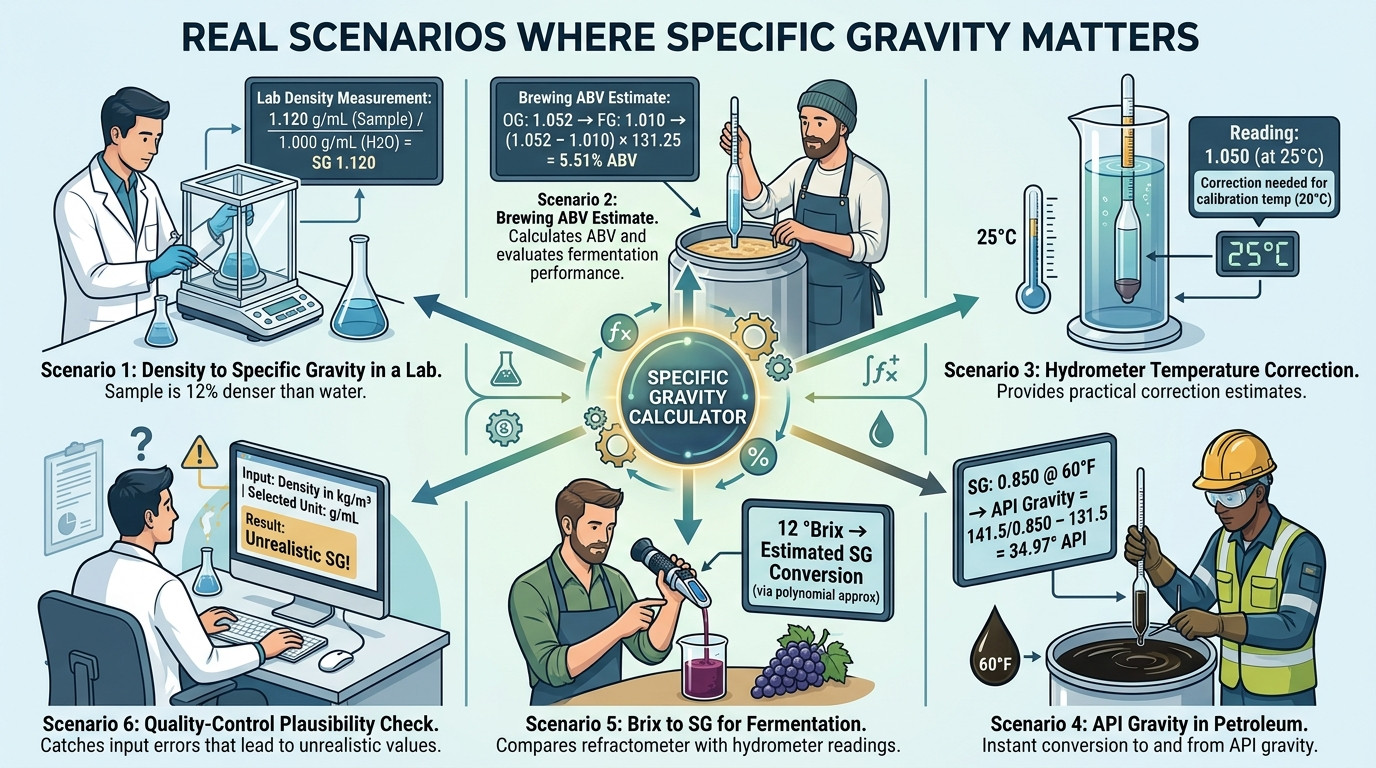
Scenario 1: Density to Specific Gravity in a Lab
A laboratory measures a liquid density of 1.120 g/mL. With water treated as 1.000 g/mL, the Specific Gravity Calculator returns SG = 1.120. The sample is 12% denser than water. If the method requires temperature-specific water density, the reference value can be adjusted.
Scenario 2: Brewing ABV Estimate
A brewer records original gravity 1.052 and final gravity 1.010. The Specific Gravity Calculator estimates ABV as (1.052 − 1.010) × 131.25 = 5.51%. It also reports apparent attenuation, helping the brewer evaluate fermentation performance.
Scenario 3: Hydrometer Temperature Correction
A hydrometer calibrated at 20°C reads 1.050 in a sample at 25°C. The reading should be corrected because the sample is warmer than calibration temperature. The Specific Gravity Calculator provides a practical correction estimate and reminds users to use official tables for certified work.
Scenario 4: API Gravity in Petroleum
A petroleum sample has SG 0.850 at 60°F. API gravity = 141.5/0.850 − 131.5 = 34.97°API. The Specific Gravity Calculator converts this instantly and provides the reverse conversion if API is known first.
Scenario 5: Brix to SG for Fermentation
A juice or wort sample is measured at 12 °Brix. The Specific Gravity Calculator estimates SG using a common polynomial approximation. This helps winemakers, cider makers, and brewers compare refractometer-style readings with hydrometer-style readings.
Scenario 6: Quality-Control Plausibility Check
A technician enters density in kg/m³ but accidentally selects g/mL. The result becomes unrealistic. The Specific Gravity Calculator interpretation and unit report make the error obvious, because SG would be far outside the expected range.
Common Specific Gravity Mistakes
Mistake 1: Treating Specific Gravity as a Unit
Specific gravity is dimensionless. Writing “SG units” is common informally, but scientifically SG is a ratio. A Specific Gravity Calculator can convert SG into density units when needed.
Mistake 2: Ignoring Temperature
Hydrometer readings depend on temperature. A reading at 30°C may not match the calibrated SG at 20°C. The Specific Gravity Calculator includes temperature correction for practical use.
Mistake 3: Using the Wrong Density Unit
1.050 g/mL, 1050 kg/m³, and 8.762 lb/gal can represent the same approximate density. Selecting the wrong unit can create huge errors.
Mistake 4: Confusing API Gravity and SG
Higher API gravity means lighter petroleum liquid, while higher SG means denser liquid. The relationship is inverse. Use the Specific Gravity Calculator API mode to avoid reversing the formula.
Mistake 5: Reading a Hydrometer Incorrectly
Meniscus, bubbles, foam, temperature, and insufficient sample depth can all distort hydrometer readings. Calculation cannot fix poor measurement technique.
Mistake 6: Applying Brewing ABV Formula Outside Its Range
The standard ABV formula is an estimate. Very high-gravity fermentations, spirits, or unusual sugar matrices may need specialized formulas or lab analysis.
💡 Rule of Thumb: record density unit, sample temperature, calibration temperature, and sample type. Then use the Specific Gravity Calculator to calculate and interpret SG.
Safety and Measurement Essentials
Safety: Specific gravity testing may involve acids, fuels, solvents, hot liquids, biological fluids, or pressurized samples. The Specific Gravity Calculator provides math only. Follow the SDS, lab SOP, and appropriate PPE requirements.
- Use eye protection when handling acids, bases, petroleum products, or unknown liquids.
- Use ventilation for fuels, solvents, alcohol vapours, or volatile chemicals.
- Avoid open flames around flammable samples.
- Clean hydrometers carefully because glass instruments can break and cause cuts.
- Use compatible containers for corrosive or solvent samples.
- Handle biological samples as potentially infectious when appropriate.
Which Mode Fits Your Problem
| Mode | Use Case | Key Formula | Inputs | Output |
|---|---|---|---|---|
| Density to SG | Convert measured density | SG = density/water | density, unit, reference density | SG and unit report |
| Hydrometer Correction | Correct observed reading | temperature factor | observed SG, sample temp, calibration temp | corrected SG |
| Brewing ABV | Estimate alcohol | (OG−FG)×131.25 | OG, FG, formula choice | ABV and attenuation |
| API Gravity | Petroleum conversion | API = 141.5/SG−131.5 | SG or API | API or SG |
| Brix/Plato Convert | Fermentation sugar estimate | polynomial approximation | Brix/Plato or SG | SG or °P |
Specific Gravity in Brewing
Brewers use original gravity, final gravity, apparent attenuation, and ABV to track fermentation. The Specific Gravity Calculator combines these in one mode so a brewer can quickly check whether fermentation is complete and estimate alcohol content.
Specific Gravity in Petroleum
Petroleum laboratories often report API gravity rather than SG. Lighter oils have higher API gravity. The Specific Gravity Calculator uses the standard API relationship at 60°F, making it useful for quick conversions and plausibility checks.
Specific Gravity in Clinical and Biological Contexts
Urine specific gravity is used as a hydration and concentration indicator. A Specific Gravity Calculator can explain the ratio, but clinical interpretation must be performed by qualified professionals using approved instruments and reference ranges.
Specific Gravity in Batteries
Lead-acid battery electrolyte SG changes with state of charge and temperature. The Specific Gravity Calculator can help with density understanding, but battery service requires proper acid-resistant PPE and manufacturer guidance.
Specific Gravity in Food and Beverage Quality
Syrups, juices, brines, sauces, and fermented products are often monitored by SG, Brix, or density. The Specific Gravity Calculator helps convert readings and identify whether values are plausible for a process specification.
Advanced Notes for Precision Work
A Specific Gravity Calculator is only as accurate as the inputs. Precision density work may require air buoyancy correction, exact water density at temperature, instrument calibration with certified reference materials, degassing, and controlled sample temperature. For regulated work, use the official method and treat this calculator as a planning or checking tool.
Temperature correction is especially important for hydrometers. Hydrometers are often calibrated at 20°C or 60°F, and the correction depends on liquid composition. The practical correction in the Specific Gravity Calculator is helpful for many aqueous readings, but alcohol, sugar, petroleum, and acid solutions may require specialized correction tables.
When converting Brix or Plato, remember that refractometers measure refractive index, not density directly. Before fermentation, Brix-to-SG approximations are useful. After fermentation begins, alcohol changes refractive index, so fermented-sample refractometer readings need alcohol correction. The Specific Gravity Calculator Brix/Plato mode is best for unfermented or general comparison readings unless a dedicated fermented refractometer correction is applied.
API gravity is defined around petroleum density at 60°F. A Specific Gravity Calculator can convert API and SG mathematically, but custody transfer, refinery, and laboratory reporting may require ASTM temperature corrections, density meter calibration, and official rounding rules.
For unusual liquids, SG interpretation depends on composition. Saltwater, sugar syrup, glycerol, acids, and heavy brines may all have SG above water, but the same SG does not imply the same chemistry. The Specific Gravity Calculator reports the physical ratio; chemical identity still requires separate analysis.
Worked Examples
Example 1 — Density: density = 1.250 g/mL, water = 1.000 g/mL. SG = 1.250. The liquid is 25% denser than water.
Example 2 — API: SG = 0.850. API = 141.5/0.850 − 131.5 = 34.97°API.
Example 3 — Brewing: OG 1.060, FG 1.012. ABV ≈ (1.060 − 1.012) × 131.25 = 6.30%.
Example 4 — Unit conversion: SG 1.050 corresponds to about 1.050 g/mL, 1050 kg/m³, and 8.7627 lb/US gal when water is treated as 1.000 g/mL.
Example 5 — Plato: 12 °P converts to approximately 1.048 SG using a common brewing approximation.
Frequently Asked Questions
1. What is a Specific Gravity Calculator?
A Specific Gravity Calculator calculates SG from density, corrects hydrometer readings, converts API gravity, estimates brewing ABV, and converts Brix or Plato values.
2. What is the formula for specific gravity?
Specific gravity = sample density ÷ reference water density. The result is dimensionless.
3. Is specific gravity the same as density?
No. Density has units such as g/mL or kg/m³. Specific gravity is a ratio compared with water and has no unit.
4. Why does temperature matter?
Liquid density changes with temperature. Hydrometers are calibrated at a specified temperature, so readings at other temperatures may need correction.
5. How do brewers use specific gravity?
Brewers measure original gravity before fermentation and final gravity after fermentation. The difference estimates alcohol content and attenuation.
6. How is API gravity related to SG?
API gravity = 141.5/SG − 131.5 at 60°F. Higher API means lighter petroleum liquid.
7. Can SG be below 1?
Yes. Liquids less dense than water, such as many oils and alcohols, have SG below 1.
8. Is this Specific Gravity Calculator free?
Yes. The Specific Gravity Calculator is free and browser-based. Review submissions are saved to the WordPress site database.
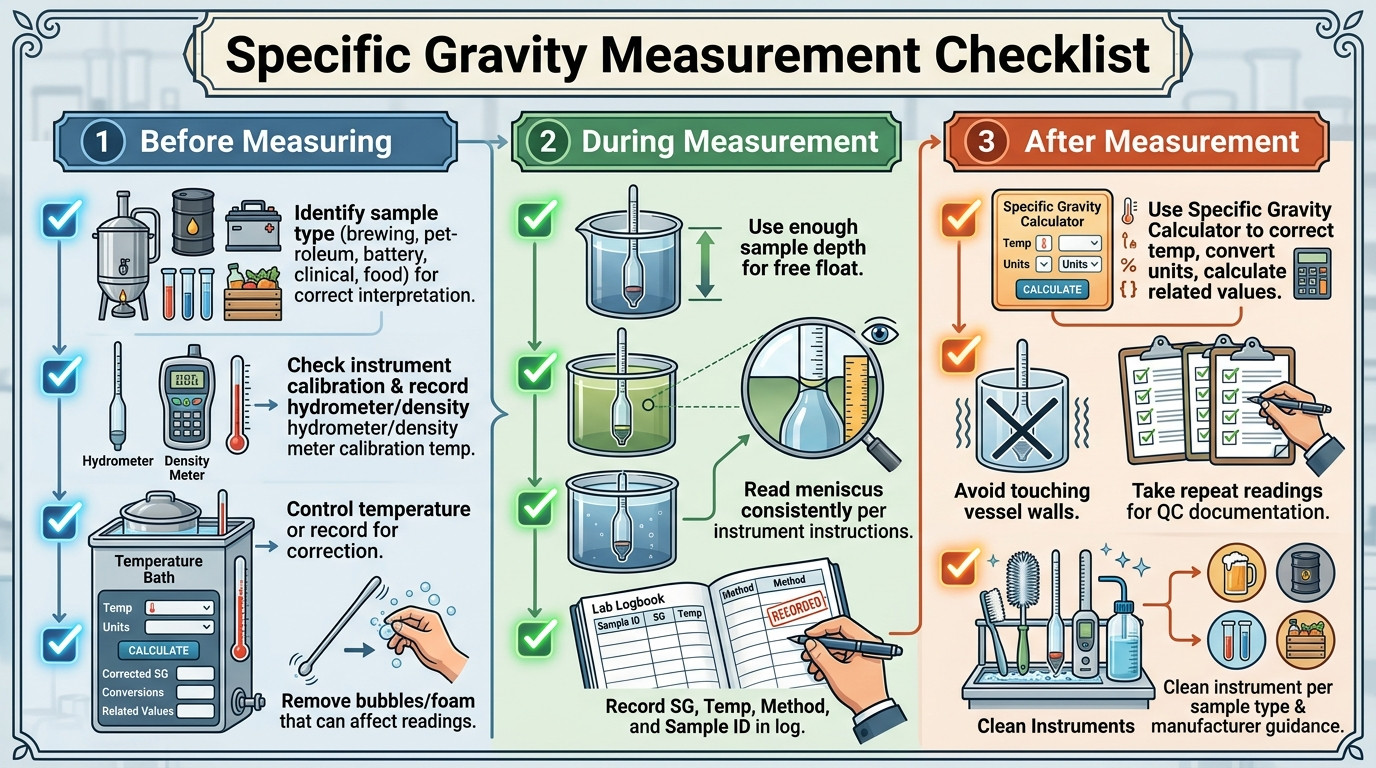
Specific Gravity Measurement Checklist
Before Measuring
During Measurement
After Measurement
Trusted Reference Resources
NIST Chemistry WebBook — NIST chemical reference data for density-related chemical properties and reliable reference information.
ASTM International Standards — ASTM test methods for petroleum density, API gravity, hydrometer methods, and laboratory measurement standards.
Brewers Association Resources — Brewing references for gravity, fermentation, and quality-control measurements.
Instrument Manufacturer Manuals — Always follow the hydrometer, refractometer, or density meter manual for calibration, cleaning, and correction tables.
User Reviews & Ratings
Share Your Experience with This Specific Gravity Calculator
Advanced Guide to Accurate Specific Gravity Results
A Specific Gravity Calculator can only be as accurate as the measurement entered into it. For high-quality results, begin by deciding which reference condition applies. Brewing hydrometers may be calibrated at 20°C, petroleum calculations often reference 60°F, and laboratory density meters may use a controlled temperature such as 20.00°C. A reading without temperature information is incomplete for precision work.
The next step is sample preparation. Degas carbonated samples, mix stratified liquids, filter particles if the method requires it, and avoid evaporation of volatile components. A Specific Gravity Calculator can correct and convert, but it cannot know whether a sample was foamy, warm, contaminated, or partially evaporated.
For hydrometers, choose the correct range. A narrow-range hydrometer gives better resolution than a broad-range instrument. If the stem scale is too coarse, the Specific Gravity Calculator may display more decimals than the measurement supports. Report results using realistic precision.
For density meters, calibration matters. Air and water checks, certified reference materials, cleaning cycles, and temperature stabilization all influence results. A Specific Gravity Calculator is useful for downstream conversions, but the density meter must be maintained according to the manufacturer’s instructions.
For brewing, remember that apparent attenuation is not the same as real attenuation because alcohol is less dense than water. The Specific Gravity Calculator provides practical brewing estimates, but commercial alcohol reporting may require distillation, density, spectroscopy, or approved lab methods.
For petroleum, API gravity is tied to standard temperature. The Specific Gravity Calculator converts the formula, but official reporting can require ASTM tables, hydrometer thermal expansion correction, and observed-to-standard density correction. Use the calculator as a fast check, not as a replacement for regulated reporting.
For batteries, temperature correction and safety are critical. Electrolyte SG can indicate state of charge, but acid stratification, recent charging, and temperature can mislead readings. A Specific Gravity Calculator helps with ratio understanding, while battery manufacturer guidance controls service decisions.
For clinical or biological fluids, do not diagnose from a calculator. Urine SG, for example, must be interpreted with patient context, instrument type, and clinical standards. A Specific Gravity Calculator can explain density ratio, but qualified healthcare interpretation is required.
For food and beverage manufacturing, SG is often part of a specification range. Syrups, brines, juices, and sauces may need temperature-controlled readings and calibration checks. The Specific Gravity Calculator can help operators convert values and recognize outliers before product is released.
For education, the greatest value of a Specific Gravity Calculator is conceptual clarity. Students can enter density values and immediately see why SG above 1 means denser than water and SG below 1 means less dense than water. They can also see why dimensionless ratios can still be connected to real density units.
When documenting results, include sample name, measurement method, observed reading, corrected SG, temperature, calibration temperature, and calculation mode. If a Specific Gravity Calculator is used for a report, copy the step-by-step output so another person can reproduce the calculation.
Finally, use the Specific Gravity Calculator consistently. Switching between mental approximations, old correction charts, and undocumented spreadsheets creates avoidable variation. A consistent tool and a consistent measurement procedure produce clearer, more defensible results.
Complete Reference Guide for Specific Gravity Interpretation
A Specific Gravity Calculator is most helpful when the user understands what the number means in the real sample system. Specific gravity is a comparison value, so it never exists completely alone. A reading of 1.020 may be normal for one sample and abnormal for another. A wort at 1.020 may be fermenting or finished depending on the original gravity and yeast. A urine sample at 1.020 may be within a common screening range but must be interpreted clinically. A brine at 1.020 may be far too weak for a process that expects a stronger salt solution. The ratio is universal, but the meaning is contextual.
For density-based calculations, start with the density unit. Many laboratory balances and pycnometers produce g/mL or g/cm³, while industrial references may use kg/m³. In the United States, some process and petroleum calculations use lb/US gal. The conversion is straightforward, but unit mistakes are common. A density of 1050 kg/m³ is approximately 1.050 g/mL, not 1050 g/mL. A clear unit report prevents this mistake because it shows equivalent density values next to the SG result.
Temperature is the second major context. Liquids expand when heated and contract when cooled, so density changes with temperature. Water also has a temperature-dependent density, and hydrometers float differently in warmer or cooler samples. A reading taken from a hot syrup pan, a warm fermenter, a cold cellar sample, or a petroleum sample in the field may not match the reference-temperature value. For everyday estimation, a practical correction is often enough. For official reporting, use the correction method required by the applicable standard.
Hydrometer users should pay attention to meniscus rules. Some hydrometers are read at the bottom of the meniscus; others, especially opaque liquids or certain petroleum methods, may be read differently according to the method. Foam and bubbles can lift the hydrometer and make SG appear higher than it is. Hydrometers can also cling to the cylinder wall if the sample tube is too narrow. Spinning the hydrometer gently can dislodge bubbles, but the reading should be taken only after the instrument settles freely.
Digital density meters reduce some reading errors but introduce other requirements. The measuring cell must be clean, dry or properly rinsed, free of bubbles, and temperature-stabilized. Sticky syrups, oily samples, salts, proteins, and suspended solids can contaminate the cell. If the instrument is not checked with water or reference material, the final SG may look precise while being biased. Precision on the display is not the same as accuracy in the method.
In brewing and fermentation, the specific gravity story changes over time. Before fermentation, sugars raise SG. As yeast converts sugar into ethanol and carbon dioxide, sugar decreases and ethanol increases. Ethanol is less dense than water, so final gravity can be much lower than the original gravity. Apparent attenuation uses this gravity drop to estimate fermentation progress. However, residual dextrins, fruit solids, acids, and alcohol all influence the reading, which is why advanced brewing work may combine hydrometer, refractometer, temperature correction, and lab alcohol methods.
Brix and Plato conversions are approximations unless the sample matrix is known. Brix originally relates to sucrose solutions. Plato is widely used in brewing for extract. A grape juice, sugar syrup, wort, or soft drink may behave similarly enough for a practical estimate before fermentation, but alcohol changes refractive index after fermentation begins. A refractometer reading from finished beer cannot be converted directly to true SG without alcohol correction. This is one reason the tool labels Brix/Plato outputs as approximations.
API gravity is another special system. Petroleum users often prefer API because it spreads out values for oils lighter than water and gives a familiar industry scale. Higher API means lighter oil, which is the opposite direction from SG. A crude oil with API 40 is lighter than a crude oil with API 20. Because API is defined relative to SG at 60°F, field readings normally require temperature correction before final reporting. The API mode is therefore ideal for quick conversion and plausibility checks, while official custody transfer depends on standardized tables and procedures.
Specific gravity is also used for battery electrolyte. In a flooded lead-acid battery, sulfuric acid concentration changes with state of charge, so electrolyte SG can indicate charge condition. But readings are affected by temperature, stratification, recent charging, water addition, and battery age. Battery acid is corrosive, so safety matters more than speed. Use eye protection, acid-resistant gloves, and manufacturer instructions. Never treat a calculator result as a substitute for safe battery service procedures.
In food processing, SG can help monitor sugar concentration, salt concentration, solids content, and batch consistency. Brines, syrups, sauces, juices, and concentrates may have target SG windows. If a batch is outside range, the cause may be incorrect ingredient addition, evaporation, dilution, temperature difference, or incomplete mixing. A calculation can identify the measured value, but process knowledge is needed to decide whether to adjust, rework, or reject the batch.
In clinical and biological settings, specific gravity is a screening or supporting measurement rather than a standalone conclusion. Urine SG, for example, can reflect hydration and dissolved solute concentration, but interpretation depends on patient history, medications, kidney function, and other lab results. Biological samples also require infection-control precautions. A calculator can explain the ratio, but diagnosis belongs to qualified healthcare professionals and validated clinical instruments.
For education, SG is an excellent way to teach proportional reasoning. Students can compare water, oil, syrup, saltwater, and alcohol and predict whether layers will form. If two immiscible liquids are placed together, the lower SG liquid often floats above the higher SG liquid. However, miscibility, temperature, and composition still matter. Oil may float on water because its SG is lower, while sugar syrup sinks because its SG is higher.
A useful quality-control habit is to define an expected range before measuring. If a sample is expected near 1.000 and the result is 10.00, the problem is almost certainly unit entry or instrument error. If a petroleum product expected near 0.80 appears as 1.20, check whether the sample was contaminated with water or whether the wrong conversion was applied. Expected ranges turn the calculator into a diagnostic check instead of a passive arithmetic tool.
Another practical habit is to document uncertainty. If a hydrometer scale is marked every 0.002 SG, reporting 1.05237 suggests a precision that the instrument cannot support. If a digital density meter is calibrated and temperature-controlled, more decimals may be justified. The final report should match the measurement method, not merely the number of decimals the calculation can display.
The Specific Gravity Calculator is designed to combine fast calculation with interpretation. It does not only return SG; it also reports density units, API where relevant, brewing estimates, and a plain-language interpretation. This helps users catch obvious mistakes, understand the meaning of the result, and choose the next action. The goal is not to replace a lab method but to make the math transparent and repeatable.
When using the Specific Gravity Calculator for official work, keep the original observations. Record observed hydrometer reading, sample temperature, calibration temperature, correction method, corrected SG, instrument ID, and analyst initials. If the calculation is later reviewed, the reviewer needs the raw reading and method conditions, not only the final value. Traceability is especially important in regulated labs, breweries, fuel testing, and manufacturing quality systems.
If a value seems impossible, repeat the measurement before changing the process. Clean the instrument, re-mix the sample, remove bubbles, verify units, and check temperature. Many unusual readings come from simple causes: wrong unit selection, hydrometer touching the wall, warm sample, air bubble in a density meter, or a sample that was not homogeneous. The Specific Gravity Calculator can highlight the outlier, but the user must investigate the measurement.
The Specific Gravity Calculator also helps communicate results between teams. A brewer may think in OG and FG, a lab analyst may think in g/mL, a petroleum technician may think in API, and a process engineer may think in kg/m³. A multi-output report reduces translation errors and makes the same sample understandable across roles.
For beginners, the easiest mental model is this: SG of 1.000 behaves like water for density comparison; SG above 1 is heavier than water; SG below 1 is lighter than water. The exact amount above or below 1 is the proportional density difference. An SG of 1.250 is about 25% denser than water. An SG of 0.750 is about 25% less dense than water. This simple interpretation makes the number intuitive before advanced corrections are considered.
The Specific Gravity Calculator can also support recipe adjustments, though it does not replace a full formulation model. If a syrup is too low in SG, solids may need to be added or water evaporated. If a brine is too high in SG, water may be added. But the relationship between SG and concentration is not always linear for complex mixtures. Sugar, salt, alcohol, acids, and suspended solids each affect density differently, so use product-specific tables for exact formulation.
For environmental and field work, ruggedness matters. Field hydrometers and portable density meters may face dust, temperature swings, vibration, and limited calibration resources. The Specific Gravity Calculator is useful for quick conversions in those conditions, but field notes should include limitations. If the result affects compliance or payment, confirm with the required standard method.
Finally, remember that specific gravity is a measurement bridge. It connects physics, chemistry, manufacturing, brewing, petroleum, batteries, and biology through one simple ratio. The Specific Gravity Calculator makes that bridge easier to use by combining density, temperature correction, API, ABV, Brix/Plato, and unit conversion in one advanced tool. Accurate input, correct context, and careful documentation turn the calculation into a reliable decision-support result.
Reporting Examples for Different Users
Different fields report SG in different ways. A brewing note may say, “OG 1.052 at 20°C, FG 1.010 at 20°C, estimated ABV 5.51%, apparent attenuation 80.8%.” That short line captures the important fermentation values and makes it clear that the readings were treated at the hydrometer calibration temperature. If the sample was read warm and corrected, the note should say “observed 1.049 at 27°C, corrected to 1.050.”
A laboratory density report may be more formal: “Sample A density 1.0472 g/mL at 20.0°C; reference water density 0.9982 g/mL; calculated SG 1.0491; method: digital density meter; instrument check passed with water before analysis.” This style is better for audits because it identifies the instrument, temperature, reference condition, and calculation basis. It also prevents a reviewer from wondering whether the analyst assumed water as exactly 1.000 or used a temperature-specific value.
A petroleum field note may state: “Observed density corrected to SG 0.8500 at 60°F; API gravity 34.97°API.” If this value affects custody transfer or pricing, the official method, temperature correction table, and instrument serial number should also be recorded. Quick calculator output is useful for a field estimate, but regulated documentation needs the method trail.
A food-production record may use a target range: “Batch 24-061: syrup SG 1.315 at 20°C; specification 1.310–1.320; result within range.” When a batch is outside range, the record should describe the corrective action. For example, “added measured water, mixed 10 minutes, rechecked SG 1.318.” In this context the number supports process control rather than a one-time conversion.
A battery service record should include temperature and safety context: “Cell 1 electrolyte SG 1.260 corrected to 25°C; cell 2 SG 1.255; cell 3 SG 1.180, investigate imbalance.” Because electrolyte is corrosive and battery readings depend on charging history, the record should also state whether the battery was rested, recently charged, or recently watered.
For teaching, a complete answer should include formula substitution. A student answer might show: “SG = density of sample / density of water = 1.20 g/mL / 1.00 g/mL = 1.20.” This makes the dimensionless nature of SG obvious. If the problem asks whether the sample floats on water, the answer should add: “Because SG is greater than 1, the sample is denser than water and would sink if immiscible.”
These examples show why the calculation and the report are not the same thing. The calculation produces a value. The report explains how the value was measured, corrected, interpreted, and used. Good reporting protects the result from being misunderstood later.
Instrument Care and Calibration Notes
Instrument care is part of measurement quality. Hydrometers should be stored upright or in protective cases, washed after use, and inspected for cracks, scale damage, or trapped residue. A small film of syrup, oil, or acid on the glass changes how the instrument floats and can shift the reading. Density meters should be cleaned with compatible solvents, checked for bubbles, and verified with reference liquids according to the manufacturer instructions.
Calibration checks should be scheduled, not improvised only when results look strange. Water checks are common, but water alone may not verify the full range needed for heavy syrups, light oils, or concentrated acids. If a process specification is tight, use reference materials close to the expected sample density. Record the check result before relying on production or lab measurements.
Sample containers should also be clean and suitable for the liquid. A solvent sample in the wrong plastic container may extract material or evaporate. A hot syrup in a cold cylinder may cool unevenly. A foamy fermenting sample may cling to the hydrometer stem. These practical details explain why two people can test the same batch and get different readings even when both calculations are mathematically correct.
When training staff, separate the workflow into measurement, correction, conversion, and interpretation. Measurement is the observed reading. Correction accounts for temperature or instrument calibration. Conversion changes SG into API, density units, ABV, or Brix/Plato. Interpretation compares the result with the sample’s expected range. This separation makes troubleshooting much easier.
Final Thoughts on Specific Gravity Calculation
Specific gravity is simple in definition but rich in application. A Specific Gravity Calculator can support density comparison, hydrometer correction, brewing ABV, petroleum API gravity, Brix/Plato conversion, and unit reporting in one workflow. That makes it useful for classrooms, breweries, laboratories, petroleum operations, battery service, food processing, and quality-control documentation.
The best results come from pairing the Specific Gravity Calculator with good measurement technique: calibrated instruments, controlled temperature, clean samples, correct units, and clear records. Use the calculator to reduce arithmetic errors, but use the correct professional method for regulated or safety-critical decisions.
🔒 Review Storage Note: Calculations run in your browser. When you submit a review, the review is saved to the WordPress site database through the shortcode AJAX handler.
Pingback: Brix Calculator – Calculate °Brix Instantly & Accurately
Pingback: Ratio Dilution Calculator – Calculate Exact Mixing Ratios Fast
Pingback: Essential Oil Dilution Calculator – Free Online Tool for Safe Blending
Pingback: Dilution Calculator mg/mL - Protein, Drug & Lab Solutions | Free
Pingback: PPM Calculator - Water Quality, Soil & Trace Analysis | Free Tool
Pingback: Serial Dilution Calculation Table – Step-by-Step Guide & Free Calculator
Pingback: How to Do a Dilution Calculation – Step-by-Step Guide & Free Calculator
Pingback: Mixing Ratio Calculator: Exact Volumes for Any Ratio (Free Tool)
Pingback: Sodium Hypochlorite Dilution Calculator | Free CDC Bleach Tool
Pingback: Neem Oil Dilution Ratio Calculator | Mix Neem Oil Correctly -
Pingback: Hydrogen Peroxide For Plants Dilution Calculator (3%, 12% & 34% for Root Rot)
Pingback: Isopropyl Alcohol Calculator | Calculate IPA Dilutions Instantly
Pingback: Pediatric Dose Calculator | Calculate Child Medication Doses
Pingback: Paint Thinner Calculator | Calculate Mixing Ratios Instantly
Pingback: ABV Calculator – Calculate Alcohol by Volume Instantly