
Stoichiometry Calculator — Mole Ratio, Limiting Reactant, Theoretical Yield & Percent Yield
A Stoichiometry Calculator converts a balanced chemical equation into practical mole, mass, limiting-reactant, theoretical-yield, and percent-yield calculations. Stoichiometry is based on mole ratios from the coefficients in a balanced equation. If a reaction is written as aA + bB → cC, then a moles of A react with b moles of B to form c moles of C. This Stoichiometry Calculator handles five common chemistry workflows: mole ratio conversion, grams-to-moles conversion, limiting reactant, theoretical yield, and percent yield. Enter your coefficients, molar masses, and quantities below to get a step-by-step answer.
Key facts at a glance
- Core idea: coefficients in a balanced equation are mole ratios, not gram ratios.
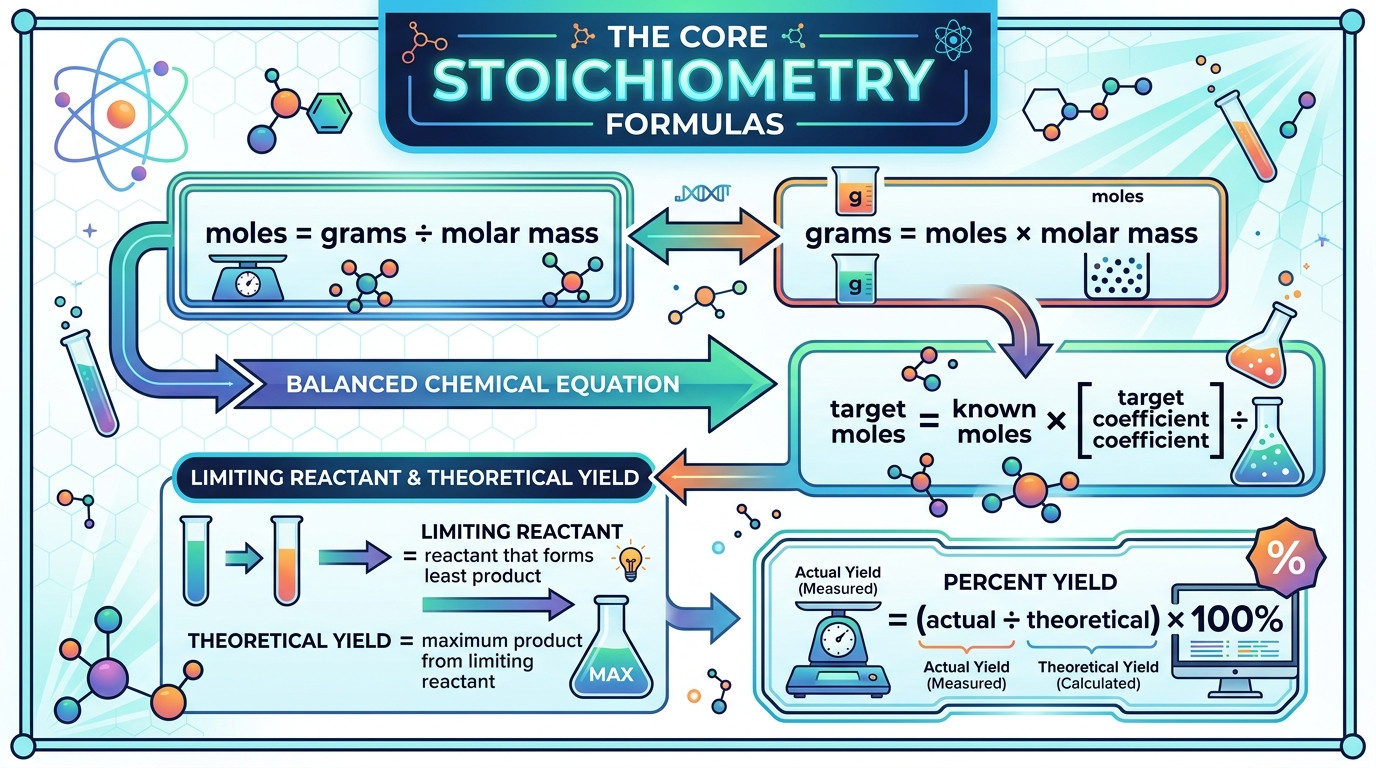
- Mass to moles: moles = grams ÷ molar mass.
- Moles to mass: grams = moles × molar mass.
- Limiting reactant: the reactant that produces the smallest amount of product.
- Theoretical yield: maximum product predicted from stoichiometry.
- Percent yield: actual yield ÷ theoretical yield × 100%.
📋 Table of Contents
▼
- What a Stoichiometry Calculator Does
- Stoichiometry Calculator — Five Modes
- How Stoichiometry Works
- Real Scenarios Where Stoichiometry Matters
- Common Stoichiometry Mistakes
- Chemistry Safety Essentials
- Which Mode Fits Your Problem
- Frequently Asked Questions
- Stoichiometry Problem Checklist
- Trusted Reference Resources
- User Reviews & Ratings
What a Stoichiometry Calculator Does
A Stoichiometry Calculator turns a balanced chemical equation into a complete quantitative reaction calculation. In chemistry, the balanced equation tells you how many moles of each substance react and how many moles of product form. The calculator then uses molar mass to move between grams and moles, compares reactants to identify the limiting reagent, and converts the maximum predicted product into theoretical yield.
The Stoichiometry Calculator is useful because many chemistry errors happen when students or technicians try to compare grams directly. Chemical equations compare moles, not grams. For example, 2H₂ + O₂ → 2H₂O means 2 moles of hydrogen react with 1 mole of oxygen to form 2 moles of water. It does not mean 2 grams of hydrogen react with 1 gram of oxygen. You must convert mass to moles first.
This tool is designed for high-school chemistry, college general chemistry, analytical chemistry, laboratory preparation, reaction planning, synthesis yield checks, and quality-control calculations. The Stoichiometry Calculator shows every step so the result can be copied into homework, a lab notebook, or an SOP calculation sheet.
Stoichiometry Calculator
Calculate mole ratios, grams to moles, limiting reactants, theoretical yield, and percent yield with clear step-by-step chemistry math.
Calculation Result
Step-by-step working
How Stoichiometry Works
Stoichiometry is the quantitative relationship between reactants and products in a chemical reaction. A Stoichiometry Calculator begins with a balanced chemical equation because the coefficients are the mole ratios that control the reaction. In the equation 2H₂ + O₂ → 2H₂O, two moles of hydrogen react with one mole of oxygen to form two moles of water. Every mole-ratio, limiting-reactant, and theoretical-yield calculation comes from those coefficients.
Balanced Equations Come First
A Stoichiometry Calculator assumes the equation is already balanced. If atoms are not balanced, the mole ratios are wrong and every answer after that is wrong. Balance atoms first, then use coefficients as conversion factors. Coefficients can be read as molecules, formula units, or moles, but lab calculations almost always use moles because grams can be converted into moles through molar mass.
Why Moles Matter
Chemical substances have different molar masses. One mole of water has a mass of about 18.015 g, while one mole of carbon dioxide has a mass of about 44.01 g. A Stoichiometry Calculator converts grams to moles so different substances can be compared using the balanced equation. After mole ratios are applied, the calculator converts moles back to grams when a mass yield is needed.
Limiting Reactant Logic
When more than one reactant quantity is given, the limiting reactant is the one that runs out first. The Stoichiometry Calculator determines this by calculating how much product each reactant could make if it reacted completely. The reactant that produces the smaller product amount is limiting. The other reactant is in excess.
Theoretical Yield and Percent Yield
Theoretical yield is the maximum amount of product predicted by the balanced equation. Actual yield is what is obtained in the real experiment. Percent yield compares the two: percent yield = actual yield ÷ theoretical yield × 100%. A Stoichiometry Calculator can compute theoretical yield from reactant mass and then calculate percent yield from actual product mass.
grams = moles × molar mass
limiting reactant = reactant that forms least product
theoretical yield = maximum product from limiting reactant
percent yield = actual ÷ theoretical × 100%
Quick Reference Values
Remember: the Stoichiometry Calculator does not balance equations automatically in this version. Enter coefficients from a correctly balanced equation, then let the tool handle mole ratios, masses, yields, and limiting-reactant comparisons.
Real Scenarios Where Stoichiometry Matters
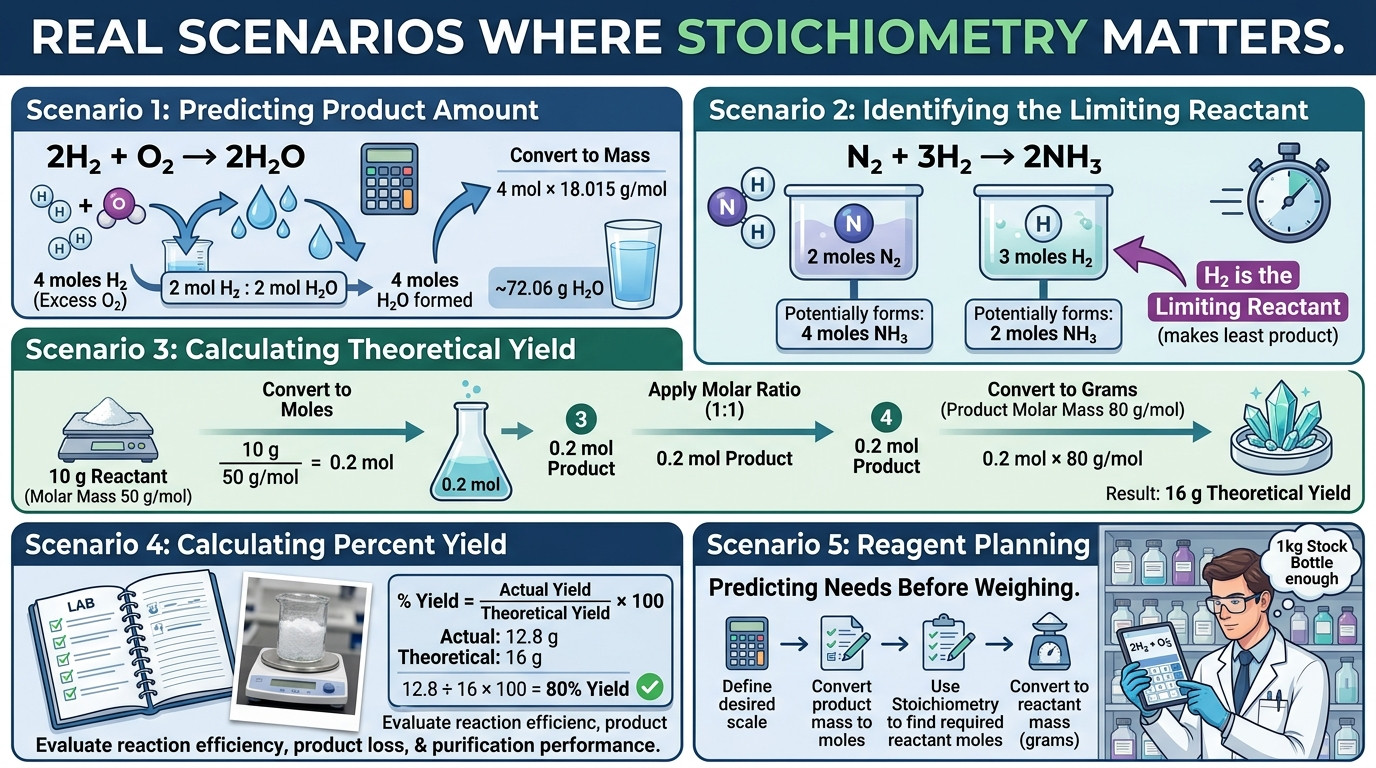
Scenario 1: Predicting Water Formation
For 2H₂ + O₂ → 2H₂O, a student has 4 moles of H₂ and enough oxygen. The Stoichiometry Calculator uses the ratio 2 mol H₂ to 2 mol H₂O, so 4 moles of H₂ can form 4 moles of water. Multiplying by 18.015 g/mol gives about 72.06 g H₂O.
Scenario 2: Identifying the Limiting Reactant
For N₂ + 3H₂ → 2NH₃, suppose 2 moles of N₂ and 3 moles of H₂ are available. Nitrogen could make 4 moles NH₃, but hydrogen could make only 2 moles NH₃. The Stoichiometry Calculator identifies H₂ as the limiting reactant.
Scenario 3: Calculating Theoretical Yield
A synthesis starts with 10 g of a reactant with molar mass 50 g/mol and a 1:1 product ratio. The reactant amount is 0.2 mol. If the product molar mass is 80 g/mol, theoretical yield is 16 g. The Stoichiometry Calculator shows each conversion.
Scenario 4: Percent Yield in a Lab Report
If the theoretical yield is 16 g but the actual isolated product is 12.8 g, percent yield is 12.8 ÷ 16 × 100 = 80%. This value helps evaluate reaction efficiency, product loss, side reactions, and purification performance.
Scenario 5: Reagent Planning
A chemist scaling a reaction must know whether a bottle contains enough reactant. The Stoichiometry Calculator converts grams to moles, applies coefficients, and estimates how much product could be formed before any chemicals are weighed.
Common Stoichiometry Mistakes
Mistake 1: Using an Unbalanced Equation
Stoichiometry depends on balanced coefficients. If the equation is not balanced, the mole ratio is wrong. Always balance first, then use the Stoichiometry Calculator.
Mistake 2: Comparing Grams Directly
Balanced equations compare moles, not grams. Convert each mass to moles before applying coefficient ratios.
Mistake 3: Forgetting Diatomic Elements
Hydrogen, nitrogen, oxygen, fluorine, chlorine, bromine, and iodine are often diatomic as elements: H₂, N₂, O₂, F₂, Cl₂, Br₂, I₂. Their molar masses must reflect the diatomic formula.
Mistake 4: Choosing the Larger Reactant as Limiting
The limiting reactant is not necessarily the reactant with fewer grams or fewer moles. It is the reactant that produces the least product after coefficients are considered.
Mistake 5: Confusing Theoretical and Actual Yield
Theoretical yield comes from stoichiometry. Actual yield comes from the experiment. Percent yield compares them.
💡 Rule of Thumb: Balance → convert grams to moles → use coefficient ratio → convert to requested units → check limiting reactant if multiple reactants are given.
Chemistry Safety Essentials
Safety: Stoichiometry calculations can involve hazardous reactants, products, gases, heat, pressure, or corrosive solutions. The Stoichiometry Calculator provides math only. Always consult the SDS, instructor, supervisor, or approved procedure before performing a reaction.
- Read safety data sheets before handling chemicals.
- Use appropriate PPE such as goggles, gloves, and lab coat.
- Work in a fume hood when volatile, toxic, odorous, or gas-producing chemicals are involved.
- Scale reactions cautiously because heat and gas evolution may increase with scale.
- Label all containers with chemical identity, concentration, hazards, and date.
- Dispose waste properly according to institutional rules.
Which Mode Fits Your Problem
| Mode | Use Case | Key Formula | Inputs | Output |
|---|---|---|---|---|
| Mole Ratio | Convert moles of one substance to another | moles × coefficient ratio | Known coefficient, known moles, target coefficient | Target moles |
| Grams ⇄ Moles | Convert mass and amount | moles = grams/mm | grams, molar mass, optional moles | moles or grams |
| Limiting Reactant | Compare two reactants | product from each reactant | reactant moles and coefficients | limiting reactant |
| Theoretical Yield | Predict product mass | mass → moles → ratio → mass | reactant mass, molar masses, coefficients | product grams |
| Percent Yield | Evaluate experiment | actual/theoretical × 100 | actual and theoretical yields | percent yield |
Stoichiometry in General Chemistry
In general chemistry, stoichiometry is the bridge between balanced equations and measurable quantities. The Stoichiometry Calculator helps students see why coefficients become mole ratios and why molar mass is needed for gram-based problems.
Stoichiometry in Laboratory Synthesis
In synthesis labs, stoichiometry determines how much reagent to weigh and how much product could form. A Stoichiometry Calculator is useful for planning scale, choosing limiting reactants, and estimating expected yield.
Stoichiometry in Quality Control
Quality-control labs use stoichiometry to verify assay reactions, titration factors, reagent equivalence, and expected product amounts. Clear step-by-step calculations reduce transcription and unit errors.
Worked Examples
Example 1 — Mole ratio: In 2H₂ + O₂ → 2H₂O, 3 mol O₂ produces 6 mol H₂O.
Example 2 — Grams to moles: 58.44 g NaCl ÷ 58.44 g/mol = 1.000 mol NaCl.
Example 3 — Limiting reactant: If A makes 0.8 mol product and B makes 0.6 mol product, B is limiting and theoretical product is 0.6 mol.
Example 4 — Theoretical yield: 0.25 mol product × 100 g/mol = 25 g product.
Example 5 — Percent yield: 18 g actual ÷ 20 g theoretical × 100 = 90%.
Frequently Asked Questions
1. What is a Stoichiometry Calculator?
A Stoichiometry Calculator uses balanced-equation coefficients to calculate mole ratios, limiting reactants, theoretical yield, and percent yield.
2. What is the first step in stoichiometry?
Balance the chemical equation. Stoichiometry depends on the coefficients in the balanced equation.
3. Why do I convert grams to moles?
Balanced equations compare moles. Grams must be converted to moles using molar mass before mole ratios can be applied.
4. How do I find the limiting reactant?
Calculate how much product each reactant can form. The reactant that forms the least product is the limiting reactant.
5. What is theoretical yield?
Theoretical yield is the maximum amount of product predicted by stoichiometry from the limiting reactant.
6. What is percent yield?
Percent yield is actual yield divided by theoretical yield, multiplied by 100%.
7. Can percent yield be over 100%?
It can happen in raw data, but it usually indicates impurities, wet product, measurement error, or an incorrect theoretical-yield calculation.
8. Is this Stoichiometry Calculator free?
Yes. The Stoichiometry Calculator is free and browser-based. Review submissions are saved to the WordPress site database.
Stoichiometry Problem Checklist
Before Calculating
During Calculation
After Calculating

Trusted Reference Resources
ChemLibreTexts Stoichiometry — General chemistry reference covering balanced equations, mole ratios, limiting reactants, and yields.
NIST Chemistry WebBook — NIST chemical data for reliable molecular information and thermochemical reference data.
OpenStax Chemistry — Free textbook chapters on chemical quantities, reaction stoichiometry, and limiting reactants.
Periodic Table Resources — Use current atomic weights to calculate molar masses accurately.
User Reviews & Ratings
Share Your Experience with This Stoichiometry Calculator
Final Thoughts on Stoichiometry Calculation
Stoichiometry is one of the most important skills in chemistry because it connects symbolic equations with real measurable amounts. A Stoichiometry Calculator makes the process easier by organizing the steps: balance the equation, convert mass to moles, apply coefficient ratios, identify limiting reactants, calculate theoretical yield, and compare actual yield with percent yield.
Use the Stoichiometry Calculator as a learning and checking tool, not as a substitute for understanding the balanced equation. When the coefficients, molar masses, and units are correct, the calculator can save time and prevent common arithmetic errors in homework, lab reports, and reaction planning.
🔒 Review Storage Note: Calculations run in your browser. When you submit a review, the review is saved to the WordPress site database through the shortcode AJAX handler.
Pingback: Titration Calculator – Calculate Titration Results Instantly
Pingback: Redox Calculator – Calculate Oxidation & Reduction Instantly
Pingback: Dilution Calculator mg/mL - Protein, Drug & Lab Solutions | Free
Pingback: Acid Dilution Calculator - Safe Lab & Industrial Use | Free Tool
Pingback: How to Calculate the Dilution Factor: 7 Simple Steps to Success
Pingback: Infusion Rate Calculator – Calculate IV Infusion Rates Instantly
Pingback: Western Blot Calculator – Calculate Sample Loading Instantly
Pingback: Hydrogen Peroxide plant Calculator (3%, 12% & 34% for Root Rot)
Pingback: Cleaning Solution Calculator | Calculate Dilution Instantly
Pingback: Pediatric Dose Calculator | Calculate Child Medication Doses
Pingback: Paint Thinner Calculator | Calculate Mixing Ratios Instantly
Pingback: Herbicide Calculator | Calculate Spray Mix Instantly
Pingback: Pesticide Calculator | Calculate Spray Mix Instantly
Pingback: ABV Calculator – Calculate Alcohol by Volume Instantly
Pingback: IV Dilution Calculator | Calculate IV Drug Dilutions Instantly
Pingback: Antibiotic Dose Calculator | Calculate Accurate Dosages