
Matrix Dilution Calculator — Dilution Factor, Matrix-Matched Diluent, Final Concentration, Back Calculation & Serial Planning
A Matrix Dilution Calculator helps calculate how to dilute a sample matrix, extract, serum, wastewater, food homogenate, soil digest, calibration matrix, biological fluid, or process sample while keeping dilution factor, final concentration, matrix percentage, and reporting correction clear. The core idea is simple: dilution factor = final volume ÷ sample volume, and original concentration = measured diluted concentration × dilution factor. This Matrix Dilution Calculator also helps plan matrix-matched dilutions, final matrix percentage, diluent volume, serial matrix dilution, and back-calculated sample results for analytical chemistry, microbiology, clinical testing, food labs, environmental monitoring, and pharmaceutical QC.
Key facts at a glance
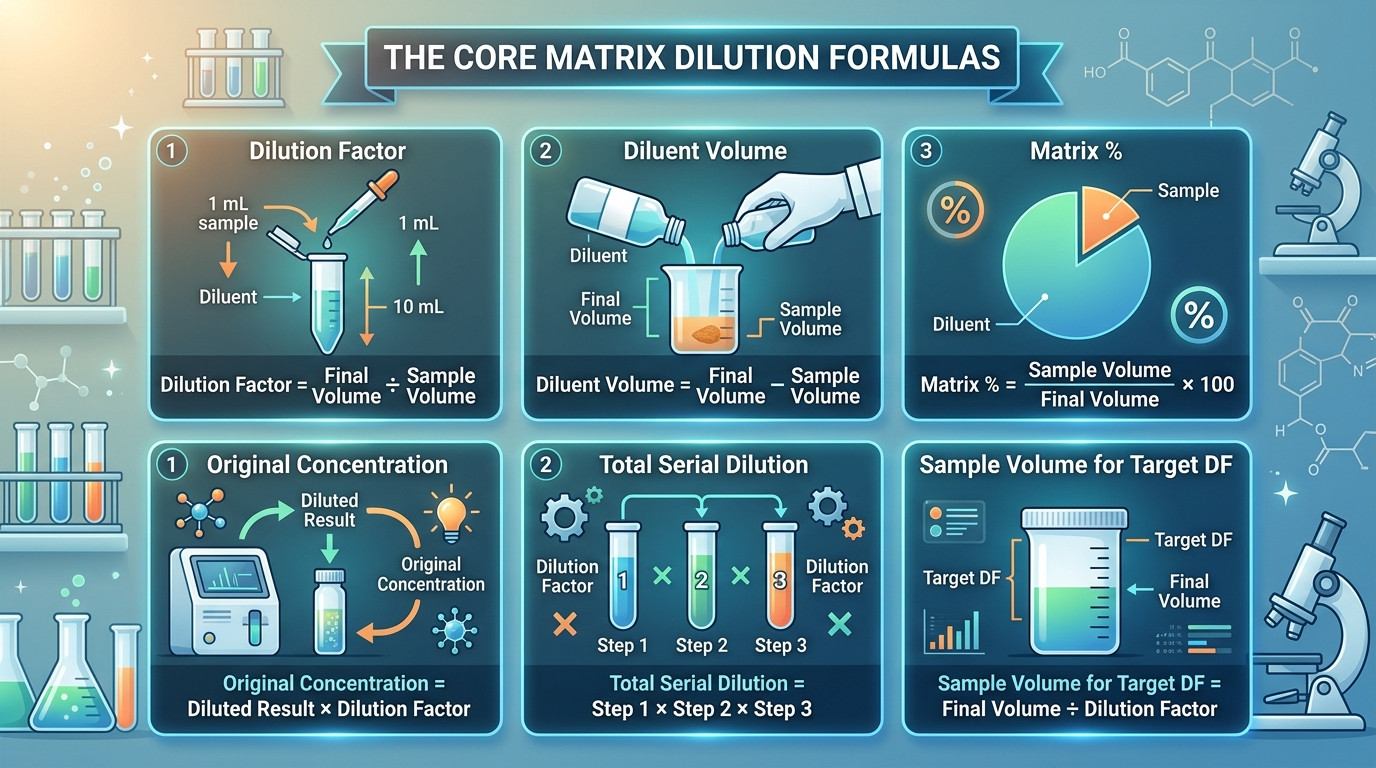
- Core formula: dilution factor = final volume ÷ sample volume.
- Back calculation: original concentration = diluted result × dilution factor.
- Diluent volume: diluent = final volume − sample volume.
- Matrix percentage: matrix % = sample volume ÷ final volume × 100.
- Serial dilution: total dilution factor = product of each step factor.
- Best practice: document matrix type, diluent composition, final volume, dilution factor, and reporting basis.
📋 Table of Contents
▼
- What a Matrix Dilution Calculator Does
- Matrix Dilution Calculator — Advanced Tool
- How Matrix Dilution Calculations Work
- Real Scenarios Where Matrix Dilution Matters
- Common Matrix Dilution Mistakes
- Safety, Handling & Quality Essentials
- Which Mode Fits Your Workflow
- Frequently Asked Questions
- Matrix Dilution Checklist
- Trusted Reference Resources
- User Reviews & Ratings
What a Matrix Dilution Calculator Does
A Matrix Dilution Calculator converts sample volume, diluent volume, final volume, target dilution factor, measured result, and matrix percentage into clear preparation and reporting instructions. Matrix dilution is more than adding water or buffer. The “matrix” can contain salts, proteins, acids, fats, soil solids, wastewater components, preservatives, solvents, microbes, pigments, or excipients that affect measurement. Diluting that matrix may reduce interference, bring an analyte into instrument range, improve pipetting, or make a sample safer to handle.
The Matrix Dilution Calculator is useful because matrix dilution calculations often control both preparation and reporting. A technician may dilute 1 mL serum to 10 mL and report the original concentration. A food lab may dilute a high-sugar extract so the detector response falls inside the calibration range. An environmental analyst may dilute a wastewater sample to reduce matrix suppression. A microbiologist may prepare a tenfold series while keeping matrix records traceable. The calculator keeps the dilution factor and final matrix percentage visible.
The tool below includes five modes: calculate dilution factor from sample and final volume, calculate sample and diluent volumes for a target dilution, back-calculate original concentration from a diluted result, plan final matrix percentage, and calculate total serial matrix dilution. Each mode uses the same blue design pattern as the previous pages and returns step-by-step output for documentation.
Use the Matrix Dilution Calculator as a planning and documentation tool. It does not replace validated SOPs, medical instructions, biosafety rules, quality-control acceptance limits, extraction protocols, calibration verification, or regulatory reporting requirements. It simply makes dilution arithmetic transparent so the operator can focus on sample identity, matrix compatibility, pipetting technique, and correct reporting.
Matrix Dilution Calculator
Calculate dilution factor, matrix percentage, diluent volume, back-calculated concentration, and serial matrix dilution with step-by-step working.
Calculation Result
Step-by-step working
How Matrix Dilution Calculations Work
Matrix dilution means diluting a real sample or matrix-containing preparation, not just a clean standard solution. A Matrix Dilution Calculator calculates the dilution factor and the reporting correction while keeping the matrix percentage visible. This matters because the matrix can change instrument response, recovery, viscosity, pH, microbial growth, extraction efficiency, or sample stability. A dilution may reduce interference, but it also lowers analyte concentration and may raise detection-limit concerns.
The core calculation is dilution factor = final volume divided by sample volume. A Matrix Dilution Calculator then uses that factor to back-calculate the original concentration from the measured diluted result. If 1 mL of sample is diluted to 10 mL, the dilution factor is 10. If the diluted tube measures 25 units, the original sample is reported as 250 units before any additional reporting factors are applied. The units remain the same; the factor changes the basis.
Dilution Factor
Dilution factor is the ratio of final prepared volume to original sample volume. A Matrix Dilution Calculator reports the factor and the required diluent volume. The same factor can be written as 10×, 1:10, or one part sample to nine parts diluent, but the notation must be used consistently. A 1:10 dilution often means one part sample in ten total parts, not one part sample plus ten parts diluent.
Matrix Percentage
Matrix percentage is sample volume divided by final volume, multiplied by 100. A Matrix Dilution Calculator is helpful when a method requires calibration standards, controls, or diluted samples to contain a specific percentage of matrix. For example, a 20% matrix solution contains 20% sample matrix and 80% diluent by volume. Matrix percentage can influence signal suppression, background, viscosity, and compatibility.
Back Calculation
Back calculation returns the result to the original sample basis. A Matrix Dilution Calculator multiplies the measured diluted result by the dilution factor and any additional reporting factor. This is common when a high sample is diluted into calibration range, when a matrix is too strong for direct injection, or when an extract is diluted before instrument analysis. The factor should be applied only once unless the method specifies multiple corrections.
Serial Matrix Dilution
Serial matrix dilution uses multiple steps, such as 1:10 followed by 1:10 followed by 1:5. A Matrix Dilution Calculator multiplies the step factors to get the total factor. Serial dilution is useful when a direct dilution would require impractical volumes or when the matrix must be gradually reduced to stay within pipette, instrument, or biological limits.
Matrix-Matched Diluent
Sometimes the diluent is not plain water or solvent. It may be blank matrix, buffer, extraction solvent, saline, culture medium, acid, mobile phase, or a matrix-matched solution. A Matrix Dilution Calculator handles the arithmetic, but the diluent composition must come from the method. The wrong diluent can precipitate proteins, change pH, destabilize analytes, or alter recovery.
matrix % = sample volume ÷ final volume × 100
original concentration = diluted result × dilution factor
total serial dilution = step 1 × step 2 × step 3
sample volume for target DF = final volume ÷ dilution factor
Remember: the Matrix Dilution Calculator provides arithmetic. Matrix compatibility, calibration range, detection limits, stability, biosafety, and reporting rules must come from the approved method or SOP.
Real Scenarios Where Matrix Dilution Matters
Scenario 1: Serum or Plasma Dilution
A clinical or research sample may be diluted to reduce matrix interference or bring a high result into range. A Matrix Dilution Calculator calculates the dilution factor and original concentration after the diluted tube is measured.
Scenario 2: Wastewater Matrix Reduction
Wastewater can contain salts, organics, surfactants, and suspended material. A Matrix Dilution Calculator helps analysts dilute the sample while documenting the original reporting basis and any extra reporting factor.
Scenario 3: Food Extract Dilution
Food extracts may be oily, sugary, acidic, or pigmented. The Matrix Dilution Calculator helps plan dilutions that reduce matrix effects without losing the analyte below detection limits.
Scenario 4: Soil Digest or Leachate
Soil digests often require dilution before ICP, ion chromatography, or colorimetric measurement. A Matrix Dilution Calculator keeps final volume, dilution factor, and original sample basis clear.
Scenario 5: Microbiology Serial Dilution
Microbiology workflows often dilute matrix-containing samples in tenfold steps. The Matrix Dilution Calculator multiplies all step factors and helps calculate original concentration from colony count, qPCR result, or measured response.
Scenario 6: Pharmaceutical Excipient Matrix
Drug product matrices and excipients can interfere with assay response. A Matrix Dilution Calculator helps plan matrix dilution and reporting correction during method development or troubleshooting.

Common Matrix Dilution Mistakes
Mistake 1: Confusing 1:10 Notation
Some users read 1:10 as one part sample plus ten parts diluent, which is actually 1:11 total. A Matrix Dilution Calculator avoids ambiguity by using sample volume and final volume.
Mistake 2: Applying Dilution Factor Twice
A diluted result should be multiplied by the dilution factor once unless additional reporting factors are required. A Matrix Dilution Calculator can show the calculation clearly so duplicate corrections are avoided.
Mistake 3: Ignoring Matrix Percentage
Matrix percentage can affect calibration matching, signal suppression, viscosity, and compatibility. A Matrix Dilution Calculator helps keep matrix percentage visible instead of focusing only on dilution factor.
Mistake 4: Using the Wrong Diluent
The diluent may need to match buffer, solvent, acid, salt, protein, preservative, or blank matrix conditions. A Matrix Dilution Calculator cannot fix chemical incompatibility caused by the wrong diluent.
Mistake 5: Diluting Below Detection Limit
Dilution reduces analyte concentration. A Matrix Dilution Calculator can calculate the factor, but the user must verify that the diluted result remains above detection and quantitation limits.
Mistake 6: Poor Mixing of Matrix Samples
Viscous, particulate, oily, or biological matrices may not mix instantly. A Matrix Dilution Calculator assumes the aliquot represents the sample, so homogenization and mixing technique matter.
💡 Rule of Thumb: write the dilution as sample volume, diluent volume, final volume, and factor. The Matrix Dilution Calculator handles the math, but the method controls compatibility, detection limits, and reporting rules.
Safety, Handling & Quality Essentials
Safety: Matrix dilution may involve infectious samples, solvents, acids, bases, wastewater, food allergens, drugs, soil extracts, heavy metals, or biological fluids. The Matrix Dilution Calculator provides math only. Follow SDS guidance, biosafety rules, PPE, ventilation, waste disposal, and institutional SOPs.
- Confirm sample hazards before opening, vortexing, centrifuging, or diluting.
- Use compatible diluent according to the method or validation plan.
- Mix matrix samples thoroughly before taking an aliquot.
- Use calibrated pipettes that match the sample volume range.
- Label diluted tubes with sample ID, dilution factor, matrix percentage, date, and analyst.
- Dispose of leftovers according to chemical, biological, or regulated waste rules.
A Matrix Dilution Calculator makes the preparation plan easier, but safety and data integrity depend on technique. Avoid aerosols with infectious or volatile matrices, use secondary containment for hazardous extracts, and prevent carryover from concentrated samples. If the matrix is viscous or particulate, pre-mixing and representative sampling are essential.
Which Mode Fits Your Workflow
| Mode | Use Case | Key Formula | Inputs | Output |
|---|---|---|---|---|
| Dilution Factor | Known sample and final volume | final/sample | sample volume, final volume | DF, diluent, matrix % |
| Target Dilution | Prepare a specific factor | sample = final/DF | target factor, final volume | sample + diluent volumes |
| Back Calculate | Report original result | result × DF × RF | diluted result, factors | original concentration |
| Matrix Percent | Match matrix level | final × matrix% | target %, final volume | sample and diluent |
| Serial Dilution | Multiple dilution steps | DF₁ × DF₂ × DF₃ | step factors | total factor |
Analytical Chemistry
In analytical chemistry, a Matrix Dilution Calculator supports dilution of extracts, digests, calibration matrices, and high-level samples. It helps keep the original reporting basis linked to the measured diluted result.
Clinical and Biological Samples
Serum, plasma, urine, saliva, lysates, and culture fluids may require dilution to reduce viscosity or matrix interference. The Matrix Dilution Calculator helps record factor and matrix percentage, while the method controls biosafety and acceptance criteria.
Food and Beverage Testing
Food matrices may be thick, oily, sugary, salty, or pigmented. A Matrix Dilution Calculator helps plan practical dilutions so the extract can be pipetted, filtered, injected, or compared with matrix-matched calibration.
Environmental Testing
Water, wastewater, sediment extracts, and soil digests often contain interfering matrix components. The Matrix Dilution Calculator supports dilution planning and reporting correction for original sample basis.
Microbiology
Microbiology often uses serial dilutions of matrix-containing samples. A Matrix Dilution Calculator helps calculate total dilution factor, but colony selection, plating volume, and countable range rules remain method-specific.
Advanced Guide to Matrix Dilution Planning
Dilution Notation
A Matrix Dilution Calculator supports dilution notation decisions, but the dilution must match the sample matrix and method. Dilution Notation matters because matrix dilution changes both concentration and sample environment. The analyst should record sample identity, matrix type, sample volume, diluent identity, final volume, dilution factor, matrix percentage, measured diluted result, and final reporting basis. If the diluted result is unexpected, review mixing, aliquot representativeness, pipette performance, precipitation, adsorption, extraction carryover, calibration range, and whether the dilution factor was applied correctly. Good records make it possible to repeat the dilution and defend the reported value.
Sample Homogeneity
A Matrix Dilution Calculator supports sample homogeneity decisions, but the dilution must match the sample matrix and method. Sample Homogeneity matters because matrix dilution changes both concentration and sample environment. The analyst should record sample identity, matrix type, sample volume, diluent identity, final volume, dilution factor, matrix percentage, measured diluted result, and final reporting basis. If the diluted result is unexpected, review mixing, aliquot representativeness, pipette performance, precipitation, adsorption, extraction carryover, calibration range, and whether the dilution factor was applied correctly. Good records make it possible to repeat the dilution and defend the reported value.
Matrix Percentage
A Matrix Dilution Calculator supports matrix percentage decisions, but the dilution must match the sample matrix and method. Matrix Percentage matters because matrix dilution changes both concentration and sample environment. The analyst should record sample identity, matrix type, sample volume, diluent identity, final volume, dilution factor, matrix percentage, measured diluted result, and final reporting basis. If the diluted result is unexpected, review mixing, aliquot representativeness, pipette performance, precipitation, adsorption, extraction carryover, calibration range, and whether the dilution factor was applied correctly. Good records make it possible to repeat the dilution and defend the reported value.
Diluent Compatibility
A Matrix Dilution Calculator supports diluent compatibility decisions, but the dilution must match the sample matrix and method. Diluent Compatibility matters because matrix dilution changes both concentration and sample environment. The analyst should record sample identity, matrix type, sample volume, diluent identity, final volume, dilution factor, matrix percentage, measured diluted result, and final reporting basis. If the diluted result is unexpected, review mixing, aliquot representativeness, pipette performance, precipitation, adsorption, extraction carryover, calibration range, and whether the dilution factor was applied correctly. Good records make it possible to repeat the dilution and defend the reported value.
Pipette Range
A Matrix Dilution Calculator supports pipette range decisions, but the dilution must match the sample matrix and method. Pipette Range matters because matrix dilution changes both concentration and sample environment. The analyst should record sample identity, matrix type, sample volume, diluent identity, final volume, dilution factor, matrix percentage, measured diluted result, and final reporting basis. If the diluted result is unexpected, review mixing, aliquot representativeness, pipette performance, precipitation, adsorption, extraction carryover, calibration range, and whether the dilution factor was applied correctly. Good records make it possible to repeat the dilution and defend the reported value.
Serial Steps
A Matrix Dilution Calculator supports serial steps decisions, but the dilution must match the sample matrix and method. Serial Steps matters because matrix dilution changes both concentration and sample environment. The analyst should record sample identity, matrix type, sample volume, diluent identity, final volume, dilution factor, matrix percentage, measured diluted result, and final reporting basis. If the diluted result is unexpected, review mixing, aliquot representativeness, pipette performance, precipitation, adsorption, extraction carryover, calibration range, and whether the dilution factor was applied correctly. Good records make it possible to repeat the dilution and defend the reported value.
Back Calculation
A Matrix Dilution Calculator supports back calculation decisions, but the dilution must match the sample matrix and method. Back Calculation matters because matrix dilution changes both concentration and sample environment. The analyst should record sample identity, matrix type, sample volume, diluent identity, final volume, dilution factor, matrix percentage, measured diluted result, and final reporting basis. If the diluted result is unexpected, review mixing, aliquot representativeness, pipette performance, precipitation, adsorption, extraction carryover, calibration range, and whether the dilution factor was applied correctly. Good records make it possible to repeat the dilution and defend the reported value.
Reporting Factor
A Matrix Dilution Calculator supports reporting factor decisions, but the dilution must match the sample matrix and method. Reporting Factor matters because matrix dilution changes both concentration and sample environment. The analyst should record sample identity, matrix type, sample volume, diluent identity, final volume, dilution factor, matrix percentage, measured diluted result, and final reporting basis. If the diluted result is unexpected, review mixing, aliquot representativeness, pipette performance, precipitation, adsorption, extraction carryover, calibration range, and whether the dilution factor was applied correctly. Good records make it possible to repeat the dilution and defend the reported value.
Detection Limit
A Matrix Dilution Calculator supports detection limit decisions, but the dilution must match the sample matrix and method. Detection Limit matters because matrix dilution changes both concentration and sample environment. The analyst should record sample identity, matrix type, sample volume, diluent identity, final volume, dilution factor, matrix percentage, measured diluted result, and final reporting basis. If the diluted result is unexpected, review mixing, aliquot representativeness, pipette performance, precipitation, adsorption, extraction carryover, calibration range, and whether the dilution factor was applied correctly. Good records make it possible to repeat the dilution and defend the reported value.
Quantitation Limit
A Matrix Dilution Calculator supports quantitation limit decisions, but the dilution must match the sample matrix and method. Quantitation Limit matters because matrix dilution changes both concentration and sample environment. The analyst should record sample identity, matrix type, sample volume, diluent identity, final volume, dilution factor, matrix percentage, measured diluted result, and final reporting basis. If the diluted result is unexpected, review mixing, aliquot representativeness, pipette performance, precipitation, adsorption, extraction carryover, calibration range, and whether the dilution factor was applied correctly. Good records make it possible to repeat the dilution and defend the reported value.
Calibration Range
A Matrix Dilution Calculator supports calibration range decisions, but the dilution must match the sample matrix and method. Calibration Range matters because matrix dilution changes both concentration and sample environment. The analyst should record sample identity, matrix type, sample volume, diluent identity, final volume, dilution factor, matrix percentage, measured diluted result, and final reporting basis. If the diluted result is unexpected, review mixing, aliquot representativeness, pipette performance, precipitation, adsorption, extraction carryover, calibration range, and whether the dilution factor was applied correctly. Good records make it possible to repeat the dilution and defend the reported value.
Matrix Matching
A Matrix Dilution Calculator supports matrix matching decisions, but the dilution must match the sample matrix and method. Matrix Matching matters because matrix dilution changes both concentration and sample environment. The analyst should record sample identity, matrix type, sample volume, diluent identity, final volume, dilution factor, matrix percentage, measured diluted result, and final reporting basis. If the diluted result is unexpected, review mixing, aliquot representativeness, pipette performance, precipitation, adsorption, extraction carryover, calibration range, and whether the dilution factor was applied correctly. Good records make it possible to repeat the dilution and defend the reported value.
Recovery Effects
A Matrix Dilution Calculator supports recovery effects decisions, but the dilution must match the sample matrix and method. Recovery Effects matters because matrix dilution changes both concentration and sample environment. The analyst should record sample identity, matrix type, sample volume, diluent identity, final volume, dilution factor, matrix percentage, measured diluted result, and final reporting basis. If the diluted result is unexpected, review mixing, aliquot representativeness, pipette performance, precipitation, adsorption, extraction carryover, calibration range, and whether the dilution factor was applied correctly. Good records make it possible to repeat the dilution and defend the reported value.
Viscosity
A Matrix Dilution Calculator supports viscosity decisions, but the dilution must match the sample matrix and method. Viscosity matters because matrix dilution changes both concentration and sample environment. The analyst should record sample identity, matrix type, sample volume, diluent identity, final volume, dilution factor, matrix percentage, measured diluted result, and final reporting basis. If the diluted result is unexpected, review mixing, aliquot representativeness, pipette performance, precipitation, adsorption, extraction carryover, calibration range, and whether the dilution factor was applied correctly. Good records make it possible to repeat the dilution and defend the reported value.
Particulates
A Matrix Dilution Calculator supports particulates decisions, but the dilution must match the sample matrix and method. Particulates matters because matrix dilution changes both concentration and sample environment. The analyst should record sample identity, matrix type, sample volume, diluent identity, final volume, dilution factor, matrix percentage, measured diluted result, and final reporting basis. If the diluted result is unexpected, review mixing, aliquot representativeness, pipette performance, precipitation, adsorption, extraction carryover, calibration range, and whether the dilution factor was applied correctly. Good records make it possible to repeat the dilution and defend the reported value.
Filtration
A Matrix Dilution Calculator supports filtration decisions, but the dilution must match the sample matrix and method. Filtration matters because matrix dilution changes both concentration and sample environment. The analyst should record sample identity, matrix type, sample volume, diluent identity, final volume, dilution factor, matrix percentage, measured diluted result, and final reporting basis. If the diluted result is unexpected, review mixing, aliquot representativeness, pipette performance, precipitation, adsorption, extraction carryover, calibration range, and whether the dilution factor was applied correctly. Good records make it possible to repeat the dilution and defend the reported value.
Centrifugation
A Matrix Dilution Calculator supports centrifugation decisions, but the dilution must match the sample matrix and method. Centrifugation matters because matrix dilution changes both concentration and sample environment. The analyst should record sample identity, matrix type, sample volume, diluent identity, final volume, dilution factor, matrix percentage, measured diluted result, and final reporting basis. If the diluted result is unexpected, review mixing, aliquot representativeness, pipette performance, precipitation, adsorption, extraction carryover, calibration range, and whether the dilution factor was applied correctly. Good records make it possible to repeat the dilution and defend the reported value.
Adsorption
A Matrix Dilution Calculator supports adsorption decisions, but the dilution must match the sample matrix and method. Adsorption matters because matrix dilution changes both concentration and sample environment. The analyst should record sample identity, matrix type, sample volume, diluent identity, final volume, dilution factor, matrix percentage, measured diluted result, and final reporting basis. If the diluted result is unexpected, review mixing, aliquot representativeness, pipette performance, precipitation, adsorption, extraction carryover, calibration range, and whether the dilution factor was applied correctly. Good records make it possible to repeat the dilution and defend the reported value.
Protein Precipitation
Protein Precipitation matters because matrix dilution changes both concentration and sample environment. The analyst should record sample identity, matrix type, sample volume, diluent identity, final volume, dilution factor, matrix percentage, measured diluted result, and final reporting basis. If the diluted result is unexpected, review mixing, aliquot representativeness, pipette performance, precipitation, adsorption, extraction carryover, calibration range, and whether the dilution factor was applied correctly. Good records make it possible to repeat the dilution and defend the reported value.
pH Change
pH Change matters because matrix dilution changes both concentration and sample environment. The analyst should record sample identity, matrix type, sample volume, diluent identity, final volume, dilution factor, matrix percentage, measured diluted result, and final reporting basis. If the diluted result is unexpected, review mixing, aliquot representativeness, pipette performance, precipitation, adsorption, extraction carryover, calibration range, and whether the dilution factor was applied correctly. Good records make it possible to repeat the dilution and defend the reported value.
Salt Effects
Salt Effects matters because matrix dilution changes both concentration and sample environment. The analyst should record sample identity, matrix type, sample volume, diluent identity, final volume, dilution factor, matrix percentage, measured diluted result, and final reporting basis. If the diluted result is unexpected, review mixing, aliquot representativeness, pipette performance, precipitation, adsorption, extraction carryover, calibration range, and whether the dilution factor was applied correctly. Good records make it possible to repeat the dilution and defend the reported value.
Organic Solvent Fraction
Organic Solvent Fraction matters because matrix dilution changes both concentration and sample environment. The analyst should record sample identity, matrix type, sample volume, diluent identity, final volume, dilution factor, matrix percentage, measured diluted result, and final reporting basis. If the diluted result is unexpected, review mixing, aliquot representativeness, pipette performance, precipitation, adsorption, extraction carryover, calibration range, and whether the dilution factor was applied correctly. Good records make it possible to repeat the dilution and defend the reported value.
Biological Safety
Biological Safety matters because matrix dilution changes both concentration and sample environment. The analyst should record sample identity, matrix type, sample volume, diluent identity, final volume, dilution factor, matrix percentage, measured diluted result, and final reporting basis. If the diluted result is unexpected, review mixing, aliquot representativeness, pipette performance, precipitation, adsorption, extraction carryover, calibration range, and whether the dilution factor was applied correctly. Good records make it possible to repeat the dilution and defend the reported value.
Carryover Prevention
Carryover Prevention matters because matrix dilution changes both concentration and sample environment. The analyst should record sample identity, matrix type, sample volume, diluent identity, final volume, dilution factor, matrix percentage, measured diluted result, and final reporting basis. If the diluted result is unexpected, review mixing, aliquot representativeness, pipette performance, precipitation, adsorption, extraction carryover, calibration range, and whether the dilution factor was applied correctly. Good records make it possible to repeat the dilution and defend the reported value.
Tube Labeling
Tube Labeling matters because matrix dilution changes both concentration and sample environment. The analyst should record sample identity, matrix type, sample volume, diluent identity, final volume, dilution factor, matrix percentage, measured diluted result, and final reporting basis. If the diluted result is unexpected, review mixing, aliquot representativeness, pipette performance, precipitation, adsorption, extraction carryover, calibration range, and whether the dilution factor was applied correctly. Good records make it possible to repeat the dilution and defend the reported value.
Chain of Custody
Chain of Custody matters because matrix dilution changes both concentration and sample environment. The analyst should record sample identity, matrix type, sample volume, diluent identity, final volume, dilution factor, matrix percentage, measured diluted result, and final reporting basis. If the diluted result is unexpected, review mixing, aliquot representativeness, pipette performance, precipitation, adsorption, extraction carryover, calibration range, and whether the dilution factor was applied correctly. Good records make it possible to repeat the dilution and defend the reported value.
Replicate Dilutions
Replicate Dilutions matters because matrix dilution changes both concentration and sample environment. The analyst should record sample identity, matrix type, sample volume, diluent identity, final volume, dilution factor, matrix percentage, measured diluted result, and final reporting basis. If the diluted result is unexpected, review mixing, aliquot representativeness, pipette performance, precipitation, adsorption, extraction carryover, calibration range, and whether the dilution factor was applied correctly. Good records make it possible to repeat the dilution and defend the reported value.
Quality Control
Quality Control matters because matrix dilution changes both concentration and sample environment. The analyst should record sample identity, matrix type, sample volume, diluent identity, final volume, dilution factor, matrix percentage, measured diluted result, and final reporting basis. If the diluted result is unexpected, review mixing, aliquot representativeness, pipette performance, precipitation, adsorption, extraction carryover, calibration range, and whether the dilution factor was applied correctly. Good records make it possible to repeat the dilution and defend the reported value.
Troubleshooting
Troubleshooting matters because matrix dilution changes both concentration and sample environment. The analyst should record sample identity, matrix type, sample volume, diluent identity, final volume, dilution factor, matrix percentage, measured diluted result, and final reporting basis. If the diluted result is unexpected, review mixing, aliquot representativeness, pipette performance, precipitation, adsorption, extraction carryover, calibration range, and whether the dilution factor was applied correctly. Good records make it possible to repeat the dilution and defend the reported value.
Audit Records
Audit Records matters because matrix dilution changes both concentration and sample environment. The analyst should record sample identity, matrix type, sample volume, diluent identity, final volume, dilution factor, matrix percentage, measured diluted result, and final reporting basis. If the diluted result is unexpected, review mixing, aliquot representativeness, pipette performance, precipitation, adsorption, extraction carryover, calibration range, and whether the dilution factor was applied correctly. Good records make it possible to repeat the dilution and defend the reported value.
A Matrix Dilution Calculator should therefore be used before tubes or flasks are prepared. It gives a clear plan for volumes and factors, but the final reliability depends on matrix compatibility, calibrated equipment, representative sampling, method acceptance criteria, and complete documentation.
Complete Reference Guide for Matrix Dilution Planning
The Matrix Dilution Calculator is useful for sample dilution design because it turns a matrix dilution into a traceable volume and factor calculation. The user can prepare a target dilution, calculate matrix percentage, back-calculate the original result, and document the correction applied to the measured diluted sample. Planned values should be separated from actual values, and any deviation should be recorded. If the result is outside expectation, check dilution notation, final volume, diluent identity, sample homogeneity, detection limits, and whether the dilution factor was applied once.
The Matrix Dilution Calculator is useful for matrix percentage planning because it turns a matrix dilution into a traceable volume and factor calculation. The user can prepare a target dilution, calculate matrix percentage, back-calculate the original result, and document the correction applied to the measured diluted sample. Planned values should be separated from actual values, and any deviation should be recorded. If the result is outside expectation, check dilution notation, final volume, diluent identity, sample homogeneity, detection limits, and whether the dilution factor was applied once.
The Matrix Dilution Calculator is useful for serial dilution records because it turns a matrix dilution into a traceable volume and factor calculation. The user can prepare a target dilution, calculate matrix percentage, back-calculate the original result, and document the correction applied to the measured diluted sample. Planned values should be separated from actual values, and any deviation should be recorded. If the result is outside expectation, check dilution notation, final volume, diluent identity, sample homogeneity, detection limits, and whether the dilution factor was applied once.
The Matrix Dilution Calculator is useful for original result reporting because it turns a matrix dilution into a traceable volume and factor calculation. The user can prepare a target dilution, calculate matrix percentage, back-calculate the original result, and document the correction applied to the measured diluted sample. Planned values should be separated from actual values, and any deviation should be recorded. If the result is outside expectation, check dilution notation, final volume, diluent identity, sample homogeneity, detection limits, and whether the dilution factor was applied once.
The Matrix Dilution Calculator is useful for diluent selection because it turns a matrix dilution into a traceable volume and factor calculation. The user can prepare a target dilution, calculate matrix percentage, back-calculate the original result, and document the correction applied to the measured diluted sample. Planned values should be separated from actual values, and any deviation should be recorded. If the result is outside expectation, check dilution notation, final volume, diluent identity, sample homogeneity, detection limits, and whether the dilution factor was applied once.
The Matrix Dilution Calculator is useful for high sample reruns because it turns a matrix dilution into a traceable volume and factor calculation. The user can prepare a target dilution, calculate matrix percentage, back-calculate the original result, and document the correction applied to the measured diluted sample. Planned values should be separated from actual values, and any deviation should be recorded. If the result is outside expectation, check dilution notation, final volume, diluent identity, sample homogeneity, detection limits, and whether the dilution factor was applied once.
The Matrix Dilution Calculator is useful for calibration matching because it turns a matrix dilution into a traceable volume and factor calculation. The user can prepare a target dilution, calculate matrix percentage, back-calculate the original result, and document the correction applied to the measured diluted sample. Planned values should be separated from actual values, and any deviation should be recorded. If the result is outside expectation, check dilution notation, final volume, diluent identity, sample homogeneity, detection limits, and whether the dilution factor was applied once.
The Matrix Dilution Calculator is useful for method troubleshooting because it turns a matrix dilution into a traceable volume and factor calculation. The user can prepare a target dilution, calculate matrix percentage, back-calculate the original result, and document the correction applied to the measured diluted sample. Planned values should be separated from actual values, and any deviation should be recorded. If the result is outside expectation, check dilution notation, final volume, diluent identity, sample homogeneity, detection limits, and whether the dilution factor was applied once.
The Matrix Dilution Calculator is useful for clinical specimens because it turns a matrix dilution into a traceable volume and factor calculation. The user can prepare a target dilution, calculate matrix percentage, back-calculate the original result, and document the correction applied to the measured diluted sample. Planned values should be separated from actual values, and any deviation should be recorded. If the result is outside expectation, check dilution notation, final volume, diluent identity, sample homogeneity, detection limits, and whether the dilution factor was applied once.
The Matrix Dilution Calculator is useful for environmental samples because it turns a matrix dilution into a traceable volume and factor calculation. The user can prepare a target dilution, calculate matrix percentage, back-calculate the original result, and document the correction applied to the measured diluted sample. Planned values should be separated from actual values, and any deviation should be recorded. If the result is outside expectation, check dilution notation, final volume, diluent identity, sample homogeneity, detection limits, and whether the dilution factor was applied once.
For food extracts, it turns a matrix dilution into a traceable volume and factor calculation. The user can prepare a target dilution, calculate matrix percentage, back-calculate the original result, and document the correction applied to the measured diluted sample. Planned values should be separated from actual values, and any deviation should be recorded. If the result is outside expectation, check dilution notation, final volume, diluent identity, sample homogeneity, detection limits, and whether the dilution factor was applied once.
For pharmaceutical matrices, it turns a matrix dilution into a traceable volume and factor calculation. The user can prepare a target dilution, calculate matrix percentage, back-calculate the original result, and document the correction applied to the measured diluted sample. Planned values should be separated from actual values, and any deviation should be recorded. If the result is outside expectation, check dilution notation, final volume, diluent identity, sample homogeneity, detection limits, and whether the dilution factor was applied once.
For microbiology counts, it turns a matrix dilution into a traceable volume and factor calculation. The user can prepare a target dilution, calculate matrix percentage, back-calculate the original result, and document the correction applied to the measured diluted sample. Planned values should be separated from actual values, and any deviation should be recorded. If the result is outside expectation, check dilution notation, final volume, diluent identity, sample homogeneity, detection limits, and whether the dilution factor was applied once.
For training worksheets, it turns a matrix dilution into a traceable volume and factor calculation. The user can prepare a target dilution, calculate matrix percentage, back-calculate the original result, and document the correction applied to the measured diluted sample. Planned values should be separated from actual values, and any deviation should be recorded. If the result is outside expectation, check dilution notation, final volume, diluent identity, sample homogeneity, detection limits, and whether the dilution factor was applied once.
For final reporting, it turns a matrix dilution into a traceable volume and factor calculation. The user can prepare a target dilution, calculate matrix percentage, back-calculate the original result, and document the correction applied to the measured diluted sample. Planned values should be separated from actual values, and any deviation should be recorded. If the result is outside expectation, check dilution notation, final volume, diluent identity, sample homogeneity, detection limits, and whether the dilution factor was applied once.
For audit review, it turns a matrix dilution into a traceable volume and factor calculation. The user can prepare a target dilution, calculate matrix percentage, back-calculate the original result, and document the correction applied to the measured diluted sample. Planned values should be separated from actual values, and any deviation should be recorded. If the result is outside expectation, check dilution notation, final volume, diluent identity, sample homogeneity, detection limits, and whether the dilution factor was applied once.
Frequently Asked Questions
1. What is a Matrix Dilution Calculator?
A Matrix Dilution Calculator calculates dilution factor, sample volume, diluent volume, matrix percentage, back-calculated original concentration, and total serial dilution for matrix-containing samples.
2. How do I calculate dilution factor?
Dilution factor equals final volume divided by sample volume.
3. How do I back-calculate the original result?
Multiply the measured diluted result by the dilution factor and any additional reporting factor required by the method.
4. What is matrix percentage?
Matrix percentage is sample volume divided by final volume, multiplied by 100.
5. What does 1:10 dilution mean?
In many laboratory contexts, 1:10 means one part sample in ten total parts, which is a 10× dilution. Always confirm method notation.
6. Can I use any diluent?
No. The diluent must be compatible with the matrix, analyte, method, and calibration approach.
7. Is this Matrix Dilution Calculator free?
Yes. The matrix dilution tool is free and browser-based. Review submissions are saved to the WordPress database through AJAX.
8. Does this replace an SOP?
No. It supports arithmetic only. Sample handling, compatibility, safety, and reporting rules come from the approved SOP or method.
Matrix Dilution Checklist
Before Dilution
During Dilution
After Dilution

Trusted Reference Resources
EPA Quality Guidance — EPA quality system resources for environmental analytical data quality concepts.
CDC Laboratory Safety — biosafety guidance for biological matrix handling.
Supplier and Method Instructions — Always follow approved diluent, stability, storage, and reporting requirements.
Institutional SOPs — Use validated procedures for regulated samples, clinical matrices, food testing, and pharmaceutical QC.
User Reviews & Ratings
Share Your Experience with This matrix dilution tool
Final Thoughts on Matrix Dilution Calculation
Matrix dilution is a routine step that can strongly affect accuracy, detection limits, matrix effects, and reporting. A matrix dilution tool makes the arithmetic reliable by calculating dilution factor, diluent volume, matrix percentage, back-calculated original concentration, and total serial dilution in one workflow.
Before reporting, confirm that the diluted result is inside the valid calibration range, the analyte remains above the reporting limit, the diluent is compatible, and the dilution factor was applied correctly. If a result looks unusual, review sample homogeneity, pipetting, precipitation, adsorption, extraction history, and whether the matrix changed during dilution.
Use the matrix dilution tool before preparing tubes, flasks, vials, extracts, or serial dilutions. Record planned and actual volumes, label every dilution clearly, and copy the step-by-step result into worksheets when helpful. Careful matrix dilution planning turns a simple volume adjustment into a traceable quality-control step.
🔒 Review Storage Note: Calculations run in your browser. When you submit a review, the review is saved to the WordPress site database through the shortcode AJAX handler.