
Standard Addition Calculator — Single-Point Standard Addition, Multi-Point Regression, Spike Level & Matrix Effect Planning
A Standard Addition Calculator helps determine an unknown analyte concentration by adding known amounts of standard directly to the sample matrix and measuring signal response. It is especially useful when matrix effects make an external calibration curve unreliable. The common single-point relationship is unknown concentration = sample signal × added standard concentration ÷ signal increase, adjusted for sample volume and final volume. This Standard Addition Calculator also supports multi-point standard addition regression, x-intercept interpretation, spike-added concentration, dilution correction, and matrix-effect checking for analytical chemistry, environmental testing, food analysis, pharmaceutical QC, spectroscopy, chromatography, and electrochemical methods.
Key facts at a glance
- Core idea: add known standard to the unknown sample and compare signal increase.
- Single-point formula: Cx = Sx × Cstd × Vstd ÷ [Vsample × (Sspiked − Sx)].
- Multi-point method: plot signal versus added concentration and use the x-intercept.
- Matrix advantage: standards are added into the same sample matrix, reducing matrix-effect bias.
- Requirement: signal must be linear over the concentration range used.
- Best practice: keep final volume consistent and document sample volume, spike volumes, standard lot, and dilution factor.
📋 Table of Contents
▼
- What a Standard Addition Calculator Does
- Standard Addition Calculator — Advanced Tool
- How Standard Addition Calculations Work
- Real Scenarios Where Standard Addition Matters
- Common Standard Addition Mistakes
- Safety, Handling & Quality Essentials
- Which Mode Fits Your Workflow
- Frequently Asked Questions
- Standard Addition Checklist
- Trusted Reference Resources
- User Reviews & Ratings
What a Standard Addition Calculator Does
A Standard Addition Calculator converts sample signal, spiked signal, standard concentration, spike volume, sample volume, final volume, dilution factor, and regression data into an estimated unknown concentration. Standard addition is a calibration strategy where the analyst adds known analyte standards directly to aliquots of the sample. Because the calibration additions are inside the same matrix, the method can compensate for signal suppression, enhancement, viscosity, salt content, acidity, organic matter, proteins, or other matrix components that would make a simple external calibration less reliable.
The Standard Addition Calculator is useful because the calculation can be confusing when final volume, dilution, and spike level are included. A chemist may measure an unspiked sample signal, then add a small volume of certified standard and measure the increased signal. Another analyst may prepare four flasks with increasing standard additions and use the regression x-intercept to estimate the original concentration. The calculator helps keep those workflows clear and shows the arithmetic step by step.
This tool includes five practical modes: single-point standard addition, multi-point regression from concentration-signal pairs, added standard concentration from spike volume, unknown concentration from x-intercept, and matrix effect comparison against external calibration response. Each mode follows the same blue design pattern used in the previous pages and gives step-by-step output that can be copied into a laboratory worksheet or method validation note.
Use the Standard Addition Calculator as a planning and documentation aid. It does not replace validated analytical methods, certified reference material instructions, instrument calibration checks, quality-control requirements, or regression review. Standard addition works best when the response is linear, the added standard is chemically identical to the analyte, final volumes are controlled, and all aliquots receive the same treatment before measurement.
Standard Addition Calculator
Calculate single-point standard addition, regression x-intercept, added concentration, dilution-corrected result, and matrix-effect response.
Calculation Result
Step-by-step working
How Standard Addition Calculations Work
Standard addition is a calibration method designed for samples where the matrix changes instrument response. A Standard Addition Calculator calculates the unknown concentration by measuring the sample response before and after adding known analyte standard. Instead of preparing standards in clean solvent only, the analyst adds standards into the same sample matrix. This can compensate for matrix suppression or enhancement because each calibration point contains the sample itself.
In a single-point workflow, one unspiked aliquot and one spiked aliquot are compared. The signal increase after adding standard is used to estimate how much analyte was already present. A Standard Addition Calculator applies the formula Cx = Sx × Cstd × Vstd ÷ [Vsample × (Sspiked − Sx)]. This assumes a linear response, stable instrument signal, matched treatment, and correct volume control. If final volume or dilution is handled differently by the method, the equation must be adjusted according to the SOP.
Single-Point Standard Addition
Single-point standard addition is fast and practical when the method permits it. A Standard Addition Calculator uses the unspiked signal, spiked signal, standard concentration, standard volume, and sample volume. The larger the signal increase from the spike, the more stable the calculation tends to be. If the spiked signal is only slightly higher than the unspiked signal, uncertainty can be high.
Multi-Point Standard Addition
Multi-point standard addition prepares several aliquots of the same sample with increasing standard additions. A Standard Addition Calculator fits signal versus added concentration and uses the x-intercept. The absolute value of the x-intercept estimates the unknown concentration in the prepared sample. Multi-point data allow the analyst to review linearity, outliers, and intercept behavior more clearly than a single spike.
X-Intercept Meaning
The x-intercept is where the fitted signal would become zero. In standard addition, that negative x-value corresponds to the amount of analyte originally present before any standard was added. A Standard Addition Calculator converts the intercept into a positive unknown concentration and applies any dilution factor if the sample was diluted before measurement.
Added Standard Concentration
The x-axis in a standard addition plot should represent concentration added to the final prepared solution, not merely the concentration of the stock bottle. A Standard Addition Calculator can calculate added concentration from standard stock concentration, spike volume, and final flask volume. This prevents plotting errors when different spike volumes are diluted to the same final volume.
Matrix Effect Review
Standard addition is often chosen because external calibration response is not trusted in the sample matrix. A Standard Addition Calculator can compare matrix slope with external calibration slope. If the slopes differ significantly, the matrix changes the response and standard addition may provide a better sample-specific estimate.
linear fit: signal = slope × added concentration + intercept
x-intercept = −intercept ÷ slope
unknown concentration = |x-intercept| × dilution factor
matrix response ratio = matrix slope ÷ external slope × 100
Remember: the Standard Addition Calculator performs calculations only. The analyst must verify linearity, blank correction, final volume, standard identity, instrument stability, and method-specific acceptance requirements.

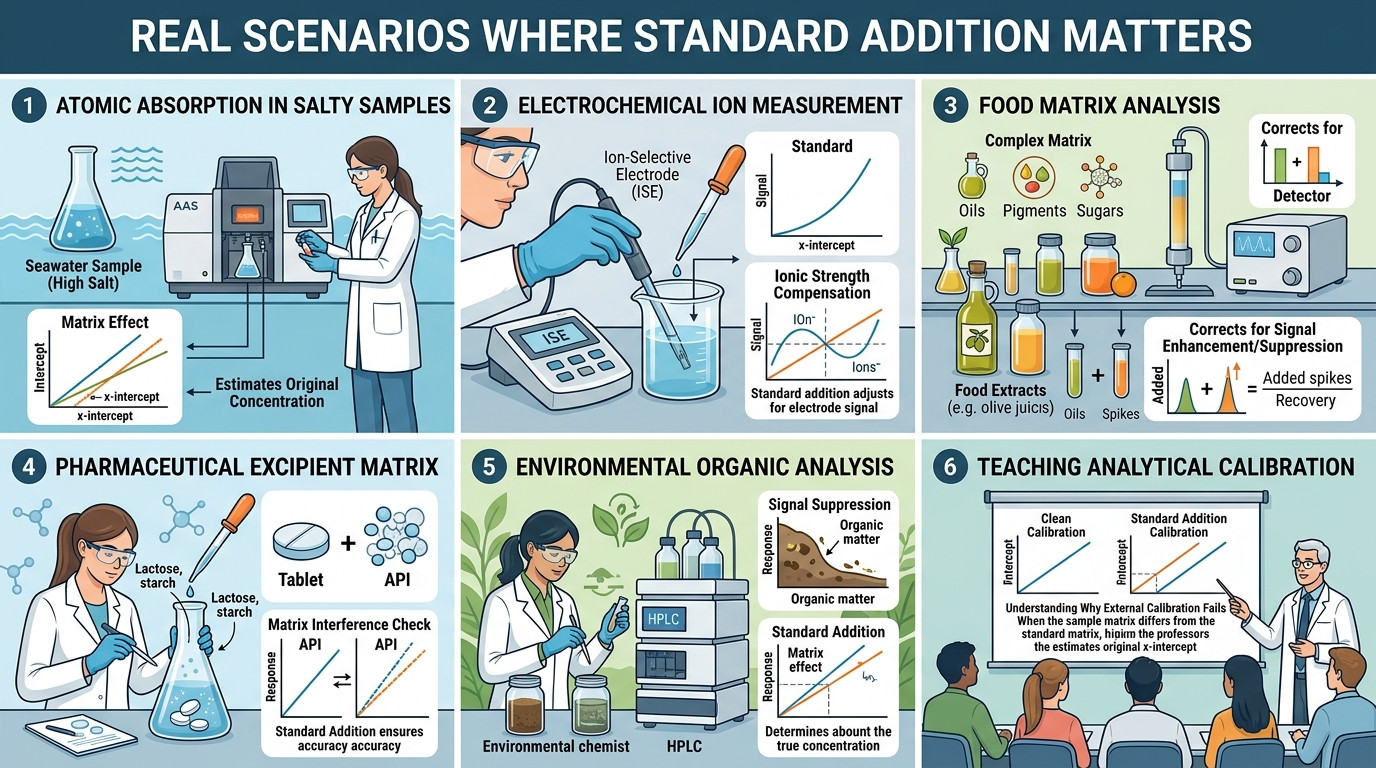
Real Scenarios Where Standard Addition Matters
Scenario 1: Atomic Absorption in Salty Samples
A metal analysis sample contains high dissolved salts that suppress external calibration response. A Standard Addition Calculator helps the analyst add known metal standard directly to sample aliquots and estimate the original concentration from the x-intercept.
Scenario 2: Electrochemical Ion Measurement
Ion-selective electrode measurements can be affected by ionic strength and sample composition. A Standard Addition Calculator supports standard addition calculations when a known ion standard is added and the signal change is used to estimate concentration.
Scenario 3: Food Matrix Analysis
Food extracts can contain oils, pigments, sugars, proteins, and acids that influence chromatographic or spectroscopic response. The Standard Addition Calculator helps calculate added concentrations for matrix-specific calibration points and improves documentation of fortification levels.
Scenario 4: Pharmaceutical Excipient Matrix
A drug product placebo or excipient matrix may change the response of an active ingredient or impurity. A Standard Addition Calculator can support accuracy checks when known standard is added to the matrix and measured after the full sample preparation procedure.
Scenario 5: Environmental Organic Analysis
Soil, wastewater, and sediment extracts often contain organic matter that affects recovery or detector response. The Standard Addition Calculator helps plan standard additions and interpret regression intercepts when matrix effects are suspected.
Scenario 6: Teaching Analytical Calibration
Students learn why external calibration can fail when matrices differ. A Standard Addition Calculator lets them compare clean calibration response with standard addition response and understand why the x-intercept estimates the original analyte level.
Common Standard Addition Mistakes
Mistake 1: Plotting Stock Concentration Instead of Added Concentration
The x-axis should usually be concentration added to the final prepared solution. A Standard Addition Calculator can calculate that value from standard stock, spike volume, and final volume.
Mistake 2: Ignoring Final Volume
If each flask is diluted to a fixed final volume, calculations must reflect that dilution. A Standard Addition Calculator helps avoid treating spike stock concentration as if it were the concentration in the measured flask.
Mistake 3: Using Nonlinear Response
Standard addition assumes linear response over the range used. A Standard Addition Calculator can calculate regression, but it cannot make curved data valid. Review residuals, calibration range, and instrument saturation.
Mistake 4: Adding Too Much Standard
Very large additions can shift matrix composition, solvent percentage, pH, or ionic strength. A Standard Addition Calculator helps choose reasonable additions, but the method should define acceptable spike levels.
Mistake 5: Forgetting Blank or Background Correction
Background signal can bias the intercept if not handled consistently. A Standard Addition Calculator should be used with signals that follow the method requirement for blanks, baselines, and background subtraction.
Mistake 6: Trusting a Poor Regression
A multi-point line with one bad point can produce a misleading x-intercept. A Standard Addition Calculator gives a result, but the analyst must review points, replicate precision, and instrument behavior.
💡 Rule of Thumb: prepare equal final volumes, choose spike levels that create clear signal increases, verify linearity, and document every addition. The Standard Addition Calculator handles the math; the method controls data acceptance.
Safety, Handling & Quality Essentials
Safety: Standard addition may involve concentrated standards, acids, solvents, metals, drugs, toxic analytes, biological extracts, or high-salt samples. The Standard Addition Calculator provides math only. Follow SDS guidance, PPE requirements, fume hood rules, waste disposal instructions, and institutional SOPs.
- Confirm standard identity before adding it to any sample matrix.
- Use compatible volumetric glassware for solvents, acids, and trace analytes.
- Prevent contamination by separating high-level standards from low-level samples.
- Control final volume with calibrated flasks, pipettes, or autosampler vials.
- Document blank correction and background handling according to the method.
- Dispose of spiked samples according to chemical, biological, or regulated waste rules.
A Standard Addition Calculator can make the calculation clear, but laboratory technique determines whether the result is trustworthy. Prepare standards carefully, mix each aliquot thoroughly, protect light-sensitive analytes, and avoid carryover from concentrated standards. If the matrix is hazardous, infectious, corrosive, or controlled, follow the approved containment and chain-of-custody process.
Which Mode Fits Your Workflow
| Mode | Use Case | Key Formula | Inputs | Output |
|---|---|---|---|---|
| Single Addition | One spike comparison | Sx × Cstd × Vstd / [Vs(Ss − Sx)] | signals, standard, volumes | unknown concentration |
| Regression | Multi-point standard addition | x-intercept = −b/m | added concentrations, signals | unknown by intercept |
| Added Conc | Prepare x-axis values | Cstd × Vstd / Vfinal | stock, spike volume, final volume | added concentration |
| X-Intercept Result | Use known slope/intercept | |−b/m| × DF | slope, intercept, dilution factor | corrected unknown |
| Matrix Effect | Compare slopes | matrix slope/external slope × 100 | two slopes, threshold | response ratio |
Spectroscopy
In spectroscopy, matrix effects can change absorbance, emission, or ionization response. A Standard Addition Calculator supports standard addition for atomic absorption, ICP, fluorescence, UV-visible, and similar methods when the sample matrix does not match clean calibration standards.
Chromatography
In chromatography, standard addition may be useful when extraction, coelution, ion suppression, or sample composition affects response. The Standard Addition Calculator helps plan added concentrations and interpret the x-intercept, while the method still controls integration and identification criteria.
Electrochemistry
Ion-selective electrodes and voltammetric methods often use standard addition because matrix ionic strength and sample background affect signal. A Standard Addition Calculator can calculate single addition or regression-based unknowns from measured signal changes.
Environmental Samples
Wastewater, soil extracts, brines, seawater, and sediment extracts can differ strongly from calibration solvent. The Standard Addition Calculator helps analysts decide whether standard addition is appropriate when matrix response differs from external calibration response.
Method Validation
For validation and troubleshooting, standard addition can show whether a sample-specific matrix effect exists. A Standard Addition Calculator supports the arithmetic, but validation decisions require replicate data, acceptance limits, and formal review.
Advanced Guide to Standard Addition Planning
Linearity
A Standard Addition Calculator supports linearity decisions, but the calculation must match the analytical method. Linearity matters because standard addition relies on a valid relationship between added analyte and measured response. The analyst should record standard lot, certified concentration, sample volume, final volume, added concentration, instrument signal, blank correction, dilution factor, and regression result. When a point looks unusual, do not simply delete it; review preparation notes, pipette performance, integration, background correction, and instrument stability. A reliable standard addition record explains both the numerical result and the practical conditions that produced it.
Final Volume Control
A Standard Addition Calculator supports final volume control decisions, but the calculation must match the analytical method. Final Volume Control matters because standard addition relies on a valid relationship between added analyte and measured response. The analyst should record standard lot, certified concentration, sample volume, final volume, added concentration, instrument signal, blank correction, dilution factor, and regression result. When a point looks unusual, do not simply delete it; review preparation notes, pipette performance, integration, background correction, and instrument stability. A reliable standard addition record explains both the numerical result and the practical conditions that produced it.
Added Concentration
A Standard Addition Calculator supports added concentration decisions, but the calculation must match the analytical method. Added Concentration matters because standard addition relies on a valid relationship between added analyte and measured response. The analyst should record standard lot, certified concentration, sample volume, final volume, added concentration, instrument signal, blank correction, dilution factor, and regression result. When a point looks unusual, do not simply delete it; review preparation notes, pipette performance, integration, background correction, and instrument stability. A reliable standard addition record explains both the numerical result and the practical conditions that produced it.
Standard Certification
A Standard Addition Calculator supports standard certification decisions, but the calculation must match the analytical method. Standard Certification matters because standard addition relies on a valid relationship between added analyte and measured response. The analyst should record standard lot, certified concentration, sample volume, final volume, added concentration, instrument signal, blank correction, dilution factor, and regression result. When a point looks unusual, do not simply delete it; review preparation notes, pipette performance, integration, background correction, and instrument stability. A reliable standard addition record explains both the numerical result and the practical conditions that produced it.
Blank Correction
A Standard Addition Calculator supports blank correction decisions, but the calculation must match the analytical method. Blank Correction matters because standard addition relies on a valid relationship between added analyte and measured response. The analyst should record standard lot, certified concentration, sample volume, final volume, added concentration, instrument signal, blank correction, dilution factor, and regression result. When a point looks unusual, do not simply delete it; review preparation notes, pipette performance, integration, background correction, and instrument stability. A reliable standard addition record explains both the numerical result and the practical conditions that produced it.
Background Subtraction
A Standard Addition Calculator supports background subtraction decisions, but the calculation must match the analytical method. Background Subtraction matters because standard addition relies on a valid relationship between added analyte and measured response. The analyst should record standard lot, certified concentration, sample volume, final volume, added concentration, instrument signal, blank correction, dilution factor, and regression result. When a point looks unusual, do not simply delete it; review preparation notes, pipette performance, integration, background correction, and instrument stability. A reliable standard addition record explains both the numerical result and the practical conditions that produced it.
Regression Review
A Standard Addition Calculator supports regression review decisions, but the calculation must match the analytical method. Regression Review matters because standard addition relies on a valid relationship between added analyte and measured response. The analyst should record standard lot, certified concentration, sample volume, final volume, added concentration, instrument signal, blank correction, dilution factor, and regression result. When a point looks unusual, do not simply delete it; review preparation notes, pipette performance, integration, background correction, and instrument stability. A reliable standard addition record explains both the numerical result and the practical conditions that produced it.
Replicate Precision
A Standard Addition Calculator supports replicate precision decisions, but the calculation must match the analytical method. Replicate Precision matters because standard addition relies on a valid relationship between added analyte and measured response. The analyst should record standard lot, certified concentration, sample volume, final volume, added concentration, instrument signal, blank correction, dilution factor, and regression result. When a point looks unusual, do not simply delete it; review preparation notes, pipette performance, integration, background correction, and instrument stability. A reliable standard addition record explains both the numerical result and the practical conditions that produced it.
Spike Level Selection
A Standard Addition Calculator supports spike level selection decisions, but the calculation must match the analytical method. Spike Level Selection matters because standard addition relies on a valid relationship between added analyte and measured response. The analyst should record standard lot, certified concentration, sample volume, final volume, added concentration, instrument signal, blank correction, dilution factor, and regression result. When a point looks unusual, do not simply delete it; review preparation notes, pipette performance, integration, background correction, and instrument stability. A reliable standard addition record explains both the numerical result and the practical conditions that produced it.
Matrix Matching
A Standard Addition Calculator supports matrix matching decisions, but the calculation must match the analytical method. Matrix Matching matters because standard addition relies on a valid relationship between added analyte and measured response. The analyst should record standard lot, certified concentration, sample volume, final volume, added concentration, instrument signal, blank correction, dilution factor, and regression result. When a point looks unusual, do not simply delete it; review preparation notes, pipette performance, integration, background correction, and instrument stability. A reliable standard addition record explains both the numerical result and the practical conditions that produced it.
Instrument Stability
A Standard Addition Calculator supports instrument stability decisions, but the calculation must match the analytical method. Instrument Stability matters because standard addition relies on a valid relationship between added analyte and measured response. The analyst should record standard lot, certified concentration, sample volume, final volume, added concentration, instrument signal, blank correction, dilution factor, and regression result. When a point looks unusual, do not simply delete it; review preparation notes, pipette performance, integration, background correction, and instrument stability. A reliable standard addition record explains both the numerical result and the practical conditions that produced it.
Carryover Prevention
A Standard Addition Calculator supports carryover prevention decisions, but the calculation must match the analytical method. Carryover Prevention matters because standard addition relies on a valid relationship between added analyte and measured response. The analyst should record standard lot, certified concentration, sample volume, final volume, added concentration, instrument signal, blank correction, dilution factor, and regression result. When a point looks unusual, do not simply delete it; review preparation notes, pipette performance, integration, background correction, and instrument stability. A reliable standard addition record explains both the numerical result and the practical conditions that produced it.
Pipette Accuracy
A Standard Addition Calculator supports pipette accuracy decisions, but the calculation must match the analytical method. Pipette Accuracy matters because standard addition relies on a valid relationship between added analyte and measured response. The analyst should record standard lot, certified concentration, sample volume, final volume, added concentration, instrument signal, blank correction, dilution factor, and regression result. When a point looks unusual, do not simply delete it; review preparation notes, pipette performance, integration, background correction, and instrument stability. A reliable standard addition record explains both the numerical result and the practical conditions that produced it.
Volumetric Glassware
A Standard Addition Calculator supports volumetric glassware decisions, but the calculation must match the analytical method. Volumetric Glassware matters because standard addition relies on a valid relationship between added analyte and measured response. The analyst should record standard lot, certified concentration, sample volume, final volume, added concentration, instrument signal, blank correction, dilution factor, and regression result. When a point looks unusual, do not simply delete it; review preparation notes, pipette performance, integration, background correction, and instrument stability. A reliable standard addition record explains both the numerical result and the practical conditions that produced it.
Dilution Factor
A Standard Addition Calculator supports dilution factor decisions, but the calculation must match the analytical method. Dilution Factor matters because standard addition relies on a valid relationship between added analyte and measured response. The analyst should record standard lot, certified concentration, sample volume, final volume, added concentration, instrument signal, blank correction, dilution factor, and regression result. When a point looks unusual, do not simply delete it; review preparation notes, pipette performance, integration, background correction, and instrument stability. A reliable standard addition record explains both the numerical result and the practical conditions that produced it.
Sample Homogeneity
A Standard Addition Calculator supports sample homogeneity decisions, but the calculation must match the analytical method. Sample Homogeneity matters because standard addition relies on a valid relationship between added analyte and measured response. The analyst should record standard lot, certified concentration, sample volume, final volume, added concentration, instrument signal, blank correction, dilution factor, and regression result. When a point looks unusual, do not simply delete it; review preparation notes, pipette performance, integration, background correction, and instrument stability. A reliable standard addition record explains both the numerical result and the practical conditions that produced it.
Ion Suppression
A Standard Addition Calculator supports ion suppression decisions, but the calculation must match the analytical method. Ion Suppression matters because standard addition relies on a valid relationship between added analyte and measured response. The analyst should record standard lot, certified concentration, sample volume, final volume, added concentration, instrument signal, blank correction, dilution factor, and regression result. When a point looks unusual, do not simply delete it; review preparation notes, pipette performance, integration, background correction, and instrument stability. A reliable standard addition record explains both the numerical result and the practical conditions that produced it.
Signal Enhancement
A Standard Addition Calculator supports signal enhancement decisions, but the calculation must match the analytical method. Signal Enhancement matters because standard addition relies on a valid relationship between added analyte and measured response. The analyst should record standard lot, certified concentration, sample volume, final volume, added concentration, instrument signal, blank correction, dilution factor, and regression result. When a point looks unusual, do not simply delete it; review preparation notes, pipette performance, integration, background correction, and instrument stability. A reliable standard addition record explains both the numerical result and the practical conditions that produced it.
Residual Review
Residual Review matters because standard addition relies on a valid relationship between added analyte and measured response. The analyst should record standard lot, certified concentration, sample volume, final volume, added concentration, instrument signal, blank correction, dilution factor, and regression result. When a point looks unusual, do not simply delete it; review preparation notes, pipette performance, integration, background correction, and instrument stability. A reliable standard addition record explains both the numerical result and the practical conditions that produced it.
Outlier Decisions
Outlier Decisions matters because standard addition relies on a valid relationship between added analyte and measured response. The analyst should record standard lot, certified concentration, sample volume, final volume, added concentration, instrument signal, blank correction, dilution factor, and regression result. When a point looks unusual, do not simply delete it; review preparation notes, pipette performance, integration, background correction, and instrument stability. A reliable standard addition record explains both the numerical result and the practical conditions that produced it.
Detection Limits
Detection Limits matters because standard addition relies on a valid relationship between added analyte and measured response. The analyst should record standard lot, certified concentration, sample volume, final volume, added concentration, instrument signal, blank correction, dilution factor, and regression result. When a point looks unusual, do not simply delete it; review preparation notes, pipette performance, integration, background correction, and instrument stability. A reliable standard addition record explains both the numerical result and the practical conditions that produced it.
Quantitation Limits
Quantitation Limits matters because standard addition relies on a valid relationship between added analyte and measured response. The analyst should record standard lot, certified concentration, sample volume, final volume, added concentration, instrument signal, blank correction, dilution factor, and regression result. When a point looks unusual, do not simply delete it; review preparation notes, pipette performance, integration, background correction, and instrument stability. A reliable standard addition record explains both the numerical result and the practical conditions that produced it.
Extrapolation Risk
Extrapolation Risk matters because standard addition relies on a valid relationship between added analyte and measured response. The analyst should record standard lot, certified concentration, sample volume, final volume, added concentration, instrument signal, blank correction, dilution factor, and regression result. When a point looks unusual, do not simply delete it; review preparation notes, pipette performance, integration, background correction, and instrument stability. A reliable standard addition record explains both the numerical result and the practical conditions that produced it.
Internal Standards
Internal Standards matters because standard addition relies on a valid relationship between added analyte and measured response. The analyst should record standard lot, certified concentration, sample volume, final volume, added concentration, instrument signal, blank correction, dilution factor, and regression result. When a point looks unusual, do not simply delete it; review preparation notes, pipette performance, integration, background correction, and instrument stability. A reliable standard addition record explains both the numerical result and the practical conditions that produced it.
Standard Purity
Standard Purity matters because standard addition relies on a valid relationship between added analyte and measured response. The analyst should record standard lot, certified concentration, sample volume, final volume, added concentration, instrument signal, blank correction, dilution factor, and regression result. When a point looks unusual, do not simply delete it; review preparation notes, pipette performance, integration, background correction, and instrument stability. A reliable standard addition record explains both the numerical result and the practical conditions that produced it.
Solvent Effects
Solvent Effects matters because standard addition relies on a valid relationship between added analyte and measured response. The analyst should record standard lot, certified concentration, sample volume, final volume, added concentration, instrument signal, blank correction, dilution factor, and regression result. When a point looks unusual, do not simply delete it; review preparation notes, pipette performance, integration, background correction, and instrument stability. A reliable standard addition record explains both the numerical result and the practical conditions that produced it.
pH Control
pH Control matters because standard addition relies on a valid relationship between added analyte and measured response. The analyst should record standard lot, certified concentration, sample volume, final volume, added concentration, instrument signal, blank correction, dilution factor, and regression result. When a point looks unusual, do not simply delete it; review preparation notes, pipette performance, integration, background correction, and instrument stability. A reliable standard addition record explains both the numerical result and the practical conditions that produced it.
Ionic Strength
Ionic Strength matters because standard addition relies on a valid relationship between added analyte and measured response. The analyst should record standard lot, certified concentration, sample volume, final volume, added concentration, instrument signal, blank correction, dilution factor, and regression result. When a point looks unusual, do not simply delete it; review preparation notes, pipette performance, integration, background correction, and instrument stability. A reliable standard addition record explains both the numerical result and the practical conditions that produced it.
Documentation
Documentation matters because standard addition relies on a valid relationship between added analyte and measured response. The analyst should record standard lot, certified concentration, sample volume, final volume, added concentration, instrument signal, blank correction, dilution factor, and regression result. When a point looks unusual, do not simply delete it; review preparation notes, pipette performance, integration, background correction, and instrument stability. A reliable standard addition record explains both the numerical result and the practical conditions that produced it.
Audit Review
Audit Review matters because standard addition relies on a valid relationship between added analyte and measured response. The analyst should record standard lot, certified concentration, sample volume, final volume, added concentration, instrument signal, blank correction, dilution factor, and regression result. When a point looks unusual, do not simply delete it; review preparation notes, pipette performance, integration, background correction, and instrument stability. A reliable standard addition record explains both the numerical result and the practical conditions that produced it.
A Standard Addition Calculator should therefore be used before the flasks, vials, or tubes are prepared. It gives a clean plan for additions and calculations, but the final data quality depends on linear response, careful preparation, matrix consistency, calibrated instruments, and transparent review.
Complete Reference Guide for Standard Addition Planning
The Standard Addition Calculator is useful for single-point calculation because it turns standard addition theory into a repeatable worksheet calculation. A user can enter signals, concentrations, volumes, slope, intercept, or matrix slope and immediately see the expected result. The best practice is to record planned additions and actual additions separately, review linearity before accepting an intercept, and keep the calculation linked to the standard certificate and instrument run. If results do not make sense, check units, final volume, blank correction, response range, dilution factor, and matrix behavior before reporting.
The Standard Addition Calculator is useful for multi-point regression because it turns standard addition theory into a repeatable worksheet calculation. A user can enter signals, concentrations, volumes, slope, intercept, or matrix slope and immediately see the expected result. The best practice is to record planned additions and actual additions separately, review linearity before accepting an intercept, and keep the calculation linked to the standard certificate and instrument run. If results do not make sense, check units, final volume, blank correction, response range, dilution factor, and matrix behavior before reporting.
The Standard Addition Calculator is useful for x-intercept reporting because it turns standard addition theory into a repeatable worksheet calculation. A user can enter signals, concentrations, volumes, slope, intercept, or matrix slope and immediately see the expected result. The best practice is to record planned additions and actual additions separately, review linearity before accepting an intercept, and keep the calculation linked to the standard certificate and instrument run. If results do not make sense, check units, final volume, blank correction, response range, dilution factor, and matrix behavior before reporting.
The Standard Addition Calculator is useful for added concentration setup because it turns standard addition theory into a repeatable worksheet calculation. A user can enter signals, concentrations, volumes, slope, intercept, or matrix slope and immediately see the expected result. The best practice is to record planned additions and actual additions separately, review linearity before accepting an intercept, and keep the calculation linked to the standard certificate and instrument run. If results do not make sense, check units, final volume, blank correction, response range, dilution factor, and matrix behavior before reporting.
The Standard Addition Calculator is useful for matrix effect review because it turns standard addition theory into a repeatable worksheet calculation. A user can enter signals, concentrations, volumes, slope, intercept, or matrix slope and immediately see the expected result. The best practice is to record planned additions and actual additions separately, review linearity before accepting an intercept, and keep the calculation linked to the standard certificate and instrument run. If results do not make sense, check units, final volume, blank correction, response range, dilution factor, and matrix behavior before reporting.
The Standard Addition Calculator is useful for quality control notes because it turns standard addition theory into a repeatable worksheet calculation. A user can enter signals, concentrations, volumes, slope, intercept, or matrix slope and immediately see the expected result. The best practice is to record planned additions and actual additions separately, review linearity before accepting an intercept, and keep the calculation linked to the standard certificate and instrument run. If results do not make sense, check units, final volume, blank correction, response range, dilution factor, and matrix behavior before reporting.
The Standard Addition Calculator is useful for sample preparation because it turns standard addition theory into a repeatable worksheet calculation. A user can enter signals, concentrations, volumes, slope, intercept, or matrix slope and immediately see the expected result. The best practice is to record planned additions and actual additions separately, review linearity before accepting an intercept, and keep the calculation linked to the standard certificate and instrument run. If results do not make sense, check units, final volume, blank correction, response range, dilution factor, and matrix behavior before reporting.
The Standard Addition Calculator is useful for instrument response because it turns standard addition theory into a repeatable worksheet calculation. A user can enter signals, concentrations, volumes, slope, intercept, or matrix slope and immediately see the expected result. The best practice is to record planned additions and actual additions separately, review linearity before accepting an intercept, and keep the calculation linked to the standard certificate and instrument run. If results do not make sense, check units, final volume, blank correction, response range, dilution factor, and matrix behavior before reporting.
The Standard Addition Calculator is useful for method troubleshooting because it turns standard addition theory into a repeatable worksheet calculation. A user can enter signals, concentrations, volumes, slope, intercept, or matrix slope and immediately see the expected result. The best practice is to record planned additions and actual additions separately, review linearity before accepting an intercept, and keep the calculation linked to the standard certificate and instrument run. If results do not make sense, check units, final volume, blank correction, response range, dilution factor, and matrix behavior before reporting.
The Standard Addition Calculator is useful for validation support because it turns standard addition theory into a repeatable worksheet calculation. A user can enter signals, concentrations, volumes, slope, intercept, or matrix slope and immediately see the expected result. The best practice is to record planned additions and actual additions separately, review linearity before accepting an intercept, and keep the calculation linked to the standard certificate and instrument run. If results do not make sense, check units, final volume, blank correction, response range, dilution factor, and matrix behavior before reporting.
For environmental testing, it turns standard addition theory into a repeatable worksheet calculation. A user can enter signals, concentrations, volumes, slope, intercept, or matrix slope and immediately see the expected result. The best practice is to record planned additions and actual additions separately, review linearity before accepting an intercept, and keep the calculation linked to the standard certificate and instrument run. If results do not make sense, check units, final volume, blank correction, response range, dilution factor, and matrix behavior before reporting.
For food analysis, it turns standard addition theory into a repeatable worksheet calculation. A user can enter signals, concentrations, volumes, slope, intercept, or matrix slope and immediately see the expected result. The best practice is to record planned additions and actual additions separately, review linearity before accepting an intercept, and keep the calculation linked to the standard certificate and instrument run. If results do not make sense, check units, final volume, blank correction, response range, dilution factor, and matrix behavior before reporting.
For pharmaceutical analysis, it turns standard addition theory into a repeatable worksheet calculation. A user can enter signals, concentrations, volumes, slope, intercept, or matrix slope and immediately see the expected result. The best practice is to record planned additions and actual additions separately, review linearity before accepting an intercept, and keep the calculation linked to the standard certificate and instrument run. If results do not make sense, check units, final volume, blank correction, response range, dilution factor, and matrix behavior before reporting.
For teaching laboratories, it turns standard addition theory into a repeatable worksheet calculation. A user can enter signals, concentrations, volumes, slope, intercept, or matrix slope and immediately see the expected result. The best practice is to record planned additions and actual additions separately, review linearity before accepting an intercept, and keep the calculation linked to the standard certificate and instrument run. If results do not make sense, check units, final volume, blank correction, response range, dilution factor, and matrix behavior before reporting.
For final reporting, it turns standard addition theory into a repeatable worksheet calculation. A user can enter signals, concentrations, volumes, slope, intercept, or matrix slope and immediately see the expected result. The best practice is to record planned additions and actual additions separately, review linearity before accepting an intercept, and keep the calculation linked to the standard certificate and instrument run. If results do not make sense, check units, final volume, blank correction, response range, dilution factor, and matrix behavior before reporting.
For record retention, it turns standard addition theory into a repeatable worksheet calculation. A user can enter signals, concentrations, volumes, slope, intercept, or matrix slope and immediately see the expected result. The best practice is to record planned additions and actual additions separately, review linearity before accepting an intercept, and keep the calculation linked to the standard certificate and instrument run. If results do not make sense, check units, final volume, blank correction, response range, dilution factor, and matrix behavior before reporting.
Frequently Asked Questions
1. What is a Standard Addition Calculator?
A Standard Addition Calculator estimates unknown concentration from standard addition signals, spike volumes, regression slope and intercept, added concentration, and matrix-effect slope comparison.
2. How does single-point standard addition work?
It compares the unspiked sample signal with the signal after adding a known standard. The signal increase is used to estimate the unknown concentration.
3. What is the x-intercept in standard addition?
The x-intercept is the added concentration where the fitted signal would be zero. Its absolute value estimates the original analyte concentration in the prepared sample.
4. When should I use a Standard Addition Calculator?
Use it when matrix effects make external calibration questionable or when a method specifically requires standard addition.
5. Does standard addition require linear response?
Yes. Standard addition assumes the signal is linear across the original sample level and added standard levels.
6. What units should I use?
Use consistent concentration and volume units. Added concentration should be based on the final prepared volume used for measurement.
7. Is this standard addition tool free?
Yes. The standard addition tool is free and browser-based. Review submissions are saved to the WordPress database through AJAX.
8. Can this replace a validated method?
No. It supports arithmetic only. Acceptance criteria, blank correction, and reporting rules must come from the approved method or SOP.
Standard Addition Checklist
Before Preparation
During Preparation
After Measurement

Trusted Reference Resources
NIST Reference Materials — NIST standard reference materials for traceability and certified value concepts.
EPA Quality Guidance — EPA quality system resources for analytical data quality and documentation concepts.
Instrument Manufacturer Guides — Follow method-specific recommendations for standard addition, background correction, and linear range.
Institutional SOPs — Use approved procedures for regulated samples, clinical matrices, environmental reporting, and validated assays.
User Reviews & Ratings
Share Your Experience with This standard addition tool
Final Thoughts on Standard Addition Calculation
Standard addition is one of the most useful ways to handle matrix effects when clean external calibration does not represent the sample. A standard addition tool makes the arithmetic reliable by calculating single-point unknown concentration, added concentration, regression x-intercept, dilution-corrected result, and matrix response ratio in one workflow.
Before reporting a result, check that the response was linear, final volumes were controlled, standard additions were correctly prepared, blank correction was applied consistently, and dilution factor was applied only once. If the intercept looks unreasonable, investigate spike levels, signal noise, matrix suppression, background correction, carryover, and transcription before accepting the result.
Use the standard addition tool before preparing standard addition flasks or autosampler vials. Plan the x-axis values, document standard lot and volumes, review regression quality, and copy the step-by-step output into worksheets when helpful. Careful standard addition planning turns matrix-effect uncertainty into a controlled, traceable analytical workflow.
🔒 Review Storage Note: Calculations run in your browser. When you submit a review, the review is saved to the WordPress site database through the shortcode AJAX handler.