
🧴 Sodium Hypochlorite Dilution Calculator
Calculate exact bleach dilutions for disinfection, water treatment, and cleaning — CDC-compliant
⚠️ BLEACH SAFETY WARNING
NEVER MIX BLEACH WITH AMMONIA, ACIDS, OR OTHER CLEANING PRODUCTS. Mixing bleach with ammonia produces toxic chloramine gas. Mixing bleach with acids produces toxic chlorine gas. Always use bleach in well-ventilated areas. Wear gloves and eye protection when handling concentrated bleach (>5%). Bleach solutions degrade over time—prepare fresh solutions daily for critical disinfection. This sodium hypochlorite dilution calculator assumes fresh bleach; reduce concentration by 10-20% for bleach older than 6 months.
🔗 You Might Also Need
🕐 Calculation History
Sodium Hypochlorite Dilution Calculator: CDC-Compliant Bleach Solutions
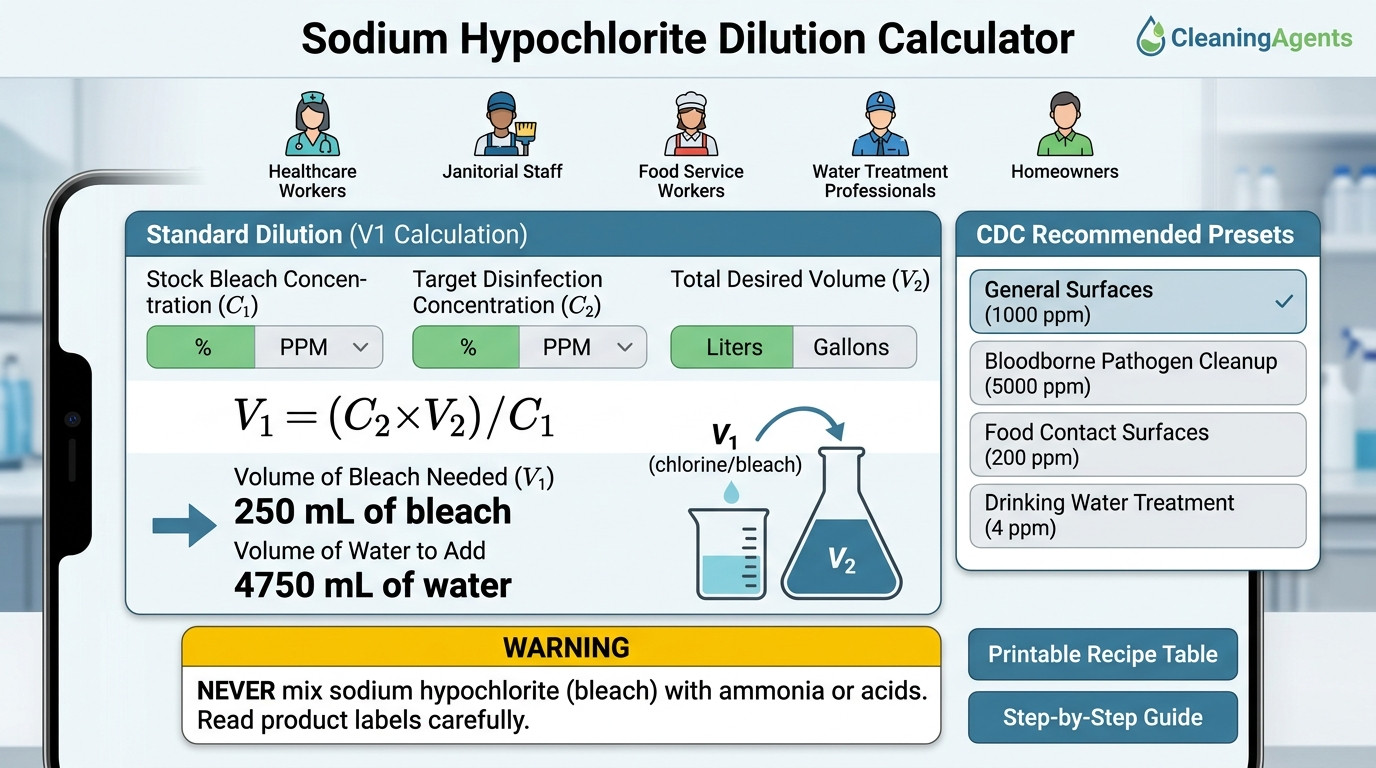
A sodium hypochlorite dilution calculator determines the exact volume of bleach needed to achieve a target disinfection concentration (in ppm or %) for a specific total volume. For example, to make 1 liter of 1000 ppm disinfectant from 5.25% household bleach: you need 19 mL of bleach + 981 mL of water. According to the CDC (Centers for Disease Control and Prevention), sodium hypochlorite (bleach) is one of the most effective and widely used disinfectants, but the correct concentration varies by application: 1000 ppm for general surfaces, 5000 ppm for bloodborne pathogens, and 200 ppm for food contact surfaces. This sodium hypochlorite dilution calculator includes CDC-recommended presets, PPM-to-% conversions, and safety reminders for every calculation.
NEVER MIX BLEACH WITH AMMONIA, ACIDS (including vinegar), OR OTHER CLEANING PRODUCTS. Mixing bleach with ammonia produces toxic chloramine gas. Mixing bleach with acids produces toxic chlorine gas. Both can be fatal. Always use bleach in well-ventilated areas. Wear chemical-resistant gloves and eye protection when handling concentrated bleach (>5%). Never use bleach on food directly. Bleach solutions degrade over time—prepare fresh solutions daily for critical disinfection. This sodium hypochlorite dilution calculator assumes fresh bleach; reduce concentration by 10-20% for bleach older than 6 months.
📋 Table of Contents
▼- What a Sodium Hypochlorite Dilution Calculator Does
- Understanding Bleach Concentrations and PPM
- CDC-Recommended Concentrations by Application
- Real Scenarios Where Bleach Dilution Errors Matter
- Common Sodium Hypochlorite Dilution Mistakes
- Expert Perspectives on Disinfection Accuracy
- Frequently Asked Questions
- Sodium Hypochlorite Best Practices
- Trusted Reference Resources
- Leave a Review
What a Sodium Hypochlorite Dilution Calculator Does
A sodium hypochlorite dilution calculator is a specialized tool that computes the exact volume of bleach (NaOCl solution) needed to achieve a target disinfection concentration (in ppm or %) for a specific total volume. It uses the formula V₁ = (C₂ × V₂) ÷ C₁, where concentrations are converted to a common unit (ppm). According to the Centers for Disease Control and Prevention (CDC), sodium hypochlorite dilution calculators should include application-specific presets, PPM-to-% conversions, and safety reminders about bleach incompatibilities.
This sodium hypochlorite dilution calculator was built specifically for healthcare workers, janitorial staff, food service workers, water treatment professionals, and homeowners who use bleach for disinfection. Unlike a general-purpose dilution calculator, this tool includes CDC-recommended presets for common applications (general surfaces at 1000 ppm, bloodborne pathogen cleanup at 5000 ppm, food contact surfaces at 200 ppm), automatic conversion between % available chlorine and PPM, and safety reminders about bleach incompatibilities (never mix with ammonia or acids).
The sodium hypochlorite dilution calculator offers four dedicated modes: (1) Standard Dilution for any stock-to-target calculation, (2) Disinfection Presets with CDC-recommended concentrations, (3) PPM Converter for unit translations, and (4) Volume Calculator for quick “how much bleach for X gallons” answers. Every mode includes step-by-step solutions, a visual flask diagram, a printable recipe table, and safety reminders.
Whether you are preparing a 1000 ppm surface disinfectant for a hospital, mixing a 5000 ppm solution for bloodborne pathogen cleanup, calculating bleach for drinking water treatment at 4 ppm, or determining how much bleach to add to a 5-gallon bucket for general cleaning, this sodium hypochlorite dilution calculator gives you the exact measurements and safety guidance every time.
Understanding Bleach Concentrations and PPM
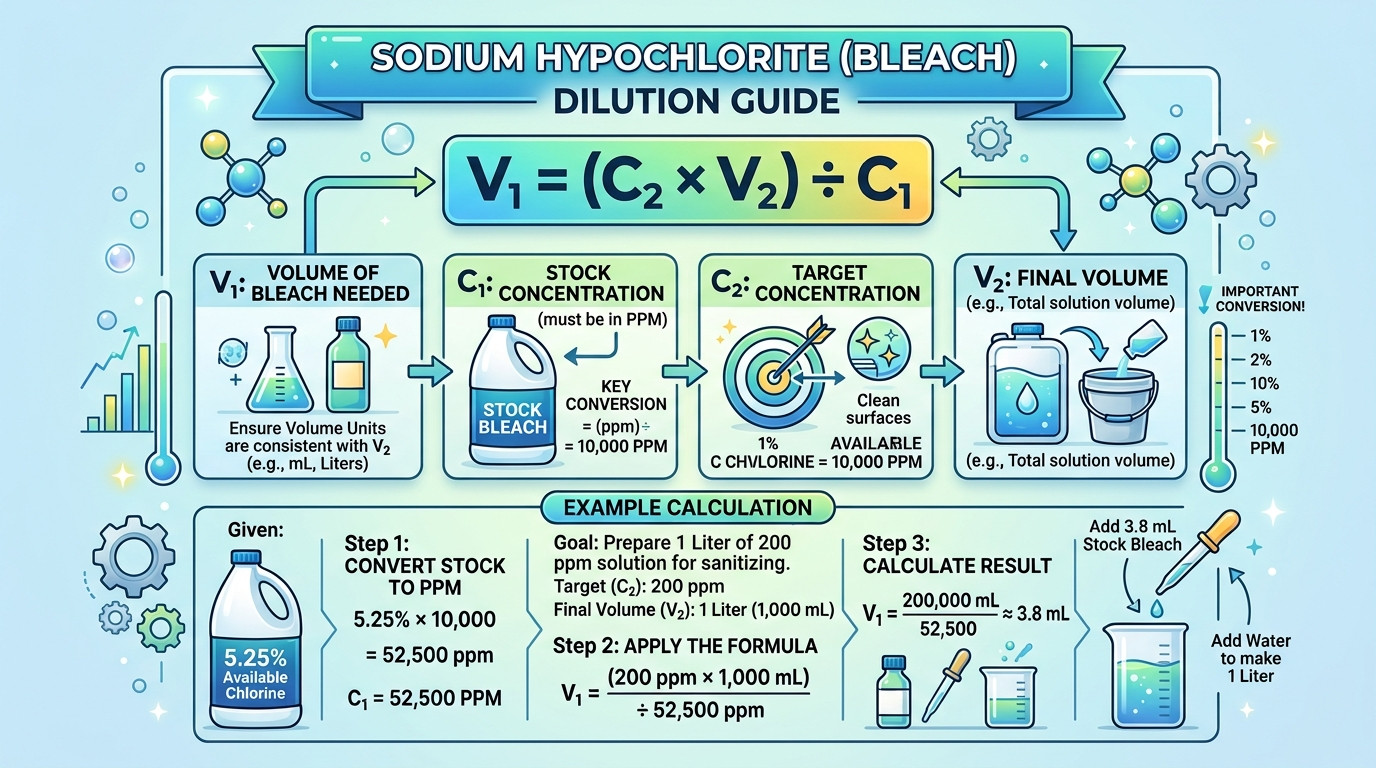
Sodium hypochlorite (NaOCl) concentrations can be expressed in multiple units, and understanding the relationships between them is essential for using the sodium hypochlorite dilution calculator correctly. According to the Environmental Protection Agency (EPA), bleach products are typically labeled in % available chlorine, while disinfection guidelines use ppm (parts per million).
C₂ = target concentration (ppm) | V₂ = final volume
Key conversion: 1% available chlorine = 10,000 ppm
Example: 5.25% bleach = 52,500 ppm
The PPM-to-% Conversion
The most important conversion for the sodium hypochlorite dilution calculator is: 1% available chlorine = 10,000 ppm. This means:
- 5.25% household bleach = 52,500 ppm
- 6% bleach = 60,000 ppm
- 8.25% concentrated bleach = 82,500 ppm
- 10% industrial bleach = 100,000 ppm
- 12.5% pool-grade bleach = 125,000 ppm
- 15% industrial strength = 150,000 ppm
Common Bleach Products and Concentrations
| Product | % Available Cl | PPM | Common Use |
|---|---|---|---|
| Regular household bleach | 5.25% | 52,500 | General disinfection |
| Concentrated bleach | 6.0% | 60,000 | Healthcare, food service |
| Ultra-concentrated | 8.25% | 82,500 | Industrial cleaning |
| Industrial bleach | 10-12.5% | 100,000-125,000 | Water treatment, pools |
| Pool shock | 10-15% | 100,000-150,000 | Pool/spa chlorination |
most common
CDC general
CDC bloodborne
FDA food code
residual
all calculations
⚠️ CRITICAL: The sodium hypochlorite dilution calculator assumes fresh bleach. Sodium hypochlorite degrades over time, losing approximately 20% of its available chlorine per year at room temperature. For bleach older than 6 months, increase the calculated volume by 10-20% or use a chlorine test strip to verify the actual concentration before diluting. According to OSHA guidelines, always check the expiration date and look for a strong chlorine odor as indicators of freshness.
CDC-Recommended Concentrations by Application
The sodium hypochlorite dilution calculator includes CDC-recommended presets for the most common disinfection applications. According to the CDC Guidelines for Disinfection and Sterilization in Healthcare Facilities, the following concentrations are recommended:
General Surface Disinfection (1000 ppm / 0.1%)
For routine disinfection of hard, non-porous surfaces in homes, offices, schools, and healthcare facilities. Contact time: 1 minute. The sodium hypochlorite dilution calculator shows that for 1 liter of 1000 ppm from 5.25% bleach: V₁ = (1000 × 1000) ÷ 52500 = 19 mL bleach + 981 mL water. This is approximately a 1:52 dilution.
Bloodborne Pathogen Cleanup (5000 ppm / 0.5%)
For cleaning up blood, body fluids, or other potentially infectious materials. Required by OSHA Bloodborne Pathogens Standard (29 CFR 1910.1030). Contact time: 10 minutes. For 1 liter of 5000 ppm from 5.25% bleach: V₁ = (5000 × 1000) ÷ 52500 = 95 mL bleach + 905 mL water. This is approximately a 1:10 dilution.
Food Contact Surfaces (200 ppm / 0.02%)
For sanitizing food preparation surfaces, cutting boards, and utensils. Per the FDA Food Code, a 200 ppm chlorine solution is effective for food contact surface sanitization. Contact time: 1 minute, then air dry (no rinse required at this concentration). For 1 liter: V₁ = (200 × 1000) ÷ 52500 = 3.8 mL bleach + 996 mL water.
Drinking Water Treatment (0.5-4 ppm)
For emergency water purification, the EPA recommends 1/8 teaspoon (approximately 0.6 mL) of 5.25% bleach per gallon of clear water, producing approximately 4 ppm free chlorine. Wait 30 minutes before drinking. The sodium hypochlorite dilution calculator’s preset mode handles this calculation automatically.
Real Scenarios Where Bleach Dilution Errors Matter
The following scenarios show why using a sodium hypochlorite dilution calculator correctly is critical in real-world settings.
Scenario 1: The Hospital Janitor and the Ineffective Disinfectant
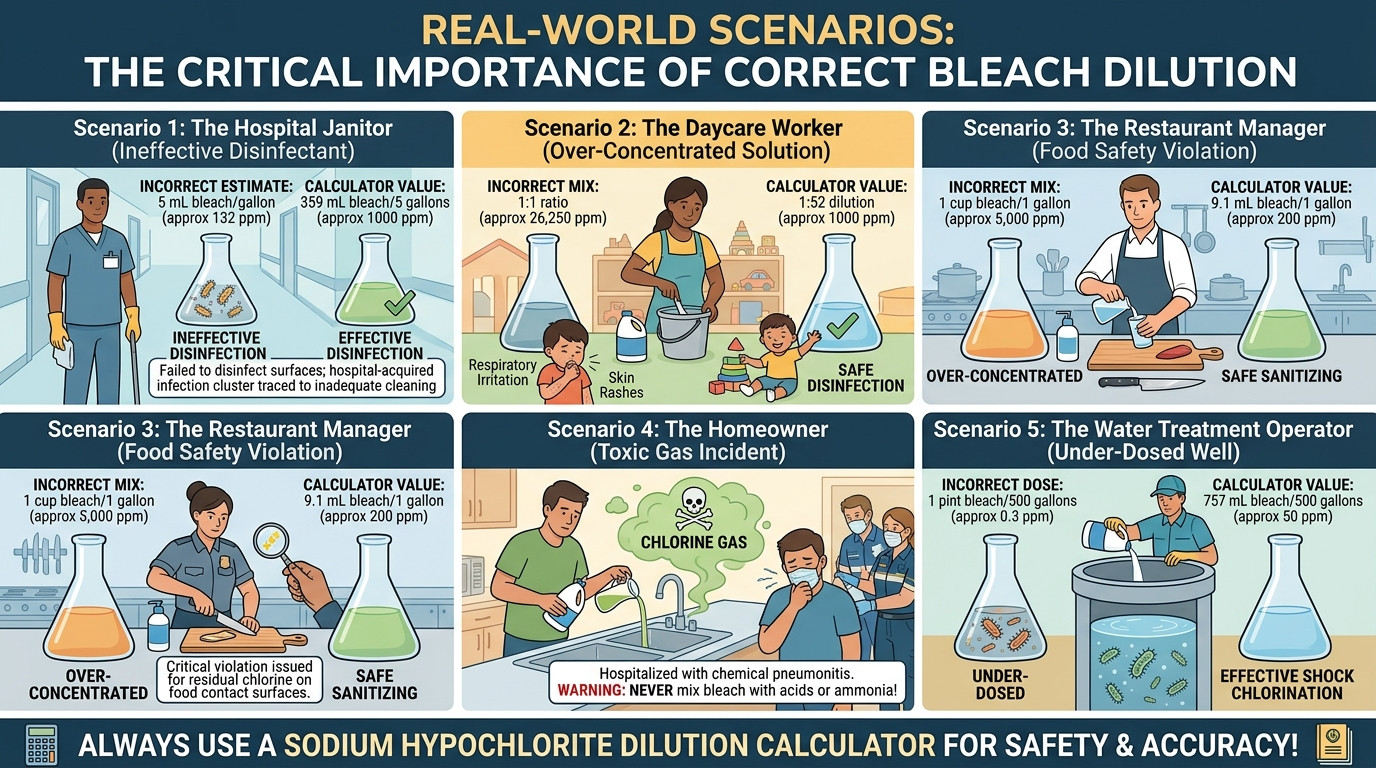
A hospital janitor was tasked with preparing 5 gallons of 1000 ppm surface disinfectant from 5.25% bleach. Without using the sodium hypochlorite dilution calculator, the janitor estimated “a capful of bleach per gallon” and added approximately 5 mL per gallon (25 mL total in 5 gallons = 18,927 mL). The resulting concentration was only 132 ppm—far below the 1000 ppm needed for effective disinfection. Surfaces were not properly disinfected, and a hospital-acquired infection cluster was later traced to inadequate environmental cleaning. The sodium hypochlorite dilution calculator would have shown: 19 mL per liter × 18.9 L = 359 mL bleach for 5 gallons.
Scenario 2: The Daycare Worker and the Over-Concentrated Solution
A daycare worker mixed “1 part bleach to 1 part water” for toy disinfection, creating a 1:2 dilution (approximately 26,250 ppm from 5.25% bleach). This is 26 times stronger than the recommended 1000 ppm for general surfaces. Several children developed respiratory irritation and skin rashes from the over-concentrated solution. The sodium hypochlorite dilution calculator would have shown the correct 1:52 dilution (19 mL bleach per liter) for safe surface disinfection, preventing the children’s exposure to excessive chlorine.
Scenario 3: The Restaurant Manager and the Food Safety Violation
A restaurant manager prepared a sanitizing solution for food contact surfaces by adding 1 cup (237 mL) of 8.25% bleach to 1 gallon (3785 mL) of water. The resulting concentration was approximately 5,000 ppm—25 times higher than the FDA-recommended 200 ppm for food contact surfaces. A health inspector detected residual chlorine on cutting boards and issued a critical violation. The sodium hypochlorite dilution calculator would have shown: for 200 ppm in 1 gallon from 8.25% bleach, only 9.1 mL (approximately 2 teaspoons) of bleach is needed.
Scenario 4: The Homeowner and the Toxic Gas Incident
A homeowner mixed bleach with vinegar to create a “stronger” cleaning solution, not knowing that mixing bleach (sodium hypochlorite) with an acid (acetic acid in vinegar) produces toxic chlorine gas. The homeowner was hospitalized with chemical pneumonitis. The sodium hypochlorite dilution calculator includes prominent safety warnings: NEVER mix bleach with acids, ammonia, or other cleaning products. This warning appears in every calculation result and in the safety box at the top of the page.
Scenario 5: The Water Treatment Operator and the Under-Dosed Well
A water treatment operator was shock-chlorinating a private well and needed to achieve 50 ppm free chlorine in 500 gallons of water. Without the sodium hypochlorite dilution calculator, the operator added 1 pint (473 mL) of 12.5% bleach. The resulting concentration was only 0.3 ppm—far below the 50 ppm needed for effective well disinfection. The well remained contaminated with coliform bacteria. The sodium hypochochlorite dilution calculator would have shown: V₁ = (50 × 1892.5 L) ÷ 125,000 = 757 mL (approximately 3.2 cups) of 12.5% bleach for 500 gallons at 50 ppm.
Common Sodium Hypochlorite Dilution Mistakes
Even experienced professionals make errors when diluting bleach. The sodium hypochlorite dilution calculator prevents most of them, but knowing why they happen helps you stay vigilant.
Mistake 1: Confusing % and PPM
The most common error is confusing % available chlorine with ppm. A 1% solution is 10,000 ppm, not 1 ppm. If a protocol calls for 1000 ppm and you prepare a 1% solution instead, you have created a solution 10 times too concentrated. The sodium hypochlorite dilution calculator automatically converts between % and ppm to prevent this error.
Mistake 2: Using the Wrong Stock Concentration
Household bleach comes in multiple concentrations: 5.25%, 6%, 8.25%, and 10%. Using the wrong concentration in your calculation produces the wrong volume. Always check the label on your bleach bottle and enter the exact concentration into the sodium hypochlorite dilution calculator.
Mistake 3: Mixing Bleach with Incompatible Products
Never mix bleach with ammonia (produces toxic chloramine gas), acids including vinegar (produces toxic chlorine gas), or alcohol (produces chloroform). The sodium hypochlorite dilution calculator includes this warning in every calculation result. Always use bleach with plain water only.
Mistake 4: Not Accounting for Bleach Degradation
Sodium hypochlorite loses approximately 20% of its available chlorine per year at room temperature. A bottle of 5.25% bleach that is 1 year old may actually be only 4.2% available chlorine. The sodium hypochlorite dilution calculator assumes fresh bleach—for older bleach, increase the calculated volume by 10-20% or verify with a chlorine test strip.
Mistake 5: Using Hot Water
Hot water accelerates the decomposition of sodium hypochlorite, reducing the effective concentration of the disinfectant solution. Always use cold or room-temperature water when preparing bleach solutions. The sodium hypochlorite dilution calculator assumes room-temperature water in all calculations.
💡 Rule of Thumb: Always use the sodium hypochlorite dilution calculator to get the exact volume, check the bleach label for the correct stock concentration, use only cold or room-temperature water, never mix with other chemicals, and prepare fresh solutions daily. These five practices, supported by this sodium hypochlorite dilution calculator, cover virtually every disinfection scenario safely and effectively.
Expert Perspectives on Disinfection Accuracy
The professionals who work with sodium hypochlorite daily share consistent advice about what separates effective disinfection from dangerous failures.
“In 20 years of infection control, I have investigated dozens of hospital-acquired infection clusters linked to inadequate environmental disinfection, and nearly every case involved a bleach dilution error—usually too dilute to be effective. A sodium hypochlorite dilution calculator that includes CDC-recommended presets is not just a convenience—it is a patient safety tool. Every janitorial cart should have a printed copy of the correct dilution for each application.”
“The confusion between ‘1:10’ and ‘1:100’ is the single most common error I see in food service establishments. A 1:10 dilution of household bleach produces approximately 5,250 ppm—far too concentrated for food contact surfaces. The FDA recommends 200 ppm for food contact surfaces, which is approximately a 1:260 dilution. The sodium hypochlorite dilution calculator eliminates this confusion by showing the exact volumes for each application.”
“For emergency water purification, the difference between 2 ppm and 4 ppm is the difference between safe drinking water and potential waterborne illness. I always recommend using the sodium hypochlorite dilution calculator to get the exact volume for your water volume, then verifying with a chlorine test strip. This is especially critical for well chlorination, where under-dosing can leave coliform bacteria alive.”
Frequently Asked Questions About Sodium Hypochlorite Dilution
These questions come from healthcare workers, janitorial staff, food service workers, and homeowners who use the sodium hypochlorite dilution calculator in their daily practice.
The sodium hypochlorite dilution calculator shows: V₁ = (1000 × 3785) ÷ 52500 = 72 mL. For 6% bleach: 63 mL. For 8.25% bleach: 46 mL.
The sodium hypochlorite dilution calculator’s Disinfection Presets mode includes both concentrations with CDC-recommended contact times.
Always check the label for the exact concentration and use the sodium hypochlorite dilution calculator to determine the correct volume for your application.
The sodium hypochlorite dilution calculator includes this reminder in every calculation result.
The sodium hypochlorite dilution calculator’s “Food contact surfaces” preset calculates the exact volume for 200 ppm.
The sodium hypochlorite dilution calculator’s “Drinking water treatment” preset handles this calculation for any volume of water.
The sodium hypochlorite dilution calculator includes this warning prominently in every calculation result and in the safety box.
The sodium hypochlorite dilution calculator’s PPM Converter mode handles this conversion automatically for any value.
For hard surfaces, the sodium hypochlorite dilution calculator can calculate the correct volume for 5000 ppm (effective against surface mold).
The sodium hypochlorite dilution calculator’s Volume Calculator mode handles pool volumes in gallons and converts automatically.
Sodium Hypochlorite Best Practices
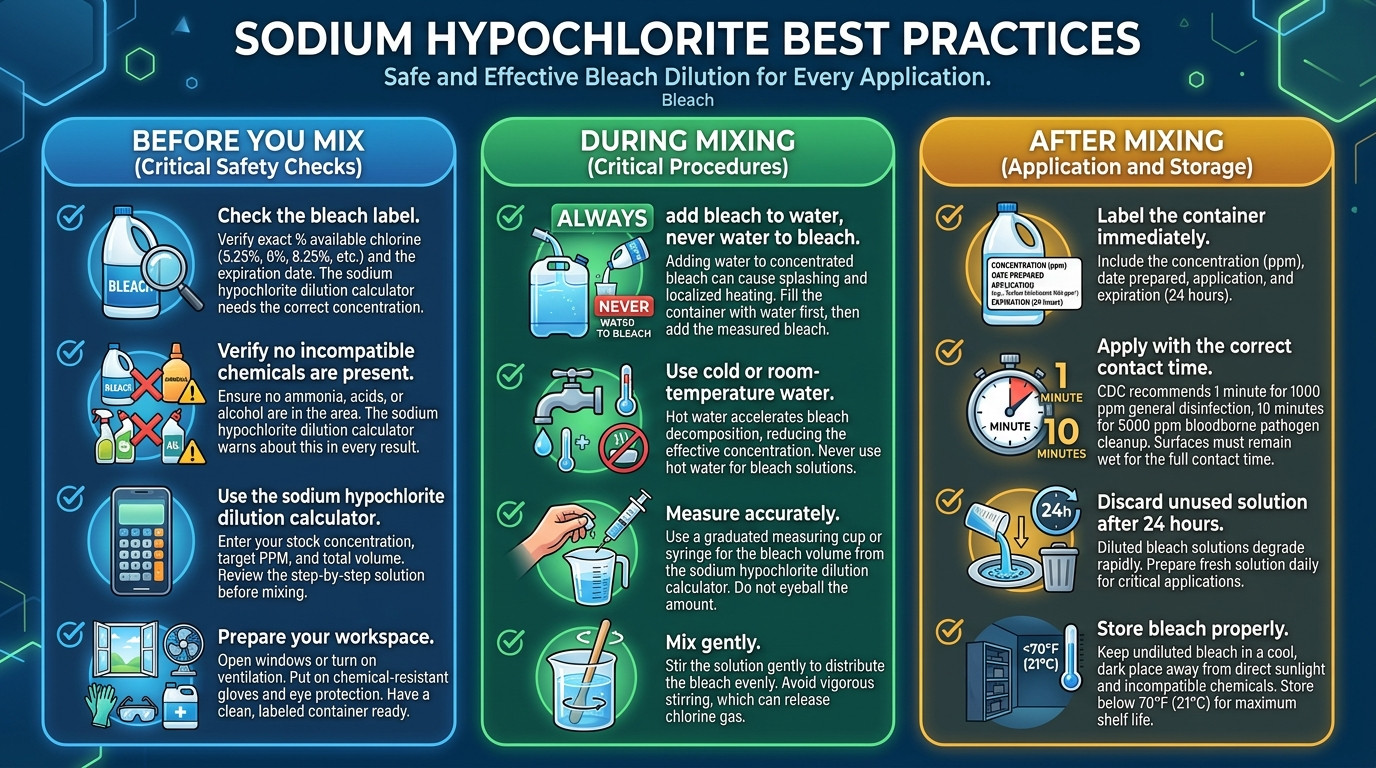
These practices ensure safe and effective bleach dilution for every application.
Before You Mix (Critical Safety Checks)
During Mixing (Critical Procedures)
After Mixing (Application and Storage)
Trusted Reference Resources
These are the authoritative references that healthcare workers, food service professionals, and water treatment operators rely on for sodium hypochlorite dilution guidance.
Centers for Disease Control and Prevention (CDC) — cdc.gov — Provides guidelines for disinfection and sterilization in healthcare facilities, including recommended sodium hypochlorite concentrations for surface disinfection (1000 ppm), bloodborne pathogen cleanup (5000 ppm), and food contact surfaces (200 ppm).
Environmental Protection Agency (EPA) — epa.gov — Registers sodium hypochlorite as an antimicrobial pesticide and provides guidelines for drinking water treatment, pool chlorination, and environmental disinfection.
Occupational Safety and Health Administration (OSHA) — osha.gov — Sets workplace safety standards for handling concentrated bleach, including PPE requirements, exposure limits, and the Bloodborne Pathogens Standard (29 CFR 1910.1030) requiring 5000 ppm for blood cleanup.
Food and Drug Administration (FDA) — fda.gov — The FDA Food Code recommends 200 ppm chlorine for food contact surface sanitization. Higher concentrations require rinsing with potable water.
World Health Organization (WHO) — who.int — Provides guidelines for emergency water treatment using sodium hypochlorite, including dosing for household water treatment and well chlorination.
On our platform, the full suite of related tools includes the all-in-one dilution calculator, bleach dilution calculator, hydrogen peroxide dilution calculator, pool chlorine calculator, PPM calculator, solution dilution calculator, dilution factor calculator, mixing ratio calculator, percentage dilution calculator, and chemical mixing calculator.
Leave a Review
Used this sodium hypochlorite dilution calculator in your hospital, restaurant, or home? Share your experience below. Your review helps other professionals decide if this sodium hypochlorite dilution calculator fits their disinfection needs. Every review is stored locally on your device and appears instantly.
📝 Share Your Experience
Final Thoughts on Safe Sodium Hypochlorite Disinfection
Sodium hypochlorite (bleach) is one of the most effective and widely used disinfectants in healthcare, food service, water treatment, and household cleaning. The difference between effective disinfection and a dangerous failure often comes down to a single calculation: the correct volume of bleach for your target concentration and total volume.
What matters is not just getting the volume right. It is having the right tool and the right habits: use the sodium hypochlorite dilution calculator to get the exact volume, check the bleach label for the correct concentration, always add bleach to water (never the reverse), never mix with incompatible chemicals, and prepare fresh solutions daily. Those five practices, supported by this sodium hypochlorite dilution calculator, cover virtually every disinfection scenario safely and effectively.
The breadth of where sodium hypochlorite appears—from hospital operating rooms and restaurant kitchens to private wells and swimming pools—reflects how fundamental this chemical is to modern public health. This sodium hypochlorite dilution calculator is designed to make that work accurate, safe, and CDC-compliant every time. Bookmark this page as your starting point for any bleach dilution task, and explore the main dilution calculator when you need additional modes for non-bleach dilutions.
🔒 Privacy Guarantee: Every calculation on this page runs entirely within your browser. No data—whether concentrations, volumes, or any other inputs—is transmitted to any external server, stored in any database, or shared with any third party. Your sodium hypochlorite dilution calculations are completely private.
[sodium_hypochlorite_dilution_calculator]
How Sodium Hypochlorite Dilution Works
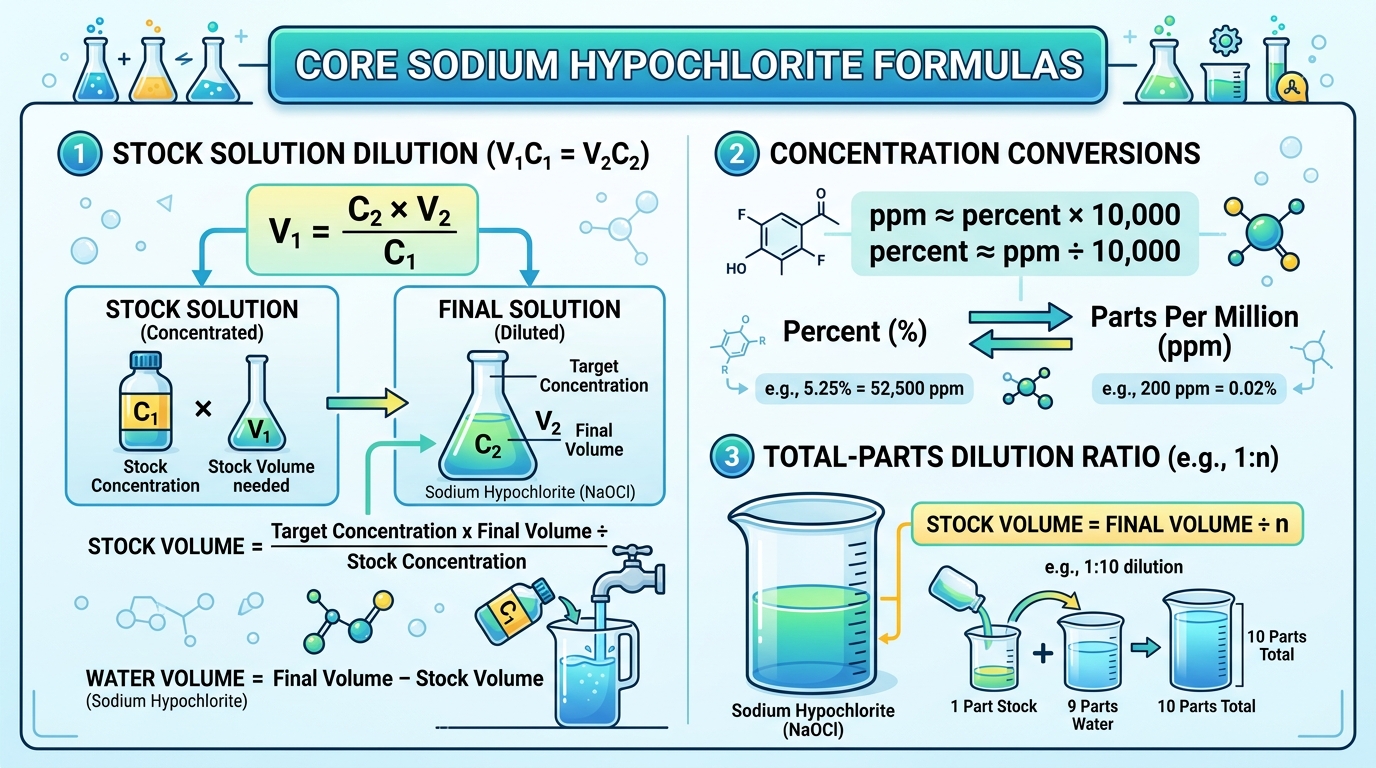
Sodium hypochlorite dilution is the controlled reduction of a stronger bleach solution into a weaker working solution. A Sodium Hypochlorite Dilution Calculator works because the amount of available chlorine transferred from the stock remains proportional to the stock volume. When water is added, concentration decreases but the active chlorine introduced from the measured stock volume is conserved, aside from normal chemical degradation over time.
The Sodium Hypochlorite Dilution Calculator uses the same dilution equation taught in chemistry and laboratory practice: C₁V₁ = C₂V₂. C₁ is stock concentration, V₁ is the stock volume required, C₂ is target concentration, and V₂ is final volume. Rearranged, the stock volume is V₁ = (C₂ × V₂) / C₁. This is the central formula behind percent dilution, ppm dilution, and scaled recipes.
Percent Strength and Available Chlorine
Bleach labels can be confusing because some products report sodium hypochlorite by weight, while many protocols discuss available chlorine. For practical dilution, a Sodium Hypochlorite Dilution Calculator treats the labelled percent strength as the working concentration provided by the product label. If your protocol specifically requires available chlorine and your product label gives a different basis, follow the product safety data sheet or institutional SOP. In routine field and lab use, 1% available chlorine is often approximated as 10,000 ppm available chlorine.
ppm and Percent Conversion
ppm means parts per million. For dilute aqueous chlorine solutions, 1 ppm is approximately 1 mg/L. The practical conversion used by a Sodium Hypochlorite Dilution Calculator is simple: 0.05% is about 500 ppm, 0.1% is about 1,000 ppm, 0.5% is about 5,000 ppm, and 1% is about 10,000 ppm. This conversion helps when a cleaning procedure lists ppm but the bleach bottle lists percent.
Ratio Dilution Wording
Ratio language is a frequent source of error. A 1:10 total-parts dilution means one part stock in ten total parts, so it is one part bleach plus nine parts water. If the stock is 5%, a 1:10 total-parts dilution gives about 0.5%. Some people say “one to ten” when they mean one part bleach plus ten parts water, which is eleven total parts and gives a different result. The Sodium Hypochlorite Dilution Calculator avoids ambiguity by asking for total final volume and denominator.
Degradation and Fresh Working Solutions
Sodium hypochlorite is not perfectly stable. Heat, light, age, metals, organic contamination, and repeated opening of containers reduce available chlorine. A Sodium Hypochlorite Dilution Calculator gives the mathematical dilution, but it cannot restore degraded stock. For critical disinfection, use fresh stock, store it cool and protected from light, verify concentration when required, and prepare working solutions according to your SOP.
Water volume = final volume − stock volume
ppm ≈ percent × 10,000
percent ≈ ppm ÷ 10,000
1:n total-parts dilution = final volume ÷ n stock
Quick Reference Values
Remember: the Sodium Hypochlorite Dilution Calculator provides arithmetic, not permission to ignore your product label or safety data sheet. Always follow your institution’s approved concentration, contact time, surface compatibility, and disposal requirements.
Real Scenarios Where Bleach Dilution Math Matters
Scenario 1: 5% Bleach to 0.5% Disinfectant
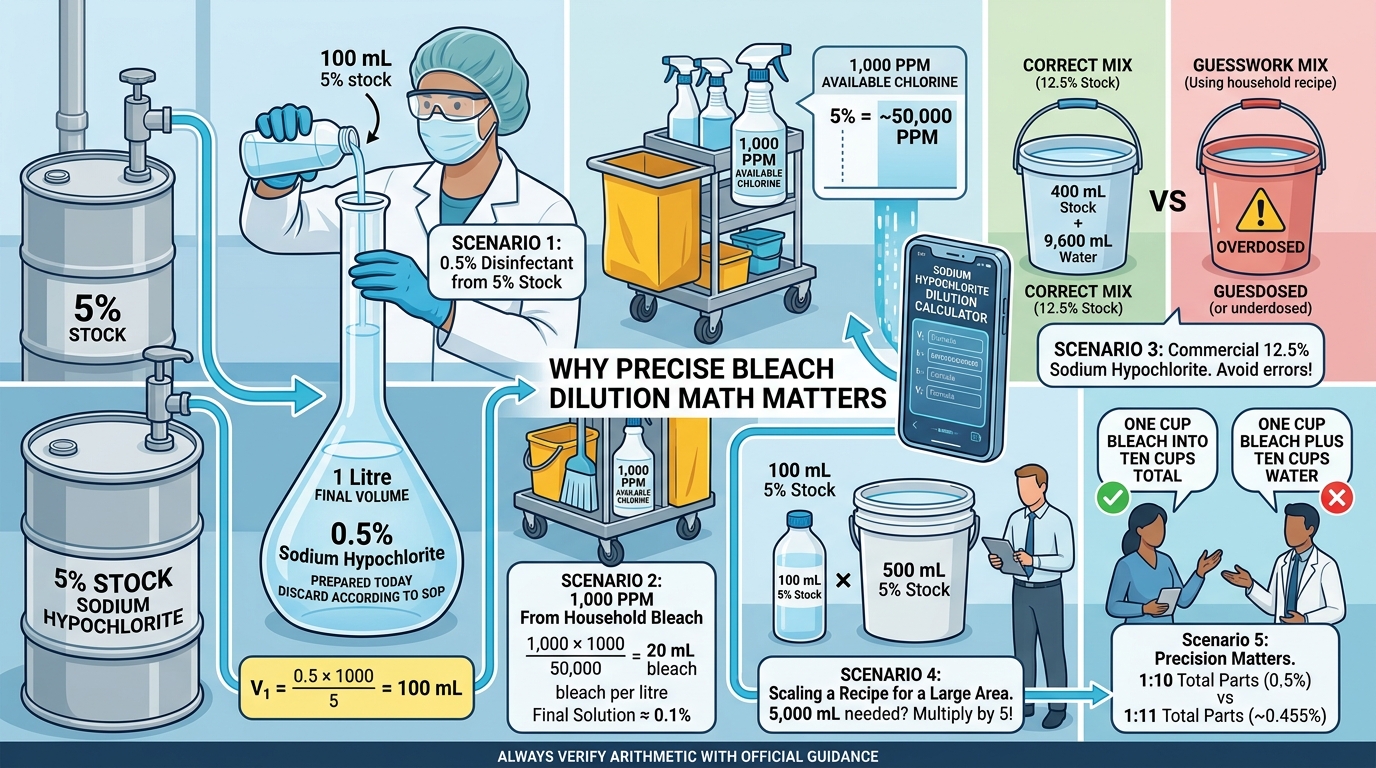
A lab needs 1 litre of 0.5% sodium hypochlorite from a 5% stock. The Sodium Hypochlorite Dilution Calculator returns V₁ = (0.5 × 1000) / 5 = 100 mL stock, with 900 mL water. This is a 1:10 total-parts dilution. The result is easy to label: 0.5% sodium hypochlorite, prepared today, discard according to SOP.
Scenario 2: 1,000 ppm From Household Bleach
A cleaning team has 5% bleach and a protocol that requires 1,000 ppm available chlorine. Because 5% is about 50,000 ppm, the Sodium Hypochlorite Dilution Calculator computes 1,000 × 1000 / 50,000 = 20 mL bleach per litre. The final solution is approximately 0.1% sodium hypochlorite.
Scenario 3: Commercial 12.5% Sodium Hypochlorite
A facility uses 12.5% commercial sodium hypochlorite. To make 10 litres of 0.5% solution, the Sodium Hypochlorite Dilution Calculator returns (0.5 × 10,000 mL) / 12.5 = 400 mL stock plus 9,600 mL water. Using a household bleach recipe would have overdosed or underdosed the mix.
Scenario 4: Scaling a Recipe for a Larger Area
A supervisor has an approved recipe of 100 mL 5% bleach brought to 1,000 mL final volume. For a large cleanup, 5,000 mL is needed. The scale mode multiplies by five: 500 mL bleach and 4,500 mL water. The Sodium Hypochlorite Dilution Calculator keeps the same concentration while changing batch size.
Scenario 5: Checking an Informal Ratio
A staff member says “mix one cup bleach into ten cups total.” With 5% stock, the final concentration is 0.5%. Another staff member says “one cup bleach plus ten cups water,” which is 11 total cups and about 0.455%. The Sodium Hypochlorite Dilution Calculator highlights why ratio wording must be precise.
Scenario 6: Water Treatment Emergency Planning
Emergency plans may reference ppm chlorine targets. A Sodium Hypochlorite Dilution Calculator can translate stock percent into ppm, but drinking-water treatment must follow official public-health instructions, not general surface-disinfection recipes. The calculator is useful for arithmetic, while the approved guidance determines the target.
Common Sodium Hypochlorite Dilution Mistakes
Mistake 1: Confusing ppm With Percent
5,000 ppm is about 0.5%, not 5%. This tenfold error is one of the main reasons to use a Sodium Hypochlorite Dilution Calculator. Always convert ppm to percent by dividing by 10,000.
Mistake 2: Using the Wrong Stock Strength
Household bleach, low-splash bleach, disinfecting bleach, and commercial sodium hypochlorite can have very different strengths. The Sodium Hypochlorite Dilution Calculator only works when the stock percentage entered matches the product being used.
Mistake 3: Misreading 1:10 Dilution
One part bleach plus nine parts water is a 1:10 total-parts dilution. One part bleach plus ten parts water is a 1:11 total-parts mixture. The Sodium Hypochlorite Dilution Calculator uses exact final volume to remove this ambiguity.
Mistake 4: Mixing Bleach With Acid or Ammonia
Sodium hypochlorite can release hazardous chlorine or chloramine gases when mixed with acids, vinegar, ammonia, toilet cleaners, descalers, or unknown chemicals. A Sodium Hypochlorite Dilution Calculator cannot make unsafe chemistry safe.
Mistake 5: Using Old or Poorly Stored Bleach
Sodium hypochlorite degrades over time. A bottle stored in a hot room or direct sun may be weaker than the label. For critical work, use fresh stock or verify available chlorine.
Mistake 6: Ignoring Contact Time
Correct dilution is only one part of disinfection. The surface must stay wet for the required contact time and must be compatible with sodium hypochlorite. Organic soil can reduce available chlorine, so pre-cleaning is often necessary.
💡 Rule of Thumb: enter the real stock strength, choose the target from your SOP, use the Sodium Hypochlorite Dilution Calculator for volumes, label the batch, ventilate, and never mix bleach with other chemicals.
Safety Essentials Before Mixing Bleach
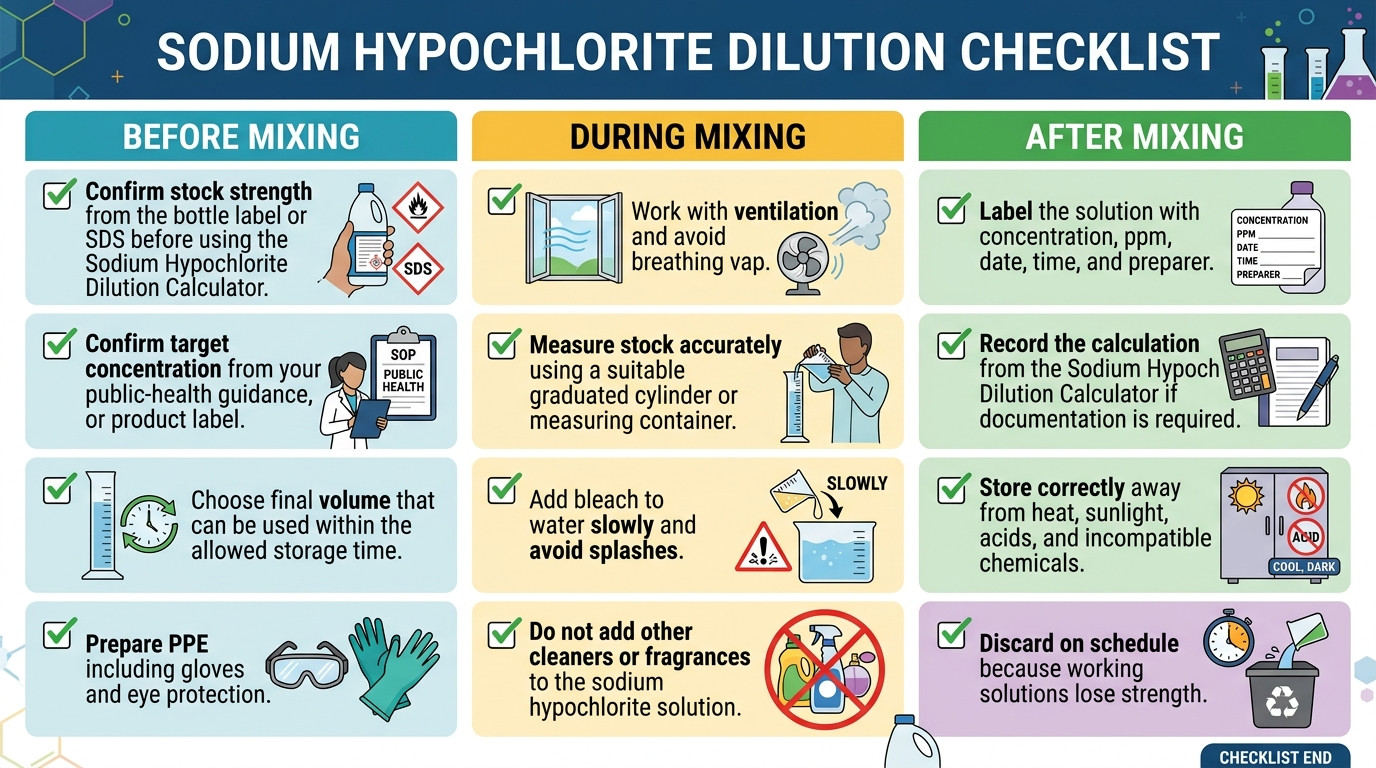
Chemical safety: Sodium hypochlorite is corrosive and reactive. Wear suitable gloves and eye protection, work in a ventilated area, add bleach to water slowly, avoid splashes, and never mix sodium hypochlorite with acids, ammonia, vinegar, toilet bowl cleaner, or unknown chemicals.
- Read the product label and safety data sheet before using the Sodium Hypochlorite Dilution Calculator.
- Use cold or room-temperature water unless your SOP states otherwise.
- Add bleach to water rather than pouring water into concentrated bleach when practical.
- Use compatible containers such as clean plastic containers dedicated to bleach solutions.
- Label every working solution with concentration, date, time, preparer, and intended use.
- Do not store in sunlight or heat; sodium hypochlorite decomposes faster.
- Dispose according to local policy and never combine leftover bleach with other waste chemicals.
Which Mode Fits Your Situation
| Mode | Use Case | Key Formula | Inputs | Applications |
|---|---|---|---|---|
| Percent Dilution | Make target % solution | C₁V₁ = C₂V₂ | Stock %, target %, final volume | 0.1%, 0.5%, 1% bleach |
| ppm Chlorine | Make target ppm | ppm = % × 10,000 | Stock %, target ppm, volume | 500 ppm, 1,000 ppm, 5,000 ppm |
| Ratio Mix | Use 1:n instructions | V stock = final/n | Stock %, ratio, volume | 1:10, 1:50, 1:100 |
| Find Final Strength | Check a prepared mix | C₂ = C₁V₁/V₂ | Stock %, stock volume, final volume | Auditing recipes |
| Scale Recipe | Resize a known recipe | Scale factor | Original and new volume | Batch preparation |
Sodium Hypochlorite Dilution in Laboratories
Labs commonly use sodium hypochlorite for bench decontamination, liquid waste treatment, and spill response. The Sodium Hypochlorite Dilution Calculator helps translate institutional SOPs into exact volumes, but the SOP controls required contact time, organic load assumptions, and disposal.
Sodium Hypochlorite Dilution in Healthcare Support Areas
Healthcare cleaning protocols may specify different chlorine concentrations for routine surfaces, blood spills, and isolation areas. A Sodium Hypochlorite Dilution Calculator helps prevent under-strength and over-strength mixes, but it should be used only with approved infection-control guidance.
Sodium Hypochlorite Dilution in Food and Facility Sanitation
Food-contact and facility sanitation may require low ppm chlorine solutions and rinsing rules. Because regulations vary by surface and jurisdiction, use the Sodium Hypochlorite Dilution Calculator for arithmetic while following the exact target and procedure in the applicable regulation or label.
Worked Examples
Example 1 — Percent dilution: 5% stock to 0.5%, final volume 1,000 mL. Stock = 100 mL, water = 900 mL.
Example 2 — ppm dilution: 5% stock to 1,000 ppm, final volume 1,000 mL. Stock ppm = 50,000 ppm. Stock = 20 mL, water = 980 mL.
Example 3 — Strong stock: 12.5% stock to 0.5%, final volume 10 L. Stock = 400 mL, water = 9.6 L.
Example 4 — Find final concentration: 250 mL of 6% bleach brought to 5,000 mL final gives 0.3% or about 3,000 ppm.
Example 5 — Ratio: A 1:50 total-parts dilution of 5% stock gives 0.1% or about 1,000 ppm.
Frequently Asked Questions
1. What is a Sodium Hypochlorite Dilution Calculator?
A Sodium Hypochlorite Dilution Calculator calculates how much bleach stock and water are needed to make a target percent, ppm, or ratio-based sodium hypochlorite solution.
2. What formula does the calculator use?
It uses C₁V₁ = C₂V₂. Stock volume equals target concentration multiplied by final volume, divided by stock concentration.
3. How do I convert percent bleach to ppm?
As a practical approximation, percent × 10,000 = ppm. So 0.1% is about 1,000 ppm and 0.5% is about 5,000 ppm.
4. How do I make 0.5% from 5% bleach?
Use one part 5% bleach in ten total parts. For 1 litre, use 100 mL bleach and 900 mL water. The Sodium Hypochlorite Dilution Calculator shows this as a 1:10 total-parts dilution.
5. Can I mix sodium hypochlorite with vinegar?
No. Do not mix sodium hypochlorite with vinegar, acids, ammonia, toilet cleaner, or unknown chemicals because hazardous gases can form.
6. Does bleach lose strength?
Yes. Sodium hypochlorite degrades with time, heat, light, and contamination. Use fresh stock for critical disinfection and follow storage instructions.
7. Is a 1:10 dilution the same as 1 plus 10?
No. A 1:10 total-parts dilution is one part stock plus nine parts water. One part stock plus ten parts water is eleven total parts.
8. Is this Sodium Hypochlorite Dilution Calculator free?
Yes. The Sodium Hypochlorite Dilution Calculator is free and browser-based. Review submissions are saved to the WordPress site database.
Sodium Hypochlorite Dilution Checklist
Before Mixing
During Mixing
After Mixing
Practical Planning Guide for Accurate Bleach Dilution
A Sodium Hypochlorite Dilution Calculator is most valuable when it is used as part of a complete preparation workflow rather than as a single arithmetic step. Start by reading the label, because bleach products are not interchangeable. Some bottles contain 3% sodium hypochlorite, many household products are around 5% to 6%, older institutional products may be 5.25%, concentrated household products may be 7.5% to 8.25%, and commercial drums may be 10% to 12.5%. The Sodium Hypochlorite Dilution Calculator should always receive the actual stock strength in your hand, not a remembered value from another product.
The second planning step is to identify the target from an approved source. A Sodium Hypochlorite Dilution Calculator can calculate 500 ppm, 1,000 ppm, 5,000 ppm, 0.1%, or 0.5%, but it cannot decide which target is appropriate for a given organism, spill, surface, or regulation. In a laboratory, the biosafety manual or spill SOP may define the concentration. In healthcare, infection-prevention guidance and product labels may define the concentration and contact time. In food or facility sanitation, local rules and label instructions may determine both concentration and whether rinsing is needed.
The third step is to select a realistic batch size. A Sodium Hypochlorite Dilution Calculator can scale a recipe to 250 mL, 1 L, 5 L, or 20 L, but larger is not always better. Sodium hypochlorite working solutions lose strength during storage, and a huge batch may sit too long. Many operations prepare fresh solution daily or at a frequency written in the SOP. Smaller batches also reduce waste and limit the amount of corrosive liquid being handled.
When preparing a small bottle, the Sodium Hypochlorite Dilution Calculator is useful because millilitre errors become proportionally large. For example, making 100 mL of 0.5% solution from 5% stock requires only 10 mL stock. Accidentally using 20 mL doubles the concentration. For a 10 L batch, a 10 mL error is less dramatic, but for a spray bottle it can be a major deviation. This is why measuring cylinders, marked bottles, or validated dispensing pumps are better than visual estimates.
When preparing a large container, the Sodium Hypochlorite Dilution Calculator prevents another type of error: forgetting to subtract the stock volume from the water volume. If the target final volume is 10 L and the calculator calls for 400 mL stock, the water volume is 9.6 L, not 10 L plus 400 mL. Adding stock on top of the full final water volume makes the batch slightly weaker than intended. The calculator result is written as stock plus water, so the final total is correct.
Another useful habit is to record both percent and ppm on the label. The Sodium Hypochlorite Dilution Calculator makes this easy because it reports approximate ppm from percent and approximate percent from ppm. A label that says “0.1% sodium hypochlorite, approximately 1,000 ppm available chlorine” is clearer for mixed teams than a label using only one unit. It also helps supervisors compare SOP language with the bottle in front of them.
A Sodium Hypochlorite Dilution Calculator is also helpful when training new staff because it shows the difference between concentration and volume. New users sometimes think that 100 mL of 5% bleach and 100 mL of 10% bleach are equivalent because the volume is the same. They are not. The 10% stock contains roughly twice the available chlorine. The calculator forces the user to enter stock strength, which makes this difference visible in the result.
For audit trails, the Sodium Hypochlorite Dilution Calculator output can be copied into a log: date, stock lot, stock concentration, target concentration, final volume, stock volume, water volume, preparer, and verification. This is especially useful in regulated environments where dilution records must be reviewed. The arithmetic steps reduce ambiguity and make it easier to identify whether a deviation came from stock strength, target selection, measuring error, or storage time.
The Sodium Hypochlorite Dilution Calculator should not be used to override compatibility warnings. Sodium hypochlorite can corrode metals, discolor fabrics, damage some plastics, irritate skin and eyes, and react with residues left by other cleaners. A mathematically correct 0.5% solution may still be wrong for a sensitive instrument or surface. Always check surface compatibility and rinse requirements from the label or SOP.
If organic matter is present, a Sodium Hypochlorite Dilution Calculator only solves part of the problem. Blood, soil, proteins, and other organic loads can consume available chlorine. Many disinfection procedures require cleaning first, then applying the sodium hypochlorite solution for a defined wet contact time. Without pre-cleaning, even a correctly diluted solution may not perform as expected.
The Sodium Hypochlorite Dilution Calculator is also useful for reverse checking a recipe found online or in an old manual. Enter the stock strength, the stock volume, and the final volume in the final-strength mode. If the final percent or ppm does not match the stated target, the recipe may be using a different stock strength, a different ratio convention, or an outdated bleach concentration. This check is safer than copying informal recipes blindly.
Finally, use the Sodium Hypochlorite Dilution Calculator consistently. Switching between mental math, cup measures, old laminated cards, and informal ratios increases variation. A single calculator workflow gives the same answer every time, helps staff learn the relationship between percent and ppm, and supports safer mixing habits. The goal is not just a correct number; the goal is a repeatable sodium hypochlorite preparation process that is accurate, documented, and safe.
Trusted Reference Resources
CDC Environmental Cleaning and Disinfection — CDC bleach cleaning and disinfecting guidance for disinfectant selection, safety, and contact time.
WHO chlorine solution guidance — Emergency and infection-prevention resources that explain chlorine concentrations and safe preparation.
EPA disinfectant labels — EPA pesticide and disinfectant label guidance is legally important for concentration, contact time, surface compatibility, and use sites.
Safety Data Sheet for your product — Always consult the SDS for sodium hypochlorite hazards, PPE, first aid, storage, and incompatibilities.
User Reviews & Ratings
Share Your Experience with This Sodium Hypochlorite Dilution Calculator
Documentation, Labels, Contact Time, and Quality Control
Accurate dilution is only useful when the prepared solution can be identified later. After using a Sodium Hypochlorite Dilution Calculator, label the container immediately. A strong label includes the final percent, approximate ppm, preparation date, preparation time, preparer initials, intended use, and expiry or discard time. For example: “0.5% sodium hypochlorite, about 5,000 ppm, prepared 2026-06-28 at 10:00, for spill response, discard end of shift.” This makes the bottle usable by another trained person without guessing.
A Sodium Hypochlorite Dilution Calculator also supports documentation in quality systems. If a facility keeps a disinfectant preparation log, the log should show the stock concentration, stock lot number, target concentration, final volume, measured stock volume, measured water volume, and any verification result. This is especially helpful when different stock strengths are used at different times. A 5% bottle, a 6% bottle, and a 12.5% drum all require different stock volumes for the same final target.
Contact time is a separate variable from concentration. The Sodium Hypochlorite Dilution Calculator can tell you how to make a 0.1% or 0.5% solution, but the label or SOP tells you how long the surface must remain wet. If the solution dries too quickly, the effective exposure time may be shorter than required. In practice, correct dilution, full surface coverage, adequate wet time, and pre-cleaning all work together.
Quality control may be simple or formal. In a small workplace, quality control may mean preparing fresh solution daily and checking that labels are complete. In a laboratory or production environment, quality control may include test strips, titration, documented lot numbers, and supervisor review. A Sodium Hypochlorite Dilution Calculator fits into either system because it standardises the arithmetic and reduces variation between preparers.
Test strips can be useful when available chlorine must be verified. The Sodium Hypochlorite Dilution Calculator predicts the target, but a strip or titration can detect degraded stock, measuring mistakes, or contamination. Verification is especially important for critical applications, old bleach, high-temperature storage, or situations where the solution contacts heavy organic load. The calculator result and the test result should be reasonably consistent, allowing for the accuracy limits of the test method.
Containers matter. A Sodium Hypochlorite Dilution Calculator may say to prepare 1,000 mL, but the container must safely hold that volume with headspace for mixing. Do not use containers that previously held acids, ammonia products, solvents, or unknown materials. Residues can react with sodium hypochlorite. Use clean, compatible plastic containers when possible, and do not store bleach solution in unlabelled drink bottles.
Measuring tools matter as well. When the Sodium Hypochlorite Dilution Calculator returns 20 mL stock for a 1,000 ppm solution, a rough splash from a bottle cap is not good enough. Use a measuring cylinder, syringe, dosing cup, or calibrated pump suitable for corrosive liquid. Rinse or dedicate equipment according to your facility procedure. Accuracy of measurement is the real-world partner of calculator accuracy.
Temperature and storage conditions influence the useful life of the prepared solution. A Sodium Hypochlorite Dilution Calculator cannot predict every degradation rate, but it can remind users that fresh solutions are more reliable. Heat and sunlight accelerate loss of available chlorine. Organic contamination can consume chlorine quickly. If a container is repeatedly opened, dipped into, or topped up, the actual strength may drift away from the calculated strength.
For training, a Sodium Hypochlorite Dilution Calculator is valuable because it makes invisible chemistry visible. Staff can see that 0.5% is ten times stronger than 0.05%, that 5,000 ppm is not the same as 5%, and that a 12.5% stock requires much less volume than a 5% stock. These lessons reduce dependence on memorised recipes and help workers adapt when supply chains change and a different bleach strength is purchased.
For emergency response, a Sodium Hypochlorite Dilution Calculator can quickly scale a known recipe. However, emergency use should still follow official instructions. Some situations require specific concentrations, special PPE, ventilation, pre-cleaning, neutralisation, or professional remediation. The calculator gives the dilution math; the emergency plan gives the decision-making framework.
For home users, a Sodium Hypochlorite Dilution Calculator can reduce common mistakes, but product labels remain the first authority. Many household products are scented, thickened, splashless, or blended with surfactants. These products may not be appropriate for all disinfection or water-treatment uses. Use plain, unscented sodium hypochlorite when a protocol requires it, and never assume that every product labelled “bleach” behaves the same way.
For environmental and equipment protection, a Sodium Hypochlorite Dilution Calculator can help avoid excessive concentrations. More bleach is not always better. Overly strong solutions can corrode stainless steel, damage rubber seals, fade surfaces, irritate workers, and increase fumes. The best solution is the approved concentration that achieves the intended purpose with the least unnecessary chemical burden.
When reviewing older documents, a Sodium Hypochlorite Dilution Calculator can uncover outdated assumptions. Many old recipes were written for 5.25% bleach. If the current product is 7.5% or 8.25%, the same recipe produces a stronger final solution. If the current product is 3%, the same recipe produces a weaker final solution. Updating recipes with calculator-verified volumes prevents silent drift in disinfection practice.
Another useful practice is to standardise units before mixing. The Sodium Hypochlorite Dilution Calculator accepts millilitres in the tool, but the concept works for litres, gallons, or ounces if units remain consistent. Problems occur when users mix units accidentally, such as entering litres as millilitres or interpreting a gallon recipe with a litre container. For shared SOPs, write one unit system clearly and train staff to use it consistently.
Some workplaces prepare intermediate dilutions. A Sodium Hypochlorite Dilution Calculator can be used for each step, but each intermediate solution adds another opportunity for error and degradation. Whenever possible, dilute directly from the verified stock to the final target. If intermediate solutions are required, label them clearly and document both steps.
In summary, the Sodium Hypochlorite Dilution Calculator is the calculation engine inside a broader safe-preparation workflow. It helps determine the correct stock volume and water volume, converts percent to ppm, checks final strength, and scales recipes. The user still controls stock selection, PPE, ventilation, measurement accuracy, labelling, storage, contact time, and disposal. When those pieces are combined, sodium hypochlorite dilution becomes repeatable, auditable, and much safer.
Storage, Compatibility, and Practical Use Notes
Storage conditions can change the real strength of a bleach solution after it has been prepared. Keep diluted solutions in clean, closed, clearly labelled containers. Avoid transparent containers in direct sunlight, hot storage rooms, and locations near acids or ammonia products. If a working bottle is used throughout the day, train staff not to dip dirty cloths, brushes, or tools into the container because organic contamination consumes available chlorine and can make the solution weaker than expected.
Surface compatibility is just as important as concentration. Sodium hypochlorite can damage some metals, rubber seals, fabrics, painted surfaces, and sensitive equipment. Stainless steel may tolerate brief contact at approved concentrations, but repeated exposure or failure to rinse when required can cause corrosion. For electronics, optical instruments, incubator parts, and delicate laboratory equipment, follow the manufacturer’s cleaning instructions instead of assuming bleach is acceptable.
Organic load changes performance. Blood, serum, food residue, soil, biofilm, and other organic material can react with chlorine before disinfection is complete. This is why many procedures require a cleaning step before the chlorine solution is applied. The calculator can prepare the target mix, but it cannot compensate for a dirty surface, short contact time, or incomplete coverage. A surface must remain visibly wet for the required time if the procedure specifies wet contact.
Water quality may also matter. In most routine situations, clean tap water is used for surface disinfectant preparation, but some specialised procedures require deionised, distilled, or otherwise controlled water. Hard water, high organic content, or contaminated containers can affect solution quality. When a regulated protocol specifies water type, use that water type and do not substitute without approval.
Do not “top up” an old bottle unless your SOP specifically allows it. Adding new solution to old solution makes it difficult to know the actual concentration, preparation date, and discard time. Empty, rinse if appropriate, and prepare a fresh labelled batch. This simple habit prevents old degraded solution from being mistaken for a fresh disinfectant.
If a spill occurs during preparation, respond according to the product SDS and local policy. Small splashes on compatible surfaces may be diluted and wiped with proper PPE, while larger spills, eye exposure, skin exposure, or inhalation symptoms require formal response. Know where eyewash, spill materials, and emergency contact information are located before preparing large batches.
For staff training, it helps to show both a correct and incorrect example. For instance, compare 100 mL bleach plus 900 mL water with 100 mL bleach plus 1,000 mL water. The first makes one litre final volume; the second makes 1.1 litres and is weaker. This demonstration reinforces why final volume matters and why the water amount is not simply the target bottle size plus bleach.
Finally, keep the workflow simple. Confirm stock strength, confirm target, calculate volumes, measure carefully, mix safely, label immediately, use within the approved period, and discard correctly. A consistent workflow reduces errors far more effectively than relying on memory, rough ratios, or unlabelled bottles.
Quick Summary for Routine Preparation
For routine preparation, keep the process consistent: use a fresh stock bottle, verify the label strength, choose the target from an approved procedure, calculate the stock and water volumes, mix with PPE and ventilation, then label the final container. If the target is listed in ppm, convert it to percent only after confirming that the procedure uses available chlorine. If the target is listed as a ratio, confirm whether it means total parts or added parts. Those small checks prevent most bleach dilution mistakes.
A practical log entry should be short but complete: stock strength, target concentration, final volume, stock volume, water volume, preparation time, discard time, and preparer. When the same solution is prepared repeatedly, this log becomes a quality-control record and a training tool. If a future result looks wrong, the log helps determine whether the issue was stock degradation, an incorrect target, a measuring error, or a storage problem.
Final Thoughts on Sodium Hypochlorite Dilution
Sodium hypochlorite is effective, inexpensive, and widely available, but it must be diluted carefully. Too weak a solution may fail to meet the intended disinfection target. Too strong a solution may damage surfaces, create unnecessary fumes, increase corrosion, or violate a protocol. The Sodium Hypochlorite Dilution Calculator makes the arithmetic transparent by showing the stock volume, water volume, final percent, ppm conversion, and ratio interpretation.
Use the Sodium Hypochlorite Dilution Calculator whenever a label, SOP, or public-health instruction gives you a stock strength and a target concentration. Then apply the non-math parts of safe practice: verify the target, wear PPE, ventilate, label the container, respect contact time, and keep sodium hypochlorite away from incompatible chemicals. Accurate dilution plus safe handling is what makes a bleach solution useful.
🔒 Review Storage Note: Calculations run in your browser. When you submit a review, the review is saved to the WordPress site database through the shortcode AJAX handler so the site owner can keep user feedback.
Pingback: Ratio Dilution Calculator - Convert 1:10, 1:32 to Volumes | Free
Pingback: Bleach Dilution Calculator – Calculate Safe Mixing Ratios Fast
Pingback: Essential Oil Dilution Calculator – Free Online Tool for Safe Blending
Pingback: How to Calculate the Dilution Factor: 7 Simple Steps to Success
Pingback: Weight by Volume Dilution Calculator (W/V %) – Free Lab Tool
Pingback: Serial Dilution Calculation Table – Step-by-Step Guide & Free Calculator
Pingback: Star San Sanitizer Multi-Unit Tool | Free No-Rinse Brewing Sanitizer
Pingback: ABV Calculator – Calculate Alcohol by Volume Instantly
Pingback: Pediatric Dose Calculator | Calculate Child Medication Doses
Pingback: Ethanol Dilution Calculator | Calculate Ethanol Dilutions Instantly
Pingback: Pesticide Calculator | Calculate Spray Mix Instantly
Pingback: Nanomolar Calculator | Convert & Calculate nM Instantly
Pingback: Star San Sanitizer Tool | Calculate Dilution Instantly
Pingback: RNA Dilution Calculator | Calculate RNA Dilutions Instantly
Pingback: Pool Chlorine Dilution Calculator | Calculate Chlorine Dosage