
📐 Pool Volume Calculator
Calculate pool volume for rectangular, round, oval & kidney-shaped pools in gallons & liters
⚠️ Pool Volume Accuracy Note
ACCURATE VOLUME IS CRITICAL. Pool volume affects every chemical calculation — salt dosing, chlorine levels, acid additions, and SWG sizing. A 10% error in volume means a 10% error in chemical dosing. Measure dimensions carefully with a tape measure, not by eye. For pools with irregular shapes, use the closest matching calculator mode. When in doubt, verify with a professional pool measurement or use a salt/chlorine test to confirm volume after filling.
Calculation History
💡 You Might Also Like
Pool Volume Calculator: Calculate Pool Volume for Rectangular, Round, Oval & Kidney-Shaped Pools
A pool volume calculator is the foundation of every pool chemical calculation. Knowing your exact pool volume in gallons or liters is essential for proper salt dosing, chlorine levels, SWG sizing, and every other pool chemistry task. This pool volume calculator handles four common pool shapes—rectangular, round/circular, oval, and kidney/L-shape—with support for sloped bottoms, hopper designs, and multiple unit systems (feet, meters, inches). Accurate pool volume prevents over-chemical dosing, under-chlorination, SWG malfunctions, and equipment damage. Whether you have a standard rectangular pool, an above-ground round pool, a custom oval, or a freeform kidney-shaped pool, this pool volume calculator gives you precise results with step-by-step explanations.
ACCURATE VOLUME IS CRITICAL FOR POOL CHEMISTRY. A 10% error in pool volume means a 10% error in every chemical calculation — salt dosing, chlorine levels, acid additions, and SWG sizing. Under-dosing causes algae and unsafe water. Over-dosing wastes chemicals, damages equipment, and can harm swimmers. Always measure pool dimensions with a tape measure, not by estimation. For pools with complex shapes, consider professional measurement. After calculating volume, verify by checking chemical response — if adding the calculated salt amount doesn’t reach target levels, your volume estimate may be off.
📋 Table of Contents
▼What a Pool Volume Calculator Does
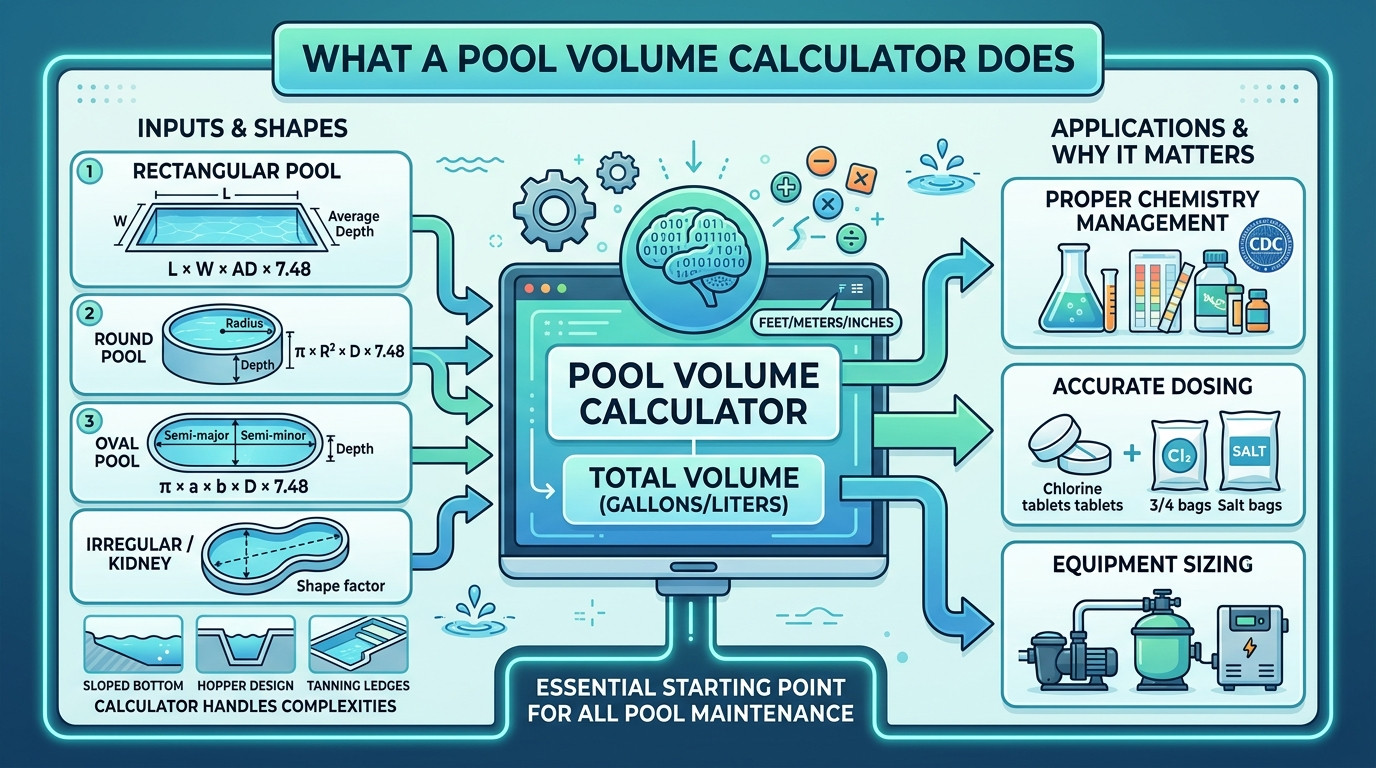
A pool volume calculator is a specialized tool that calculates the total water capacity of a swimming pool based on its shape, dimensions, and depth profile. According to the Centers for Disease Control and Prevention (CDC), knowing your exact pool volume is the single most important piece of information for proper pool chemistry management. Every chemical dose, salt addition, and equipment sizing decision depends on accurate pool volume, making the pool volume calculator the essential starting point for all pool maintenance tasks.
A pool volume calculator tells you exactly how many gallons or liters your pool holds based on its shape and dimensions. For rectangular pools, it multiplies length × width × average depth × 7.48. For round pools, it uses π × radius² × depth × 7.48. For oval pools, it calculates π × semi-major × semi-minor × depth × 7.48. For kidney and irregular shapes, it applies shape factors to account for the non-geometric form. The pool volume calculator handles all of these scenarios in one tool, converting between feet, meters, and inches automatically.
The reason pool volume calculations trip people up is not the arithmetic itself but accurately measuring pool dimensions and choosing the right shape model. Many pools have features that complicate volume calculation: sloped bottoms, hopper designs, tanning ledges, spa spillovers, and freeform curves. The pool volume calculator addresses these complexities by offering multiple shape options, slope types, and shape factors for irregular pools.
This pool volume calculator handles the four most common pool shapes in one place: rectangular (the most common in-ground pool shape), round/circular (common for above-ground pools), oval (popular for both above-ground and in-ground pools), and kidney/L-shape (for freeform, roman, and grecian pool designs). Each mode shows the answer and every step of the working, so you can verify the reasoning, learn the geometry, or document the calculation for your pool records.
Whether you are a new pool owner trying to figure out how much salt to add, a pool service technician sizing chemicals for a client’s pool, a commercial pool operator maintaining water quality for multiple facilities, or a pool builder verifying design specifications, the pool volume calculator gives you the exact volume every time—no guesswork, no chemical errors, no SWG malfunctions, no wasted money.
How Pool Volume Calculations Work
Every pool volume calculation comes down to one idea: determine the surface area of the pool, multiply by the average depth, and convert from cubic feet to gallons (or liters). From that single principle, different formulas apply to different pool shapes. The pool volume calculator exists to handle those formulas reliably and transparently, because in practice the “arithmetic” is layered with unit conversions, slope profiles, and shape factors—and any one of them, applied wrongly, can throw off every chemical calculation that depends on volume.
Rectangular Pool Volume
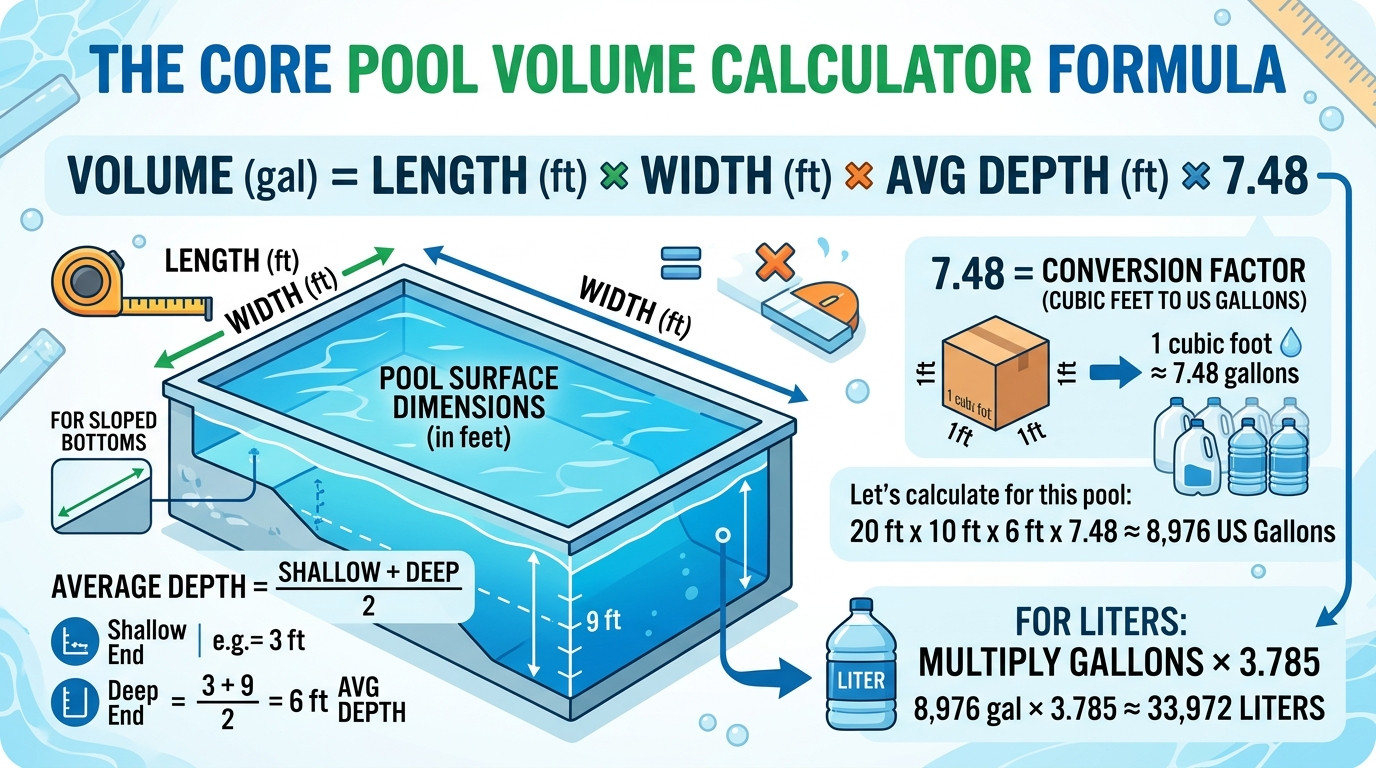
Rectangular pools are the simplest to calculate. The formula is: Volume (gallons) = Length × Width × Average Depth × 7.48. The constant 7.48 converts cubic feet to gallons (1 cubic foot = 7.48052 gallons). For pools with a sloped bottom (shallow end to deep end), average depth = (Shallow Depth + Deep Depth) / 2. For flat-bottom pools, use the uniform depth. For hopper-design pools (deep in the center), the pool volume calculator applies a weighted average that gives more weight to the deeper center section.
Average Depth = (shallow + deep) / 2 for sloped bottoms
7.48 = conversion factor (cubic feet to US gallons)
For liters: multiply gallons × 3.785
Round/Circular Pool Volume
Round pools (common for above-ground pools) use the circle area formula: Volume (gallons) = π × Radius² × Depth × 7.48. The radius is half the diameter. For example, a 24-foot round pool that is 4 feet deep holds: π × 12² × 4 × 7.48 = 3.14159 × 144 × 4 × 7.48 = 13,572 gallons. The pool volume calculator handles the π calculation automatically—you just enter the diameter.
Oval Pool Volume
Oval pools use the ellipse area formula: Volume (gallons) = π × (Length/2) × (Width/2) × Depth × 7.48. This is the same as (π/4) × Length × Width × Depth × 7.48. Oval above-ground pools are very popular, and this formula gives accurate results for standard oval pool shapes. The pool volume calculator requires the long axis (length) and short axis (width).
Kidney, L-Shape & Freeform Pools
Irregular pool shapes require a shape factor to account for the area lost to curves and indentations. The pool volume calculator uses: Volume = Length × Average Width × Average Depth × Shape Factor × 7.48. Shape factors vary: Kidney (0.45), L-Shape (0.50), Freeform (0.55), Roman/Grecian (0.60). These factors represent the ratio of actual water area to the bounding rectangle. A kidney pool that fits inside a 30×16 foot rectangle with a shape factor of 0.45 has an effective surface area of 30 × 13 × 0.45 = 175.5 sq ft instead of the full 390 sq ft.
Quick Reference Values for the Pool Volume Calculator
Remember: The pool volume calculator provides accurate calculations based on the dimensions you enter. However, pool volume can be affected by features like built-in steps, tanning ledges, swim-outs, and spa sections that displace water. For the most accurate results, use the calculator as a starting point, then verify by comparing chemical response—if your calculated salt addition doesn’t reach target levels, adjust your volume estimate accordingly.
Real Scenarios Where Pool Volume Mattered
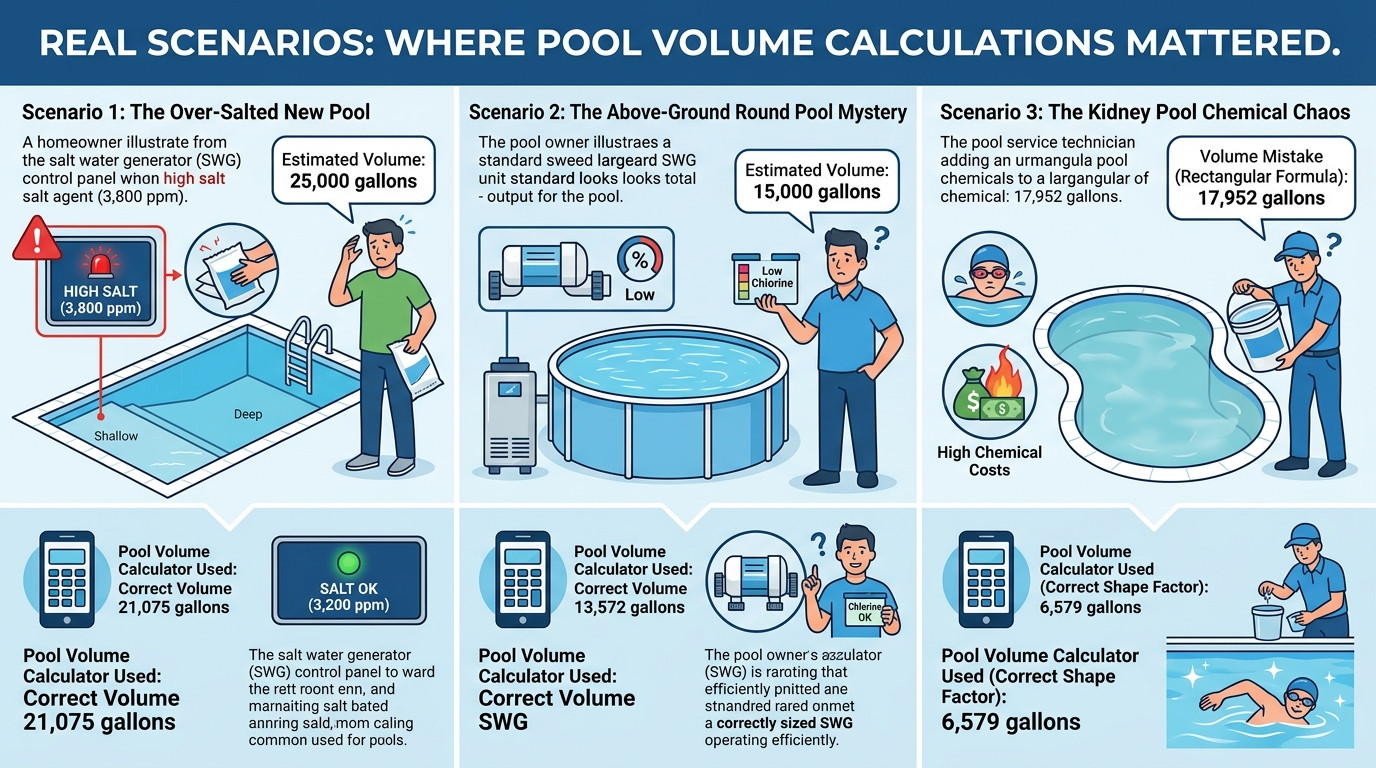
These scenarios reflect real pool ownership situations where pool volume calculation errors made a tangible difference to pool chemistry, equipment performance, and maintenance costs. Each scenario shows how the pool volume calculator would have prevented the error.
Scenario 1: The Over-Salted New Pool
A homeowner with a new 16×32 rectangular pool with a sloped bottom (3ft to 8ft) estimated the volume at 25,000 gallons. They added salt based on that estimate. In reality, the pool volume calculator showed: 32 × 16 × ((3+8)/2) × 7.48 = 21,075 gallons. The over-estimate caused them to add 18.6% more salt than needed, raising salt to 3,800 ppm instead of the target 3,200 ppm. The SWG displayed a high-salt warning. The pool volume calculator would have given the exact volume from the start.
Scenario 2: The Above-Ground Round Pool Mystery
A pool owner with a 24-foot round above-ground pool (48 inches deep) couldn’t understand why their chlorine levels were always too low. They assumed the pool held 15,000 gallons (a common estimate). The pool volume calculator showed: π × 12² × 4 × 7.48 = 13,572 gallons. Using the wrong volume meant they were adding 10.5% too much chlorine, but the real problem was that their SWG was sized for 15,000 gallons and running at a lower output percentage, producing insufficient chlorine for the actual 13,572-gallon pool.
Scenario 3: The Kidney Pool Chemical Chaos
A pool service company maintained a kidney-shaped pool and used the rectangular formula (Length × Width × Depth) without applying a shape factor. For a 30×16 foot kidney pool, they calculated 30 × 16 × 5 × 7.48 = 17,952 gallons. The actual volume with a 0.45 kidney factor was only 30 × 13 × 5 × 0.45 × 7.48 = 6,579 gallons. They were over-dosing chemicals by 173%, causing eye irritation for swimmers and unnecessary chemical costs.
Scenario 4: The Hopper Pool Depth Error
A pool with a hopper design (shallow around the edges, deep in the center) was measured using simple average depth. The pool was 3 feet around the perimeter and 8 feet in the center. Simple average gave (3+8)/2 = 5.5 ft, but a hopper has more deep area. The pool volume calculator’s hopper mode uses a weighted average (0.4 × shallow + 0.6 × deep = 6.0 ft), giving 9% more volume than the simple average. This accuracy matters for proper chemical dosing.
Common Pool Volume Mistakes
These are the most frequent pool volume errors that the pool volume calculator helps prevent:
1. Guessing Pool Dimensions
The most common pool volume mistake is estimating dimensions by eye rather than measuring. A 2-foot error in length on a 30-foot pool means a 6.7% volume error. Always measure with a tape measure. The pool volume calculator gives accurate results only when inputs are accurate. Walk the pool perimeter, measure width at multiple points, and use a weighted line for depth.
2. Using Wrong Shape Formula
Applying the rectangular formula to a kidney-shaped pool overestimates volume significantly. A kidney pool holds only 45% of the bounding rectangle’s volume. The pool volume calculator offers four shape modes — make sure you select the one that matches your pool shape.
3. Ignoring Sloped Bottoms
Many in-ground pools have sloped bottoms (3 feet shallow to 8 feet deep). Using only the shallow depth underestimates volume. Using only the deep depth overestimates. The pool volume calculator handles sloped bottoms by computing the average depth: (shallow + deep) / 2.
4. Forgetting Unit Conversions
Mixing feet and inches, or meters and feet, is a common source of error. A depth of 48 inches is 4 feet, not 48 feet. The pool volume calculator handles unit conversions automatically — just select the correct unit for each measurement.
5. Not Accounting for Pool Features
Built-in steps, tanning ledges, swim-outs, and attached spas displace water and reduce actual volume. The pool volume calculator gives the volume based on the main pool dimensions. For pools with significant features, subtract the displaced volume or verify with chemical response testing.
Warning: Pool volume is the foundation of every chemical calculation. A wrong volume affects salt dosing, chlorine levels, pH adjustments, alkalinity corrections, and CYA additions. Always use the pool volume calculator with measured dimensions, and verify the result by checking chemical response after your first treatment.
Expert Perspectives on Pool Volume
“In my 30 years of pool service, the number one cause of chemical problems is wrong pool volume. Every new client’s pool gets measured first thing. I carry a laser measure and a pool volume calculator app. Five minutes of accurate measurement saves months of chemical troubleshooting.”
“Pool volume accuracy is non-negotiable in commercial aquatic facilities. Health departments require documented pool volumes for chemical management plans. We use the pool volume calculator for every pool in our portfolio and verify with flow meter readings during fill operations. A 5% volume error in a 100,000-gallon competition pool means 5,000 gallons of chemical calculation error.”
“When I design a pool, the volume calculation drives everything — pump sizing, heater capacity, SWG selection, and chemical feeder settings. I always use a pool volume calculator during the design phase and verify the calculation after construction with actual fill measurements. It’s the single most important number in pool engineering.”
Expert Consensus: All three experts agree that accurate pool volume is the absolute foundation of pool chemistry management. Using a pool volume calculator with properly measured dimensions eliminates guesswork and provides documented calculations for every pool maintenance decision.
Frequently Asked Questions
With accurate measurements, the pool volume calculator is within 1-5% of actual volume for standard pool shapes. For irregular shapes with features like steps and ledges, actual volume may be slightly less than calculated. Verify by checking chemical response.
Measure from the water line to the pool floor for depth. For round pools, measure the diameter across the widest point. For oval pools, measure both the long axis and short axis. Enter all measurements into the pool volume calculator with the correct units.
The pool volume calculator’s kidney/L-shape mode includes these shape factors. If unsure, start with 0.50 (L-Shape) as a middle estimate, then verify with chemical response testing.
For hopper-design pools (deep center with shallow edges), select the “Hopper” slope type in the rectangular mode. This applies a weighted average that gives more weight to the deep center area.
Use the pool volume calculator with your actual pool dimensions for an accurate result. Above-ground pools typically hold 5,000-15,000 gallons depending on size.
The pool volume calculator uses standard volume formulas that are accurate for all normal pool operating temperatures. No temperature adjustment is needed.
For quick reference: 1,000 gallons = 3,785 liters, 10,000 gallons = 37,854 liters, 20,000 gallons = 75,708 liters.
The pool volume calculator handles the main pool. For the attached spa, run a separate calculation and add the results. Most in-ground spas hold 500-1,000 gallons.
For example, if you add exactly 40 lbs of salt (calculated to raise 1,000 gallons by 4,800 ppm), and the actual salt increase is 3,600 ppm instead of 4,800 ppm, your actual volume is 4,800/3,600 × 1,000 = 1,333 gallons. The pool volume calculator helps you work backwards from chemical response.
Above-ground pools typically have flat bottoms and uniform depth, which makes volume calculation very accurate. Measure the actual water depth (not the wall height) for best results.
Pool Volume Best Practices
These practices ensure accurate pool volume calculations that form the foundation of proper pool chemistry management. Follow them alongside the pool volume calculator for optimal results.
Before Calculating Pool Volume
During Volume Calculation
After Volume Calculation
Trusted Reference Resources
These are authoritative references for pool volume calculations and pool engineering that complement the pool volume calculator.
CDC Healthy Swimming — cdc.gov/healthywater/swimming — Comprehensive pool safety guidelines, water chemistry recommendations, and pool volume standards from the Centers for Disease Control and Prevention.
Pool & Hot Tub Alliance (PHTA) — phta.org — Industry association for pool and hot tub professionals, offering education, certification, and best practices for pool design and volume calculations.
National Swimming Pool Foundation (NSPF) — nspf.org — Certified Pool Operator (CPO) training, pool engineering education, and pool volume management resources.
Association of Pool & Spa Professionals (APSP) — apsp.org — Industry standards, certification programs, and engineering best practices for pool volume calculations and hydraulic design.
On our platform, related calculation tools that complement the pool volume calculator include: pool salt calculator, pool chemistry calculator, pool chemical calculator, bleach dilution calculator, sodium hypochlorite calculator, pH calculator, PPM calculator, solution dilution calculator, percent concentration calculator, dilution factor calculator, mixing ratio calculator, and dilution calculator (all-in-one).
Leave a Review
Used this pool volume calculator for your pool? Share your experience below. Your review helps other pool owners decide if this pool volume calculator fits their needs. Every review is stored locally on your device and appears instantly.
📝 Share Your Experience
Final Thoughts on the Pool Volume Calculator
Pool volume calculation is the absolute foundation of pool chemistry management. Every chemical dose, every salt addition, every SWG sizing decision depends on knowing how many gallons or liters your pool holds. A 10% volume error creates a 10% error in every chemical calculation that follows — and those errors compound over weeks and months of pool maintenance. The pool volume calculator exists to give you that foundational number accurately, transparently, and quickly for any pool shape.
What separates well-maintained pools from problem pools is precision at the foundation. Using the pool volume calculator with properly measured dimensions, selecting the right shape model, accounting for slope and features, and verifying with chemical response: these are the habits that prevent over-chemical dosing, under-chlorination, SWG malfunctions, and wasted money. The pool volume calculator does the geometry perfectly every time, but it cannot measure your pool — that remains the pool owner’s responsibility.
The framework is short: measure pool dimensions, calculate with the pool volume calculator, document the volume, and use that number for every chemical calculation from that point forward. That sequence gives accurate, consistent pool chemistry every time. From backyard pools and above-ground installations to commercial aquatic facilities and competition pools, accurate pool volume calculation is the starting point for everything, and getting it right with the pool volume calculator is the single most important step in pool maintenance.
Keep this pool volume calculator handy as your starting point for every pool chemistry task, and use the related dilution and concentration tools in the sidebar whenever you need to plan or verify a chemical calculation for your pool.
🔒 Privacy Guarantee: Every calculation on this pool volume calculator page runs entirely within your browser. No data—pool dimensions, volume results, or any other inputs—is sent to any server, stored, or shared. Your calculations are completely private.
Pingback: Hot Tub Chemical Calculator | Balance Your Water Instantly
Pingback: Pool Shock Calculator | Calculate Shock Dosage Instantly
Pingback: Baking Soda Pool Calculator | Calculate How Much to Add