
⚡ Pool Shock Calculator
Calculate chlorine shock, non-chlorine shock, breakpoint chlorination & complete shock treatment plans
⚠️ Pool Shock Safety Note
SHOCK TREATMENTS REQUIRE CAUTION. Never swim during or immediately after shocking — wait until free chlorine drops below 5 ppm. Never mix shock products together. Add shock to water, never water to shock. Pre-dissolve Cal-Hypo in a bucket of pool water before adding. Wear gloves and eye protection. Shock at dusk or evening to prevent UV degradation. Run pump continuously during and after shocking. Keep pool cover open during chlorine shock to allow off-gassing. Do not shock a saltwater pool through the SWG — add shock directly to the pool water.
Calculation History
💡 You Might Also Like
Pool Shock Calculator: Chlorine Shock, Non-Chlorine Shock, Breakpoint Chlorination & Complete Shock Treatment Plans
A pool shock calculator is an essential tool that helps pool owners accurately calculate chlorine shock dosing (Cal-Hypo, dichlor, liquid chlorine), non-chlorine shock (MPS/monopersulfate) for oxidation, breakpoint chlorination to destroy combined chlorine (chloramines), and complete shock treatment schedules. Pool shocking raises free chlorine to 10-30 ppm to destroy algae, bacteria, and organic contaminants that regular sanitization cannot eliminate. Whether you’re performing a routine weekly shock, treating an algae outbreak, destroying chloramines through breakpoint chlorination, or creating a complete seasonal shock schedule, this pool shock calculator provides precise dosing with step-by-step explanations for safe, effective shock treatments.
SHOCK TREATMENTS REQUIRE EXTREME CAUTION. Never swim during or immediately after shocking — wait until free chlorine drops below 5 ppm (may take 8-24 hours). Never mix shock products together. Pre-dissolve Cal-Hypo in a bucket of pool water before adding to the pool. Add shock to water, never water to shock. Wear gloves and eye protection. Shock at dusk or evening to prevent UV degradation of chlorine. Run pump continuously during and after shocking. Keep pool cover open during chlorine shock. Never shock through an SWG — add shock directly to pool water. Store shock products in a cool, dry place away from other chemicals.
📋 Table of Contents
▼What a Pool Shock Calculator Does
A pool shock calculator is a specialized tool that performs essential calculations for pool shock treatments, including chlorine shock dosing (Cal-Hypo, dichlor, liquid chlorine), non-chlorine shock (MPS/monopersulfate) for oxidation, breakpoint chlorination to destroy combined chlorine (chloramines), and complete shock treatment scheduling. According to the Centers for Disease Control and Prevention (CDC), regular pool shocking is critical for destroying chloramines, eliminating algae, oxidizing organic contaminants, and maintaining safe swimming conditions that routine sanitization alone cannot achieve.
A pool shock calculator tells you exactly how many ounces of Cal-Hypo to raise free chlorine to shock levels, how much MPS to add for non-chlorine oxidation, the precise breakpoint chlorination dose to destroy chloramines, and when to shock based on your pool’s usage patterns and water chemistry. Unlike basic pool chemical calculators, a pool shock calculator focuses specifically on high-dose treatment calculations that require precise measurements — under-dosing fails to achieve the desired effect, while over-dosing wastes chemicals and creates extended swim closures. Every pool owner, CPO, and pool service technician relies on these calculations, and the pool shock calculator exists to make them fast, accurate, and educational.
The reason pool shock calculations trip people up is the need to hit specific chlorine targets — 10 ppm for regular shock, 20 ppm for heavy shock, 30 ppm for algae kill, and 10× combined chlorine for breakpoint chlorination. These targets interact with CYA levels (which reduce chlorine effectiveness) and pool volume (which determines the dose). The pool shock calculator handles all of these variables internally so you can focus on treating your pool rather than doing complex chlorine chemistry calculations.
This pool shock calculator handles the four most important shock treatment tasks in one place: chlorine shock (Cal-Hypo, dichlor, liquid chlorine, or bleach dosing for 10-30 ppm targets), non-chlorine shock (MPS dosing for routine oxidation without chlorine buildup), breakpoint chlorination (calculating the precise dose to destroy combined chlorine), and complete shock plans (personalized schedules with all dosing amounts). Each mode shows the answer and every step of the working, so you can verify the reasoning, learn the science, or document the calculation for your pool maintenance records.
Whether you are a homeowner doing a weekly shock, a pool service technician treating a green pool, a commercial pool operator destroying chloramines for an inspection, or a seasonal pool owner opening a pool for the summer, the pool shock calculator gives you the exact calculations every time—no guesswork, no under-dosing, no algae survival, no extended swim closures.

How Pool Shock Calculations Work
Every pool shock calculation comes down to one idea: raise free chlorine to a target level high enough to destroy contaminants that routine sanitization cannot handle. From that single principle, different formulas apply depending on the shock type and goal. The pool shock calculator exists to handle those formulas reliably and transparently, because in practice the “arithmetic” is layered with chlorine concentration factors, CYA interactions, breakpoint chlorination ratios, and pool volume conversions—and any one of them, applied wrongly, can result in a failed shock treatment.
Chlorine Shock: Cal-Hypo, Dichlor, and Liquid Chlorine
Chlorine shock raises free chlorine to 10-30 ppm to destroy algae, bacteria, and organic contaminants. The pool shock calculator uses the formula: Amount = (Volume / 10,000) × (FC increase / 10) × dosing rate. Each product has a different rate: Cal-Hypo (65% available chlorine) uses 2.0 oz per 10,000 gallons per 10 ppm; dichlor (56%) uses 2.3 oz; liquid chlorine (12.5%) uses 10.7 fl oz; household bleach (8.25%) uses 15.5 fl oz. For a 20,000-gallon pool going from 2 ppm to 10 ppm with Cal-Hypo: (20,000 / 10,000) × (8 / 10) × 2.0 = 3.2 oz.
FC Increase = target shock level minus current free chlorine
Product Rate = oz (or fl oz) per 10,000 gal per 10 ppm for each product
Cal-Hypo: 2.0 oz | Dichlor: 2.3 oz | Liquid Cl: 10.7 fl oz | Bleach: 15.5 fl oz
Non-Chlorine Shock: MPS (Monopersulfate)
MPS (potassium monopersulfate) oxidizes organic contaminants without adding chlorine. It’s ideal for weekly maintenance, after heavy use, or when chlorine levels are already adequate. The pool shock calculator uses: Amount (lbs) = (Volume / 10,000) × dosing rate. Standard rate is 1 lb per 10,000 gallons for routine oxidation, 2 lbs for heavy use or cloudy water. MPS allows swimming within 15-30 minutes — much faster than chlorine shock.
Breakpoint Chlorination: Destroying Combined Chlorine
Combined chlorine (chloramines) causes eye irritation, strong chlorine smell, and reduced sanitization. Breakpoint chlorination destroys chloramines by adding enough chlorine to reach 10× the combined chlorine level. The pool shock calculator uses: Combined Chlorine (CC) = Total Chlorine – Free Chlorine; Breakpoint FC = CC × 10. For example, if TC = 3.0 and FC = 1.5, CC = 1.5 ppm, and breakpoint requires 15 ppm additional FC. The pool shock calculator then determines the product amount needed to reach that target.
SLAM Level: CYA-Based Shock Targets
For serious algae problems, the SLAM (Shock Level And Maintain) protocol uses CYA-adjusted shock targets. The pool shock calculator determines SLAM level as CYA × 0.4 (minimum 10 ppm). For a pool with 50 ppm CYA, SLAM level is 20 ppm. This target must be maintained until the pool passes three criteria: FC holds overnight (loss < 1 ppm), CC is below 0.5 ppm, and water is clear.
Quick Reference Values for the Pool Shock Calculator
Remember: The pool shock calculator provides accurate dosing, but shock effectiveness depends on proper application. Shock at dusk, run the pump continuously, pre-dissolve granular products, and brush pool surfaces to distribute the shock. Always retest 8-24 hours after shocking to verify chlorine levels before swimming.

Real Scenarios Where Pool Shocking Mattered
These scenarios reflect real pool maintenance situations where shock calculation errors made a tangible difference to water quality and swimmer safety. Each scenario shows how the pool shock calculator would have prevented the error.
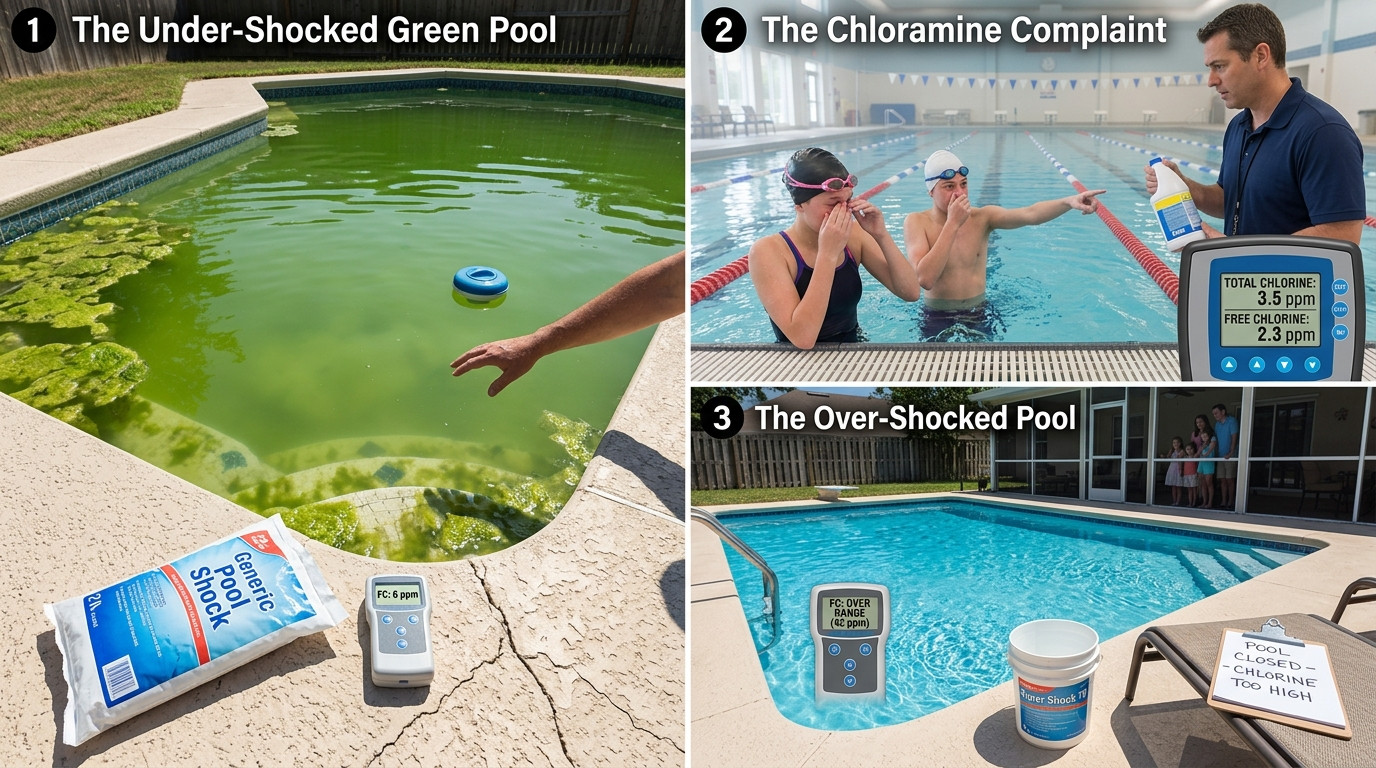
Scenario 1: The Under-Shocked Green Pool
A pool owner had a green algae-filled pool and added 2 lbs of Cal-Hypo (a “generous” guess) to their 25,000-gallon pool. This raised FC to only 6 ppm — not enough to kill the algae. After 48 hours, the algae was still growing. The pool shock calculator’s algae kill mode would have shown that 30 ppm was needed: (25,000/10,000) × (28/10) × 2.0 = 14 oz of Cal-Hypo. The under-dose wasted time and chemicals.
Scenario 2: The Chloramine Complaint
A commercial pool received complaints about “strong chlorine smell” and eye irritation. The operator kept adding more chlorine, making the problem worse. The actual issue was 1.2 ppm combined chlorine (TC 3.5 – FC 2.3). The pool shock calculator’s breakpoint mode would have calculated: CC × 10 = 12 ppm additional FC needed, and the exact amount of liquid chlorine to achieve it. Adding chlorine without hitting breakpoint actually creates more chloramines.
Scenario 3: The Over-Shocked Pool
A homeowner shocked their 10,000-gallon pool with 5 lbs of Cal-Hypo “to be safe.” This raised FC to over 40 ppm — far above any necessary level. The pool was unusable for 4 days until chlorine naturally dissipated. The pool shock calculator would have shown that for a regular 10 ppm shock: (10,000/10,000) × (8/10) × 2.0 = 1.6 oz — a fraction of the 5 lbs they added.
Scenario 4: The Ignored MPS Alternative
A pool owner shocked with chlorine every week, gradually building chlorine to uncomfortable levels. They didn’t know about non-chlorine shock (MPS). The pool shock calculator’s non-chlorine mode would have recommended 1 lb of MPS per 10,000 gallons for routine weekly oxidation — destroying organics without adding chlorine, allowing swimming within 30 minutes instead of 24 hours.
Common Pool Shock Mistakes
These are the most frequent pool shock errors that the pool shock calculator helps prevent:
1. Guessing the Shock Dose
The most common pool shock mistake is guessing how much product to add. Too little shock fails to achieve the target level; too much creates extended swim closures. The pool shock calculator provides exact amounts based on pool volume, current FC, and target level.
2. Shocking During the Day
UV sunlight destroys chlorine rapidly — up to 90% within 2 hours. Always shock at dusk or evening so the shock chlorine has overnight to do its work. The pool shock calculator provides the correct dose, but timing is the pool owner’s responsibility.
3. Not Pre-Dissolving Cal-Hypo
Cal-Hypo granules can bleach pool surfaces if they settle undissolved. Always pre-dissolve in a bucket of pool water before broadcasting across the pool surface. This is especially important for vinyl liner pools.
4. Ignoring Combined Chlorine
If you only test free chlorine, you miss the combined chlorine (chloramines) that cause eye irritation and smell. The pool shock calculator’s breakpoint mode requires both FC and TC readings to calculate the correct breakpoint dose.
5. Swimming Too Soon After Shock
After chlorine shock, FC is typically 10-30 ppm — well above the safe swimming level of 5 ppm. Wait 8-24 hours, retest, and only swim when FC drops below 5 ppm. The pool shock calculator shows the target shock level — the owner must wait for dissipation.
Warning: Never mix Cal-Hypo with dichlor, trichlor, or any acid-based product. This combination can cause a violent chemical reaction, fire, or explosion. Always use one shock product at a time. The pool shock calculator handles each product separately — never combine products in the same treatment.
Expert Perspectives on Pool Shocking
“The number one question I get is ‘how much shock do I add?’ and the answer always depends on pool volume, current chlorine, and what you’re trying to achieve. A pool shock calculator takes the guesswork out. I recommend every pool owner keep one bookmarked — it’s the difference between a 30-minute shock treatment and a 3-day pool closure.”
“Breakpoint chlorination is the most misunderstood concept in pool chemistry. Operators add more chlorine when they smell more chlorine — but the smell is chloramines, not free chlorine. You need 10 times the combined chlorine level in additional FC to break through. A pool shock calculator with breakpoint mode solves this problem instantly.”
“Non-chlorine shock is the best-kept secret in pool maintenance. MPS oxidizes organics, destroys bather waste, and clears cloudy water without adding chlorine. My residential clients who use weekly MPS need chlorine shock half as often. The pool shock calculator’s MPS mode makes it easy to dose correctly every time.”
Expert Consensus: All three experts agree that using a pool shock calculator for precise dosing eliminates the most common shock errors — under-dosing, over-dosing, and ignoring combined chlorine. The pool shock calculator is essential for effective shock treatments.
Frequently Asked Questions
Accuracy depends on accurate pool volume and current chlorine test results. CYA levels, water temperature, and organic load can affect actual chlorine demand. Always retest 8-24 hours after shocking.
The pool shock calculator’s schedule mode provides a personalized shock schedule based on your pool volume, usage level, and current water chemistry.
The pool shock calculator includes both modes. Use chlorine shock for algae/bacteria problems, MPS for routine weekly oxidation and bather waste removal.
The pool shock calculator’s breakpoint mode calculates CC from your FC and TC readings, then determines the exact product amount needed to achieve breakpoint and destroy all chloramines.
Turn off the SWG before shocking, add the calculated shock dose, run the pump, and re-enable the SWG after FC drops back to normal levels (usually 24-48 hours).
The pool shock calculator shows the target shock level. After adding the calculated dose, test FC periodically. Only swim when FC ≤ 5 ppm and pH is 7.2-7.8.
The pool shock calculator provides the correct dose regardless of timing. Apply it at dusk, run the pump overnight, and retest in the morning.
The pool shock calculator’s schedule mode includes SLAM level calculation. Maintain SLAM level until FC loss overnight is less than 1 ppm, CC is below 0.5, and water is clear.
Use only plain, unscented bleach without splashless additives, thickeners, or fragrances. Bleach requires more volume than Cal-Hypo due to lower concentration — the calculator handles the conversion.
For vinyl liner pools, always pre-dissolve Cal-Hypo in a bucket of pool water before adding. The pool shock calculator provides accurate dosing for any pool construction type.
Pool Shock Best Practices
These practices separate effective shock treatments from wasted chemicals and extended swim closures. Follow them alongside the pool shock calculator for optimal results.
Before Shocking
During Shock Treatment
After Shock Treatment
Trusted Reference Resources
These are authoritative references for pool shock treatments and water sanitation that complement the pool shock calculator.
CDC Healthy Swimming — cdc.gov/healthywater/swimming — CDC guidelines for pool sanitation, shock treatment protocols, chlorine levels, and recreational water illness prevention.
Pool & Hot Tub Alliance (PHTA) — phta.org — Industry standards for pool shock treatments, breakpoint chlorination, and water sanitation best practices.
National Swimming Pool Foundation (NSPF) — nspf.org — Certified Pool Operator (CPO) training including shock treatment protocols, breakpoint chlorination, and SLAM procedures.
Association of Pool & Spa Professionals (APSP) — apsp.org — Industry guidelines for pool shock products, dosing standards, and water sanitation management.
On our platform, related calculation tools that complement the pool shock calculator include: pool chemical calculator, pool chemistry calculator, pool salt calculator, pool volume calculator, bleach dilution calculator, sodium hypochlorite calculator, pH calculator, PPM calculator, solution dilution calculator, percent concentration calculator, dilution factor calculator, and dilution calculator (all-in-one).
Leave a Review
Used this pool shock calculator for your pool maintenance? Share your experience below. Your review helps other pool owners decide if this pool shock calculator fits their needs. Every review is stored locally on your device and appears instantly.
📝 Share Your Experience
Final Thoughts on the Pool Shock Calculator
Pool shocking is one of the most powerful maintenance tools available to pool owners — and one of the most commonly misused. Under-dosing wastes time and chemicals while failing to solve the problem. Over-dosing creates extended swim closures and unnecessary chemical exposure. The pool shock calculator exists to eliminate both extremes, providing precise dosing for every shock scenario from routine weekly maintenance to breakpoint chlorination to full algae elimination.
What separates crystal-clear pool water from green, cloudy, or smelly water is proper shock treatment with correct dosing. Using the pool shock calculator for precise measurements, shocking at the right time (dusk), choosing the right product for the right problem, and following a consistent shock schedule: these are the habits that prevent algae, destroy chloramines, and keep water sparkling clean. The pool shock calculator does the math perfectly every time, but it cannot apply the shock or time the treatment — that remains the pool owner’s responsibility.
The framework is short: test water chemistry, calculate with the pool shock calculator, shock at dusk, run pump overnight, retest in the morning, and swim when safe. That sequence gives effective, reliable shock treatments every time. From backyard pools and saltwater systems to commercial aquatic facilities and seasonal openings, accurate pool shock calculations are the foundation of water sanitation, and getting it right with the pool shock calculator is one of the most important skills in pool maintenance.
Keep this pool shock calculator handy as your starting point for every shock treatment, and use the related dilution and concentration tools in the sidebar whenever you need to plan or verify a calculation before treating your pool.
🔒 Privacy Guarantee: Every calculation on this pool shock calculator page runs entirely within your browser. No data—pool volumes, chlorine levels, shock doses, or any other inputs—is sent to any server, stored, or shared. Your calculations are completely private.