
🧁 Baking Soda Pool Calculator
Calculate baking soda to raise alkalinity, adjust pH, remove stains & complete sodium bicarbonate dosing plans
⚠️ Baking Soda Pool Safety Note
USE ONLY PURE SODIUM BICARBONATE. Grocery store baking soda (Arm & Hammer) is the same chemical as pool-store alkalinity increaser. Do NOT use baking powder (contains acid and aluminum). Baking soda is safe to handle without gloves, but avoid inhaling the dust. Add gradually to pool water with pump running — never dump large amounts in one spot. Baking soda raises alkalinity with minimal pH effect, making it the safest alkalinity adjuster. Do not add more than 2 lbs per 10,000 gallons in a single application — split larger doses over 24 hours.
Calculation History
💡 You Might Also Like
Baking Soda Pool Calculator: Raise Alkalinity, Adjust pH, Remove Stains & Complete Sodium Bicarbonate Dosing
A baking soda pool calculator is an essential tool that helps pool owners accurately calculate how much sodium bicarbonate (baking soda) to add for raising total alkalinity, mildly adjusting pH upward, creating baking soda paste for stain removal, and generating complete baking soda treatment plans. Baking soda is the safest, most affordable alkalinity increaser available — the same chemical sold in grocery stores as Arm & Hammer for a fraction of pool-store prices. Whether you’re raising alkalinity from 50 to 100 ppm, creating a stain-removing paste, or getting a full baking soda dosing plan for your pool, this baking soda pool calculator provides precise measurements with step-by-step explanations for optimal pool water balance.
USE ONLY PURE SODIUM BICARBONATE (NaHCO₃). Grocery store baking soda (Arm & Hammer) is identical to pool-store “Alkalinity Increaser” — same chemical, lower price. Do NOT use baking powder (contains acid salts and aluminum). Do NOT use washing soda (sodium carbonate — that’s a different, stronger chemical). Baking soda is safe to handle without gloves, but avoid inhaling the dust. Add gradually with pump running — never dump large amounts in one spot. Do not add more than 2 lbs per 10,000 gallons in a single application. Split larger doses over 24 hours with retesting between doses.
📋 Table of Contents
▼What a Baking Soda Pool Calculator Does
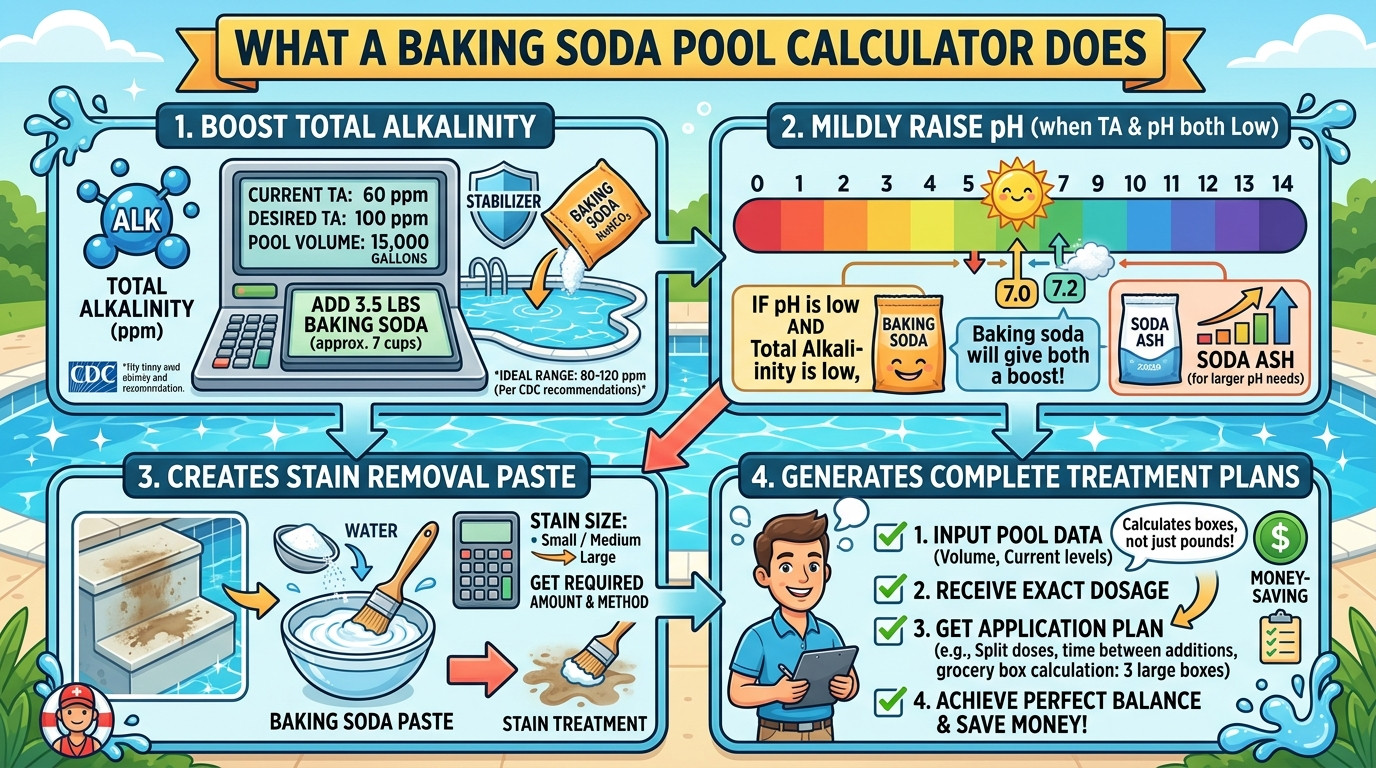
A baking soda pool calculator is a specialized tool that performs essential calculations for sodium bicarbonate (NaHCO₃) applications in swimming pools, including raising total alkalinity to the ideal 80-120 ppm range, mildly raising pH when both alkalinity and pH are low, creating baking soda paste for pool stain removal, and generating complete baking soda treatment plans. According to the Centers for Disease Control and Prevention (CDC), proper total alkalinity is critical for pH stability and overall pool water balance, and sodium bicarbonate is the safest, most cost-effective alkalinity increaser available.
A baking soda pool calculator tells you exactly how many pounds or cups of baking soda to add to raise your pool’s alkalinity to the ideal range, whether baking soda can help your pH situation, how much baking soda paste to make for stain treatment, and the complete order of baking soda applications for your pool’s current chemistry. Unlike generic pool calculators, a baking soda pool calculator focuses specifically on sodium bicarbonate applications — the most commonly used and most affordable pool chemical. Every pool owner who wants stable water chemistry without overspending on branded products relies on these calculations, and the baking soda pool calculator exists to make them fast, accurate, and money-saving.
The reason baking soda pool calculations trip people up is not the complexity — the formula is simple — but the practical details: how many boxes from the grocery store, whether to split the dose, when to use baking soda versus soda ash, and how baking soda affects both alkalinity and pH simultaneously. The baking soda pool calculator handles all of these practical questions so you can focus on treating your pool rather than doing math.
This baking soda pool calculator handles the four most important baking soda applications in one place: raise alkalinity (precise dosing with split-dose safety limits), pH adjustment (when baking soda is appropriate vs. soda ash), stain treatment (baking soda paste recipes for different stain types and surfaces), and complete treatment plans (evaluating all parameters and recommending the right baking soda actions). Each mode shows the answer and every step of the working, so you can verify the reasoning, learn the chemistry, or document the calculation for your pool maintenance records.
Whether you are a budget-conscious homeowner using grocery-store baking soda instead of expensive pool chemicals, a pool service technician looking for cost-effective alkalinity solutions, a DIY pool owner dealing with pool stains naturally, or a new pool owner learning that Arm & Hammer baking soda is the same chemical as pool-store alkalinity increaser, the baking soda pool calculator gives you the exact calculations every time—no guesswork, no overspending, no pH bounce, no wasted product.
How Baking Soda Pool Calculations Work
Every baking soda pool calculation comes down to one idea: sodium bicarbonate (NaHCO₃) raises total alkalinity with a mild, safe pH increase. From that single principle, a handful of formulas cover almost every baking soda pool task. The baking soda pool calculator exists to handle those formulas reliably and transparently, because the practical details — split doses, box conversions, stain paste ratios — are where pool owners make mistakes.
Raising Alkalinity: The Primary Baking Soda Use
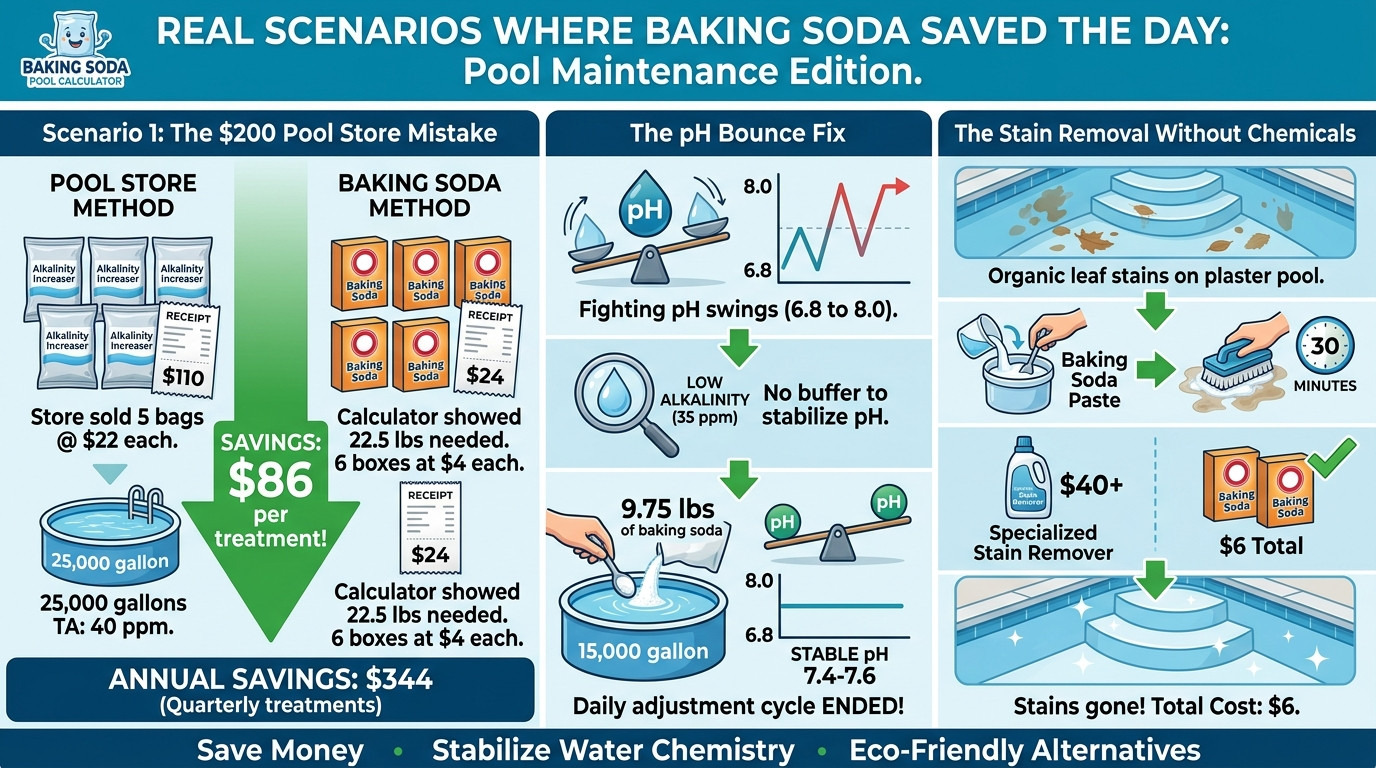
The number one reason pool owners use baking soda is to raise total alkalinity. Ideal alkalinity is 80-120 ppm. When alkalinity drops below 80 ppm, pH becomes unstable (“pH bounce”), chlorine becomes less effective, and pool water can become corrosive. The baking soda pool calculator uses the formula: Baking Soda (lbs) = (Volume / 10,000) × (TA increase / 10) × 1.5. For example, to raise alkalinity from 50 to 100 ppm in a 20,000-gallon pool: (20,000 / 10,000) × (50 / 10) × 1.5 = 15 lbs of baking soda. That’s about 30 cups or roughly 4 standard 4-lb boxes from the grocery store.
TA increase = desired alkalinity increase in ppm
1.5 = lbs of baking soda per 10,000 gallons per 10 ppm increase
Max single dose: 2 lbs per 10,000 gallons (split larger doses over 24 hours)
pH Adjustment: Baking Soda vs. Soda Ash
Baking soda raises pH very mildly — approximately 0.1 pH units per 1.5 lbs per 10,000 gallons. This makes it ideal when both alkalinity and pH are low (pH below 7.2 and TA below 80 ppm). However, if only pH is low and alkalinity is already in range, soda ash (sodium carbonate) is a better choice because it raises pH more aggressively without adding as much alkalinity. The baking soda pool calculator evaluates both parameters and recommends the right chemical for your situation.
Stain Removal: Baking Soda Paste
Baking soda paste is one of the most effective DIY pool stain treatments. The basic recipe is 2 cups baking soda mixed with enough water to form a thick paste per 10 square feet of stained area. Apply the paste directly to stains, let it sit for 15-30 minutes, then scrub gently with a pool brush. For metal stains, add crushed vitamin C tablets to the paste. For organic stains, pre-treat with a chlorine tablet. The baking soda pool calculator adjusts the recipe based on stain area, type, severity, and pool surface material.
Cost Savings: Grocery Store vs. Pool Store
One of the biggest advantages of the baking soda pool calculator is showing pool owners that grocery-store baking soda is identical to pool-store “Alkalinity Increaser.” A 4-lb box of Arm & Hammer costs $3-5, while the same chemical in a pool-store bag costs $15-25. For a 20,000-gallon pool needing 15 lbs of baking soda, that’s $12-20 at the grocery store versus $60-100 at the pool store — savings of $48-80 per treatment.
Quick Reference Values for the Baking Soda Pool Calculator
Remember: The baking soda pool calculator provides accurate dosing, but always add baking soda gradually with the pump running. Broadcast it across the pool surface in 2-3 portions over several hours. Never dump the full calculated amount in one spot — this can create a concentrated alkaline cloud that damages pool surfaces. Retest alkalinity 6-24 hours after adding baking soda.
Real Scenarios Where Baking Soda Saved the Day
These scenarios reflect real pool maintenance situations where baking soda calculations made a tangible difference to water quality and the pool owner’s wallet. Each scenario shows how the baking soda pool calculator would have prevented problems and saved money.
Scenario 1: The $200 Pool Store Mistake
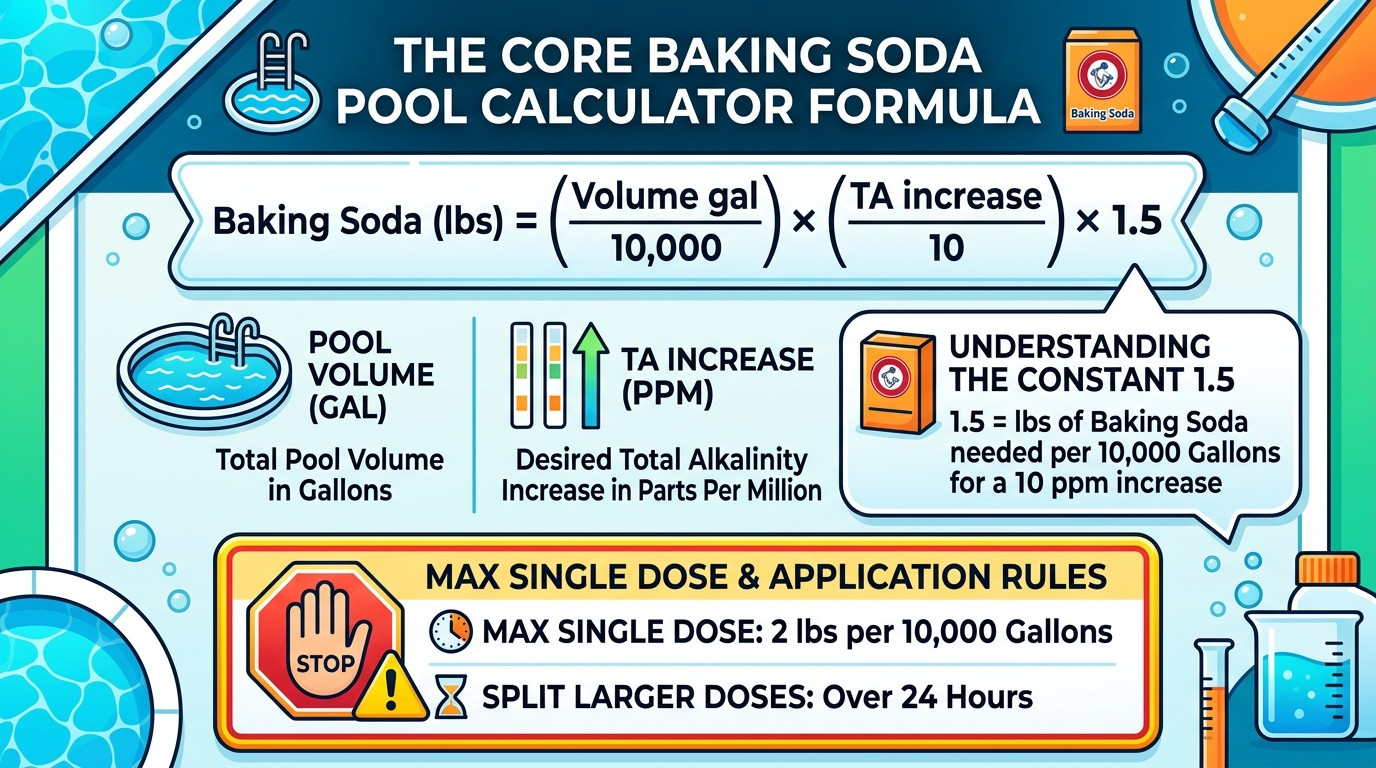
A pool owner visited the pool store to buy “Alkalinity Increaser” for their 25,000-gallon pool with TA at 40 ppm. The store sold them 5 bags at $22 each = $110. The baking soda pool calculator would have shown: (25,000/10,000) × (60/10) × 1.5 = 22.5 lbs needed. At the grocery store, that’s 6 boxes of Arm & Hammer at $4 each = $24. Same chemical, $86 savings per treatment. Over a year of quarterly treatments, that’s $344 saved.
Scenario 2: The pH Bounce Fix
A pool owner kept fighting pH that swung from 6.8 to 8.0 within days despite daily adjustments. The root cause was low alkalinity at 35 ppm — without adequate alkalinity buffer, pH had nothing to stabilize it. The baking soda pool calculator would have identified low TA as the primary problem and calculated 9.75 lbs of baking soda for the 15,000-gallon pool to raise TA from 35 to 100 ppm, stabilizing pH permanently and ending the daily adjustment cycle.
Scenario 3: The Stain Removal Without Chemicals
A pool owner had brown organic stains on their plaster pool from fallen leaves. Instead of buying expensive stain removal chemicals ($40+), they used the baking soda pool calculator’s stain mode: for 20 sq ft of moderate organic stains on plaster, the calculator recommended 6 cups of baking soda paste. Total cost: $6 for two boxes of baking soda. The stains were gone in 30 minutes with gentle scrubbing.
Scenario 4: The Over-Dose Prevention
A pool owner with a 30,000-gallon pool and TA at 40 ppm wanted to raise it to 120 ppm (80 ppm increase). The full dose would be 36 lbs — but the baking soda pool calculator’s safety limit (max 2 lbs per 10,000 gallons per dose) flagged this as needing 6 split doses of 6 lbs each over 24 hours. Without this safety check, dumping 36 lbs at once could have caused localized high-alkalinity damage to the pool surface and created cloudy water.
Common Baking Soda Pool Mistakes
These are the most frequent baking soda errors that the baking soda pool calculator helps prevent:
1. Using Baking Powder Instead of Baking Soda
Baking powder contains acid salts (cream of tartar) and aluminum compounds that can stain pool surfaces and disrupt water chemistry. Only use pure sodium bicarbonate (baking soda). The baking soda pool calculator specifically references baking soda / sodium bicarbonate — if a product says “baking powder,” it’s the wrong product.
2. Dumping All Baking Soda in One Spot
Dumping a large amount of baking soda in one area creates a concentrated alkaline cloud that can etch plaster, damage vinyl liners, or create white deposits on fiberglass. Always broadcast baking soda across the pool surface with the pump running. The baking soda pool calculator shows split-dose recommendations for large amounts.
3. Adding More Than 2 lbs Per 10,000 Gallons at Once
The maximum safe single dose is 2 lbs per 10,000 gallons. Larger amounts should be split into multiple doses over 24 hours with retesting between doses. The baking soda pool calculator automatically calculates split doses when the total exceeds this limit.
4. Using Baking Soda When Soda Ash is Needed
If pH is very low (below 7.0) but alkalinity is already in range (80-120 ppm), baking soda will raise alkalinity too high without fixing pH enough. Soda ash (sodium carbonate) is the correct choice in this situation. The baking soda pool calculator evaluates both pH and alkalinity to recommend the right product.
5. Not Retesting After Adding Baking Soda
Baking soda takes 6-24 hours to fully dissolve and distribute. Always retest alkalinity the next day before adding more. The baking soda pool calculator reminds you to retest and provides follow-up calculations if needed.
Warning: Baking soda is one of the safest pool chemicals, but “safe” doesn’t mean “careless.” Adding too much at once can raise alkalinity above 150 ppm, causing pH to climb constantly, scaling on surfaces, and cloudy water. If you accidentally over-dose, use the pool alkalinity calculator’s lower mode to calculate the acid needed to bring it back down. The baking soda pool calculator’s split-dose feature prevents this problem entirely.
Expert Perspectives on Baking Soda in Pools
“The biggest secret in pool maintenance is that Arm & Hammer baking soda from Walmart is the exact same chemical as the $25 bag of ‘Alkalinity Increaser’ from the pool store. I tell every client: buy the grocery store brand, use a baking soda pool calculator to get the right dose, and save yourself hundreds of dollars per year. Same results, fraction of the cost.”
“Baking soda is my first-line treatment for low alkalinity in every pool I service. It’s safe, predictable, affordable, and it doesn’t dramatically swing pH like soda ash can. The baking soda pool calculator is the first tool I open when I see low TA on a test strip — it gives me the exact dose and reminds me about split dosing for larger pools.”
“For DIY pool stain removal, baking soda paste is unbeatable. It’s non-toxic, it doesn’t damage surfaces, and it works on 90% of common pool stains. The baking soda pool calculator’s stain mode takes the guesswork out of paste ratios and gives surface-specific application tips that most pool owners don’t know about.”
Expert Consensus: All three experts agree that baking soda is the most cost-effective and safest alkalinity increaser for pools. Using a baking soda pool calculator for precise dosing, buying grocery-store baking soda instead of pool-store brands, and following split-dose guidelines for larger amounts eliminates the most common alkalinity problems while saving significant money.
Frequently Asked Questions
The baking soda pool calculator works with both grocery-store baking soda and pool-store alkalinity increaser. The dosing calculations are identical because the chemical is identical. Save your money and buy from the grocery store.
The baking soda pool calculator handles any pool volume and any target increase. Enter your current and target alkalinity, and it calculates the exact amount in lbs, cups, and number of boxes.
The baking soda pool calculator’s pH mode evaluates both parameters and tells you whether baking soda or soda ash is the better choice for your specific situation.
The baking soda pool calculator automatically calculates split doses when the total amount exceeds the safety limit. Add in portions over 24 hours with retesting between doses.
Retest alkalinity the next day to verify the increase. The baking soda pool calculator recommends retesting and provides follow-up calculations if the target wasn’t reached.
The baking soda pool calculator’s stain mode adjusts the recipe based on stain area, type (metal, organic, scale), severity, and pool surface material (plaster, fiberglass, vinyl, tile).
The baking soda pool calculator provides the same accurate dosing regardless of pool construction. For stain treatment, the calculator adjusts application technique based on surface type.
The baking soda pool calculator uses sodium bicarbonate dosing rates. If you accidentally use washing soda (soda ash), the dose would be approximately 20% less — but the pH effect would be much stronger.
For example, if you need 15 lbs, that’s approximately 4 boxes of the 4-lb size. Buy in bulk at warehouse stores for the best price per pound.
The baking soda pool calculator’s full plan mode evaluates your current chemistry and recommends when to add baking soda and how much. Keep a testing log to track alkalinity trends.
Baking Soda Pool Best Practices
These practices separate effective baking soda treatments from wasted product and potential problems. Follow them alongside the baking soda pool calculator for optimal results.
Before Adding Baking Soda
During Baking Soda Addition
After Baking Soda Addition
Trusted Reference Resources
These are authoritative references for pool alkalinity management and sodium bicarbonate applications that complement the baking soda pool calculator.
CDC Healthy Swimming — cdc.gov/healthywater/swimming — Comprehensive pool safety guidelines, water chemistry recommendations, and alkalinity standards from the Centers for Disease Control and Prevention.
Pool & Hot Tub Alliance (PHTA) — phta.org — Industry association for pool professionals, offering education, certification, and best practices for alkalinity management and water balance.
National Swimming Pool Foundation (NSPF) — nspf.org — Certified Pool Operator (CPO) training, water chemistry education, and sodium bicarbonate dosing guidelines.
Association of Pool & Spa Professionals (APSP) — apsp.org — Industry standards and best practices for pool water chemistry, alkalinity management, and cost-effective chemical selection.
On our platform, related calculation tools that complement the baking soda pool calculator include: pool alkalinity calculator, pool chemistry calculator, pool chemical calculator, pool salt calculator, pool volume calculator, pH calculator, PPM calculator, solution dilution calculator, percent concentration calculator, dilution factor calculator, and dilution calculator (all-in-one).
Leave a Review
Used this baking soda pool calculator for your pool maintenance? Share your experience below. Your review helps other pool owners decide if this baking soda pool calculator fits their maintenance needs. Every review is stored locally on your device and appears instantly.
📝 Share Your Experience
Final Thoughts on the Baking Soda Pool Calculator
Baking soda is the unsung hero of pool maintenance — the most affordable, safest, and most versatile chemical in any pool owner’s arsenal. It raises alkalinity to stabilize pH, mildly adjusts pH when both parameters are low, removes stains without harsh chemicals, and costs a fraction of branded pool-store products. The baking soda pool calculator exists to make every one of these applications precise, educational, and cost-effective, showing each step of every calculation so results can be verified and learned.
What separates stable, balanced pool water from pH bounce and scaling is alkalinity precision — and baking soda is the most practical tool for achieving it. Using the baking soda pool calculator for exact measurements, buying grocery-store baking soda instead of expensive branded products, following split-dose guidelines, and retesting after every addition: these are the habits that eliminate alkalinity problems while saving hundreds of dollars per year. The baking soda pool calculator does the math perfectly every time, but it cannot test your water or add the baking soda — that remains the pool owner’s responsibility.
The framework is short: test alkalinity weekly, calculate with the baking soda pool calculator, add baking soda gradually with the pump running, retest after 24 hours, and adjust if needed. That sequence gives stable, balanced water every time at the lowest possible cost. From backyard pools and above-ground installations to commercial aquatic facilities and vacation rental pools, baking soda is the foundation of affordable alkalinity management, and getting it right with the baking soda pool calculator is the smartest investment in pool maintenance.
Keep this baking soda pool calculator handy as your starting point for every alkalinity task, and use the related dilution and concentration tools in the sidebar whenever you need to plan or verify a calculation before treating your pool.
🔒 Privacy Guarantee: Every calculation on this baking soda pool calculator page runs entirely within your browser. No data—pool volumes, alkalinity readings, baking soda amounts, or any other inputs—is sent to any server, stored, or shared. Your calculations are completely private.