
🧂 Pool Alkalinity Calculator
Calculate alkalinity adjustments — raise with baking soda, lower with acid, corrected alkalinity & complete analysis
⚠️ Pool Alkalinity Safety Note
MAINTAIN PROPER ALKALINITY. Total alkalinity should be 80-120 ppm for most pools. Low alkalinity (<80 ppm) causes pH bounce, corrosive water, and equipment damage. High alkalinity (>120 ppm) causes pH to rise constantly, scaling, and cloudy water. Always adjust alkalinity BEFORE adjusting pH — alkalinity stabilizes pH. Add chemicals gradually, retest after 6-24 hours, and never mix acids with other chemicals. Wear protective gloves and eyewear when handling muriatic acid.
Calculation History
💡 You Might Also Like
Pool Alkalinity Calculator: Raise, Lower & Correct Total Alkalinity for Perfect Pool Water Balance
A pool alkalinity calculator is an essential tool that helps pool owners accurately calculate how much baking soda (sodium bicarbonate) to add to raise alkalinity, how much muriatic acid or dry acid to add to lower alkalinity, and how to determine corrected alkalinity by removing the cyanuric acid contribution. Total alkalinity (ideal: 80-120 ppm) is the pH buffer that prevents pH bounce, protects equipment from corrosion, and prevents scaling. Whether you’re raising alkalinity from 50 to 100 ppm with baking soda, lowering it from 180 to 120 ppm with acid, calculating corrected alkalinity for LSI accuracy, or running a complete alkalinity analysis, this pool alkalinity calculator provides precise calculations with step-by-step explanations for optimal pool water balance.
ALWAYS ADJUST ALKALINITY BEFORE pH. Alkalinity stabilizes pH — adjusting pH without fixing alkalinity first causes pH to bounce back within hours. Low alkalinity (<80 ppm) causes corrosive water that etches plaster and corrodes metal equipment. High alkalinity (>120 ppm) causes constant pH rise, scaling, and cloudy water. When adding acid, always add acid to water, never water to acid. Wear protective gloves and goggles. Add chemicals gradually and retest after 6-24 hours. Never mix muriatic acid with chlorine or other chemicals — this creates toxic chlorine gas.
📋 Table of Contents
▼What a Pool Alkalinity Calculator Does
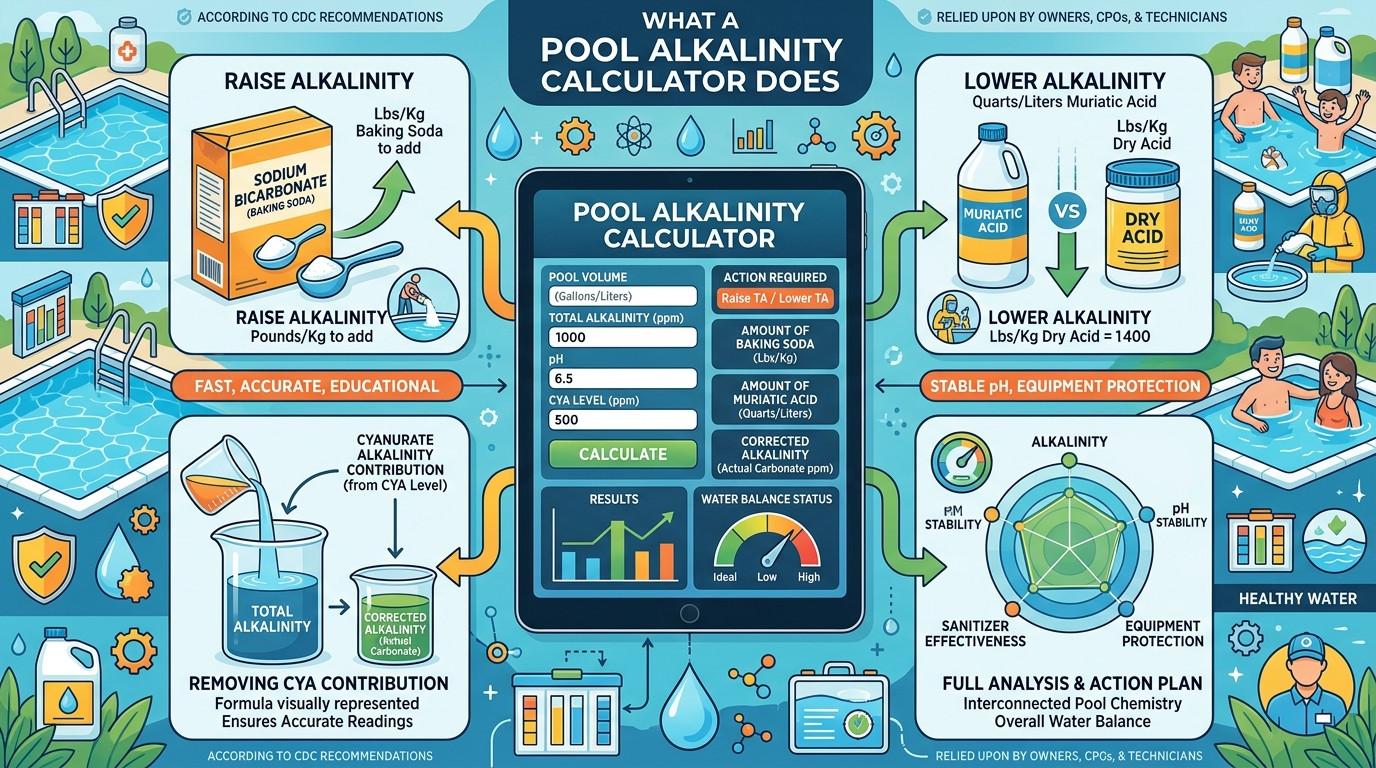
A pool alkalinity calculator is a specialized tool that performs essential calculations for total alkalinity management, including raising alkalinity with sodium bicarbonate (baking soda), lowering alkalinity with muriatic acid or dry acid, determining corrected alkalinity (removing the cyanurate alkalinity contribution from CYA), and providing complete alkalinity analysis with action plans. According to the Centers for Disease Control and Prevention (CDC), proper total alkalinity is critical for pH stability, equipment protection, and overall water balance in swimming pools.
A pool alkalinity calculator tells you exactly how many pounds of baking soda to add to raise alkalinity, how many quarts of muriatic acid to lower it, what your corrected alkalinity is after removing the CYA contribution, and whether your alkalinity, pH, and CYA are all working together for balanced water. Unlike basic pool calculators, a pool alkalinity calculator focuses specifically on the alkalinity-pH relationship that is the foundation of all pool water chemistry. Every pool owner, Certified Pool Operator, and pool service technician who wants stable pH and balanced water relies on these calculations, and the pool alkalinity calculator exists to make them fast, accurate, and educational.
The reason pool alkalinity calculations trip people up is the interconnected nature of pool chemistry — alkalinity affects pH, pH affects sanitizer effectiveness, and CYA inflates the total alkalinity reading. The pool alkalinity calculator handles all of these interactions internally so you can focus on maintaining balanced water rather than doing complex carbonate chemistry calculations.
This pool alkalinity calculator handles the four most important alkalinity management tasks in one place: raise alkalinity (baking soda or soda ash dosing), lower alkalinity (muriatic acid or dry acid dosing), corrected alkalinity (removing CYA contribution for accurate LSI calculations), and full analysis (complete alkalinity assessment with pH, CYA, and temperature). Each mode shows the answer and every step of the working, so you can verify the reasoning, learn the science, or document the calculation for your pool maintenance records.
Whether you are a homeowner fighting pH bounce, a pool service technician correcting high alkalinity from fill water, a commercial pool operator maintaining LSI balance, or a CPO preparing for an inspection, the pool alkalinity calculator gives you the exact calculations every time—no guesswork, no pH bounce, no scaling, no corrosive water.
How Pool Alkalinity Calculations Work
Every pool alkalinity calculation comes down to one idea: total alkalinity is the pH buffer that keeps pool water stable. From that single principle, a handful of formulas cover almost every alkalinity management task. The pool alkalinity calculator exists to handle those formulas reliably and transparently, because in practice the “arithmetic” is layered with pool volume conversions, chemical concentration factors, and the critical CYA correction—and any one of them, applied wrongly, can destabilize your entire water chemistry.
Raising Alkalinity: Sodium Bicarbonate (Baking Soda)
When total alkalinity is below 80 ppm, the pool needs an alkalinity increaser. The most common and safest product is sodium bicarbonate (NaHCO₃), commonly known as baking soda. The pool alkalinity calculator uses the formula: Amount (lbs) = (Volume / 10,000) × (TA increase / 10) × 1.5. For example, to raise alkalinity from 50 to 100 ppm in a 15,000-gallon pool: (15,000 / 10,000) × (50 / 10) × 1.5 = 11.25 lbs of baking soda. Sodium carbonate (soda ash) can also raise alkalinity but has a stronger pH-raising effect.
TA increase = desired alkalinity increase in ppm
1.5 = lbs of baking soda per 10,000 gallons per 10 ppm
For lowering: Muriatic acid rate = 0.8 qts per 10,000 gal per 10 ppm
Lowering Alkalinity: Muriatic Acid or Dry Acid
When total alkalinity exceeds 120 ppm, the pool needs an alkalinity reducer. Muriatic acid (31.45% HCl) is the most effective and common choice. The pool alkalinity calculator uses: Amount (quarts) = (Volume / 10,000) × (TA decrease / 10) × 0.8 for 31.45% muriatic acid. For dry acid (sodium bisulfate), the rate is approximately 2.0 lbs per 10,000 gallons per 10 ppm decrease. Lowering alkalinity also lowers pH, so pH must be checked and adjusted after alkalinity is corrected.
Corrected Alkalinity: Removing CYA Contribution
Cyanuric acid (CYA) contributes to the total alkalinity reading. When CYA is present, the measured total alkalinity includes both carbonate alkalinity (the useful buffer) and cyanurate alkalinity (a false contribution). The pool alkalinity calculator corrects for this using: Corrected Alkalinity = Total Alkalinity – (CYA / 3). For example, if TA is 120 ppm and CYA is 60 ppm, corrected alkalinity is 120 – 20 = 100 ppm. This corrected value is what should be used for LSI calculations and water balance assessments.
The Alkalinity-pH Relationship
Alkalinity and pH are interconnected. Low alkalinity causes pH to bounce erratically. High alkalinity causes pH to climb constantly. The pool alkalinity calculator always recommends adjusting alkalinity first, waiting 6-24 hours for it to stabilize, then adjusting pH. This order ensures pH adjustments are effective and lasting rather than temporary fixes that reverse within hours.
Quick Reference Values for the Pool Alkalinity Calculator
Remember: The pool alkalinity calculator provides accurate dosing calculations, but always test alkalinity with a reliable test kit before and after adding chemicals. Add chemicals gradually — you can always add more, but you can’t easily remove excess. Use the calculator as a starting point, then verify with retesting after 6-24 hours of circulation.

Real Scenarios Where Pool Alkalinity Mattered
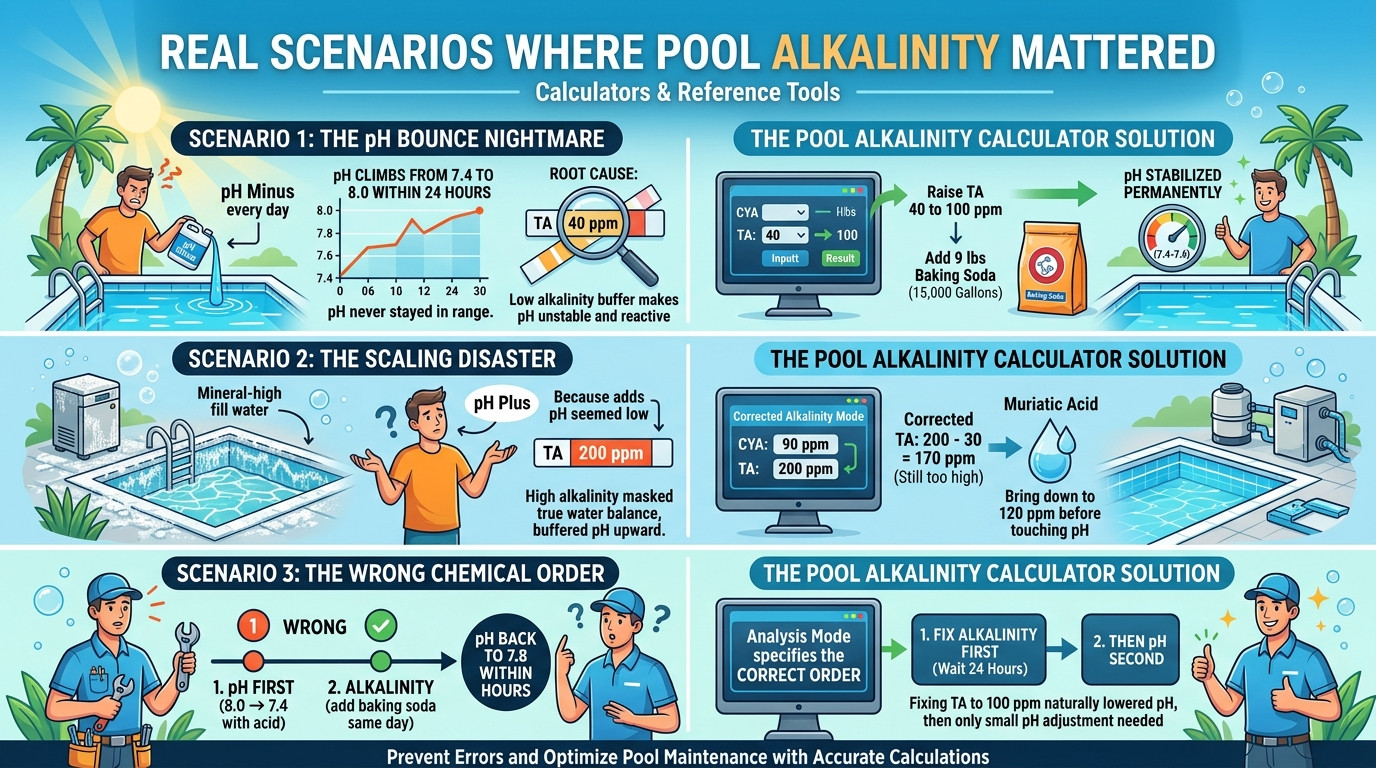
These scenarios reflect real pool maintenance situations where alkalinity calculation errors made a tangible difference to water quality and equipment longevity. Each scenario shows how the pool alkalinity calculator would have prevented the error.
Scenario 1: The pH Bounce Nightmare
A pool owner kept adding pH Minus every day because pH climbed from 7.4 to 8.0 within 24 hours. Despite daily adjustments, pH never stayed in range. The root cause was low alkalinity at 40 ppm — without adequate alkalinity buffer, pH was unstable and reactive. The pool alkalinity calculator would have identified low TA as the primary problem and calculated 9 lbs of baking soda for the 15,000-gallon pool to raise TA from 40 to 100 ppm, stabilizing pH permanently.
Scenario 2: The Scaling Disaster
A pool with fill water high in minerals had alkalinity at 200 ppm. The owner didn’t test alkalinity and kept adding pH Plus because pH seemed low. The high alkalinity was actually buffering pH upward, and the real TA reading masked the true water balance. The pool alkalinity calculator’s corrected alkalinity mode would have shown that with CYA at 90 ppm, corrected alkalinity was 200 – 30 = 170 ppm — still too high — and calculated the muriatic acid needed to bring it down to 120 ppm before touching pH.
Scenario 3: The Wrong Chemical Order
A pool service tech adjusted pH first (lowering from 8.0 to 7.4 with acid), then raised alkalinity with baking soda the same day. The baking soda pushed pH back up to 7.8 within hours. The pool alkalinity calculator’s analysis mode specifies the correct order: alkalinity first (wait 24 hours), then pH second. Fixing TA to 100 ppm first would have naturally lowered pH, and then only a small pH adjustment would have been needed.
Scenario 4: The Ignored CYA Correction
A pool operator used measured TA of 130 ppm for LSI calculations, not knowing that CYA at 90 ppm was inflating the reading. The corrected alkalinity was actually 130 – 30 = 100 ppm, which was ideal — but the operator thought alkalinity was too high and added acid unnecessarily, dropping actual carbonate alkalinity too low and causing corrosive water. The pool alkalinity calculator’s corrected mode prevents this by always showing the true carbonate alkalinity.
Common Pool Alkalinity Mistakes
These are the most frequent alkalinity errors that the pool alkalinity calculator helps prevent:
1. Adjusting pH Before Alkalinity
The most common alkalinity mistake is adjusting pH without checking alkalinity first. If alkalinity is out of range, any pH adjustment will be temporary — pH will bounce back within hours. The pool alkalinity calculator always evaluates alkalinity first and provides the correct adjustment order.
2. Ignoring the CYA Correction
When CYA is above 30 ppm, it inflates the total alkalinity reading. A pool with TA of 140 ppm and CYA of 90 ppm actually has corrected alkalinity of only 110 ppm — which is ideal. Without the correction, you might unnecessarily lower alkalinity with acid. The pool alkalinity calculator’s corrected mode handles this automatically.
3. Adding Too Much Acid at Once
Dumping the full calculated dose of muriatic acid into the pool can overshoot the target and crash both alkalinity and pH. The pool alkalinity calculator recommends adding 75% of the calculated dose, waiting 6 hours, retesting, and adding the remaining 25% if needed.
4. Using Soda Ash When You Need Baking Soda
Sodium carbonate (soda ash) raises both alkalinity AND pH significantly. Sodium bicarbonate (baking soda) raises alkalinity with minimal pH effect. If you only need to raise alkalinity without raising pH, use baking soda. The pool alkalinity calculator includes both options with appropriate dosing rates.
5. Not Accounting for Fill Water Alkalinity
When adding fresh water to the pool (from backwashing, splash-out, or evaporation), the fill water’s alkalinity affects the pool’s alkalinity. If fill water has high alkalinity (150+ ppm), the pool alkalinity will gradually increase over time. The pool alkalinity calculator helps you track and manage these changes.
Warning: Never mix muriatic acid with chlorine, bleach, or any oxidizer. This combination produces toxic chlorine gas that can be fatal. Always add acid to the pool water separately, with the pump running, and wait at least 4 hours before adding any other chemical. The pool alkalinity calculator shows chemical-specific safety notes with every calculation.
Expert Perspectives on Pool Alkalinity
“Alkalinity is the most misunderstood parameter in pool chemistry. Pool owners obsess over pH but ignore alkalinity, not realizing that alkalinity controls pH stability. I tell every CPO class: fix alkalinity first, and pH problems solve themselves. A pool alkalinity calculator should be in every service tech’s toolkit.”
“The CYA correction for alkalinity is one of the most important calculations that most pool operators skip. When CYA is above 50 ppm, the measured TA is misleading. The corrected alkalinity tells you the real carbonate buffering capacity. I use a pool alkalinity calculator with every client to show them the true picture.”
“In 20 years of pool service, I’ve learned that 80% of water quality complaints trace back to alkalinity problems. pH bounce, scaling, cloudy water, chlorine inefficiency — check alkalinity first. The pool alkalinity calculator has cut my troubleshooting time in half because I can show clients exactly what’s wrong and how to fix it.”
Expert Consensus: All three experts agree that proper alkalinity management is the foundation of stable pool chemistry. Using a pool alkalinity calculator to maintain TA at 80-120 ppm, applying the CYA correction, and following the correct adjustment order (alkalinity first, pH second) eliminates the majority of pool water quality problems.
Frequently Asked Questions
Accuracy depends on accurate pool volume and current test results. Water temperature, fill water chemistry, and bather load can affect actual chemical demand. Always retest after adding chemicals and adjust as needed.
The pool alkalinity calculator uses 80-120 ppm as the standard range. For corrected alkalinity (after CYA correction), the ideal range is 60-100 ppm.
The pool alkalinity calculator’s analysis mode automatically recommends the correct order of chemical additions based on your current readings.
The pool alkalinity calculator’s corrected mode performs this calculation automatically. If your CYA is above 30 ppm, you should always use corrected alkalinity for water balance decisions.
The pool alkalinity calculator’s baking soda dosing rates apply to both branded products and generic sodium bicarbonate. A 4-lb box of Arm & Hammer is the same chemical as pool-store alkalinity increaser.
If alkalinity keeps rising, test your fill water alkalinity. The pool alkalinity calculator’s lower mode calculates the acid needed to bring it back down. Consider switching to dichlor or liquid chlorine, which don’t add alkalinity.
The pool alkalinity calculator provides the total amount needed. Split it into two or three additions over 24 hours for the safest approach. Run the pump continuously during treatment.
The pool alkalinity calculator includes both options with correct dosing rates. Soda ash requires less product but has a stronger pH impact — use it only when both alkalinity and pH are low.
Use the pool alkalinity calculator whenever alkalinity is outside the 80-120 ppm range. Keep a testing log to track alkalinity trends and identify when adjustments are typically needed.
Saltwater pools may benefit from slightly lower alkalinity (80-100 ppm) to reduce pH drift from the SWG. The pool alkalinity calculator works for both ranges.
Pool Alkalinity Best Practices
These practices separate stable, balanced pool water from pH bounce and scaling problems. Follow them alongside the pool alkalinity calculator for optimal alkalinity management.
Before Adjusting Alkalinity
During Alkalinity Adjustment
After Alkalinity Adjustment
Trusted Reference Resources
These are authoritative references for pool alkalinity management and water balance chemistry that complement the pool alkalinity calculator.
CDC Healthy Swimming — cdc.gov/healthywater/swimming — Comprehensive pool safety guidelines, water chemistry recommendations, and alkalinity standards from the Centers for Disease Control and Prevention.
Pool & Hot Tub Alliance (PHTA) — phta.org — Industry association for pool professionals, offering education, certification, and best practices for alkalinity management and water balance.
National Swimming Pool Foundation (NSPF) — nspf.org — Certified Pool Operator (CPO) training, water chemistry education, and alkalinity management resources.
Association of Pool & Spa Professionals (APSP) — apsp.org — Industry standards and best practices for pool water chemistry, alkalinity management, and LSI calculations.
On our platform, related calculation tools that complement the pool alkalinity calculator include: pool chemistry calculator, pool chemical calculator, pool salt calculator, pool volume calculator, bleach dilution calculator, sodium hypochlorite calculator, pH calculator, PPM calculator, solution dilution calculator, percent concentration calculator, dilution factor calculator, and dilution calculator (all-in-one).
Leave a Review
Used this pool alkalinity calculator for your pool maintenance? Share your experience below. Your review helps other pool owners decide if this pool alkalinity calculator fits their maintenance needs. Every review is stored locally on your device and appears instantly.
📝 Share Your Experience
Final Thoughts on the Pool Alkalinity Calculator
Pool alkalinity management is the foundation of stable pool water chemistry. When alkalinity is correct (80-120 ppm), pH stays stable, chlorine works effectively, and water remains clear and comfortable. When alkalinity is wrong, everything else becomes a battle — pH bounces, chemicals seem ineffective, and water quality degrades despite constant attention. The pool alkalinity calculator exists to make alkalinity management precise, educational, and repeatable, showing every step of every calculation so results can be verified and learned.
What separates stable pool water from pH bounce and scaling is alkalinity precision. Using the pool alkalinity calculator for exact chemical measurements, applying the CYA correction, adjusting alkalinity before pH, and adding chemicals gradually: these are the habits that eliminate water chemistry problems at their root. The pool alkalinity calculator does the math perfectly every time, but it cannot test your water or add chemicals — that remains the pool owner’s responsibility.
The framework is short: test alkalinity, calculate with the pool alkalinity calculator, adjust alkalinity first, wait 6-24 hours, then adjust pH, and retest. That sequence gives stable, balanced water every time. From backyard pools and saltwater systems to commercial aquatic facilities and competition pools, accurate alkalinity management is the foundation of water balance, and getting it right with the pool alkalinity calculator is the most important skill in pool chemistry.
Keep this pool alkalinity calculator handy as your starting point for every alkalinity task, and use the related dilution and concentration tools in the sidebar whenever you need to plan or verify a calculation before treating your pool.
🔒 Privacy Guarantee: Every calculation on this pool alkalinity calculator page runs entirely within your browser. No data—pool volumes, alkalinity readings, chemical amounts, or any other inputs—is sent to any server, stored, or shared. Your calculations are completely private.
Pingback: Muriatic Acid Pool Calculator – Calculate Acid Dosage
Pingback: Spa Alkalinity Calculator | Calculate Alkalinity Adjustment