
♨️ Spa Alkalinity Calculator
Calculate alkalinity adjustments for spas & hot tubs — raise with baking soda, lower with acid, corrected alkalinity & complete analysis
⚠️ Spa Alkalinity Safety Note
SPAS REQUIRE PRECISE CHEMISTRY. Hot water (100-104°F) accelerates chemical reactions and makes alkalinity adjustments more sensitive than pools. Add chemicals in small increments — never dump full doses at once. For spas under 500 gallons, use measuring spoons (teaspoons/tablespoons) rather than cups. Wait 30 minutes between additions and retest. Never mix acid with chlorine or other chemicals. Wear gloves when handling acid. Run jets during chemical addition for even distribution. Do not use spa until chemistry is balanced.
Calculation History
💡 You Might Also Like
Spa Alkalinity Calculator: Raise, Lower & Correct Total Alkalinity for Spas, Hot Tubs & Jacuzzis
A spa alkalinity calculator is an essential tool that helps spa and hot tub owners accurately calculate how much baking soda (sodium bicarbonate) or acid to add for adjusting total alkalinity in small-volume heated water systems (200-500 gallons). Spas require precise alkalinity management because hot water (100-104°F) accelerates chemical reactions, making both adjustments and errors more dramatic than in pools. Whether you’re raising alkalinity from 50 to 100 ppm with teaspoons of baking soda, lowering it from 180 to 120 ppm with carefully measured acid, calculating corrected alkalinity accounting for CYA, or getting a complete alkalinity analysis with temperature-adjusted recommendations, this spa alkalinity calculator provides precise measurements in teaspoons, tablespoons, and grams — not cups and pounds — because spa volumes demand precision.
SPAS REQUIRE EXTREME PRECISION. Hot water (100-104°F) accelerates chemical reactions 2-3× faster than pool water. Add chemicals in small increments — never dump full doses at once. For spas under 500 gallons, use measuring spoons (teaspoons/tablespoons) and a kitchen scale for accuracy. Wait 30 minutes between additions and retest before adding more. Never mix acid with chlorine, bromine, or other spa chemicals — this creates toxic gases. Wear gloves when handling acid. Run jets during chemical addition for even distribution. Do not enter the spa until all chemistry parameters are balanced. Over-dosing in a spa can cause skin irritation, eye burning, and equipment damage within minutes.
📋 Table of Contents
▼What a Spa Alkalinity Calculator Does
A spa alkalinity calculator is a specialized tool that performs essential calculations for total alkalinity management in spas, hot tubs, and jacuzzis — small-volume heated water systems typically holding 200-500 gallons at 100-104°F. It calculates precise amounts of sodium bicarbonate (baking soda) to raise alkalinity, muriatic acid or dry acid to lower alkalinity, corrected alkalinity accounting for CYA levels, and complete alkalinity analyses with temperature-adjusted recommendations. According to the Centers for Disease Control and Prevention (CDC), proper total alkalinity in spas (80-120 ppm) is critical for pH stability, sanitizer effectiveness, bather comfort, and equipment protection in heated water environments.
A spa alkalinity calculator tells you exactly how many teaspoons of baking soda to raise your spa’s alkalinity from 50 to 100 ppm, how many teaspoons of acid to lower it from 180 to 120 ppm, what your corrected alkalinity is after accounting for CYA, and the complete alkalinity action plan for your spa’s current chemistry. Unlike pool alkalinity calculators that work with cups and pounds for 10,000-30,000 gallon volumes, a spa alkalinity calculator works with teaspoons and grams for 200-500 gallon volumes — where a single tablespoon too much can overshoot your target by 20+ ppm. Every spa owner, hot tub technician, and resort maintenance staff who needs to manage alkalinity in small heated water systems relies on these precise calculations, and the spa alkalinity calculator exists to make them fast, accurate, and safe.
The reason spa alkalinity calculations trip people up is the combination of small volumes and high temperatures. A 400-gallon spa is 1/50th the volume of a 20,000-gallon pool, so dosing errors that would be insignificant in a pool become dangerous in a spa. High water temperature (100-104°F) accelerates chemical reactions, making both adjustments and errors happen faster. The spa alkalinity calculator handles these precision requirements internally, converting pool-scale formulas into spa-scale measurements (teaspoons, grams) so you can focus on safe application rather than doing complex unit conversions.
This spa alkalinity calculator handles the four most important alkalinity management tasks in one place: raise alkalinity (baking soda dosing in teaspoons/tablespoons/grams for 200-500 gallon spas), lower alkalinity (acid dosing in teaspoons/mL with split-dose safety), corrected alkalinity (CYA-adjusted alkalinity for accurate water balance assessment), and complete alkalinity analysis (evaluating TA, pH, CYA, and temperature with prioritized action recommendations). Each mode shows the answer in spa-appropriate units and every step of the working, so you can verify the reasoning, learn the chemistry, or document the calculation for your spa maintenance records.
Whether you are a new spa owner learning that your hot tub needs different measurements than a pool, an experienced hot tub owner fine-tuning alkalinity after a water change, a spa service technician managing multiple client hot tubs, or a resort maintenance staff keeping dozens of guest spas balanced, the spa alkalinity calculator gives you the exact calculations every time—no guesswork, no over-dosing, no pH bounce, no skin irritation.

How Spa Alkalinity Calculations Work
Every spa alkalinity calculation comes down to one idea: sodium bicarbonate (baking soda) raises total alkalinity, while acid lowers it — but in a spa, the small volume means you need precise measurements in teaspoons, not cups. From that single principle, a handful of formulas cover almost every spa alkalinity task. The spa alkalinity calculator exists to handle those formulas reliably and transparently, converting pool-scale dosing into spa-scale precision.
Raising Alkalinity: Baking Soda in Teaspoons
When spa alkalinity drops below 80 ppm, the water becomes corrosive, pH bounces erratically, and sanitizer becomes less effective. The spa alkalinity calculator uses the formula: Baking Soda (teaspoons) = (Volume / 10,000) × (TA increase / 10) × 1.5 × 96. The “96” converts pounds to teaspoons (1 lb baking soda ≈ 96 tsp). For example, to raise alkalinity from 50 to 100 ppm in a 400-gallon spa: (400 / 10,000) × (50 / 10) × 1.5 × 96 = 28.8 teaspoons (about 9.6 tablespoons or 144 grams).
TA increase = desired alkalinity increase in ppm
1.5 = lbs baking soda per 10,000 gallons per 10 ppm
96 = teaspoons per pound of baking soda
Result in teaspoons (divide by 3 for tablespoons, multiply by 5 for grams)
Lowering Alkalinity: Acid in Teaspoons
When spa alkalinity exceeds 120 ppm, pH climbs constantly, scaling occurs on surfaces, and water becomes cloudy. The spa alkalinity calculator uses: Acid (teaspoons) = (Volume / 10,000) × (TA decrease / 10) × rate × 6. For muriatic acid (31.45%), the rate is approximately 1.5 fl oz per 10,000 gallons per 10 ppm decrease, and 1 fl oz ≈ 6 teaspoons. For a 400-gallon spa going from 180 to 120 ppm: (400 / 10,000) × (60 / 10) × 1.5 × 6 = 21.6 teaspoons of muriatic acid.
Corrected Alkalinity: CYA Adjustment
Cyanuric acid (CYA) contributes to measured total alkalinity but does not provide useful pH buffering. The spa alkalinity calculator corrects for this using: Corrected Alkalinity = Total Alkalinity – (CYA × 0.333). For example, if TA is 150 ppm and CYA is 60 ppm, corrected alkalinity is 150 – 20 = 130 ppm. This corrected value is what matters for water balance decisions and LSI calculations. Many spa owners don’t realize their “high” alkalinity reading is inflated by CYA.
Temperature Effects on Spa Chemistry
Hot water (100-104°F) accelerates chemical reactions 2-3× faster than pool water (78-82°F). This means alkalinity adjustments happen faster in spas, but so do errors. The spa alkalinity calculator accounts for this by recommending smaller increments and longer wait times between additions. At 102°F, a teaspoon of baking soda dissolves and distributes in minutes — compared to 30+ minutes in cool pool water.
Quick Reference Values for the Spa Alkalinity Calculator
Remember: The spa alkalinity calculator provides accurate dosing in teaspoons, but always add chemicals in small increments — never the full calculated amount at once. Add 50% of the calculated dose, run jets for 30 minutes, retest, then add the remaining 50% if needed. Hot water makes chemical reactions fast — patience prevents over-dosing.

Real Scenarios Where Spa Alkalinity Mattered
These scenarios reflect real spa maintenance situations where alkalinity calculation errors made a tangible difference to water quality, bather comfort, and equipment longevity. Each scenario shows how the spa alkalinity calculator would have prevented the error.
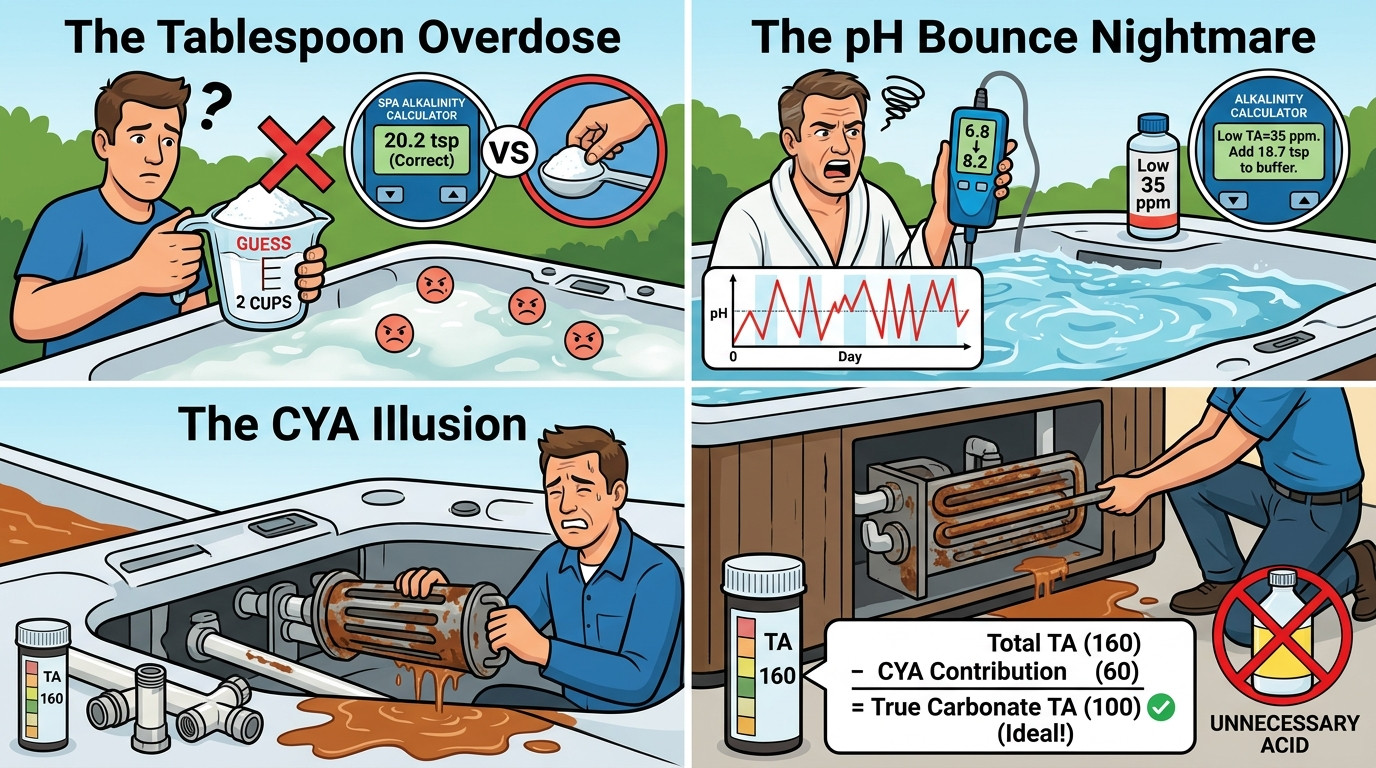
Scenario 1: The Tablespoon Overdose
A spa owner with a 350-gallon hot tub needed to raise alkalinity from 40 to 100 ppm (60 ppm increase). They used a pool calculator that recommended 1.26 lbs of baking soda — correct for a pool, but they guessed and added 2 cups (approximately 1 lb). In a 350-gallon spa, this raised alkalinity to 180 ppm — far above the 120 ppm maximum. The high alkalinity caused pH to climb to 8.4 within hours, making the water cloudy and causing skin irritation for bathers. The spa alkalinity calculator would have shown 20.2 teaspoons (about 6.7 tablespoons) — less than half of what they added.
Scenario 2: The pH Bounce Nightmare
A spa owner kept adjusting pH daily, but it bounced from 6.8 to 8.2 within 24 hours despite acid additions. The root cause was low alkalinity at 35 ppm — without adequate buffering capacity, pH had nothing to stabilize it. The spa alkalinity calculator would have identified low TA as the primary problem and calculated 18.7 teaspoons of baking soda to raise TA from 35 to 100 ppm, stabilizing pH permanently and ending the daily adjustment cycle.
Scenario 3: The CYA Illusion
A spa owner saw TA at 160 ppm and added acid to lower it, not knowing that 60 ppm of that reading was CYA contribution. The actual carbonate alkalinity was only 140 ppm — already in the ideal range. The unnecessary acid addition dropped pH to 6.6, making the water corrosive and damaging the spa heater element ($400 replacement). The spa alkalinity calculator’s corrected alkalinity mode would have shown the true carbonate alkalinity was fine and prevented the costly mistake.
Scenario 4: The Hot Water Surprise
A pool service technician used their standard pool alkalinity protocol on a 400-gallon spa — adding the full calculated dose of baking soda at once and testing after 15 minutes. In hot water (102°F), the baking soda dissolved and reacted 3× faster than in pool water, overshooting the target by 30 ppm before they could retest. The spa alkalinity calculator recommends adding 50% of the dose, waiting 30 minutes, retesting, then adding the remainder — preventing the hot-water acceleration problem.
Common Spa Alkalinity Mistakes
These are the most frequent spa alkalinity errors that the spa alkalinity calculator helps prevent:
1. Using Pool Dosing for Spas
Pool calculators recommend doses in cups and pounds for 10,000-30,000 gallon volumes. A 400-gallon spa is 1/50th that volume — using pool doses will massively over-chem the spa. The spa alkalinity calculator automatically scales formulas to spa volumes and provides results in teaspoons and grams.
2. Adding Full Dose at Once
In hot water, chemicals dissolve and react 2-3× faster than in cool pool water. Adding the full calculated dose at once can overshoot the target before you can retest. The spa alkalinity calculator recommends splitting doses into 2-3 increments with 30-minute waits between each.
3. Not Using Measuring Spoons
Eyeballing “about a cup” of baking soda in a spa can add 50-100% too much. For spas, use actual measuring spoons (teaspoons/tablespoons) or a kitchen scale for accuracy. The spa alkalinity calculator provides precise teaspoon measurements — use them exactly.
4. Ignoring CYA Contribution
CYA inflates the total alkalinity reading. If CYA is 60 ppm, approximately 20 ppm of your TA reading is CYA contribution, not useful carbonate buffering. The spa alkalinity calculator’s corrected alkalinity mode reveals the true carbonate alkalinity for accurate water balance decisions.
5. Adjusting pH Before Alkalinity
If alkalinity is out of range, pH adjustments won’t last. Fix alkalinity first, wait 24 hours for it to stabilize, then fine-tune pH. The spa alkalinity calculator’s full analysis mode evaluates both parameters and recommends the correct order of treatment.
Warning: In a 400-gallon spa, a single extra tablespoon of baking soda can raise alkalinity by approximately 5 ppm. A single extra teaspoon of muriatic acid can lower alkalinity by approximately 3 ppm. These small margins mean precision matters enormously. The spa alkalinity calculator provides exact measurements — use measuring spoons, not estimation.
Expert Perspectives on Spa Alkalinity
“The biggest mistake I see with spa owners is using pool chemistry habits on hot tubs. A cup of baking soda in a 20,000-gallon pool is barely noticeable — in a 400-gallon spa, it’s a 25 ppm alkalinity increase. Spa chemistry demands teaspoon-level precision, and a spa alkalinity calculator is the only way to get it right consistently.”
“Hot water changes everything about chemical management. Reactions happen faster, errors are magnified, and bather sensitivity is higher because people are immersed in the water for extended periods. I recommend every spa owner keep a spa alkalinity calculator bookmarked — it’s the difference between comfortable, clear water and irritated skin with cloudy water.”
“For resort spas that get drained and refilled between guests, alkalinity management is a daily task. The spa alkalinity calculator saves my maintenance team hours of calculation and prevents the over-dosing incidents that used to require emergency water changes. It’s the most-used tool on our maintenance tablets.”
Expert Consensus: All three experts agree that spa alkalinity requires teaspoon-level precision that pool calculators cannot provide. Using a spa alkalinity calculator designed for small volumes (200-500 gallons) and providing measurements in teaspoons and grams eliminates the most common spa chemistry errors and ensures comfortable, safe hot tub water.
Frequently Asked Questions
Always add chemicals in small increments (50% of calculated dose first), wait 30 minutes, retest, then add the remainder if needed. Hot water accelerates reactions, so patience prevents over-dosing.
The spa alkalinity calculator provides exact amounts for any spa volume and any target alkalinity increase. Always split the dose into 2-3 additions with 30-minute waits between each.
The spa alkalinity calculator works with any pure sodium bicarbonate product. The dosing is the same whether you buy Arm & Hammer from the grocery store or branded alkalinity increaser from the spa store.
The spa alkalinity calculator helps you calculate the exact dose to restore alkalinity. For spas that drop frequently, consider raising alkalinity to 110-120 ppm (upper end of ideal range) for a larger buffer against drops.
The spa alkalinity calculator uses the same 80-120 ppm target range but provides spa-specific dosing in teaspoons for small volumes. The chemistry is identical — only the measurement precision differs.
In hot water (100-104°F), baking soda dissolves and distributes faster than in cool pool water — usually within 15-20 minutes with jets running. The spa alkalinity calculator recommends 30 minutes as a safe minimum wait time.
The spa alkalinity calculator’s full analysis mode considers temperature and provides adjusted recommendations for addition speed and wait times based on your spa’s actual water temperature.
Inflatable hot tubs typically hold 200-300 gallons. Enter your exact volume for accurate dosing. The calculator provides the same precise teaspoon measurements regardless of spa construction.
Use the spa alkalinity calculator whenever alkalinity falls outside 80-120 ppm. Keep a testing log to track trends and identify when your spa typically needs adjustments.
For vinyl or inflatable spas, pre-dissolve baking soda in a cup of spa water before adding to prevent undissolved granules from sitting on the surface. The spa alkalinity calculator provides the same accurate dosing regardless of spa material.
Spa Alkalinity Best Practices
These practices separate stable, comfortable spa water from pH bounce, skin irritation, and equipment damage. Follow them alongside the spa alkalinity calculator for optimal results.
Before Adding Chemicals
During Chemical Addition
After Chemical Addition
Trusted Reference Resources
These are authoritative references for spa alkalinity management and hot tub water chemistry that complement the spa alkalinity calculator.
CDC Healthy Swimming — Hot Tubs — cdc.gov/healthywater/swimming — CDC guidelines for hot tub water chemistry, alkalinity standards, and recreational water illness prevention in heated water environments.
Pool & Hot Tub Alliance (PHTA) — phta.org — Industry association for spa professionals, offering education, certification, and best practices for hot tub alkalinity management and water balance.
National Swimming Pool Foundation (NSPF) — nspf.org — Certified Pool/Spa Operator (CPO) training, hot tub water chemistry education, and spa alkalinity management guidelines.
Association of Pool & Spa Professionals (APSP) — apsp.org — Industry standards for spa construction, chemical management, and hot tub water quality best practices.
On our platform, related calculation tools that complement the spa alkalinity calculator include: pool alkalinity calculator, baking soda pool calculator, muriatic acid pool calculator, pool chemistry calculator, pool volume calculator, pH calculator, PPM calculator, solution dilution calculator, percent concentration calculator, dilution factor calculator, and dilution calculator (all-in-one).
Leave a Review
Used this spa alkalinity calculator for your hot tub maintenance? Share your experience below. Your review helps other spa owners decide if this spa alkalinity calculator fits their maintenance needs. Every review is stored locally on your device and appears instantly.
📝 Share Your Experience
Final Thoughts on the Spa Alkalinity Calculator
Spa alkalinity management is where precision matters most in recreational water chemistry. A 400-gallon hot tub is 1/50th the volume of a typical pool, which means every teaspoon counts. A single extra tablespoon of baking soda can raise alkalinity by 5 ppm — a change that would be invisible in a pool but noticeable in a spa. The spa alkalinity calculator exists to provide that teaspoon-level precision, converting pool-scale formulas into spa-scale measurements so you can manage alkalinity accurately in small-volume heated water systems.
What separates comfortable, clear spa water from pH bounce, skin irritation, and cloudy water is precision and patience. Using the spa alkalinity calculator for exact teaspoon measurements, adding chemicals in small increments, waiting 30 minutes between additions, and retesting before adding more: these are the habits that prevent over-dosing and deliver consistent results. The hot water in spas makes chemical reactions fast — which means both adjustments and errors happen quickly. The spa alkalinity calculator does the math perfectly every time, but it cannot add the chemicals carefully or wait patiently between doses — that remains the spa owner’s responsibility.
The framework is short: test alkalinity twice weekly, calculate with the spa alkalinity calculator, add 50% of the dose with jets running, wait 30 minutes, retest, add the remainder if needed, and enjoy. That sequence gives stable, comfortable spa water every time. From backyard hot tubs and inflatable spas to resort jacuzzis and commercial therapy pools, accurate spa alkalinity calculations are the foundation of hot tub water quality, and getting it right with the spa alkalinity calculator is the most important skill in spa maintenance.
Keep this spa alkalinity calculator handy as your starting point for every alkalinity task, and use the related dilution and concentration tools in the sidebar whenever you need to plan or verify a calculation before treating your spa.
🔒 Privacy Guarantee: Every calculation on this spa alkalinity calculator page runs entirely within your browser. No data—spa volumes, alkalinity readings, chemical amounts, or any other inputs—is sent to any server, stored, or shared. Your calculations are completely private.