
💧 Pool Chlorine Dilution Calculator
Calculate chlorine dilutions, ppm dosing, shock solutions & complete chlorine treatment plans for pools
⚠️ Pool Chlorine Safety Note
HANDLE CHLORINE WITH CARE. Never mix chlorine with acid, ammonia, or other chemicals — this produces deadly gases. Store liquid chlorine in a cool, dark place away from direct sunlight (degrades rapidly). Wear gloves and eye protection when handling concentrated chlorine. Pre-dissolve granular chlorine (Cal-Hypo, Dichlor) in a bucket of pool water before adding. Add chlorine to the pool at dusk or evening to minimize UV degradation. Never swim when FC exceeds 5 ppm (or 10 ppm during shock treatment with CYA adjustment). Keep chlorine products away from children and organic materials.
Calculation History
💡 You Might Also Like
Pool Chlorine Dilution Calculator: Dilute Chlorine, Calculate PPM Dosing, Shock Solutions & Complete Chlorine Plans
A pool chlorine dilution calculator is an essential tool that helps pool owners accurately calculate chlorine dilutions using the C1V1=C2V2 formula, determine precise PPM dosing for any chlorine product (liquid chlorine, bleach, Cal-Hypo, dichlor), calculate shock treatment amounts for regular/heavy/algae-kill levels, and generate complete chlorine treatment plans based on free chlorine, combined chlorine, CYA, and pH. Whether you’re diluting 12.5% liquid chlorine to a 5% spray solution, calculating how much bleach to raise FC from 1 to 3 ppm in a 20,000-gallon pool, determining shock dosage, or getting a complete chlorine action plan with CYA-adjusted targets, this pool chlorine dilution calculator provides precise calculations with step-by-step explanations for safe and effective pool sanitation.
NEVER MIX CHLORINE WITH ACID OR AMMONIA. Mixing chlorine with muriatic acid produces deadly chlorine gas. Mixing with ammonia creates toxic chloramine fumes. Store liquid chlorine in a cool, dark place — it degrades rapidly in heat and sunlight (loses 1-2% per week at 80°F). Wear gloves and eye protection when handling concentrated chlorine. Pre-dissolve granular chlorine (Cal-Hypo, Dichlor) in a bucket of pool water before adding. Never add water to dry chlorine — always add chlorine to water. Do not swim when FC exceeds 5 ppm (or the CYA-adjusted maximum). Keep chlorine products away from children, organic materials, and all other pool chemicals.
📋 Table of Contents
▼- What a Pool Chlorine Dilution Calculator Does
- How Pool Chlorine Dilution Calculations Work
- Real Scenarios Where Chlorine Dilution Mattered
- Common Chlorine Dilution Mistakes
- Expert Perspectives on Chlorine Dilution
- Frequently Asked Questions
- Pool Chlorine Dilution Best Practices
- Trusted Reference Resources
- Leave a Review
What a Pool Chlorine Dilution Calculator Does
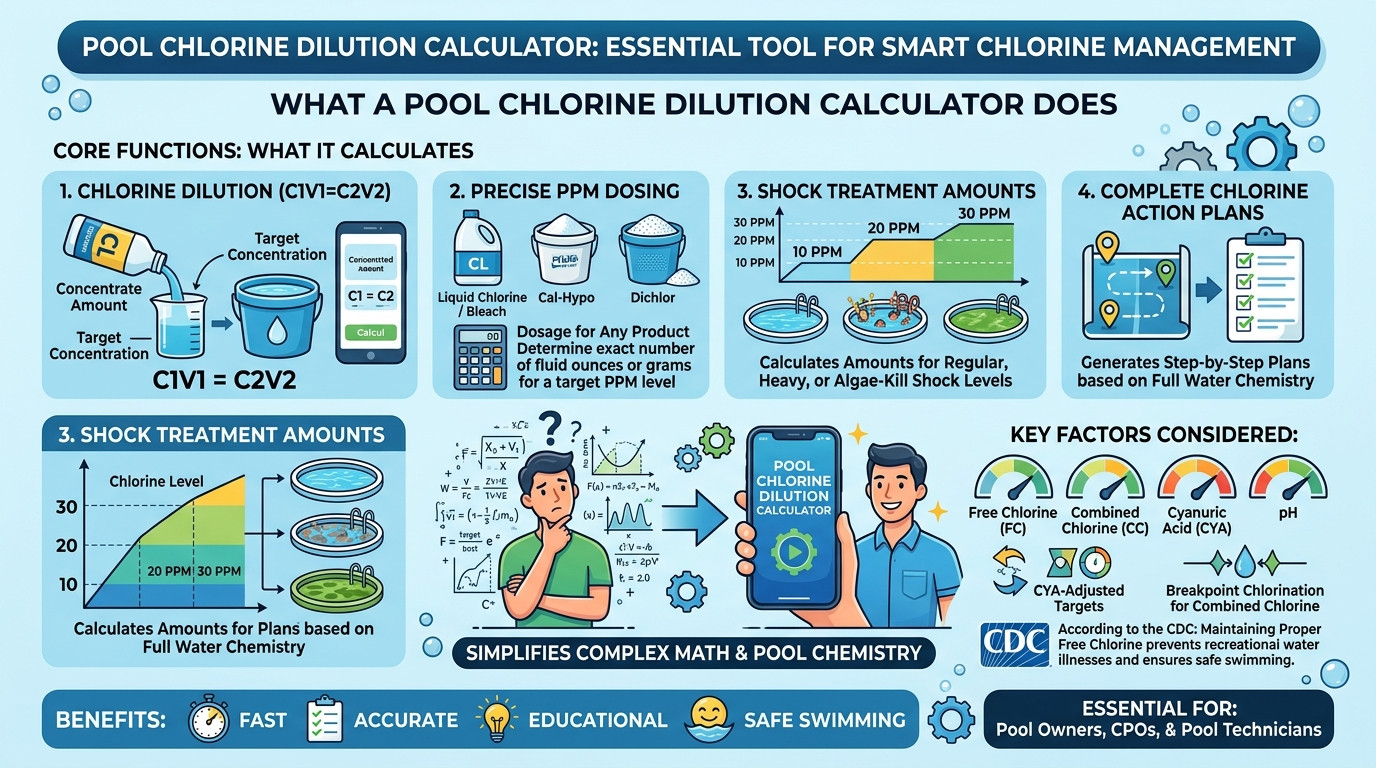
A pool chlorine dilution calculator is a specialized tool that performs essential calculations for chlorine management in swimming pools, including diluting concentrated chlorine to desired concentrations using the C1V1=C2V2 formula, calculating precise PPM dosing for liquid chlorine, bleach, Cal-Hypo, and dichlor products, determining shock treatment amounts for regular, heavy, and algae-kill chlorine levels, and generating complete chlorine treatment plans based on free chlorine, combined chlorine, CYA, and pH readings. According to the Centers for Disease Control and Prevention (CDC), maintaining proper free chlorine levels is the most critical factor in preventing recreational water illnesses and ensuring safe swimming conditions.
A pool chlorine dilution calculator tells you exactly how much concentrated chlorine to mix with water to create a specific concentration, how many fluid ounces or grams of any chlorine product to add to reach a target PPM level, how much chlorine is needed for shock treatments at 10, 20, or 30 ppm, and the complete chlorine action plan based on your pool’s current chemistry. Unlike generic dilution calculators, a pool chlorine dilution calculator understands pool-specific chlorine products (liquid chlorine, bleach, Cal-Hypo, dichlor), CYA-adjusted targets, breakpoint chlorination for combined chlorine, and the relationship between chlorine effectiveness and CYA levels. Every pool owner, CPO, and pool service technician relies on these calculations, and the pool chlorine dilution calculator exists to make them fast, accurate, and educational.
The reason chlorine dilution calculations trip people up is the combination of concentration math and pool chemistry. You need to understand both the C1V1=C2V2 dilution formula AND how chlorine products differ in concentration, how CYA affects chlorine effectiveness, and what target FC levels are appropriate for your CYA level. The pool chlorine dilution calculator handles all of these complexities internally so you can focus on maintaining safe pool water rather than doing complex chemistry calculations.
This pool chlorine dilution calculator handles the four most important chlorine management tasks in one place: chlorine dilution (C1V1=C2V2 for any source and target concentration), PPM dosing (exact amounts for 6 different chlorine products), shock dilution (regular 10 ppm, heavy 20 ppm, or algae-kill 30 ppm), and complete chlorine plans (FC/CC/CYA/pH analysis with CYA-adjusted targets and action recommendations). Each mode shows the answer and every step of the working, so you can verify the reasoning, learn the chemistry, or document the calculation for your pool maintenance records.
Whether you are a homeowner diluting liquid chlorine for a spray bottle, a pool service technician calculating daily chlorine doses for multiple clients, a commercial pool operator preparing shock treatments, or a DIY pool owner trying to understand the relationship between CYA and chlorine levels, the pool chlorine dilution calculator gives you the exact calculations every time—no guesswork, no under-dosing, no over-chlorinating, no wasted chemicals.
How Pool Chlorine Dilution Calculations Work
Every pool chlorine dilution calculation comes down to two core principles: the dilution formula (C1V1=C2V2) for mixing concentrations, and the PPM dosing formula for adding chlorine to pool water. From these two principles, all chlorine management tasks can be calculated. The pool chlorine dilution calculator exists to handle these formulas reliably and transparently, because chlorine is the most important pool chemical and precision matters for both effectiveness and safety.
Chlorine Dilution: C1V1 = C2V2
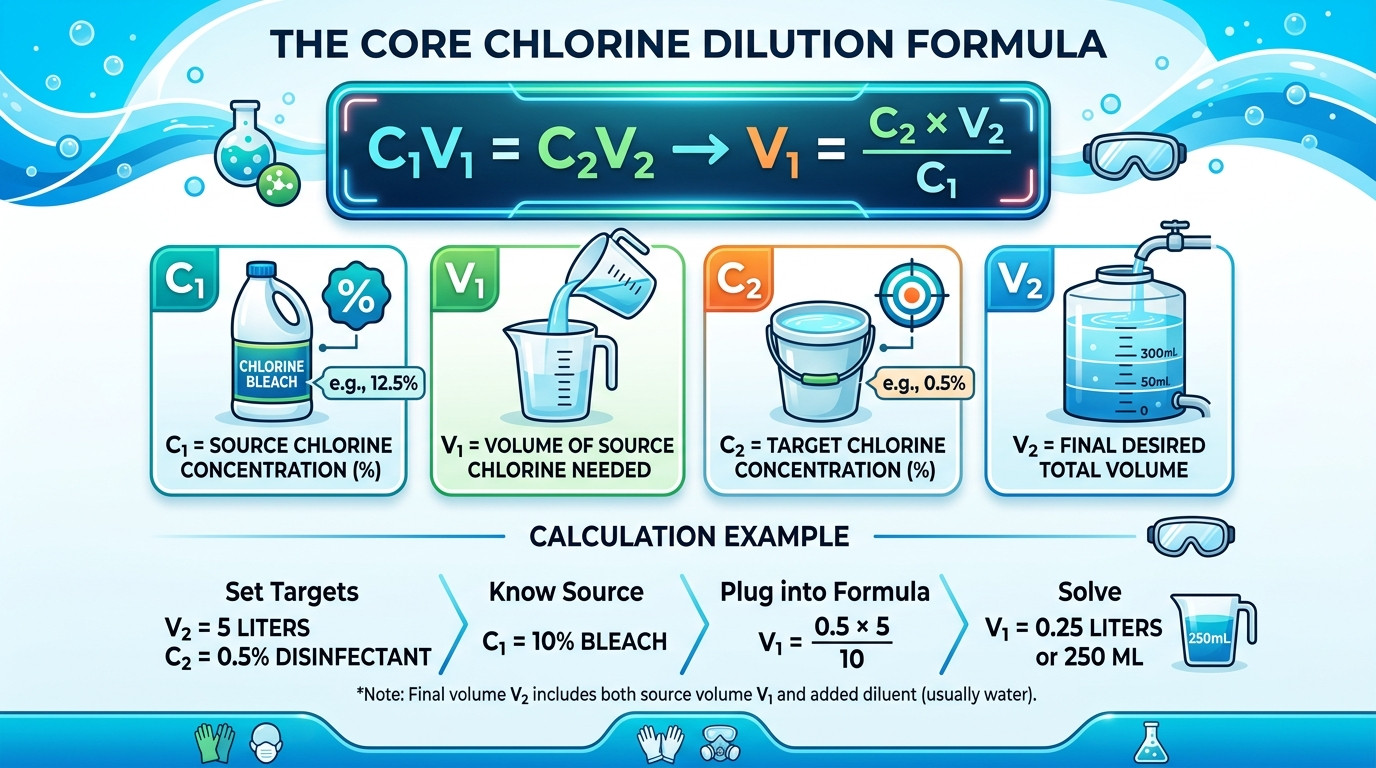
When you need to dilute concentrated chlorine to a lower concentration (for spray bottles, cleaning solutions, or equipment sanitization), the pool chlorine dilution calculator uses the standard dilution formula: C1V1 = C2V2, where C1 is the source concentration, V1 is the volume of source needed, C2 is the target concentration, and V2 is the final desired volume. Solving for V1: V1 = (C2 × V2) / C1. For example, to make 1 gallon of 5% chlorine from 12.5% liquid chlorine: V1 = (5 × 128) / 12.5 = 51.2 fl oz of 12.5% chlorine + 76.8 fl oz of water.
V₁ = Volume of source chlorine needed
C₂ = Target chlorine concentration (%)
V₂ = Final desired total volume
PPM Dosing: Adding Chlorine to Pool Water
When you need to raise free chlorine in your pool to a specific PPM level, the pool chlorine dilution calculator uses: Amount = (Volume / 10,000) × (FC increase / 10) × product rate. Each chlorine product has a different rate based on its available chlorine concentration: Liquid Chlorine 12.5% uses 10.7 fl oz per 10,000 gallons per 10 ppm; Household Bleach 8.25% uses 15.5 fl oz; Cal-Hypo 65% uses 2.0 oz (weight); Dichlor 56% uses 2.3 oz (weight). For a 20,000-gallon pool going from 1 to 3 ppm with liquid chlorine: (20,000/10,000) × (2/10) × 10.7 = 4.28 fl oz.
Shock Dilution: High-Dose Chlorine Treatment
Shocking raises free chlorine to 10-30 ppm to destroy algae, bacteria, and chloramines. The pool chlorine dilution calculator provides three shock levels: Regular Shock (10 ppm FC) for routine maintenance, Heavy Shock (20 ppm FC) for cloudy water or after heavy use, and Algae Kill Shock (30 ppm FC) for active algae outbreaks. The same PPM dosing formula applies, but with higher target levels and larger product amounts.
CYA-Adjusted Chlorine Targets
Cyanuric acid (CYA) protects chlorine from UV degradation but also reduces chlorine’s sanitizing power. The minimum effective FC increases with CYA: approximately 7.5% of CYA. For example, with 50 ppm CYA, minimum FC is approximately 4 ppm. The pool chlorine dilution calculator’s full plan mode calculates CYA-adjusted minimum FC and shock levels, ensuring your chlorine is actually effective at sanitizing your pool water.
Quick Reference Values for the Pool Chlorine Dilution Calculator
Remember: The pool chlorine dilution calculator provides accurate dosing, but chlorine degrades rapidly in sunlight and heat. Add chlorine at dusk or evening for maximum effectiveness. Liquid chlorine loses approximately 1-2% concentration per week when stored at 80°F — buy fresh product and use it within 2-3 weeks for best results.
Real Scenarios Where Chlorine Dilution Mattered
These scenarios reflect real pool maintenance situations where chlorine dilution calculation errors made a tangible difference to water quality, safety, and cost. Each scenario shows how the pool chlorine dilution calculator would have prevented the error.
Scenario 1: The Spray Bottle Disaster
A pool owner wanted to make a 5% chlorine spray solution for disinfecting pool equipment. They guessed and mixed equal parts 12.5% liquid chlorine and water, creating a 6.25% solution — 25% stronger than intended. The over-concentrated spray damaged plastic equipment and caused skin irritation. The pool chlorine dilution calculator would have shown the exact mix: 51.2 fl oz of 12.5% chlorine + 76.8 fl oz water = 1 gallon of 5% solution.
Scenario 2: The Under-Chlorinated Pool Party
A homeowner prepared for a pool party by adding “a splash” of liquid chlorine to their 25,000-gallon pool. FC went from 1 ppm to only 1.5 ppm — far below the 3-5 ppm needed for a heavily-loaded pool. After 20 swimmers, FC dropped to 0 ppm within 2 hours, and the pool became unsanitized. The pool chlorine dilution calculator would have calculated: (25,000/10,000) × (4/10) × 10.7 = 10.7 fl oz to raise FC from 1 to 5 ppm, providing a safety buffer for the party.
Scenario 3: The CYA Blind Spot
A pool owner maintained FC at 2 ppm with CYA at 80 ppm, thinking 2 ppm was adequate. In reality, with 80 ppm CYA, the minimum effective FC is 6 ppm — the pool had been inadequately sanitized for months. Swimmers developed recreational water illnesses. The pool chlorine dilution calculator’s full plan mode would have flagged the dangerous mismatch: “FC 2 ppm is below minimum 6 ppm for CYA 80” and recommended immediate action.

Scenario 4: The Expensive Bleach Mistake
A pool owner used household bleach 8.25% instead of liquid chlorine 12.5% to shock their pool, not realizing they needed 1.6× more volume. They added the same amount they would have used for 12.5% liquid chlorine, resulting in only 60% of the intended shock level. The incomplete shock failed to kill the algae. The pool chlorine dilution calculator would have automatically adjusted the dose for whichever product was selected, ensuring the correct shock level regardless of product concentration.
Common Chlorine Dilution Mistakes
These are the most frequent chlorine dilution errors that the pool chlorine dilution calculator helps prevent:
1. Guessing Dilution Ratios
Eyeballing chlorine dilutions leads to over- or under-concentrated solutions. The C1V1=C2V2 formula is simple but must be calculated precisely. The pool chlorine dilution calculator handles the math for any source concentration and target combination.
2. Using the Wrong Product Rate
Each chlorine product has a different dosing rate. Using the 12.5% rate for 8.25% bleach under-doses by 48%. Using the Cal-Hypo rate for liquid chlorine creates confusion between weight (oz) and volume (fl oz). The pool chlorine dilution calculator includes correct rates for all 6 common chlorine products.
3. Ignoring CYA When Setting Chlorine Targets
CYA dramatically affects how much FC is needed for effective sanitization. With 30 ppm CYA, 2 ppm FC is adequate. With 80 ppm CYA, 2 ppm FC is dangerously ineffective. The pool chlorine dilution calculator’s full plan mode calculates CYA-adjusted minimum FC automatically.
4. Adding Chlorine During Peak Sunlight
UV sunlight destroys free chlorine rapidly — up to 90% within 2 hours in direct sun. Adding chlorine at noon wastes most of the product. Always add chlorine at dusk or evening. The pool chlorine dilution calculator provides the correct dose — apply it at the right time for maximum effectiveness.
5. Not Pre-Dissolving Granular Chlorine
Cal-Hypo and Dichlor granules can sink to the pool floor and bleach plaster or damage vinyl liners if added directly. Always pre-dissolve in a bucket of pool water first, then broadcast the solution across the pool surface. The pool chlorine dilution calculator notes this requirement for granular products.
Warning: Liquid chlorine degrades over time. A jug labeled 12.5% that has been sitting in a hot garage for 2 months may only be 8-10% effective. Buy fresh product, store in a cool dark place, and use within 2-3 weeks. The pool chlorine dilution calculator assumes the labeled concentration — if your product is old, the actual dose delivered may be less than calculated.
Expert Perspectives on Chlorine Dilution
“The most common mistake I see is pool owners using the same chlorine dose regardless of product concentration. Liquid chlorine 12.5%, bleach 8.25%, and Cal-Hypo 65% are completely different products with completely different dosing rates. A pool chlorine dilution calculator removes this confusion entirely — select your product, enter your volume and target, and get the exact amount every time.”
“CYA-adjusted chlorine targets are the single most important concept in modern pool chemistry, and most pool owners have never heard of it. Your FC needs to be at least 7.5% of your CYA level for effective sanitization. The pool chlorine dilution calculator’s full plan mode calculates this automatically — it’s like having a water chemistry PhD on your phone.”
“For equipment disinfection and surface cleaning, pool professionals need diluted chlorine solutions at specific concentrations. Getting the dilution wrong means either ineffective disinfection or damaged equipment. The pool chlorine dilution calculator’s C1V1=C2V2 mode is the fastest, most accurate way to prepare any chlorine solution from any source product.”
Expert Consensus: All three experts agree that using a pool chlorine dilution calculator for precise dosing, understanding CYA-adjusted chlorine targets, and selecting the correct product rate eliminates the most common chlorine management errors and ensures effective, safe pool sanitization.
Frequently Asked Questions
Actual chlorine effectiveness can vary due to product age (liquid chlorine degrades over time), water temperature, sunlight exposure, and bather load. The calculator provides the correct theoretical dose — actual results depend on product freshness and application timing.
The pool chlorine dilution calculator provides exact amounts for any pool volume and any target FC increase with liquid chlorine or any other chlorine product.
The pool chlorine dilution calculator includes bleach 8.25% as a product option with the correct adjusted dosing rate (15.5 fl oz per 10,000 gal per 10 ppm). Use only plain, unscented bleach without splashless additives.
The pool chlorine dilution calculator applies this formula automatically for any combination of source concentration (6%, 8.25%, 10%, 12.5%, 56%, 65%) and target concentration.
The pool chlorine dilution calculator’s full plan mode calculates CYA-adjusted minimum FC and shock levels automatically, ensuring your chlorine is actually effective at sanitizing.
The pool chlorine dilution calculator’s shock mode calculates exact amounts for regular (10 ppm), heavy (20 ppm), and algae-kill (30 ppm) shock levels with any chlorine product.
The pool chlorine dilution calculator’s full plan mode evaluates FC, TC, and CC to determine if breakpoint chlorination is needed to destroy combined chlorine.
Store liquid chlorine in a cool, dark place (below 75°F ideal). The pool chlorine dilution calculator assumes the labeled concentration — old product delivers less chlorine than calculated.
Once diluted in pool water, both types of chlorine become the same active ingredient (hypochlorous acid). The pool chlorine dilution calculator handles each product separately with correct dosing rates.
The dosing calculations are identical for saltwater and traditional chlorine pools — chlorine is chlorine regardless of the source (SWG or manual addition).
Pool Chlorine Dilution Best Practices
These practices separate effective chlorine management from wasted chemicals and unsafe water. Follow them alongside the pool chlorine dilution calculator for optimal results.
Before Adding Chlorine
During Chlorine Addition
After Chlorine Addition
Trusted Reference Resources
These are authoritative references for pool chlorine management and dilution chemistry that complement the pool chlorine dilution calculator.
CDC Healthy Swimming — cdc.gov/healthywater/swimming — Comprehensive pool safety guidelines, chlorine level recommendations, and recreational water illness prevention from the Centers for Disease Control and Prevention.
Pool & Hot Tub Alliance (PHTA) — phta.org — Industry association for pool professionals, offering education, certification, and best practices for chlorine management and dilution protocols.
National Swimming Pool Foundation (NSPF) — nspf.org — Certified Pool Operator (CPO) training, chlorine chemistry education, and CYA-adjusted chlorine target guidelines.
Trouble Free Pool (TFP) — troublefreepool.com — Community-driven pool chemistry resource with detailed chlorine/CYA charts, SLAM protocols, and practical chlorine management guidance.
On our platform, related calculation tools that complement the pool chlorine dilution calculator include: sodium hypochlorite calculator, bleach dilution calculator, pool shock calculator, pool chemistry calculator, pool chemical calculator, pool volume calculator, PPM calculator, pH calculator, solution dilution calculator, percent concentration calculator, dilution factor calculator, and dilution calculator (all-in-one).
Leave a Review
Used this pool chlorine dilution calculator for your pool maintenance? Share your experience below. Your review helps other pool owners decide if this pool chlorine dilution calculator fits their maintenance needs. Every review is stored locally on your device and appears instantly.
📝 Share Your Experience
Final Thoughts on the Pool Chlorine Dilution Calculator
Chlorine is the most important chemical in pool maintenance — it’s the primary sanitizer that keeps water safe, clear, and free from harmful bacteria and algae. Getting chlorine dosing right requires understanding both dilution math and pool chemistry, and that’s where the pool chlorine dilution calculator shines. It bridges the gap between “I think I need about a cup of chlorine” and “I need exactly 4.28 fl oz of 12.5% liquid chlorine to raise FC from 1 to 3 ppm in my 20,000-gallon pool.” That precision is the difference between effective sanitization and wasted chemicals, between safe water and recreational water illness.
What separates crystal-clear, safe pool water from green, cloudy, or unsafe water is chlorine precision. Using the pool chlorine dilution calculator for exact measurements, understanding CYA-adjusted targets, buying fresh chlorine products, adding at dusk, and pre-dissolving granular products: these are the habits that deliver consistent, effective sanitization. The pool chlorine dilution calculator does the math perfectly every time, but it cannot test your water, buy fresh chlorine, or time the addition — those remain the pool owner’s responsibilities.
The framework is short: test FC and CYA, calculate with the pool chlorine dilution calculator, add the correct amount at dusk with pump running, wait 30 minutes, retest, and swim when safe. That sequence gives effective, reliable chlorination every time. From backyard pools and above-ground installations to commercial aquatic facilities and competition pools, accurate chlorine dilution and dosing calculations are the foundation of pool sanitation, and getting it right with the pool chlorine dilution calculator is the most important skill in pool chemistry.
Keep this pool chlorine dilution calculator handy as your starting point for every chlorine task, and use the related dilution and concentration tools in the sidebar whenever you need to plan or verify a calculation before treating your pool.
🔒 Privacy Guarantee: Every calculation on this pool chlorine dilution calculator page runs entirely within your browser. No data—pool volumes, chlorine amounts, FC readings, CYA levels, or any other inputs—is sent to any server, stored, or shared. Your calculations are completely private.