
💧 Coolant Water Ratio Calculator
Calculate exact coolant-to-water ratios, freeze & boil protection, concentrate volumes & complete mixing plans
🔬 4 Calculation Modes • EG & PG Support • All UnitsCoolant Water Ratio Calculator
Calculate exact coolant concentrate and distilled water volumes for any ratio and cooling system capacity.
Mix Coolant from Concentrate
Calculate how much 100% coolant concentrate and distilled water to mix for a target coolant water ratio.
Adjust Current Coolant Water Ratio
Calculate how much to drain and replace to adjust your current coolant water ratio to the target.
Complete Coolant Water Ratio Service Plan
Full coolant water ratio assessment with freeze/boil protection, coolant age, and service recommendations.
🔗 Recommended Tools
📜 Calculation History
Coolant Water Ratio Calculator: Calculate Coolant-to-Water Mixing Ratios, Freeze & Boil Protection, Concentrate Volumes & Complete Coolant Service Plans
A coolant water ratio calculator is an essential tool that helps mechanics, DIYers, and vehicle owners accurately calculate coolant-to-water mixing ratios for any cooling system capacity, determine exact concentrate and distilled water volumes for mixing coolant from scratch, adjust an existing coolant water ratio up or down by calculating drain-and-fill volumes, and generate complete coolant service plans with freeze protection, boil protection, coolant age evaluation, and maintenance recommendations. Whether you’re mixing a 50/50 coolant water ratio for year-round protection, blending coolant from concentrate and distilled water, boosting a weak 30% mix up to 50%, or planning a complete coolant service, this coolant water ratio calculator provides precise calculations with step-by-step explanations for safe and effective engine cooling system maintenance.
COOLANT IS TOXIC — KEEP AWAY FROM CHILDREN AND PETS. Ethylene glycol antifreeze has a sweet taste that attracts children and animals but is highly toxic — even small amounts (as little as 2 tablespoons for a child) can be fatal. Always store coolant in sealed containers out of reach. Clean up spills immediately. Use propylene glycol as a less toxic alternative when possible. NEVER mix different coolant types (green IAT, orange OAT, yellow HOAT) — they can react and form sludge that clogs the cooling system and damages the engine. Always use distilled water (NOT tap water) when mixing coolant — tap water contains minerals that cause corrosion and scale buildup. Dispose of used coolant at a recycling center — NEVER pour down drains or onto the ground.
📋 Table of Contents
▼- What a Coolant Water Ratio Calculator Does
- How Coolant Water Ratio Calculations Work
- Real Scenarios Where Coolant Water Ratios Mattered
- Common Coolant Water Ratio Mistakes
- Expert Perspectives on Coolant Water Ratios
- Frequently Asked Questions
- Coolant Water Ratio Best Practices
- Trusted Reference Resources
- Leave a Review
What a Coolant Water Ratio Calculator Does
A coolant water ratio calculator is a specialized tool that performs essential calculations for engine cooling system maintenance, including calculating exact coolant concentrate and distilled water volumes for any mixing ratio and system capacity, determining how to mix coolant from 100% concentrate and distilled water, adjusting existing coolant water ratios up or down using drain-and-fill calculations, and generating complete coolant service plans with freeze protection, boil protection, coolant age assessments, and service recommendations. According to SAE International standards, the proper coolant water ratio (typically 50/50 for most vehicles) is critical for freeze protection, boil protection, corrosion inhibition, and engine longevity.
A coolant water ratio calculator tells you exactly how much coolant concentrate and how much distilled water to mix for a 2-gallon, 3.5-gallon, or any cooling system capacity, what freeze protection your current coolant water ratio provides, how much to drain and replace with concentrate to boost a weak mixture, and whether your coolant water ratio protects against the coldest temperatures in your region. Unlike generic dilution calculators, a coolant water ratio calculator understands automotive-specific requirements: different coolant types (ethylene glycol vs. propylene glycol), freeze protection lookup tables, boil protection with pressure cap ratings, the critical 33-70% safe operating range, and distilled water requirements. Every mechanic, DIYer, and fleet manager relies on these calculations, and the coolant water ratio calculator exists to make them fast, accurate, and safe.

The coolant water ratio calculator handles four essential scenarios that cover virtually every coolant service situation: calculating coolant and water volumes for any mixing ratio, mixing coolant from 100% concentrate and distilled water, adjusting an existing coolant water ratio by drain-and-fill, and generating complete service plans that assess your entire cooling system health. Whether you’re preparing a vehicle for winter, topping off a cooling system after a repair, or diagnosing an overheating problem caused by incorrect coolant water ratio, the coolant water ratio calculator provides the precise measurements you need.
How Coolant Water Ratio Calculations Work
Understanding how a coolant water ratio calculator works requires knowledge of coolant chemistry, cooling system dynamics, and the relationship between concentration and protection. The coolant water ratio calculator uses several mathematical formulas and lookup tables to provide accurate results for every scenario.
The Coolant Water Ratio Formula
The basic coolant water ratio calculation is straightforward: multiply the system capacity by the desired percentage to find coolant volume, and the remainder is distilled water volume. The coolant water ratio calculator automates this for any system size and any ratio.
Water Volume = System Capacity − Coolant Volume
Common Coolant Water Ratios and Protection Levels
The coolant water ratio calculator uses industry-standard lookup tables based on ASTM D3306 specifications for ethylene glycol and propylene glycol coolant.
| Coolant Ratio | EG Freeze (°F) | EG Freeze (°C) | PG Freeze (°F) | Boil Point (°F) | Best For |
|---|---|---|---|---|---|
| 30% | +4°F | -16°C | +8°F | 259°F | Mild climates only |
| 33% | -2°F | -19°C | +2°F | 260°F | Minimum recommended |
| 40% | -16°F | -27°C | -10°F | 262°F | Moderate winters |
| 50% | -34°F | -37°C | -26°F | 265°F | Most vehicles (standard) |
| 60% | -52°F | -47°C | -40°F | 268°F | Extreme cold climates |
| 70% | -56°F | -49°C | -42°F | 270°F | Maximum recommended |
💡 Key Insight: The coolant water ratio calculator shows that 50/50 (50% coolant, 50% distilled water) is the industry standard for most vehicles. This provides -34°F freeze protection with ethylene glycol, covering virtually all inhabited areas. Going above 70% actually reduces cooling efficiency and can cause overheating.
Why the Coolant Water Ratio Matters
The coolant water ratio directly affects three critical functions of the cooling system, and the coolant water ratio calculator helps you balance all three:

The coolant water ratio calculator also accounts for pressure cap ratings when calculating boil protection. Each PSI of cap pressure raises the boiling point by approximately 3°F. A standard 15 PSI cap raises water’s boiling point from 212°F to 257°F, and the coolant itself adds additional boil protection on top of that. The coolant water ratio calculator factors in all these variables to give you a complete picture of your cooling system’s protection.
Real Scenarios Where Coolant Water Ratios Mattered
These real-world scenarios show why a coolant water ratio calculator is essential for preventing engine damage and ensuring reliable vehicle operation in all weather conditions.
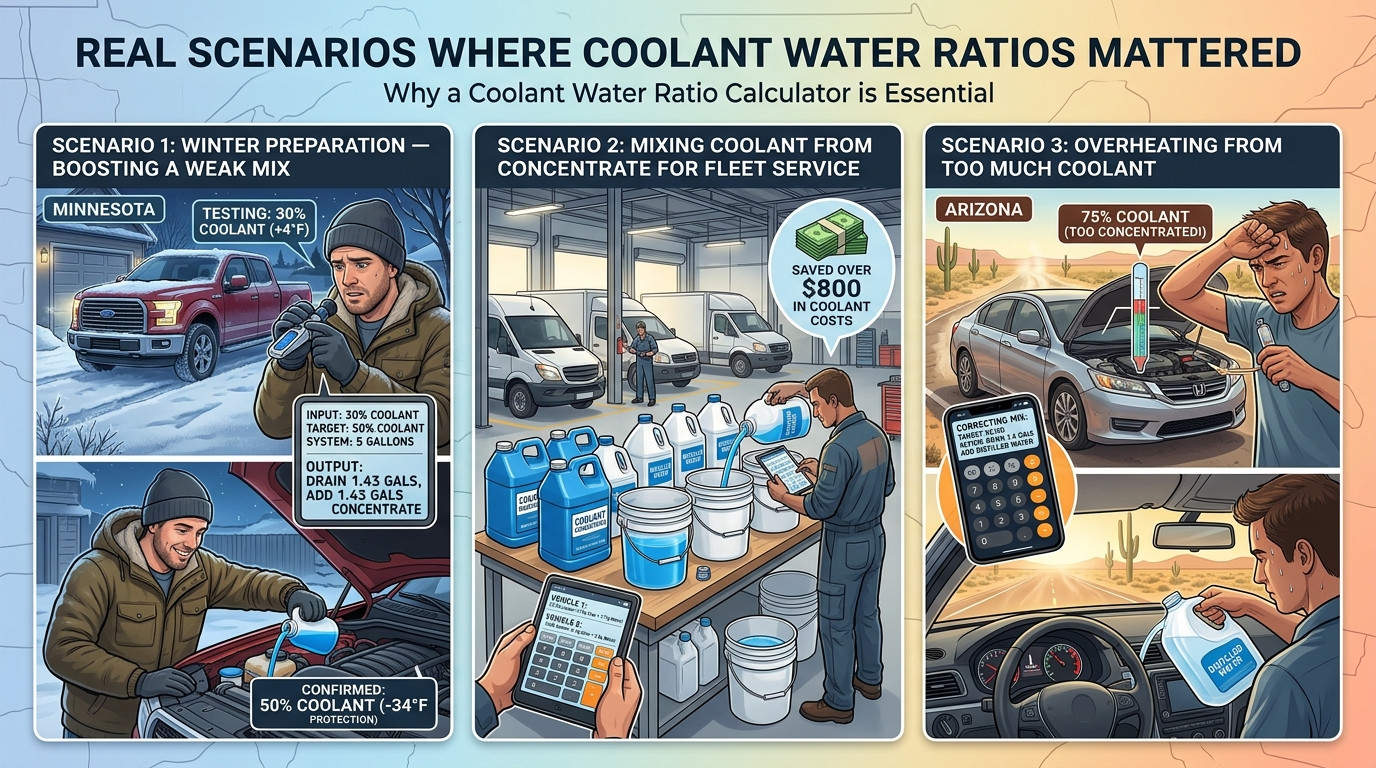
Scenario 1: Winter Preparation — Boosting a Weak 30% Mix to 50%
A truck owner in Minnesota tested their coolant before winter and found only 30% coolant concentration — enough for +4°F protection. With Minnesota winters regularly hitting -20°F, the engine block would crack. Using the coolant water ratio calculator, they calculated the drain-and-fill volume needed to boost from 30% to 50% in a 5-gallon system: drain 1.43 gallons and replace with 1.43 gallons of concentrate. The coolant water ratio calculator confirmed -34°F freeze protection, saving the engine from certain destruction.
Scenario 2: Mixing Coolant from Concentrate for Fleet Service
A fleet maintenance shop needed to service 15 vehicles with different cooling system capacities. Instead of buying expensive prediluted coolant, they used the coolant water ratio calculator to mix coolant from concentrate. For a 3.5-gallon system at 50/50: 1.75 gallons concentrate + 1.75 gallons distilled water. For a 5-gallon V8 system: 2.5 gallons concentrate + 2.5 gallons distilled water. The coolant water ratio calculator saved the fleet over $800 in coolant costs that month alone.
Scenario 3: Overheating from Too Much Coolant
A sedan kept overheating in Arizona summer traffic despite a new thermostat and clean radiator. The owner tested the coolant and found 75% coolant — far too concentrated. Pure coolant transfers heat 25% less efficiently than water. The coolant water ratio calculator showed that draining 1.2 gallons and replacing with distilled water would bring the system to 50/50, restoring proper heat transfer. The coolant water ratio calculator diagnosed the problem in seconds.
⚠️ Real Consequence: A car owner in Wisconsin ignored their coolant water ratio and ran with only 20% concentration. When temperatures dropped to -10°F, the coolant froze, cracked the engine block, and caused $6,000 in damage. The coolant water ratio calculator would have shown they needed at least 33% for minimum protection and 50% for safe winter operation.
Common Coolant Water Ratio Mistakes
These are the most frequent coolant water ratio errors that mechanics and DIYers make, and how the coolant water ratio calculator helps you avoid every one of them.
❌ Running Too Little Coolant (Below 33%)
Below 33% concentration, corrosion inhibitors cannot protect the cooling system metals (aluminum heads, iron blocks, copper heater cores, solder joints). The coolant water ratio calculator flags any concentration below 33% as dangerously low. Even in warm climates, minimum 33% is required year-round for corrosion protection.
❌ Running Too Much Coolant (Above 70%)
Above 70% concentration, the reduced water content means reduced heat transfer efficiency. The engine runs hotter, especially in summer and under load. The coolant water ratio calculator flags anything above 70% and recommends dilution with distilled water. Many people assume “more coolant = more protection” but the opposite is true above 70%.
❌ Using Tap Water Instead of Distilled Water
Tap water contains dissolved minerals (calcium, magnesium, iron, silica) that form scale deposits inside the cooling system. Scale acts as insulation, reducing heat transfer and causing hot spots. The coolant water ratio calculator always specifies distilled water. A $1 jug of distilled water prevents thousands in cooling system repairs.
❌ Mixing Different Coolant Types
Green (IAT), Orange (OAT/DEX-COOL), and Yellow/Gold (HOAT) coolants have different additive chemistries. Mixing them causes chemical reactions that form brown sludge, clogging the radiator and heater core. The coolant water ratio calculator reminds users to always use the correct coolant type specified by the vehicle manufacturer.
❌ Ignoring Coolant Age
Even with the correct coolant water ratio, old coolant loses its corrosion inhibitors. Green (IAT) coolant lasts 2 years or 30,000 miles. Orange (OAT) and Yellow (HOAT) last 5 years or 150,000 miles. The coolant water ratio calculator’s Full Plan mode includes coolant age assessment to flag when replacement is due regardless of concentration.
❌ Not Testing Concentration Before Service
Adding coolant without testing current concentration leads to over-concentration or under-concentration. Always test with a refractometer or hydrometer first, then use the coolant water ratio calculator to determine the exact adjustment needed.
✅ Pro Tip: The coolant water ratio calculator’s Adjust Ratio mode is specifically designed to handle the most common scenario: a weak mixture that needs boosting. Enter your current tested concentration, your target (usually 50%), and the system capacity. The calculator tells you exactly how much to drain and replace with concentrate.
Expert Perspectives on Coolant Water Ratios
“The coolant water ratio is one of the most overlooked aspects of vehicle maintenance. I’ve seen hundreds of engines damaged by incorrect coolant concentration — both too weak (frozen blocks) and too strong (overheating). A coolant water ratio calculator removes all the guesswork and gives you exact measurements every time.”
“In fleet operations, maintaining correct coolant water ratios across hundreds of vehicles is a logistics challenge. Using a coolant water ratio calculator standardized our service procedures and eliminated cooling system failures during extreme weather. It paid for itself in the first winter season.”
“The relationship between coolant concentration and freeze protection follows well-established chemical principles. The eutectic point of ethylene glycol-water is approximately 60% concentration, providing maximum freeze protection. Above 70%, the chemistry works against you. A coolant water ratio calculator helps users stay in the optimal range.”
“Modern engines with aluminum blocks and heads are more sensitive to coolant chemistry than older cast-iron engines. The coolant water ratio must be precise — too little coolant means insufficient corrosion inhibitors for aluminum protection, and too much means reduced heat transfer. The coolant water ratio calculator is essential for modern engine cooling systems.”
Frequently Asked Questions
This 50/50 coolant water ratio balances freeze protection, boil protection, corrosion inhibition, and heat transfer efficiency. The coolant water ratio calculator defaults to 50% as the recommended target for most applications.
Actual cooling system volume may vary slightly from manufacturer specifications due to residual coolant in the heater core and engine block passages.
Water is actually the primary heat transfer fluid in the cooling system. Coolant is the additive that provides freeze protection, boil protection, and corrosion inhibition. The coolant water ratio calculator shows that going above 70% reduces all three functions.
Use propylene glycol when toxicity is a concern (homes with children or pets). The coolant water ratio calculator handles both types and provides correct freeze protection for each.
Test concentration when the engine is cool. Draw a sample from the radiator or overflow tank. Enter the tested concentration into the coolant water ratio calculator to determine what adjustments are needed.
In extreme cold regions (Alaska, northern Canada, northern Minnesota), use 55-60% coolant. Never exceed 70% even in extreme cold, as reduced heat transfer causes other problems.
Always use the coolant type specified by the vehicle manufacturer. If you don’t know what’s in the system, flush completely and refill with the correct type at the ratio calculated by the coolant water ratio calculator.
Also test after any cooling system repair, coolant top-off, or if the vehicle overheats. Regular testing with the coolant water ratio calculator prevents costly engine damage.
The coolant water ratio calculator uses system capacity as input, so it adapts to any vehicle size. Just enter the correct capacity from your vehicle’s service manual.
Always use the coolant water ratio calculator before winter to ensure your concentration provides adequate freeze protection for your region’s lowest expected temperature.
Coolant Water Ratio Best Practices
These practices separate healthy cooling systems from cracked engine blocks and costly repairs. Follow them alongside the coolant water ratio calculator for optimal cooling system health.
Before Adjusting Coolant Water Ratio
During Coolant Water Ratio Adjustment
After Coolant Water Ratio Adjustment
Trusted Reference Resources
These are authoritative references for coolant water ratio calculations and cooling system maintenance that complement the coolant water ratio calculator.
SAE International — Coolant Standards — sae.org/standards — SAE J1034 and J1036 standards for engine coolant specifications, testing, and performance requirements.
ASTM International — Antifreeze Standards — astm.org — ASTM D3306 and D4985 standards for coolant concentrate and prediluted coolant specifications.
Automotive Service Excellence (ASE) — ase.com — ASE certification for automotive technicians, including cooling system service and engine repair certifications.
EPA — Coolant Disposal — epa.gov — EPA guidelines for hazardous waste disposal, including used coolant recycling and disposal requirements.
On our platform, related calculation tools that complement the coolant water ratio calculator include: coolant mix ratio calculator, coolant dilution calculator, antifreeze dilution calculator, antifreeze ratio calculator, solution dilution calculator, mixing ratio calculator, percent concentration calculator, dilution factor calculator, C1V1 dilution calculator, dilution ratio calculator, volume converter, temperature converter, and PPM calculator.
Leave a Review
Used this coolant water ratio calculator for your cooling system service? Share your experience below. Your review helps other mechanics and DIYers decide if this coolant water ratio calculator fits their service needs. Every review is stored locally on your device and appears instantly.
📝 Share Your Experience
Final Thoughts on the Coolant Water Ratio Calculator
The coolant water ratio calculator is the single most important tool for cooling system maintenance. Getting the coolant water ratio right — typically 50/50 for most vehicles — prevents frozen engine blocks in winter, overheating in summer, corrosion damage year-round, and thousands of dollars in repairs. The sequence is always the same: test current concentration with a refractometer, enter it into the coolant water ratio calculator, follow the recommended drain-and-fill volumes, and verify with another test. That sequence gives a healthy cooling system every time.
Whether you’re a professional mechanic servicing dozens of vehicles per week, a DIYer maintaining your family car, or a fleet manager responsible for hundreds of vehicles, the coolant water ratio calculator eliminates guesswork and delivers precise, reliable results. From compact cars and SUVs to heavy-duty trucks and fleet vehicles, accurate coolant water ratio calculations are the foundation of cooling system health, and getting it right with the coolant water ratio calculator is the most important skill in cooling system maintenance.
Keep this coolant water ratio calculator handy as your starting point for every cooling system service, and use the related dilution and concentration tools in the sidebar whenever you need to plan or verify a calculation before servicing a cooling system.
🔒 Privacy Guarantee: Every calculation on this coolant water ratio calculator page runs entirely within your browser. No data—cooling system volumes, coolant water ratios, freeze protection levels, or any other inputs—is sent to any server, stored, or shared. Your calculations are completely private.