
☀️ Cyanuric Acid Calculator
Calculate CYA dosing, water replacement to reduce CYA, chlorine-to-CYA ratios & complete stabilizer analysis
⚠️ Cyanuric Acid Safety Note
CYA CANNOT BE REMOVED CHEMICALLY. The only way to reduce CYA is by draining and replacing pool water. CYA accumulates from stabilized chlorine products (trichlor tablets, dichlor granules). Over time, CYA builds up and reduces chlorine effectiveness. When CYA exceeds 80 ppm, significantly more chlorine is needed for sanitization. When CYA exceeds 100 ppm, partial drain and refill is recommended. Always test CYA monthly during swim season. Add granular CYA slowly through the skimmer with the pump running — it dissolves very slowly (24-48 hours). Do not backwash for 48 hours after adding granular CYA.
Calculation History
💡 You Might Also Like
Cyanuric Acid Calculator: Add CYA, Reduce CYA, Chlorine-to-CYA Ratios & Complete Stabilizer Analysis
A cyanuric acid calculator is an essential tool that helps pool owners accurately calculate how much stabilizer (granular CYA, liquid CYA, or trichlor tablets) to add to reach ideal CYA levels (30-50 ppm for outdoor pools, 60-80 ppm for saltwater pools), how much water to drain and replace to reduce high CYA (which can only be removed by water replacement — not chemically), the minimum free chlorine required for effective sanitization at any CYA level (FC should be 7.5% of CYA minimum), and complete CYA analysis with chlorine/CYA ratio assessment. Whether you’re adding stabilizer to a new pool, reducing CYA that has built up from years of trichlor tablet use, determining if your chlorine level is adequate for your CYA level, or getting a complete stabilizer management plan, this cyanuric acid calculator provides precise calculations with step-by-step explanations for optimal pool stabilization.
CYA CANNOT BE REMOVED CHEMICALLY. The only way to reduce high CYA is by draining and replacing pool water with fresh water. No chemical, product, or treatment can break down or remove cyanuric acid from pool water. CYA accumulates from stabilized chlorine products (trichlor tablets, dichlor granules) and does not evaporate or degrade. When CYA exceeds 80 ppm, chlorine effectiveness is significantly reduced — you need much more chlorine for the same sanitization. When CYA exceeds 100 ppm, partial drain and refill is strongly recommended. Always test CYA monthly during swim season. Add granular CYA slowly through the skimmer with the pump running — it dissolves very slowly (24-48 hours). Do not backwash for 48 hours after adding granular CYA.
📋 Table of Contents
▼What a Cyanuric Acid Calculator Does
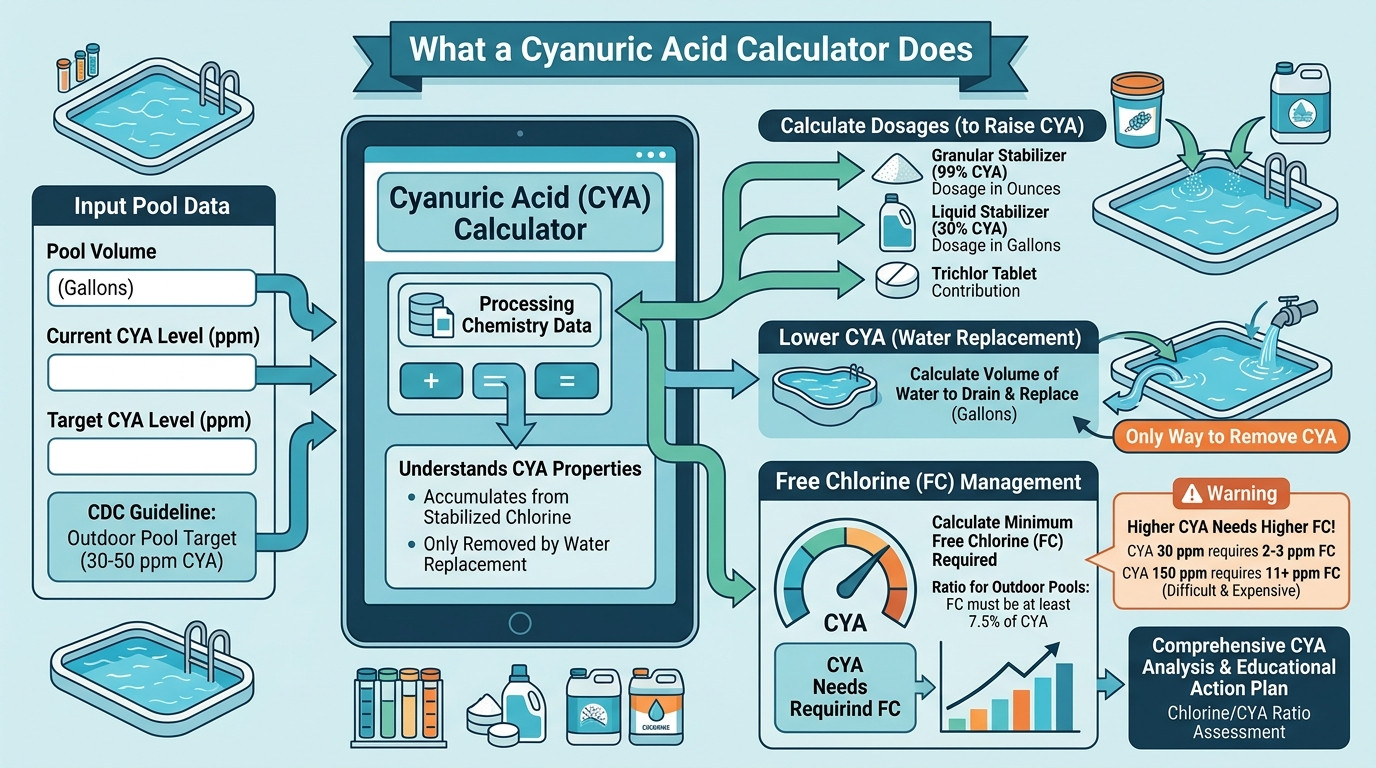
A cyanuric acid calculator is a specialized tool that performs essential calculations for cyanuric acid (CYA, also called stabilizer or conditioner) management in swimming pools, including calculating how much granular stabilizer (99% CYA), liquid stabilizer (30% CYA), or trichlor tablets to add to reach target CYA levels, determining how much water to drain and replace to reduce high CYA (the only way to remove CYA), calculating the minimum free chlorine required for effective sanitization at any CYA level (FC should be at least 7.5% of CYA for outdoor pools), and generating complete CYA analysis with chlorine/CYA ratio assessment. According to the Centers for Disease Control and Prevention (CDC), maintaining proper CYA levels (30-50 ppm for outdoor pools) is critical for protecting chlorine from UV degradation while ensuring adequate sanitization.
A cyanuric acid calculator tells you exactly how many ounces of granular stabilizer to add to raise CYA from 10 to 40 ppm in your 20,000-gallon pool, how many gallons of water to drain and replace to reduce CYA from 100 to 40 ppm, what your minimum free chlorine should be at your current CYA level, and the complete CYA action plan based on your pool’s current chemistry. Unlike generic pool calculators, a cyanuric acid calculator understands the unique properties of CYA — that it can only be removed by water replacement, that it accumulates from stabilized chlorine products, and that it fundamentally changes how much chlorine you need for effective sanitization. Every pool owner, CPO, and pool service technician who manages outdoor pools relies on these calculations, and the cyanuric acid calculator exists to make them fast, accurate, and educational.
The reason cyanuric acid calculations trip people up is the counterintuitive relationship between CYA and chlorine. More CYA doesn’t mean better protection — it means you need MORE chlorine for the same sanitization. A pool with 30 ppm CYA needs 2-3 ppm FC. A pool with 80 ppm CYA needs 6-8 ppm FC. A pool with 150 ppm CYA needs 11+ ppm FC — which is difficult to maintain and expensive. The cyanuric acid calculator handles this relationship internally, showing you the minimum FC for your CYA level and flagging when CYA is too high.
This cyanuric acid calculator handles the four most important CYA management tasks in one place: add CYA (granular stabilizer, liquid stabilizer, or trichlor tablet dosing), reduce CYA (water replacement calculations — the only way to remove CYA), chlorine/CYA ratio (determining if your FC is adequate for your CYA level), and complete CYA analysis (evaluating CYA, FC, CC, pH with prioritized action recommendations). Each mode shows the answer and every step of the working, so you can verify the reasoning, learn the chemistry, or document the calculation for your pool maintenance records.
Whether you are a new pool owner adding stabilizer for the first time, a pool service technician managing CYA buildup from years of trichlor tablet use, a commercial pool operator dealing with high CYA from stabilized chlorine, or a DIY pool owner trying to understand why their chlorine test reads 5 ppm but the pool is still green (hint: CYA is probably 100+ ppm), the cyanuric acid calculator gives you the exact calculations every time—no guesswork, no over-stabilizing, no ineffective chlorination, no wasted chemicals.
How Cyanuric Acid Calculations Work
Every cyanuric acid calculation comes down to one core principle: CYA protects chlorine from UV degradation but also reduces chlorine’s sanitizing power. From that principle, a handful of formulas cover almost every CYA management task. The cyanuric acid calculator exists to handle these formulas reliably and transparently, because CYA management is one of the most misunderstood aspects of pool chemistry.
Adding CYA: Stabilizer Dosing
When CYA is below 30 ppm in an outdoor pool, chlorine degrades rapidly in sunlight — up to 90% within 2 hours. The cyanuric acid calculator uses product-specific dosing rates: Granular Stabilizer (99% CYA) requires approximately 1.3 oz per 1,000 gallons per 10 ppm increase; Liquid Stabilizer (30% CYA) requires approximately 4.3 fl oz per 1,000 gallons per 10 ppm increase; each 8-oz Trichlor Tablet adds approximately 6 ppm CYA per 10,000 gallons. For a 20,000-gallon pool going from 10 to 40 ppm with granular stabilizer: (20,000 / 1,000) × (30 / 10) × 1.3 = 78 oz (about 4.9 lbs).
CYA increase = desired CYA increase in ppm
1.3 = oz of 99% granular stabilizer per 1,000 gal per 10 ppm
Add slowly through skimmer. Dissolves in 24-48 hours. Do not backwash for 48 hours.
Reducing CYA: Water Replacement (The Only Method)
CYA cannot be removed chemically — no product, enzyme, or treatment can break it down. The only way to reduce CYA is by draining pool water and replacing it with fresh water (which has 0 ppm CYA). The cyanuric acid calculator uses: Volume to drain = Pool Volume × (Current CYA – Target CYA) / (Current CYA – Source CYA). Since source water CYA is usually 0 ppm, this simplifies to: Volume to drain = Pool Volume × (Current CYA – Target CYA) / Current CYA. For a 20,000-gallon pool going from 100 to 40 ppm: 20,000 × (100 – 40) / 100 = 12,000 gallons (60% of the pool).
Chlorine/CYA Ratio: Minimum FC for Sanitization
The most important concept in CYA management is that CYA reduces chlorine’s sanitizing power. The minimum effective FC increases proportionally with CYA. For outdoor pools, FC should be at least 7.5% of CYA (e.g., CYA 40 ppm → minimum FC 3 ppm). For saltwater pools, FC should be at least 5% of CYA (e.g., CYA 70 ppm → minimum FC 3.5 ppm). The cyanuric acid calculator’s chlorine/CYA ratio mode evaluates your current FC against the minimum required for your CYA level and flags when sanitization is inadequate.
CYA Accumulation: The Hidden Problem
CYA accumulates from stabilized chlorine products. Each 8-oz trichlor tablet adds approximately 6 ppm CYA per 10,000 gallons. A pool using 3 tablets per week in a 20,000-gallon pool adds approximately 5.4 ppm CYA per week — 280 ppm per year! Since CYA doesn’t evaporate or degrade, it builds up over time. Pools using trichlor exclusively for several years commonly reach CYA levels of 100-200+ ppm, requiring expensive partial drain and refill.
Quick Reference Values for the Cyanuric Acid Calculator
Remember: The cyanuric acid calculator provides accurate dosing, but granular CYA dissolves very slowly — 24-48 hours. Add it slowly through the skimmer with the pump running, and do not backwash for 48 hours. Retest CYA after 1 week to verify the increase. For liquid stabilizer, it dissolves faster (2-4 hours) but is more expensive per ppm of CYA added.

Real Scenarios Where CYA Management Mattered
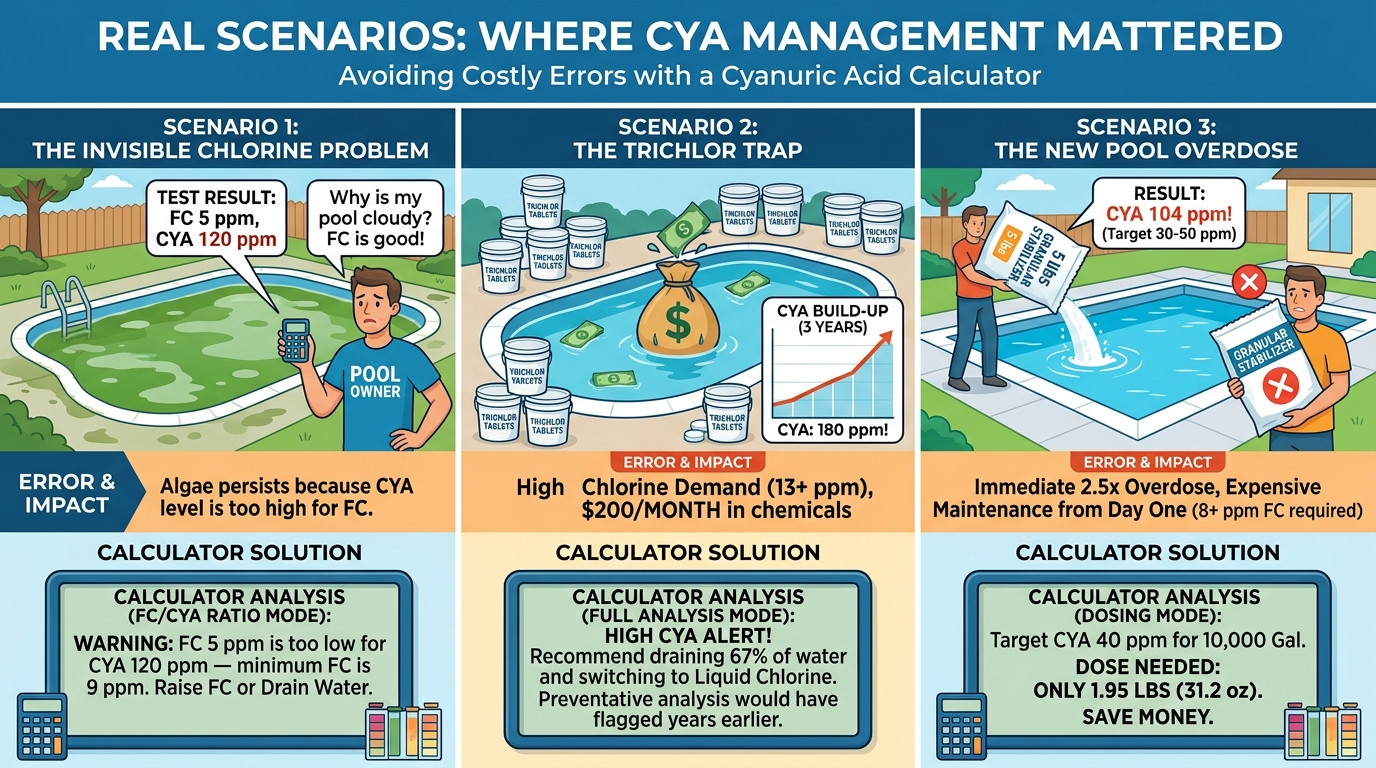
These scenarios reflect real pool maintenance situations where cyanuric acid management errors made a tangible difference to water quality, sanitization effectiveness, and cost. Each scenario shows how the cyanuric acid calculator would have prevented the error.
Scenario 1: The Invisible Chlorine Problem
A pool owner tested FC at 5 ppm and couldn’t understand why the pool was still cloudy with algae. The CYA was 120 ppm — which means the minimum effective FC is 9 ppm (7.5% of 120). At 5 ppm FC, the pool was effectively unsanitized despite the “good” chlorine reading. The cyanuric acid calculator’s chlorine/CYA ratio mode would have flagged this immediately: “FC 5 ppm is too low for CYA 120 ppm — minimum FC is 9 ppm. Either raise FC to 9+ ppm or drain to reduce CYA.”
Scenario 2: The Trichlor Trap
A pool service company used trichlor tablets exclusively for 3 years in a 15,000-gallon pool. CYA built up to 180 ppm. The pool required constant high chlorine doses (13+ ppm FC) to maintain sanitization, costing the owner $200/month in chlorine. The cyanuric acid calculator’s full analysis mode would have flagged the high CYA years earlier and recommended switching to liquid chlorine (no CYA contribution) and draining 67% of the water to reduce CYA from 180 to 60 ppm — saving thousands in chemical costs.
Scenario 3: The New Pool Overdose
A new pool owner added 5 lbs of granular stabilizer to their 10,000-gallon pool without calculating. This raised CYA from 0 to 104 ppm — far above the ideal 30-50 ppm range. The high CYA required 8+ ppm FC for sanitization (instead of 2-3 ppm), making the pool expensive to maintain from day one. The cyanuric acid calculator would have shown that only 1.95 lbs (31.2 oz) was needed to reach 40 ppm — preventing the 2.5× overdose and the resulting high chlorine costs.
Scenario 4: The Indoor Pool Mistake
A pool owner added CYA to their indoor pool because “all pools need stabilizer.” Indoor pools have no UV exposure, so CYA provides no benefit and only increases the chlorine requirement. The cyanuric acid calculator’s chlorine/CYA mode for indoor pools would have flagged: “CYA not needed for indoor pools — drain to remove. Maintain FC at 1-3 ppm without CYA.” This would have saved the owner the cost of unnecessary CYA and the ongoing higher chlorine costs.
Common Cyanuric Acid Mistakes
These are the most frequent CYA management errors that the cyanuric acid calculator helps prevent:
1. Using Trichlor Tablets Exclusively
Trichlor tablets add both chlorine and CYA. Using them exclusively causes CYA to build up 200-300+ ppm per year. After 2-3 years, CYA is so high that chlorine becomes ineffective and expensive. The cyanuric acid calculator’s full analysis mode tracks CYA accumulation and recommends switching to liquid chlorine or cal-hypo (no CYA contribution) for daily sanitization, using trichlor only for occasional shock or vacation periods.
2. Not Testing CYA Regularly
Many pool owners test pH and chlorine weekly but never test CYA. CYA doesn’t change quickly, but it accumulates steadily from stabilized chlorine. Test CYA monthly during swim season. The cyanuric acid calculator requires current CYA as input — this forces you to test before making adjustments.
3. Adding CYA to Indoor Pools
Indoor pools have no UV exposure, so CYA provides no benefit. It only increases the chlorine requirement and makes water balance more difficult. The cyanuric acid calculator’s chlorine/CYA mode includes an “Indoor Pool” option that correctly recommends 0 ppm CYA and 1-3 ppm FC.
4. Trying to Remove CYA Chemically
No product can remove CYA from pool water. Products claiming to “reduce CYA” or “break down stabilizer” are ineffective. The only way to reduce CYA is by draining and replacing water. The cyanuric acid calculator’s reduce mode calculates the exact volume to drain — saving you from wasting money on ineffective products.
5. Ignoring the FC/CYA Ratio
A “good” chlorine reading of 3-5 ppm is only good if CYA is low. At CYA 80 ppm, 3 ppm FC provides almost no sanitization. The cyanuric acid calculator’s chlorine/CYA ratio mode evaluates your FC against the minimum required for your CYA level and flags when sanitization is inadequate — preventing the “invisible chlorine” problem.
Warning: When CYA exceeds 100 ppm, the only practical solution is partial drain and refill. The cost of water replacement ($50-200 depending on pool size and local water rates) is far less than the ongoing cost of maintaining high chlorine levels for high CYA. The cyanuric acid calculator’s reduce mode shows the exact volume to drain and the estimated water cost — helping you make the cost-effective decision.
Expert Perspectives on Cyanuric Acid
“CYA is the most misunderstood chemical in pool maintenance. Pool owners think ‘more stabilizer = better protection,’ but the reality is that high CYA makes chlorine less effective, not more. I use a cyanuric acid calculator with every client to show them the FC/CYA ratio and explain why their 5 ppm chlorine isn’t working when CYA is 100 ppm. It’s the most important conversation I have with new clients.”
“The trichlor trap is the number one cause of high CYA in residential pools. Homeowners buy trichlor tablets because they’re convenient, not realizing each tablet adds CYA that never goes away. After 2-3 years, CYA is 150+ ppm and they’re spending $200/month on chlorine. A cyanuric acid calculator would have shown them the problem years earlier and recommended switching to liquid chlorine for daily use.”
“For commercial pools, CYA management is a health department requirement. Inspectors check CYA levels and require them to be below 100 ppm. When CYA exceeds that, we have to drain and refill — which costs $500-2,000 depending on pool size. The cyanuric acid calculator helps us plan water replacements before CYA gets too high, avoiding emergency drain events and health department violations.”
Expert Consensus: All three experts agree that CYA management is one of the most important — and most misunderstood — aspects of pool chemistry. Using a cyanuric acid calculator to track CYA levels, understand the FC/CYA ratio, and plan water replacements when CYA gets too high prevents the most common and costly pool maintenance problems.
Frequently Asked Questions
Always retest CYA 1 week after adding stabilizer to verify the increase. Granular CYA dissolves slowly (24-48 hours), so testing too soon will show lower-than-actual readings.
The cyanuric acid calculator provides exact amounts for any pool volume and any target CYA increase. Always add granular CYA slowly through the skimmer with the pump running — it dissolves over 24-48 hours.
The cyanuric acid calculator’s reduce mode calculates the exact volume to drain for any target CYA reduction. Products claiming to “reduce CYA” or “break down stabilizer” are ineffective — save your money.
The cyanuric acid calculator’s chlorine/CYA ratio mode shows the minimum FC for your CYA level. When CYA exceeds 80 ppm, the ongoing chlorine cost often exceeds the cost of draining and refilling to reduce CYA.
The cyanuric acid calculator uses these ideal ranges as targets. If your CYA is below the ideal range, add stabilizer. If it’s above, drain and refill to reduce it.
The cyanuric acid calculator’s full analysis mode tracks CYA accumulation from trichlor use and recommends when to switch to liquid chlorine (no CYA contribution) or cal-hypo (no CYA contribution) for daily sanitization.
Add granular CYA slowly through the skimmer (1-2 oz per minute) with the pump running. Retest CYA after 1 week to verify the full increase. Liquid stabilizer dissolves faster (2-4 hours) but is more expensive per ppm.
The cyanuric acid calculator’s chlorine/CYA mode includes an “Indoor Pool” option that correctly recommends 0 ppm CYA. If you’ve already added CYA to an indoor pool, drain and refill to remove it.
Use the cyanuric acid calculator whenever CYA falls outside the ideal range (30-50 ppm outdoor, 60-80 ppm SWG). Keep a CYA testing log to track accumulation rates from trichlor or dichlor use.
The calculator provides the same accurate dosing and water replacement calculations regardless of pool material. For saltwater pools, the ideal CYA range is higher (60-80 ppm) to protect the SWG-generated chlorine from UV degradation.
Cyanuric Acid Best Practices
These practices separate effective CYA management from high-CYA problems and ineffective chlorination. Follow them alongside the cyanuric acid calculator for optimal results.
Before Adding CYA
During CYA Addition
After CYA Addition
Trusted Reference Resources
These are authoritative references for cyanuric acid management and pool stabilizer chemistry that complement the cyanuric acid calculator.
CDC Healthy Swimming — cdc.gov/healthywater/swimming — Comprehensive pool safety guidelines, CYA level recommendations, and chlorine/CYA ratio standards from the Centers for Disease Control and Prevention.
Pool & Hot Tub Alliance (PHTA) — phta.org — Industry association for pool professionals, offering education, certification, and best practices for CYA management and stabilizer dosing.
National Swimming Pool Foundation (NSPF) — nspf.org — Certified Pool Operator (CPO) training, water chemistry education, and cyanuric acid management guidelines.
Trouble Free Pool (TFP) — troublefreepool.com — Community-driven pool chemistry resource with detailed CYA/chlorine charts, FC/CYA ratio tables, and practical CYA management guidance for residential pools.
On our platform, related calculation tools that complement the cyanuric acid calculator include: pool chemistry calculator, pool chemical calculator, pool shock calculator, pool chlorine dilution calculator, pool alkalinity calculator, pool volume calculator, pH calculator, PPM calculator, solution dilution calculator, percent concentration calculator, dilution factor calculator, and dilution calculator (all-in-one).
Leave a Review
Used this cyanuric acid calculator for your pool maintenance? Share your experience below. Your review helps other pool owners decide if this cyanuric acid calculator fits their maintenance needs. Every review is stored locally on your device and appears instantly.
📝 Share Your Experience
Final Thoughts on the Cyanuric Acid Calculator
Cyanuric acid is the most misunderstood chemical in pool maintenance — and the cyanuric acid calculator exists to fix that misunderstanding. Pool owners think “more stabilizer = better protection,” but the reality is that high CYA makes chlorine less effective, not more. At CYA 40 ppm, 3 ppm FC provides effective sanitization. At CYA 100 ppm, you need 7.5 ppm FC for the same protection. At CYA 150 ppm, you need 11+ ppm FC — which is expensive, difficult to maintain, and often ineffective. The cyanuric acid calculator shows you the exact FC/CYA relationship for your pool, helping you maintain effective sanitization without over-stabilizing.
What separates well-managed pools from high-CYA problem pools is understanding and tracking. Using the cyanuric acid calculator for exact stabilizer dosing, testing CYA monthly, understanding the FC/CYA ratio, switching from trichlor to liquid chlorine for daily use, and planning water replacements when CYA gets too high: these are the habits that prevent the “trichlor trap” and keep chlorine costs reasonable. The cyanuric acid calculator does the math perfectly every time, but it cannot test your CYA or drain your pool — those remain the pool owner’s responsibilities.
The framework is short: test CYA monthly, calculate with the cyanuric acid calculator, add stabilizer only when below 30 ppm (outdoor) or 60 ppm (SWG), use liquid chlorine or cal-hypo for daily sanitization (no CYA contribution), and drain to reduce CYA when it exceeds 80 ppm. That sequence gives effective, affordable pool sanitization every time. From backyard pools and saltwater systems to commercial aquatic facilities and resort pools, accurate CYA management is the foundation of effective chlorination, and getting it right with the cyanuric acid calculator is the most important skill in pool chemistry.
Keep this cyanuric acid calculator handy as your starting point for every CYA task, and use the related dilution and concentration tools in the sidebar whenever you need to plan or verify a calculation before treating your pool.
🔒 Privacy Guarantee: Every calculation on this cyanuric acid calculator page runs entirely within your browser. No data—pool volumes, CYA levels, chlorine readings, or any other inputs—is sent to any server, stored, or shared. Your calculations are completely private.