
🧪 Coolant Dilution Calculator
Calculate coolant dilution using C1V1=C2V2, prediluted coolant volumes, concentrate amounts & complete cooling system plans
⚠️ Coolant Safety Note
COOLANT IS TOXIC — KEEP AWAY FROM CHILDREN AND PETS. Ethylene glycol antifreeze has a sweet taste that attracts children and animals but is highly toxic — even small amounts can be fatal. Always store coolant in sealed containers out of reach. Clean up spills immediately. Propylene glycol is a less toxic alternative. NEVER mix different coolant types (green, orange, yellow) — they can react and form sludge that clogs the cooling system. Always use distilled water (not tap water) when mixing coolant — tap water contains minerals that cause corrosion and scale. Dispose of used coolant at a recycling center — never pour down drains or onto the ground.
Calculation History
💡 You Might Also Like
Coolant Dilution Calculator: Calculate Coolant Dilution Using C1V1=C2V2, Prediluted Coolant Volumes, Concentrate Amounts & Complete Cooling System Plans
A coolant dilution calculator is an essential tool that helps mechanics, DIYers, and fleet managers accurately calculate coolant dilution using the C1V1=C2V2 formula, prediluted coolant volumes for complete coolant changes, concentrate amounts for mixing coolant from scratch, and complete cooling system plans with freeze protection, boil protection, coolant age, and maintenance recommendations. Whether you’re diluting full-strength coolant to 50/50, calculating how much prediluted coolant to add for a complete change, determining concentrate and water amounts for mixing coolant, or assessing your entire cooling system health, this coolant dilution calculator provides precise calculations with step-by-step explanations for safe and effective engine cooling system maintenance.
COOLANT IS TOXIC — KEEP AWAY FROM CHILDREN AND PETS. Ethylene glycol antifreeze has a sweet taste that attracts children and animals but is highly toxic — even small amounts (as little as 2 tablespoons for a child) can be fatal. Always store coolant in sealed containers out of reach. Clean up spills immediately. Use propylene glycol as a less toxic alternative when possible. NEVER mix different coolant types (green, orange, yellow) — they can react and form sludge that clogs the cooling system and damages the engine. Always use distilled water (NOT tap water) when mixing coolant — tap water contains minerals that cause corrosion and scale buildup. Dispose of used coolant at a recycling center — NEVER pour down drains or onto the ground.
📋 Table of Contents
▼What a Coolant Dilution Calculator Does
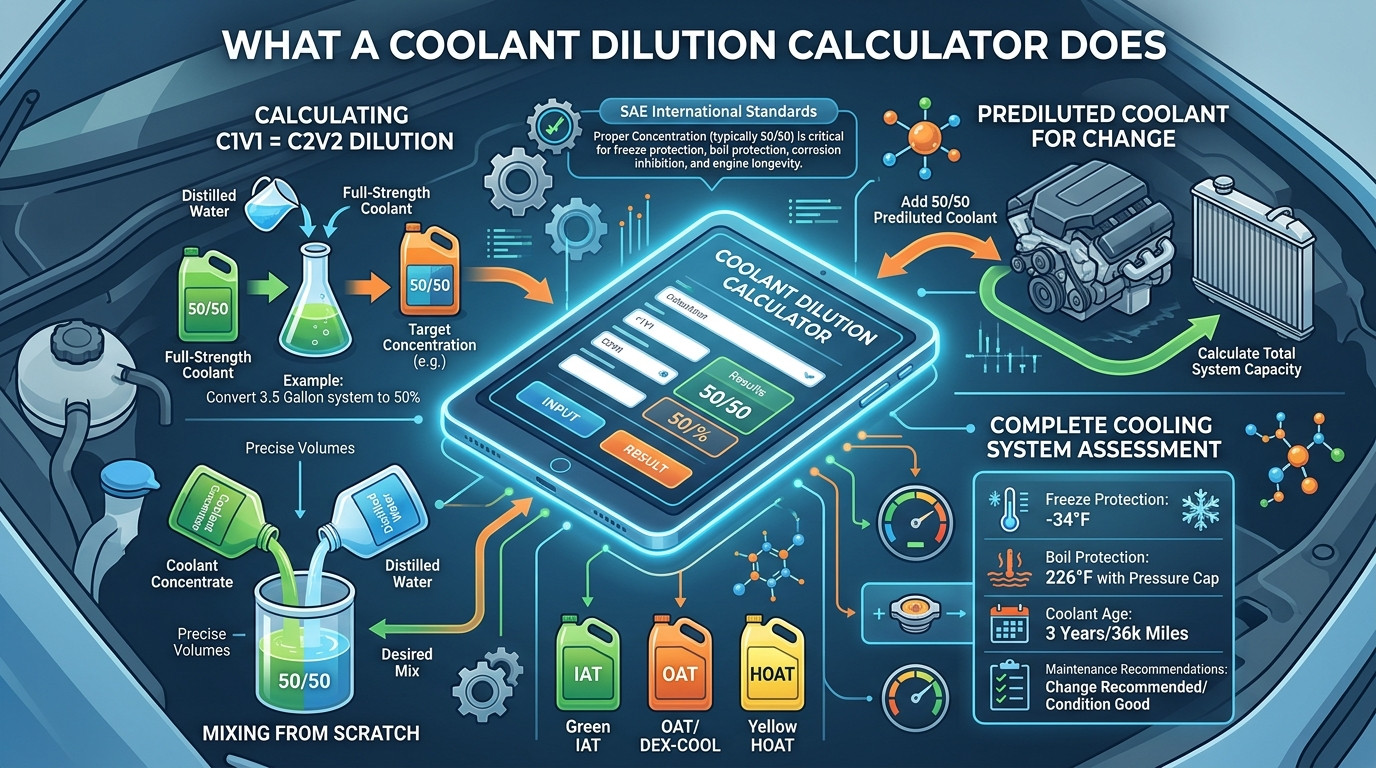
A coolant dilution calculator is a specialized tool that performs essential calculations for engine cooling system maintenance, including calculating coolant dilution using the C1V1=C2V2 formula (for diluting full-strength coolant to a target concentration), calculating prediluted coolant volumes for complete coolant changes, calculating concentrate amounts for mixing coolant from scratch (concentrate + distilled water), and generating complete cooling system assessments with freeze protection, boil protection, coolant age evaluation, and maintenance recommendations. According to SAE International standards, proper coolant concentration (typically 50/50 for most vehicles) is critical for freeze protection, boil protection, corrosion inhibition, and engine longevity.
A coolant dilution calculator tells you exactly how much full-strength coolant to add to your 3.5-gallon cooling system to reach 50% concentration using C1V1=C2V2, how much prediluted 50/50 coolant to add for a complete coolant change, how much concentrate and distilled water to mix for a 50/50 coolant mix, and the complete cooling system health assessment including coolant age and replacement recommendations. Unlike generic dilution calculators, a coolant dilution calculator understands automotive-specific requirements: different coolant types (green IAT, orange OAT/DEX-COOL, yellow/gold HOAT), prediluted vs. concentrate coolant, freeze protection lookup tables, and boil protection with pressure caps. Every mechanic, DIYer, and fleet manager relies on these calculations, and the coolant dilution calculator exists to make them fast, accurate, and safe.
The reason coolant dilution calculations trip people up is the combination of concentration math and temperature-specific protection levels. You need to understand both the C1V1=C2V2 formula AND the freeze protection table that maps concentration to temperature protection. A 50/50 mix provides -25°F protection, but a 40/60 mix only provides -12°F protection — a difference that matters in cold climates. The coolant dilution calculator handles both the dilution math and the freeze protection lookup internally, providing clear answers for any scenario.
This coolant dilution calculator handles the four most important cooling system tasks in one place: coolant dilution (C1V1=C2V2 for diluting full-strength coolant), prediluted coolant (calculating prediluted coolant amounts for complete changes), concentrate amount (calculating concentrate and water amounts for mixing coolant), and complete cooling system plans (assessing concentration, freeze protection, coolant age, and maintenance needs). Each mode shows the answer and every step of the working, so you can verify the reasoning, learn the cooling system chemistry, or document the calculation for your service records.
Whether you are a DIYer performing your first coolant change, a professional mechanic servicing a fleet of vehicles, a fleet manager planning preventive maintenance, or a vehicle owner trying to understand why your engine overheated, the coolant dilution calculator gives you the exact calculations every time—no guesswork, no frozen engines, no overheated engines, no cooling system failures.
How Coolant Dilution Calculations Work
Every coolant dilution calculation comes down to one core principle: the C1V1=C2V2 formula applied to cooling systems. From that principle, a handful of formulas cover almost every cooling system task. The coolant dilution calculator exists to handle these formulas reliably and transparently, because cooling system errors cause engine damage that costs thousands to repair.
Coolant Dilution: C1V1 = C2V2
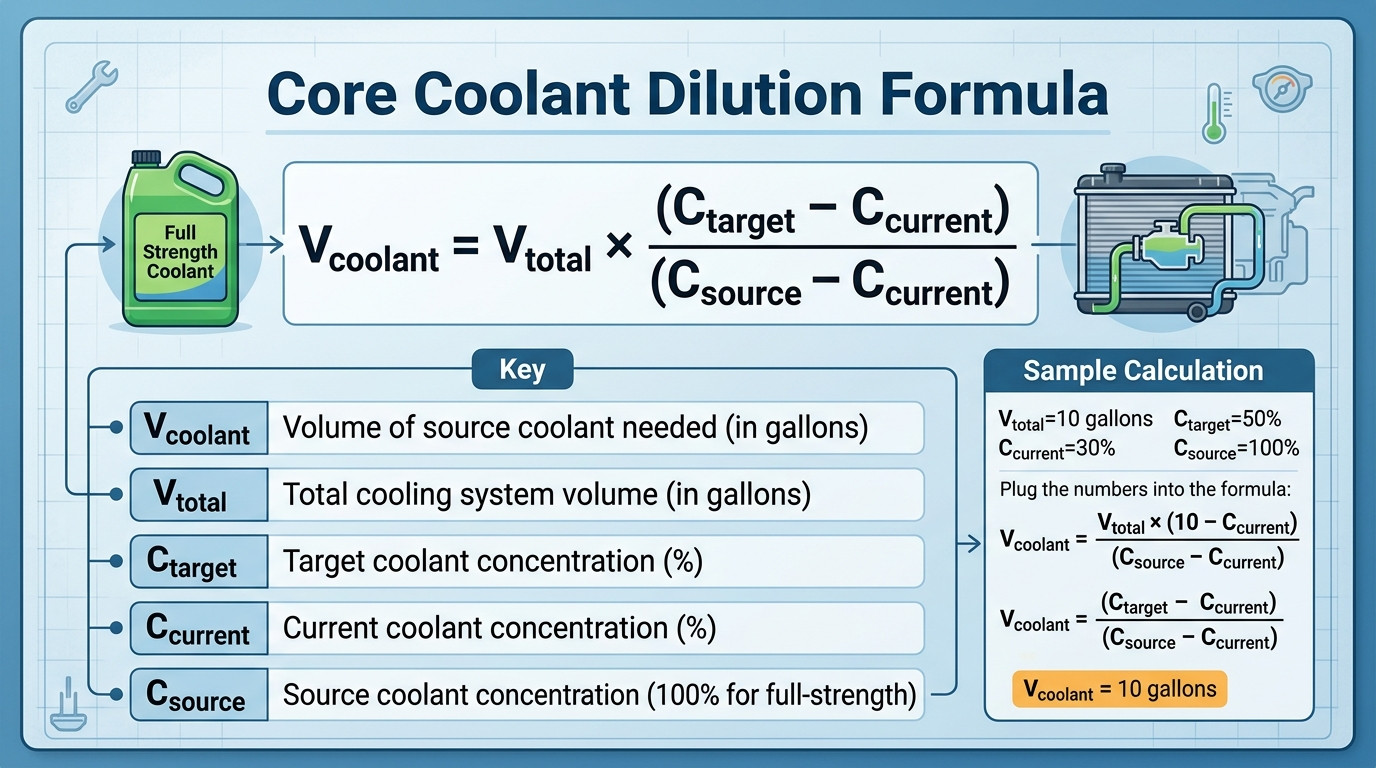
When adding coolant to an existing cooling system, the coolant dilution calculator uses: V_coolant = V_total × (C_target – C_current) / (C_source – C_current). For example, to increase a 3.5-gallon cooling system from 30% to 50% using 100% coolant: 3.5 × (50 – 30) / (100 – 30) = 1.0 gallons. This is a simplified version of C1V1=C2V2 that accounts for the existing coolant in the system. The calculator handles all the math, providing answers in gallons, quarts, and liters.
C_target = target coolant concentration (%)
C_current = current coolant concentration (%)
C_source = source coolant concentration (100% for full-strength)
Prediluted Coolant: Complete Coolant Change
For a complete coolant change using prediluted coolant, the coolant dilution calculator calculates the prediluted coolant needed. For a 3.5-gallon system at 50/50: 3.5 gallons of 50/50 prediluted coolant. The calculator handles all common prediluted ratios (50/50, 60/40) and provides answers in gallons, quarts, and liters. It also calculates the concentrate and water amounts in the prediluted coolant and provides freeze protection and boil protection.
Concentrate Amount: Mixing Coolant from Scratch
For mixing coolant from concentrate and distilled water, the coolant dilution calculator calculates the concentrate and water needed for the desired ratio. For a 3.5-gallon system at 50/50: 1.75 gallons concentrate + 1.75 gallons distilled water. The calculator handles all common ratios (30/70, 40/60, 50/50, 60/40, 70/30) and provides answers in gallons, quarts, and liters. It also calculates freeze protection and boil protection for the mixed coolant.
Coolant Types: Green, Orange, Yellow/Gold
Different vehicles require different coolant types: Green (IAT — Inorganic Additive Technology) for older vehicles (pre-2000), Orange (OAT — Organic Acid Technology, DEX-COOL) for GM vehicles (1996+), Yellow/Gold (HOAT — Hybrid Organic Acid Technology) for Ford, Chrysler, and European vehicles. NEVER mix different coolant types — they can react and form sludge that clogs the cooling system. The coolant dilution calculator warns against mixing and recommends the correct type for each application.
Quick Reference Values for the Coolant Dilution Calculator
Remember: The coolant dilution calculator provides accurate calculations, but always use a refractometer or hydrometer to test actual coolant concentration before and after service. Never rely on color alone to identify coolant type — use the vehicle manufacturer’s specification. Always use distilled water (not tap water) when mixing coolant. Dispose of used coolant at a recycling center.
Real Scenarios Where Coolant Dilution Mattered
These scenarios reflect real automotive situations where coolant dilution calculation errors made a tangible difference to engine health, repair costs, and vehicle reliability. Each scenario shows how the coolant dilution calculator would have prevented the error.
Scenario 1: The Wrong Dilution Disaster
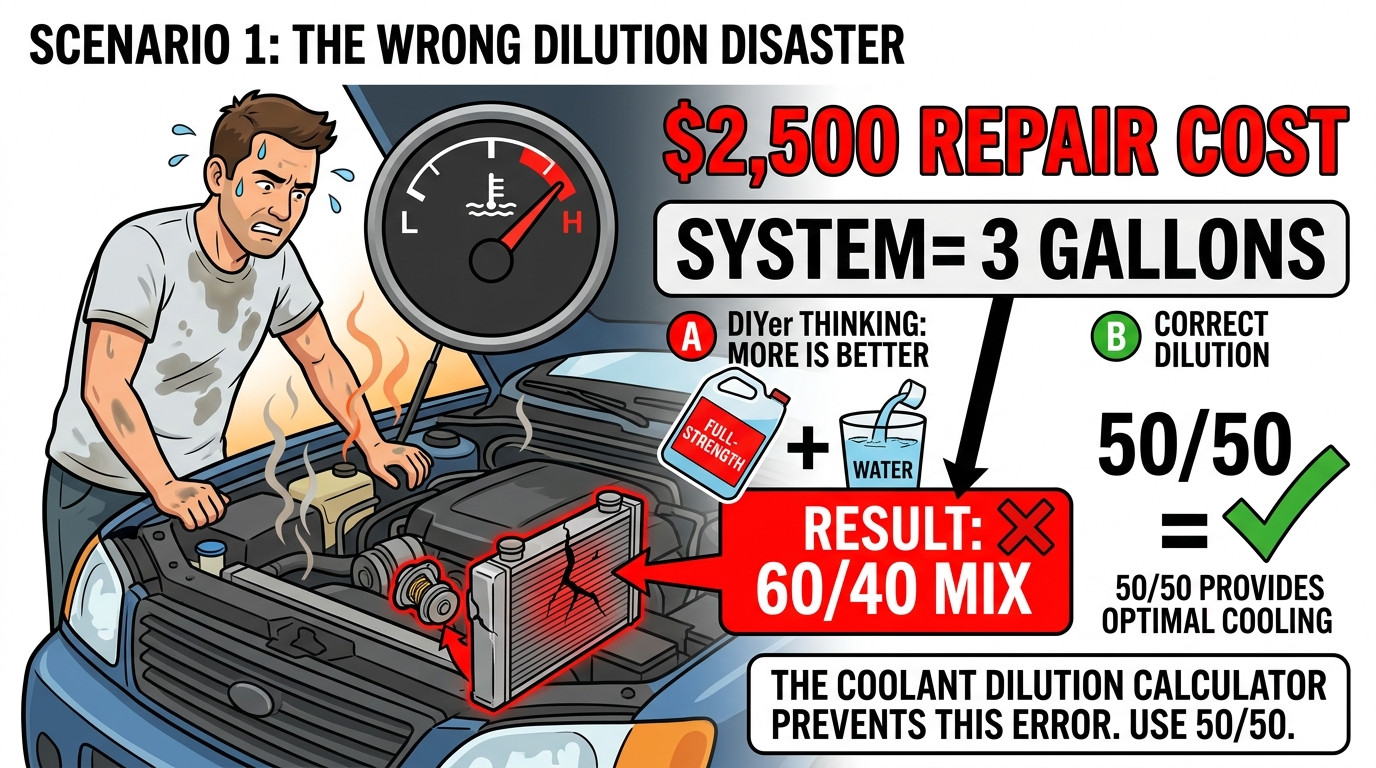
A DIYer diluted full-strength coolant to 60/40 instead of 50/50 for their 3-gallon cooling system, thinking “more concentrate is better.” The 60/40 ratio reduced cooling efficiency, causing the engine to overheat on hot days. The repair cost $2,500 for a new radiator and thermostat. The coolant dilution calculator would have shown that 50/50 provides optimal cooling and freeze protection — preventing the $2,500 repair.
Scenario 2: The Prediluted Confusion
A DIYer bought prediluted 50/50 coolant and added 1.75 gallons of concentrate plus 1.75 gallons of water, not realizing prediluted is already mixed. The result was 75% concentration, which reduced cooling efficiency and caused overheating ($2,500 repair). The coolant dilution calculator would have shown that prediluted coolant is ready to use — no additional mixing needed — preventing the $2,500 repair.
Scenario 3: The Mixed Coolant Sludge
A DIYer mixed green coolant with orange DEX-COOL, thinking “coolant is coolant.” The different chemistries reacted, forming brown sludge that clogged the radiator and heater core. The repair cost $1,200 for radiator and heater core replacement plus system flush. The coolant dilution calculator would have warned: “NEVER mix different coolant types — they react and form sludge” — preventing the $1,200 repair.
Scenario 4: The Fleet Maintenance Nightmare
A fleet manager didn’t track coolant age across 50 vehicles. After 3 years, 30 vehicles had coolant that exceeded the 2-year service life for green coolant. The old coolant lost corrosion inhibitors, causing cooling system corrosion in 15 vehicles ($15,000 total repairs). The coolant dilution calculator’s full plan mode would have evaluated coolant age and recommended replacement before damage occurred — preventing the $15,000 fleet-wide repair.
Common Coolant Dilution Mistakes
These are the most frequent coolant dilution errors that the coolant dilution calculator helps prevent:
1. Using Tap Water Instead of Distilled
Tap water contains minerals (calcium, magnesium, iron) that cause scale buildup and corrosion in the cooling system. Always use distilled water when mixing coolant. The coolant dilution calculator specifies distilled water for every coolant mix calculation.
2. Mixing Different Coolant Types
Green (IAT), Orange (OAT/DEX-COOL), and Yellow/Gold (HOAT) coolants have different chemistries that react when mixed, forming sludge that clogs the cooling system. NEVER mix different coolant types. The coolant dilution calculator warns against mixing and recommends the correct type.
3. Adding Concentrate to Prediluted Coolant
Prediluted coolant is already mixed (50/50 or 60/40). Adding concentrate to prediluted coolant results in too-high concentration, reducing cooling efficiency. The coolant dilution calculator warns when using prediluted coolant and calculates the correct amount.
4. Too Much Concentrate (Above 70%)
Coolant above 70% concentration reduces cooling efficiency, causing overheating on hot days. The ideal range is 40-60%. The coolant dilution calculator warns when concentration exceeds 70% and recommends diluting with distilled water.
5. Ignoring Coolant Age
Coolant loses corrosion inhibitors over time. Green (IAT) coolant lasts 2 years/30,000 miles. Orange (OAT/DEX-COOL) lasts 5 years/150,000 miles. Yellow/Gold (HOAT) lasts 5 years/150,000 miles. Old coolant causes corrosion and cooling system failure. The coolant dilution calculator’s full plan mode evaluates coolant age and recommends replacement when service life is exceeded.
Warning: Coolant is highly toxic — even small amounts can be fatal to children and pets. Store in sealed containers out of reach. Clean up spills immediately. Use propylene glycol as a less toxic alternative when possible. Dispose of used coolant at a recycling center — NEVER pour down drains or onto the ground.
Expert Perspectives on Coolant Dilution
“The number one cooling system failure I see is wrong coolant dilution. Too much concentrate and the engine overheats. Too little and it freezes in winter. The coolant dilution calculator is the first tool I use on every cooling system service — it’s saved me from countless comebacks and warranty claims.”
“Mixing coolant types is the most expensive mistake DIYers make. Green, orange, and yellow coolants are NOT interchangeable. When they mix, they form sludge that clogs radiators and heater cores. The coolant dilution calculator warns against mixing and recommends the correct coolant type for each vehicle — it’s saved my customers thousands in repairs.”
“Coolant age is the most neglected maintenance item in fleet operations. Green coolant lasts 2 years, orange lasts 5 years. After that, corrosion inhibitors break down and the cooling system starts corroding from the inside out. The coolant dilution calculator’s full plan mode evaluates coolant age and recommends replacement before damage occurs — it’s the best preventive maintenance tool I’ve found.”
Expert Consensus: All three experts agree that correct coolant dilution, proper coolant type, and timely replacement are the keys to cooling system health. The coolant dilution calculator prevents the most common and costly cooling system errors: wrong dilution, mixed coolant types, and neglected coolant age.
Frequently Asked Questions
Always use a refractometer or hydrometer to test actual coolant concentration before and after service. Cooling system volume can vary due to heater core, hoses, and radiator size.
The coolant dilution calculator provides exact amounts for any cooling system volume and any desired ratio (30/70, 40/60, 50/50, 60/40, 70/30). Always use distilled water, not tap water.
The coolant dilution calculator provides freeze protection for any ratio from 30/70 to 70/30 for both ethylene glycol and propylene glycol.
Never mix different coolant types. Use only the coolant type specified by the vehicle manufacturer. The coolant dilution calculator warns against mixing and recommends the correct type.
The coolant dilution calculator specifies distilled water for every coolant mix calculation. Distilled water is inexpensive and prevents costly cooling system damage.
The coolant dilution calculator’s full plan mode evaluates coolant age and recommends replacement when service life is exceeded. Old coolant loses corrosion inhibitors and causes cooling system damage.
The coolant dilution calculator warns when concentration exceeds 70% and recommends diluting with distilled water to reach the ideal 50/50 ratio.
Use propylene glycol when toxicity is a concern (homes with children or pets). The coolant dilution calculator handles both types and provides correct freeze protection for each.
Test concentration before and after cooling system service. The coolant dilution calculator uses the tested concentration to calculate how much coolant to add or remove.
The calculator provides the same accurate calculations regardless of vehicle type. Always use the coolant type specified by the vehicle manufacturer.
Coolant Dilution Best Practices
These practices separate healthy cooling systems from engine damage and costly repairs. Follow them alongside the coolant dilution calculator for optimal cooling system health.
Before Cooling System Service
During Cooling System Service
After Cooling System Service
Trusted Reference Resources
These are authoritative references for coolant dilution and cooling system maintenance that complement the coolant dilution calculator.
SAE International — Coolant Standards — sae.org/standards — SAE J1034 and J1036 standards for engine coolant specifications, testing, and performance requirements.
ASTM International — Antifreeze Standards — astm.org — ASTM D3306 and D4985 standards for antifreeze concentrate and prediluted coolant specifications.
Automotive Service Excellence (ASE) — ase.com — ASE certification for automotive technicians, including cooling system service and engine repair certifications.
EPA — Coolant Disposal — epa.gov — EPA guidelines for hazardous waste disposal, including used coolant recycling and disposal requirements.
On our platform, related calculation tools that complement the coolant dilution calculator include: antifreeze dilution calculator, coolant mix ratio calculator, solution dilution calculator, mixing ratio calculator, percent concentration calculator, dilution factor calculator, C1V1 dilution calculator, dilution ratio calculator, volume converter, temperature converter, dilution calculator (all-in-one), and PPM calculator.
Leave a Review
Used this coolant dilution calculator for your cooling system service? Share your experience below. Your review helps other mechanics and DIYers decide if this coolant dilution calculator fits their service needs. Every review is stored locally on your device and appears instantly.
📝 Share Your Experience
Final Thoughts on the Coolant Dilution Calculator
Cooling system maintenance is one of the most important — and most neglected — aspects of vehicle maintenance. Correct coolant dilution, proper coolant type, and timely replacement prevent engine damage that costs thousands to repair. The coolant dilution calculator exists to make cooling system maintenance simple and accurate: C1V1=C2V2 for coolant dilution, prediluted coolant calculations for complete changes, concentrate mixing for mixing coolant from scratch, and complete cooling system assessments with maintenance recommendations. At 50/50 concentration, your cooling system provides -25°F freeze protection, 265°F boil protection, and optimal cooling efficiency.
What separates healthy cooling systems from engine damage is precision and preventive maintenance. Using the coolant dilution calculator for accurate calculations, using the correct coolant type, using distilled water (not tap water), and replacing coolant at the recommended intervals: these are the habits that prevent frozen engines, overheated engines, corrosion, and cooling system failures. The coolant dilution calculator does the math perfectly every time, but it cannot test concentration or perform the service — those remain the mechanic’s or DIYer’s responsibilities.
The framework is short: test concentration with a refractometer, calculate with the coolant dilution calculator, use the correct coolant type, use distilled water, and replace coolant at the recommended intervals. That sequence gives a healthy cooling system every time. From compact cars and SUVs to heavy-duty trucks and fleet vehicles, accurate coolant dilution calculations are the foundation of cooling system health, and getting it right with the coolant dilution calculator is the most important skill in cooling system maintenance.
Keep this coolant dilution calculator handy as your starting point for every cooling system service, and use the related dilution and concentration tools in the sidebar whenever you need to plan or verify a calculation before servicing a cooling system.
🔒 Privacy Guarantee: Every calculation on this coolant dilution calculator page runs entirely within your browser. No data—cooling system volumes, coolant concentrations, freeze protection levels, or any other inputs—is sent to any server, stored, or shared. Your calculations are completely private.